WIRELESS LOCAL AREA NETWORK: A COMPREHENSIVE
REVIEW OF ATTACKS AND METRICS
1
SAMIRA SARVARI, 2NOR FAZLIDA MOHD SANI, 3ZURINA MOHD HANAPI, 4MOHD TAUFIK ABDULLAH
1,2,3,4
Faculty of Computer Science and Information Technology, Universiti Putra Malaysia, 43400 UPM
Serdang Selangor, Malaysia
E-mail: [email protected]
ABSTRACT
Wireless Local Area Networks (WLAN) was once a single network solution. Yet now, it contributes to all part of business and computer industry. Thus, WLAN security measures need special attention. In order to identify WLAN networks’ vulnerability, some intrusion detection systems, architecture, and potential threats in the literature of this area is investigated. This approach is to categorize present wireless intrusion detection system (IDS) and detection technique. Several advantageous and drawbacks are presented and an in-depth critical literature review is presented. Different WLAN attack types and review some metrics in relation to operability and performance of IDS is summarized and extensively argued which can be conducted through integrating both practitioners and scholars. The future research areas are also discussed.
Keywords: Wireless Local Area Networks (WLAN), Intrusion Detection System (IDS), Network topology, Ad-hoc Network, Network attack
1. INTRODUCTION
Although Intrusion detection has been extensively studied, but there is a need to be investigated by researchers critically, in order to help detection of malicious activities within a variety of promising software applications. Other than malicious activities prevention, intrusion detection can function as a useful instrument, to act as protection against unauthorized access to computer applications, particularly the ones with more sensitivity of faults in the real world. Moreover, the inhibition of unauthorized access to wireless networks is essential for people who maintain the wired networks, as well as for those who protect against any serious damage to wireless networks. Today, wired and wireless networks have been working together and a smooth connection was demonstrated between them, therefore it is crucial to understand how these networks can be running together. Any intruder can gain unauthorized access to the network by the assistance of unauthorized WAP (wireless access point). WLANs are dependent on IEEE 802.11 and they encompass many security defects [1, 2].
In the 1970s, TCP and IP protocols came into being having drawback such as flexibility [3].
Intrusion detection and intrusion prevention are utilized to protect any illegal access to WLAN data [4]. Even intrusion prevention proves inefficient against some intrusions. Intrusion detection searches for the opponents that have jumped over the network borderline. One method could be to find the nodes that possess anomalous background [5]. Pervious research endeavours can be classified as six IDS techniques classification in WLANs [6-9]. All these studies differ in four operational activities; detection technique, collection approach, multi-trust, and analysis approach. An in-depth overview of all above mentioned studies uncovered shining examples of the classification of WLAN IDSs:
• Anomaly detection technique encompasses Zhong Technique and Nodeprints [6, 7],
• Anomaly which integrated by signature detection system includes; MABDIDS, Haddadi, and Yuan Techniques [8, 10, 11],
• Signature includes Sneeze Technique [9].
marginal detection rates (65.3 to 82.5%) and strong assumptions [6]. Moreover, the anomaly based IDS in Mitchell research that relies on RSSI is one example of using raw multi-trust data to detect anomaly behaviours. The advantage of this study is that it improves performance by using multi-trust data from untrusted nodes [7]. The disadvantage of this study is that it does not accommodate mobility. Their approach focuses on spoofing attacks. In regard to signature-based design approach, the Sneeze algorithm to detect intruders on a WLAN and locate them have been proposed [9].Sneeze is essentially a signature based detection technique with a traffic based collection process and simple pattern matching. The authors focus on attacks involving a rogue access point/man in the middle. Hence, it is critical to find out the various types of wireless intrusions and the security standards to highlight the characteristics needed to further clear the concept. Complexity issues in elaborating IT projects will be present even when the most optimal development methodologies are used to achieve the specific goals [2], thereby, it can be asserted that categorization of present wireless intrusion detection system (IDS) and detection technique are of utmost important to meet the IT projects’ mission [12]. Hence, it is critical to find out the various types of wireless intrusions and the security standards to highlight the characteristics needed to further clear the concept.
It was in this context that the author undertaken this research to introduce a crystalized the concept of intrusion detection, to classify the current IDS methodical approaches and last but not least to introduce the WLAN often concepts and the WALN intrusions often interpretations.
It is argued that this research endeavor contributes to theory and practice in three ways: First, incorporated and integrated an in-depth critical literature review; second, extensively discussed some measures to be taken against WLAN intrusion; Third, have provoked a debate about the significance of the topic in which can be conducted through integrating both practitioners and scholars. Also at the end of this study the future research areas have been discussed.
2. WIRELESS LOCAL AREA NETWORK (WLAN)
Wireless networks can be divided into two groups considering establishment and architecture of the networks: (1) infrastructure-based network and (2) ad-hoc (infrastructure- less) network.
WLAN’s Basic Model has been illustrated in Figure 1.
Figure 1: WLAN Basic Model
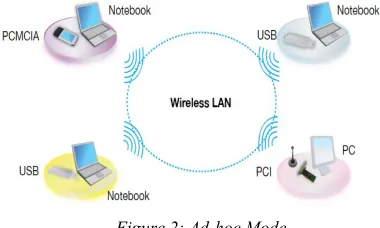
Furthermore, WLANs are giving the opportunity to their users for setting up a wireless communication within a range of 100 meters. WLANs can usually operate in different modes, either in infrastructure WLAN and ad-hoc mode or in infrastructure-based mode, or they can even function as an independent WLAN. An example of infrastructure mode WLAN is illustrated in Figure 2. Ethernet can connect the wireless stations to wired networks through WAPs. This would actually happen through WAPs in an infrastructure WLAN. Besides, in areas where network coverage is fully provided, wireless devices can move freely with no disruption.
2.1 Infrastructure-based Network
2.2 Ad-hoc Network
[image:3.612.94.284.261.375.2]As it has been depicted in figure 2, in independent WLAN or ad-hoc Network, nodes are capable of communicating with one another freely and they do not possess any fixed point. This has been proven to be convenient for people who use a laptop in public places for conducting a meeting. This has been acknowledged as an Independent Basic Service Set (IBSS) in IEEE 802.11 nomenclature [13]. The information can be exchanged through access points, by diversified loci in Independent Basic Service Set (IBSS) within themselves or other networks.
Figure 2: Ad-hoc Mode
If one of the nodes as an access point would be available for Independent Basic Service Set (IBSS), it can be considered as dependent and can be also marked as Basic Service Set (BSS). These access points are essential because every single information must be exchanged through them, which subsequently authorize these access nodes to safeguard the bundles and also to forward them in an enormous amount to the base functioning in short power organized manner. In infrastructure design, mobile nodes can exchange information through the steady access points. The network access points can be linked to wireless nodes with the wired nodes, in order to widen the ability of LANs. However, in some cases, services might extend to other areas where they can overlap with another one, and increase the possibility of bond development. Currently, this structure has been recognized to be identical to mobile networks throughout the world.
Infrastructure mode can be differentiated from an ad-hoc mode (A-Mode) based on different variables, such as the way the information is being communicated, as well as diverse other activities. In MAC frame header, FromDS and ToDS can be indicated clearly, whether the frame is being sent from the Distribution System or inside a Distribution System, respectively. In ad-hoc network, when any types of information exchange
taking place, two of ToDS and FromDS bits together equal nothing. BSSID has recognized the Basic Service Set (BSSID) into which the frame was being transported. For differentiating the joint networks on the same pathway, it is important to know that BSSID is also tied in 802.11. MAC address of BSSID in infrastructure network has been referring to the wireless surface, which assists the BSS. BSSID has been chosen in an indefinite manner in ad-hoc network. The node has been connecting with a network by the intention of accepting the delivery of frames, which are having BSSID. Association ID has been also possessed by some of the frames being delivered to the access points (AP). In an Infrastructure mode, when a node is active, frames are generally being delivered to access points. In those types of situation, two bits of ToDS must be set to one and the other FromDS must be set up to zero. Moreover, the access points that MAC addresses, as BSSID must be accepted by frames. However, in comparison in A-mode, the frames with BSSID of an ad-hoc network as well as FromDS and ToDS set, nothing must be transmitted. In this paper, it has been demonstrated that nodes in ad-hoc network would be able to accept the frames, which has been sent by the access points properly [14].
2.3 WLAN security
the 24 bit IV being delivered through the utilization of WEP [15].
Also, the initialization vector could not be used for diversified messages because of not being big enough. An intruder can easily get access to the access protocol and the wireless devices by assembling initialization vector. Present 802.11 standard vendors no measurement for bringing any modifications initialization vector. Some merchants do utilize the initialization vector for IV stream. Some other systems produce the initialization vector in sequence to counter the breakdowns WEP security also lacks the proper explanation of key management. Because of this, the keys in the device could not be easily altered in case, the user loses its device then the intruder can utilize the key to compensate all the devices including the lost device. Active management of keys can help to enhance the complexity as well as turn off the warnings possessed by WEP keys descending in the incorrect direction [16].
3. TAXONOMY OF ATTACKS IN WLAN
Security is a primary concern for any network environment. The security in a network can be ensured via blocking intruders or attackers against gaining the access to network resources and network information. Network attackers are mostly attempting to make the network data unavailable to the users. Howard has been constructing an advanced anatomy, which could include the purpose of intrusions and its categories, hardware utilized, as well as invaders and an approach to sensitive content [17]. Howard taxonomy is presented in Figure 3.
Figure 3: Howard’s Taxonomy of Attacks
Initially, the intruders try to take over the hardware or the device in order to execute an illegitimate act. Intruders can make use of different hardware devices to execute successful attacks to the network by looking for the vulnerabilities in the hardware devices or the network. Six of the most common types of attack categories are discussed as follows.
3.1 Network Discovery Attacks
Network Discovery attacks, which has been known as the materialized using tools that aids in the determination of the features of network including addressing of the merchant, MAC, information exchange route, security rules set in a network and SSID of the access point. Information
extracted using such tools are later exploited for launching attacks on a network [18].
3.2 Eavesdropping/Traffic Analysis
Eavesdropping/Traffic Analysis, are popular attacks, which involves in listening to the private conversations. This attack allows the intruders to collect information and compose a descriptive analysis from wireless network [19]. Since the data inside 802.11 bundles are in the unencrypted format, it is easy for competent eavesdroppers to interpret them. One of the popular software that has been using for launching such attacks is “Air peek” [20].
3.3 Masquerading/Impersonation
Masquerading/Impersonation known as the attacks, which tries to abstract the identifications of genuine consumers or of authentic AP. The software is required for these attacks to modify the MAC address of the actual user address in order to duplicate the authorized user. The intrusion of this attack has been acknowledged as Rogue AP since it is capable of regulating the network traffic. Consequently, spying intrusion has become easy for intruders.
3.4 Man-In-The-Middle
In such attacks, the intruder is in the middle, that is, between the devices. Therefore, the intruder can make modification in the content as long as he has the encoded keys. Such as intrusion is not considered feasible in the network guarded by 802.11. This is due to the deployment of EAP techniques [21].
3.5 Daniel-Of-Service
These attacks have been attempting to hinder the usage of network information and any other resources to intended users. And has been causing more interruptions and absorbing costly network assets. It has been proven to be harmful to wireless networks because network restrictions can be easily endangered [22]. EAPOL-failure, WAPOL-start, EAPOL-Logoff and EAPOL-Success are some of the latest DoS attacks for 802.11i implementations. Because of the need of a solution for such attacks, DoS have become very important for wireless network administrators.
3.6 802.11i Oriented Attacks
permitted by 802.11i. Communication with both pre-RSNA and RSNA networks can be generated by user’s gadget or any devices. In these type of situations, the opponent can, therefore, launch an attack in user’s device by using pre-RSNA. The attack has been launched by unifying the frameworks from RSNA assembled Access points. A list of WLAN (802.11i) attacks is discussed in detail as follows.
Mac address spoofing: There is a difference between mac address spoofing and IP spoofing. Impersonation has been found to be more accurate in mac address spoofing because the invader does not use another source to build-up a data. Intruders would ensure about their wireless card right after resulting in any modification in their MAC address for sending and receiving purposes. Ipconfig tool or any other short length C program, which have SIOCSIFHWADDR flag, can be used in Modification of a mac address [20]. An intruder can achieve MAC address by Illegitimate access. Intruders can actually construct their MAC address with the purpose of deflect network intrusion detection systems (NIDS).
Bypassing access control lists: In order for granting permission to authorized MAC addresses for the purpose of exchanging information on the network, network administrators have been fixing the access points. These access control forms can be deflected by intruders, by regular base supervising network and producing only those MAC addresses that are allowed to exchange information [23].
Authenticated user impersonation: In this attack, intruders would closely observe the network functionality in order to be able to cross the security doorway. So, that subsequently they can gain access to applicants’ authorized MAC address and following by that before exchanging information on the network create the applicants MAC address with the exact same characteristic. Because intrude has been possessing the potential to generate the dynamic list of MAC IDs, which do not resemble ID of association in any way. Noticing the MAC address can reveal such intrusions.
Deauthentication: Once 802.11 applicants have chosen the access point for the purpose of information exchange, it will authorize itself before any information exchange occur. The intruder would be able to have data access by acting either as an access point or applicant and then forward it to another one. However, no applicant or access points will be participating in the verification process, not until the process is set-up again [24].
Disassocation: Usually, there are no verified Association frameworks and 802.11 would control the de-authorized information. Abusing any vulnerable hole is similar to de-authentication or authorized intrusion. Importantly, the de-authentication intrusion has been identified to be more efficient than disassociation intrusion [25].
Address resolution protocol (ARP) poisoning has been created as a mediator between MAC and IP address in order to revolutionize the information content further, which includes handling the MAC and IP affair efficiently [26]. However, it has been reported that ARP data content could be tricked easily. An intruder can bring the modification in MAC to IP address from a distant place. This would result in changing the traffic direction and provoke modification in forwarding the accurate object to where ever the intruder desires.
Wormhole attack: In this intrusion, the intruders in a network would take reports the bundles at one spot or region, and continuously drift and transfer it to another network spot [27]. Wormhole intrusion has been identified to be unsafe and extremely dangerous to location based wireless security systems and ad-hoc network routing protocols and some trustworthy protocols have been introduced to address this intrusion issues [28].
Daniel of service attacks (DoS) can be experienced in several layers in OSI model. Intrusions, which did not allow the legal users to access networks have been produced in the wireless environment. Determination of the exact time and place that an intrusion should be performed was allowed by intruders due to lack of physical framework. The susceptible holes inside 802.11 MAC protocol have allowed the intruder to disorganize the network entirely, with less energy consumption by using some packet bundles [29].
arbitrary key has been the quick fix against these types of intrusions.
Virtual carrier-sense attack has been known as the Network Allocation Vector (NAV) mechanism, which would be supported by the MAC layer. Huge bundle streams have been producing unassigned location places, possessing values of considerable duration along with RTS and CTS frames, host and ACK frames particularly bound for the access points [30].
Invalid state: Both associated and unauthenticated states have been impossible under standard 802.11. But they can be included through the utilization of 2-bit condition [6]. Some kind of intrusiveness might be the results of any type of unpractical attitude point.
Fragmentation attacks: IP has been divided into a number of bundles in Fragmentation attacks. If fragmented bundles in IPV4 gain an illegitimate access, there will be a chance that the appliance to which the bundles have been delivered might break down the IPV4 stack. This might happen while the application has been involved in the building of the crashed bundles. Corrugated portions can be handled in different ways by different types of operating systems [31].
Packet alternation can bring any types of changes in the bundle that is unidentified by the access points, which means that if an intruder is capable of detecting some of the data in bundles he can change it more and provoke it again in the network [32].
Packet re-routing has been allowed to altering the IP header in order to direct the bundles to the appliance on the wired network [32]. When the bundle has been delivered to the wired appliance, has exposed the data content, since it has been in an un-encoded form. TCP checksum has not been proved to be useful because it only has been inspected during its arrival to the target place.
Packet insertion: An attacker can insert the arbitrary packets into the network, by knowing a single plaintext message, since it has been given out the random stream linked to one of the IVs [34]. Therefore, in order to create malfunctioning of the network, attackers can insert synthesized packets into the system.
War driving: Any person with mobile devices would search for the Wi-Fi wireless network by extracting the network information [35]. Wireless networks have been facing this more than wired networks. Looking for the system security through a confined network is not wise. Thus, any kind of defects in the network security should be immediately reported.
Active Man-in-the-middle: Performing the MITM attack together with encoded HTTPS and SSH through the utilization of tools that have been security analyzed, is not difficult. The collaboration of most of the applicants with the access points having high signal has been discovered in the ESS organization. Applicants can be tricked by any crooked access point, by taking benefit of this attitude and come across with the node that has been executed the MITM attack in contrast to the delicate traffic [21].
High-power amplifiers: Enhancing the transmission rate to a large extent has been possible for the high potential amplifiers. Sending the bundles to a large distance area by an amplifier with either 1 or 8 watts, which further 802.1 lb. devices could collect has been possible. The vulnerability of bundles can result in disorganized services, for instance, the bundles that have been visible from the access points with which the applicant has exchanged the information content or the content has been passed from the applicant. High potential amplifiers would permit the intruders to penetrate the network access points if only the controlled antenna from a far-off distance has been utilized.
Multiple virtual access points: The attacker would be able to use a number of virtual access points in order to copy them and demand 802.1 lb. to connect with them. A diversified number of intrusions could have been launched against the applicant, once the linkage has appeared. MITM against HTTP and SSL web flow is one of the examples here. By transmitting access point flow of high potential, either of false IP settings a number of accesses points or fake SSID could be closed.
MAC ID based inference of access control list: Many access points have been refusing clients with a MAC ID, which could not be found in an access control list or another whitelist mechanism as a security feature. This has been unsuccessful against capable attackers, as they will be capable of inferring the set of valid MAC ID’s associated with an active network, and subsequently assuming any one of these MAC ID’s for their use as required.
4. INTRUSION DETECTION
computing systems. Typically, intrusion detection systems have been consisted of stream sources, which gives an updated information regarding what is happenings, figuring out the existing threats and generating an alarm in a case where any kind of illegitimate activity has been detected, so that an immediate action can be taken. Wireless intrusions have been usually launched before any information content in present turn on wired networks. Therefore, it has been vital for the source to penetrate in the airwaves before the content has received on the access points [33]. The whole process has been depending on the present intrusion detection methods, which could have thus, possess more than one aspect. If the IDS produce an alarm without any threat being discovered, then the credibility of IDS can get deficient. Moreover, the IDS trustworthiness could also get curtailed if the threat has been presented but no alarm has been produced[34].
The precise outcome has been delivered by Signature-based techniques (Table 1) but has been showing some limitations against the historical intrusions [35-42]. Therefore, depending completely on the signature-based technique is not recommended until later when has been rectified. Sellers have been claiming to bring updated modifications to the recent intrusions within a short time period as well as changing the signature database within the applicant’s premises. On the other hand, by careful observation of the network flow Anomaly-based detection (Table 2) has possessed the potential to reveal the hidden intrusions, however, they have been less efficient than signature-based [43-50]. Both signature and anomaly based techniques have been combined with each other in complex IDS techniques. The state analysis and policy deviation have been also included within the complex approach.
Table 1: Signature-based Technique and Associated IDSs.
Table 2: Anomaly based Technique and Associated IDSs.
Hybrid intrusion detection systems have been encompassed of signature and anomaly-based approaches. Two detection measurements have been possessed by the Hybrid method; one has been for detecting of familiar vulnerable infiltration using signs and the other one has been for network behavior auditing, for detection of any types of deviation from the usual network profile [51]. Any kind of attacks has been detected precisely by hybrid intrusion detection systems, however, this
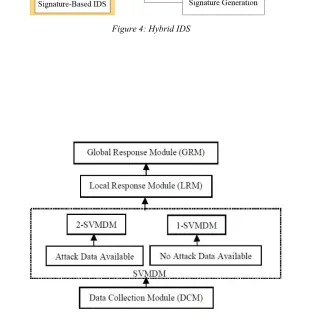
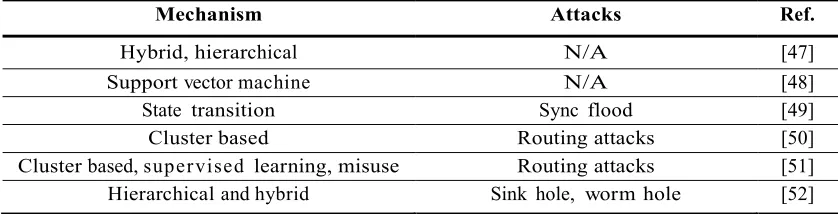
hybrid intrusion detection systems have been consuming more energy and other resources. Figure 4 presents the hybrid detection model of IDS [43]. Table 3 also represents the hybrid technique and associated IDSs [52-57].
Figure 4: Hybrid IDS
Table 3: Hybrid Technique and Associated IDSs.
The nodes in above model have been disconnected from one another and have classified into hexagonal areas similar to mobile or cellular networks. Cluster nodes have checked and controlled each of these areas, and regional nodes have been auditing cluster node. These regional nodes themselves have been controlled and authorized by base terminals, which have been arranged in the tree-like structure. Attack signatures have been accumulated in base terminals and moved towards the leaf nodes for detecting the malicious attacks. In the same vein, the method has possessed requirements of both irregular and regular actions. Anomaly detection has been done by measurement of any kind of divergence or change from the presented requirements. Authors did not observe any kind of detection ratio. Also, they did not highlight what kind of vulnerabilities would be detected by this method.
In addition, the misuse detection and support vector machine (SVM) have been utilized by hybrid IDS, which the mechanism includes Monitoring component, Analysis & detection and Alarm. Cluster-based Hybrid IDS mechanism is shown in figure 5. A well spread cultivated algorithm has been utilized to cultivate SVM in order to differentiate the fine and vengeful arrangements. An intrusion detection system has utilized stream flood and state evolution investigation to discover a sync flood attack, which has been introduced in [46]. The method has observed TCP in order to detect this types of attack arrangement, however, the mechanism has not been examined and applied yet. Cluster hybrid IDS has been shown in [47], the cluster head has possessed the charge for detection of intrusions with the main purpose of the reduction of the energy consumption. An improved IDS, which has been suggested in [48] was divided into signature-based detection, decision-making, and anomaly-based detection.
cultivated algorithm is utilized to cultivate SVM so as to differentiate between the fine and vengeful arrangements. This method of intrusion detection method is sketched in a way that it can function in clustered WSNs, where all nodes observe nearby nodes in their surroundings. An intrusion detection system that utilizes state evolution investigation and stream flood to discover sync-flood attacks has been introduced in [46]. Cluster hybrid IDS has been shown in Deng’s research [47], the cluster head possesses the charge for the detection of intrusions with the main purpose of the reduction of the energy consumption an improved ID has been suggested in [48] divided into anomaly based detection, signature-based detection, and decision making.
Figure 5: Cluster-based Hybrid IDS
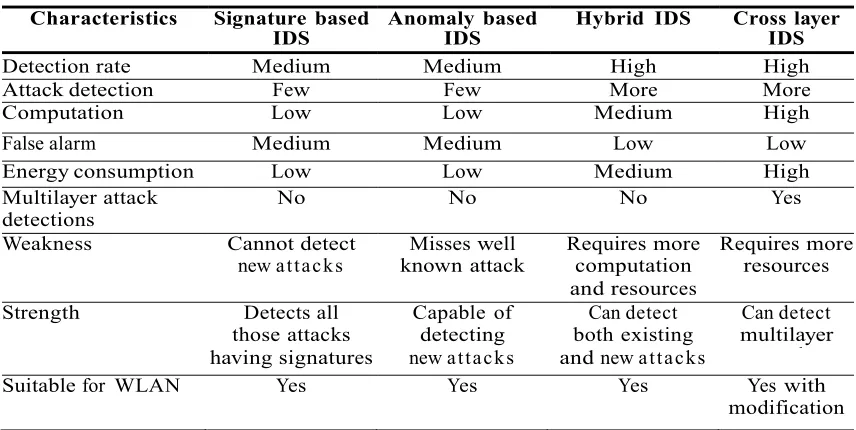
The network, which has been already managed was operated to recognize vengeful and bundles. Still another tree structured IDS has been having high effectiveness in the detection of security intrusions in the network layer, which was shown in [50]. In Table 4, a brief overview of some of these hybrid IDSs has been shown. Across OSI layers, separate requirements for the ideal solution have been changed with each other in another new security mechanism [58]. Conventional IDS can observe and detect attacks a single layer of the OSI model because they usually function in that specific layer. For example, it has been known that network layer IDS would be able to discover routing intrusions, however, they are not capable of acknowledging physical, MAC or transport layer deviations. With the ability to exchange information and other characteristics between separate layers, cross-layer IDSs have been having the potential to detect and discover attacks in diversified layers. This communication exchange has been taking place by using cross layer interface between separate layers. Even though a number of attacks in diversified layers have been discovered by cross-layer IDS, but this mechanism has been utilizing more computational assets and energy through proper examination and observation of parameters between layers. Cross-layer ID agent, which is CLIDA has been proposed in [59]. CLIDA has guaranteed that communication and information exchange would navigate all areas between MAC, network and physical layer. Cross-layer information component has been depicting information to all layers. The potential to discover intrusions in diversified layers has been possessed
by CLIDA, the intrusion detection agent. Intrusions with good efficiency can be detected by architecture. Another cross-layer security technique has been proposed in [60]. It has been discovered that the proposed technique would consume the constrained assets of sensor nodes. Later in another study [61], intrusion track back technique and cross-layer security technique, which has been discovering flood was introduced. Different requirements from network and MAC layers have been utilized to discover diversified flooding intrusions. Description of low, medium and high intrusions has been recorded. Table 4 introduces contrasting IDs.
Table 4: A Comparison among IDSs.
4.1 multi-Dimensional Intrusion Detection For Wlan
analytical analysis would be able to identify any kind of abnormal activity from the fine arrangement. Attributes of anomaly and misuse detection can be reviewed in a various way because there are no major differences between them. In one study, Stavroulakis and Stamp (2010) have introduced an arrangement to separate the biological ideas, computation-depended approach and artificial intelligence. This arrangement, however, has made it difficult to understand the detection approach features. Even though many shortcomings have been identified in explanation of detection approaches, but studies have introduced the categorization of understudy classes with a detailed explanation of their categories such as: State and Heuristic based, Pattern based, Statistics based and Rule-based. Table 6 presents the Intrusion Detection approaches, which have been organized. From Table 6, it can be also demonstrated whether the aspects of time series have been taking into consideration or not. With the proper approach, which has been introduced in the discovery of intrusion areas, such kinds of intrusions can be recognized. Performance area has mentioned the capabilities at which the IDS process flow analyzes the events [35]. The flow has been carefully detected by Signature-based detection and then it has searched the patterns physically arrangement against the signatures present in the database. By learning based examination of arrangement [62], this also can be done in an automated manner. Physical signature detection as an anti-virus system has been performing in a similar manner. Here the signature database amends in an automated manner as fresh signatures have been detected. On the other hand, automated signature learning systems need through erosion of complicated network functions and the remarkable data mining that can have an impact on the efficiency as well as effectiveness. The signature process must be capable of forwarding frames before being backed on the wire, in order to be more capable and efficient in tackling these intrusions [63]. Moreover, security guidelines have been given the description regarding the sufficient performance guidelines and network functioning [64]. A policy deviation engine would produce alarms if the earlier set performance borderline gets infringed and supports the Wireless LAN pattern [65]. Table 5 is also illustrated from these references [66-73].
Table 5: Advantages of IDS for WLAN and Ad-hoc Networks.
Table 6: Intrusion Detection System Classification in WLAN.
For instance, network and security administrator have been facing difficulties with rogue Access points. Because the workers have possessed the potential to buy and redistribute wireless LAN, it has been hard to realize when and where they have been redistributed unless the site has been physically scrutinized with a scanner. As soon as rogue access points have been deployed, a policy deviation engines should generate an alarm if the bluff access points get redistributed. For a well-performed wireless LAN, policy deviation engine requires an entry to wireless casing information from airwaves. Protocol analysis (SP) has been observing 802.11 MAC protocols from the abnormal behavior if being traced from the standards. Improved network and intrusion detection have been provided by proper in time observation [74]. Two of the examples of protocol intrusions have been including session DoS intrusions and hijacking. In order to discover the intrusion, which divides the protocol requirements, it has been essential to observe the condition. Certainly, un-doubtfully statistical anomaly detection, which was based on classical measurements, could have been classified as the discovery of anomalous network activity. By grouping and introducing the functions that lead to the fine measurement of activities, the basic standard network functioning has been described [75]. Considering the remarkable fine activity as the basic standard, deviations from normal behavior could have been detected by other mechanisms, which detect attacks.
How the intrusion detection mechanism has been differing from others was dependent on the surroundings. So far, IDS mechanism has been established for CPSs, WPANs, WLANs, WMNs and cellular networks WSNs.
4.2 Advantages And Disadvantage Of Ids Techniques
cellular and WSN networks. ad-hoc networks have been also able to get assistance from signature-based approach because of its higher processing abilities. Anomaly based approach has been able to provide assistance to ad-hoc and WLANs networks due to its potential in discovering the hidden intrusions. The reputation-based approach has been also providing assistance to WLAN ad-hoc network in order to conclude mean nodes, particularly those applications, which have been unacceptable and the confirmation on mean nodes has been well explained. A number of behavior-based approaches, because of their minimal memory burden have been providing assistance to ad-hoc and WLAN networks; the alternative, a traffic based approach and requires a lot of storage. Traffic based approaches have been also able to provide assistance to ad-hoc and WLAN networks because of their data possesses characteristics have not been accessible to applications like SNR and RSSI. Assistance can be also provided to ad-hoc and WLAN by Multi-trust based approach networks, where the community has not been static. This is because the determined evidence has been providing a clear view of the system even when that data was prejudiced with unreliable input [7]. The signature-based approach has not been accepted easily and it has been facing some objections. Since these could have considered a huge intrusion vocabulary, applications, WLAN and ad-hoc network have been trying hard to keep the intrusion vocabularies clean for signature-based approaches. Anomaly based approaches have been also not accepted easily because of their poor detection rate. A clear idea of functionality was not possessed by ad-hoc and WLAN network applications and the deviation from normal behavior have not been agreed with the basic standard activity. WLAN and network ad-hoc applications have been also introducing threats to the specification-based approaches or requirement because experienced people have been usually trying hard to distribute the requirements for application without clear use cases. Even though they have not been using clear use cases, but examination and scrutinization from specification-based approaches have been required, which proves to be expensive to deliver requirements for these applications.
Table 7: Disadvantages of IDS for WLAN and Ad-hoc Networks
Reputation-based approaches also have not been accepted easily because they have been pointing out more towards the mean nodes rather
than poor nodes. Even though they were not possessing any activity demanding and economic and responsibilities, but ad-hoc and WLAN network applications have been trying hard to take charge of the authorization of better but mean nodes. Because their portrait cannot be expressed in advance WLAN and ad-hoc network applications introduce some threats for behavior-based approaches [7]. Because of the varying clarity of the varying environment, WLAN and ad-hoc network applications have been trying hard with traffic based approaches to utilize the multitrust. Due to the productive community, which has proved problematic for the formation of reliable connections, ad-hoc and WLAN network applications have been also introducing threats to multi-trust based approaches.
5. IDS METRICS FOR WLAN
possessed the capability of recording the allotted microseconds. This has also computed the Network Allocation Vector (NAV) on every single node. Network Allocation Vector (NAV) would be permitted to broadcast further, the only f it approaches to point 0.
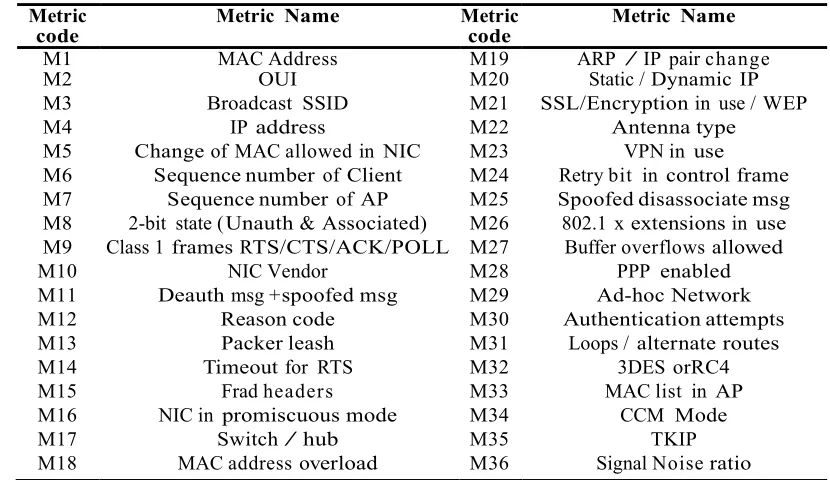
Table 8: Classification of Relevant Metrics for WLAN Attacks
This characteristic feature has been utilized by RTS or request to send and CTS or clear to send that coordinates admission to the pathway where an invisible base may be intruding the broadcast. When this exchange has been taking place, the transmitting node, in the beginning, has delivered a tiny sized RTS framework, which has possessed considerable time to finish CTS and data frame, RTS/CTS framework and some others. The targeted node has answered back to CTS and RTS having a freshly assigned time period. Therefore, CTS/RTS frames have been also presenting in the IDS measurements. Distributed Coordination Function Inter-Frame Space and Short Inter-Frame Space have been the two-time windows out of four-time windows, which were given preferences to enter the midway radio. It is the responsibility of the delivering frame to monitor a silent midway before any frame has been delivered at least for one of the represented windows. SIFS window has employed for frames, which have been delivered by a sector of enduring trade channel. DIF window has employed for the nodes, which have been interested in the initialization of the frame trade. Time has been also partitioned into the sections in order to hold back from the nodes that have been broadcasted soon after the completion of DIFS. The broadcasting node arbitrarily has selected the section where the broadcast was begun. If any type of accident occurs, then before re-broadcasting sender are required to employ an arbitrary ceased algorithm. In addition, three metrics have been used in order to record the effectiveness and efficiency of IDS, including False negative rate, Detection rate and False positive rate [76-78]. The false negative rate has been developed when the crooked node was labeled as well-mannered [79]. Detection rate has been taking place when the IDS have recognized the crooked node accurately [77, 80]. And the false positive rate has been usually taking place when an IDS has labeled a well-mannered node as an attacker. Some efficient measurements have been launched to improve IDS. Detection latency has been regarded as an essential factor in the measurement of IDS effectiveness and
efficiency [81, 82]. In spite of whether the intrusion has been dynamic or static, immediate detection of faults has been helping to respond to them also immediately. The system has been having some disadvantages features such as energy consumption and CPU capacity, which has been known as vital measurements. Time-period for the random nodes has been recorded by Ma et al. [83], so as to drain their efficiency when utilizing an inclined method. The speed of fragmented packets was recorded by Misra et al. [80]. Packet sampling speed has been referring to the packets that IDS has labeled as crooked. The main concept is that no necessity has been proved to consider all the packet bundles when just some of them have prompted IDS. Misra et al.’s architecture has enhanced the fragmented proportion if the detection proportion has been reducing the fragmented proportion, only if the detection proportion has been under the fined threshold.
Table 9: WLAN Attack Type
examined by Haddadi and Sarram [10]. Even though this data has been plain and straightforward but it could not explain everything. Classifications of the relevant metrics for categorization of wireless network attacks have been listed in Table 8. In the consecutive Table 9, various types of network intrusions have been explained by the author. The explanations of wireless and metrics intrusions have been conceiving the matrix of metrics and attacks.
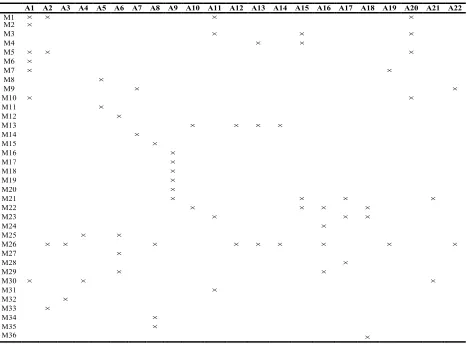
Table 10: WLAN Attack Type (Matrix)
The work has congregated the metrics, which has been classifying a wireless network presented in Table 8 and Table 9. Table 10 has been introducing a matrix that congregates the attack types and the measurements required to classify it. The matrix has been assisting in the collaboration of each intrusion with its metric employed in IDS system.
6. CONCLUSIONS AND FUTURE RESEARCH
Following the objectives of this research, a crystalized concept of intrusion detection was introduced. To do so, three main aspects of intrusion detection known as identification of an unauthorized, illicit, and anomalous behavior were articulated as one might hope. Moreover, the current IDS methodical approaches were classified. So, all classification have been tabulated as well. Ultimately, the WLAN often concepts and the WALN intrusions often interpretations were introduced. So the security vulnerabilities of the WLAN systems were scrutinized along with this different intrusion detection systems in association with WLAN systems were extensively reviewwed. The uniqueness of the research has roots in extracting metrics or features in relation to different attack types. To pinpoint, WLAN has gained high attention throughout, due to the progress that has been made in wireless communication. As the guidelines being set for the computing networks are utilized to observe their security, other intrusion features such as mining can allow the safety measures to be applied to a greater extent. It would have been better if wireless IDS and its efficient and effective measurements have been explored in detail. Detection latency has been mostly used for enhancing the efficiency and effectiveness of IDS. For instance, the IDS would be able to perform better if it adjusts the detection rate based on
strength and type of the adversary it faces. Possible repair strategies have been stated to identify the compromised segments and for each one: stop operating, revert all nodes to certified software loads and configurations, rekey/reset passwords and progressively resume operation from the production side of the network towards the consumers. Analysis techniques, which provided early warning of attacks, have been another potential research area. These techniques would be serving as an enabler by providing a promoter for pre-detection responses in WLAN. Another research direction has been distinguishing the early warnings from detections by using confidence level, which accompanies existing analysis techniques.
REFERENCES:
[1] Bhoyar, R., M. Ghonge, and S. Gupta,
Comparative Study on IEEE Standard of
Wireless LAN/Wi-Fi 802.11 a/b/g/n.
International Journal of Advanced Research in Electronics and Communication Engineering (IJARECE). (2/7), 2013: p. 687-691.
[2] Taherdoost, H. and A. Keshavarzsaleh. A
Theoretical Review on IT Project
Success/Failure Factors and Evaluating
the Associated Risks. in International
Conference on Telecommunications and
Informatics. Sliema, Malta. 2015.
[3] Al-Surmi, I., M. Othman, and B.M. Ali,
Mobility management for IP-based next generation mobile networks: Review,
challenge and perspective. Journal of
Network and Computer Applications. (35/1), 2012: p. 295-315.
[4] Pabst, R., et al., Relay-based deployment
concepts for wireless and mobile
broadband radio. IEEE Communications
Magazine. (42/9), 2004: p. 80-89.
[5] Wilhoit, K. and S. Hara. The real world evaluation of cyber-attacks against ICS
system. in Society of Instrument and
Control Engineers of Japan (SICE), 2015
54th Annual Conference of the. 2015.
IEEE.
[6] Zhong, S., T.M. Khoshgoftaar, and S.V. Nath. A clustering approach to wireless
network intrusion detection. in Tools with
Artificial Intelligence, 2005. ICTAI 05.
17th IEEE International Conference on.
[7] Mitchell, R., R. Chen, and M. Eltoweissy.
Signalprint-based intrusion detection in
wireless networks. in International
Workshop on Security in Emerging Wireless Communication and Networking
Systems. 2009. Springer.
[8] Hairui, W. and W. Hua. Research and design of multi-agent based intrusion
detection system on wireless network. in
Computational Intelligence and Design, 2008. ISCID'08. International Symposium on. 2008. IEEE.
[9] Sampangi, R.V., S. Dey, and V.N. Viswanath. The sneeze algorithm: A social network & biomimetic approach for
intrusion detection in wireless networks. in
Business Applications of Social Network
Analysis (BASNA), 2010 IEEE
International Workshop on. 2010. IEEE.
[10] Haddadi, F. and M.A. Sarram. Wireless
intrusion detection system using a
lightweight agent. in Computer and
Network Technology (ICCNT), 2010
Second International Conference on. 2010.
IEEE.
[11] Yuan, S., Q.-j. Chen, and P. Li. Design of a four-layer ids model based on immune
danger theory. in Wireless
Communications, Networking and Mobile
Computing, 2009. WiCom'09. 5th
International Conference on. 2009. IEEE.
[12] Eklund, J.M., et al. Information Technology for Assisted Living at Home: building a wireless infrastructure for
assisted living. in Engineering in Medicine
and Biology Society, 2005. IEEE-EMBS
2005. 27th Annual International
Conference of the. 2006. IEEE.
[13] Gupta, S., S. Kar, and S. Dharmaraja.
BAAP: blackhole attack avoidance
protocol for wireless network. in Second
International Conference on Computer &
Communication Technology (ICCCT).
2011.
[14] Chen, J., S.-H. Chan, and S.-C. Liew.
Mixed-mode WLAN: the integration of ad
hoc mode with wireless LAN
infrastructure. in Global
Telecommunications Conference, 2003.
GLOBECOM'03. IEEE. 2003. IEEE.
[15] Sherman, I., Apparatus for and method of low power wireless local area network independent basic service set mode
operation. 2007, Google Patents.
[16] Karygiannis, T. and L. Owens, Wireless
network security. NIST special
publication. (800/, 2002: p. 48.
[17] Howard, J.D. and T.A. Longstaff, A common language for computer security
incidents. Sandia National Laboratories,
1998: p.
[18] Ifeagwu, E., M. Alor, and G. Obi,
Received Signal Strength Estimation in Wireless Local Area Network (WLAN)
Environment. 2015: p.
[19] Singh, J., A. Singh, and R. Shree, An assessment of frequently adopted unsecure patterns in mobile ad hoc network: Requirement and security management
perspective. International Journal of
Computer Applications (0975–8887). (24/9), 2011: p.
[20] Lee, I.W. and A.O. Fapojuwo,
Characteristics of wireless LAN traffic.
Proc. WNET. (4/, 2004: p. 674-679. [21] Sachdeva, S. and R. Malhotra, A
Probabilistic Cell Generation Based Improved Decision Tree Approach for
Intrusion Detection. Journal of Network
Communications and Emerging
Technologies (JNCET) www. jncet. org. (3/1), 2015: p.
[22] Singh, R. and T.P. Sharma, On the IEEE
802.11 i security: a denial‐of‐service
perspective. Security and Communication
Networks. (8/7), 2015: p. 1378-1407. [23] Kwon, H. and S.-H. Kim, Efficient mobile
device management scheme using security events from wireless intrusion prevention
system, in Ubiquitous information
technologies and applications. 2013,
Springer. p. 815-822.
[24] Noman, H.A., S.M. Abdullah, and H.I. Mohammed, An Automated Approach to
Detect Deauthentication and
Disassociation Dos Attacks on Wireless
802.11 Networks. International Journal of
Computer Science Issues (IJCSI). (12/4), 2015: p. 107.
[25] Nguyen, T., et al. An efficient solution for preventing dis’ ing attack on 802.11
networks. 2013. The International
Conference on Green Technology and Sustainable Development.
[26] Kumar, R., S. Verma, and G.S. Tomar,
Thwarting address resolution protocol poisoning using man in the middle attack
Information and Assurance. (1/1), 2013: p. 8-19.
[27] Shi, Z., et al., A wormhole attack resistant neighbor discovery scheme with RDMA protocol for 60 GHz directional network.
IEEE Transactions on Emerging Topics in Computing. (1/2), 2013: p. 341-352. [28] Hu, Y.-C., A. Perrig, and D.B. Johnson,
Wormhole attacks in wireless networks.
IEEE journal on selected areas in communications. (24/2), 2006: p. 370-380. [29] Pelechrinis, K., M. Iliofotou, and S.V. Krishnamurthy, Denial of service attacks in wireless networks: The case of jammers.
IEEE Communications Surveys & Tutorials. (13/2), 2011: p. 245-257. [30] Malekzadeh, M., et al., Empirical analysis
of virtual carrier sense flooding attacks
over wireless local area network. Journal
of Computer science. (5/3), 2009: p. 214. [31] Cam-Winget, N., et al., Security flaws in
802.11 data link protocols.
Communications of the ACM. (46/5), 2003: p. 35-39.
[32] Rathee, G., P. Bano, and S. Singh, A study various security attacks in wireless
networks. International Journal of
Computer Science and Mobile Computing. (4/, 2015: p. 249-253.
[33] Patil, S. and S. Vanjale, A Survey on Malicious Access Point Detection Methods
for Wireless Local Area Network.
International Journal of Computer Sciences and Engineering. (2/, 2014: p. 22-25.
[34] Khan, S., K.-K. Loo, and Z.U. Din,
Framework for intrusion detection in
IEEE 802.11 wireless mesh networks. Int.
Arab J. Inf. Technol. (7/4), 2010: p. 435-440.
[35] Liao, H.-J., et al., Intrusion detection
system: A comprehensive review. Journal
of Network and Computer Applications. (36/1), 2013: p. 16-24.
[36] Ioannis, K., T. Dimitriou, and F.C. Freiling. Towards intrusion detection in
wireless sensor networks. in Proc. of the
13th European Wireless Conference. 2007.
[37] Jadidoleslamy, H., A hierarchical
intrusion detection architecture for
wireless sensor networks. International
Journal of Network Security & Its Applications. (3/5), 2011: p. 131.
[38] Abraham, A., et al., D-SCIDS: Distributed soft computing intrusion detection system.
Journal of Network and Computer Applications. (30/1), 2007: p. 81-98. [39] Abraham, A., C. Grosan, and C.
Martin-Vide, Evolutionary design of intrusion
detection programs. IJ Network Security.
(4/3), 2007: p. 328-339.
[40] da Silva, A.P.R., et al. Decentralized intrusion detection in wireless sensor
networks. in Proceedings of the 1st ACM
international workshop on Quality of service & security in wireless and mobile
networks. 2005. ACM.
[41] Roman, R., J. Zhou, and J. Lopez.
Applying intrusion detection systems to
wireless sensor networks. in IEEE
Consumer Communications & Networking
Conference (CCNC 2006). 2006.
[42] Banerjee, S., C. Grosan, and A. Abraham.
IDEAS: intrusion detection based on
emotional ants for sensors. in Intelligent
Systems Design and Applications, 2005. ISDA'05. Proceedings. 5th International
Conference on. 2005. IEEE.
[43] Li, Y. and L.E. Parker. Intruder detection using a wireless sensor network with an
intelligent mobile robot response. in
Southeastcon, 2008. IEEE. 2008. IEEE.
[44] Bhuse, V. and A. Gupta, Anomaly intrusion detection in wireless sensor
networks. Journal of High Speed
Networks. (15/1), 2006: p. 33-51.
[45] Alipour, H., et al., Wireless anomaly detection based on IEEE 802.11 behavior
analysis. IEEE transactions on information
forensics and security. (10/10), 2015: p. 2158-2170.
[46] Eik Loo, C., et al., Intrusion detection for routing attacks in sensor networks.
International Journal of Distributed Sensor Networks. (2/4), 2006: p. 313-332. [47] Deng, H., Q.-A. Zeng, and D.P. Agrawal.
SVM-based intrusion detection system for
wireless ad hoc networks. in Vehicular
Technology Conference, 2003. VTC
2003-Fall. 2003 IEEE 58th. 2003. IEEE.
[48] Huang, Y.-a., et al. Cross-feature analysis
for detecting ad-hoc routing anomalies. in
Distributed Computing Systems, 2003.
Proceedings. 23rd International
Conference on. 2003. IEEE.
[49] Dang, B.H. and W. Li, Performance
evaluation of unsupervised learning
techniques for intrusion detection in
Information Science. 2015, Springer. p. 71-86.
[50] Onat, I. and A. Miri. An intrusion detection system for wireless sensor
networks. in Wireless And Mobile
Computing, Networking And
Communications, 2005.(WiMob'2005),
IEEE International Conference on. 2005.
IEEE.
[51] Chen, G., Y. Zhang, and C. Wang, A
wireless multi-step attack pattern
recognition method for WLAN. Expert
Systems with Applications. (41/16), 2014: p. 7068-7076.
[52] Mamun, M.S.I. and A. Kabir, Hierarchical design based intrusion detection system
for wireless ad hoc network. arXiv
preprint arXiv:1208.3772, 2012: p. [53] Sedjelmaci, H. and M. Feham, Novel
hybrid intrusion detection system for
clustered wireless sensor network. arXiv
preprint arXiv:1108.2656, 2011: p. [54] Bhatnagar, R. and U. Shankar, The
proposal of hybrid intrusion detection for defence of sync flood attack in wireless
sensor network. International Journal of
Computer Science and Engineering Survey. (3/2), 2012: p. 31.
[55] Yan, K., S. Wang, and C. Liu. A hybrid intrusion detection system of cluster-based
wireless sensor networks. in Proceedings
of the International MultiConference of
Engineers and Computer Scientists. 2009.
[56] Yan, K., et al. Hybrid Intrusion Detection System for enhancing the security of a
cluster-based Wireless Sensor Network. in
Computer Science and Information
Technology (ICCSIT), 2010 3rd IEEE
International Conference on. 2010. IEEE.
[57] Hai, T.H., F. Khan, and E.-N. Huh. Hybrid intrusion detection system for wireless
sensor networks. in International
Conference on Computational Science and
Its Applications. 2007. Springer.
[58] Boubiche, D.E. and A. Bilami, Cross layer intrusion detection system for wireless
sensor network. International Journal of
Network Security & Its Applications. (4/2), 2012: p. 35.
[59] Alrajeh, N.A., S. Khan, and B. Shams,
Intrusion detection systems in wireless
sensor networks: a review. International
Journal of Distributed Sensor Networks, 2013: p.
[60] Xiao, M., X. Wang, and G. Yang. Cross-layer design for the security of wireless
sensor networks. in Intelligent Control and
Automation, 2006. WCICA 2006. The Sixth
World Congress on. 2006. IEEE.
[61] Khan, S. and K.-K. Loo, Real-time cross-layer design for a large-scale flood
detection and attack trace-back
mechanism in IEEE 802.11 wireless mesh
networks. Network Security. (2009/5),
2009: p. 9-16.
[62] Alazab, A., et al., Developing an
Intelligent Intrusion Detection and
Prevention System against Web
Application Malware, in Advances in
Security of Information and
Communication Networks. 2013, Springer.
p. 177-184.
[63] Shafi, K. and H.A. Abbass, Evaluation of
an adaptive genetic-based signature
extraction system for network intrusion
detection. Pattern Analysis and
Applications. (16/4), 2013: p. 549-566. [64] Dilmaghani, R., et al. Policy-aware
service composition in sensor networks. in
Services Computing (SCC), 2012 IEEE
Ninth International Conference on. 2012.
IEEE.
[65] John, S.N., et al. Creating a Policy Based Network Intrusion Detection System using
Java Platform. in Proceedings of the
International Conference on Security and
Management (SAM). 2014. The Steering
Committee of The World Congress in Computer Science, Computer Engineering and Applied Computing (WorldComp). [66] Vigna, G. and R.A. Kemmerer, NetSTAT:
A network-based intrusion detection
system. Journal of computer security.
(7/1), 1999: p. 37-71.
[67] Lazarevic, A., V. Kumar, and J. Srivastava, Intrusion detection: A survey,
in Managing Cyber Threats. 2005,
Springer. p. 19-78.
[68] Wang, S.-S., et al., An integrated intrusion detection system for cluster-based wireless
sensor networks. Expert Systems with
Applications. (38/12), 2011: p. 15234-15243.
[69] Fragkiadakis, A.G., et al., Design and performance evaluation of a lightweight wireless early warning intrusion detection
prototype. EURASIP Journal on Wireless
[70] Mar, J., et al., Intelligent intrusion detection and robust null defense for
wireless networks. International Journal of
Innovative Computing Information and Control. (8/5), 2012: p. 3341-59.
[71] Modi, C., et al., A survey of intrusion
detection techniques in cloud. Journal of
Network and Computer Applications. (36/1), 2013: p. 42-57.
[72] Sendi, A.S., et al., Real Time Intrusion Prediction based on Optimized Alerts with
Hidden Markov Model. JNW. (7/2), 2012:
p. 311-321.
[73] Li, Y., et al., An efficient intrusion detection system based on support vector machines and gradually feature removal
method. Expert Systems with
Applications. (39/1), 2012: p. 424-430. [74] Corona, I., G. Giacinto, and F. Roli,
Adversarial attacks against intrusion detection systems: Taxonomy, solutions
and open issues. Information Sciences.
(239/, 2013: p. 201-225.
[75] Bhuyan, M.H., D.K. Bhattacharyya, and J.K. Kalita, Network anomaly detection:
methods, systems and tools. Ieee
communications surveys & tutorials. (16/1), 2014: p. 303-336.
[76] Tao, Z. and A. Ruighaver. Wireless Intrusion Detection: Not as easy as
traditional network intrusion detection. in
TENCON 2005 2005 IEEE Region 10.
2005. IEEE.
[77] Xiao, Z., C. Liu, and C. Chen. An anomaly detection scheme based on machine
learning for wsn. in Information Science
and Engineering (ICISE), 2009 1st
International Conference on. 2009. IEEE.
[78] Han, H., X.-L. Lu, and L.-Y. Ren. Using data mining to discover signatures in
network-based intrusion detection. in
Machine Learning and Cybernetics, 2002.
Proceedings. 2002 International
Conference on. 2002. IEEE.
[79] Svecs, I., et al. Xidr: A dynamic framework utilizing cross-layer intrusion
detection for effective response
deployment. in Computer Software and
Applications Conference Workshops
(COMPSACW), 2010 IEEE 34th Annual.
2010. IEEE.
[80] Misra, S., P.V. Krishna, and K.I. Abraham. Energy efficient learning solution for intrusion detection in wireless
sensor networks. in Communication
Systems and Networks (COMSNETS),
2010 Second International Conference on.
2010. IEEE.
[81] Foo, B., et al. ADEPTS: Adaptive intrusion response using attack graphs in an
e-commerce environment. in Dependable
Systems and Networks, 2005. DSN 2005.
Proceedings. International Conference on.
2005. IEEE.
[82] Ko, C., M. Ruschitzka, and K. Levitt.
Execution monitoring of security-critical programs in distributed systems: A
specification-based approach. in Security
and Privacy, 1997. Proceedings., 1997
IEEE Symposium on. 1997. IEEE.
[83] Ma, Y., H. Cao, and J. Ma. The intrusion detection method based on game theory in
wireless sensor network. in Ubi-Media
Computing, 2008 First IEEE International
Conference on. 2008. IEEE.
[84] Farid, D.M. and M.Z. Rahman. Learning intrusion detection based on adaptive
bayesian algorithm. in Computer and
Information Technology, 2008. ICCIT
2008. 11th International Conference on.
2008. IEEE.
[85] Shin, J., T. Kim, and S. Tak. A reputation
management scheme improving the
trustworthiness of p2p networks. in
Convergence and Hybrid Information Technology, 2008. ICHIT'08. International
Conference on. 2008. IEEE.
[86] Li, F., et al. Behaviour profiling on mobile
devices. in Emerging Security
Technologies (EST), 2010 International
Figure 1: WLAN Basic Model
[image:17.612.142.472.403.701.2]
Figure 4: Hybrid IDS
Table 1: Signature-based Technique and Associated IDSs.
Mechanism Attacks Evaluation metrics Ref.
Collaborative Black hole, selective forwarding Window length, [30] false negative rates
Local and cooperative detection Sink hole Detection rate, [31]
false negative rates
Hierarchical N/A N/A [32]
Genetic programming DoS, unauthorized access Classification accuracy [33]
Soft computing Unauthorized access, probing Classification accuracy [34] Repetition attack, delay attack,
Specification based worm hole, alteration attack, Detection rate, false positives [35] black hole, selective forwarding
Spontaneous watchdog N/A N/A [36]
[image:19.612.93.516.390.505.2]Ant colony Abnormal transmission N/A [37]
Table 2: Anomaly based Technique and Associated IDSs.
Mechanism Attacks Ref.
Artificial neural network Time related changes [38]
Set of techniques at OSI layers Masquerade, routing Attacks [39, 40] Cluster based Periodic r o u t e e rr or attack, sink hole attack [41]
Support vector Black-hole attacks [42]
Cross feature Packet dropping attacks [43, 44]
Sliding window Route depletion attack [45]
Table 3: Hybrid Technique and Associated IDSs.
Mechanism Attacks Ref.
Hybrid, hierarchical N/A [47]
Support vector machine N/A [48]
State transition Sync flood [49]
Cluster based Routing attacks [50]
Cluster based, super vised learning, misuse detection
Routing attacks [51]
[image:19.612.103.522.592.699.2]