ORIGINAL RESEARCH ARTICLE
HUMAN RIGHTS AND HUMAN DEVELOPMENT: A CONCEPTUAL FRAMEWORK
FOR RESEARCH
*Ayub Mallick
Department of Political Science, University of Kalyani, Kalyani, Nadia
ARTICLE INFO ABSTRACT
The concept of Human Rights Based Approach to Development concerning entitlements of the recipients of development and consequent obligation of the duty bearing state and other actors depends upon the interaction and mutually reinforcing relationship amongst human rights, development and democracy. The human development index is a summary measure of human development, which measures three basic dimensions of human development, i.e. a healthy life measured by life expectancy at birth on average, knowledge measured by adult literacy rate on average with two-third weight and CEC enrolment ratio with one-third weight, and standard of living measured by estimated earned income per capita. Enhancing employment opportunities in rural areas is a necessary condition for economic development, when economic development involves more than job creation. Sustainable economic development is not possible in the absence of employment opportunity. Communities may be able to improve the degree of social cohesion; they may be able to develop both their physical infrastructure and the level of human capital.
Copyright ©2017,Ayub Mallick. This is an open access article distributed under the Creative Commons Attribution License, which permits unrestricted use, distribution, and reproduction in any medium, provided the original work is properly cited.
INTRODUCTION
The classic definition of a human right is a right which is universal and held by all persons, i.e. ‘A human right by definition is a universal moral right, something which all men, everywhere, at all times ought to have, something of which no one may be deprived without a grave affront to justice, something which is owing to every human being simply because he is human.’ (Cranston, 1973: 36). It is argued that any true human right must satisfy at least four requirements: (1) it must be possessed by all human beings, as well as only by human beings, (2) because it is the same right that all human beings possess, it must be possessed equally by all human beings, (3) because human rights are possessed by all human beings, we can rule out as possible candidates any of those rights which one might have in virtue of occupying any particular status or relationship, and (4) if there are any human rights, they have the additional characteristic of being assertable, in a manner of speaking, ‘against the whole world’. (Wasserstrom, 1979: 50). Article 17 of the Universal Declaration of Human Rights provides that everyone has the
*Corresponding author: Ayub Mallick
Department of Political Science, University of Kalyani, Kalyani, Nadia
right to own property alone as well as in association with others and that no one shall be arbitrarily deprived of his property. The value underlying this standard is hardly universal. One commentator refers to the problem with Article 17 as one of cultural imperialism because it ‘... seeks to impose free enterprise and capitalism on the rest of the world’ (Zvobgo, 1979: 95). Another human rights analyst rejects the universality of Article 17 (1) that the community ideology does not admit of private property, except in consumer goods. (Sinha, 1978: 144). Some of the articles concerning elections reflect a preference for a particular kind of political system. Articles 18, 19, and 20 provide for rights to freedom of thought, religion, and association. Article 21 guarantees the right to participate in government, equal access to public service, and free elections. In Article 21 (3) the ideological basis of the human right standard is made manifest: ‘The will of the people shall be the basis of the authority of government: this will shall be expressed in periodic and genuine elections which shall be by universal and equal suffrage and shall be held by secret vote or by equivalent free voting procedures.’ While these articles clearly embody the preferred set of political devices of Western liberal democratic regimes, the provisions may not be universally accepted. From the Third World perspective, Article 21 seeks to ‘universalize
Western-ISSN: 2230-9926
International Journal of Development Research
Vol. 07, Issue, 11, pp.17065-17077, November,2017
Article History:
Received 30th August 2017
Received in revised form 14th September, 2017
Accepted 18th October, 2017 Published online 30th November, 2017
Key Words:
Human rights. Human development. Participatory development. Health. Education. Human capital. Human development. Sustainable development.
Citation: Ayub Mallick,2017. “Human rights and human development: a conceptual framework for research”, International Journal of Development
Research, 7, (11), 17065-17077.
style elections’ (Zvobgo, 1979: 95), which are obviously not universal: ‘Monarchies, dictatorships, single-party rules, or single-candidate elections are not non-existent in today’s world. (Sinha, 1978: 144). Of course, one cannot infer from the existence of these political regimes that the people themselves prefer them to Western- style democracies. But it is ethnocentric to assume that Western electoral procedures are unanimously favoured. The participatory development argument appears convincing that international law must apply to certain non-state actors, that the right to development exists as a human right under international law, that the definition of such a human right can be defined in vague and aspirational terms like ‘stakeholder’ and ‘participation’. The constructo-positivist framework provides a fresh look at the relationship between international human rights norms and legal human rights. Article 22 of the Universal Declaration of Human Rights states that everyone as a member of society is entitled to the realization of the economic, social and cultural rights are indispensable for his dignity and the free development of his personality.
Arjun Sengupta, former Independent Expert on the Right to Development for the UN Commission on Human Rights, views that this right is entitled to the ‘process of development’, which must be carried out in a manner known as rights-based, in accordance with the international human rights standards, as
a participatory, non-discriminatory, accountable and
transparent process with equity in decision-making and sharing of the fruits of the process (Sengupta, 2002, supra note 46, at 846). Sengupta’s use of the phrase ‘rights-based approach’ is a potentially significant move. The recent turn toward recasting the right to development debate as a debate about rights-based approaches to development may be consistent with the constructo-positivist approach proposed in this Article. Alston, for example, has contrasted the ‘abstract and often sterile discussions on the right to development’ with rights-based approaches that ‘have been actively promoted on the ground and have sought to influence the actual practice of states and of the key international development agencies.’ (Alston, 2005,
supra note 46, at 799). Rights-based approaches may recognize that the crystallization of the right to development has not yet occurred, but still push toward greater realization of participatory norms. As Sengupta’s use of the phrase
demonstrates, however, the rhetoric of ‘rights-based
approaches’ does not necessarily separate legal from moral claims (Sengupta, 2002: supra note 46, at 846).
Article 1of the Declaration on the Right to Development puts forward the concept of the right to development. It states that the right to development is an inalienable human right by virtue of which every human person and all peoples are entitled to participate in and contribute to and enjoy economic, social, cultural, and political development in which all human rights and fundamental freedoms can be fully realised. First, there is a human right that is called the right to development, and this right is ‘inalienable’, meaning it cannot be bargained away. Then, there is a process of economic, social, cultural, and political development, which is recognised as a process in which all human rights and fundamental freedoms can be fully realised. The right to development is a human right, by virtue of which every human person and all peoples are entitled to participate in, contribute to and enjoy that processes of development. Subsequent articles in the Declaration clarify the nature of this process of development further and elaborate on the principles of exercising the right to development. Article 1,
clause 2, even explicitly refers to the right of peoples to self-determination. But that does not mean that ‘peoples’ rights’ can be seen as countering to or in contradistinction from an individual’s or ‘every human person’s’ right. Article 2, clause1 categorically states that it is ‘the human person’ who is the central subject of development, in the sense of the active participant and beneficiary of the right to development. Even if ‘peoples’ or collectives of ‘human persons’ are entitled to some rights, such as full sovereignty over the natural wealth and resources in terms of territory, it is the individual human person who must be the active participant in and beneficiary of this right. The process of development, in which all human rights and fundamental freedoms can be fully realised, would lead to, according to Article 2, clause 3, the constant improvement of the well-being of the entire population and of all individuals, on the basis of their active, free and meaningful participation in development and in the fair distribution of benefits resulting there from.
Article 8 elaborates this point further by stating that the measures for realising the right to development shall ensure equality of opportunity for all in their access to basic
resources, education, health services, food, housing,
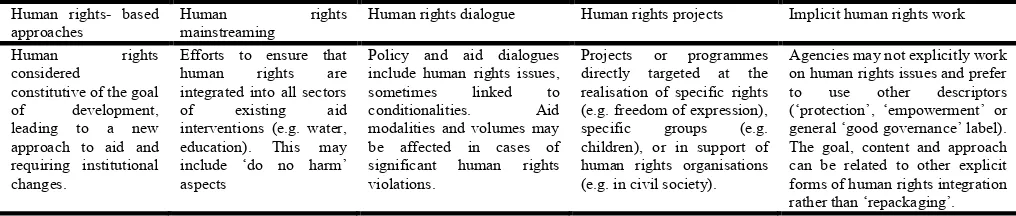
(Sengupta, 2001: 2530). The human rights approach to development may be explained below in Box 1 and Table 1.
The Right to Development Approach explicitly aims to focus on the process aspect, which means that it would be concerned with the manner in which the produce is distributed. Thus the question of distributive justice is integral to the Right to Development Approach. An emphasis on the process aspect also means that the Right to Development would be participatory and satisfy the requirements of accountability and transparency on the p art of the agencies that have the obligation to provide the basic rights. Economic, social, and cultural rights are often classified as second-generation rights, while political rights and civil liberties are considered as rights of the first generation. Many have understood this not as a mere categorization but as a ranking which puts economic, social, and cultural rights after political rights. Thus, the so-called second-generation rights have led a kind of shadow life until the late 1980s. This is more or less still true for cultural rights, which are mainly considered in the context of minorities. In contrast, economic and social rights have become part of the mainstream human rights discussion, although they have not yet received equal treatment as compared with political rights and civil liberties.
The Overseas Development Institute (ODI) states that a rights-based approach to development sets the achievement of human rights as an objective of development (ODI, 2001). However, one can delineate some common factors like reference to and starting from human rights treaties; non-discrimination, special focus on disadvantaged groups, explicitly women and children; participation and empowerment; and good governance. Participation in this sense is empowerment and implies that the people have the right to determine their path of development. For this, they need other human rights, above all the rights to education and to information. An appropriate standard of living with adequate food, housing, health, etc. is another precondition for participation as well as an outcome. This
basic understanding of participation strongly affects
development policy, for it changes the direction from top down to one that integrates from the bottom up. Participation of the
people concerned requires the decentralization of
programming from the headquarters to the local level, a state of events that is now unusual. In its policy paper of 1999, the
Overseas Development Institute (ODI) states that a rights-based approach requires performance standards that are best
negotiated locally (ODI, 1999). This will not only strengthen civil society, but increase the sustainability of the outcome, because the measures are not imposed from above. Good governance is indispensable to the realization of human rights in general and in the success of participation. One can imagine various forms of participation that do not necessarily coincide with a democratic socio-political structure. However, democratic institutions best guarantee stable and continuous participation and the growth of civil society and discourage dependence on paternalistic and arbitrary will. The strengthening of democratic institutions is the aim of good governance in development policy. Good governance as a complement to economic development was first propagated by the World Bank. The Bank perceives of good governance as a government’s capability to manage a country’s economic, political, and social affairs based on the rule of law.
Characteristics are transparency, accountability, and
efficiency. In principle, good governance can be understood as a state's inner sovereignty, meaning the legitimacy based on the government's ability to fulfil general state functions, such as the provision of public goods. This refers to both political rights, especially the rule of law, and economic and social rights, such as education, basic health care, and other public goods that states have to supply in some form or other for their population. The Human Development Report 2000 combines this under-standing of human development as the enhancement of capabilities with the concept of basic freedoms (HDR, 2000). UNICEF has a similar understanding of sustainable human development, embracing the economic, political, social, environmental, and cultural dimensions of development (UNICEF, 1998). Such holistic visions of development are consistent with human rights standards because human rights also refer to the whole human being.
The concept of Human Rights Based Approach to Development concerning entitlements of the recipients of development and consequent obligation of the duty bearing state and other actors depends upon the interaction and mutually reinforcing relationship amongst human rights, development and democracy. The grass roots level democracy at the village level ushered in by a constitutional amendment, Box 1. UN Common Understanding on a human rights-based approach
1. All programmes of development cooperation, policies and technical assistance should further the realisation of human rights as laid down in the Universal Declaration of Human Rights and other international human rights instruments.
2. Human rights standards contained in, and principles derived from, the Universal Declaration of Human Rights and other international human rights instruments guide all development cooperation and programming in all sectors and in all phases of the programming process. 3. Development cooperation contributes to the development of the capacities of ‘duty bearers’ to meet their obligations and/or of ‘rights-holders’ to claim their rights.
[image:3.595.45.553.213.321.2]4. The human rights principles identified in this agreement are: universality and inalienability; indivisibility; inter-dependence and interrelatednessz; equality and non-discrimination; participation and inclusion; and accountability and rule of law.
Table 1.
Human rights- based approaches
Human rights mainstreaming
Human rights dialogue Human rights projects Implicit human rights work
Human rights considered
constitutive of the goal of development, leading to a new approach to aid and requiring institutional changes.
Efforts to ensure that human rights are integrated into all sectors of existing aid interventions (e.g. water, education). This may include ‘do no harm’ aspects
Policy and aid dialogues include human rights issues, sometimes linked to conditionalities. Aid modalities and volumes may be affected in cases of significant human rights violations.
Projects or programmes directly targeted at the realisation of specific rights (e.g. freedom of expression), specific groups (e.g. children), or in support of human rights organisations (e.g. in civil society).
which defines the legal framework of the Panchayati Raj Institutions in India, has close link with the rights based approach to development, as it makes participation a right which in itself politicizes economic and social rights. This empowers the citizens in the remotest rural areas in the key process of decision making by enacting policies at the local level on how to distribute economic and social resources. The linkages of human rights, development and democracy within the local context of the law, policy and practice, become crucial factors to examine while assessing the elements of internationally recognized human rights based approach to development, within the mandate of the Panchayati Raj Institutions. The Panchayati Raj system empowers and enables the rights holding citizens to use their reasoned agency and to advance their rights to carve out a life they value. The Office of the High Commissioner on Human Rights lays emphasis on the rights based approach to development by stressing on the rights based empowerment of the poor in its ‘Conceptual Framework on Human Rights and Poverty Reduction’, which states that a major contribution of a human rights approach to poverty reduction is the empowerment of poor people, expanding their freedom of choice and action to structure their own lives. Human rights empower individuals and communities by granting them entitlements that give rise to legal obligations on others. (Hunt, Nowak and Osmani, 2004). Empowerment of the individuals and communities according to a human rights based approach is one of the salient determinants of development. This understanding of development places pre-eminence on human rights, existing within a participatory democratic framework where the voices of the poor are heard and respected.
Drawing on the international human rights instruments and the Declaration on the Right to Development, Mary Robinson highlights the importance of the interrelationship of Human Rights and participatory democracy, she writes, ‘They (Human Rights instruments) assert that these rights must be effectively enjoyed, whether a country is developing or developed, and that a participatory democracy, based on the rule of law, is the only system of government that can ensure the implementation of all rights.’ (Robinson, 2005: 27). Steiner and Alston among others have pointed out that the liberal content of Indian Constitution has remarkable human rights significance, reflected through its provisions of fundamental rights and directive principles which are designed to incorporate individual liberty, equality and social justice (Steiner and Alston, 2000). The Panchayats as a system of local level participatory governance and grassroots level democracy was brought about by the constitutional provisions of placing these institutions in the Part IV of the constitution, under Directive Principles of State Policy through the Section 40 of the Constitution (Austin, 1999). Amartya Sen’s work provides a framework of linking human rights with development. His focus on concepts as ‘functioning’, ‘capability’, ‘individual freedoms to choose a life one values’, characterises development as ‘freedom’ and this informs the understanding of the concept of human development utilised by number of scholars, institutions and policy makers (ODI, 2001: 2-3). The UNDP applies these concepts to link human rights and development which has a direct bearing and relevance to the rights based approach to development.
The Human Development Report 2000 notes that ‘human development shares a common vision with human rights. The goal is human freedom. And in pursuing capabilities and
realizing rights, this freedom is vital. People must be free to exercise their choices and to participate in decision making that affects their lives. Human development and human rights are mutually reinforcing, helping to secure the well-being and dignity of all people, building self-respect and the respect of others.’ (UNDP, 2001: 9). Informed by these concerns, a pro-poor rights based empowerment oriented developmental framework is the fundamental characteristic of the rights based approach to development. The principles of a rights based approach to development further qualify the right to a ‘process’ of development, which states that it is not important only to reach at the development outcome but it is equally important how and in what manner – that is through what process that outcome has been reached. The rights based approach aims at the process which expands the capabilities or freedoms of the individuals to improve their well-being and to realise what they value. This is characterised by adherence to principles derived from the texts of international human rights instruments. These include; equity, non-discrimination, participation, accountability and transparency.
Hamm (2001) observes that the human rights based approach broadens the consideration of non-discrimination to all spheres of development policy and ensures that measures against discrimination neither depend on specific programming nor change according to political decisions. In this way non-discrimination then becomes basic criteria for designing development programmes and policies and a benchmark for measuring their success. The rights based development enterprise respects the dignity and individual autonomy of all those who are supposed to be benefited by development, by giving importance to participation and empowerment. It promotes institutionalisation of participatory and democratic processes locally and nationally. This principle gets qualified and further strengthened by Sen’s concept of capabilities to link human rights and development, where participation is considered as a key element. This conception of participation relates to a human rights standard where capabilities of the people are pursued to build up opportunities for them to claim their rights. This involves inclusion in the process of development of all those people who are the poorest, the marginalized, the minorities and the excluded and discriminated against. The World Bank study ‘Voices of Poor: Crying Out for Change’ underlying the importance of participation for poverty reduction states, ‘The poor want desperately to have their voices heard, to make decisions, and not always receive the law handed down from above.’ (Narayan et. al., 2000: 281).46.
choices of the customers or clients, to foster citizens to recognise and claim their rights and obligation- holders to honour their responsibilities. According to the UN Special Rapporteur on Right to Development, Arjun Sengupta, the human rights approach helps to establish accountability, and where possible culpability for the failure or shortcoming in the implementation of the policies by establishing the duties and obligations of different parties, especially the state and of the international community. This approach establishes rights – duty correspondence by the provisions of remedial or corrective actions, some of them through legislations and where possible, others through appropriate monitoring mechanisms. Prof.
Sengupta observes that the search for accountability leading up to culpability is a genuine value addition of the human rights approach to the fulfilment of human development. For a people to participate, they need information and knowledge, and consequently any human rights approach to development cares very much about clarity and transparency. The right to information is an important element of transparency. Transparency is essential for ensuring accountability because development programme must be designed in such a manner as to bring out openly all interrelations and linkages between different actions and actors to ensure that the benefits reach the right holders. The Right to Development is ‘integrally connected with the fulfilment of civil and political rights and the freedom to participate in both the decision-making processes and the enjoyment of the fruits of development in all spheres, which cannot be realised without the fulfilment of civil and political rights. Furthermore, the concept of such a process of development is rooted in the realisation of the principles of equity and social justice. The entire human rights movement is founded on the equal treatment of every individual human being, equality of opportunity and the demand for justice. The movement for formulating the right to development was also motivated initially to bring about a more egalitarian international economic order.’ (UNO, General Assembly, 2000: para 17).
UNDP's vision of ‘sustainable human development’ provides the current culmination of the drive for a greatly expanded conception of development. Human development is defined as expanding the choices for all people in society. There are five aspects to sustainable human development affecting the lives of the poor. These are first, empowerment, i.e. the expansion of men and women's capabilities and choices increase their ability to exercise those choices free of hunger, want and deprivation. It also increases their opportunity to participate in, or endorse, decision-making affecting their lives. Second, co-operation with a sense of belonging is important for personal fulfilment, well-being and a sense of purpose and meaning. Human development is concerned with the ways in which people work together and interact. Third, equity, i.e. the expansion of capabilities and opportunities means more than income; it also means equity, such as an educational system to which everybody should have access. Fourth, sustainability means that the needs of this generation must be met without compromising the right of future generations to be free of poverty and deprivation and to exercise their basic capabilities. Fifth, security means particularly the security of livelihood. People need to be freed from threats, such as disease or repression and from sudden harmful disruptions in their lives. Although the motives behind such efforts are admirable, they should be rejected on analytical grounds.
Human rights and sustainable human development are inextricably linked only if development is defined to make this relationship tautological. ‘Sustainable human development’ simply redefines human rights, along with democracy, peace, and justice, as subsets of development. Setting aside the fact that neither most ordinary people nor governments use the term in this way, such a definition fails to address the relationship between economic development and human rights. Tensions between these objectives cannot be evaded by stipulated definitions. Less radical equity-oriented conceptions face similar problems. For example, ‘redistribution with growth’ is indeed a desirable objective. However, this objective involves two processes, redistribution and growth, that sometimes support and sometimes conflict with one another. As with liberal democracy, two fundamentally different social and political logics are combined despite analytical and political reasons to draw attention to the differences between the logics of growth and redistribution (UNDP, 1997; Anand and Sen, 1996; and Nussbaum and Sen, 1993).
Rural development in general is used to denote the actions and initiatives taken to improve the standard of living in non-urban neighbourhoods, countryside, and remote villages. These communities can be exemplified with a low ratio of inhabitants to open space. Agricultural activities may be prominent in this case whereas economic activities would relate to the primary sector, production of foodstuffs and raw materials. Land reform, however serves as a base for equitable development. Even radical reforms, unless they are vigorously supported, are subject to rapid erosion. For example, market forces tend to re-establish inequality by squeezing out the smallest farmers and increasing the relative rewards of the large or efficient. Small farmers are especially vulnerable to natural disasters and family calamities; they also face significant disadvantages in marketing, credit, and access to agricultural services and improved technologies. Development is viewed as a necessary condition for the effective implementation of human rights; the implementation of an extensive range of economic and social human rights is considered impossible in the absence of a relatively large GNP (Donnelly, 1984). For example, the Government of India and the supporters of government policies decided to change the meaning of the concept of ‘rural development’ after the mid-sixties. ‘rural development’ earlier implied agricultural development and community development enveloping the entire population of rural areas as a part of modernisation of the underdeveloped, backward, third world society.
development is the answer to this point of directed development. The new stance appeared in India with the slogan Garibi Hatao. It was adopted to prevent some sections of the rural poor from plunging deeper and deeper into the bottomless levels of primary poverty and increasingly finding fewer avenues of livelihood and purchasing power in the context of the path of development pursued by the rulers which, however, was not to be basically changed. It is my submission that the full implication of this shift in the orientation of rural development and the reasons for such change, in the context of the stirring of the vast and varied segments of pauperising and proletarianising rural poor has not been adequately examined. Nor are the dangerous implications of the new orientation of government involved in this changed limited, distributional approach to rural development adequately studied from the point of view of the rural poor as subjects. It is necessary to draw attention to the implication of this shift in the strategy of the rulers in approaching the rural poor, in the name of ‘rural development’ as differently defined.
This shift in strategy enables the state to evolve various tactical programmes and pragmatic policies to appease selected fragments of the poor temporarily to divide them, by specific relief measures by choosing selectively target groups from the rural poor to serve the basic interests of the rulers with a view to diffuse and fragment the rising upsurge of the various segments of the rural poor. The significance of the crucial changes in the politico-economic setting and socio-cultural atmosphere of the entire country which has taken place after the mid-sixties has not been adequately realised by academics and researchers. The government in India evolved a two-pronged strategy to counteract these assertions and struggles of the poor and depressed. (a) It adopted the strategy of smothering and suppressing the assertions of the poor on a larger and more brutal scale. This was reflected in increasingly curtailing their civil and democratic rights and curbing the struggles of the poor. The measures to suppress the movements can be found in A.R. Desai’s works (Desai, 1985, 1986). (b) It also adopted simultaneously a strategy of evolving schemes comprising specific measures under the new rubric characterised as ‘rural development’. The new strategy of rural development comprises a number of programmes. They can be classified into four broad categories: (a) programmes attempting to alleviate the lot of those sections of the people, that is, rural poor, who are overlooked, bypassed or have been the victims of the earlier developmental efforts. These programmes are sometimes as beneficiary-oriented programme focusing on specific target groups.
IRDP programmes, nutrition programmes assisting specific groups who are worst nourished, Antyodaya Programmes in some parts of India in which the poorest families in the villages are identified for specific assistance are some of the illustrations of this category of programmes. (b) The second category of programmes is similarly oriented as the first, but these are specific area-oriented programmes; the drought-prone areas, the desert-development programmes, the command areas, or hill area development programmes are illustrations of this category of programmes. (c) The third category is characterised as sectoral programmes. These programmes are designed to ensure that they improve the overall well-being of rural society by focusing with greater care on specific sectors of socio-economic and cultural infrastructure. Programmes for education, health care,
transport, providing drinking water, establishment of fair price shops, etc. belong to this category of programmes. (d) The fourth category of programmes is oriented to raising production, and productivity: programmes to enhance
irrigation potential, special programmes to enhance
agriculture, even in dry land areas, by small-scale farmers, programmes to encourage and expand dairy development, rural industries including handloom, or programmes to raise the production of inputs like fertilisers, use of improved seeds and good quality food. ‘The underlying assumption about the ‘new strategy of rural development’ is that Indian rulers have good intentions but ‘lack of political will’.
Further it is also assumed that this new strategy of ‘rural development’, concentrating on redistribution of benefits can realise the objective task of bringing about justice and equality, without basically changing the capitalist path of development which uses its developmental thrust to encourage, help, facilitate and even condone the lapses of the industrialists, traders, rich farmers and moneylenders as they are considered the main agents of development and growth… In fact the basic assumption underlying the analysis of ‘strategy of rural development’ is that Indian state is a non-class, welfare institution, capable of re-distributing incomes, providing justice, and bringing about equality of opportunities to all, even though it is wedded to the capitalist path of development.’ (Desai, 1987: 1295). After an experience of democratic governance of around forty years, the role and form of democracy and within it the ‘normative and political basis of local government’ (Mitra, 2001: 109) was being
reconsidered. It was acknowledged that political
decentralisation provides a more durable ‘rational legal’ framework and a basis of decentralised development and the panchayati raj model in this context, is well-suited to the Indian conditions. Apart from the demands of a democratic structure whose three fourth population resided in the villages, there was widespread concern amongst scholars and policy makers for ‘democratic deepening’ (Mathew, 2003: 156) and to infuse ‘legitimacy to India’s democratic institutions’ (Kohli, 2001: 12).
Stuart Corbridge and others have pointed out that it was around this time in the late eighties and the early nineties that within the development discourse participatory approaches had been gaining ground which advocated for greater power to the people and lesser bureaucratic determinism in a meaningful democracy to build a people oriented developmental environment (Corbridge, 2005: 124-125). It is important to note that the international politics and the human rights agenda was also increasingly taking a pro-poor stance and advocating democratic practices. All this must have impacted and facilitated the general atmosphere for change. We can consider the situation of India’s rural poor through the lens of capabilities, a framework developed by Amartya Sen in
Life is being able to live to the end of a human life of normal length; not dying prematurely, or before one’s life is so reduced as to be not worth living.
Bodily Health is being able to have good health, including reproductive health; to be adequately nourished; to have adequate shelter.
Bodily Integrity is being able to move freely from place to place; to be secure against violent assault, including
sexual assault and domestic violence; having
opportunities for sexual satisfaction and for choice in matters of reproduction.
Senses, Imagination, and Thought is (a) being able to use the senses, to imagine, think, and reason — and to do these things in a ‘truly human’ way, a way informed and cultivated by an adequate education, including, but by no means limited to, literacy and basic mathematical and scientific training, (b) being able to use imagination and thought in connection with experiencing and producing works and events of one’s own choice, religious, literary, musical, and so forth, (c) being able to use one’s mind in ways protected by guarantees of freedom of expression with respect to both political and artistic speech, and freedom of religious exercise, and (d) being able to have pleasurable experiences and to avoid non beneficial pain.
Emotions are being able to have attachments to things and people outside ourselves; to love those who love and care for us, to grieve at their absence; in general, to love, to grieve, to experience longing, gratitude, and
justified anger, not having one’s emotional
development blighted by fear and anxiety. Supporting this capability means supporting forms of human association that can be shown to be crucial in their development.
Practical Reason is being able to form a conception of the good and to engage in critical reflection about the planning of one’s life. This entails protection for the liberty of conscience and religious observance.
Affiliation is (a) being able to live with and toward others, to recognize and show concern for other human beings, to engage in various forms of social interaction; to be able to imagine the situation of another. Protecting this capability means protecting institutions that constitute and nourish such forms of affiliation, and also protecting the freedom of assembly and political speech, and (b) having the social bases of self-respect and non-humiliation; being able to be treated as a dignified being whose worth is equal to that of others. This entails provisions of non-discrimination on the basis of race, sex, sexual orientation, ethnicity, caste, religion, national origin.
Other Species are being able to live with concern for and in relation to animals, plants, and the world of nature.
Play is being able to laugh, to play, to enjoy
recreational activities.
Control over one’s Environment is (a) political being able to participate effectively in political choices that govern one’s life; having the right of political participation, protections of free speech and association, and (b) material being able to hold property (both land and movable goods), and having property rights on an equal basis with others; having the right to seek employment on an equal basis with others; having the
freedom from unwarranted search and seizure. Being able to work as a human being, exercising practical reason and entering into meaningful relationships of mutual recognition with other workers are important aspects of human rights approach to development.
Following independence at the middle of the twentieth century, India’s development strategy was one of heavy industrialization, a process that often came at the expense of the agricultural sector. Between 1951 and 1956, for example, the Indian government allocated 31% of its budgets to the agricultural sector, but government expenditures on the rural sector fell to approximately 20-25% over the next five years. Investment in rural development has since continued to decline, with many ‘urban and growth-oriented’ development initiatives largely neglecting rural India. As one scholar expresses it, policies concentrating on economic growth rather than on ‘equity and equality, have widened the gap between “urban and rural” and “haves and have-nots.”’ Indeed, rural-urban income gaps remain wider across Asia than in any other
world region. Meanwhile, IFAD’s Rural Poverty Report 2011
categorizes India as a nation with a “high level of hunger and slow progress in improving it.’ (IFAD, supra note 33, at 51). India has more poor people, as measured by income alone, than any country in the world — about 300 million or roughly one-third of the world’s total poor. Both India’s central and state governments have long financed antipoverty initiatives, but these have not proved particularly effective. Nevertheless, the poverty rate in India declined from 55% to 27% during 1973 and 2005. More recent data, however, suggest that poverty is once again on the rise, measuring 37% in 2010 (100 Million More Indians, supra note 35). Despite changes in access to education and affirmative action by the Indian government, social groups that were traditionally at the lowest rung of the social hierarchy are still economically worse off.
measure of human development to reflect the inequalities between tribal men and tribal women in terms of measures like life expectancy at birth, adult literacy rate and CEC enrolment ratio, and estimated earned income. The gender empowerment is measured by political participation and decision-making, economic participation and decision-making and power over economic resources as measured by women's and men's estimated earned income. An equally distributed equivalent percentage (EDEP) for panchayat representation has been calculated in this respect. The following are the indicators of human development relating to the majority tribal populace in this Block. This work was by me in the area of Jamalpur Block of Burdwan district of West Bengal.
Human Development Index:
Life expectancy index = 6278.52525 = 3753.5 = 0.707
Adult literacy index = 25100.3900 = 25100.39 = 0.253
Gross enrolment index in CEC = 30.070 1000 =
30.07
100 = 0.300
Education index = 2/3 (adult literacy index) + 1/3 (gross enrolment index in CEC)
= 2/3 (0.253) + 1/3 (0.300) = 0.268
Gross earned income index = loglog(2,383) log(100)
(13,333) log(100) =
2.3772 4.1242 =
0.177
Human Development Index = 1/3 (life expectancy index) + 1/3 (education index) + 1/3 (GDP index) = 1/3 (0.707) + 1/3 (0.268) + 1/3 (0.117) = 0.707/3 + 0.268/3 + 0.117/3 = 1.623/3 = 0.121
Human Poverty Index:
P1 = Probability at birth of not surviving more than age of 60 =
84.7 %
P2 = Adults lacking literacy and functional literacy skills =
85.21 %
P3 = Population below income poverty line = 33.52 %
P4 = Long-term unemployment rate (lasting 12 months or
more) = 0 %
HPI = [1/4 (P1 + P2 + P3 + P4 )] 1/
= [1/4 (84.7 3 + 85.21 3 + 33.52 3 + 0 3)] 1/3 = [1/4 (607645.42 + 618688 + 37662.75 + 0)]
= [1/4 (1263996.1)] 1/3 = [(1263996.1/ 4)] 1/3 = 315999.02 1/3 = 68.112
Gender-related Development Index:
Female life expectancy index = 6526 8026 =
39
54 = 0.722
Male life expectancy index = 6024 7624 =
36
52 = 0.692
Female adult literacy index = 18.730 1000 =
18.73
100 = 0.187
Male adult literacy index = 32.060 1000 =
32.06
100 = 0.320
Gross female enrolment index in CEC = 13.810 1000 =
13.81
100 = 0.138
Gross male enrolment index in CEC = 16.260 1000 =
16.26
100 = 0.162
Female education index = 2/3 (adult literacy index) + 1/3 (gross enrolment index)
= 2/3 (0.187) + 1/3 (0.138) = 203.187+ 0.1383 = 0.3743 + 0.1383 = 0.512
3 = 0.170
Male education index = 2/3 (adult literacy index) + 1/3 (gross enrolment index)
= 2/3 (0.320) + 1/3 (0.162) = 20.320
3 +
0.162
3 =
0.640
3 +
0.162
3 = 0.802
3 = 0.267
Female estimated earned income index = log(11,550) log(100) log(60,000) log(100) =
4.0622
4.7782 = 2.062
2.778= 0.742
Male estimated earned income index = loglog(9,900) log(100)
(60,000) log(100) =
3.9952
4.7782 = 1.995
2.778= 0.718
Equally distributed life expectancy index = {[female population share (female index 1)] + [male population share (male index 1)]} 1
Indicators Maximum value Minimum value Actual value
Life expectancy at birth on average (in years) 78 25 62.50
Adult literacy rate (%) on average 100 0 25.39
Gross enrolment ratio (%) in total in CEC 100 0 30.07
Gross estimated earned income (Rs.) as single earner 60,000 100 10,725 Per capita income (Rs.) in a single earner family 13,333 100 2,383
Female life expectancy at birth (in years) 80 26 65
Male life expectancy at birth (in years) 76 24 60
Female adult literacy rate (%) 100 0 18.73
Male adult literacy rate (%) 100 0 32.06
Gross female enrolment ratio (%) in CEC 100 0 13.81
Gross male enrolment ratio (%) in CEC 100 0 16.26
Female population share in comparison to total population 16,501 (15.93%) as per 1991 Census Male population share in comparison to total population 16, 389 (15.1%) as per 1991 Census
Women's percentage share in panchayat seats 5.11%
Men's percentage share in panchayat seats 10.24%
Female estimated earned income Rs. 11,550
Male estimated earned income Rs. 9,900
= {[15.93 (0.722 1)] + [15.1 (0.692 1)]} 1
= {[15.93 1/ 0.722] + [15.1 1/ 0.692]} 1 = {15.93/ 0.722 + 15.1/ 0.692} 1
= {11.023+10.902 0.499 }
1
= { 21.925 0.499}
1
= 1/21.925
0.499 = 0.022
Equally distributed education index = {[female population share (female index 1)] + [male population share (male index 1
)]} 1
= {[15.93 (0.170 1)] + [15.1 (0.267 1)]} 1
= {[15.93 1/ 0.170] + [15.1 1/ 0.267]} 1 = {15.93/ 0.170 + 15.1/ 0.267} 1
= {4.235+2,567 0.045 }
1
= { 6.820 0.045}
1
= 1/6.820
0.045 = 0.006
Equally distributed income index = {[female population share (female index 1)] + [male population share (male index 1)]}
1
= {[15.93 (0.742 1)] + [15.1 (0.718 1)]} 1
= {[15.93 1/ 0.742] + [15.1 1/ 0.718]} 1 = {15.93/ 0.742 + 15.1/ 0.718} 1
= {11.437+11.204 0.532 }
1
= { 22.641 0.532}
1
= 1/22.641
0.532 = 0.023
Gender-related development Index = 1/3 (equally distributed life expectancy index) + 1/3 (equally distributed education index) + 1/3 (equally distributed income index)
= 1/3 (0.022) + 1/3 (0.006) + 1/3 (0.023) = 0.022/3 + 0.006/3 + 0.023/3 = 0.051/3 = 0.017
Gender Empowerment Measure:
Equally distributed equivalent percentage (EDEP) for representation in Panchayats:
{[female population share (female percentage representation
1
)] + [male population share (male percentage representation
1
)]} 1
= {[15.93 (5.11 1)] + [15.1 (10.24 1)]} 1
= {[15.93 1/ 5.11] + [15.1 1/ 10.24]} 1 = {15.93/ 5.11 + 15.1/ 10.24} 1
= {163.12352.+32677.161} 1 = { 24052.326.284} 1 = 1/24052.326.284 = 0.217
Indexed EDEP for representation in Panchayati Raj institutions = 0.217/50 = 0.004 (when initial EDEP is indexed to an ideal value of 50 per cent). Mention here may be made that four variables are used in the construction of the Human Development Index: life expectancy at birth, the adult literacy rate, combined (primary, secondary and tertiary) school enrolment rates, and real GDP per capita. On average human development indicators tend to rise and fall with income. That finding is hardly surprising. Very low average incomes and high levels of income poverty contribute to the lack of substantive freedoms in the world, robbing people of the ability to achieve adequate nutrition, treat illness or gain an education. The HDI reflects the positive association between income on one side and health and education on the other: people in richer countries tend to be healthier and to have more
educational opportunities. It also draws attention to the fact that some countries are far better than others at converting wealth into opportunities for health and education. Sonalde B. Desai et al(2010) examines that – … much of the inequality seems to emerge from differential access to livelihoods. Salaried jobs pay far more than casual labour or farming. These jobs elude the disadvantaged groups for many reasons. Living in rural areas, having lower education, and arguably having fewer connections for job search, all may play a role. Regardless of the reason, more than three out of ten forward caste and minority religion men have salaried jobs, compared with about two out of ten Muslim, OBC, and Dalit men and even fewer Adivasi men. Dalits and Adivasis are further disadvantaged by not owing land, or owning some, mainly, low productivity land.
Not surprisingly, these income differences translate into differences in other indicators of human development… Indicators of human development such as school enrolment and infant mortality are often correlated with state income, in part, because individual families in richer states have higher incomes and so are better able to provide school fees and medical care for their own children. But more development creates many spill-over effects that provide the institutions and social climate that benefit poor families in these developed areas. These context effects have a more subtle but pervasive impact. If richer households ensure that their children are vaccinated, even poor children have a lower likelihood of contracting measles or chickenpox because their wealthier friends are vaccinated and if vaccinations become more common as more households acquire the means to access better medical care, the expectations of what parents do for their children change for everyone. Even poor parents may have a greater incentive to ensure that their children attend school if they see widespread availability of better paying jobs requiring some education. When there are enough consumers, the supply of amenities such as cell phones and LPG will be higher than in poor states, with few buyers, thereby improving the chances of even lower income households in these areas to acquire these amenities. (Desai, Sonalde B. et. al., 2010: 208, 211).
Fostering sustainable economic growth and development is the most effective way to increase overall welfare for India’s rural population. Sustainable initiatives lead eventually to generation of revenues for future government projects, thereby providing a long-term solution for rural poverty. When it has invested in the rural sector, the Indian government has devoted resources to both agricultural and non-agricultural growth. Conventional wisdom holds that the former leads indirectly to poverty alleviation by increasing mean consumption. The creation of rural nonfarm jobs and higher wages, on the other hand, tends to have greater ‘trickle down’ benefits for the poor because it raises mean income and enhances income distribution (Fan et. al., Government Spending, supra note 42, at 1038, 1040; see also Sen, Development as Freedom). United Nations International Fund for Agricultural Development,
Rural Poverty Report, 2011 lists four ‘drivers’ that stimulate the non-farm economy: first, urbanization, and particularly the growth of small or medium-sized centres and the growing integration of rural and urban economies, second, the processes of liberalization and globalization creating new employment and service opportunities in rural areas, third,
improved communication and information systems,
areas and finally, increasing investment in decentralized and renewable-based energy systems. These drivers may be present and combine differently within and across countries, creating different opportunities for the development of the rural non-farm economy (IFAD, Rural Poverty Report 2011, supra note 33, at 21). Amartya Sen and Martha Nussbaum developed the capabilities framework for evaluating human welfare as an alternative to standard social contractarianism theories. Nussbaum, Frontiers of Justice, supra note 21, at 3-8 notes that social contractarian theories were expressed principally in John Rawls’s A Theory of Justice. Nussbaum and Sen assert that focusing on resources (e.g., GDP, national poverty rates) or utility fails to take into account roadblocks to human dignity, including imbalances in power along various axes. The major departure of the capabilities approach from traditional contractarianism is the former’s reliance on functional capabilities, such as the ability to live to an old age or engage in meaningful relationships, as the measure of human welfare (Nussbaum, Frontiers of Justice, supra note 21, at 165).
Nussbaum maintains that the capabilities approach is as successfully universal as the traditional approach, while still acknowledging and protecting the heterogeneous nature of
human welfare. Because the capabilities approach
compliments human rights and second-wave rights
movements, it is a significant source of influence in both the international human rights and development communities, as well as among rights theorists more broadly (Nussbaum,
Frontiers of Justice, supra note 21, at 179-83). Agency is a hallmark of the capabilities framework, which recognizes each
human being ‘as an agent and an end’ (Nussbaum, Women and
Human Development, supra note 22, at 106) and focuses on ‘what people are able to do and be’ (Nussbaum, Frontiers of Justice, supra note 21, at 70). In particular, Nussbaum calls for
a ‘threshold level of each capability’ (Nussbaum, Women and
Human Development, supra note 22, at 6) below which citizens are not truly functioning as humans. Nussbaum and Sen distinguish between capabilities and what they label ‘functionings’, which are the ways in which people act on, or realize the possibilities associated with, their capabilities. Professor Jennifer Prah Ruger similarly explains capabilities as the building blocks or prerequisites of functionings, specifically in relation to the life and bodily health capabilities (Ruger, Global Health Justice, supra note 29, at 267). Ruger notes that health capabilities represent the ability of individuals to achieve certain health-related functionings.
The difference between health capabilities and health functionings is the difference between the freedom to achieve and achievement, and there is feedback between the two. In short, functionings are the fruition of capabilities, and the capabilities framework recognizes that different individuals may utilize their capabilities to achieve different functionings
(Nussbaum, Women and Human Development, supra note 22,
at 87 and Frontiers of Justice, supra note 21, at 79). Take an example from China. The UN Food and Agricultural Organization in 1988 said that sustainable development is the management and conservation of the natural resources base and the orientation of technological and institutional change in such a manner as to ensure the attainment and continued satisfaction of human needs for present and future generations. Such sustainable development in the agriculture, forestry and fisheries sectors conserves land, water, plant and animal
genetic resources, is environmentally non-degrading,
technically appropriate, economically viable and socially acceptable. While this definition shares many conceptual weaknesses with other definitions of sustainability (such as the questionable idea that all ‘human needs’ could be satisfied without harming the natural environment), it emphasized two aspects, which seem noteworthy:
The definition requires that the development must be economically viable.
The definition also requires that development must be socially acceptable.
If we use these two requirements of the FAO definition as yardsticks for an evaluation of China's rural development policies in the past 50 years, we can clearly say that the first 30 years failed both of these sustainability measures: they were neither economically viable nor socially acceptable. With the exception of the first few years after the foundation of the People's Republic, the agriculture stagnated or developed only slowly, if it was not driven into a major catastrophe (such as during the ‘Great Leap Forward’). The top-down command and control structure, which was the guiding principle until 1978, discouraged and frustrated the farmers and led to widespread mismanagement, inefficiency or sabotage. With the economic reforms beginning in 1978, China embarked on a completely different development strategy (even if many terms are the same as in the command- and-control period): The guiding principle was economic efficiency – with whatever structure was necessary to achieve it. Deng Zaoping said: ‘I don't care if a cat is grey or black, as long as it catches mice.’ Not surprisingly, this economic efficiency was also socially acceptable to a high degree. A large section of China's peasants clearly enjoyed the new freedom of market-oriented farming; and the consumers, for sure, took greatest pleasure in the abundant food markets after decades of food shortages or even starvation.
labor in the next town or city. In other words, a large part of China’s agriculture is traditional subsistence farming, which contributes little to a modern economy.
We have a similar situation in some countries of Eastern Europe such as Poland, where a large number of small-scale farmers either lives very poorly at the subsistence level or depend on income sources from outside agriculture. In the long run, there is only one solution to this problem: farm sizes must increase to allow competitive market production – at least in those areas, where the natural conditions are suitable for commercial agriculture. With China’s special situation in land ownership (where farmland is formally owned by the state, but rented to the farmers according to need) it will be difficult to solve this problem. The system minimizes the landless rural population, which is certainly a great achievement (in history, landless rural population was always a factor of political and social unrest and conflict). But the system is also inefficient, which – in the long run undermines the primary economic basis of the countryside. China must find a way to increase average farm size, without creating an ‘army’ of landless rural inhabitants, who have little chance of finding employment outside agriculture. It is certainly a most relevant and interesting research question, how this could be achieved.
The mobilization of the rights of citizens is seen as a common and overlapping element of both human rights and democracy. Acknowledging the linkage between the human rights based approach to development and democracy, Brigitte Hamm considers that ‘democratic institutions best guarantee stable and continuous participation and the growth of civil society and discourage dependence on paternalistic and arbitrary goodwill’ (Hamm, 2001: 1020). David Beetham maintains that the, ‘connection between democracy and human rights is an intrinsic rather than extrinsic one; human rights constitute a necessary part of democracy’ (Beetham, 1999: 92). The human rights based approach which gives salience to democratic ideals like equality, participation and empowerment of the poor and the marginalized. It strives for a democratic structure and process of political and social regulation, which does not remain limited to national parliaments alone, but goes deep to effectively involve local level participatory democracy (Gaventa, 2006).108. The central concern of this research work has been to explore the relevance of the synergy between the development and human rights especially in the case of rural poor with the help of examining the framework of participatory democratic structure and process, which gives shape and meaning to the citizen’s participation as an equal and rights holding subject in a relationship with the state (Kabeer, 2005).109. Rose Mary McGee and other have tried to highlight in a recent study that the elements of mainstreaming inclusive citizenship, rights, participation and accountability can also be seen in the concerns of some existing country programmes related to local level participatory democracy where a legal framework has been devised to elaborate on the empowerment of the poor and the marginalized (McGee, at. al., 2003).110.
Nyamu - Musembi and Cornwall point out that there is a realisation that some of the country programmes, policy and legal frameworks should be seen for their inherent worth for building up and strengthening the rights based approach as the existing programmes may be ‘informed by broadly similar principles to those articulated within the rights discourse without ever calling what they are doing “rights- based”’
(Nyamu-Musembi and Cornwall, 2004: 5). Commenting on these rights based realisation of pro-poor participation in development outcomes a recent World Bank study notes, ‘We find that the programmes that provide benefits such as toilets, housing and the transfers to the poor and disadvantaged (including the provision of BPL card) are more likely to reach
the SCs /STs when the gram panchayat has a
pradhan(chairperson) who is an SC/ST. This suggests that caste reservations are effective in including the disadvantaged groups into the preview of the local government. It supplements the previous research that finds that women Pradhans in seats reserved for women tend to take decisions more in line with the women’ (World Bank, 2006: vii). Corbridge and others have remarked on the way the notion of citizenship and the cautiousness of rights and entitlements is beginning to grow slowly, a process through which, to use their expression, the state comes ‘more clearly and more evenly into the sight lines of citizens’ (Corbridge, 2005: 126).
This is represented through the growing awareness of the people to hold control over the village schools and health visitors and to exert a voice through gram sabhas in the
process of distribution of economic resources and
opportunities like the Employment Assurance Scheme, which are increasingly seen as a matter of entitlement (Corbridge, 2005: 126-46). They highlight the fact that the PRI institutions have brought out the empowerment element within the participatory development by linking the notions of citizenship and entitlements. This optimism is also reflected by Jean Dreze and Amartya Sen when they observe that the practice of local democracy is also a form of wider political education …people are learning (if only at a varying speed) to organize, to question established patterns of authority, to demand their rights, to resist corruption and so on. (Dreze and Sen, 2002). The citizen state interactions created and sustained through these institutions of local self-governance as envisaged by the PRI amendments show their deep relevance to a rights based approach. Enhancing employment opportunities in rural areas is a necessary condition for economic development, when economic development involves more than job creation. Sustainable economic development is not possible in the absence of employment opportunity. Communities may be able to improve the degree of social cohesion; they may be able to develop both their physical infrastructure and the level of human capital. It suggests that policy to enhance employment opportunity in rural areas should emphasize the accumulation of human capital. While differences among urban and rural function existed during the era when manufacturing was dominant, the general assumption was that over time manufacturing farms in a given sector migrated from urban to rural areas.