ORIGINAL RESEARCH ARTICLE
IDENTIFICATION OF PROBLEMS EXPERIENCED BY TEACHER EDUCATORS IN COMPLETING THE
PRACTICAL WORK OF ENGLISH EDUCATION
*Dr. Anjusha Gawande
Assistant Professor, MIT WPU Faculty of Education, Pune, India
ARTICLE INFO ABSTRACT
Regardless of various positive efforts in teacher education, many aspects are far from satisfactory like improper implementation of curriculum, academic, unavailability of modern instructional materials, inadequate library & internet facility, problems associated to practical work and content knowledge of pupil teachers at large. The present study was an endeavor to study the various issues faced by the English teacher educators. This study aimed to investigate the present status of components of the English education system influencing English teacher educators and suggesting the recommendations thereof. This study found that regardless of various positive efforts in teacher education, many aspects are far from satisfactory like improper implementation of curriculum, academic, unavailability of modern instructional materials, inadequate library & internet facility, problems associated to practical work and content knowledge of pupil teachers at large.
Copyright © 2019, Dr. Anjusha Gawande. This is an open access article distributed under the Creative Commons Attribution License, which permits unrestricted use, distribution, and reproduction in any medium, provided the original work is properly cited.
INTRODUCTION
Being a regulatory body for teacher education, NCTE published, “Teacher Education Curriculum – A Framework” for in 1978. Elaborating this, Nagpure (1990) stated “The NCTE prepared a framework of Teacher Education curriculum in 1978 and it was circulated to all the states. In Maharashtra the State Board of Teacher Education prepared a detailed draft of B.Ed. syllabus which was circulated among all colleges of education and teacher educators. It was discussed thoroughly and thought over seriously by the concerned departments of universities. Most of the universities revised their syllabus of teacher education at secondary level based on the teacher education curriculum framework of NCTE.” Curriculum factor is one of the important component of English education system. It includes the nature of subject which is concerned with the science of teaching English education. B.Ed. syllabus is consisted with theoretical and practical part. English education has its own syllabus model and it varies from university to university. In Practicum It lays importance on different teaching methods, techniques and approaches used by the English teacher educators. Integration of theory and practice of English education has its own significance for effective teaching.
*Corresponding author: Dr. Anjusha Gawande
Assistant Professor, MIT WPU Faculty of Education, Pune, India
The programmes included under it are content-cum-methodology workshop and various lessons like micro-lessons, integration lessons, simulation lessons, practice lessons, IT based lessons etc. Teaching strategy is concerned about planning of teaching with respect to selection of teaching method/techniques and selection of instructional material and planning of learning experiences.
Theoretical Background
The Bachelor of Education Programme (B.Ed.) is a professional course that prepares teachers for upper primary (Classes VI-VIII), secondary level (classes IX-X) and higher secondary level (classes XI-XII).
General objectives of the B. Ed. Programme
To enable the student teacher:
To integrate the study of subject knowledge, human
development, pedagogical knowledge and
communication skill in student teachers.
To promote capabilities for inculcating national values
and goals as mentioned in the constitution of India.
To become competent and committed professionals
willing to perform the identified tasks.
ISSN: 2230-9926
International Journal of Development Research
Vol. 09, Issue, 01, pp.25490-25495, January, 2019
Article History:
Received 28th October, 2018
Received in revised form 26th November, 2018
Accepted 17th December, 2018
Published online 30th January, 2019
Key Words:
Teacher Educators, English Education, Educational problems.
Citation: Dr. Anjusha Gawande. 2019. “Identification of problems experienced by teacher educators in completing the practical work of English education”,
International Journal of Development Research, 09, (01), 25490-25495.
To use competencies and skills needed for becoming an effective teacher in a normal setup and in an inclusive setup.
To understand, develop and apply various evaluation
procedures in education.
To be sensitive student teacher about emerging issues
such as environment, population, gender equality, legal literacy, critical understanding of ict, yoga education, etc.
To use managerial and organizational skills.
To enable him/her to become aware about the day to
day problems in the field and develop the capacity to solve them through research.
To develop an understanding of the interdisciplinary
perspectives in education
To develop the habit of reflective teaching among the
student teachers.
Syllabus of Pune University: Pedagogy of School subjects is also there in the syllabus. Student teacher selects two subjects like English, History, Geograpghy, Marathi, Hindi, Sanskrit, and Economics etc. Student should select the same two subjects s/he has offered for course. English Education is one of them where students have to study theory as well as practical. In practical aspect, various practical are introduced like micro teaching, Integrated lessons, Block teaching, Practice Lessons etc.
Statement of the Problem: The present study was an endeavour to study the various issues faced by the teacher-educators of English in completing the practical work of English methodology. In order to identify those, the study aimed to identify the problems experienced by the teacher educators in completing the practical work of English methodology in Marathi medium B.Ed. Colleges in Maharashtra State. For this purpose the researcher has analysed the practicum of B.Ed. syllabus. Document analysis was used for the same. And survey method was used to identify the problems experienced by the teacher educators in completing the practical work of English methodology.
Conceptual Definitions
Identification: The action or process of identifying someone
or something or the fact of being identified.
Problems: something that is difficult to deal with: something that is a source of trouble, difficulty in understanding
something, A feeling of not liking or wanting to do something.
Teacher Educators: A teacher educator is a person who helps other people to acquire the knowledge, competences and attitudes they require to be effective teachers.
Practical Work: Tasks in which students observe or manipulate real objects or materials.
English Education: A program designed to prepare students to teach middle and high school English.
Operational Definitions
Identification: Recognizing the problems related to practical
work.
Problems: difficulty in understanding and completing the practical work of English Education.
Teacher Educator: A teacher educator of English Education teaching in B.Ed. College.
Practical Work: Tasks in which students observe or manipulate real objects or materials.
English Education: A program designed to prepare students to teach middle and high school English.
Need of the Study
Regardless of various positive efforts in teacher education, many aspects are far from satisfactory like improper implementation of curriculum, academic, unavailability of modern instructional materials, inadequate library & internet facility, problems associated to practical work and content knowledge of pupil teachers at large. “Rajput (1999) has rightly observed that the curriculum is transacted today in training institution is no different from the way it was being transacted several decades ago.” (Sarsani, 2006, p. 12). The teacher educators face problems also associated to submission of practical work. Practical aspect of teaching English education is taken care of by provision of micro-lessons, integrated lessons and simulation lessons by peer groups and practice teaching lessons in English subject. This practice teaching work is delivered in real classroom situation at various schools. Content-cum-methodology workshop is one of important practical work which is generally arranged for two weeks. In this work theoretical and practical aspects are mingled. Pupil teacher has to conduct lessons in English according to the level of standard and selection of method as per content. Most of the pupil teachers face difficulty in submission of this practical work. Eventually teacher educators face issue in evaluation of this practical work due to repetition of writing mistakes in practical report.
The researcher herself is also a teacher educator of English education and in her experience; she too has come across various educational problems. Such problems could also have been faced by other teacher educators of English. Hence the researcher decided to investigate these problems. Moreover it is observed that the academic session starts with a delay of a month or two as a result of delay in admission procedure, therefore pupil teachers find difficulty to complete practical work within given time. Extensive curriculum in one year of B.Ed., keeps pupil teachers busy, which may restrict them to dedicate more time for submission of practical work. Ultimately delay in submission creates intricacy for teacher educators in the process of evaluation. Such other curriculum related problems of teacher educators need to be addressed in enhancing teacher education.
Importance of the Study
1. It has importance in exploring various educational problems of teacher-educators of English regarding Practical’s and its completion.
Objectives of the Study
1. To analyse the practicum of syllabus of English
Education of B.Ed. in Maharashtra.
2. To identify the problems experienced by teacher
educators in completing the practical work of English education.
Assumptions
Delay in submission creates intricacy for teacher educators in the process of evaluation. The problems in the classroom, and schools in general, are considered one of the most serious factors facing the component of the educational process, such
as parents, teachers, educational administrators, and
supervisors, also vandalism, theft, destruction of property, failure in the school, poor study accomplishment, lack of educational facilities such as equipment and technology, the physical environment, and the violence against teachers and students (Mohammad Salem al-amarat, 2011).
Research Question
What are the problems experienced by the teacher educators in completing the practical work of English education?
MATERIALS AND METHODS
Method of Research: Descriptive research (quantitative) was adopted in the present study. Document Analysis and Survey study was done in the present study. Singh and Bajpai (2008) elaborated it as, “Descriptive research (quantitative) uses quantitative methods to describe what is, describing, recording, analysing, and interpreting conditions that exist. It involves some types of comparison or contrast and at tempts to discover relationships between existing non-manipulated variables. Some form of statistical analysis is used to describe the results of the study.” Similarly the researcher used descriptive (quantitative) research method for the present study to describe systematically the problems experienced by the teacher educators in completing the practical work of English methodology. The survey method was adopted for data collection from sampling elements i.e. teacher educators of English education and principals with the help of various research tools like questionnaires. Document analysis was done to analyse the syllabus of B.Ed. from all universities to understand the nature of practical related to English Education.
Population: Teacher-educators of English education from B.Ed. colleges in Maharashtra State.
Sample: Teacher-educators of English education were selected to be surveyed by stratified random method of Marathi medium B.Ed. colleges in the State of Maharashtra. The researcher applied stratified random sampling for selection. And next section explains stratified random sampling method briefly.
Sampling Method: Stratified Random Sampling method was chosen to collect significant data from targeted population in the present study. As stated earlier, the list of B.Ed. colleges was retrieved from the web portals of MKCL and Maharashtra
Vinaanudan Adhyapak Mahavidyalaya Sansthachalak
Association. For the process of data collection, Teacher-educators of English were classified as per the university their
colleges were affiliated to and samples were collected from each university covering rural and urban area. The samples were collected equally from each stratum.
Sample Size: 100 Teacher-educators of English education.
Data Collection Tools: For data collection the researcher had used, Document analysis& Questionnaire. All these tools were selected relevant to the objectives of the research.
Research tools used in this study
Sr. No. Tools Information collected from Objectives 1 Document
analysis
Syllabus of B.Ed.in Maharashtra State
Objective no. 1 2 Questionnaire Teacher-educators of English
education, and Principals.
Objective no. 2 3 Interview Subject Experts of English
Education
Objective no. 2
Document analysis: According to the objectives of the study, the researcher had analysed the syllabus of B.Ed. colleges in Maharashtra State to understand the nature of practical course and thereof to identify the problems faced by teacher educators of English Education related to practical submission.
Questionnaire: Questionnaire was given to teacher educators of English education to identify the problems associated with practical work.
Data Analysis Tools: The researcher has made use of the following statistical tool in the present study,
Percentage -This tool was used in the analysis of,
1. The responses given by the teacher educators in the questionnaires.
2. The responses given by the principals in the questionnaires.
These tools were used to find out the problems experienced by the teacher educators in completing the practical work of English education of student teachers of English education.
Procedure of the study
Scope: Present study is intended to identify the problems experienced by the teacher educators in completing the practical work of English education of student teachers of English education in Marathi medium B.Ed. Colleges in Maharashtra State.
Delimitations
This study was restricted to Marathi medium B.Ed.
colleges in Maharashtra.
This study was restricted to pre-service teacher
The deemed universities and YashwantraoChavan Maharashtra Open University, Nashik were excluded in this research.
This study was conducted during 2007-2010.
Limitations: Conclusions of the present study were completely dependent on the responses given by sampling elements i.e. pupil teachers & teacher educators,
Data Analysis & Interpretation: Analysis of practicum of English methodology of B.Ed. Syllabus:
Interpretation
Above table shows that universities in Maharashtra have variation in the syllabus as far as practical work of English methodology is concerned. Most of the universities have included micro lessons, integration lessons and practice lessons. 5(45%) universities out of 11 have not included block teaching lessons, simulated lessons and lessons on model of teaching. 8(72%) universities out of 11 have not included team teaching lessons, IT based lessons and lessons on environment education. 6(54%) universities out of 11 have not included CCM lessons. 7(63%) universities out of 11 have not included lessons value education.
Analysis and Interpretation of the Interview of Subject Experts: Almost all experts concurred that the most of teacher educators of English methodology face problems in completing practical work from their pupil teachers. Prof. Rajput Kesarsingh believed that the late submission of practical work by pupil teachers directly causes problems for teacher educators, as due late submission this whole evaluation schedule gets collapsed, which ultimately forces teacher educators to wrap the process of evaluation in short duration of time. Prof.Kesharkar Krishna had similar thought that time provided is not sufficient for preparing lesson notes and guidance, so that leads to haste for both pupil teachers and teacher educators. And thus the process of evaluation transforms to intricate exercise.
Mrs.Shahin Shaikh and Dr. Mrs.Jagpat Anupama also insisted that the late submission, and delay in submission of practical work by pupil teachers and there after the problem of pending marking scheme affects the teacher educators. Dr. Tapkeer Dattatraya and Dr. Mrs.Vartak Lalita too pointed that the late
submission of practical work obligates insufficient time for guidance. They also highlighted the issues related to late admission; overburden pupil teachers throughout academic session. Dr. Mrs.Pawar V.U. and Dr. Mrs.TidkeSangeeta articulated that repetition of simple grammatical mistakes and spelling mistakes by pupil teachers in lesson notes and in practical reports becomes discouraging circumstances for teacher educators. Mrs.PawarShoba added that as most of pupil teachers don’t have enough mastery over English content knowledge along with lack of confidence to speak English, this result to lamentable performance.
Thus it creates embarrassing situation for teacher educators during observation of lessons. Dr. Mrs.PhatakSmita and Prof.PaithankarSanjiwini uttered clearly that more number of lessons in the syllabus is squeezed into short academic session, creates difficulties for teacher educators in completing evaluation process in predefined schedule. Dr. Mrs. Harichandan Swarnalata added that teacher educators face problems of irregularity of pupil teachers in attending college; results in problems to teacher educators in getting completed the practical work by pupil teachers. However Dr. Rajhans S.S. was of the opinion that usually teacher educators have no problems related to practical work, if any the teacher educators have overcome those. Dr. Mrs.TawadeSnehlata had drawn attention to miserable situation that few pupil teachers get their project and practical work written by somebody else; this distracts teacher educators in the process of assessment.
Analysis & Interpretation of problems faced by teacher educators while completing the practical work by student teachers
List of practical work for English Education included in the syllabus
Interpretation
As the question was open-ended, large variation in the views of teacher educators was found, so statistical representation was not feasible.
Following are typical types of practical work included for study of English Education.
Action research in English language
Practicum of English Methodology Sr. No. Universities
Micro
-l
ess
o
n
Int
eg
ra
tion
Lessons Bloc
k teach
in
g
Simu
late
d
Pr
ac
tice
CCM Models
o
f
Tea
ch
ing
Tea
m
Teac
h
in
g IT
Value Educati
o
n
Envir
o
nm
enta
l
1 SantGadge Baba Amaravati University, Amravati 5 No 5 No 10 No No No No No No 2 Dr.BabasahebAmbedkar Marathwada University,
Aurangabad
3 3 No 3 10 No No No No No No
3 RashtrasantTukdojiMaharaj Nagpur University, Nagpur
5 4 2 3 15 4 2 1 No 2 2
4 North Maharashtra University, Jalgaon 8 2 No No 10 No No No No 2 No
5 Shivaji University, Kolhapur 10 1 No No 11 2 2 No 1 No No
6 SwamyRamanandTeerth Marathwada University, Nanded
6 2 4 4 16 2 4 1 1 No No
7 University of Mumbai, Mumbai 4 1 No 2 10 No 2 No No 4 6
8 University of Pune , Pune 6 2 4 1 6 4 1 1 1 2 2
9 University of Solapur, Solapur 5 1 4 No 4 1 1 No No No No
10 University of S.N.D.T 5 1 4 3 6 No No No No No No
Assignment
Microteaching
Integration lessons
Simulation lessons
Team teaching lessons
IT lessons
Lesson on model of teaching
Lessons based on value education and environment
Content cum methodology workshop
Practice teaching lessons
Preparation of teaching aids
Power point presentation
Internship
Seminar presentation
Preparation of blue print and unit test
Preparation of unit plan and year plan
Interview with school English teacher
Difficulties in conducting Block Teaching during Internship N=100
Difficulties in conducting Block Teaching during Internship N=100
Sr. No.
Response Type Frequency Percentage
1 Insufficient number of classes in the schools 75 20.05 %
2 Poor response from the school teacher 81 21.66 %
3 Non-availability of teaching aids in the schools
52 13.90 %
4 Poor response from teachers regarding their lesson observation
49 13.10 %
5 Other 60 16.04 %
6 None 57 15.24 %
Total 374 100 %
Interpretation
The above table shows that the teacher educators agreed that they majorly faced difficulties in conducting block teaching lessons was poor response from school teachers (21.66%), and the least upsetting difficulty was poor response from teachers regarding their lesson observation (13.10%).
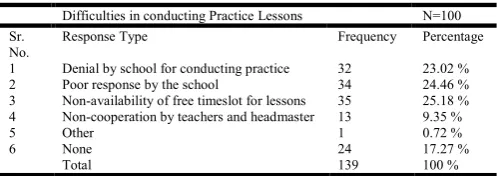
Difficulties in conducting Practice Lessons
Difficulties in conducting Practice Lessons N=100
Sr. No.
Response Type Frequency Percentage
1 Denial by school for conducting practice 32 23.02 %
2 Poor response by the school 34 24.46 %
3 Non-availability of free timeslot for lessons 35 25.18 %
4 Non-cooperation by teachers and headmaster 13 9.35 %
5 Other 1 0.72 %
6 None 24 17.27 %
Total 139 100 %
Table describes that major difficulty faced by the teacher educators was non-availability of free timeslot for lessons (25.18%). And the least troubling difficulty was non-cooperation by teachers & headmaster (9.35%).
[image:5.595.38.287.520.608.2]Permission by the schools for conducting the Practice Lessons
Table Permission by the schools for conducting the Practice Lessons
N=100
Sr. No. Response Type No. of Teacher Educators
Percentage
1 Yes 62 62.00 %
2 No 28 28.00 %
3 No Answer 10 10.00 %
Total 100 100 %
It shows that 62% of teacher educators had no issue in getting permission for conducting the practice lessons in the schools, whereas 28% teacher educators conveyed that they had struggle to get permission by the schools for conducting the practice lesson.
Complains by Schools about Pupil Teachers
Complains by Schools about Pupil Teachers N=100 Sr. No. Response Type No. of Teacher Educators Percentage
1 Yes 29 29.00 %
2 No 54 54.00 %
3 No Answer 17 17.00 %
Total 100 100 %
It shows that 54% of teacher educators agreed that they got complaint by schools with reference to pupil teachers.
Following were typical complaints reported to teacher educators,
Poor English content knowledge of pupil teachers
Less use of teaching aids by pupil teachers
Improper selection of content
Poor black board work by pupil teachers
Lack of class control
Problems related to submission of the Practical Work
Problems related to submission of the Practical Work
N=100
Sr. No. Response Type Frequency Percentage 1 Repetition of mistakes 36 36.36 % 2 Poor response of pupil teachers 29 29.29 %
3 Other 6 6.06 %
4 None 28 28.28 %
Total 99 100
It shows that the teacher educators mainly faced problems related to submission of the practical work was repetition of mistakes done by pupil teachers (36.36%), followed by poor response of pupil teachers (29.29%) towards the practical submission. Also other problems (6.06%) were highlighted by teacher educators like Lack of punctuality, Lack of content knowledge, Late submission etc
Difficulties faced by the Pupil Teachers while conducting the Practice Lessons
Difficulties faced by the Pupil Teacherswhile conducting the Practice Lessons
N=100
Sr. No. Response Type Frequency Percentage 1 Denial by school for conducting
practice lessons
26 20.00 %
2 Poor response by the school 36 27.69 % 3 Non-availability of free timeslot
for lessons
28 21.54 %
4 Non-cooperation by teachers and headmaster
12 9.23 %
5 Other 5 3.85 %
6 None 23 17.69 %
Total 130 100.00 %
[image:5.595.38.285.700.778.2]Problems in Submission of the Practical Work
Problems in Submission of the Practical Work N=100 Sr. No. Response Type Frequency Percentage 1 Non availability/Insufficiency of
printed lesson notes in the college
9 8.65 %
2 Repetitions of mistakes 40 38.46 % 3 Poor response of pupil teachers 27 25.96 %
4 Other 3 2.88 %
5 None 25 24.04 %
Total 104 100.00 %
One can understand from the above table that according to the principals, majorly pupil teachers repeat mistakes (38.46%) during the submission of practical work. And a rarely faced problem was Non availability/Insufficiency of printed lesson notes in the college (8.65%).
Complaints by the English Teacher Educators related to incompletion of Practical Work
Complaints by the English Teacher Educators related to incompletion of Practical Work
N=100
Sr. No. Response Type No. of Principals responded Percentage
1 Yes 26 26.00 %
2 No 61 61.00 %
3 No Answer 13 13.00 %
Total 100 100.00 %
It reveals that only 26% of principals received complaints from the teacher educators related to incompletion of practical work and 61% of principals didn’t.
This indicates that majority of teacher educators did not escalate issues related to incompletion of practical work even if faced by them.
How do you manage such problems related to practical work of English methodology?
Interpretation: As above question was open-ended the researcher received an assortment of answers from the principals.
Following are ways that were used to manage problems related to practical work of English methodology
Provide extra time for submission.
Consulting teacher educators & pupil teachers to
resolve such issues.
Instruct to follow annual calendar strictly.
Encourage to complete practical work.
Put extra efforts to resolve such problems.
Circulate proper instructions and providing sufficient
material if required.
MAJOR FINDINGS
Objective 1: To analyse the practicum of syllabus of English Education of B.Ed. in Maharashtra.
1. Almost all universities have included micro lessons and
integration lessons in their syllabus. However few universities have included block teaching, simulated lessons and lessons on model of teaching.
2. All universities have practice lessons; however no. of
lessons varies from university to university.
3. Most of universities have not included team teaching
lessons, IT based lessons, lessons on environment education, CCM lessons, and lessons on value education in their syllabus
Objective 2: To identify the problems experienced by teacher educators in completing the practical work of English education.
It is seen that most of the English teacher educators
faced problems like non-availability of free time slot for lessons and non-cooperation of teachers and head masters in the schools.
The English teacher educators faced problems during
the submission of practical work by pupil teachers. This lead to delay in the evaluation process.
Almost all experts concurred that most of the English
teacher educators face problems in completing practical work by pupil teachers like delay in submission, insufficient time for proper guidance, irregularity of pupil teachers etc
Major Conclusions
The universities of Maharashtra have variation in the
syllabus as far as practical work of English education is concerned. Most of the universities have not included team teaching lessons, IT based lessons, lessons on environment education, CCM lessons, and lessons on value education in their syllabus
The English teacher educators faced problems during
the submission of practical work by pupil teachers. This lead to delay in the evaluation process.
The above conclusions indicate that most of the teacher educators faced difficulties in completing practical work because of lack of time due to busy academic schedule of B.Ed. course. And the researcher felt that, this could lead to the problems for teacher educators. Ultimately teacher educators face delay in the evaluation process.
REFERENCES
Best, J.W. and Kahn, J.V. 2003. Research in education (9th Edition). New Delhi Prentice Hall of India Private Limited Nagpure, V.R. 1990. A critical study of the system of teacher
education at the secondary level in Maharashtra Pune University Syllabus, 2008
Sarsani, M.R. 2006. Quality improvement in teacher education. New Delhi:Sarup & Sons
www.google.com