1446
MULTI FACTORS IMPLEMENTATION OF INFORMATION
SECURITY MANAGEMENT SYSTEM: THE INHIBITING
1IMAM MARZUKI SHOFI, 2AHMAD NURUL FAJAR, 2RULLY TATIARA
1Informatics Engineering Department, UIN Syarif Hidayatullah, Jakarta, Indonesia 2,3Information Systems Management Department,
BINUS Graduate Program-Master of Information Systems Management, Bina Nusantara University, Jakarta Indonesia
E-mail: 1 [email protected], 2[email protected], 3[email protected]
ABSTRACT
The purpose of this research is to propose a follow-up recommendation on the factors that inhibit the implementation of the ISMS from the previous research. Continuously. This research inspired from the critical success factor in implementation of information security management system (ISMS). Its purpose is to analysis the multi factors that are inhibiting in implementation of the ISMS. It is also to propose a follow-up recommendation on the factors that inhibit the implementation of the ISMS In the previous research data were collected from questionnaires to 182 respondents from DCO at BCA, NIT PT TELIN, and DATIN Centre at Ministry of Health Republic of Indonesia. The result from the questionnaires ie 1) implement and operate the ISMS, 2) ISMS documentation management, and 3) continual improvement. This research is focusing on conducting depth interviews to the experts who already have experience in implementing the ISMS in the organizations in Indonesia. It can be concluded that in implementing the ISMS the necessity of the role of all parties in succeeding the implementation of the ISMS continuously. Keywords: Multi Factors, ISMS, In Depth Interview, Users, Information Security
1. INTRODUCTION
This research is to propose a follow-up recommendation on the factors that inhibit the implementation of the ISMS from the previous research in [1]. In this further research authors conducting depth interviews to the experts who already have experience in implementing the ISMS in the organizations in Indonesia. In the previous research in [1], data were collected from questionnaires to 182 respondents from DCO Unit at PT BCA, Tbk, NIT Division at PT TELIN, and DATIN Centre at Ministry of Health Republic of Indonesia. Data were analyzed by using Multiple Linear Regression Analysis and Paired T-test. The result is ie 1) implement and operate the ISMS, 2) ISMS documentation management, and 3) continual improvement. These three factors are inhibiting the implementation of the ISMS. Based on the results authors conducting the further research.
Organization has much valuable assets to support business processes life cycle. The most important and critical valuable assets is information [2].Thus, in order to protect information, information security is an approach to protection against the
1447 the impact of it can reduce the competitiveness of the organization. Then, another impact is also reduce the reputation of the organization. In order to achieve the secure information in an integrated, effective and efficient manner, it requires a good management framework. Information security management framework provide guidance and standard in information security management area. The specifically for the management of information security is the ISO 27001 standard on Information Security Management Systems and called the ISMS. Although there are much organizations have been implemented ISMS based on ISO 27001, the successfully implementation is relate and depend on the various factors. It always often encounter significant obstacles such as: the inconsistency of conducting the ISMS activities in accordance with the policies or procedures established.Further more, there are recurring findings of internal audits in the ISMS at any time that would risk disturbance to the organization's information security, external audit findings, and the detention of ISO 27001 certification extension [4]. There are various research which has related with critical success factors in implementing the ISMS based on ISO 27001. It will be inspired and could be to explore the reason, factors, indicators, and the inhibiting of the ISMS implementation. It will be the rationale thinking from the authors to conducting this research. The organizations that have implemented ISMS based on ISO 27001 often encounter significant obstacles such as: the inconsistency of conducting the ISMS activities in accordance with the policies or procedures established and further more there are recurring findings of internal audits of the ISMS at any time that would risk disturbance to the organization's information security, external audit findings, and the detention of ISO 27001 certification extension. The benefits of this research are to help the organizations to improve the ISMS implementation with provide some of recommendation and suggestion.
2. RELATED WORK
There are various types of researches which is focused on information security and information security management system in various cluster types industry at organizations. The research for measuring the level of information security awareness has been done with [4]. It is using Multiple Criteria Decision Analysis (MDCA) in government organizations [4]. It shows the level of awareness of information security is at "moderate"
1448 such as ISO 14000, ISO 22000 and OHSAS 18000 assessment to obtain reliable and concrete analytical results for decision makers in their decision-making process
3. RESEARCH METHOD
According to [5], research variables in this study are as follows:
1. Implementation of ISMS (Y)
2. Commitment and leadership from top management (X1)
3. Effective information security policies and objectives (X2)
4. An effective process approach (X3)
5. An effective information security risk management (X4)
6. Implement and operate the ISMS (X5) 7. Assign roles, responsibilities, and authorities
for the ISMS (X6)
8. Training, awareness, and competence of effective human resources (X7)
9. ISMS documentation management (X8) 10. Management of incidents, events, and
weaknesses of information security (X9) 11. An effective internal audit (X10) 12. Continual improvement (X11) 13. Company wide involving (X12)
14. An effective management reviews (X13) 15. An effective motivation management (X14) 16. Knowledge management (X15)
There are 16 research variables in this study. Relate to these variables, the authors determine the hypothesis in this study. The next stage is create and distribute questionnaires. The author distributed questionnaires to the three companies that were sampled:
1. Data Center Operations (DCO) Unit Bank Central Asia (BCA), located in Jakarta with 50 employees.
2. Network & Information Technology (NIT) Division at Telekomunikasi Indonesia International (TELIN), located in Jakarta with 60 employees.
3. Data and Information (DATIN) Centre of the Ministry of Health of Republic of Indonesia located in Jakarta with 72 employees.
[image:3.612.327.524.570.728.2]Stages of this research can be illustrated in the following figure:
Figure 1: Stages of Research
4. RESULTS AND DISCUSSION
This research results are derived from data analysis from distribute questionnaires and also using in depth interview analysis. The first stage to measure the questionnaires validity is doing the validity test.
Validity Test
According to [7] validity is used to measure the validity or validity of a questionnaire. A questionnaire will be valid if the question in the questionnaire is able to reveal something that the questionnaire will measure. In this study there were 182 populations, using the slovin formula: n = N / 1 + NE2. Then n = 182 / (1 + 182 x 0,052) = 125,08 rounded to 126.
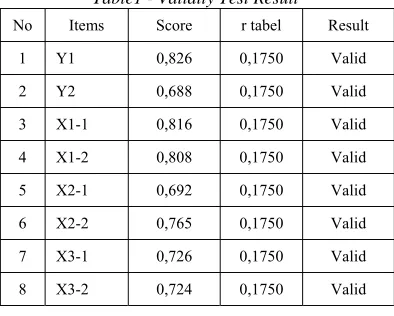
Based on ref [7] a significant test is done by comparing the value of r with r table value for degree of freedom (df) = N-2 where N is 126 and k is the number of variables there are 16, so (df) = 126-2 = 124 For value 124 in r table with significance 0,05 is equal to 0,1750. So after comparison with r table can be seen that the total of all score is bigger than r table, as shown by following table 1 below:
Table1 - Validity Test Result
No Items Score r tabel Result
1 Y1 0,826 0,1750 Valid
2 Y2 0,688 0,1750 Valid
3 X1-1 0,816 0,1750 Valid
4 X1-2 0,808 0,1750 Valid
5 X2-1 0,692 0,1750 Valid
6 X2-2 0,765 0,1750 Valid
7 X3-1 0,726 0,1750 Valid
1449
9 X4-1 0,749 0,1750 Valid
10 X4-2 0,661 0,1750 Valid
11 X5-1 0,789 0,1750 Valid
12 X5-2 0,788 0,1750 Valid
13 X6-1 0,848 0,1750 Valid
14 X6-2 0,758 0,1750 Valid
15 X7-1 0,711 0,1750 Valid
16 X7-2 0,782 0,1750 Valid
17 X8-1 0,746 0,1750 Valid
18 X8-2 0,758 0,1750 Valid
19 X9-1 0,712 0,1750 Valid
20 X9-2 0,764 0,1750 Valid
21 X10-1 0,748 0,1750 Valid
22 X10-2 0,642 0,1750 Valid
23 X11-1 0,837 0,1750 Valid
24 X11-2 0,757 0,1750 Valid
25 X12-1 0,779 0,1750 Valid
26 X12-2 0,778 0,1750 Valid
27 X13-1 0,772 0,1750 Valid
28 X13-2 0,859 0,1750 Valid
29 X14-1 0,861 0,1750 Valid
30 X14-2 0,825 0,1750 Valid
31 X15-1 0,793 0,1750 Valid
32 X15-2 0,880 0,1750 Valid
Reliability Test
Relate with [7] this reliability test is used to see whether responses and responses from respondents will produce the same value or results if done in different times and places. According to [9] a construct or variable is said to be reliable if it gives a Cronbach Alpha value > 0.60. After the authors perform calculations using SPSS then obtained the results 0.862 so that the instrument can be said reliable.
Correlation Test and Different Test
The authors conducted a test of correlation and different test using multiple linear regression analysis method and paired t test. The author is assisted by using SPSS application version 23. After using multiple linear regression and getting the results table, the authors then do paired t test to determine whether the author's
hypothesis accepted or rejected. The t test results are presented as follows:
DCO Unit at BCA
In t test at DCO Unit of BCA, the total number of samples is 50 employees. By using the formula (df) = obtained result (df) = = 50 - 16 = 34. In t table (df) = 35 with 2 side test (significance 0.025) is 2.032. The test results using SPSS show the following results:
Table2 – Hypothesis Test DCO BCA
Var t-count Correlation t-tab Result
X1 0,776 < 2,032 Accept H0
X2 1,471 < 2,032 Accept H0
X3 0,869 < 2,032 Accept H0
X4 1,750 < 2,032 Accept H0
X5 0,012 < 2,032 Accept H0
X6 0,911 < 2,032 Accept H0
X7 0,304 < 2,032 Accept H0
X8 0,677 < 2,032 Accept H0
X9 1,740 < 2,032 Accept H0
X10 0,569 < 2,032 Accept H0
X11 0,477 < 2,032 Accept H0
X12 1,579 < 2,032 Accept H0
X13 1,773 < 2,032 Accept H0
X14 0,400 < 2,032 Accept H0
X15 0,037 < 2,032 Accept H0
In the table 2 above can be concluded that all the variables X has no significant effect on the variable Y.
NIT Division at TELIN
1450
Table3 – Hypothesis Test NIT TELIN
Var t-count Correlation t-tabel Result
X1 1,626 < 2,015 Accept H0
X2 0,447 < 2,015 Accept H0
X3 0,257 < 2,015 Accept H0
X4 1,586 < 2,015 Accept H0
X5 0,589 < 2,015 Accept H0
X6 0,328 < 2,015 Accept H0
X7 0,193 < 2,015 Accept H0
X8 0,082 < 2,015 Accept H0
X9 0,838 < 2,015 Accept H0
X10 0,895 < 2,015 Accept H0
X11 0,511 < 2,015 Accept H0
X12 0,923 < 2,015 Accept H0
X13 0,549 < 2,015 Accept H0
X14 2,233 > 2,015 Reject H0
X15 1,027 < 2,015 Accept H0
In the table 3 above can be concluded that all variables X except X14 does not have a significant influence on the variable Y, while the variable X14 has a significant influence on the variable Y.
DATIN Center of Ministry of Health RI In t test at DATIN Center the total number of samples is 72 employees. Using the formula (df) = obtained result (df) = = 72 - 16 = 56. In t table (df) = 56 with 2 side test (significance 0.025) is 2,003. The test results using SPSS show the following results:
Table4 – Hypothesis Test DATIN Centre
Var t-count Correlation t-tabel Result
X1 2,559 > 2,003 Reject H0
X2 0,722 < 2,003 Accept H0
X3 0,986 < 2,003 Accept H0
X4 1,486 < 2,003 Accept H0
X5 0,692 < 2,003 Accept H0
X6 0,527 < 2,003 Accept H0
X7 1,056 < 2,003 Accept H0
X8 0,270 < 2,003 Accept H0
X9 0,626 < 2,003 Accept H0
X10 0,090 < 2,003 Accept H0
X11 0,126 < 2,003 Accept H0
X12 0,426 < 2,003 Accept H0
X13 1,145 < 2,003 Accept H0
X14 1,843 < 2,003 Accept H0
X15 2,207 > 2,003 Reject H0
In the table 4 above can be concluded that all variables X except X1 and X15 do not have a significant influence on the variable Y, while the variables X1 and X15 have a significant influence on the variable Y.
1451 To obtain qualitative data, the authors decided to compile the question of depth interview and depth interview to experts / experts in charge of ISMS
4.1.Analysis of Depth Interview Results
Based on interviews with experts, an ISMS implementation is not easy to run in a short time. Based on expert experience, an organization can be said to experience significant improvement of ISMS implementation after passing the fifth year of running implementation. This should be supported by the consistency of the process running and balanced with the competence of human resources and updating technology that continues to increase.
4.1.1. DCO unit at BCA
o ISMS documentation management (X8)
This variable has a value of 12.8%. According to the expert analysis this is because some employees do not understand about the management of documentation in accordance with applicable policies so that the handling of ISMS documentation is not maximal.
o Commitment and leadership from top
management (X1)
This variable has a value of 11.8%. According to the expert analysis this can be caused by communication related to the importance of information security in the organization from top management that is less effective or not periodically implemented so that employees feel the lack of top management role in assisting smooth implementation of the ISMS in the organization.
o An effective internal audit (X10)
This variable has a value of 10%. According to the expert analysis this can be caused by lack of communication related to the results of internal audit and audit of ISO 27001 certification to all employees. Communication of internal audit results and certification audit can help employees become more aware of the importance of implementing their duties and responsibilities for managing information security in organizations.
o Continual improvement (X11)
This variable has a value of 8.2%. According to the expert analysis this can be caused by the lack of communication related to the plan to increase the ISMS program to all employees. Communication on the plan of the ISMS improvement program can help employees become more aware of the importance of succeeding the current ISMS improvement program plan.
o An effective motivation management
(X14)
This variable has a value of 7.4%. According to the expert analysis this can be caused by the management is less active in providing an example or as a role model for employees in implementing the ISMS in the organization.
o Training, awareness, and competence of
effective human resources (X7)
This variable has a value of 5.1%. According to the expert analysis this can be caused by the presence of some employees who have not received training and awareness related to information security in the organization
o Knowledge management (X15)
This variable has a value of 0.6%. According to the expert analysis this can be caused by the lack of knowledge management database of ISMS implementation.
o Implement and operate the ISMS (X5)
This variable has a value of 0.2%. According to the expert analysis this can be caused by the lack of awareness of employees related to the implementation of information security risk management plan, the implementation of the ISMS program, as well as the information security control plan implemented in the organization.
4.1.2. NIT division at TELIN
o An effective management review (X13)
This variable has a value of 6.6%. According to the expert analysis this can be caused by the lack of effectiveness implementation of management review by top management, such as the lack of feedback from top management in providing improvement of the ISMS in the future.
o Information security incident, event, and
security management (X9)
This variable has a value of 6.1%. According to the expert analysis this can be caused by the incomplete mechanism of incident handling, incidents, and weaknesses of information security. This is demonstrated by the lack of awareness of employees in reporting all information security incidents, events and weaknesses to the information security incident management section.
o Implement and operate the ISMS (X5)
This variable has a value of 6%. According to expert analysis this can be caused by the lack of awareness of employees related to the implementation of information security risk management plan, the implementation of the ISMS program, as well as the information security control plan implemented in the organization.
o Continual improvement (X11)
1452 communication related to the plan to increase the ISMS program to all employees. Communication on the plan of the ISMS improvement program can help employees become more aware of the importance of succeeding the current ISMS improvement program plan.
o Assign roles, responsibilities, and
authorities for the ISMS (X6)
This variable has a value of 3.4%. According to the expert analysis this can be due to the lack of clarity regarding the allocation of tasks and responsibilities and authority related to information security in the organization, although top management has established a decree related tasks, responsibilities and authority related to information security, effective communication to all employees assist the implementation of these variables in supporting the implementation of the ISMS.
o The effective process approach (X3)
This variable has a value of 2.1%. Experts analyze this is caused by the lack of annual ISMS programs related to the implementation of the ISMS so as to make all employees are not clear and understand about what things they should consider in achieving the maximum implementation of ISMS.
o Training, awareness, and competence of
effective human resources (X7)
This variable has a value of 1.7%. According to expert analysis this can be caused by the presence of some employees who have not received training and awareness related to information security in the organization.
o ISMS documentation management (X8)
This variable has a value of 0.9%. According to expert analysis this is because some employees do not understand about the management of documentation in accordance with applicable policies so that the handling of documentation ISMS is not following the proper procedure.
4.1.3. DATIN center of Ministry of Health RI
o Effective information security policies and
targets (X2)
This variable has a value of 11.5%. According to the expert analysis this can be caused by a lack of communication related to information security policies and targets in the organization.
o Information security incident, event, and
security management (X9)
This variable has a value of 10%. According to the expert analysis this can be caused by the incomplete mechanism of incident handling, incidents, and weaknesses of information security. This is demonstrated by the lack of awareness of employees in reporting all information security
incidents, events and weaknesses to the information security incident management section.
o Implement and operate the ISMS (X5)
This variable has a value of 8.5%. According to the expert analysis this can be caused by the lack of awareness of employees related to the implementation of information security risk management plans, the implementation of the ISMS program, as well as the information security control plan implemented in the organization.
o Company wide involving (X12)
This variable has a value of 5.7%. According to the expert analysis this can be caused by the target that the information security of each sub unit of work has not been clearly defined.
o Assign roles, responsibilities, and
authorities for the ISMS (X6)
This variable has a value of 5.7%. According to the expert analysis this can be caused by a lack of clarity regarding the allocation of tasks and responsibilities and authority related to information security in the organization, although top management has established a decree related tasks, responsibilities and authority related to information security, effective communication to all employees assist the implementation of these variables in supporting the implementation of the ISMS.
o ISMS documentation management (X8)
This variable has a value of 3.7%. According to expert analysis this is because some employees do not understand about the management of documentation in accordance with applicable policies so that the handling of documentation ISMS is not following the proper procedure.
o Continual improvement (X11)
This variable has a value of 1.4%. According to the expert analysis this can be caused by the lack of communication related to the plan to increase the ISMS program to all employees. Communication on the plan of the ISMS improvement program can help employees become more aware of the importance of succeeding the current ISMS improvement program plan.
o An effective internal audit (X10)
1453 4.2.The Recommendation
Based on the results of statistical data analysis and qualitative data from conducting depth interviews with experts, the recommendations for each organization are as follows.
4.2.1. DCO unit at BCA
In general, DCO unit at BCA has implemented factors that support the implementation of the ISMS although it can be said that it has not been significantly implemented. Some things that must be followed up in order to support the implementation of the ISMS in the future are as follows:
1. Socialize policies and procedures for handling documentation to all employees on a regular basis.
2. Top management is more active in communicating the importance of implementing information security at any coordination meeting or meeting or special events organized by the organization, in order to build a culture of information security in the organization.
3. Communicating internal audit results and external audit results to all relevant employees so that all employees can contribute significantly to the implementation of the ISMS.
4. Communicate to all employees related to the existing improvement plan program every year so that all employees always make improvements related to the implementation of the ISMS in the organization.
5. Superiors and top management are more active in providing examples or as role models for employees in implementing the ISMS in the organization.
6. Provide training and awareness related to information security to all employees on a regular basis.
7. Using information systems in managing employee knowledge related to information security, can be internal website or internal portal.
8. Conduct periodic reviews regarding implementation of the ISMS in accordance with the ISMS annual program, information security risk management plan, information security control plan implemented in the organization.
4.2.2. NIT Division at TELIN
In general, NIT division at PT TELIN has implemented the factors that support the implementation of the ISMS although it has not been significantly implemented. Some things that must be followed up in order to support the implementation of the ISMS in the future are as follows:
1. Top management is more active in conducting management reviews by providing feedback for future ISMS improvements.
2. Socialize policies and procedures related to the management of information security incidents to all employees on a regular basis.
3. Conduct periodic reviews regarding implementation of the ISMS in accordance with the ISMS annual program, information security risk management plan, information security control plan implemented in the organization.
4. Communicate to all employees related to the existing improvement plan program every year so that all employees always make improvements related to the implementation of the ISMS in the organization.
5. Communicate related roles, responsibilities, and related authority of the ISMS to all employees on a regular basis.
6. Make a work program in the implementation of the ISMS every year and then communicate the work program on a regular basis to all personnel to be implemented optimally. 7. Provide training and awareness related to
information security to all employees on a regular basis.
8. Socialize policies and procedures for handling documentation to all employees on a regular basis.
4.2.3. DATIN Centre at Ministry of Health RI In general, DATIN Centre at Ministry of Health Republic of Indonesia has implemented the factors that support the implementation of the ISMS although it can be said has not been significantly implemented. Some things that must be followed up in order to support the implementation of the ISMS in the future are as follows:
1. Communicate the information security policies and objectives that have been assigned to all employees on a regular basis.
2. Socialize policies and procedures related to the management of information security incidents to all employees on a regular basis.
1454 with the ISMS annual program, information security risk management plan, information security control plan implemented in the organization.
4. Clearly define the information security objectives of each sub-unit in DATIN Centre. 5. Communicate related roles, responsibilities,
and related authority of the ISMS to all employees on a regular basis.
6. Socialize policies and procedures for handling documentation to all employees on a regular basis.
7. Communicate to all employees related to the existing improvement plan program every year so that all employees always make improvements related to the implementation of the ISMS in the organization.
8. Communicating internal audit results and external audit results to all relevant employees so that all employees can contribute significantly to the implementation of the ISMS.
Then the authors do further analysis of the variables that have low contribution value to the implementation of the ISMS which the variable is the authors classify as factors inhibiting the implementation of the ISMS in the organization, the inhibiting factors are as follows:
DCO Unit at BCA
There are 8 inhibiting factors in DCO Unit at BCA as follows :
1. ISMS documentation management
2. Commitment and leadership from top management
3. An effective internal audit 4. Continual improvement
5. An effective motivation management
6. Training, awareness, and competence of effective human resources
7. Knowledge management 8. Implement and operate the ISMS
NIT Division at TELIN
There are 8 inhibiting factors in NIT Division at TELIN as follows :
1. An effective management review
2. Information security incident, event, and security management
3. Implement and operate the ISMS 4. Continual improvement
5. Assign roles, responsibilities, and authorities for the ISMS
6. The effective process approach
7. Training, awareness, and competence of effective human resources
8. ISMS documentation management
DATIN Center of Ministry of Health RI
There are 8 inhibiting factors in DATIN Centre at Ministry of Health as follows :
1. Effective information security policies and targets
2. Information security incident, event, and security management
3. Implement and operate the ISMS 4. Company wide involving
5. Assign roles, responsibilities, and authorities for the ISMS
6. ISMS documentation management 7. Continual improvement
8. An effective internal audit
Based on the inhibiting factors of implementation in each organization, the authors also mapping and analyzed which inhibiting factors were repeated in each organization. The result from the mapping and analyzing process shows that there are three factors as follows:
1. Implement and operate the ISMS 2. ISMS documentation management 3. Continual improvement
Seeing this the authors conclude that the implementation of the ISMS of the three organizations must still be a special attention by top management and always improved and supported by all interested parties.
This study examines the inhibiting factors of ISMS implementation based on ISO 27001 in organizations using critical success factors based on previous research from [4] and other supporting literature review. Suggestions for further studies are:
1. Increase the number of samples of organizations that become the object of research, especially organizations that have more than five years to implement the ISMS in the organization.
1455 5. CONCLUSIONS
This research is to propose a follow-up recommendation on the factors that inhibit the implementation of the ISMS from the previous research. This research was conducted to analyze the inhibiting factors of ISMS implementation based on ISO 27001 in organizations using critical success factors. The author took a sample of research on three organizations that have implemented the ISMS, the Data Center Operations Unit at Bank Central Asia, , Network & Information Technology Division at Telekomunikasi Indonesia International, Data and Information Center of the Ministry of Health Republic of Indonesia. From the analysis of the authors, each organization has different characteristics of the implementation of the ISMS, in the Data Center Operations Unit at Bank Central Asia, all independent variables have no significant effect on the implementation of ISMS. In the Network & Information Technology Division Telekomunikasi Indonesia International, there is only one independent variable that has significant effect on the implementation of ISMS, that is knowledge management. There are two independent variables that influence the implementation of the ISMS In Indonesia, such as the commitment and leadership of top management, and knowledge management.
REFRENCES:
[1] Rully, T, Fajar,A.N, Siregar.B,Wang.G. (2017), ANALYSIS OF FACTORS THAT
INHIBITING IMPLEMENTATION OF
INFORMATION SECURITY
MANAGEMENT SYSTEM (ISMS) BASED ON ISO 27001. 2nd International Conference
on Computing and Applied Informatics (ICCAI 2017)
[2] Pavlov, G., & Karakneva, J. (2011). Information Security Managemnet System In Organization. Trakia Journal of Sciences, 9, 4, 20-25. ISSN: 1313-3551.
[3]Whitman, M. E., & Mattord, H. J. (2011). Principles of Information Security (Fourth Edition). United States of America: Cengage Learning.
[4] (2012). International Standard ISO/IEC 27000 Second Edition 2012-12-0. Switzerland. [5]Hai, Hui-Lin., & Kuei-Min Wang. (2014). The
critical success factors assessment of ISO 27001 certification in computer organization
by test-retest reliability. African Journal of
Business Management. 8, 27, 705-716.
[6] SORA, Daniel. (2012). Securing IT Newtworks with ISMS Family of Standards (ISO 27001 Series). Defense Resources Management In The 21st Century.
[7] (2013). International Standard ISO/IEC 27001 Second Edition 2013-10-01. Switzerland. [8] Chazar, Chalifa. (2015). Standar Manajemen
Keamanan Sistem Informasi Berbasis ISO/IEC 27001:2005. Jurnal Informasi. 7, 2, 48-57. [9] Fajar,A.N, Shofi,I.M. (2016). Development of
SPL Government System with Ontology Web Language. Proceedings of 2016 4th International Conference on Cyber and IT Service Management, CITSM 2016, 7577587. Indonesia
[10]. Landau, Sabine., & Everitt, Brian S. (2004). A
Handbook of Statistical Analyses using SPSS.