University of Pennsylvania
ScholarlyCommons
Publicly Accessible Penn Dissertations
1-1-2016
Compositional Reactive Synthesis for Multi-Agent
Systems
Salar Moarref
University of Pennsylvania, [email protected]
Follow this and additional works at:
http://repository.upenn.edu/edissertations
Part of the
Computer Sciences Commons
This paper is posted at ScholarlyCommons.http://repository.upenn.edu/edissertations/1902 For more information, please [email protected].
Recommended Citation
Moarref, Salar, "Compositional Reactive Synthesis for Multi-Agent Systems" (2016).Publicly Accessible Penn Dissertations. 1902.
Compositional Reactive Synthesis for Multi-Agent Systems
Abstract
With growing complexity of systems and guarantees they are required to provide, the need for automated and formal design approaches that can guarantee safety and correctness of the designed system is becoming more evident. To this end, an ambitious goal in system design and control is to automatically synthesize the system from a high-level specification given in a formal language such as linear temporal logic. The goal of this dissertation is to investigate and develop the necessary tools and methods for automated synthesis of controllers from high-level specifications for multi-agent systems. We consider systems where a set of controlled agents react to their environment that includes other uncontrolled, dynamic and potentially adversarial agents. We are particularly interested in studying how the existing structure in systems can be exploited to achieve more efficient synthesis algorithms through compositional reasoning.
We explore three different frameworks for compositional synthesis of controllers for multi-agent systems. In the first framework, we decompose the global specification into local ones, we then refine the local
specifications until they become realizable, and we show that under certain conditions, the strategies synthesized for the local specifications guarantee the satisfaction of the global specification. In the second framework, we show how parametric and reactive controllers can be specified and synthesized, and how they can be automatically composed to enforce a high-level objective. Finally, in the third framework, we focus on a special but practically useful class of multi-agent systems, and show how by taking advantage of the structure in the system and its objective we can achieve significantly better scalability and can solve problems where the centralized synthesis algorithm is infeasible.
Degree Type
Dissertation
Degree Name
Doctor of Philosophy (PhD)
Graduate Group
Computer and Information Science
First Advisor
Rajeev Alur
Second Advisor
Ufuk Topcu
Keywords
Compositional Synthesis, Formal Methods, Multi-Agent Systems, Reactive Synthesis
Subject Categories
COMPOSITIONAL REACTIVE SYNTHESIS FOR
MULTI-AGENT SYSTEMS
Salar Moarref
A DISSERTATION
in
Computer and Information Science
Presented to the Faculties of the University of Pennsylvania in Partial Fulfillment of the Requirements for the
Degree of Doctor of Philosophy
2016
Rajeev Alur
Zisman Family Professor of Computer and Information Science
Supervisor of Dissertation
Ufuk Topcu
Assistant Professor of Aerospace Engineering and Engineering Mechanics Co-Supervisor of Dissertation
Lyle Ungar, Professor of Computer and Information Science
Graduate Group Chairperson
Dissertation Committee:
Chaired by George Pappas, Professor of Electrical and Systems Engineering Roderick Bloem, Professor, Graz University, Austria
COMPOSITIONAL REACTIVE SYNTHESIS FOR
MULTI-AGENT SYSTEMS
COPYRIGHT
2016
Salar Moarref
Licensed under a Creative Commons Attribution 4.0 License.
To view a copy of this license, visit:
ACKNOWLEDGEMENT
I would like to thank my advisors, Rajeev and Ufuk, for their continual support and guidance
throughout my studies, and for providing me with a great deal of freedom for pursuing my
ideas and interests, while also kindly and patiently guiding me toward the right direction
whenever I needed. This dissertation would not have been possible without their supervision
and support.
I thank my dissertation committee members, Roderick Bloem, Vijay Kumar, Rahul
Mangharam, and George Pappas, for their comments and feedback that have helped to
imrove the quality of this dissertation. I am also grateful to them for being extremely
flexible with respect to the scheduling of the dissertation proposal and defense.
I am grateful to my parents for encouraging and supporting my goals and ambitions, and
providing me with every oppurtunity to realize my dreams. My stay at Penn was enriched
by the company of great collaborators and friends like Ashutosh Trivedi, Zhihao Jiang,
Miroslav Pajic, Vojtˇech Forejt, Mukund Raghothaman, Abhishek Udupa, Loris D’Antoni,
Anduo Wang, Jyotirmoy Deshmukh, Yifei Yuan, Nan Zheng, Kai Hong, Arjun Radhakrishna,
Hossein Ahmadzadeh, Shahin Jabbari and Nimit Singhania. I hope that these friendship
will continue to grow. Last, but not the least, I would like to express my deepest gratitude
to Bi Fei, Mohammad Hassan Lotfi, and Sanaz Ghadiri for always being there for me.
The research described in this dissertation was partially supported by awards NSF
Expeditions in Computing CCF 1138996, AFRL FA8650-15-C-2546, ONR N000141310778,
ABSTRACT
COMPOSITIONAL REACTIVE SYNTHESIS FOR MULTI-AGENT SYSTEMS
Salar Moarref
Rajeev Alur
Ufuk Topcu
With growing complexity of systems and guarantees they are required to provide, the
need for automated andformal design approaches that can guarantee safety and correctness
of the designed system is becoming more evident. To this end, an ambitious goal in system
design and control is to automatically synthesize the system from a high-level specification
given in a formal language such as linear temporal logic. The goal of this dissertation is
to investigate and develop the necessary tools and methods for automated synthesis of
controllers from high-level specifications for multi-agent systems. We consider systems
where a set of controlled agents react to their environment that includes other uncontrolled,
dynamic and potentially adversarial agents. We are particularly interested in studying
how the existing structure in systems can be exploited to achieve more efficient synthesis
algorithms through compositional reasoning.
We explore three different frameworks for compositional synthesis of controllers for
multi-agent systems. In the first framework, we decompose the global specification into local
ones, we then refine the local specifications until they become realizable, and we show that
under certain conditions, the strategies synthesized for the local specifications guarantee the
satisfaction of the global specification. In the second framework, we show howparametric
andreactive controllers can be specified and synthesized, and how they can be automatically
composed to enforce a high-level objective. Finally, in the third framework, we focus on a
special but practically useful class of multi-agent systems, and show how by taking advantage
of the structure in the system and its objective we can achieve significantly better scalability
Contents
ACKNOWLEDGEMENT iv
ABSTRACT v
List of Tables viii
List of Figures x
List of Algorithms xi
1 Introduction 1
1.1 Pattern-Based Assume-Guarantee Synthesis . . . 3
1.2 Compositional Synthesis with Parametric Reactive Controllers . . . 4
1.3 Compositional Synthesis for Decoupled Multi-Agent Systems . . . 6
1.4 Contributions . . . 7
2 Preliminaries 9 3 Pattern-Based Assume-Guarantee Synthesis 20 3.1 Overview and Problem Statement . . . 21
3.2 Inferring Behaviors as LTL Formulas . . . 26
3.2.1 Constructing the Abstract LTS . . . 27
3.2.2 Synthesizing Patterns . . . 28
3.2.3 Instantiating Patterns . . . 37
3.3 Counter-Strategy-Guided Refinement of Unrealizable GR(1) Specifications 38 3.3.1 Refining Unrealizable Specifications . . . 42
3.3.2 Removing the Restrictive Formulas . . . 43
3.4 Compositional Refinement . . . 47
3.5 Case Study . . . 52
4 Compositional Synthesis with Parametric Reactive Controllers 56 4.1 Controllers, Controller Interfaces, and Sequential Composition . . . 59
4.2 Problem Statement and Overview . . . 62
4.3 Synthesizing Parametric Reactive Controllers . . . 65
4.4 Synthesis of Control Strategy with Parametric Controllers . . . 70
4.5 Case Study . . . 82
5 Compositional Synthesis of Reactive Controllers for Decoupled Multi-Agent Systems 84 5.1 Decoupled Multi-Agent Systems . . . 86
5.2 Compositional Controller Synthesis . . . 90
5.2.1 Decomposition of the Synthesis Problem . . . 90
5.2.2 Compositional Synthesis . . . 92
5.2.3 Computing Strategies for the Agents . . . 93
5.3 Case Study . . . 94
6 Related Work 103
List of Tables
3.1 Evaluation of approaches on a robot motion planning case study . . . . 55
5.1 Experimental results for systems with perfect agents . . . 96
5.2 Experimental results for systems with imperfect agents . . . 97
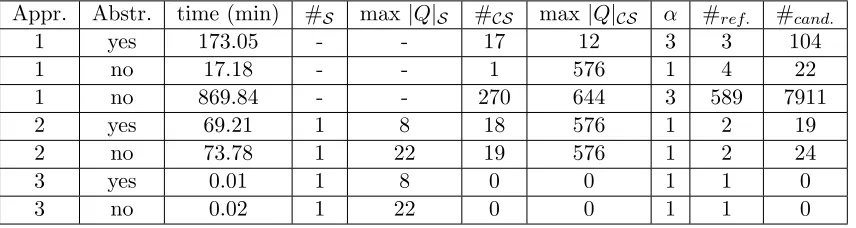
5.3 Evaluation of approaches on a robot motion planning case study with
perfect agents . . . 99
5.4 Evaluation of approaches on a robot motion planning case study with
perfect agents . . . 100
5.5 Evaluation of approaches on a robot motion planning case study with
imperfect agents . . . 101
5.6 Evaluation of approaches on a robot motion planning case study with
List of Figures
1.1 One-way streets connected by intersections. . . 3
2.1 A small grid-world . . . 11
2.2 An LTST . . . 12
2.3 A Mealy transducer . . . 13
2.4 A game structure G defined over a variablex∈[0..4]. . . 15
3.1 Serial interconnection. . . 22
3.2 Room in Example 3.1 . . . 24
3.3 An LTST . . . 36
3.4 An LTST . . . 38
3.5 Abstract LTSTa of T . . . . 38
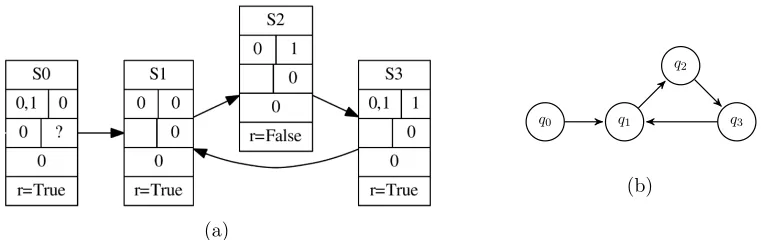
3.6 (a) A counter-strategy produced by RATSY for the specification of Exam-ple 3.6 with the additional assumption♦(¬r), wherec=true holds in all states. (b) The LTS T corresponding to the counter-strategy of part (a). 40 3.7 Grid-world for the case study . . . 53
4.1 One-way streets connected by intersections. . . 57
4.2 Part of a road divided into grids. . . 63
4.3 A game structure G defined over a variablex∈[0..3]. . . 65
4.6 (a) Part of a run in a game structure where the controller takes the control
at a state withx= 1 and increments x by 3. (b) Part of a control game
structure capturing execution of the controller from a state with x= 1. . 81
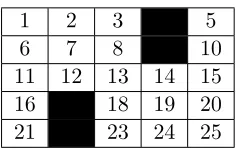
5.1 Grid-world with static obstacles . . . 88
5.2 Comparison of centralized and compositional approaches on a robot motion
planning case study with perfect agents . . . 95
5.3 Comparison of centralized and compositional approaches on a robot motion
planning case study with imperfect agents . . . 96
List of Algorithms
3.1 FindGuarantees . . . 23
3.2 Synthesizing ♦ψP patterns . . . 30
3.3 Synthesizing ψP pattern . . . 31
3.4 Synthesizing (ψP → ψP0 ) patterns . . . 32
3.5 Synthesizing ♦ψP patterns . . . 34
3.6 Synthesizing ♦ψP patterns . . . 35
3.7 Synthesizing ♦(ψP ∧ ψP0 ) patterns . . . 36
3.8 Specification Refinement . . . 42
3.9 CompositionalRefinement1 . . . 48
3.10 CompositionalRefinement2 . . . 49
3.11 CompositionalRefinement3 . . . 51
4.1 Parametric Controller Synthesis . . . 67
4.2 Control Strategy Synthesis . . . 77
1
Introduction
Complex systems often consist of multiple agents (or components) interacting with each
other and their environment to perform certain tasks and achieve specified objectives. For
example, teams of robots are employed to perform tasks such as monitoring, surveillance,
and disaster response in different domains including assembly planning [HLW00], evacuation
[RA10], search and rescue [JWE97], localization [FBKT00], object transportation [RDJ95],
and formation control [BA98]. With growing complexity of systems and guarantees they
are required to provide, the need forautomated andreliable design and analysis methods
and tools is increasing. The necessity becomes more evident considering the safety-critical
nature of some of these systems where the consequences of errors can be too catastrophic
and even life threatening.
To address these challenges, an emerging trend in systems design and control is to use
formal methods, e.g.,model checking, to ensure the safety and correctness of the designed
controllers and guarantee that the system satisfies specified high-level objectives. In model
checking, a model of the system is checked exhaustively and automatically for correctness
with respect to a given specification. This approach usually involves a design-verify cycle;
if verification tool finds a problem, the designer corrects it and runs the verification again.
Changing the design to resolve a problem often introduces other problems, causing this
cycle to repeat several times until the design is satisfactory.
An alternative and more appealing approach is to automate the design process, i.e.,
to systematically build the system where the correctness follows from construction. To
this end,reactive synthesis with the ambitious goal of automatically synthesizing
correct-by-construction controllers from high-level specifications, has recently attracted significant
of input and output signals, the synthesis problem is to find a finite-state reactive system
that assigns an output sequence to every possible input sequence such that the resulting
computation satisfies the given specification. Intuitively, the input signals are those that
are uncontrollable, i.e., system has no control over their values, contrary to output signals
whose values are decided by the system. The synthesis problem can be viewed as a game
between two players, the system and its environment. The goal of synthesis is to construct a
finite-state system that satisfies the specification regardless of how its environment behaves.
Unfortunately, high complexity of synthesis procedures has restricted the application
to relatively small-sized problems. The pioneering work by Pnueli et. al [PR89] showed
that reactive synthesis from linear temporal logic specifications is intractable. This high
computational burden has prohibited the practitioners from utilizing automated synthesis
algorithms. Nevertheless, recent advances in this growing research area have enabled
automatic synthesis of interesting real-world systems [BJP+12], indicating the potential of
the synthesis algorithms for solving realistic problems. The key insight is to consider more
restricted yet practically useful subclasses of the general problem, and in this dissertation
we take a step toward this direction.
The goal of this dissertation is to investigate and develop the necessary tools and methods
for automated synthesis of controllers from high-level specifications for multi-agent systems.
We are particularly interested in studying how the existing structure in such problems can
be exploited to achieve more efficient synthesis algorithms, e.g., through compositional
synthesis techniques. We are interested in systems where a set of controlled agents react
to their environment that includes other uncontrolled, dynamic andpotentially adversarial
agents. The objective of the system is given as a global specification, and the goal is to
synthesize controllers for each controlled agent such that the overall system satisfies the
specified objectives.
To this end, we explore different frameworks for compositional synthesis of controllers
for multi-agent systems. The general problem is, given a multi-agent system consisting of
controllable (cooperative) and uncontrollable (adversarial) agents, and a global objective
specified in temporal logic, how we can synthesize controllers for each controllable agent
such that the resulting system satisfies the given objective. The overall theme of the solution
approaches is to take advantage of the existing structure in multi-agent systems in order to
← d
↓ ↑ ↓
s0 s1 I1 → I2
↓ ↑ ↓ ↑
s2 →
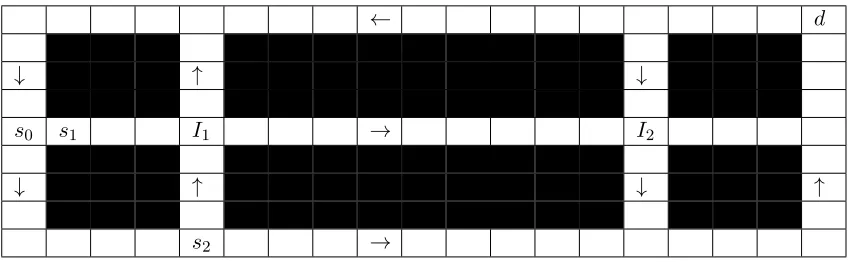
Figure 1.1: One-way streets connected by intersections.
the subproblems, and merging the results to obtain a solution to the main problem. Next
we present a brief summary of each proposed framework within this dissertation. A more
thorough exposition will be provided in the subsequent chapters.
1.1
Pattern-Based Assume-Guarantee Synthesis
Compositional synthesis techniques can potentially address the scalability problem by
solving the synthesis problem for smaller components and merging the results such that the
composition satisfies the specification. The challenge is then to find proper decompositions
and assumptions-guarantees such that each component is realizable, its expectations of its
environment can be discharged on the environment and other components, and circular
reasoning is avoided, so that the local controllers can be implemented simultaneously and
their composition satisfies the original specification.
In pattern-based assume-guarantee synthesis framework, we consider a system with two
controllable agents reacting to their dynamically changing and adversarial environment. We
decompose the global specification into two local specifications, one for each agent. We
refine the local specifications by automatic synthesis of assumptions and guarantees through
analysis of strategies and counter-strategies obtained for the agents’ local specifications.
We show how behaviors of the environment and the system can be inferred from
counter-strategies and counter-strategies, respectively, as formulas in special forms called patterns. Local
specifications are refined until both become realizable, and under certain conditions, the
strategies synthesized for the local specifications guarantee the satisfaction of the global
specification. Intuitively, additional assumptions and guarantees synthesized during the
strategy for its local specification while ensuring the satisfaction of the global specification
for the system.
Example 1.1. Consider the network of one-way roads divided into grids as shown in Figure
1.1. Assume there are two autonomous vehicles V1 and V2 that starting from locationss0
and s2, respectively, must reach and cross the intersection I1 without collision with each
other. For simplicity, assume each vehicle can either stop and stay at the same grid, or
move one step forward in the road’s specified direction. We can write these requirements as a
temporal logic specification. In the first framework, we assume that the global specification is
decomposed into local specifications, one for each controlled agent. A possible decomposition
is as follows. The local specification for vehicle V1 requires it to eventually reach and
cross the intersection. That is, V1 has no knowledge of V2. The local specification for V2
requires it to reach and cross the intersection, and also to avoid collision with V1. The
synthesized controllers for these local specifications will also guarantee satisfaction of the
global specification.
A controller forV1 that can satisfy its local specification can be automatically synthesized.
For example, V1 can keep moving forward until it reaches and then crosses the intersection.
However, the local specification for the vehicle V2 is unrealizable, i.e., there is no controller
that can satisfy it. From the perspective ofV2,V1 can stop at the intersection forever as it is
“allowed” inV2’s local specification. In the first framework, such counterexamples are analyzed
and a set of additional assumptions and guarantees are automatically synthesized. For
example, an assumption that V1 always eventually leaves the intersection can be synthesized
and added to V2’s local specification. It is also checked that V1 can indeed guarantee
this assumption. This way, the first framework iteratively discovers and refines the local
specifications until all of them become realizable.
1.2
Compositional Synthesis with Parametric
Re-active Controllers
In practice, complex systems are often not constructed from scratch but from a set of existing
building blocks. For example in robot motion planning, a robot usually has a number of
predefined motion primitives that can be selected and composed to enforce a high-level
subproblems, and hierarchically composes the solutions to implement more complicated
behaviors seems to be a more plausible way to synthesize complex systems.
We propose a compositional and hierarchical framework for synthesis from a library of
parametric andreactive controllers. Parameters allow us to take advantage of the symmetry
in many synthesis problems, e.g., in motion planning for autonomous robots and vehicles.
Reactivity of the controllers takes into account that the environment may be dynamic and
potentially adversarial. We show how these controllers can be synthesized from parametric
objectives specified by the user to form a library of parametric and reactive controllers. We
then give a synthesis algorithm that selects and instantiates controllers from the library
in order to satisfy a given safety and reachability objective. To show the potential of our
framework, we implement and apply the methods to an autonomous vehicle case study,
where a controller is synthesized from a library of parametric and reactive controllers to
safely navigate a controlled vehicle to its destination while avoiding collision with other
uncontrolled vehicles.
Example 1.2. Consider the network of one-way roads shown in Figure 1.1. Assume there is
a controlled vehicle V1 that must safely navigate from its initial location s0 to its destination
d. Safe navigation means that V1 must obey the traffic rules (e.g., move in the specific
direction of the road) and avoid collision with static obstacles and other uncontrolled vehicles.
In the second framework, we can take advantage of the symmetry in the problem to
synthesize parametric and reactive controllers. Assumex andy are two variables indicating
the location of V1. Let a and b be two parameters. The user can specify a controller C1
that starting from the parametric state(x, y) = (a, b), eventually advances the vehicle three
steps toward east, i.e., eventually (x, y) = (a+ 3, b), while avoiding collision with other
dynamic and uncontrolled vehicle. Similarly, a parametric and reactive controllerC2 can be
synthesized that advances the vehicle two steps toward north while avoiding collision with
other vehicles. Synthesized controllers are the building blocks for the compositional algorithm
proposed in the second framework. The composer automatically selects and instantiates the
controllers from a given library to enforce the high-level objective. For example, to navigate
V1 from its initial location to its destination, the composer can consecutively instantiate and
applyC1 to safely navigateV1 to the right-most column, and then consecutively apply C2 to
1.3
Compositional Synthesis for Decoupled
Multi-Agent Systems
In assume-guarantee synthesis framework described above, systems with multiple components
can be treated in adecentralized manner by considering one component as a part of the
environment of another component. However, in this synthesis approach it is difficult
to capture and model the need for joint decision-making and cooperative objectives. To
address this difficulty, we propose a compositional framework for a special class of
multi-agent systems (inspired by decentralized control and swarm robotics literature) based on
automatic decomposition of objectives and compositional reactive synthesis using maximally
permissive strategies [FJR11]. In this approach, we assume that the objective of the system
is given in a conjunctive form. We make an observation that in many cases, each conjunct
of the global objective only refers to a small subset of agents in the system. We take
advantage of this structure to decompose the synthesis problem: for each conjunct of the
global objective, we only consider the agents that are involved, and compute the maximally
permissive strategies for those agents with respect to the considered conjunct. We then
intersect the strategies to remove potential conflicts between them, and project back the
constraints to subproblems. The subproblems are solved again with updated constraints,
and this process is repeated until the strategies reach a fixed point. With this approach we
manage to solve synthesis problems for systems with multiple agents and objectives such as
collision avoidance, formation control and reachability, and for grid-worlds of sizes that are
much larger than the cases considered in similar works in the related literature. We show
that the compositional algorithm outperforms the centralized synthesis approach, both from
time and memory perspective, and can solve problems where the centralized algorithm is
infeasible.
Example 1.3. Consider the network of one-way roads shown in Figure 1.1. Assume there
are two controlled autonomous vehicles V1 and V2 initially at positions s0 and s1. Suppose
the objective of the system is forV1 andV2 to infinitely visit locations dand s0 while obeying
traffic rules, avoiding collision with each other, with static obstacles and also with other
uncontrolled vehicles. Furthermore, assumeV1 and V2 are required to stay close to each other,
e.g., they must not be more than two steps away from each other. The latter requirement
we show how such requirements can be specified and propose a compositional and symbolic
algorithm for synthesizing controllers for controlled agents.
1.4
Contributions
We now provide a short summary of the contributions made by this dissertation1:
• We propose algorithms for automatic refinement of temporal logic specifications by
synthesizing additional environment assumptions or system guarantees. The suggested
refinements can be validated by the user to ensure compatibility with her design intent.
• We propose three different approaches that can be used to refine the specifications of the
components in the context of compositional synthesis. Intuitively, these approaches differ
in how much information about one component is shared with the other one. We show
that providing more knowledge of one component’s behavior for the other component can
make it significantly easier to refine the local specifications, with the expense of increasing
the coupling between the components. We illustrate and compare the methods with
examples and a case study.
• We give a symbolic algorithm for synthesizing a control strategy that reactively chooses
and instantiates controllers from a given library of controllers to enforce a high-level
safety and reachability objective for the system. We show how a designer can simply
specify parametric controllers and then a controller and its interface along with acceptable
parameter values are synthesized automatically. We implement our algorithms symbolically
using binary decision diagrams (BDDs) and apply them to an autonomous vehicle case
study to show the potential of our approach.
• We propose a framework for modular specification and compositional controller synthesis
for multi-agent systems withimperfectcontrolled agents, i.e., agents that can only partially
observe the state of the system. We give a compositional algorithm that automatically
decomposes the synthesis problem using the structure in the system and compositionally
synthesizes controllers for the agents. We implement the methods symbolically using BDDs
and apply them to a robot motion planning case study. We report on our experimental
results and show that the compositional algorithm can significantly outperform the
centralized approach.
The organization of the subsequent chapters is as follows. Chapter 2 introduces some
notation, background and definitions that are used in the rest of the dissertation. Proposed
frameworks are described in chapters 3, 4 and 5. These chapters are written in a way that
can be read independently from each other. Chapter 6 provides an overview of the related
work in the area and discusses how the proposed methods described in this manuscript
differs from earlier work. Finally, Chapter 7 concludes this dissertation by summarizing its
2
Preliminaries
In this chapter we introduce some notation, background and definitions that are used
in the rest of the dissertation. Let Z be the set of integers. For a, b ∈ Z, let [a..b] =
{x∈Z |a≤x≤b}.
Linear temporal logic (LTL).We use LTL to specify system objectives. LTL is a formal
specification language with two types of operators: logical connectives (e.g.,¬(negation),∧
(conjunction),∨(disjunction), and → (implication)) and temporal operators (e.g., and
(always), (next), U (until), ♦ (eventually)). LetV be a finite set of Boolean variables
(atomic propositions). The formulas of LTL are defined over a set of atomic propositionsV.
The syntax is given by the grammar:
Φ :=v |Φ∨Φ| ¬Φ| Φ|Φ U Φ forv∈ V
We define true=v∨ ¬v,false=v∧ ¬v,♦Φ =true U Φ, and Φ =¬♦¬Φ. A formula
with no temporal operator is a Boolean formula or a predicate. Given a predicateφover
variables V, we says∈2V satisfies φ, denoted bys|=φ, if the formula obtained fromφby replacing all variables insby true and all other variables byfalseis valid. Formally, we
defines|=φ inductively as
• forv∈ V,s|=v if and only ifv ∈s,
• s6|=φif and only if s6|=φ, and
• s|=φ∨ψif and only if s|=φ ors|=ψ.
We call the set of all possible assignments to variables V states and denote them by ΣV,
i.e., ΣV = 2V. An LTL formula over variablesV is interpreted over infinite wordsw∈(ΣV)ω.
Φ, i.e., L(Φ) ={w∈(ΣV)ω |w|= Φ}, where the satisfaction relationw=σ0σ1σ2· · · |= Φ is
inductively defined as follows:
1.w|=v ifv∈σ0,
2.w|= Φ1∨Φ2 ifw|= Φ1 orw|= Φ2,
3.w|=¬Φ if w6|= Φ,
4.w|=Φ ifσ1σ2· · · |= Φ, and
5.w|= Φ1UΦ2 if there is n≥0 such thatσnσn+1· · · |= Φ2 and
for all 0≤i < n, σiσi+1· · · |= Φ1.
Example 2.1. Let V ={r, c, g, v}be a set of Boolean variables. Here r, c, g and v stand for
request, clear, grant and valid signals, respectively. Consider the following LTL formulas:
Φ1 = (r → ♦g), Φ2 = ((c∨g) → ¬g), Φ3 = (c → ¬v) and Φ4 = ♦(g∧v).
Intuitively, Φ1 requires that every request must be granted eventually starting from the next
step by setting signalg to high. Φ2 says that if clear or grant signal is high, then grant must
be low at the next step. Φ3 says if clear is high, then the valid signal must be low. Finally,
Φ4 says that system must issue a valid grant infinitely often.
We often use predicates overV ∪ V0 whereV0is the set of primed versions of the variables in V, i.e., V0 = {v0 |v∈ V}. Given a subset of variables X ⊆ V and a state s∈ ΣV, we
denote by s|X the projection of s to X, i.e., s|X = {x∈ X |x∈s}. For a predicate φ
over variables V, we let JφK be the set of valuations over V that make φ true, that is,
JφK={s∈ΣV |s|=φ}. For a set Z ⊆ V, letSame(Z,Z
0) be a predicate specifying that
the value of the variables in Z stay unchanged during a transition. Ordered binary decision
diagrams (OBDDs) can be used for obtaining concise representations of sets and relations
over finite domains [CGP99]. IfRis ann-ary relation over{0,1}, thenRcan be represented
by the BDD for its characteristic function:
fR(x1,· · · , xn) = 1 if and only ifR(x1,· · ·, xn) = 1.
With a little bit abuse of notation and when it is clear from the context, we treat sets and
functions as their corresponding predicates.
Generalized Reactivity (1) (GR(1)). Let V be a set of Boolean variables partitioned
into inputI and outputO variables. GR(1) specifications are of the form Φ = Φe →Φs,
1 2
3 4
Figure 2.1: A small grid-world
• φαi: A predicate overI if α=eand overI ∪ O otherwise, characterizing the initial state.
• Φαg: A formula of the form V
i♦Bi characterizing fairness/liveness, where eachBi is a
predicate overI ∪ O.
• Φα
t: An LTL formula of the form
V
iψi characterizing safety and transition relations,
where ψi is a predicate over expressionsv and v0 where v∈ I ∪ O and,v0 ∈ I if α=e
andv0 ∈ I ∪ Oifα=s.
Observe that GR(1) is a fragment of LTL. Intuitively, Φe indicates the assumptions on the
environment and Φs characterizes the requirements of the system. Any correct
implementa-tion that satisfies the specificaimplementa-tion guarantees to satisfy Φs, provided that the environment
satisfies Φe.
Example 2.2. Consider the 2×2 grid-world shown in Figure 2.1. Assume there are two
robotsR1 andR2 initially at locations1 and4, respectively. We use variablesX1, X2∈[1..4]
to encode the location of each robot at any time-step. At each time-step, each robot can move
from its current location to one of its neighboring cells by moving up, down, left or right.
Assume R1 is controlled while R2 is not, i.e., X1 is the output variable and X2 is the input
variable. The goal ofR1 is to always eventually visit the cell 3, and it must also avoid being
at the same cell asR1 at any time-step. We assume that R2 infinitely often visits the cell3.
We can formally specify above requirements in GR(1) as follows. The predicates φei :=
X2 = 4 and φsi := X1 = 1 specify the initial locations of R2 and R1, respectively. The
formula
Φit=(Xi = 1→ (Xi = 2∨Xi = 3))∧(Xi= 2→ (Xi = 1∨Xi = 4))∧
(Xi = 3→ (Xi = 1∨Xi = 4))∧(Xi= 4→ (Xi = 2∨Xi = 3))
for i ∈ {1,2} characterizes the transitions of robot Ri. The formula Φ1s = (X1 6= X2)
indicates that R1 must not be at the same cell with R2. The formula Φ1g = ♦(X1 = 3)
characterizes the goal of R1. Similarly, the formula Φ2g =♦(X2 = 3) characterizes the
q1
start q2
q3 q4
Figure 2.2: An LTS T
system requirements where Φe = φ2i ∧Φ2t ∧Φ2g encodes assumptions on the environment
(robotR1,) and Φs=φ1i ∧Φ1t ∧Φ1s∧Φ1g characterizes system guarantees.
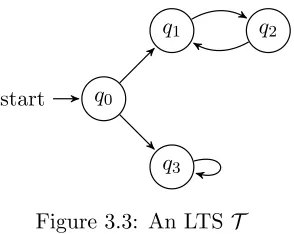
Labeled Transition System (LTS). An LTS is a tuple T =hQ, Q0, δ,Liwhere Qis a
finite set of states, Q0⊆Qis a set of initial states,δ ⊆Q×Q is a transition relation, and
L :Q→ φ is a labeling function that maps each state to a predicateφ over variables V.
Without loss of generality, we assume that every state of an LTS has an outgoing edge,
i.e., for all q ∈Qthere exists q0 ∈Qsuch that (q, q0) ∈δ. A run of an LTS is an infinite sequence of statesσ=q0q1q2...whereq0∈Q0 and for anyi≥0,qi∈Qand (qi, qi+1)∈δ.
The language of an LTS T is defined as the set L(T) = {w∈Qω |wis a run of T }, i.e.,
the set of infinite words generated by the runs ofT. We often consider an LTS as a directed
graph with a natural bijection between the states and transitions of the LTS and vertices
and edges of the graph, respectively. Formally for an LTS T =hQ, Q0, δ,Li, we define the
graphGT =hV, Ei where eachvi∈V corresponds to a unique stateqi ∈Q, and (vi, vj)∈E
if and only if (qi, qj)∈δ.
Example 2.3. Consider the setting introduced in Example 2.2. We can model the transitions
of robot R1 with an LTS T = hQ, Q0, δ,Li where Q = {q1, q2, q3, q4}, Q0 = {q1}, δ =
{(q1, q2),(q1, q3),(q2, q1),(q2, q4),(q3, q1),(q3, q4),(q4, q2),(q4, q3)}, and the labeling function
L is defined as L(qi) = (X1 =i) fori∈[1..4], i.e., each state of T corresponds to a possible
location forR1 in the grid-world. Figure 2.2 shows the graphical representation of the LTS
T.
Moore (Mealy) Transducer. AMoore transduceris a tupleM = (S, s0,I,O, δ, γ), where
S is a set of states,s0 ∈S is an initial state, ΣI = 2I is the input alphabet, ΣO = 2O is
s0
start s1
r,¬g
¬r,¬g
¬r, g
r, g
Figure 2.3: A Mealy transducer
output function. A Mealy transducer is similar, except that the state output function is
γ :S×ΣI →ΣO. For an infinite wordw∈(ΣI)ω, a run ofM is an infinite sequenceσ∈Sω
such thatσ0=s0 and for alli≥0,σi+1=δ(σi, wi). The run σ on input word w produces
an infinite wordM(w)∈(ΣV)ω such thatM(w)i =γ(σi)∪wi for all i≥0. The language
of M is the setL(M) ={M(w)|w∈ Iω}of infinite words generated by runs of M.
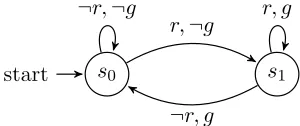
Example 2.4. Let r and g be two Boolean variables representing request and grant signals,
respectively. Figure 2.3 shows a Mealy transducerM = (S, s0,I,O, δ, γ) whereS ={s0, s1},
I ={r}, O = {g}, the transition function δ is defined as δ(s0,{r}) = s1, δ(s0,{}) =s0,
δ(s1,{r}) =s1, andδ(s1,{}) =s0, and the state output functionγ is defined asγ(s0,{r}) =
{}, γ(s0,{}) ={}, γ(s1,{r}) ={g}, and γ(s1,{}) ={g}. Intuitively, every time the request
signal is high, the mealy transducer M issues a grant at the next step.
LTL Realizability and Synthesis. An LTL formula Φ is satisfiable if there exists an
infinite wordw∈(ΣV)ω such thatw|= Φ. A Moore (Mealy) transducer M satisfies an LTL
formula Φ, written as M |=φ, if and only if L(M)⊆ L(φ). An LTL formula Φ is Moore
(Mealy) realizable if there exists a Moore (Mealy, respectively) transducer M such that
M |= Φ. Therealizability problem asks whether there exists such a transducer for a given Φ.
Given an LTL formula Φ over variablesV and a partitioning ofV intoIandO, thesynthesis
problem is to find a Mealy transducerM with input alphabet ΣI = 2I and output alphabet
ΣO = 2O that satisfies Φ. Acounter-strategy for the synthesis problem is a strategy for the
environment that can falsify the specification, no matter how the system plays. Formally, a
counter-strategy can be represented by a Moore transducerMc= (Sc, sc0,Ic,Oc, δc, γc) that
satisfies¬Φ, where Ic=O and Oc =I are the input and output variables for M
c which
are generated by the system and the environment, respectively.
Game structures. A game structure G of imperfect information is a tuple G =
(V,Λ, τ,OBS, γ) where V is a finite set of variables, Λ is a finite set of actions, τ is
variables, andγ : ΣOBS →2ΣV\∅ maps each observation to its corresponding set of states.
We assume that the set{γ(o)|o∈ΣOBS} partitions the state space ΣV2. A game structure Gis calledperfect information ifOBS =V andγ(s) ={s}for alls∈ΣV. We omit (OBS, γ)
in the description of games of perfect information.
Within the scope of this dissertation, we consider two-player turn-based game structures
where player-1 and player-2 take turn playing. Let t∈ V be a special variable with domain
{1,2} determining which player’s turn it is during the game. Without loss of generality,
we assume that player-1 always starts the game unless specified otherwise. For i= 1,2,
let ΣiV =
s∈ΣV |s|t=i denote player-i’s states in the game structure. At any state
s∈ΣiV, player-ichooses an action `∈Λ such that there exists a successor state s0 ∈ΣV0
where (s, `, s0)|=τ. Intuitively, at a player-istate, she chooses an available action according to the transition relation τ and the next state of the system is chosen from the possible
successor states. For every states∈ΣV, we define Γ(s) ={`∈Λ | ∃s0 ∈ΣV0.(s, `, s0)|=τ}
to be the set of available actions at that state. A run inG from an initial statesinit∈ΣV
is a sequence of states π = s0s1s2· · · such that s0 = sinit and, for all i > 0, there is an
action`i ∈Λ with (si−1, `i, si0) |=τ, where s0i is obtained by replacing the variables in si
by their primed copies. A run π is maximal if either it is infinite or it is finite and ends
in a state s∈ΣV where Γ(s) =∅. Theobservation sequence of π is the unique sequence
Obs(π) = o0o1o2· · · such that for all i ≥0, we have si ∈γ(oi). For ` ∈Λ and X ⊆ΣV,
let P ostG`(X) = {r∈ΣV | ∃s∈X : (s, `, r0)|=τ}. Composition of two game structures G1 = (V1,Λ1, τ1),G
2 = (V2,Λ2, τ2) of perfect information, denoted by G⊗ =G1⊗ G2, is a
game structureG⊗= (V⊗,Λ⊗, τ⊗) of perfect information whereV⊗ =V1∪V2, Λ⊗ = Λ1∪Λ2,
and τ⊗=τ1∧τ2.
Example 2.5. Let t∈ {1,2} and x∈[0..4] be two variables. Figure 2.4 shows an explicit
representation of a two-player turn-based game structure G of perfect information where
player-1(player-2) states are represented with ovals (boxes, respectively). The game structure
G is defined over variablesV ={t, x}and actionsΛ ={inc, dec}. Intuitively, at any player-i
state for i∈ {1,2}, she chooses an available action to increment or decrement the value
of x. Note that at player-2 states with x ∈ [0..2] if she chooses the action inc, the value
ofx can be incremented non-deterministically by one or two. Also note that inc action is
2
x= 0
x= 1
x= 2
x= 3
x= 3
x= 2
x= 1
x= 4 x= 4
x= 0 inc dec inc inc dec inc dec inc inc dec inc inc dec dec dec inc inc dec
Figure 2.4: A game structureG defined over a variablex∈[0..4].
not available at player-2 states with x ∈ [3..4]. The transition relation τ of G is defined
symbolically as τ =τe∧τs where
τe:=t= 1∧t0 = 2∧ 4
^
i=1
(x=i∧dec∧x0 =i−1)∧
3
^
i=0
(x=i∧inc∧x0 =i+ 1), and
τs:=t= 2∧t0 = 1∧ 4
^
i=1
(x=i∧dec∧x0 =i−1)∧
2
^
i=0
Intuitively, τe (τs) defines player-1 (player-2, respectively) transitions.
Strategies. A strategy S in G for player-i, i ∈ {1,2}, is a function S : (ΣV)∗.ΣiV → Λ.
A strategy S inG for player-2 isobservation-based if for all prefixesρ1, ρ2 ∈(ΣV)∗.Σ2V, if
Obs(ρ1) =Obs(ρ2), thenS(ρ1) =S(ρ2). We are interested in the existence of
observation-based strategies for player-2. Given two strategies S1 and S2 for player-1 and player-2,
respectively, the possible outcomes ΩS1,S2(s) from a states∈ΣV are runs: a runs0s1s2· · ·
belongs to ΩS1,S2(s) if and only if s0 = s and for allj ≥0 either sj has no successor, or
sj ∈ΣiV and (sj,Si(s0· · ·sj), s0j+1)|=τ.
Strategies may need memory to remember the history of a game. Let M be a finite
set called memory. A finite-memory strategy S = (m0, fM, fΛ) for player-i is defined as
an initial memory m0 ∈ M along with a pair of functions: a memory-update function
fM :M ×ΣV →M, which given the current state of the game and the memory, updates
the memory, and a next-action function fΛ:M×ΣiV →Λ, which given the current player-i
state and the memory, suggests the next action for the player. A strategy Sis memory-less
(a.k.a. positional) if the memoryM is a singleton, i.e.,|M|= 1. A memory-less strategy
is independent of the history of the game and only depends on the current state. Thus, a
memory-less strategy for player-ican be represented as a function S: Σi V →Λ.
Winning condition. A game (G, φinit,Φ) consists of a game structureG, a predicateφinit
specifying a set of initial states, and an LTL objective Φ for player-2. A run π=s0s1· · ·
is winning for player-2 if it is infinite and π ∈ L(Φ). Let Π be the set of runs that are
winning for player-2. A strategy S2 is winning for player-2 if for all strategies S1 of player-1
and all initial statessinit|=φinit, we have ΩS1,S2(sinit)⊆Π, that is, all possible outcomes
are winning for player-2. It is well known that for ω-regular objectives, the games are
determined, i.e., either player-2 has a winning strategy or player-1 has a spoiling strategy
[GH82]. We say the game (G, φinit,Φ) is realizable if and only if the system has a winning
strategy in the game (G, φinit,Φ).
Knowledge game structure. For a game structure G = (V,Λ, τ,OBS, γ) of imperfect
information, a game structure GK of perfect information can be obtained using a subset
construction procedure such that for any objective Φ, there exists a deterministic
observation-based strategy for player-2 in G with respect to Φ if and only if there exists a deterministic
winning strategy for player-2 in GK for Φ [Rei84, CDHR06]. Formally, we define the
information whereVK = 2V\ {∅} and (s
1, `, s2)∈τK iff there existsobs∈ OBS such that
s2=P ostG`(s1)∩γ(obs) ands26= ∅. Intuitively, each state inGK is a set of states ofG that
represents player-2’s knowledge about the possible states in which the game can be after a
sequence of observations. In the worst case, the size ofGK is exponentially larger than the
size ofG. We refer to GK as theknowledge game structure corresponding toG. In the rest
of this chapter, we only consider game structures of perfect information.
Solving games. Let G = (V,Λ, τ) be a game structure of perfect information. Let
ϕ=∃Λ∃V0.τ be a predicate specifying the set of states in G with at least one outgoing
transition, i.e., the set of statess∈ΣV for which there exists an action`∈Λ and next state
s0∈ΣV0 such that (s, `, s0)|=τ. The set D= ΣV\
JϕKof dead-end states, i.e., states with no
outgoing transition, can be computed symbolically as ϕD =¬ϕ. That is,D=JϕDK. Note
that any dead-end state is losing for player-2 by definition.
The operator EpreΛ: 2ΣV →2ΣV maps a set X ⊆ΣV of states to the states for which
there exists an action`∈Λ such that all`-successors belong to the set X, and is formally
defined as follows:
EpreΛ(X) ={v∈ΣV |(∃`∈Λ∀w∈ΣV.(v, `, w0)|=τ →w∈X)∧v|=ϕ}
= (∃Λ∀V0.(τ →X0))∧ϕ.
Note that the set of dead-end states are excluded fromEpreΛ(X) by conjoining the pre-image
states with the predicate ϕ.
The operatorApreΛ: 2ΣV →2ΣV maps a setX⊆ΣV of states to the states for which
for all actions`∈Λ all `-successors belong to the set X, and is formally defined as
ApreΛ(X) ={v∈ΣV |(∀`∈Λ∀w∈ΣV.(v, `, w0)|=τ →w∈X)∧v|=ϕ}
= (∀Λ∀V0.(τ →X0))∧ϕ.
Symbolic algorithms for solving the realizability and synthesis problems are based on the
controllable predecessor operator [MPS95]. The (player-2) controllable predecessor operator
CP re: 2ΣV →2ΣV maps a set X⊆Σ
V of states to the states from which player-2 can force
the game intoX in one step. Player-2 can force the game intoX from a state s∈Σ1V iff for all available moves`, all`-successors ofsare inX, and she can force the game intoX from
Formally,
CP re(X) = (t= 2∧EpreΛ(X))∨(t= 1∧ApreΛ(X)).
The set of states from which player-2 can avoid a setJΦerrK⊆ΣV of states is the greatest
fixed pointνX.J¬ΦerrK∩CP re(X) (safety objective,) and the set of states from which
player-2 can reach a set JΦreachK⊆ΣV of states is the least fixed point µX.JΦreachK∪CP re(X)
(reachability objective). Roughly speaking, the fixed point algorithm that computes the set
W of winning states over the game structure G and with respect to a safety or reachability
objective, iteratively computes sets of statesWi for i≥0 until it reaches the fixed point
Wi =Wi+1 =W.
Safety Games. In Chapter 5, we use the bounded synthesis approach [SF07a, FJR11] to
solve the synthesis problems from LTL specifications. In [FJR11], it is shown how LTL
formulas can be reduced tosafety games. Formally, a safety game is a game (G, φinit,Φ) with
a special safety objective Φ =(true). That is, any infinite run in the game structureG
starting from any initial states|=φinit is winning for player-2. We drop Φ from description
of safety games as it is implicitly defined. Intuitively, in a safety game, the goal of player-2
is to avoid the dead-end states, i.e., states that there is no available action. We refer the
readers to [FJR11, Ehl12] for details of reducing LTL formulas to safety games and solving
them. To solve a game (G, φinit,Φ) using bounded synthesis approach, we first obtain the
game structure GΦ corresponding to Φ using the methods proposed in [FJR11], and then
solve the safety game (G ⊗ GΦ, φ
init) to determine the winner of the game and compute a
winning strategy for player-2, if one exists.
Maximally permissive strategies. Safety games arememory-less determined, i.e.,
player-2 wins the game if and only if there exists a strategy S: Σ2V →Λ. Intuitively, a memory-less strategy only depends on the current state and is independent from the history of the game.
Let (G, φinit) be a safety game, whereG = (V,Λ, τ) is a game structure of perfect information.
Assume W ⊆ΣV be the set of winning states for player-2, i.e., from any states∈W there
exists a strategyS2 such that for any strategyS1 chosen by player-1, all possible outcomes
π∈ΩS1,S2(s) are winning. The maximally permissive strategy S : Σ 2
V →2Λ for player-2 is
defined as follows: for alls∈Σ2V,S(s) ={`∈Λ| ∀r∈ΣV0.(s, `, r)|=τs→r∈W}, i.e., the
set of actions`where all`-successors belong to the set of winning states. It is well known
thatS subsumes all winning strategies of player-2 in the safety game (G,Φinit). Composition
as S(s) =S1(s)∩ S2(s) for any s∈ΣV, i.e., the set of allowed actions by S at any state
s ∈ ΣV is the intersection of the allowed actions by S1 and S2. The restriction of the
game structure G with respect to its maximally permissive strategy S is the game structure
G[S] = (V,Λ, τ ∧φS) where φS is the predicate encoding S, i.e., for all (s, `) ∈ Σ2V ×Λ,
(s, `)|=φS if and only if`∈ S(s). Intuitively, G[S] is the same asG but player-2’s actions
3
Pattern-Based Assume-Guarantee Synthesis
The reactive synthesis problem is known to be intractable for general LTL specifications
[Ros92]. However, there are fragments of LTL, such as Generalized Reactivity(1), for which
the realizability and synthesis problems can be solved in polynomial time in the size of
the state space [BJP+12]. Yet scalability is a big challenge as increasing the number of
formulas in a specification may cause an exponential blowup in the size of its state space
[BJP+12]. Compositional synthesis techniques are used to address this issue by solving the
synthesis problem for smaller components and merging the results such that the composition
satisfies the specification. The challenge is then to find proper decompositions and interface
specifications such that each component is realizable, its expectations of its environment can
be discharged on the environment and other components, and circular reasoning is avoided,
so that the local controllers can be implemented simultaneously and their composition
satisfies the original specification [OTM11].
In this chapter, we study the problem of synthesizing interface specifications between
components in the context of compositional reactive synthesis. To this end, we consider
a problem in which the system consists of two components C1 andC2 and that a global
specification is given which is realizable and decomposed into two local specifications,
corresponding to C1 and C2, respectively. We consider a special case in which there is
a serial interconnection between the components [OTM11], i.e., roughly speaking, the
dependency between components’ output variables is acyclic and only the output variables
of C2 depend on the output variables of C1. We are interested in computing refinements
such that the refined local specifications are both realizable and when implemented, the
resulting system satisfies the global specification.
in LTL. The core of the method is the synthesis of a set of LTL formulas of special form,
called patterns, which hold over all runs of an abstraction of the strategy or counter-strategy
computed for the specification. If the local specification for a componentC2 is unrealizable,
we refine its environment assumptions, while ensuring that the other component C1 can
indeed guarantee those assumptions. To this end, it is sometimes necessary to refine
C1’s specification by adding guarantees to it. We propose three different approaches that
can be used to synthesize the interface specifications of the components in the context of
compositional synthesis. Intuitively, these approaches differ in how much information about
one component is shared with the other one. We show that providing more knowledge of one
component’s behavior for the other component can make it significantly easier to refine the
interface specifications, with the expense of increasing the coupling between the components.
We illustrate and compare the methods with examples and a case study.
3.1
Overview and Problem Statement
Assume a global LTL specification is given that is realizable. Furthermore, assume the
system consists of a set of components, and that a decomposition of the global specification
into a set of local ones is given, where each local specification corresponds to a system
component. The decomposition may result in components whose local specifications are
unrealizable, e.g., due to the lack of adequate assumptions on their environment. The
general question is how to refine the local specifications such that the refined specifications
are all realizable, and when implemented together, the resulting system satisfies the global
specification.
We consider a special case of this problem. We assume the system consists of two
components C1 and C2, where there is a serial interconnection between the components
[OTM11]. Intuitively, it means that the dependency between the output variables of the
components is acyclic, as shown in Figure 3.1. This assumption enables us to define a
total order over the components and avoid circular reasoning. Let I be the set of input
variables controlled by the environment and O be the set of output variables controlled by
the system, partitioned into O1 and O2, the set of output variables controlled byC1 and
C2, respectively. For a specification Φ = Φe → Φs, we define an assumption refinement
Ψe=
V
iΨei as a conjunction of a set of environment assumptions such that (Φe∧Ψe)→Φs
Figure 3.1: Serial interconnection.
An assumption refinement Ψe is consistent with Φ if Φe∧Ψe is satisfiable. Note that an
inconsistent refinement Φe∧Ψe=falseleads to an specification which is trivially realizable,
but neither interesting nor useful.
We now formally define the problem that is considered in this chapter.
Problem Statement 3.1. Consider a realizable global specificationΦ = Φe→Φs. Assume
Φ is decomposed into two local specifications Φ1 = Φe1 →Φs1 and Φ2 = Φe2 → Φs2 such
that Φe→(Φe1 ∧Φe2) and (Φs1 ∧Φs2)→Φs. We assume Φe, Φs, Φe1, Φs1, Φe2, and Φs2
are LTL formulas which only contain variables from the sets I, I ∪ O, I, I ∪ O1, I ∪ O1,
and I ∪ O, respectively. We would like to find refinements Ψ and Ψ0 such that the refined specificationsΦref1 = Φe1 →(Φs1 ∧Ψ0) and Φref2 = (Φe2∧Ψ)→Φs2 are both realizable, and
Ψ0 →Ψ.
If refinements Ψ and Ψ0 exist, then the resulting system from implementing the refined specifications Φref1 and Φref2 satisfies the global specification Φ [OTM11]. We use this fact to
establish the correctness of the decomposition and refinements in our proposed approaches.
As Φ is realizable, and C1 is independent from C2, it follows that Φ1 (in case it is not
realizable) can be made realizable by adding assumptions on its environment. Especially,
providing all the environment assumptions of the global specification forC1 is enough to
make its specification realizable. However, this might not be the case for Φ2. In the rest
of this chapter, we assume that Φ1 is realizable, while Φ2 is not. We investigate how the
strategy and counter-strategy computed for C1 and C2, respectively, can be used to find
suitable refinements for the interface specifications.
Our solution is based on an automated refinement of assumptions and guarantees
expressed in LTL. We refine an unrealizable specification by adding assumptions on its
environment. The refinement is synthesized step by step guided by counter-strategies. When
Algorithm 3.1: FindGuarantees
Input: Φ = Φe →Φs: a realizable specification,U: subset of variables
Output: P: A set of formulas Ψ such that Φe→(Φs∧Ψ) is realizable
1 Ms=ComputeStrategy(Φ);
2 P := Infer-GR(1)-Formulas(Ms, U);
3 P0 :=Infer-Complement-GR(1)-Formulas(Ms, U);
4 foreach Ψ∈ P0 do
5 if (Φe→(Φs∧ ¬Ψ)) is realizable then
6 P =P ∪ ¬Ψ ;
7 returnP ;
the forms♦ψ,♦ψ, and ♦(ψ∧ ψ0), which hold overall runs of the counter-strategy, is inferred. Intuitively, these formulas describe potentially “bad” behaviors of the environment
that may cause unrealizability. Their complements (which are in forms allowed by GR(1)
syntax) form the set of candidate assumptions, and adding any of them as an assumption
to the specification prevents the environment player (player-1) from behaving according to
the counter-strategy (without violating its assumptions). We say the counter-strategy is
ruled out from the environment’s possible behaviors. Counter-strategy-guided refinement
algorithm (explained in detail in Section 3.3) iteratively chooses and adds a candidate
assumption to the specification, and the process is repeated until the specification becomes
realizable, or the search cannot find a refinement within the specified search depth. The user
is asked to specify a subset of variables to be used in synthesizing candidate assumptions.
This subset may reflect the designer’s intuition on the source of unrealizability, and help to
narrow down the search for finding a proper refinement.
A similar idea can be used to refine the guarantees of a specification. When the
specification is realizable, a winning strategy can be computed for the system. The winning
strategy might not be unique, that is, there may be several strategies that can satisfy the
same specification. The computed strategy for a realizable specification restricts the possible
runs of the system to the ones which satisfy the given specification. As it is deterministic, it
might also put different restrictions on the system. These restrictions define the differences
between two winning strategies that satisfy the same specification.
We can use patterns to infer the behaviors of the strategies as LTL formulas. The inferred
formulas can be used in two ways. One is to get an insight into the possible behaviors and
1 2 3 4
5 6 7 8
Figure 3.2: Room in Example 3.1
system by adding guarantees, similar to restricting the environment by adding assumptions.
Restricting the system can be used to compute a different winning strategy which satisfies
the original specification, and also provides additional guarantees.
Formulas of the form ♦ψ, ψ, and (ψ → ψ0) can be used to infer implicit
guarantees provided by the given strategy, i.e., they can be added to the original specification
as guarantees, and the same strategy satisfies the new specification as well as the original
one. These formulas can be seen as additional guarantees a component can provide in the
context of compositional synthesis. Formulas of the form ♦ψ, ♦ψ, and♦(ψ∧ ψ0) can be used to restrict the system by adding the complement of them to the specifications as
guarantees. As a result, the current strategy is ruled out from system’s possible strategies
and therefore, the new specification, if still realizable, will have a different strategy which
satisfies the original specification, and also provides additional guarantees. Algorithm 3.1
shows how a set of additional guaranteesP are computed for the specification Φ and subset
of variables U. For the computed strategy Ms, the procedure Infer-GR(1)-Formulas
synthesizes formulas of the forms♦ψ,ψ,and(ψ→ ψ0) which hold over all runs of
the strategy. Similarly, the procedure Infer-Complement-GR(1)-Formulassynthesizes
formulas of the form♦ψ,♦ψ,and♦(ψ∧ ψ0). These procedures are explained in Section
3.2. In what follows, we will use grid-world examples commonly used in robot motion
planning case studies to illustrate the concepts and techniques [LaV06].
Example 3.1. Assume there are two robots, R1 and R2, in a room divided into eight cells
as shown in Figure 3.2. Both robots must infinitely often visit the goal cell 4. Besides, they
cannot be in the same cell simultaneously (no collision). Finally, at any time-step, each
robot can either stay put or move to one of its neighbor cells. In the sequel, assumeiranges
over {1,2}. We denote the location of robot Ri with LocRi, and cells by their numbers.
Initially LocR1 = 1 and LocR2 = 8.
The global specification is realizable. Note that in this example, all the variables are
controlled and there is no external environment. Assume that the specification is decomposed
i.e., no assumption on the environment of R1, and Φs1 only includes the initial location of
R1, its transition rules, and its goal to infinitely often visit cell 4. Φs2 includes the initial
location ofR2, its transition rules, its objective to infinitely often visit cell 4, while avoiding
collision withR1. Here R1 serves as the environment for R2 which can play adversarially.
Assume Φe2 only includes the initial location of R1.
Inferring formulas: Φ1 is realizable. A winning strategy MS1 for R1 is to move to
cell 2from the initial location, then to cell 3, and then to move back and forth between cells
4 and 3 forever. The following are examples of formulas inferred from this strategy:
• eventually always: ♦(LocR1 ∈ {3,4}),
• eventually: ♦(LocR1 = 3), ♦(LocR1 = 4),
• eventually next: ♦(LocR1 = 3∧ LocR1 = 4), ♦(LocR1 = 4∧ LocR1 = 3),
• always eventually: ♦(LocR1 = 3), ♦(LocR1 = 4),
• always: (LocR1 ∈ {1,2,3,4}), and
• always next: (LocR1 = 2→ LocR1 = 3), (LocR1 = 3→ LocR1 = 4).
Refining assumptions: Note that Φ2 includes no assumption on R1 other than its
initial location. Specifically, Φ2 does not restrict the wayR1 can move. That is, from the
perspective ofR2,R1 can go to any cell at any time-step. The specification Φ2 is unrealizable.
A counter-strategy forR1 is to move from cell 1 to the goal cell 4, and stay there forever,
preventing R2 from fulfilling its requirements. Using counter-strategy-guided refinement for
refining the assumptions on the environment, we find the refinementsΨ1 =♦(LocR1 6= 4),
Ψ2 =(LocR1 6= 4), and Ψ3 =(LocR1 = 4→ LocR1 6= 4). Ψ1 states that R1 should
infinitely often move out of the goal location. Ψ2 says that R1 must never enter the goal
location. Ψ3 says that if R1 is at the goal location, it must move out of it at the next
time-step. Intuitively, these refinements suggest that R1 is not present at cell 4 at some
point during the execution. Adding any of these formulas to the assumptions of Φ2 makes it
realizable. The designer can validate and choose the appropriate refinement.
Refining guarantees: Formula Ψ4 =♦(LocR1 ∈ {3,4})is satisfied byMS1, meaning
thatR1 eventually reaches and stays at the cells3 and 4 forever. An example of a guarantee
refinement is to add the guarantee ¬Ψ4 = ♦(LocR1 6∈ {3,4}) to Φ1, meaning that the
robot R1 should infinitely often move out of cells 3 and 4. A winning strategy for the new
specification is to move back and forth in the first row between initial and goal cells. That is,
We use these techniques to refine the interface specifications. We propose three different
approaches for finding suitable refinements, based on how much information about the
strategy of the realizable component is allowed to be shared with the unrealizable component.
The first approach has no knowledge of the strategy chosen by C1, and tries to find a
refinement by analyzing counter-strategies. The second approach iteratively extracts some
information from the strategies computed for Φ1, and uses this information to refine the
specifications. The third approach encodes the strategy as a conjunction of LTL formulas,
and provides it as a set of assumptions forC2, allowing it to have a full knowledge of the
strategy. These approaches are explained in detail in Section 3.4.
Compositional Refinement: AssumeMS1 is the computed strategy forR1. The first
approach, computes a refinement for the unrealizable specification, then checks if the other
component can guarantee it. For example, Ψ3 is a candidate refinement for Φ2, i.e., by
assuming thatR1 infinitely often leaves the goal cell, there exists a strategy forR2 to satisfy
its objective. Now we need to ensure that this assumption is indeed guaranteed byR1 in
order to ensure that the global specification is satisfied. The strategyMS can provide such
a guarantee. However, there exists other winning strategies that can satisfyφ1 which do
not guarantee Ψ3. For example, if R1 reaches the goal location and stays there forever,
Φ1 is still satisfied. However, this strategy does not satisfy Ψ3 anymore. To ensure that
the specification for R1 satisfies Ψ3 no matter how the strategy is computed, Φ1 should be
refined. Φ1 can be refined by Ψ3 added to its guarantees. The strategy MS1 still satisfies
the new specification, and refined specifications are both realizable. Thus, the first approach
returns Ψ3 as a possible refinement.
Using the second approach, formula Ψ5 =♦(LocR1 = 3) is inferred fromMS1. Refining
both specifications with Ψ5 leads to two realizable specifications, hence Ψ4 is returned as
a refinement. The third approach encodes MS1 as conjunction of transition formulas
Ψ6 = V3i=1(LocR1 = i → LocR1 = i+ 1)∧(LocR1 = 4 → LocR1 = 3). Refining
assumptions of Φ2 with Ψ6 makes it realizable.
3.2
Inferring Behaviors as LTL Formulas
In this section we show how certain types of LTL formulas that hold over all runs of a
counter-strategy or strategy can be synthesized. The user chooses the subset U of variables

![Figure 2.4: A game structure G defined over a variable x ∈ [0..4].](https://thumb-us.123doks.com/thumbv2/123dok_us/9335908.1468093/29.612.151.503.66.456/figure-a-game-structure-g-dened-over-variable.webp)