Lincoln University Digital Thesis
Copyright
Statement
The
digital
copy
of
this
thesis
is
protected
by
the
Copyright
Act
1994
(New
Zealand).
This
thesis
may
be
consulted
by
you,
provided
you
comply
with
the
provisions
of
the
Act
and
the
following
conditions
of
use:
you
will
use
the
copy
only
for
the
purposes
of
research
or
private
study
you
will
recognise
the
author's
right
to
be
identified
as
the
author
of
the
thesis
and
due
acknowledgement
will
be
made
to
the
author
where
appropriate
you
will
obtain
the
author's
permission
before
publishing
any
material
from
the
thesis.
Conserving New Zealand’s endemic carnivorous land snail
Powelliphanta patrickensis through restoration of a functioning
ecosystem
A thesis
submitted in partial fulfilment
of the requirements for the Degree of
Doctor of Philosophy
at
Lincoln University
by
Benjamin R. Waterhouse
Abstract of a thesis submitted in partial fulfilment of the
requirements for the Degree of Doctor of Philosophy.
Abstract
Conserving New Zealand’s endemic carnivorous land snail
Powelliphanta
patrickensis
through restoration of a functioning ecosystem
by
Benjamin R. Waterhouse
As of 2014, New Zealand’s largest active opencast mine, covering approximately 2500 hectares, and located on the West Coast of the South Island has been granted an extension that will further impact the diverse range of native and endemic flora and fauna in the area. Powelliphanta patrickensis, a locally endemic carnivorous land snail, will be subject to restoration and relocation programmes as a result of habitat loss. Mining of this type requires the complete removal of ecosystems, including vegetation, soil and rock to access the mineral resources beneath, impacting a range of species and ecological processes. Soil and rock are then stored in large, mixed stockpiles that can become depleted in volume, organic matter and nutrients. A number of restoration measures are already undertaken on site including: vegetation direct transfer (VDT), where intact sods of topsoil, flora and fauna are lifted and transplanted to a holding site or site requiring restoration; addition of biosolids to stockpiled soils to restore organic matter and nutrient levels in stockpiled soil; and spread of untreated soil stockpiles. The objectives of this thesis were to test the efficacy of the current
restoration methods and further develop ecological restoration practices following mining to inform decision-making concerning restoration, with an initial focus on P. patrickensis.
Molecular analysis of P. patrickensis diet showed that this species has a relatively generalist feeding behaviour consisting predominantly, if not exclusively, of endemic earthworms. Notable seasonal variation occurred between summer and winter diet composition, and comparison to the closely related but allopatric species Powelliphanta augusta showed a strong difference in diet composition. Such analyses support the notion that flagship species do not necessarily represent the needs of other, even closely related, species.
addition led to total earthworm mortality, compared to significantly lower mortality rates in pots containing ‘unmodified’ native and untreated stockpiled soil. Biosolids, however, doubled plant growth compared to controls, and both biosolids and earthworms benefited soil community and function.
Subsequent work investigated the response of various other ecosystem processes to VDT, biosolids amendments and stockpiled soil. Soil microbial activity, biomass, community-level physiological profile and functional diversity were examined in a field setting. VDT was the most effective restoration technique, followed by biosolids treatment, and then stockpiled soil spreads. Reconciling results with studies of the effects of restoration protocols on earthworm species richness and abundance led to the recommendation that VDT is a preferable restoration type, and that P. patrickensis should be relocated only to VDT or undisturbed native sites when being translocated.
Responses of other ecosystem functions, including plant-arbuscular mycorrhzal fungal (AMF) interactions and their effects on plant growth and soil microbial communities, to restoration
practices were examined in glasshouse experiments. It was found not only that native vegetation was sensitive to the AMF species present, but also that biosolids disrupted colonisation of plant roots by AMF.
Rather than pursue a ‘flagship’ or ‘keystone’ species approach focusing on a single species, this thesis used the legal, conservation and media attention that P. patrickensis attracted, to
investigate a range of ecosystem-wide processes that inform site restoration. Recommendations for restoration should be supported by strong empirical evidence, and this thesis has provided a basis for further work on complex ecological interactions associated with restoration of opencast mining.
Keywords: AMF, biomass production, CLPP, conservation, diet, diversity, DNA, earthworms,
Acknowledgements
Undertaking a PhD is tricky business, and I would like to express my sincere gratitude to a number of people who enabled my completion of this research.
First and foremost, my supervisors Steve Wratten and Stéphane Boyer for their continued support, intellectual stimulation, guidance and conversation. Both of my supervisors have operated and open-door policy of which I have taken full advantage and the student-supervisor dynamic was the best I could have hoped for. Thank you.
I have been lucky to enlist the help of a number of other advisors whose expertise has taught me a range of skills and enriched my work and experience. Namely, Dr. Andrew Holyoake: one of the most talented and patient molecular scientists I know; Dr. Hayley Ridgway and Dr. Eirian Jones, my mycorrhizal and soil biological science gurus; Dr. Karen Adair who was my go-to for soil biology and multivariate statistics (and a roof over my head following my arrival in New Zealand).
My work on an active opencast mine would not have been possible without the continued and impeccable support of Mark Hamilton and his team at MBC Contracting Ltd., the onsite mine environmental consultants. Paul Weber and Phil Rossiter were my main contacts at Solid Energy New Zealand Ltd. who arranged site access and have great knowledge of the processes and environmental issues on site. Barry Walker and Robbie Blankenstein were extremely generous with onsite support, access, information and general interest in my project.
Technical and laboratory support was provided by Roger Cresswell (soil assays and soil laboratory practice), Brent Richards (nursery and glasshouse experiments), Dave Saville (statistics), and Celine Blonde (DGGE), who put up with my innumerable requests for advice and equipment.
I would like to thank my funding bodies: Miss E. L. Hellaby Indigenous Grassland Research Trust as my primary funding source; The Bio-Protection Research Centre in Lincoln University, New Zealand; and Solid Energy New Zealand Limited. Without this financial support, the project would not have happened.
I have made numerous new friends and connections while living in New Zealand, and I am grateful for the good times had with all of them. The laboratory can become a lonely place, and having friends around for conversation and company is invaluable… even when they encourage the use of contaminated primers from the bin, Jack Lee.
Table of Contents
Abstract ... ii
Acknowledgements ... iv
Table of Contents ... v
List of Tables ... viii
List of Figures ... ix
Chapter 1 Introduction ... 1
1.1 General introduction ... 1
1.2 Impacts of opencast mining... 4
1.3 Ecological Restoration ... 5
1.3.1 Restoring ecosystem function ... 5
1.3.2 Soil restoration ... 6
1.3.3 Earthworms and biosolids ... 8
1.4 Current research ... 8
Chapter 2 Pyrosequencing of prey DNA in faeces of carnivorous landsnails to facilitate ecological restoration and relocation programmes ... 11
2.1 Abstract... 11
2.2 Introduction ... 12
2.3 Methods ... 15
2.3.1 Site location and sample collection ... 15
2.3.2 Morphological analysis ... 15
2.3.3 Molecular analysis ... 15
2.3.4 Library preparation... 17
2.3.5 Sequence analysis... 17
2.4 Results... 18
2.4.1 Morphological analysis ... 18
2.4.2 Molecular analysis ... 19
2.5 Discussion ... 23
2.5.1 Diet composition for P. patrickensis... 23
2.5.2 Diet comparison between P. patrickensis and P. augusta ... 24
2.5.3 Consequences for habitat restoration and snail conservation ... 24
2.5.4 Limitations of the molecular approach ... 25
2.6 Conclusion ... 26
Chapter 3 Using municipal biosolids in ecological restoration: what is good for plants and soil may not be good for endemic earthworms ... 27
3.1 Abstract... 27
3.2 Introduction ... 28
3.3 Methods ... 30
3.3.1 Sampling and experimental design ... 30
3.3.2 Plant biomass ... 31
3.3.3 Earthworm mortality and biomass ... 31
3.3.4 Soil dry weight ... 32
3.3.6 Microbial community-level physiological profile and functional diversity ... 33
3.3.7 Soil chemistry and pH ... 34
3.3.8 Statistical analysis ... 34
3.4 Results... 34
3.4.1 Plant biomass ... 34
3.4.2 Earthworm mortality and biomass ... 35
3.4.3 Dehydrogenase activity ... 35
3.4.4 Microbial community-level physiological profile and functional diversity ... 38
3.4.5 Soil chemistry & pH ... 38
3.5 Discussion ... 41
3.5.1 Earthworm mortality and biomass ... 41
3.5.2 Plant growth ... 42
3.5.3 Microbial community-level physiological profiles and functional diversity ... 43
3.6 Conclusion ... 44
Chapter 4 Advanced mine restoration protocols facilitate early recovery of soil microbial biomass, activity and functional diversity ... 45
4.1 Abstract ... 45
4.2 Introduction ... 46
4.3 Methods ... 48
4.3.1 Experimental design and site selection ... 48
4.3.2 Soil collection ... 49
4.3.3 Soil microbial biomass ... 49
4.3.4 Dehydrogenase activity ... 49
4.3.5 Community-level physiological profile and functional diversity ... 49
4.3.6 Statistical analyses ... 50
4.4 Results ... 50
4.4.1 Soil microbial biomass ... 50
4.4.2 Soil dehydrogenase activity ... 50
4.4.3 Community level physiological profile and functional diversity ... 52
4.5 Discussion ... 53
4.6 Conclusion ... 55
Chapter 5 Re-establishing plant-AMF symbioses is dependent on AMF source community and disrupted by high nutrient levels ... 56
5.1 Abstract ... 56
5.2 Introduction ... 57
5.3 Methods ... 59
5.3.1 Soil preparation ... 59
5.3.2 Preparation of AMF spore inoculum ... 60
5.3.3 Plant preparation ... 60
5.3.4 Experimental design ... 61
5.3.5 Plant biomass and AMF root colonisation ... 61
5.3.6 Soil community analysis ... 61
5.3.7 Dehydrogenase activity ... 62
5.3.8 Community-level physiological profile and functional diversity ... 62
5.3.9 Statistical analysis ... 62
5.4 Results ... 63
5.4.1 Plant biomass ... 63
5.4.3 CLPP, functional diversity and dehydrogenase activity ... 65
5.4.4 Microbial community ... 67
5.5 Discussion ... 67
5.5.1 Plant biomass production ... 67
5.5.2 Microbial community and function ... 69
5.5.3 Implications for ecological restoration ... 70
5.6 Conclusion ... 70
Chapter 6 Discussion ... 72
6.1 Introduction ... 72
6.2 Implications for restoration ... 74
6.3 Flagship/focal species-based restoration programmes ... 76
6.4 Future work... 77
Chapter 7 Conclusion ... 79
List of Tables
Table 3.1 Plant biomass (g) and dehydrogenase activity (DHA, µg/soil dry weight g/hour) measurements are means with standard error of the mean in parentheses. HV = unmodified Happy Valley soil, ST = untreated stockpiled tailings, BS = stockpiled tailings amended with biosolids. The addition of ‘EW’ to treatment names indicates those with earthworms added. Treatments that do not share letters differ
significantly (Fisher’s LSD, P <0.05). Source of variation is based on a two-way ANOVA omitting HV soils. Pairwise tests include HV soils as a benchmark for restoration. ... 37 Table 3.2 Soil chemistry (mg kg-1) and pH analysis. Treatments that do not share a letter
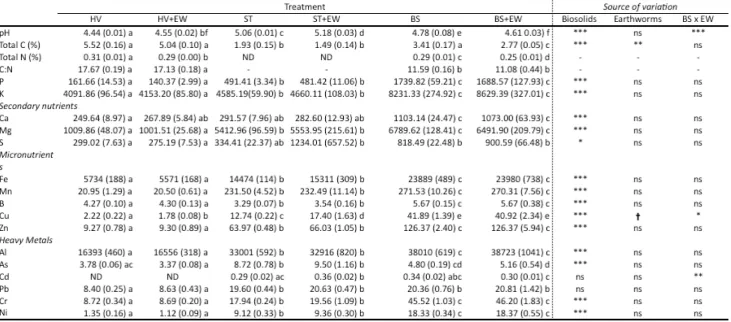
significantly differ (Fisher’s LSD, P < 0.05). Elements are grouped into categories reflecting their relationship with plant primary production. ND = none detected with the instruments used (accurate to 0.02%). HV = unmodified Happy Valley soil, ST = untreated stockpiled tailings, BS = stockpiled tailings amended with biosolids. The addition of ‘EW’ to treatment names indicates those with earthworms added. Source of variation is based on a two-way ANOVA omitting HV soils. Pairwise tests include HV soils as a benchmark for restoration... 40 Table 5.1 Leptospermum scoparium biomass (mg), root:shoot ratio and percent root
colonisation by arbuscular mycorrhizal fungi (AMF) with standard error of the mean in parentheses. Treatments include Happy Valley soil (HV); untreated stockpiled soil (ST); stopckpiled soil inoculated with AMF resident to Happy Valley (ST AMF1); stockpiled soil inoculated with non-resident AMF (ST AMF2); stockpiled soil treated with biosolids (BS); stockpiled soil treated with biosolids and the resident AMF (BS AMF1); stockpiled soil treated with biosolids and the non-resident AMF (BS AMF2). Treatments that do not share letters are considered significantly different (P < 0.05). ... 64 Table 5.2 Rhizosphere soil biological metrics including: dehydrogenase activity (DHA) and
functional diversity; richness assessment of arbuscular mycorrhizal fungi (AMF), bacteria and fungi communities; and similarity of microbial communities and
community-level physiological profile (CLPP) as determined by Bray-Curtis (CLPP) and Jaccard (AMF, bacteria, fungi) similarity indices. Standard error of the mean is denoted in parentheses and treatments that do not share letters are considered
List of Figures
Figure 1.1 Indicated in red, the location of Stockton mine on the West Coast of New Zealand’s South Island. ... 2 Figure 1.2 Stockton mine (a), occupies the entire white area and road infrastructure on the
mountain plateau, with Happy Valley highlighted in blue (embedded). The Cypress mine is to extend from the southeast of Stockton mine by approximately 4 km, the footprint of which will fall on Happy Valley tussock grasslandand, manuka and beech forest (b) and the surrounding area. ... 3 Figure 2.1 An example of the numerous earthworm chaetae of different sizes found in all of the
faecal samples examined. ... 19 Figure 2.2 Species accumulation curve representing the cumulative number of earthworm
species discovered against the number of faecal samples (n=60). The horizontal solid line represents the total number of species (26.4±0.602; SE represented by dashed horizontal lines) expected with limitless sampling, based on bootstrapped estimates. The vertical dashed line indicates sampling effort for the current experiment,
intercepting at 26 species, 98.5% of the projected total. ... 20 Figure 2.3 Rank abundance for the proportion of samples in which each earthworm species was
found for (a) all samples and (b) summer (light bars) and winter (dark bars). ... 21 Figure 2.4 Multidimensional scaling plots (MDS) of Jaccard similarity ... coefficients showing
similarity between snail diet composition between (a) summer ( ) and winter ( ) (P = 0.065), and (b) between Powelliphanta patrickensis ( ) and Powelliphanta
augusta ( ) (P > 0.001). Stress for both plots = 0.12. ... 22 Figure 2.5 Comparison of proportion of samples in which an earthworm species occurs,
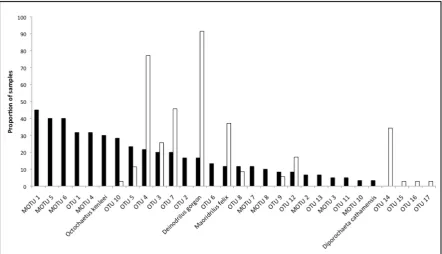
between diets of Powelliphanta patrickensis (dark bars) and Powelliphanta augusta (light bars). Diets between species significantly differed (P < 0.001)... 22 Figure 3.1 Earthworm mortality and weight changes where columns that do not share letters
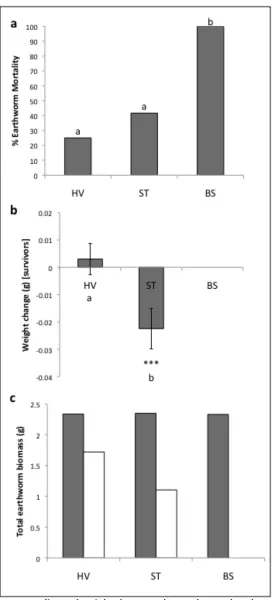
are significantly different at a maximum of P < 0.05. (a) Percent earthworm mortality; (b) weight change (±SE) of survivors, where ‘***’ denotes a significant weight change in ST (P < 0.001), in addition to ST and HV differing in the extent of weight changes (shown by differing letters); and (c) total earthworm biomass across all pots in a treatment where dark bars = biomass at the beginning of the experiment, white bars = biomass at the end of the experiment. HV = unmodified Happy Valley soil, ST =
untreated stockpiled tailings, BS = stockpiled tailings amended with biosolids. ... 36
Figure 3.2 Nonmetric multidimensional scaling plot (NMDS) of soil carbon source utilisation profiles of Happy Valley soil ( ) Happy Valley soil + earthworms ( ), stockpiled soil ( ), stockpiled soil + earthworms ( ), stockpiled soil + biosolids ( ), stockpiled soil + biosolids + earthworms ( ). Pairwise comparisons show significant differences (PERMANOVA, P < 0.05) between Happy Valley, stockpiles without biosolids and biosolids amended soil types in general, but no difference within these soil types, with the exception of stockpiled soil and stockpiled soil + earthworms, which differed significantly (PERMANOVA, P < 0.05). Stress = 0.07. ... 39 Figure 4.1 a) Soil microbial biomass; b) soil dehydrogenase activity (DHA); c) DHA did not
correlate with microbial biomass (r = 0.742, F = 5.75, P = 0.139). Unmodified native habitat ( ), VDT ( ), biosolids-amended soils ( ) and untreated stockpiled soil ( )... 51 Figure 4.2 Nonmetric multidimensional scaling (NMDS) plot based on Bray-Curtis similarities of
Figure 5.1 Plant biomass (a), and percent root colonisation by arbuscular mycorrhizal fungi (b). AMF1 is the resident AMF for Happy Valley and the L. scoparium used in this study, AMF2 is non-resident AMF community. ... 64 Figure 5.2 Non-metric multidimensional scaling plots of microbial communities based on
Chapter 1
Introduction
1.1
General introduction
In 2013, coal alone provided 29.9% of primary global power, and 41% of the world’s total electricity (World Coal Association 2013). Despite continuous research into the development of more efficient and renewable energy, humankind remains reliant on fossil fuels such as coal, oil and gas as the primary source of power. To access these natural resources often requires destructive methods such as mining, subsequently causing significant environmental disturbance or damage, often in pristine native areas. Coupled with the vast economic stake in obtaining fossil fuels, this is a source of
contention between conservationists, governments and companies seeking to exploit such resources.
Westport on the West Coast of New Zealand’s South Island (Fig. 1.1), and is an extension of the directly adjacent ‘Stockton’ mine (Fig. 1.2).
Figure 1.1 Indicated in red, the location of Stockton mine on the West Coast of New Zealand’s South Island.
The Cypress site is densely forested by native beech (Nothofagus spp.), podocarp
interactions of entire Powelliphanta genus. The Cypress mine will cause wide-scale land change that could have significant impacts on this and other native species, and the local and surrounding area, emphasising the destructive nature of opencast mining (Boyer and Wratten, 2010a). For these reasons and others, the New Zealand Environment Court has stipulated that suitable relocation programmes for P. patrickensis should be in place, together with adequate restoration of their original habitat for returning the population following mining.
Figure 1.2 Stockton mine (a), occupies the entire white area and road infrastructure on the mountain plateau, with Happy Valley highlighted in blue (embedded). The Cypress mine is to extend from the southeast of Stockton mine by approximately 4 km, the footprint of which will fall on Happy Valley tussock grasslandand, manuka and beech forest (b) and the surrounding area.
This thesis focuses on the conservation of this population of P. patrickensis in the context of the restoration of its natural habitat following opencast mining in New Zealand. A more general remediation of the ecosystems and ecological functions and processes will be undertaken as part of restoring the opencast mine. In doing so, it aims to contribute novel ecological information for P. patrickensis, New Zealand’s native ecosystems and ecosystem functions in general. Empirically tested recommendations will be developed for effective conservation of P. patrickensis and restoration of the impacted area. The experimental chapters of this thesis are written in the style of scientific journal articles, and therefore contain chapter-specific introductory literature reviews, methods, results, discussions, and conclusions.
1.2
Impacts of opencast mining
The effects of mining on above-ground biota are largely obvious, such as the removal or complete destruction of vegetation and ecological communities (Zhang and Chu 2011, Zipper et al. 2011). Boyer and Wratten (2010b) summarise a number of key impacts of mining including direct vegetation destruction, which causes the loss of vegetation in relatively undisturbed habitats.
Belowground, other impacts of opencast mining include adversely affecting abiotic environmental factors such as nutrient availability, soil organic matter content, pH, soil oxygen availability, and soil toxicity (Shrestha and Lal 2011). During resource excavation, topsoils or tailings are often stored in large stockpiled spoil heaps that can remain unused for several years (Šourková et al. 2005). Due to heavy machinery, depth and age, the heaps can become compacted, leading to reduced aeration and an anaerobic environment from as little as 1 m beneath the stockpile surface (Abdul-Kareem and McRae, 1984; Boyer et al. 2011b). There are a number of studies highlighting the susceptibility of microbial communities to environmental disturbance caused by mining practices, including soil stockpiling (Mummey et al. 2002). For example, Harris et al. (1989) recorded fewer fungal spores and aerobic bacteria in a stockpiled soil microbial community, indicative of an
anaerobic environment, and Rives et al. (1980) showed a significant reduction in viable mycorrhizae in stockpiled soil.
Soil meso- and macrofauna such as microarthropods and earthworms can also be
significantly affected by abiotic characteristics of stockpiled soil (Pižl 2001). On the Stockton mine, Boyer et al. (2011b) attributed to anaerobic conditions an almost total loss of the earthworm
community at >1 m depth of soil stockpiles. Earthworms are fundamental prey items to several guilds of vertebrate (Colbourne and Powlesland 1988, Silcox and Teaford 2002) and invertebrate (Trewick et al. 2008, King et al. 2010, Boyer et al. 2011c) species. Moreover, earthworms are considered ‘ecosystem engineers’ (Gurr et al.2004) pivotal in soil formation and organic matter breakdown among other ecosystem functions, whilst soil mesofauna can have an influential role in enhancing plant diversity and succession (De Deyn et al. 2003). Both examples are noteworthy as such research could imply a role for these groups to accelerate habitat restoration.
characteristics and nutrient content can dictate the presence and abundance of flora and fauna in a range of habitats (Vermeer and Berendse, 1983; Holmes, 2001). As with glacial retreat, conditions following stockpiling could create a habitat that is better suited to early-stage successional plant species (Šourková et al. 2005), not the mid- or late-successional species often originally inhabiting the area. Furthermore, it is mid- to late-successional plant species that are likely to provide habitat and foraging for macrofauna that previously inhabited the area. Indeed, the plants themselves can facilitate soil stability through root anchorage, and future nutrient supplies through decomposed and mineralised plant material (Angers and Caron 1998). Effective remediation of such sites is imperative to either return the area to its historic, or pre-mining condition, or create new ecosystems in order to reinstate native habitat as quickly and effectively as possible (Choi et al. 2008, Society for Ecological Restoration 2013). Accordingly, understanding the effects of soil characteristics on native flora and fauna is important in the restoration of a functioning ecosystem and the individual species therein.
1.3
Ecological Restoration
1.3.1
Restoring ecosystem function
an ecosystem (including soil biota such as earthworms, mycorrhizae and litter invertebrates), or the enhancement of their populations through appropriate ‘ecological engineering’ (Scullion and Malik 2000, Gurr et al. 2004) may be necessary to ensure native flora and fauna re-colonisation, further accelerate ecological succession, and improve ecosystem restoration (Frouz et al. 2007).
In studies where remediation of ecosystem function is measured, often undertaken on sites aged from 5-10 years following restoration (Wortley et al. 2013), it is considered that soils may take at least 15 years or more before functions comparable to untouched areas are restored (Ruiz-jaen and Aide 2005, Grant and Ward 2007, Koch 2007). Furthermore, such studies often compare restored sites to ‘untouched’ ecosystems, and rarely compare different restoration techniques against each other. For example (Boyer et al. 2011b) found that earthworm diversity significantly differed between three different restoration types and an untouched ecosystem after a relatively short time following implementation. As in previous studies (Simcock et al. 1999, Ross et al. 2000), Boyer et al. (2011b) highlights vegetation direct transfer (VDT), whereby areas of vegetation
including the associated soil can be relocated as ~1 m2 patches realigned together in a temporary or
permanent receptor site, as a potential method for accelerated restoration of ecosystem function. Comparison with pristine ecosystems is the best way to benchmark complete restoration (Harris 2003), however situations may arise where different restoration methods are required on different areas within the same site. Yet studies of restoration tend to focus on a single strategy compared to pristine ecosystems, or whether ecological restoration has been a success after many years. This raises questions of whether recent and understudied developments in restoration protocol (e.g. VDT) can yield positive functional results in a shorter time period, as restoring a functioning and self-sustained habitat as quickly and efficiently as possible is the fundamental goal of ecological restoration.
1.3.2
Soil restoration
soils spread on the Cape Floristic Region, in South Africa following stockpile simulation. This initially resulted in accelerated growth of non-native species, leading to the recommendation of ultra-slow release fertilisers to be used. This study exposes the importance of investigating remediation tools appropriate to the specific site, for example the low nitrogen environment of the Cape Floristic Region requires a restoration protocol that reflects this. In addition to standard fertilisers is the incorporation of municipal sewage sludge or biosolids – the latter a by-product of wastewater treatment, dried and sterilised – to rehabilitate tailings (Brown et al. 2005, Reid and Naeth 2005, Gardner et al. 2010). There have been some encouraging results including increased soil organic matter (Reid and Naeth 2005); benefits to the microbial community (Gardner et al. 2010); vegetative growth of target plant species (Brown et al. 2003, Evanylo et al. 2005); and remediating metal contaminated mine tailings (Brown et al. 2005). However, biosolids can induce a change in the soil bacterial community (Rojas-Oropeza et al. 2010). Indeed, Ramirez et al. (2012) emphasised that anthropogenic addition of nitrogen consistently reduces microbial mineralisation of soil organic carbon. As soil microbes can respond relatively quickly to environmental change, functions such as decomposition rate and microbial functional diversity of restored and pristine areas can provide an insight into the impact of mining and progress in restoring such functions (André et al. 2009, Greenslade et al. 2011).
Addition of fertilisers can also have an adverse effect on mutualisms, such as those between mycorrhizal fungi and plants. Reproduction of mycorrhizal fungi is contingent on the formation of an obligate relationship with plant roots (Schüβler et al. 2001), and plants can also derive a number of benefits from this relationship (Liu et al. 2007). A number of studies have observed the benefits of mycorrhizal inoculation. For example arbuscular mycorrhizal fungi (AMF) can provide a range of benefits to many plant species, including that of improved stress tolerance, growth rate, herbivore resistance and nutrient uptake (Porras-Soriano et al. 2009). The addition of nutrients such as those in biosolids, however, can cause shifts in the microbial community to a relative increase in abundance in the bacterial community and a decrease in AMF (Sullivan et al. 2006). Furthermore, plant
responses to mycorrhizae can be species specific, where both plant and mycorrhizae species can induce different responses in the benefits ascribed above (Bennett and Bever 2007). The majority of New Zealand’s native flora is known to develop mycorrhizal associations with AMF (Williams 2010), therefore it is likely that these associations may facilitate plant establishment in both
1.3.3
Earthworms and biosolids
Several studies have investigated the effects of biosolids on earthworms; however the focal species are frequently agricultural or compost species, or species that are globally widespread and common (Conder et al. 2000, Brown et al. 2005). Barrera and Andres (2001) studied the effects of sewage sludge on two widespread earthworm species (Allolobophora chlorotica chlorotica and Nicodrilus caliginosus meridionalis) inhabiting reclaimed mine soil, finding that earthworm abundance increased with the addition of sewage sludge. However, little to no research has yet explored the effects of biosolids on endemic or rare species. New Zealand, like many other countries, has
ecosystems that include diverse endemic earthworm communities (Lee 1951, Huang et al. 2007, Tsai et al. 2009). The Cypress mine site is home to a highly diverse earthworm community comprising only species endemic to New Zealand (Boyer and Wratten 2010b), many of which are new to science and yet to be described (Boyer et al. 2011a). Understanding the effects on earthworms of current remediation protocols on this site, or designing bespoke restoration plans that consider them, will be imperative to restore a functioning ecosystem. This would serve wider context for other mine sites containing endemic, rare or protected species, and further the understanding of utilising ecosystem engineers such as earthworms to accelerate restoration processes (Boyer and Wratten 2010a).
1.4
Current research
Mentioned above is the presence on the Cypress mine site of Powelliphanta patrickensis landsnails – an iconic species, which has attracted media attention. The current body of knowledge on the Powelliphanta genus suggests that earthworms are likely to play a crucial role in the diet of P. patrickensis (Colbourne and Powlesland 1988, Boyer et al. 2011c) and long-term survival of local populations of the species depends on the presence of sufficient and appropriate prey items and habitat in the existing and restored ecosystems. Also, maintenance of endemic earthworm
populations would aim to fulfil goals for conservation of a rare earthworm community, which has an intrinsic value in its own right. Following the start of mining on Cypress, the area will experience large-scale land changes and ecosystem destruction. The over-arching theme of the thesis, therefore, is to provide transferrable recommendations for ecological restoration following mining, based on hypothesis-driven experimental science.
Hypotheses: H1P. patrickensis feeds on earthworms
H2 Diet composition differs between P. patrickensis and P. augusta
H3 Seasonality exists in the earthworm diet of P. patrickensis.
The loss of soil volume and quality throughout the mining process brings about the need for replacement soil, and remediation of stockpiled soil (Brown et al. 2005, Reid and Naeth 2005, Gardner et al. 2010). Pursuing research in to the use of municipal biosolids could serve a dual purpose of mining remediation and recycling solid sewage waste (Christchurch City Council 2012). Since endemic earthworms are a keystone ecosystem engineer and putative important prey item to P. patrickensis, the great spotted kiwi Apteryx haastii and other iconic fauna present on site, it is important to establish the effects of soil remediation on endemic earthworm growth and survival (Barrera and Andres 2001).
Therefore, Chapter 3 assesses the influence of biosolids-based artificial soil creation and remediation on the growth and survival life-cycle parameters for native earthworms. The chapter contributes an insight to the effects of mine restoration on earthworms that are endemic (as opposed to common or globally widespread), and as it is undertaken on an endemic earthworm species present in P. patrickensis diet, as informed by the previous chapter, it will begin to elucidate how mine restoration may impact earthworm predators endemic to New Zealand. This chapter will also address the role of earthworms in the remediation soils by assessing plant growth and functional soil microbial community. Thus measurements of both the effects of restoring soil on earthworms, and of earthworms on soil restoration will be investigated.
Hypotheses: H1 Biosolids improves earthworm growth and survival
H2 Biosolids improves Chionochloa rubra growth
H3 Biosolids restores soil microbial community and function
H4 Earthworm inoculation improves C. rubra growth
H5 Earthworm inoculation restores soil microbial community and function
both of which are subject then to manual revegetation of native plants (approximately 1 individual per m2, planted by hand).
Chapter 4 investigates the efficacy of these protocols in restoring ecosystem functions, focussing mainly on soil microbial biomass, activity and functional diversity. There is debate
surrounding the link between biodiversity and ecosystem function (Grime 1997) and the presence of function can hang on the presence or absence of a particular species (Slade et al. 2011). Therefore the chapter aims to investigate the recovery of these soil functions by sampling from restored areas in situ. It measures restoration of function without assuming function is restored based on the presence or absence of particular species.
Hypothesis: H1 Restoration type affects soil microbial community and function
Chapter 5 is the final experimental chapter and aims to assess the potential of arbuscular mycorrhizal fungi (AMF) for remediating stockpiled soil, whilst simultaneously quantifying the effects of currently used restoration practice on important plant-AMF associations. Mānuka (L. scoparium) was selected as one of the dominant vegetation types on site. It is also present in the replanting schedules currently used and planned for use by the Stockton Alliance in future restoration planting. Mycorrhizae can provide a range of benefits to plants from accelerated growth to improved stress tolerance, and may provide a valuable asset both economically and for Stockton Alliance restoration plans.
Hypotheses: H1L. scoparium growth response differs when exposed to AMF sourced from
different locations
H2 Root colonisation by AMF differs depending on AMF source community
H3 Soil microbial community and function differs when exposed to AMF sourced from
different locations
H4 Biosolids improves L. scoparium growth
H5 Biosolids disrupts root colonisation by AMF
H6 Biosolids restores soil microbial community and function
Chapter 2
Pyrosequencing of prey DNA in faeces of
carnivorous landsnails to facilitate ecological
restoration and relocation programmes
A version of this chapter was published in March 2014: Waterhouse BR, Boyer S & Wratten SD (2014). Pyrosequencing of prey DNA in faeces of carnivorous landsnails to facilitate ecological restoration and relocation programmes. Oecologia. 175: 737-746. doi: 10.1007/s00442-014-2933-7
2.1
Abstract
earthworms leave no morphological clues suitable for accurately discriminating between species consumed through visual analysis of predator faeces. This study uses non-intrusive molecular methods on earthworm DNA extracted from the faeces of the carnivorous landsnail Powelliphanta patrickensis to identify its earthworm diet and any seasonal trends. 454-pyrosequencing data revealed earthworm DNA in all samples (n=60). Sequences were compared to a DNA library created from published and unpublished studies of New Zealand’s endemic earthworms and online
databases. Unidentified earthworm sequences were clustered into molecular operational taxonomic units (MOTUs). 26 MOTUs were identified, 17 of which matched the library, and 9 did not. Similarity indices indicate that there were seasonal differences (P < 0.05) in the earthworm communities represented in the summer and the winter diets. This study highlights the importance of utilising the vast data generated by pyrosequencing to investigate potential temporal diet shifts in protected species. The method described here is widely applicable to a wide range of predatory species of conservation interest and can further inform habitat restoration and relocation programmes to optimize the long-term survival of the target species.
2.2
Introduction
Earthworms are responsible for a number of key ecosystem functions, such as enhancing plant germination rate, seed dispersal, and seedling recruitment (Milcu et al. 2006), enhancing soil aggregation and stability (Scullion and Malik 2000), increasing plant growth rate and nutrient
availability (Chaoui et al. 2003) and many others that make this group important in the resilience and recovery of ecosystems (Boyer & Wratten 2010). However, they also undertake an important
function as prey for a range of organisms including mammals (Silcox and Teaford 2002), birds
(Colbourne and Powlesland 1988), reptiles (Brown et al., 2012), and invertebrates (King et al., 2010).
The endemic Powelliphanta patrickensis is believed to feed predominantly (perhaps
exclusively) on earthworms. Although many Rhytididae are carnivorous and predate on earthworms (Efford 2000), other species within this molluscan family rely heavily on other invertebrates, such as Wainuia urnula urnula Pfeiffer, which specialises predominantly on leaf-litter amphipods
programme has been implemented to move as much of the P. patrickensis population as possible from its habitat prior to mining. Instead of holding individuals in captivity as with other species, P. patrickensis will be moved totemporary ‘holding’ sites of either ‘untouched’ native habitat, or areas of recently completed mining that have been restored. Once mining in the original tussock habitat is complete, and the area restored, the P. patrickensis population is to be returned. The relocation is targeted through systematic surveys across the valley to collect, record and relocate individuals.
Current ecological restoration on the mine can be broadly categorized into three main areas: stockpiled soil spreads, vegetation direct transfer (VDT), and artificial soils. Mine tailing stockpiles are the soil and rock removed to access the resources beneath that can be stored for several years in deep stockpiles (Abdul-Kareem and McRae 1984). Stockpile spreading is the redistribution of these tailings over completed mined areas and manually replanting with nursery-reared native vegetation. VDT is a process whereby approximately 1 m x 1 m areas of unmodified vegetation with ~50 cm soil are translocated to either a holding site or to an area of mine requiring restoration; the aim of which is to piece together a replica of the habitat from where it was taken (Boyer et al. 2011b). Artificial soils are a mixture of stockpiled mine tailings and biosolids – municipal sewage waste that has been dried and sterilised – that is then spread and manually replanted. The aim of this mix it to
re-establish nutrients, organic matter and bulk volume lost in the mining process (Gardner et al. 2010).
Understanding the ecology of a species of conservation concern is important in achieving conservation goals, and data on what a species eats are fundamental to the effective maintenance or enhancement of its population. Many species exhibit seasonal (Hill 1997, García-Berthou and
Moreno-Amich 2000) and spatial (Stehlik and Meise 2000, Lake et al. 2003) variation in diet, often linked to prey distribution and availability, but this can also be due to specialisation by predatory species on specific prey groups or species. Such differences in prey selection or availability should be reflected in the selection and management of receptor sites, and are primary considerations in the selection of habitat restoration methods. For example, surveying restored areas or putative
relocation sites for appropriate diet species that fulfill seasonal diet coverage would be important for species such as P. patrickensis; reconciling accurate diet data with existing surveys or literature could inform conservation measures; and detailed diet information could inform further research into the impacts of restoration methods on the persistence of key prey species.
Historically, accurately identifying prey items has been problematic (summarised in
achieve comprehensive diet analysis for earthworm predators using morphological analysis have failed to discriminate between earthworm species using faeces, as only hair-like chaetae remain as evidence, which alone are not diagnostic features of many earthworm species (Colbourne and Powlesland 1988). Additionally, as with P. patrickensis, many organisms of interest may be afforded legal protection where handling is prohibited or only under license, and it may not be possible to acquire enough individuals for a reliable assessment of gut contents or feeding behaviour.
Such obstacles have, in part, been remedied with the advent of the DNA-based diet analysis utilising polymerase chain reaction (PCR), next-generation sequencing (NGS) and DNA sequences to simultaneously identify groups of consumed species accurately, which is the ultimate goal of diet analysis. These methods can generate large amounts of data relatively quickly and cost effectively, potentially allowing large numbers of individuals from a population to be sequenced simultaneously (Deagle and Tollit 2006). Many studies utilise faeces for DNA analysis, as they are relatively easy to acquire, often non-intrusive and often do not require direct contact with the organism. Furthermore, modern bioinformatics techniques combined with large NGS data sets has led to methodological developments to more accurately estimate diversity, and also account for specimens that have not been formally described by science; for example, molecular operational taxonomic units (MOTUs) in species diversity and molecular diet studies (Floyd et al. 2002, Bohmann et al. 2011).
Broadly, this chapter aims to use the conservation of P. patrickensis to inform wider ecosystem restoration and species conservation, but specifically aims to 1) identify the earthworm diet of P. patrickensis using next generation molecular methods on faecal samples; 2) investigate evidence for predation on other hard-bodied invertebrates through morphological examination of faeces; 3) investigate potential seasonal differences in the P. patrickensis diet; 4) highlight putative earthworm diversity by using predator faecal samples as indicators; and 5) investigate the use of habitats inhabited by related snails as translocation sites by comparing findings with the
Powelliphanta augusta diet described by Boyer et al. (2013). An additional outcome of using a molecular approach to investigate diverse yet understudied sites, as that in this study and groups such as New Zealand earthworms, is to encounter earthworm species that have previously gone undetected. This study focuses on a previously unstudied species and improves on previous study of the Powelliphanta genus by investigating temporal differences in the diet and by reducing
2.3
Methods
2.3.1
Site location and sample collection
The study site was the tussock grassland Happy Valley (41°42'12.91"S, 171°53'25.05"E), with dense scrub vegetation ascending the valley walls into podocarp forest. It is located within the footprint of the opencast mine extension. One faecal sample was collected from each of 60 sub-adult to adult P. patrickensis snails located in their natural habitat, typically on the fringes of the tussock grassland and scrub; 29 individuals were collected in summer (late November to December 2011); 29 in winter (July 2012); and 2 in autumn (March 2012) during pre-mining snail survey operations in the footprint of the proposed mine area. Collected snails were individually placed in clean plastic containers with damp tissue paper to prevent desiccation, and held for three days (the maximum holding time stipulated by the Department of Conservation, New Zealand) or until a faecal sample was produced, whichever was the sooner. GPS location, shell diameter and weight were recorded for each snail before they were translocated to their receptor site. Faecal samples produced within the three days were collected, individually packed in zip-lock bags, and frozen on site at approximately -19°C. Samples were then transferred to The Bio-Protection Research Centre, Lincoln University, New Zealand, where they were stored at approximately -80°C prior to analysis. Each sample was divided into two: one half for morphological analysis, and the other half for molecular analysis.
2.3.2
Morphological analysis
Sixty individual faecal samples were air dried and examined under a compound stereomicroscope at 80 x magnification for evidence of prey item remains. As previous studies suggested that earthworms are a key component of the Powelliphanta spp. diet across all age classes (Boyer et al. 2011c), the presence or absence of earthworm chaetae was scored for each sample. Also, samples were
examined for the remains of other potential prey items including hard-bodied arthropod remains and plant material, which were scored as present or absent.
2.3.3
Molecular analysis
Pompanon et al., 2012). Also, as mitochondrial DNA (mtDNA) is present in multiple copies in a given cell it is therefore more likely to be present in partially-degraded environmental DNA samples (Symondson 2002, Pompanon et al. 2012). For these reasons a ~130 bp region within the 16S gene of mtDNA was targeted. The targeted region is of variable size with total target amplicon range,
including primers, of 165-169 bp. Primers were group-specific to New Zealand endemic earthworms, designed and used in previous studies (Boyer et al. 2011c, 2013): forward primer
(nz_worm_16S_int_F) AATTMGGTTGGGGCGACSHW-3’, reverse primer (nz_worm_16S_int_R) 5’-AACATCGAGGTGCCAAWCCC-3’. A two-step molecular method was used to identify the earthworm species consumed by P. patrickensis. This differs from processes previously used by removing the nested-PCR step, thus reducing labour and the likelihood of introducing erroneous PCR artefacts. Steps consisted of PCR followed by high-throughput 454-pyrosequencing. DNA was extracted from faecal samples using the Qiagen DNeasy Blood and Tissue kit. A positive control of native earthworm tissue, and a negative control of nuclease-free water were used to highlight false positives/negatives and for comparison of amplicon length. Extracted mtDNA was amplified using 10 µl PCR comprising 5 µl KAPA2G HotStart ReadyMix, 3 µl nuclease-free water, 0.5 µl forward primer [10 µM], 0.5 µl reverse primer [10 µM], and 1 µl DNA template. For pyrosequencing the same primer sequences were used, combined with the appropriate pyrosequencing adapter to create fusion primers, including a unique 10 bp Multiplex Identifier (MID) tag for each sample, thus allowing simultaneous processing of all samples. Pyrosequencing adapters and MID tags were as recommended by the manufacturer (Roche Genome Sequencer FLX System).
2.3.4
Library preparation
A local library of 148 New Zealand native and endemic earthworm species was created from sequences of earthworms available in GenBank, those previously collected from the study site by Boyer & Wratten (2010), and various New Zealand locations by Buckley et al., (2011). This library included species not likely present on the study site. Sampling of over 1,500 individual earthworms on the study site yielded 28 putative new species (three of which were subsequently described (Boyer et al. 2011a)). An integrated taxonomic approach of morphological and molecular methods was used to group these putative species into distinct operational taxonomic units (OTUs), and representative sequences were gathered by Sanger sequencing.Where appropriate these library OTUs will be ascribed pseudonyms of OTU 1, OTU 2 and so on.
2.3.5
Sequence analysis
Following quality checking, pyrosequencing data were compared to the library using Basic Local Alignment Search Tool (BLAST) with a ≥ 95% similarity threshold (Altschul et al., 1990; Brown et al., 2012). Sequences that did not match the local library were clustered into molecular operational taxonomic units (MOTUs) (Floyd et al. 2002) to an 85% threshold based on consistent divergence across a number of measures: mean interspecific nearest-neighbour relatedness of 82.7%, average p-distance of 15% (i.e. 85% similarity), and mean percent identification of 85%, calculated based on the local library using SPIDER package for R (Brown et al., 2012) and Geneious® Pro v. 6.1.4 (Biomatters). Representative sequences from these clusters were vetted by aligning them to the existing local library, comparing them to GenBank using BLAST, constructing a neighbour-joining tree, and
discarding non-earthworm sequences. The remaining sequences were considered MOTUs when one or more representative sequence grouped in the tree independently of existing library sequences. Cluster thresholds were chosen, and the multiple comparisons undertaken, to ensure confidence in the MOTU threshold and to deliver a conservative estimate of the number of MOTUs either
consumed or present on the study site. Finally, rare earthworm haplotypes were screened by removing those with <5 sequences in a sample from that sample, and by removing all species or MOTUs that appeared in only one sample. These measures were taken to avoid inclusion of artifacts or chimeras generated by stochastic PCR or sequencing errors. Gene alignment and tree-building were undertaken in Geneious®.
diet coverage. Total contribution to P. patrickensis diet of each earthworm species was calculated based on presence/absence of each species in a given sample. For seasonal analysis, data were grouped into summer and winter categories, excluding autumn samples from the analysis due to lack of replication, and compared using a test of Jaccard similarity using permutational analysis of
variance (PERMANOVA) in PRIMER. This method was also used for comparison of diet between P. patrickensis and P. augusta. Evenness was compared using the Gini coefficient (Damgaard and Weiner 2000) that ranges from zero to one, where higher values represent a larger degree of unevenness. The Gini coefficient was calculated in R using the method of Buckley & Damgaard (2012).
The application of NGS to diet identification is a growing area of research, but there are numerous recent studies disputing the reliability of quantification estimates (relating sequence proportions to actual biomass consumed) due to a broad range of influencing factors (summarised in Pompanon et al. 2012). Unfortunately, validating quantification with feeding trials is not possible for many species with high conservation profile, or no captive population such as P. patrickensis, and therefore this type of analysis was not undertaken.
2.4
Results
2.4.1
Morphological analysis
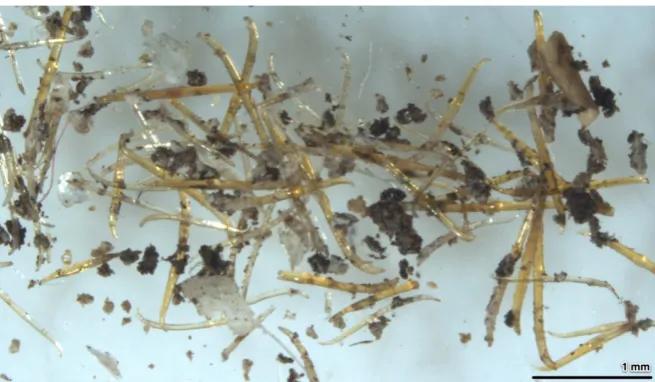
Figure 2.1 An example of the numerous earthworm chaetae of different sizes found in all of the faecal samples examined.
2.4.2
Molecular analysis
Figure 2.2 Species accumulation curve representing the cumulative number of earthworm species discovered against the number of faecal samples (n=60). The horizontal solid line represents the total number of species (26.4±0.602; SE represented by dashed horizontal lines) expected with limitless sampling, based on bootstrapped estimates. The vertical dashed line indicates sampling effort for the current experiment,
intercepting at 26 species, 98.5% of the projected total.
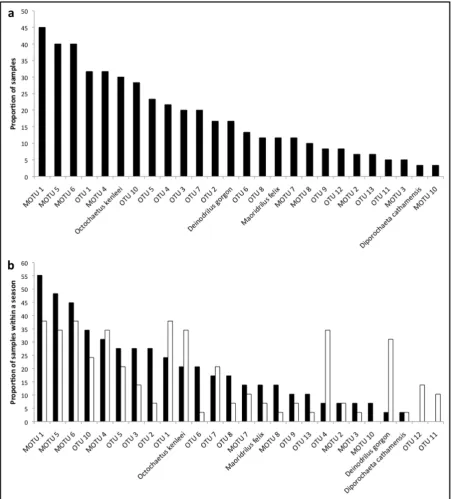
Figure 2.3 Rank abundance for the proportion of samples in which each earthworm species was found for (a) all samples and (b) summer (light bars) and winter (dark bars).
Presence/absence data were collated to assess the proportion of samples in which earthworm species occurred (Fig. 2.3a). This showed a relatively steady decrease in earthworm species
Figure 2.4 Multidimensional scaling plots (MDS) of Jaccard similarity coefficients showing
similarity between snail diet composition between (a) summer ( ) and winter ( ) (P = 0.065), and (b) between Powelliphanta patrickensis ( ) and Powelliphanta augusta ( ) (P > 0.001). Stress for both plots = 0.12.
Gini coefficients of evenness for summer (0.407), winter (0.395) and overall (0.372) did not differ greatly. Comparison between P. patrickensis and the previously assessed P. augusta (Boyer et al. 2013) indicated that P. patrickensis consumes a larger number of species (Fig. 2.5), and that the diet composition significantly differs between snail species (PERMANOVA, P < 0.001, F = 19.86; Fig. 2.4b).
2.5
Discussion
2.5.1
Diet composition for P. patrickensis
Powelliphanta patrickensis feeds by rapidly snatching prey when in close enough proximity and swallowing it whole (personal observation; Efford 2000), suggesting it is unlikely that it feeds on liquid prey or by removing liquid from prey items. Arthropod hard parts were observed in four out of 60 samples, suggesting that these remains can survive the digestive process. Little other evidence of predation on other organisms but the presence of multiple earthworm species and highly abundant earthworm chaetae in all samples strongly suggests that earthworms probably form the major component of the diet throughout the year. However, predation on other soft-bodied organisms such as slugs, which were not investigated in this study, cannot be ruled out. Given the scarcity of invertebrate hard parts, consumption may have been either opportunistic or incidental as a byproduct of earthworm consumption, where earthworms or the snails themselves may have ingested a single arthropod appendage in the soil (Piearce 1978). With respect to moss fragments, P. patrickensis is often found in deep sphagnum moss beds, which are abundant throughout their habitat. The snails may encounter earthworm prey whilst in this habitat, and the way in which this species strikes prey suggests that moss and plant fragments may have been collaterally consumed.
Twenty-six earthworm MOTUs were identified and their occurrence in the diet, both overall and seasonally, declines relatively consistently reflecting what might be considered a typical rank abundance curve; i.e. a negative binomial (Fig. 2.3). Such patterns may suggest that P. patrickensis does not selectively predate particular earthworms; however this would require validation with additional information on the earthworm community and relative abundance on the study site. Despite this, there are some clear differences between the summer and winter diets. For example, OTU 1, Ochtochaetus kenleeii Blakemore, OTU 4, and Deinodrilus gorgon Blakemore feature heavily in the summer diet, whilst are almost non-existent in the winter diet (Fig. 2.3b). Conversely, the opposite is the case for OTU 2. It seems therefore that the marginal difference in seasonal diet composition is driven by only a handful of species, which is also supported by a lack of clustering in the MDS plot (Fig. 2.4a). These differences may be attributable to seasonal availability of the individual earthworm species, given that there does not appear to be a strong preference for any particular species. Alternatively, as P. patrickensis requires damp or wet conditions in which to hunt (M. Hamilton, personal communication), foraging behaviour may change with seasonal weather patterns, such as day length and moisture; indeed the differences could be explained by a
winter temperatures and relatively consistent levels of rainfall throughout the year (National Institute of Water and Atmospheric Research 2013).
2.5.2
Diet comparison between P. patrickensis and P. augusta
The current data suggest that P. patrickensis requires seasonal availability of different earthworm species in its translocation and restored habitats regardless of whether indiscriminately consuming available earthworm species it encounters, or selectively shifting foraging behaviour across seasons. Reconciling the data in this study with that of P. augusta in Boyer et al. (2013) reveals a significant difference in prey communities consumed. However, it also reveals that there is an overlap in many of the species consumed, albeit in differing proportions (Fig. 2.4b&2.5). Boyer et al. (2013) suggest that P. augusta indiscriminately predates on earthworms that are available, however to conclude this for both species would require further information on the earthworm community in the respective habitats, and the behaviour of earthworms themselves (anecic, epigeic, or endogeic in the case of earthworms (Bouché 1972)). Until this information is available, it may be remiss to assume that habitat sufficient to support one species of Powelliphanta would be suitable for another. In
management and restoration terms this means ensuring that the relevant earthworm community is present in relocation sites, achieved through site surveys, and ensuring restored sites contain or are stocked with the correct species as compared to the current study.
2.5.3
Consequences for habitat restoration and snail conservation
2.5.4
Limitations of the molecular approach
The advantages of using a metagenomic approach is that it is possible to rapidly assess poorly studied or, in this case, imminently threatened sites and species. However collecting data in this way may lead to use of MOTUs (Floyd et al. 2002), a consideration of which is how one might go about defining the MOTU threshold. Much of the DNA library for Happy Valley was based on 1,500 earthworms collected for one study (Boyer et al., 2011a), and so may be that full intraspecific variation and some taxa were overlooked. Based on this information, a conservative threshold was used so as not to overestimate the number of species consumed or present on site, calculated using the distance measures available for the reference library. As mining has begun, sampling and site surveys are subject to strict time constraints and therefore sampling of entire communities may not be possible prior to complete ecosystem removal. In such cases, data mining combined with site surveys, although potentially limited, is often the only information on which to base such thresholds. Nevertheless, the data indicates that despite extensive sampling there may be a highly diverse endemic earthworm community at the mine site that has not yet been fully discovered. This further extends the need for adequate conservation and restoration that is not focused on very few focal-species, but the ecosystem holistically.
Of the 26 earthworm MOTUs detected in the diet of P. patrickensis, four species had already been formally described (O. kenleei, D. gorgon, Maoridrilus felix, Diprochaeta cathamensis) 13 were known library OTUs but undescribed species, and 9 were new MOTUs. This highlights several key aspects of diet studies of this type. They may accurately identify species consumed and aid in the understanding of the predator ecology, such as resource or temporal partitioning with other
predators (Bohmann et al. 2011, Razgour et al. 2011) or feeding behaviour (Suzuki et al. 2008). Also, elucidating aspects of predator ecology, such as feeding preferences, prey selectivity, or identifying prey diversity can provide valuable insights for species conservation. But in the event of
non-described prey species, as found here, prey morphology, ecology or habitat is unknown. If the aim is to use such studies to inform relocation or conservation programmes, then it may be sufficient to match the prey inhabitants of the proposed relocation area to those found in the diet analysis. Although diet analysis is indicative of the earthworm diversity likely on site, further study of the earthworm community would be required to answer the remaining ecological questions surrounding the predator-prey interactions, for example selective feeding, nocturnal foraging on anecic
2.6
Conclusion
The use of pyrosquencing to identify key components of predator diets has been proven valuable in this study as in many others, and is particularly effective in identifying prey species that leave no distinguishable remains. A large amount of data can be generated relatively quickly and
inexpensively, and can therefore lead to many opportunities for community and population-level studies. The current study has shown that this method can be used at the population level to identify seasonal variation in a predator diet, which, in principle, can be applied to almost any predator diet. Indeed, understanding how a predator diet shifts and provisioning for such changes is essential for the long-term persistence of translocated predator populations in restored or relocation sites. The current results are valuable as they can be used to inform conservation and relocation programmes for effective conservation of target P. patrickensis populations, and begin to tease apart aspects of P. patrickensis ecology. Furthermore, it shows that although earthworms may not be the sole source of nutrition, they are a key component of the diet of P. patrickensis, and therefore highlights the need for conservation of earthworms as important prey items as well as the predator itself. In the case of New Zealand, there is a highly diverse endemic earthworm community, which has conservation value in its own right, not just for its functional roles in native ecosystems as prey and ecosystem
Chapter 3
Using municipal biosolids in ecological
restoration: what is good for plants and soil
may not be good for endemic earthworms
A version of this chapter was published in June 2014: Waterhouse BR, Boyer S, Adair KL & Wratten SD (2014). Using municipal biosolids in ecological restoration: what is good for plants and soil may not be good for endemic earthworms. Ecological Engineering. 70: 414-421. doi: 10.1016/j.ecoleng.2014.06.021
3.1
Abstract
exposed, including earthworms. However, despite use of biosolids in mine soil rehabilitation, no study has examined the effects of biosolids on endemic earthworms; most focus has been on globally widespread or agricultural species and their role in ecosystem restoration. The impact of soil
remediation using municipal biosolids and endemic earthworms on plant growth and carbon substrate utilisation, as well as the direct impact of biosolids on endemic earthworm survival and growth was tested. These measures were also compared to unmodified soil from a local pristine habitat not yet mined. Although biosolids treatment almost doubled plant biomass production and increased carbon substrate utilisaton compared to untreated stockpiled or unmodified soils, earthworm mortality in biosolids-amended soils was 100%, compared with 42% and 25% in stockpiled and unmodified soils respectively. Earthworms significantly benefited soil functional diversity, but had no direct effect on plant growth. This study indicates that biosolids and endemic earthworms can play an important role in ecological restoration but thorough ecotoxicological testing of biosolids should be undertaken prior to their use in mine rehabilitation on a large scale.
3.2
Introduction
Coal mining often leads to long-term stockpiles of mine tailings (mixed soil strata and rock removed to access the coal seams) that can become anaerobic (Boyer et al. 2011b), significantly depleted in organic matter (Abdul-Kareem and McRae 1984, Shrestha and Lal 2011) and macrofauna (Boyer et al. 2011b). Significant shifts in soil microbial communities (Harris et al. 1989) and loss of bulk soil volume to erosion and sediment drainage due to lack of plant cover can also occur (Ros et al. 2003).
Consequently, if the aim is to restore native habitats, mine tailings require remediation protocols that will rehabilitate ecosystem functions. These include plant biomass production (for soil stabilisation, carbon sequestration, habitat formation etc.), functional relationships between predator and prey species, and soil functions such as nutrient cycling, to encourage long-term survival and colonisation by local flora and fauna that were present prior to mining.