R E S E A R C H
Open Access
Small-scale phenotypic differentiation
along complex stream gradients in a
non-native amphipod
Jonas Jourdan
1,2*, Kathrin Piro
2, Alexander Weigand
3and Martin Plath
4,5Abstract
Background:
Selective landscapes in rivers are made up by an array of selective forces that vary from source to
downstream regions or between seasons, and local/temporal variation in fitness maxima can result in gradual
spatio-temporal variation of phenotypic traits. This study aimed at establishing freshwater amphipods as future
model organisms to study adaptive phenotypic diversification (evolutionary divergence and/or adaptive plasticity)
along stream gradients.
Methods:
We collected
Gammarus roeselii
from 16 sampling sites in the Rhine catchment during two consecutive
seasons (summer and winter). Altogether, we dissected
n
= 1648 individuals and quantified key parameters related
to morphological and life-history diversification, including naturally selected (e.g., gill surface areas) as well as
primarily sexually selected traits (e.g., male antennae). Acknowledging the complexity of selective regimes in
streams and the interrelated nature of selection factors, we assessed several abiotic (e.g., temperature, flow velocity)
and biotic ecological parameters (e.g., conspecific densities, sex ratios) and condensed them into four principal
components (PCs).
Results:
Generalized least squares models revealed pronounced phenotypic differentiation in most of the traits
investigated herein, and components of the stream gradient (PCs) explained parts of the observed differences.
Depending on the trait under investigation, phenotypic differentiation could be ascribed to variation in abiotic
conditions, anthropogenic disturbance (influx of thermally polluted water), or population parameters. For example,
female fecundity showed altitudinal variation and decreased with increasing conspecific densities, while sexual
dimorphism in the length of male antennae
—
used for mate finding and assessment
—
increased with increasing
population densities and towards female-biased sex ratios.
Conclusions:
We provide a comprehensive protocol for comparative analyses of intraspecific variation in life history
traits in amphipods. Whether the observed phenotypic differentiation over small geographical distances reflects
evolutionary divergence or plasticity (or both) remains to be investigated in future studies. Independent of the
mechanisms involved, variation in several traits is likely to have consequences for ecosystem functions. For example,
leaf-shredding in
G. roeselii
strongly depends on body size, which varied in dependence of several ecological
parameters.
Keywords:
Local adaptation, Rapid evolution, Life-history evolution, Thermal pollution, Global warming, Intraspecific
divergence,
Gammarus roeselii
, Aquatic invertebrates, Invasive species
© The Author(s). 2019Open AccessThis article is distributed under the terms of the Creative Commons Attribution 4.0 International License (http://creativecommons.org/licenses/by/4.0/), which permits unrestricted use, distribution, and reproduction in any medium, provided you give appropriate credit to the original author(s) and the source, provide a link to the Creative Commons license, and indicate if changes were made. The Creative Commons Public Domain Dedication waiver (http://creativecommons.org/publicdomain/zero/1.0/) applies to the data made available in this article, unless otherwise stated.
* Correspondence:[email protected] 1
Department of Aquatic Ecotoxicology, Institute for Ecology, Evolution and Diversity, Goethe University Frankfurt am Main, Frankfurt am Main, Germany 2Department of River Ecology and Conservation, Senckenberg Research
Background
Selective landscapes along complex stream gradients
Environmental gradients provide a unique opportunity to
evaluate the relative importance of various forms of both
natural [
1
,
2
] and sexual selection [
3
,
4
] for creating
intra-specific phenotypic variation [
1
–
7
]. Changes of
environ-mental conditions can be accompanied by divergence of
phenotypic traits when it allows local populations to reach
a new fitness peak within a spatially heterogeneous
select-ive landscape [
6
,
8
]. Studies focusing on environmental
gradients acknowledge the multitude of different
eco-logical gradients and described, for instance, gradual
vari-ation of abiotic selection factors across latitudinal [
9
–
11
],
or altitudinal [
12
] gradients, as well as gradients formed
by environmental stressors like temperature [
13
], salinity
[
14
,
15
], or acidification [
16
,
17
]. Other studies focused on
biotic selection factors such as predation [
18
], as well as
intra- [
19
] or inter-specific competition [
20
]. Beside spatial
variation, selection pressures can also vary substantially
across time [
21
,
22
].
Streams and the associated limnic ecosystems are shaped
by a widespread form of an environmental gradient in
which an array of abiotic and biotic selection factors vary
systematically in space and time, e.g., from source regions
over smaller tributaries to slow-flowing lowland river
sec-tions [
23
–
25
] or between seasons [
21
,
23
]. Predictable
lon-gitudinal changes include, amongst others, changes in
primary carbon sources, with allochthonous organic
mater-ial typically representing the main food source for
head-water communities and autotrophic primary production
becoming more important at downstream sites [
23
,
25
].
Ac-cumulation of various forms of nutrients usually results in
a higher nutrient availability in downstream sections of
riv-ers [
23
], while in anthropogenically transformed landscapes
also pollutants tend to accumulate in downstream sections
(e.g., pharmaceuticals [
26
], pesticides [
27
], or plastics [
28
]).
Temporal changes in different river sections include,
amongst others, flow regimes and water temperatures:
source habitats usually show little seasonal fluctuation with
respect to abiotic conditions
—
such as water temperatures
[
29
]
—
and closely mirror the conditions seen in the
ground-water bodies feeding them [
23
]. The stability of abiotic
conditions rapidly decreases with increasing distance
from the source(s), especially when the stream is no
longer covered by forest canopy, such that water
temperatures will attain greater variance due to solar
input [
25
,
30
]. These river sections often experience
pro-nounced fluctuations in abiotic conditions, as they
undergo recurrent catastrophic flooding (e.g., after snow
melt [
31
]), or temporal desiccation either during hot/dry
seasons [
32
,
33
] or as a result of climate change [
34
].
Abi-otic conditions reattain a more stable state in downstream
river portions, where multiple tributaries interconnect to
form an extensive wetland system [
23
,
25
].
Despite the generality of some of these characteristics of
river gradients at a larger geographical scale [
23
–
25
], the
situation in reality tends to be more complex, not only
because numerous landscape features alter the
hydrogeo-logical setting at a local scale [
35
,
36
], but also because
several forms of anthropogenic stressors [
37
,
38
]
contrib-ute to the complexity of selective landscapes along river
gradients [
23
–
25
]. Obviously, it is close to impossible to
empirically capture all abiotic and biotic components
characterizing a given stream gradient. Moreover, several
factors
—
including those that were empirically assessed
and those not assessed
—
can be tightly interrelated (e.g.,
oxygen content and temperature, or the occurrence of
certain pollutants [
39
]). Empirical studies reporting
intra-specific trait divergence along stream gradients and
ascrib-ing this divergence to one particular component of the
gradient are, therefore, prone to overlooking that
diver-gence may have been driven instead by another,
interre-lated selection factor, or by multiple factors [
6
,
40
].
Using amphipods to study phenotypic differentiation
along stream gradients
Our present study, for the first time, reports intraspecific
differentiation of morphological and life-history
pheno-types along stream gradients in a freshwater amphipod,
Gammarus roeselii
G
ERVAIS1835 [
41
]. Given their small
size and benthic life-style [
42
,
43
], amphipods have a low
motility compared to, e.g., teleost fishes
—
which are
fre-quently used in studies on local adaptation along stream
gradients [
5
,
44
,
45
]
—
potentially rendering members of
this group prime candidates to study adaptive
diversifi-cation (i.e., evolutionary divergence or adaptive
plasti-city; see Additional file
1
: Material S1 for additional
information) over small geographic scales. We evaluated
the roles of both natural selection (e.g., low oxygen levels
favouring increased gill surface areas [
46
]; Table
1
) and
sexual selection for driving divergence in multiple trait
suites. In the latter case, divergent selection could arise as
an indirect consequence of local differences in population
densities (a correlate of mate availability [
75
]), sex ratios
[
59
,
76
], or the potential for mate competition [
59
,
77
]
(Table
1
). Nevertheless, the involvement of sexual
selec-tion in creating intraspecific phenotypic variaselec-tion along
stream gradients remains understudied [
3
,
78
,
79
].
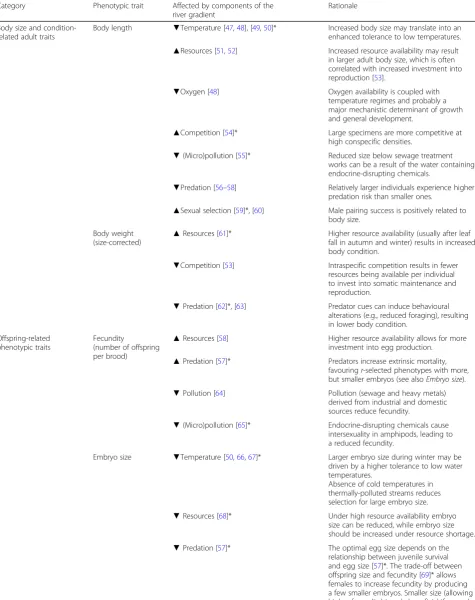
Table 1
Phenotypic traits assessed in our present study and (unidirectional) predictions for trait divergence along single
components of stream gradients
Category Phenotypic trait Affected by components of the river gradient
Rationale
Body size and condition-related adult traits
Body length ▼Temperature [47,48], [49,50]* Increased body size may translate into an enhanced tolerance to low temperatures. ▲Resources [51,52] Increased resource availability may result
in larger adult body size, which is often correlated with increased investment into reproduction [53].
▼Oxygen [48] Oxygen availability is coupled with temperature regimes and probably a major mechanistic determinant of growth and general development.
▲Competition [54]* Large specimens are more competitive at high conspecific densities.
▼(Micro)pollution [55]* Reduced size below sewage treatment works can be a result of the water containing endocrine-disrupting chemicals.
▼Predation [56–58] Relatively larger individuals experience higher predation risk than smaller ones.
▲Sexual selection [59]*, [60] Male pairing success is positively related to body size.
Body weight
(size-corrected) ▲
Resources [61]* Higher resource availability (usually after leaf fall in autumn and winter) results in increased body condition.
▼Competition [53] Intraspecific competition results in fewer resources being available per individual to invest into somatic maintenance and reproduction.
▼Predation [62]*, [63] Predator cues can induce behavioural alterations (e.g., reduced foraging), resulting in lower body condition.
Offspring-related phenotypic traits
Fecundity
(number of offspring per brood)
▲Resources [58] Higher resource availability allows for more investment into egg production.
▲Predation [57]* Predators increase extrinsic mortality, favouringr-selected phenotypes with more, but smaller embryos (see alsoEmbryo size). ▼Pollution [64] Pollution (sewage and heavy metals)
derived from industrial and domestic sources reduce fecundity.
▼(Micro)pollution [65]* Endocrine-disrupting chemicals cause intersexuality in amphipods, leading to a reduced fecundity.
Embryo size ▼Temperature [50,66,67]* Larger embryo size during winter may be driven by a higher tolerance to low water temperatures.
Absence of cold temperatures in thermally-polluted streams reduces selection for large embryo size. ▼Resources [68]* Under high resource availability embryo
size can be reduced, while embryo size should be increased under resource shortage. ▼Predation [57]* The optimal egg size depends on the
dependence of local temperature and oxygen regimes
[
46
]), reproductive life history traits known to be under
natural selection from both abiotic and biotic
selec-tion factors (brood size/fecundity and offspring size
[
18
,
82
,
83
]), and traits that are primarily under sexual
selection (e.g., size of the male gnathopods, which are
involved in mate securing and defense [
84
]; Table
1
).
Intraspecific phenotypic differentiation in invasive
amphipods
In our present study we examined a non-native species
that reached Central Europe approximately 150 years
ago [
41
] (see Additional file
1
: Material S2 for additional
information). While the examination of a species that
colonized Central Europe relatively recently already
drew the focus of our study towards questions related to
contemporary evolution [
85
,
86
] or adaptive phenotypic
plasticity [
87
], we included yet another level of questions
related to rapid evolutionary change/adaptive plasticity
and compared streams with and without anthropogenic
thermal pollution (starting approximately 50 years ago
[
88
,
89
]). Studying biotic responses to thermal pollution
has become increasingly popular to forecast the
poten-tial effects of global warming [
90
]. Thermal pollution
should primarily affect naturally selected traits (e.g., via
lower oxygen availability), but could (mediated, e.g., by
lon-ger reproductive seasons) also affect the strength and
direc-tion of sexual selecdirec-tion (Table
1
). Given that studies on
inter- and intra-specific body size variation have been at the
forefront of research on climate-related evolution for
centuries (Bergman
’
s rule, originally formulated for
endo-therms [
91
] but partly also applied to ectotherms [
47
]), we
assessed body size as another dependent variable (Table
1
).
Our study was motivated by the idea that freshwater
amphipods
—
including invasive species or those that
ex-panded their distribution ranges relatively recently
—
could
be established as a future model for several questions in
evolutionary ecology, especially questions related to local
adaptation [
6
,
8
], contemporary evolution [
85
] or adaptive
phenotypic plasticity [
87
], life-history evolution [
18
,
82
],
and climate change biology [
92
]. Our present study is
centred on two major questions:
(1) Do we find small-scale phenotypic differentiation
in non-native
G. roeselii
approximately 150 years upon
their arrival in Central Europe [
41
] along repeated river
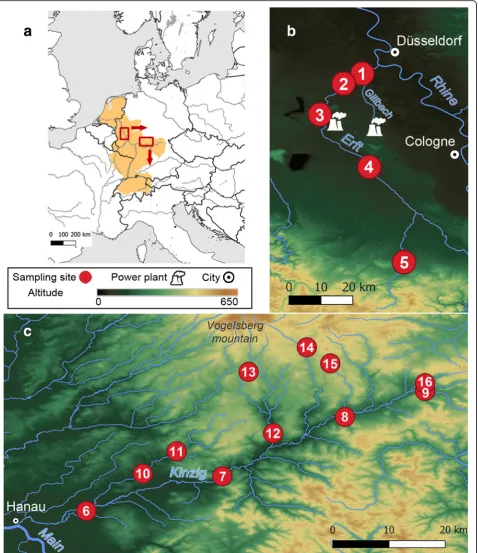
gradients? To answer this question, we sampled
amphi-pods from 16 sites along two streams in Germany (Fig.
1
)
and assessed an array of phenotypic traits (Table
1
).
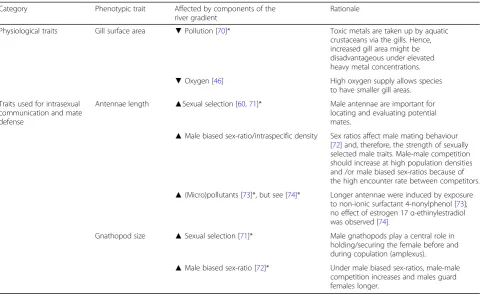
Table 1
Phenotypic traits assessed in our present study and (unidirectional) predictions for trait divergence along single
components of stream gradients
(Continued)
Category Phenotypic trait Affected by components of the river gradient
Rationale
Physiological traits Gill surface area ▼Pollution [70]* Toxic metals are taken up by aquatic crustaceans via the gills. Hence, increased gill area might be disadvantageous under elevated heavy metal concentrations.
▼Oxygen [46] High oxygen supply allows species
to have smaller gill areas.
Traits used for intrasexual communication and mate defense
Antennae length ▲Sexual selection [60,71]* Male antennae are important for locating and evaluating potential mates.
▲Male biased sex-ratio/intraspecific density Sex ratios affect male mating behaviour [72] and, therefore, the strength of sexually selected male traits. Male-male competition should increase at high population densities and /or male biased sex-ratios because of the high encounter rate between competitors. ▲(Micro)pollutants [73]*, but see [74]* Longer antennae were induced by exposure
to non-ionic surfactant 4-nonylphenol [73]; no effect of estrogen 17α-ethinylestradiol was observed [74].
Gnathopod size ▲Sexual selection [71]* Male gnathopods play a central role in holding/securing the female before and during copulation (amplexus).
▲Male biased sex-ratio [72]* Under male biased sex-ratios, male-male competition increases and males guard females longer.
(2) If phenotypic differentiation is uncovered, can we
ascribe at least parts of this variation to known drivers
of both natural and sexual selection processes (or
trig-gers of adaptive plasticity), including selection factors
arising from anthropogenic activities (Table
1
)?
Methods
Study species and sample collection
We focused on a
‘
naturalised
’
[
93
] non-native species,
Gammarus roeselii
, which has spread throughout Central
Europe and established stable populations since the
nine-teenth century [
41
].
Gammarus roeselii
is usually
consid-ered as a downstream-adapted species [
94
,
95
]. However,
several populations in downstream sections of Central
European streams were recently replaced by the more
re-cent invaders
Dikerogammarus villosus
and
Echinogam-marus ischnus
[
96
–
98
]. On the other hand,
G. roeselii
is
nowadays found in at least some Central European first
order streams at altitudes above 400 m (this study).
We collected specimens in two subcatchments within the
Rhine catchment (Fig.
1
). The Erft is located in a heavily
exploited, urbanized area and in downstream sections
re-ceives cooling water from several nearby coal power plants
[
88
,
89
], which significantly increases average water
temper-atures (mean ± SD during winter: 6.1 ± 1.1 °C at thermally
non-polluted sites and 12.4 ± 1.2 °C at thermally polluted
sites; during summer: 17.5 ± 3.0 °C at thermally
non-polluted sites and 23.7 ± 0.3 °C at thermally non-polluted sites),
while our sampling sites in the Kinzig are located within a
long-term ecological research area (LTER [
99
]), and its
tributaries do not receive thermally polluted water
(Add-itional file
1
: Table S1). We caught amphipods using a
multi-habitat kick-sampling method [
100
]. To account for
potential seasonal variation of the traits considered here, we
sampled all sites twice, once in February (winter sampling)
and once in May of 2017 (summer sampling). All captured
specimens were immediately preserved in 96% ethanol until
they were processed in the laboratory. As
G. roeselii
has
been reported to occasionally co-occur with the congeners
G. fossarum
and
G. pulex
[
94
,
101
], we verified species
iden-tity of all specimens under a stereomicroscope (Olympus
SZX12 with an Olympus DF PLFL 0.5X PF objective) using
standard identification keys [
102
,
103
]. Altogether, we
dis-sected
n
= 1648
G. roeselii
from 16 sampling sites (
n
= 373
from thermally polluted and
n
= 1275 from thermally
non-polluted sites; Additional file
1
: Table S3).
Environmental parameters
We assessed a range of environmental variables that are
fre-quently used to characterize stream gradients [
23
–
25
] and
show gradual variation along the examined river stretches
(Additional file
1
: Table S1). At each site, we measured
water temperature [°C] (using a WTW Multi 340i,
Tet-raCon® 325), flow velocity [m s
−1] using a portable
flow-meter (P770, Dostmann electronic GmbH), oxygen content
[mg L
−1] (WTW Multi 340i, CellOx® 325), and conductivity
[μS cm
−1] (WTW Multi 340i, TetraCon® 325). We
esti-mated average stream depth at our sampling sites as falling
into one of three categories (< 0.5 m, 0.5
–
1 m, > 1 m).
Simi-larly, we categorized average stream width as < 7 m, 7
–
12 m,
or > 13 m. Altitudinal information [m above sea level] was
extracted from Google Earth (
http://earth.google.com/
).
We estimated conspecific population densities by
counting all specimens caught by two persons that
applied multi-habitat kick sampling [
100
] for 30 min
in a river stretch of 50 m. We categorized population
densities as low (0
–
50 individuals), medium (51
–
200
individuals), or high (> 200 individuals). Based on the
obtained sample of
G. roeselii
specimens, we
calcu-lated sex-ratios (number of females/number of males)
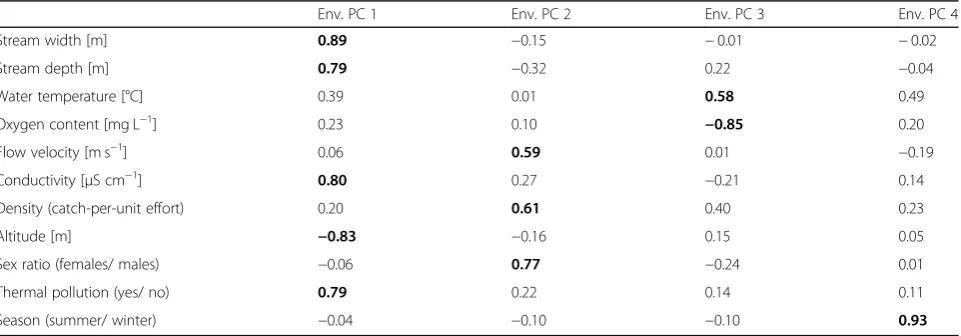
for each sampling site. Since several explanatory
vari-ables showed strong intercorrelations (Table
2
), we
Table 2
Results of a factor reduction procedure (PCA) on 11 environmental parameters measured at our 16 sampling sites
Env. PC 1 Env. PC 2 Env. PC 3 Env. PC 4
Stream width [m] 0.89 −0.15 −0.01 −0.02
Stream depth [m] 0.79 −0.32 0.22 −0.04
Water temperature [°C] 0.39 0.01 0.58 0.49
Oxygen content [mg L−1] 0.23 0.10 −0.85 0.20
Flow velocity [m s−1] 0.06 0.59 0.01 −0.19
Conductivity [μS cm−1] 0.80 0.27 −0.21 0.14
Density (catch-per-unit effort) 0.20 0.61 0.40 0.23
Altitude [m] −0.83 −0.16 0.15 0.05
Sex ratio (females/ males) −0.06 0.77 −0.24 0.01
Thermal pollution (yes/ no) 0.79 0.22 0.14 0.11
Season (summer/ winter) −0.04 −0.10 −0.10 0.93
applied a factor reduction (PCA) using the Varimax option
(based on the Kaiser normalization rotation method
[
104
]) as implemented in SPSS 23. The four resulting
rotated principal components (henceforth called
‘
environ-mental PCs
’
) with eigenvalues > 1.0 were used as
explana-tory variables for all further analyses (for axis loadings see
Table
2
). Cumulatively, they explained 71.8% of the total
variation (PC 1 explained 32.8%, PC 2: 14.5%, PC 3: 12.9%
and PC4 11.5%).
Life history and morphometric data
We collected information on male and female
life-histories (see Additional file
1
: Material S3 for additional
information) and morphological traits from 50 to 128
in-dividuals per population (Additional file
1
: Table S3). All
measurements of distances or areas were conducted
under a stereomicroscope (OLYMPUS SZX12) with an
OLYMPUS DF PLFL 0.5X PF objective and an attached
OLYMPUS SC30 camera connected to a computer. We
used the software Cell^A (Olympus) for all linear and
area measurements.
Sexing, adult body size and weight
Specimens were sexed according to external sexual
char-acteristics: males were identified by the presence of
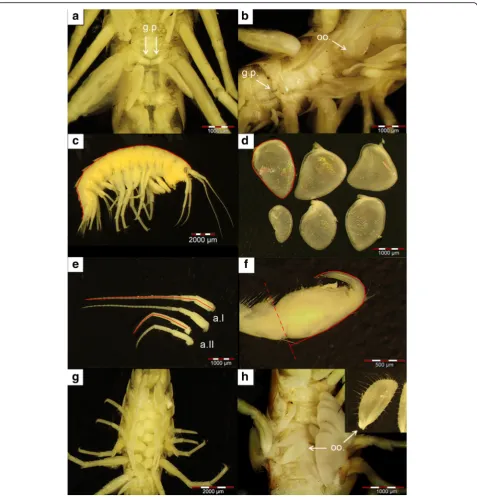
geni-tal papillae (Fig.
2
a) which lie ventrally in the middle of
the bases of the 5th pereopods [
103
]. Female
gammari-dean amphipods usually have four pairs of oostegites
between pereopods 2
–
6 [
105
]. In some cases, intersexual
individuals [
106
] with both genital papillae and oostegites
were observed (Fig.
2b
; see Additional file
1
: Material S4
for additional information and a posteriori analyses on
data from our present study).
We determined each specimen
’
s body length [mm]
from the tip of the rostrum to the telson tip (Fig.
2
c).
To do so, alcohol-stored specimens were placed in
lateral position in a wax-filled Petri dish and were
carefully straightened using preparation needles. We
ensured that all specimens were similarly stretched
be-fore measuring their body length. We also measured
head capsule length as an alternative proxy for body
size [
107
]. However, both traits were strongly collinear
(Pearson
’
s
r
= 0.92; Additional file
1
: Figure S1), and so
we used body length throughout. Before we assessed
somatic dry weight [mg], we removed all eggs from
the female marsupium, after which we dried
speci-mens for 24 h at 60 °C in a drying oven (Heraeus Type
B5042). We stored dried individuals in a desiccator
containing dry silica gel to prevent water-uptake while
cooling down to room temperature. Afterwards, we
weighted specimens to the nearest 0.1 mg on a
micro-scale (SI-234 Denver Instrument).
Physiological traits
We additionally measured gill surface areas. Gills are a
multi-functional organ, involved in several physiological
processes, tightly linked to physiological homeostasis of
oxygen/CO2
concentrations [
108
], osmoregulatory ion
transport [
109
] and excretion of nitrogenous waste
prod-ucts [
109
]. Furthermore, toxic metals are taken up by
aquatic crustaceans via the gills, such that the gills play
an important role in mediating the response of aquatic
amphipods to contaminants [
109
,
110
]. Dissecting the
delicate gills of amphipods is a tedious and
time-consuming task. We, therefore, decided to concentrate
on one sex and measured gill surface areas in males
only, even if this introduces a potential bias and
pre-vented us from detecting potential sex-specific variation.
We placed males in a dorsal position onto agarose gel
and fixed them with two fine needles, upon which we
carefully removed the gills from the right body site at
their base using a fine preparation needle. We
photo-graphed the gills and measured their circumference
(Fig.
2
d). The area of each gill was determined using the
image analysis software Cell^A (Olympus). We summed
data from all six gills per individual as a proxy of the
re-spiratory surface area [mm
2]. However, our method did
not allow us to detect potential changes in secondary
and tertiary lamella [
111
], which might be an alternative
phenotypic response to increase the overall respiratory
surface area.
Traits used for inter-sexual communication and mate
guarding
Male gammarids use their antennae during mate
assess-ment [
60
,
71
]. Accordingly, their antennae tend to be
sexually dimorphic [
112
], and the length of the antennae
in gammarids [
71
,
113
] and other crustaceans [
60
] can
show variation between populations. We carefully
re-moved both pairs of antennae of all individuals (males
and females) at their base using a fine preparation
nee-dle. Antenna length [mm] was assessed by measuring
the distance from the base of the first pedunculus to the
tip of the flagellum (Fig.
2
e). We calculated mean values
from the antennae on the left and right body sides.
Offspring-related phenotypic traits
For each female, we determined fecundity by
care-fully removing all eggs from the brood pouch (the
marsupium [
66
,
105
]; Fig.
2
g) with a fine brush and
counting them. Data from females harbouring stage 7
embryos (see below) were excluded, as some of the
juve-niles may already have left the marsupium. To estimate
egg volumes [mm
3], we measured the longest and shortest
axis of each egg in 2D view and used an ellipsoid formula
to approximate egg volume (see [
67
]). We identified
Fig. 2Overview of morphological characteristics assessed in this study.aMales were identified by the presence of genital papillae (g.p.).embryonic developmental stages according to earlier
de-scriptions for
Gammarus
spp. [
67
,
108
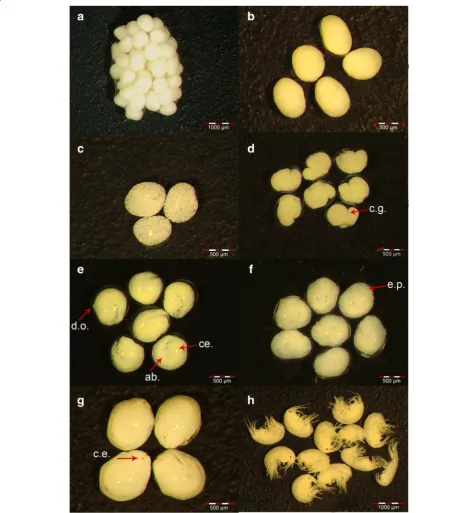
,
114
]. A detailed
description can be found in Additional file
1
: Material S5,
and exemplary photos are shown in Fig.
3
.
Statistical analyses
We asked whether and how environmental parameters
used to characterize stream gradients and condensed
into principal components (Table
2
) drive divergence of
multiple phenotypic traits. To this end, we applied
generalized least squares models (GLS) using the
gls
-function, implemented in the
nlme
package in R [
115
]
fitted by maximum-likelihood estimation and assuming
a Gaussian error distribution. To account for spatial
auto-correlation, we fit our GLS models with an autoregressive
(AR-1) correlation structure [
116
]. Each of the following
variables was modelled separately:
‘
body length
’
,
‘
dry
weight
’
,
‘
length of 1
stantennae
’
, and
‘
length of 2
ndanten-nae
’
. For females, we additionally analysed
‘
fecundity
’
and
‘
egg volume
’
and for males
‘
gill area
’
and
‘
gnathopod size
’
.
We included the explanatory variables
‘
environmental
PCs 1
–
4
’
,
‘
sex
’
(in all cases where data were available from
both sexes) and
‘
body length
’
to account for ontogenetic
changes in trait values. For the model on egg volume, we
additionally considered
‘
developmental stage
’
as an
ex-planatory variable to account for ontogenetic changes in
egg/embryo size during development. The statistical
significance of explanatory variables in the linear models
was evaluated by Type III ANOVAs (using the
Anova
-function implemented in the
car
package [
117
]).
Assump-tions of normality of residuals was assessed visually by
inspecting QQ-plots and plots of residuals vs. fitted values
(Additional file
1
: Figure S3). In the case of significant
effects, we calculated and visualized predicted marginal
effects of environmental variables on dependent variables
using the
ggeffects
package [
118
]. All statistical analyses
were performed in R 3.5.1 [
119
].
Results
Inspection of axis loadings of the four principal
compo-nents (PCs) retained from our factor reduction of various
environmental parameters (Table
2
) allows the following
interpretation: PC 1 reflected variation from upstream to
downstream conditions, with higher PC-scores being
associated with greater stream width, stream depth,
con-ductivity and thermal pollution, while altitude had a
nega-tive axis loading. PC 2 captured variation in flow velocity,
conspecific densities and sex ratios, whereby positive
values represented fast-flowing sites with high densities
and female-biased sex-ratios. PC 3 received high axis
load-ings from water temperatures and oxygen content and
could be interpreted as describing the gradient from
cold, well-oxygenated sites towards warmer sites with
lower oxygen content. Finally, PC 4 captured seasonal
variation between summer (negative values) and
win-ter samplings (positive values). In the following, we
will present significant outcomes of trait-wise
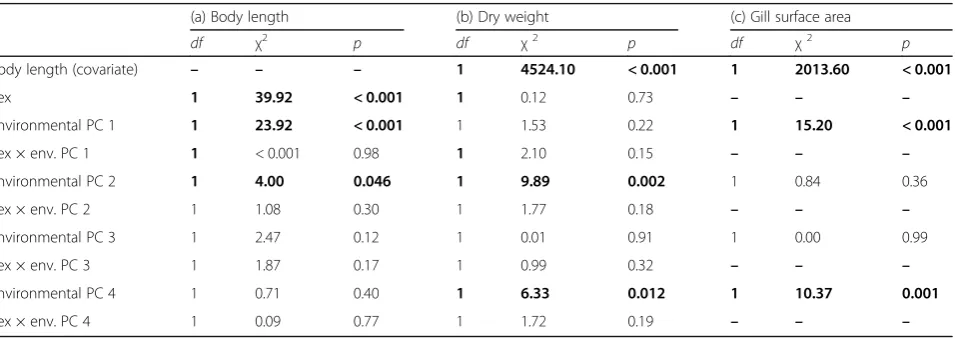
general-ized least squares models (Tables
3
,
4
,
5
) in light of
the information captured by the four PCs that served
as explanatory variables.
Body size and condition-related adult traits
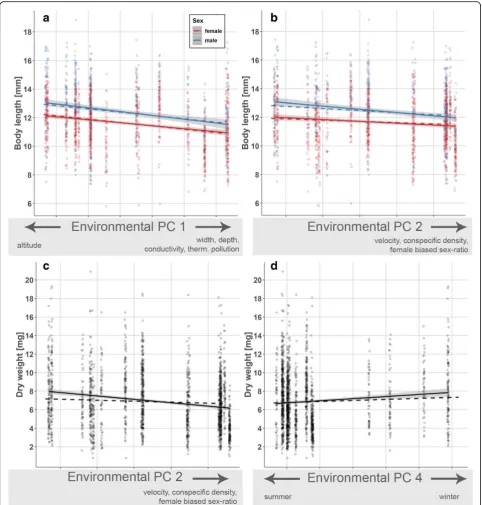
Adult body size decreased significantly from upstream
to downstream sites (i.e., along environmental PC 1;
χ
2= 23.92,
p
< 0.001; Table
3
a; Fig.
4
a) and with
increas-ing conspecific densities (PC 2;
χ
2= 4.0,
p
= 0.046;
Fig.
4
b). Likewise, adult body weight decreased
signifi-cantly along environmental PC 2 (χ
2= 9.89,
p
= 0.002;
Table
3
b; Fig.
4
c) and showed seasonal fluctuation, with
greater body weight being observed in winter (PC 4;
χ
2= 6.33,
p
= 0.012; Fig.
4
d).
Physiological traits
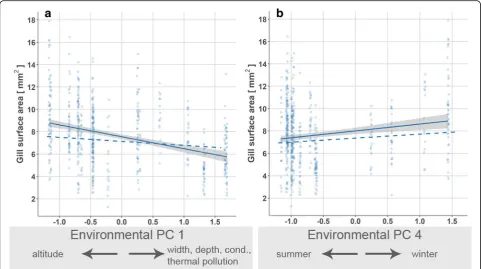
Gill surface areas decreased from upstream to
down-stream conditions (environmental PC 1;
χ
2= 15.20,
p
< 0.001; Table
3
c; Fig.
5
a). Moreover, gills surface
areas were greater during winter than summer (PC 4;
χ
2= 10.37,
p
= 0.001; Fig.
5
b).
Table 3
Results of generalized least squares models on body size/condition-related phenotypic and physiological traits of adult
G.
roeselii
(a) Body length (b) Dry weight (c) Gill surface area
df χ2 p df χ2 p df χ2 p
Body length (covariate) – – – 1 4524.10 < 0.001 1 2013.60 < 0.001
Sex 1 39.92 < 0.001 1 0.12 0.73 – – –
Environmental PC 1 1 23.92 < 0.001 1 1.53 0.22 1 15.20 < 0.001
Sex × env. PC 1 1 < 0.001 0.98 1 2.10 0.15 – – –
Environmental PC 2 1 4.00 0.046 1 9.89 0.002 1 0.84 0.36
Sex × env. PC 2 1 1.08 0.30 1 1.77 0.18 – – –
Environmental PC 3 1 2.47 0.12 1 0.01 0.91 1 0.00 0.99
Sex × env. PC 3 1 1.87 0.17 1 0.99 0.32 – – –
Environmental PC 4 1 0.71 0.40 1 6.33 0.012 1 10.37 0.001
Sex × env. PC 4 1 0.09 0.77 1 1.72 0.19 – – –
Traits involved in intersexual communication and mate
guarding
We found a pronounced sexual dimorphism in the length
of the 1
st(χ
2= 152.65,
p
< 0.001) and 2
ndantennae (χ
2=
1381.67,
p
< 0.001; Table
4
), with males possessing longer
antennae than females. Moreover, antennae length showed
gradual variation along all four environmental PCs (see
significant effects of PC 1
–
PC 4; Table
4
). Specifically,
both the 1
st(χ
2= 63.08,
p
< 0.001; Fig.
6
a) and 2
ndanten-nae (χ
2= 48.98,
p
< 0.001; Fig.
6
b) became longer along
environmental PC 1. The significant interaction term of
‘
sex × environmental PC 2
’
reflects that the length of the
1
stantennae of males increased to a greater extent along
PC 2 (i.e., with increasing population densities and
in-creasingly female-biased sex ratios) than those of females
(χ
2= 5.66,
p
= 0.017; Fig.
6
c). Both antennae increased
along environmental PC 3 (1
stantennae:
χ
2= 34.23,
p
<
0.001; Fig.
6
d; 2
ndantennae:
χ
2= 11.39,
p
= 0.001; Fig.
6
e)
and were longer during winter compared to our summer
sampling (PC 4; 1
stantennae:
χ
2= 39.96,
p
< 0.001; Fig.
6
f;
2
ndantennae:
χ
2= 13.62,
p
= 0.001; Fig.
6
g). Notably, we
did not find significant divergence in male gnathopod
length along environmental gradients (Table
4
c).
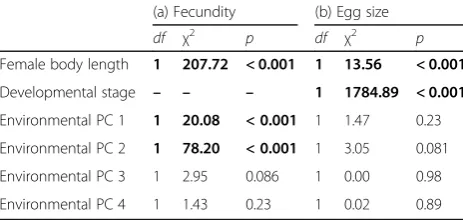
Reproductive characteristics
Female fecundity (numbers of eggs per brood)
—
size-cor-rected by inclusion of the covariate
‘
female body length
’
(Table
5
a)
—
decreased significantly from up- to
down-stream sites (i.e., along environmental PC 1;
χ
2= 20.08,
p
< 0.001; Fig.
7
a) and with higher conspecific densities
(PC 2;
χ
2= 78.20,
p
< 0.001; Fig.
7
b). Egg size did not
show gradual variation along any of the components of
the stream gradient (Table
5
b).
Discussion
We found phenotypic differentiation among populations
of
G. roeselii
occurring along the two river stretches
exam-ined in this study, including body size and weight,
physio-logical traits (gill surface areas), reproductive life-history
traits, and sexually selected morphological traits. Our
study does not allow inferences regarding the relative roles
of evolved differences (local adaptation) and phenotypic
plasticity (Additional file
1
: Material S1). Still, our analyses
suggest that spatial variation in ecological conditions
along the examined stream gradients drives the observed
intraspecific differentiation over small geographic scales
(i.e., within and between river catchments).
Ecological significance of phenotypic differentiation
What are the potential ecological implications of our
findings? Recent years have seen a steep increase in
numbers of publications that either analyse empirical
data (e.g., [
120
]) and/or use mathematical modelling
(e.g., [
121
]) to understand ecological phenomena over
large geographic scales (macroecology [
122
]). These
ap-proaches, however, usually treat species as
“
evolutionar-ily inert
”
entities with fixed (species-specific) ecological
Table 4
Results of generalized least squares models on phenotypic traits used for mate assessment and mate defence
(a) 1stAntennae (b) 2ndAntennae (c) Gnathopod length
df χ2 p df χ2 p df χ2 p
Body length 1 4388.92 < 0.001 1 4912.87 < 0.001 1 0.66 0.42
Sex 1 152.65 < 0.001 1 1381.67 < 0.001 – – –
Environmental PC 1 1 63.08 < 0.001 1 48.98 < 0.001 1 0.01 0.91
Sex × env. PC 1 1 0.08 0.78 1 6.64 0.010 – – –
Environmental PC 2 1 0.35 0.55 1 2.89 0.089 1 0.71 0.40
Sex × env. PC 2 1 5.66 0.017 1 0.05 0.83 – – –
Environmental PC 3 1 34.23 < 0.001 1 11.39 0.001 1 0.33 0.57
Sex × env. PC 3 1 0.10 0.76 1 < 0.001 0.96 – – –
Environmental PC 4 1 39.96 < 0.001 1 13.62 < 0.001 1 < 0.001 0.98
Sex × env. PC 4 1 0.55 0.46 1 0.54 0.46 – – –
We assessed the following dependent variables: (a) length of the 1st
and (b) 2nd
antennae (which males use for mate detection and assessment) in both sexes. (c) Gnathopod size (used by males during precopulatory mate guarding, called amplexus) was assessed only in males. Environmental PCs (Table2), body length and sex (where applicable) served as predictor variables. Significant effects are shown in bold
Table 5
Results of generalized least squares models on
reproductive life-history traits in females
(a) Fecundity (b) Egg size
df χ2 p df χ2 p
Female body length 1 207.72 < 0.001 1 13.56 < 0.001
Developmental stage – – – 1 1784.89 < 0.001
Environmental PC 1 1 20.08 < 0.001 1 1.47 0.23
Environmental PC 2 1 78.20 < 0.001 1 3.05 0.081
Environmental PC 3 1 2.95 0.086 1 0.00 0.98
Environmental PC 4 1 1.43 0.23 1 0.02 0.89
traits affecting ecosystem processes like nutrient and energy
flow [
123
–
125
]. Nevertheless, both theoretical
consider-ations and empirical evidence suggest that intraspecific
phenotypic variation can affect ecosystem processes
[
126
–
128
]. For example, divergence in foraging traits
of predatory fish species can alter the structure and
dynamics of ecological communities by decreasing the
mean body size, total biomass, and species richness of
Fig. 4Visualization of significant model terms in generalized least squares models on body size/condition-related adult phenotypic traits.crustacean zooplankton [
129
]. The consequences of
phenotypic divergence for ecological processes should
be particularly strong when the species under
consid-eration acts as a keystone species or ecosystem
engin-eer [
130
] or when it is simply very abundant [
127
].
Amphipods are considered to be key components of
limnic food webs, as their shredding activity
acceler-ates leaf fragmentation, produces faecal pellets, and
transfers nutrients into secondary production, all of
which are vital for maintaining diverse aquatic food
webs [
131
–
135
]. Hence, rapid evolutionary divergence
of amphipods along stream gradients is likely to result in
multiple feedbacks between evolutionary and ecological
processes [
136
–
138
]. For example,
G. roeselii
shows the
strongest degree of body size-dependency in leaf litter
decomposition rates amongst several species of native and
non-native amphipods in the Rhine drainage (see
Add-itional file
1
: Figure S2 in ref. [
139
]). Hence, the strong
decline in body size across the stream gradient reported
here will have an effect on decomposition rates and food
web dynamics. Ecological studies have merely just begun
to acknowledge the role of rapid phenotypic divergence in
the provisioning of ecosystem services [
128
,
136
,
140
], and
our present study identifies invasive amphipods as prime
candidates for future studies in this direction. Specifically,
future studies could quantify decomposition rates [
139
] of
phenotypically divergent populations to explicitly
inte-grate differences in functional responses as a consequence
of the observed trait variation and to understand
how they translate into differences in ecosystem
functioning [
140
–
142
].
Drivers of phenotypic divergence along the examined
stream gradients
The native distribution range of
G. roeselii
is
character-ized by its karst topography, with spatio-temporally
di-verse ecological conditions along stream gradients [
143
,
144
]. Therefore,
G. roeselii
might have a high potential
to inhabit variable environments, either by phenotypic
plasticity (see below) or through adaptive evolutionary
divergence (local adaptation; see also Additional file
1
:
Material S1). In support of this idea, a substantial
amount of the observed phenotypic trait divergence we
found in our dataset could be explained by selection
factors that we condensed into principal components.
We will base our discussion largely on
a priori
predic-tions of how single components of the river gradient
should affect trait divergence (Table
1
), but
acknow-ledge that additional factors that were not assessed here
(e.g., predation pressure [
145
,
146
], competition with
congeneric species [
147
]) may have driven parts of the
observed divergence.
Selection from abiotic factors
Abiotic factors had strong effects on phenotypic
diver-gence of various traits. For instance, we found larger
indi-viduals at upstream sites. In arthropods, larger specimens
tend to have an increased ability to withstand
environ-mental fluctuation [
47
,
48
]. Temperature regimes are
more variable and winter temperatures colder at higher
altitudes, and increased tolerance to low temperatures in
large-bodied individuals was empirically confirmed for
Gammarus lacustris
[
50
]. Increased body size at higher
altitudes appears to be a widespread pattern in arthropods,
unless high seasonality leads to a reduced resource
avail-ability and ultimately results in smaller body size at higher
altitudes [
47
,
148
]. As a leaf shredding species [
139
],
G.
roeselii
is not resource-limited at upstream sites (i.e.,
higher altitudes), allowing individuals from those
popula-tions to grow to a bigger size.
Counter to our prediction based on the efficiency of
oxy-gen uptake under low oxyoxy-gen tension [
46
], we found no
re-sponse in gill surface area to oxygen conditions; instead we
found a pronounced decrease in gill surface areas towards
downstream conditions and at sites receiving industrial
cooling water. Even though we are lacking quantitative
in-formation on pollution loads (other than conductivity as a
broad and indirect proxy of total dissolved ions), we argue
that increased concentrations of anthropogenic
contami-nants might explain this pattern ([
70
]; Table
1
). Cooling
water often contains additive biocides such as chlorine,
cor-rosion inhibitors, or antifreezers [
149
]. In support of this
in-terpretation, we found more incidences of intersex at sites
that receive cooling water (Additional file
1
: Material S4).
Biocides are suspected to disturb the hormone balance
be-tween androgens and estrogens and facilitate development
of both, male and female characteristics at the same time;
however, the biochemical pathways that induce intersex are
diverse and still remain controversial [
106
,
150
]. Moreover,
contaminants of both natural (e.g., from nitrogenous waste
products or soil erosion [
109
]) and anthropogenic origin
(e.g., effluents from wastewater treatment plants and
agri-culture [
151
–
153
]) accumulate towards downstream sites.
We argue that smaller gill surface areas are adaptive in that
they facilitate a reduced uptake of bioaccumulating
con-taminants (e.g., heavy metals [
109
]) or to account for
chan-ging concentration of ions in the water (i.e., osmoregulatory
purposes [
154
]).
Selection from biotic factors
We found systematic co-variation of population
demog-raphy and densities along the examined river stretches.
Specifically, higher population densities were associated
Fig. 6Visualization of significant model terms in generalized least squares models on phenotypic traits involved in mate finding and assessment. We depict marginal effects for gradual variation in the length of the 1st(a,c,d,f) and 2ndantennae (b,e,g) along environmental PC 1with more female biased sex-ratios. The exact
mecha-nisms underlying this patterns could not be examined in
the course of our present study. A likely explanation
could be sex-distortion through parasites [
155
], as
para-site transmission probably increases with increasing
population densities. For example, presence of the
microsporidian
Nosema granulosis
is associated with an
excess of females in
G. roeselii
broods [
156
].
Our analyses uncovered divergence of sexually selected
male traits towards sites with higher densities and
to-wards female biased sex-ratios. Specifically, the sexual
dimorphism in the 1
stantennae [
71
,
112
] became more
pronounced (Fig.
6
c). Male amphipods use their
anten-nae to assess the quality of potential mating partners
[
72
]. They bear high costs of mating due to
precopula-tory mate guarding [
157
], which should indeed select for
pronounced male mate choosiness [
158
]. Interestingly,
mate choosiness in our study species was stronger in
males originating from a high-density site compared to
males from a low-density site [
113
]. Based on the
afore-mentioned considerations, we suggest the following
sce-nario: systematic variation of (unrecognized) ecological
factors (e.g., predation pressure [
145
,
146
] and/or
com-petition with congeneric species [
147
]) along the
exam-ined stream sections drove differences in population
densities. Mediated by parasitism [
156
], this altered
popu-lation demographics, which in turn altered the fitness
landscape for sexually selected traits. Moreover, we
pre-dicted body size to be positively sexually selected at high
conspecific densities [
59
,
60
] (Table
1
), but instead found
reduced body size in both sexes. This likely reflects
ele-vated resource competition at high population densities
translating into reduced somatic growth [
159
].
Finally, also reproductive traits changed in response to
biotic conditions, such as population densities, and we
observed a lower fecundity at high conspecific densities
and more female biased sex-ratios. A possible adaptive
interpretation could be related to the trade-off between
offspring size and fecundity [
69
], where female fecundity
is reduced when selection favours bigger offspring [
1
,
18
,
160
]. Increased offspring size can be adaptive in highly
competitive environments (i.e., at high population
densities [
68
,
161
]). Our interpretation remains
specu-lative, however, as the effect of larger offspring size
under higher population densities was marginally
non-significant (Additional file
1
: Figure S2).
Selection at invasion fronts?
based on the existing literature on aquatic invertebrates
(Table
1
), fail to explain this pattern. Therefore, we argue
that selective regimes at upstream sites need to be
viewed in light of the species
’
colonisation history.
Upstream sites in Central Europe were only recently
in-vaded by
G. roeselii
(this study). Individuals on the
expanding edge of a population (or invasion front) face a
unique selective environment. They encounter native
competitors (in this case even congeners [
94
,
101
,
162
])
and a new set of abiotic selection factors [
163
]. Selection
arising from this condition may tip the scale of another
prominent life-history trade-off, namely the trade-off
between investment into reproduction and somatic
maintenance, which is related to the trade-off between
current and future reproduction [
82
]. Invaders may thus
show more investment into reproduction [
164
] unless
there is a strong trade-off between dispersal abilities and
fecundity [
165
].
Outlook and future research
Phylogeographic studies on amphipods are becoming
com-mon practice to study how past geological events affected
macroevolutionary
processes [
166
–
168
]. By contrast,
phenotypic divergence within and between taxonomic
groups
—
as reported here on an intraspecific level for
G.
roeselii
—
received little attention so far. Uncertainty remains
regarding the underlying mechanisms that caused the
ob-served phenotypic variation, and future studies are
war-ranted that address the potential heritability of the traits
studied herein and the role of adaptive phenotypic plasticity
[
87
,
169
]. Additionally, parts of the observed phenotypic
divergence could also arise from non-adaptive plasticity in
response to stressful environments [
87
] (Additional file
1
:
Material S1). Future studies could provide broad-sense
her-itability estimates by rearing individuals under
common-garden conditions [
170
], or make an attempt to rear
indi-vidual broods from known parents to provide narrow-sense
heritability estimates (
h
n2, via mid-parent
–
offspring
re-gressions [
171
]). To experimentally address some of the
newly generated hypotheses, future studies could use the
sister genus
Hyalella
, which is easy to breed under
labora-tory conditions.
Hyalella
spp. are routinely used in North
America as a model organism for ecotoxicological assays
[
172
] and contemporary evolution to anthropogenic
sources of selection (pesticide exposure) has been described
[
173
]. On the other hand, the relative role of plastic
responses could be addressed experimentally by
asses-sing the variance of traits, for example, in reciprocal
transplant experiments [
174
,
175
]. Finally, genome- and
transcriptome-screens could provide insights into the
underlying mechanisms of phenotypic divergence, and the
widespread occurrence of
G. roeselii
offers several
inde-pendent populations to test for parallel adaptive
diver-gence. Altogether then, our present study identifies
amphipods are promising models to study phenotypic
di-versification along ecological gradients made up by both
natural and human-induced selection factors.
Further-more, their key-role in freshwater ecosystems renders
am-phipods an excellent system in which to investigate
feedbacks between evolutionary and ecological processes.
Additional file
Additional file 1:Material S1. Additional information on sources of phenotypic divergence. Material S2. Additional information on genetic differentiation inGammarus roeselii. Material S3. Additional information on life-history characteristics ofGammarus roeselii. Material S4. Additional information on intersexuality. Material S5. Additional information on embryonic developmental stages. Material S6. Information on study sites, additional results and model summaries.Table S1.Environmental condi-tions for each sampling site.Table S2.PC scores per season and site.
Table S3.Numbers of (a) sex-determined specimens for each sampling site with number of intersex individuals and (b) individuals used for measuring phenotypic traits (male♂, female♀).Figure S1.Relationship of body length to head capsule length.Figure S2.Visualization of the marginally non-significant model term in generalized least squares models using offspring-size as the dependent variable.Table S4.Body length.
Table S5.Dry weight.Table S6.Gill surface area. Table S7.1st Antennae. Table S8.2ndAntennae.Table S9.Gnathopod length.
Table S10.Fecundity.Table S11.Egg size.Figure S3.Quantile-quantile (QQ) plots of the model residuals.Figure S4.Pictures of sampling sites.
Table S12.Location of sampling sites. (DOCX 1830 MB)
Abbreviations
GLS:Generalized least squares model; PC: Principal component
Acknowledgements
We thank U. Rose, A. Sundermann and P. Haase for rendering support to this project. We further wish to thank M. Oetken for valuable discussions.
Authors’contributions
JJ and AW developed the study idea and established the research protocol. KP and JJ collected samples. KP collected the data. JJ conducted the statistical analyses. JJ and MP discussed the conceptual framework and outline of this manuscript. JJ and MP jointly wrote the article. All authors read and approved the final version of the manuscript.
Availability of data and materials
The datasets used and analysed for this study are available from the corresponding author upon reasonable request.
Ethics approval
All animal work in the present study was conducted according to relevant national and international guidelines. The field sampling did not involve endangered or protected species.
Consent for publication
Not applicable.
Competing interests
The authors declare that they have no competing interests.
Author details
1Department of Aquatic Ecotoxicology, Institute for Ecology, Evolution and
Diversity, Goethe University Frankfurt am Main, Frankfurt am Main, Germany. 2Department of River Ecology and Conservation, Senckenberg Research
Institute and Natural History Museum Frankfurt, Gelnhausen, Germany. 3National Museum of Natural History Luxembourg, Luxembourg City,
Molecular Biology for Agriculture, Northwest A&F University, Yangling, People’s Republic of China.
Received: 21 December 2018 Accepted: 24 June 2019
References
1. Endler JA. Natural selection in the wild: Princeton University press; 1986. 2. Rundle HD, Nagel L, Boughman JW, Schluter D. Natural selection and
parallel speciation in sympatric sticklebacks. Science. 2000;287(5451):306–8. 3. Ouyang X, Gao J, Xie M, Liu B, Zhou L, Chen B, Jourdan J, Riesch R, Plath M.
Natural and sexual selection drive multivariate phenotypic divergence along climatic gradients in an invasive fish. Sci Rep. 2018;8(1):11164.
4. Andersson MB. Sexual selection: Princeton University press; 1994. 5. Jourdan J, Krause S, Lazar VM, Zimmer C, Sommer-Trembo C,
Arias-Rodriguez L, Klaus S, Riesch R, Plath M. Shared and unique patterns of phenotypic diversification along a stream gradient in two congeneric species. Sci Rep. 2016;6:38971.
6. Riesch R, Plath M, Bierbach D. Ecology and evolution along environmental gradients. Curr Zool. 2018;64(2):193–6.
7. Riesch R, Tobler M, Lerp H, Jourdan J, Doumas T, Nosil P, Langerhans RB, Plath M. Extremophile Poeciliidae: multivariate insights into the complexity of speciation along replicated ecological gradients. BMC Evol Biol. 2016;16: 136 1–15.
8. Kawecki TJ, Ebert D. Conceptual issues in local adaptation. Ecol Lett. 2004; 7(12):1225–41.
9. Palo J, O'Hara RB, Laugen AT, Laurila A, Primmer CR, Merilä J. Latitudinal divergence of common frog (Rana temporaria) life history traits by natural selection: evidence from a comparison of molecular and quantitative genetic data. Mol Ecol. 2003;12(7):1963–78.
10. Heibo E, Magnhagen C, Vøllestad LA. Latitudinal variation in life-history traits in Eurasian perch. Ecology. 2005;86(12):3377–86.
11. Watt C, Mitchell S, Salewski V. Bergmann's rule; a concept cluster? Oikos. 2010;119(1):89–100.
12. Hodkinson ID. Terrestrial insects along elevation gradients: species and community responses to altitude. Biol Rev. 2005;80(3):489–513. 13. O'Gorman EJ, Ólafsson ÓP, Demars BO, Friberg N, Guðbergsson G,
Hannesdóttir ER, Jackson MC, Johansson LS, McLaughlin ÓB, Ólafsson JS. Temperature effects on fish production across a natural thermal gradient. Glob Chang Biol. 2016;22(9):3206–20.
14. Gomez-Mestre I, Tejedo M. Contrasting patterns of quantitative and neutral genetic variation in locally adapted populations of the natterjack toad,Bufo calamita. Evolution. 2004;58(10):2343–52.
15. Laverty G, Skadhauge E. Hypersaline Environments. In: Riesch R, Tobler M, Plath M, editors. Extremophile fishes. Ecology, evolution, and physiology of Teleosts in extreme environments. Heidelberg: Springer; 2015. p. 85–106. 16. Hangartner S, Laurila A, Räsänen K. Adaptive divergence of the moor frog
(Rana arvalis) along an acidification gradient. BMC Evol Biol. 2011;11(366): 366.
17. Nelson JA. Pickled Fish Anyone? Extremophile fishes. Ecology, evolution, and physiology of Teleosts in extreme environments. Heidelberg: Springer; 2015. p. 193–215.
18. Reznick D, Endler JA. The impact of predation on life history evolution in Trinidadian guppies (Poecilia reticulata). Evolution. 1982;36(1):160–77. 19. Bolnick DI. Can intraspecific competition drive disruptive selection? An
experimental test in natural populations of sticklebacks. Evolution. 2004; 58(3):608–18.
20. Connell JH. The influence of interspecific competition and other factors on the distribution of the barnacleChthamalus stellatus. Ecology. 1961;42(4): 710–23.
21. Stubbington R, Chadd R, Cid N, Csabai Z, Miliša M, Morais M, Munné A, Pařil P, PešićV, Tziortzis I. Biomonitoring of intermittent rivers and ephemeral streams in Europe: current practice and priorities to enhance ecological status assessments. Sci Total Environ. 2018;618:1096–113.
22. Siepielski AM, Morrissey MB, Buoro M, Carlson SM, Caruso CM, Clegg SM, Coulson T, DiBattista J, Gotanda KM, Francis CD. Precipitation drives global variation in natural selection. Science. 2017;355(6328):959–62.
23. Allan JD. Stream ecology. London: Chapman & Hall; 1995. 24. Wetzel RG. Limnology: lake and river ecosystems. 3rd ed. San Diego:
Academic Press; 2001.
25. Vannote RL, Minshall GW, Cummins KW, Sedell JR, Cushing CE. The river continuum concept. Can J Fish Aquat Sci. 1980;37(1):130–7.
26. Zenker A, Cicero MR, Prestinaci F, Bottoni P, Carere M. Bioaccumulation and biomagnification potential of pharmaceuticals with a focus to the aquatic environment. J Environ Manag. 2014;133:378–87.
27. Brown CD, Van Beinum W. Pesticide transport via sub-surface drains in Europe. Environ Pollut. 2009;157(12):3314–24.
28. Wagner M, Scherer C, Alvarez-Muñoz D, Brennholt N, Bourrain X, Buchinger S, Fries E, Grosbois C, Klasmeier J, Marti T. Microplastics in freshwater ecosystems: what we know and what we need to know. Environ Sci Eur. 2014;26(1):12.
29. Kløve B, Ala-Aho P, Bertrand G, Boukalova Z, Ertürk A, Goldscheider N, Ilmonen J, Karakaya N, Kupfersberger H, Kvœrner J. Groundwater dependent ecosystems. Part I: Hydroecological status and trends. Environ Sci Pol. 2011; 14(7):770–81.
30. Moore RD, Spittlehouse D, Story A. Riparian microclimate and stream temperature response to forest harvesting: a review. J Am Water Resour Assoc. 2005;41:813–34.
31. Molini A, Katul GG, Porporato A. Maximum discharge from snowmelt in a changing climate. Geophys Res Lett. 2011;1-5.
32. Marxsen J, Zoppini A, Wilczek S. Microbial communities in streambed sediments recovering from desiccation. FEMS Microbiol Ecol. 2010;71(3): 374–86.
33. Mariotti A, Struglia MV, Zeng N, Lau K. The hydrological cycle in the Mediterranean region and implications for the water budget of the Mediterranean Sea. J Clim. 2002;15(13):1674–90.
34. IPCC. Climate change 2014: synthesis report. Contribution of Working Groups I, II and III to the fifth assessment report of the Intergovernmental Panel on Climate Change. In: Pachauri RK, Allen MR, Barros VR, Broome J, Cramer W, Christ R, Church JA, Clarke L, Dahe Q, Dasgupta P, editors. 2014. http://www.ipcc.ch/report/ar5/syr/(13072017).
35. Vidon PG, Hill AR. Landscape controls on the hydrology of stream riparian zones. J Hydrol. 2004;292(1–4):210–28.
36. Jourdan J, O'Hara RB, Bottarin R, Huttunen K-L, Kuemmerlen M, Monteith D, Muotka T, OzoliņšD, Paavola R, Pilotto F, et al. Effects of changing climate on European stream invertebrate communities: a long-term data analysis. Sci Total Environ. 2018;621:588–99.
37. Allan JD. Landscapes and riverscapes: the influence of land use on stream ecosystems. Annu Rev Ecol Evol Syst. 2004;35:257–84.
38. Woodward G, Perkins DM, Brown LE. Climate change and freshwater ecosystems: impacts across multiple levels of organization. Philos Trans R Soc Lond B Biol Sci. 2010;365(1549):2093.
39. Berger E, Haase P, Kuemmerlen M, Leps M, Schäfer RB, Sundermann A. Water quality variables and pollution sources shaping stream macroinvertebrate communities. Sci Total Environ. 2017;587:1–10. 40. Endler JA. Multiple-trait coevolution and environmental gradients in
guppies. Trends Ecol Evol. 1995;10(1):22–9.
41. Jażdżewski K. Range extensions of some gammaridean species in European inland waters caused by human activity. Crustaceana Suppl. 1980;6:84–107. 42. Marchant R, Hynes H. The distribution and production ofGammarus
pseudolimnaeus(Crustacea: Amphipoda) along a reach of the Credit River, Ontario. Freshw Biol. 1981;11(2):169–82.
43. Dangles O, Gessner MO, Guerold F, Chauvet E. Impacts of stream acidification on litter breakdown: implications for assessing ecosystem functioning. J Appl Ecol. 2004;41(2):365–78.
44. Franssen NR, Harris J, Clark SR, Schaefer JF, Stewart LK. Shared and unique morphological responses of stream fishes to anthropogenic habitat alteration. Proc R Soc B Biol Sci. 2013;280(1752):20122715.
45. Haas TC, Heins DC, Blum MJ. Predictors of body shape among populations of a stream fish (Cyprinella venusta, Cypriniformes: Cyprinidae). Biol J Linn Soc. 2015;115(4):842–58.
46. Dodds G, Hisaw FL. Ecological studies of aquatic insects: size of respiratory organs in relation to environmental conditions. Ecology. 1924;5(3):262–71. 47. Chown SL, Gaston KJ. Body size variation in insects: a macroecological
perspective. Biol Rev. 2010;85(1):139–69.
48. Horne CR, Hirst A, Atkinson D. Temperature-size responses match latitudinal-size clines in arthropods, revealing critical differences between aquatic and terrestrial species. Ecol Lett. 2015;18(4):327–35.
50. Wilhelm F, Schindler D. Reproductive strategies ofGammarus lacustris (Crustacea: Amphipoda) along an elevation gradient. Funct Ecol. 2000;14(4): 413–22.
51. Blanckenhorn WU. Different growth responses to temperature and resource limitation in three fly species with similar life histories. Evol Ecol. 1999;13(4):395.
52. Beketov MA, Liess M. Predation risk perception and food scarcity induce alterations of life-cycle traits of the mosquitoCulex pipiens. Ecol Entomol. 2007;32(4):405–10.
53. Credland PF, Dick KM, Wright AW. Relationships between larval density, adult size and egg production in the cowpea seed beetle,Callosobruchus maculatus. Ecol Entomol. 1986;11(1):41–50.
54. Wellborn GA. Trade-off between competitive ability and antipredator adaptation in a freshwater amphipod species complex. Ecology. 2002;83(1): 129–36.
55. Gross MY, Maycock DS, Thorndyke MC, Morritt D, Crane M. Abnormalities in sexual development of the amphipodGammarus pulex(L.) found below sewage treatment works. Environ Toxicol Chem. 2001;20(8):1792–7. 56. Jourdan J, Baier J, Riesch R, Klimpel S, Streit B, Müller R, Plath M. Adaptive
growth reduction in response to fish kairomones allows mosquito larvae (Culex pipiens) to reduce predation risk. Aquat Sci. 2016;78(2):303–14. 57. Wellborn GA. Size-biased predation and prey life histories: a comparative
study of freshwater amphipod populations. Ecology. 1994;75:2104–17. 58. Gliwicz ZM, Boavida MJ. Clutch size and body size at first reproduction in
Daphnia pulicariaat different levels of food and predation. J Plankton Res. 1996;18(6):863–80.
59. Bollache L, Cézilly F. Sexual selection on male body size and assortative pairing inGammarus pulex(Crustacea: Amphipoda): field surveys and laboratory experiments. J Zool. 2004;264(2):135–41.
60. Bertin A, Cézilly F. Sexual selection, antennae length and the mating advantage of large males inAsellus aquaticus. J Evol Biol. 2003;16(3):491– 500.
61. Glazier DS. Is fatter fitter? Body storage and reproduction in ten populations of the freshwater amphipodGammarus minus. Oecologia. 2000;122(3):335– 45.
62. Lagrue C, Besson AA, Lecerf A. Interspecific differences in antipredator strategies determine the strength of non-consumptive predator effects on stream detritivores. Oikos. 2015;124(12):1589–96.
63. Benard MF. Predator-induced phenotypic plasticity in organisms with complex life histories. Annu Rev Ecol Syst. 2004;35:651–73.
64. Tolba M, Holdich D. The effect of water quality on the size and fecundity of Asellus aquaticus(Crustacea: isopoda). Aquat Toxicol. 1981;1(2):101–12. 65. Ford AT, Fernandes TF, Rider SA, Read PA, Robinson CD, Davies IM.
Reproduction in the amphipod,Echinogammarus marinus: a comparison between normal and intersex specimens. J Mar Biol Assoc U K. 2003;83(5): 937–40.
66. Sheader M. Factors influencing egg size in the gammarid amphipod Gammarus insensibilis. Mar Biol. 1996;124(4):519–26.
67. Pöckl M. Reproductive potential and lifetime potential fecundity of the freshwater amphipodsGammarus fossarumandG. roeseliin Austrian streams and rivers. Freshw Biol. 1993;30(1):73–91.
68. Wellborn GA, Cothran R, Bartholf S. Life history and allozyme diversification in regional ecomorphs of theHyalella azteca(Crustacea: Amphipoda) species complex. Biol J Linn Soc. 2005;84(2):161–75.
69. Glazier DS. Smaller amphipod mothers show stronger trade-offs between offspring size and number. Ecol Lett. 2000;3(2):142–9.
70. Roast S, Jones M. Morphometrics and gill function inGammarus duebeni (Peracarida: Amphipoda) inhabiting a sewage treatment works. Mar Ecol Prog Ser. 2003;260:189–94.
71. Nahavandi N, Plath M, Tiedemann R, Mirzajani AR. Sexual and natural selection on morphological traits in a marine amphipod,Pontogammarus maeoticus(Sowinsky, 1894). Mar Biol Res. 2011;7(2):135–46.
72. Dick JT, Elwood RW. Effects of natural variation in sex ratio and habitat structure on mate-guarding decisions in amphipods (Crustacea). Behaviour. 1996;133(13):985–96.
73. Brown R, Conradi M, Depledge M. Long-term exposure to 4-nonylphenol affects sexual differentiation and growth of the amphipodCorophium volutator(# Pallas, 1766). Sci Total Environ. 1999;233(1–3):77–88. 74. Watts MM, Pascoe D, Carroll K. Population responses of the freshwater
amphipodGammarus pulex(L.) to an environmental estrogen, 17α -ethinylestradiol. Environ Toxicol Chem. 2002;21(2):445–50.
75. Berglund A. Many mates make male pipefish choosy. Behaviour. 1995; 132(3):213–8.
76. Villarreal AE, Godin JGJ, Bertram SM. Influence of the operational sex ratio on mutual mate choice in the Jamaican field cricket (Gryllus assimilis): testing the predictions of the switch point theorem. Ethology. 2018;124(11): 816–28.
77. Ward PI, Porter AH. The relative roles of habitat structure and male-male competition in the mating sytem ofGammarus pulex(Crustacea; Amphipoda): a simulation study. Anim Behav. 1993;45(1):119–33. 78. Grether GF, Hudon J, Millie DF. Carotenoid limitation of sexual coloration
along an environmental gradient in guppies. Proc R Soc Lond B Biol Sci. 1999;266(1426):1317–22.
79. Lindholm AK, Head M, Brooks R, Rollins L, Ingleby F, Zajitschek SR. Causes of male sexual trait divergence in introduced populations of guppies. J Evol Biol. 2014;27(2):437–48.
80. Piggott JJ, Townsend CR, Matthaei CD. Reconceptualizing synergism and antagonism among multiple stressors. Ecol Evol. 2015;5(7):1538–47. 81. Losos JB, Schoener TW, Langerhans RB, Spiller DA. Rapid temporal reversal
in predator-driven