R E S E A R C H A R T I C L E
Open Access
Exploring the tensions of being
and becoming a medical educator
Ahsan Sethi
1,2*, Rola Ajjawi
3, Sean McAleer
2and Susie Schofield
2Abstract
Background:Previous studies have identified tensions medical faculty encounter in their roles but not specifically those with a qualification in medical education. It is likely that those with postgraduate qualifications may face additional tensions (i.e., internal or external conflicts or concerns) from differentiation by others, greater responsibilities and translational work against the status quo. This study explores the complex and multi-faceted tensions of educators with qualifications in medical education at various stages in their career.
Methods:The data described were collected in 2013–14 as part of a larger, three-phase mixed-methods research study employing a constructivist grounded theory analytic approach to understand identity formation among medical educators. The over-arching theoretical framework for the study was Communities of Practice. Thirty-six educators who had undertaken or were undertaking a postgraduate qualification in medical education took part in semi-structured interviews.
Results:Participants expressed multiple tensions associated with both becoming and being a healthcare
educator. Educational roles had to be juggled with clinical work, challenging their work-life balance. Medical education was regarded as having lower prestige, and therefore pay, than other healthcare career tracks. Medical education is a vast speciality, making it difficult as a generalist to keep up-to-date in all its areas. Interestingly, the graduates with extensive experience in education reported no fears, rather asserting that the qualification gave them job variety.
Conclusion:This is the first detailed study exploring the tensions of educators with postgraduate qualifications in medical education. It complements and extends the findings of the previous studies by identifying tensions common as well as specific to active students and graduates. These tensions may lead to detachment, cynicism and a weak sense of identity among healthcare educators. Postgraduate programmes in medical education can help their students identify these tensions in becoming and develop coping strategies. Separate career routes, specific job descriptions and academic workload models for medical educators are recommended to further the professionalisation of medical education.
(Tensions, Fears, Healthcare Educators, Medical Education, Postgraduate Programmes, Identity, Career Choice, Faculty Development, Communities of Practice).
Background
The growing expectations of the regulatory bodies for med-ical educators to have formal training for their educational role and increased accountability has resulted in the profes-sionalisation of medical education [1–3]. We have seen an increase in the demand for postgraduate qualifications in
medical education [4, 5]. Globally, we have seen an in-crease in the number of providers (and subsequently candidates in these programmes) from 7 to over 124 and in the United Kingdom (UK) from 2 to over 31 in the last two decades [5, 6]. These programmes have been found to enhance theoretical foundations in edu-cational practices resulting in increased self-efficacy and engagement in various educational scholarship ac-tivities [2]. The attainment of a postgraduate qualifica-tion has been associated with developments in roles, leadership positions, and expanded responsibilities in * Correspondence:[email protected];[email protected]
1Institute of Health Professions Education & Research, Khyber Medical
University, Hayatabad Phase 5, Peshawar, Pakistan
2Centre for Medical Education, University of Dundee, Dundee, UK
Full list of author information is available at the end of the article
medical education [7]. The graduates also report needing to translate their academic learning to their educational practices in the workplace, which may lead to particular challenges and tensions, as yet under-explored.
In 1999 Marks [8] reported that multiple demands on time and credence given to medical education were the main tensions for those pursuing a career in medical education. Ten years later Zibrowski et al., [9] also iden-tified the time-related dilemma of faculty with an inter-est and involvement in educational scholarship. They found that fragmentation (lack of protected time to work on educational projects), prioritisation (juggling the vari-ous competing responsibilities of clinical, teaching, and administrative or leadership roles) and motivation (insti-tutional values and colleagues’reactions to their involve-ment in education) interfered with faculty members’ ability to achieve their goals.
Hu et al., [10] explored the sustainability of academic careers in medical education. They found that univer-sities valued research output over high quality of teach-ing. Appointments and promotions were based on clinical experience rather than formal qualifications or scholarship in medical education. In addition, there was smaller economic capital in terms of remuneration and research funding for education compared to their clin-ical and research roles. As a result, their participants were adamant that maintaining a clinician’s status was essential. However, Hu et al., only interviewed early car-eer professionals with experience and academic roles in education from Australian and New Zealand medical schools irrespective of whether they had a qualification in medical education.
The Academic Careers Sub-Committee of the UK Clinical Research Foundation [11] identified barriers to-wards pursuing academic careers by healthcare profes-sionals such as limited information on entry routes and subsequent career pathways in academia, and lack of structured and funded posts upon specialization. Hauer and Papadakis [12] also showed tensions over lack of reward for excellence in teaching and other educational achievements in a system that appears to only value research productivity. Such lack of recognition for schol-arship of teaching and frequent marginalization of clini-cians engaged in an academic career has been reported by Kumar and colleagues [13] as well. Their participants perceived teaching as a‘low-status occupation’that only complements research and clinical practice. They also reported that professional training and progression in academic medicine is long, inflexible and financially un-attractive. However, this study explored the journey of academic clinician-educators from one medical school within a ‘research-intensive’ university, that assumed a dichotomy between teaching and research, which is not that simple [14].
Previous studies have attempted to identify tensions medical faculty may encounter with regard to their edu-cational role, but not specifically those with a qualifica-tion in medical educaqualifica-tion. It is likely that those with postgraduate qualification face several of the identified tensions (such as time and pressures with juggling mul-tiple roles) but also are likely to face additional tensions such as through translational work or from differenti-ation by others. These tensions may lead to detachment, cynicism and a weakened sense of identity among those who are active within medical education. Therefore, it is important to recognise such tensions and foster the de-velopment of educational identities in view of the mul-tiple roles most educators fulfil [15]. Understanding the tensions related to identity formation as medical educa-tors should help improve their experiences and aid the professionalisation of medical education. This study ex-plores in detail, the complex and multi-faceted tensions of educators with qualifications in medical education at various stages in their career from academic centres worldwide. The research questions are:
For those who have or are studying a postgraduate qualification in medical education:
What are the tensions experienced in becoming and being a medical educator?
How do these tensions differ between junior and more senior educators?
Methods Study design
The data described were collected in 2013–14 as part of a larger, three-phase mixed-methods research study employ-ing constructivist grounded theory [16] to understand in-depth the transformational changes and development of professional identities among medical educators following a postgraduate qualification in medical education. A con-structivist grounded theory approach is considered useful for understanding the processes of professional practice and identity formation [16, 17]. It involves the construc-tion of a theoretical explanaconstruc-tion of a phenomenon based on gathering, synthesising, analysing and interpreting practical experiences of the participants [16]. Here we focus specifically on the tensions identified by the partici-pants as they become medical educators.
spaces influencing identity formation [20, 21]. The com-munity, and one’s relationship with it become part of one’s identity, which can cause tensions as individuals struggle to reconcile the personal with the social [22]. Here we refer to tensions as the internal/external conflicts or concerns experienced towards identity formation as medical educators during and after a postgraduate qualifi-cation in medical eduqualifi-cation. Key decisions made during the data collection, management and analysis were dis-cussed among the researchers before subsequent action, providing researcher triangulation.
Study setting
The study was conducted with students and graduates from the Centre for Medical Education (CME), University of Dundee. These qualifications are offered to a diverse range of national and international students from various health professions e.g., medicine, dentistry and nursing. According to CME records (Nov 2015), the total number of students and graduates worldwide was 2144 and 2992 respectively at that date.
Data collection
Ethical approval was obtained from the Research Ethics Committee, University of Dundee. The first author (AS) was a PhD student and tutor on the Dundee programme at the time of the study, potentially putting him in a pos-ition of power in relation to the students. To minimise this risk, the first author was not a part of the assess-ment team for that cohort of students. Invitation emails with consent forms and participant information were sent by the course’s office to the programme’s students (at the time of the study) and by the first author to the graduates.
The participants were graduates of the programme between 2008 and 2012, who had agreed to participate in this qualitative study (n= 129) during our previous survey study [2] and the full-time face-to-face students (n= 14) in the 2013/14 session in Dundee. The sample size for the graduates was not predetermined; instead an iterative approach of data collection and analysis was undertaken until sufficiency of explanation was judged to be reached [23] in line with constructivist grounded theory [17, 24]. An iterative process involves going back and forth between collection and analysis with one informing the other. Such process helps ensure the com-prehensiveness and diversity of responses. The decision to stop the data collection was made by the research team based on judgements of the preliminary analysis.
The experiences of the participants were explored through semi-structured interviews conducted by AS. The participants were asked about their fears of and ten-sions around becoming and being a healthcare educator. Participants were interviewed using landline, Skype and
face-to-face meetings depending upon individual cir-cumstances and their feasibility. The interviews from landline were recorded through a RETELL 156 Tele-phone Recording Connector device with input into a stereo recorder. Skype interviews were recorded using MP3 Skype recorder 4.2. All interviews were audio-recorded and transcribed, and transcripts were checked for accuracy against the recordings by the first author. The remaining authors are academic medical educators and were all involved in the Dundee programme at the time of the study. They were not involved in any of the recruitment or data collection and the data were de-identified before data analysis.
Data analysis
The data were imported into qualitative data manage-ment software ATLAS.ti 7. Analysis was informed by a constructivist grounded theory approach [16, 25]. Three transcripts each from the students and the graduates were initially coded by the researchers independently. Any differences in interpretation were reviewed and ei-ther new themes created or existing themes collapsed through negotiation. The codes were identified through active interaction with the data and reading each line, in-cident and segment to construct codes for fit and rele-vance. The initial codes were examined and synthesised into a number of conceptually related themes. The ana-lytical process involved constant comparison of data with data, data with themes, themes with themes, and themes with concepts, across all the participants for commonalities, differences and recurring patterns. The coding framework and relationships between themes were developed through regular team meetings, discus-sion and negotiation by the research team to make sense of the whole. CoP was a lens through which the data were interrogated.
Results
Participant demographics
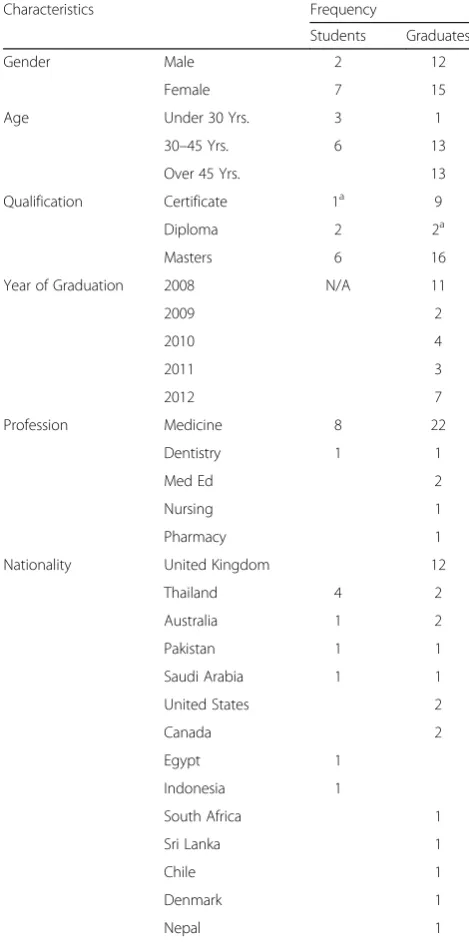
actively started looking for employment as well as PhD opportunities in medical education outwith their home country.
Tensions of being and becoming a medical educator Through analysis of the transcripts, we identified six tensions associated with both becoming and being a medical educator (Table 2). These tensions are not mu-tually exclusive and do not occur in isolation.
Balancing multiple intersecting identities
Students and graduates expressed tensions with finding the right balance between education and clinical and were worried about their loss of identities if they choose to be full-time educators. They expressed a concern that choosing one identity would result in losing the other. The clinical society might disregard them as educators and they might not be taken seriously in the medical world. A Masters’student from Indonesia mentioned:
‘If I become a full time educator what will happen with my clinical career that’s one of my worry also. I do not really know after this it’s like do I really want to sacrifice my clinical career now and become full time educator and I still can’t answer that question really well now’(Male-Medicine-Masters-Student#4)
The participants with a clinical background mentioned having to juggle multiple roles including clinical and edu-cational roles. With their new eduedu-cational responsibilities, they found it hard to maintain a work-life balance. A foun-dation programme tutor and associate medical director reported:
‘The time it takes to do it properly, I worry that it could impact on my patients and…the impact that it has on my home life as well…so those tension between my clinical work but also my home, my work life balance’(Female–
Medicine-Certificate-Graduate#168)
Educator careers are undervalued
Participants reported a negative bias and less regard to-wards those wishing to pursue a career in education compared with clinical specialities. Education was seen as less valued in comparison with other career tracks of a health professional in their countries. Despite the asso-ciated career progress, their colleagues questioned its need and importance. A clinical skills tutor mentioned:
‘Education [is] perhaps less respected than the clinical disciplines…when I talk to people who are clinicians
…they ask what are you doing and I say education and they are kind of like oh you know I am wondering Table 1Characteristics of interview participants
Characteristics Frequency
Students Graduates
Gender Male 2 12
Female 7 15
Age Under 30 Yrs. 3 1
30–45 Yrs. 6 13
Over 45 Yrs. 13
Qualification Certificate 1a 9
Diploma 2 2a
Masters 6 16
Year of Graduation 2008 N/A 11
2009 2
2010 4
2011 3
2012 7
Profession Medicine 8 22
Dentistry 1 1
Med Ed 2
Nursing 1
Pharmacy 1
Nationality United Kingdom 12
Thailand 4 2
Australia 1 2
Pakistan 1 1
Saudi Arabia 1 1
United States 2
Canada 2
Egypt 1
Indonesia 1
South Africa 1
Sri Lanka 1
Chile 1
Denmark 1
Nepal 1
a
currently enrolled for Diploma/Masters
Table 2Tensions as a medical educator
Tensions common to both active students and graduates
Balancing multiple intersecting identities
Educator careers are undervalued
Educator careers are less well defined
Translating theory to practice
Educator careers are financially disadvantaged
if that is a real speciality…and sometimes you kind of get sick of explaining that to people it might be easier to just say oh I am a surgeon ((laugh))’ (Female–Medicine-Diploma-Student#1)
Others reported active marginalisation of those work-ing in the medical education department:
‘People who didn’t cheer in the curriculum reforms so they hate the name medical education … people who forced us to change our curriculum who forced us to inte-grate and teach less so they hate the medical education department’(Female–Medicine-Masters-Student#3)
Educator careers are less well defined
Both students and graduates also stated that an educator career track was not defined in their institutions. Job descriptions and promotion policies were not clear for educators, and they were judged on the same criteria as clinicians or researchers. They expressed a concern that, being an emerging speciality, people did not have much idea of how medical educators impacted on healthcare. A continuing education director from North America stated:
‘So my job description is as a clinician educator which is probably the least well defined of all the job descriptions in terms of what the expectations are and what the criteria are for promotions.’(Male–
Medicine-Masters-Graduate#94)
Translating theory to practice
Participants also found it challenging to enact their learning due to various factors involved in the process beyond their control. They expressed tensions when translating knowledge learned during the programme to the specific-contexts of their workplaces as represented by the following excerpt from a lecturer of medical education:
‘Unfortunately you cannot impose any programme on professionalism from another country…because professionalism is a culture specific issue, what is professional for you in Pakistan, may not be
professional for me in Egypt or in UK…even the way of dressing of a doctor makes it different…so you need to tailor your own programme on professionalism which is a challenge’ (Male-MedEd-Masters-Graduate#30)
This theory-practice gap is also highlighted in the fol-lowing excerpt of consultant neurosurgeon and clinical teacher from Thailand:
‘In the accident and emergency unit that for me it is difficult to do it [feedback] readily because I had to practice at the same time…I had read about feedback that…needs to be done immediately but for me it’s very difficult in real practice’
(Female-Medicine-Diploma-Graduate#202)
Educator careers are financially disadvantaged
The participants also mentioned that pursuing a career focussed on medical education placed them in a weaker financial position in comparison to their clinical col-leagues. Moreover, funding for educational projects was less than in the biological and medical sciences, making it almost impossible to receive equal funding for their institution. Yet they were being judged based on the same metrics as those in the biological and medical sci-ences. A head of medical education centre explained:
‘The financial issue for example in Sri Lanka majority of doctors do private practice and they earn a lot in my case I depend highly on the salary I receive from the university…there are tensions about whether I took the right decision because I am at a relatively financially disadvantaged position’ (Male-Medicine-Masters-Graduate#59)
Challenges towards further development and staying up to date
Participants were concerned about their further develop-ment in medical education. They develop-mentioned various rea-sons such as unavailability of PhD programmes, lack of mentors and inaccessibility of the literature in medical education locally. An MD from Saudi Arabia mentioned:
‘I say now that I want to do a PhD but I might not get to…there aren’t many graduate programmes in medical education around the world it’s like 20 programmes in PhD so what if something does not come up then you would have to consider other avenues that would take you away from education’ (Female–Medicine-Masters-Student#2)
The graduates were challenged with further develop-ment as they came to recognise that medical education was a vast speciality with sub-specialities in teaching, learning, assessment and curriculum. Therefore, it had become difficult for them as a generalist to keep up-to-date in all areas of medical education. One senior clinical teacher from the UK reported:
Graduates also expressed a concern that they were expected to know everything about education in their in-stitutions. They were at times asked to take on responsi-bilities that were not relevant to their interests or competencies. A director in Continuing Education from Canada stated:
‘I think people end up assuming that education is just one thing and that someone who has an interest or training in education can do everything related to any aspect of education, so…my thesis was in postgraduate education but the responsibility I was given when I started here was more in a realm of continuing education.’(Male-Medicine-Masters-Graduate#94)
No fears
Interestingly, most of the graduates with extensive ex-perience in education and 45+ years of age (more senior educators) reported no fears, rather asserting that the qualification gave them job variety. In the words of a clinical tutor from UK:
‘I do not think I have any fears I think it gives me lots of options I think it gives me variety at my job because
…I facilitate research…I do a lot of clinical work and about a third of my job plan is involved in teaching now, so it’s a nice mixture.’ (Female-Medicine-Masters-Graduate#72)
Discussion
The participants reported multiple fears and tensions associated with becoming and being a healthcare educa-tor. The tensions commonly identified by the graduates and students e.g., being unable to balance various roles, lack of regard for educators, and being financially disad-vantaged are in line with those identified by healthcare educators in other studies [8–13]. Our analysis identified some additional tensions for those pursuing or having a qualification in medical education such as managing inter-secting identities, challenges towards further development, keeping up-to-date with new research and unrealistic ex-pectations from colleagues to know everything about med-ical education. Interestingly, the more experienced senior educators (45+ years of age) reported no tensions or fears. Many of these tensions related to becoming and being an educator are magnified by the disciplinary and organisational culture and policies in the workplace. Therefore, the participants’ fears were influenced by contextual factors and their response to these factors was determined by personal factors. CoP theory helps explain why there may be tensions between the personal and social, as individuals construct their identities and endeavour to find a place in the community [22]. The graduates extensively used ‘you know’ while describing
their fears. This suggested that these fears were not specific to these individuals but commonly known and shared experience of being a healthcare educator.
The participants found it difficult to balance their edu-cational roles or pursue scholarly activities with other clinical responsibilities and administrative loads, as also reported by Edwards [26]. They reported multiple time demands with no protected time for carrying out schol-arly activities. They often sacrificed personal time, thus affecting their personal lives. Zibrowski et al., [9] also re-ported similar constraints on the faculty with interest and involvement in educational scholarship. Such time related constraints with little time to improve teaching, assessment or curriculum makes the development of further competencies in education challenging for the educators [27].
Having an active clinical practice was seen as import-ant and fundamental in supporting medical education roles. The process of professional identity formation meant that students were working out how to balance their clinical and educational identities with some con-sidering becoming fulltime academics in medical educa-tion. They saw themselves at the crossroads between clinical and developing educational identity, and won-dering which direction to take. This tension arises from a comparison of their internal identities with their pos-sible selves i.e., becoming an educator [28]. In cases of conflict, this negotiation may result in rejection of the professional roles (new or old identities) or other acts of resistance such as inappropriate behaviours [29, 30]. The Early Careers Working Group at the Academy of Medical Educators also reported this career identity crises [31]. This situation probably arises because medical education is still in its nascent stage, and may resolve with the increasing professionalisation of the speciality, although many entering medical educa-tion as health professionals will have to make choices about managing their clinical and educational roles and identities.
leaders, faculty who feel their contributions are unrec-ognised are more likely to burn out and are less likely to continue contributing [13, 34].
Participants felt that medical education, being a rela-tively new field of practice, was poorly defined as a car-eer. The Academic Careers Sub-Committee of the UK Clinical Research Foundation [11] also pointed out this limited information on entry routes and subsequent car-eer pathways in academia, and lack of structured and funded posts for educators. Sethi [7] reported various extrinsic motivations for these participants towards enrolment. For example, some enrolled because they perceived the qualification would bring positive career prospects, while others were recommended and spon-sored by their home institutions. This suggests an in-creased differentiation of the roles of medical educators and a need for qualified educators. It also shows a trend towards recognition of medical education as a speciality. This shift in focus and investment towards development of medical education at the level of policy makers and leadership shows that there is a promising future for early career medical educators pursuing it full-time. As highlighted in the Table 1 above, the increased propor-tion of under 30 years old students in 2013/14 cohort in comparison with the graduates between 2008 and 2012 suggests younger healthcare professionals are also recog-nising medical education as an area worth specialising in. This is a promising positive shift for the valuing of medical education that might not be shared by all clin-ical colleagues in the workplace.
The participants also resented that the promotion pol-icies in their institutions are not clear for educationalists, and they are often judged using the same criteria as cli-nicians or researchers in their institutions (e.g., amount of awarded grant funds). This resentment towards pro-motion assessment against a metric that did not relate to teaching quality was also reported by early career medical educators in Australian and New Zealand med-ical schools [10] and clinicians engaged in an academic careers [12, 13], suggesting a worldwide phenomenon.
As with any new field of scholarly activity medical education faces multiple challenges such as low levels of funding, lack of recognition and reduced opportunities for career development [10, 13, 15, 35]. The participants mentioned that their efforts are undervalued and under-supported financially in comparison with those working in other areas. Moreover, they were concerned that a full-time career in medical education might be person-ally financiperson-ally disadvantageous, as academic salaries rarely match those of clinicians. Goldszmidt et al., [36] reported that faculty do not receive financial support for their work and they are discouraged from participating in educational conferences because of the associated costs. It has been called a ‘Cinderella discipline’ [10].
Despite all these concerns, the graduates continued to invest in education owing to their interest and passion. Most of them struggled but continued to work out-of-hours, affecting personal and family life. This is associ-ated with altruistic behaviour, which is a common trait among those classifying themselves as members of a profession [37]. However, society’s acceptance of health professionals with full-time careers in medical education will be critical to their retention and success [9].
Participants recognised the complexity of practice and highlighted the gap between theory and practice. They were also concerned about the contextual nature of prac-tice in medical education and the translational work needed to effect practice change in the workplace. Effect-ing educational change requires strong educational leader-ship and sense of self in the face of resistance and under-valuing. The flipside is that the interplay of these tensions may lead to detachment, cynicism and a weak sense of identity among healthcare educators leading to decreased ability or motivation to effect changes in the workplace and to seek further professional development.
Participants reported concerns about their further de-velopment as medical educators in their home countries after graduation. The lack of available further training in medical education conflicts with other mature specialties such as basic and clinical sciences in which the training progression is clearly defined and well-trodden [11]. Graduates also reported more practical concerns regard-ing stayregard-ing up-to-date and beregard-ing seen as an expert in medical education having returned to their institutions with a qualification. Staying current with the literature in medical education is an important competency of ex-pert teachers [38]. Faux [39] estimated that for each working day, it would take 75 min for a physician to keep themselves up-to-date with the medical education literature, which is not practical given current workload demands in the healthcare sector. All such concerns highlight a need towards continued professional devel-opment programmes as well as developing sub-speciality courses and for preparing specialists with advanced knowledge and skills in specific areas of medical education such as assessment, curriculum development, educational research methodology and technology-enabled learning. Specialised Masters’ programmes or postgraduate pro-grammes with optional specialist modules are already be-ing offered in topics such as simulation. However, such specialisation requires accepted career paths and positions within the academia and healthcare settings.
career in its own right [10, 40]. Alternatively, it may highlight that the senior educators were secure in their career choices and intersecting identities within their communities and had managed to find ways of man-aging competing demands on their time.
Limitations
The findings were based on participant self-reporting and not correlated with observed behaviours. Also, the study was based on participants from one programme but from many countries and work institutions. Yin [41] argues that case study research closely examines the data (micro-level) within a specific context and provides de-tailed insights into the behaviours when little informa-tion is available regarding a contemporary phenomenon. We have assumed that those who graduated in 2008 have more educational experience than those who grad-uated in 2012 and that those over 45 years of age are more senior educators than those under 30 years.
Thirty of thirty-six participants are medical doctors. Two participants (30–45 years age group) who men-tioned medical education as their profession (Table 1) were also doctors but did the qualification early in their professional career. The graduates belonging to profes-sions other than medicine in our study were all above 45 years of age and reported having no fears, as was found with this age group from medicine. The findings may be transferable to healthcare educators broadly as a diverse range of professionals are teaching in the med-ical schools [15] and many of these tensions are related to the policies and practices in the workplace. However, further study is needed in this area, as to assume these findings are transferrable to other healthcare educators on the current data would be premature. We have re-ported participants’ year of graduation along with a de-scription of their roles, acknowledging we could have asked more questions relating to their training. However, we were keen to keep the interview guide short to maxi-mise engagement. Despite these limitations, the study achieved its aims; it complements and extends the find-ings of the previous studies.
Implications of the study
Kumar and colleagues [13] found that beliefs and values related to teaching have a strong impact on identity for-mation of healthcare educators. Therefore, understand-ing these tensions are critical to successful academic careers [8, 42]. Postgraduate programmes in medical education could help their students identify these ten-sions and develop coping strategies. These programmes should also equip the graduates with skills around edu-cational change management and knowledge translation that takes account of the context. Postgraduate alumni mentoring programmes may further assist becoming
medical educators in navigating the multiples tensions and poorly defined career paths highlighted in this research.
Health professionals usually represent and belong to clinical disciplines from which they primarily derive their knowledge. However, when they begin to take on an educational role, they should be judged against the stated criteria for an educator in planning, policy, deliv-ery or research rather than their clinical specialty. With-out this the educators will be under pressure to spend the majority of their time in clinical practice or research rather than developing and delivering high quality of teaching or innovations in practice. Medical educators represent a heterogeneous workforce with varying re-sponsibilities for curriculum design, assessment, research or management [43]. Therefore, it is difficult to encom-pass their roles and competencies within a set of stan-dards. The descriptors for different categories of the UK Professional Standards Framework [44] and Academy of Medical Educators [45], may be able to assist in profes-sionally validating the capabilities of medical educators.
Medical educators should be given adequate oppor-tunities, including protected time and funding in order to improve their teaching, introduce innovations and interact with an educational community in the work-place. Separate career routes, specific job descriptions and academic workload models for medical educators are recommended to further the professionalisation of medical education and benefit the educators, and in turn students and patients in the long term [37, 46]. We see this specialisation also occurring through for example the Faculty of Surgical Trainers, an initiative of The Royal College of Surgeons of Edinburgh, or the Academy of Medical Educators’ recognition of specific education competencies. Further in the UK the Teaching Excel-lence Framework (TEF) is currently being developed to create a dynamic and internationally competitive teach-ing sector, and also to encourage the professionalisation of educational roles in HE [47]. This framework mirrors the Research Excellence Framework [48] which is used for assessing research and allocation of governmental funding to UK higher education institutions. The impact of the REF on improving the quality of research has been reported recently [49]. However, teaching and learning is complex, multi-faceted and dynamic, thus identifying TEF assessment metrics which encourage transformation of teaching will be a challenge.
with accessibility to medical education literature and a crit-ical number of individuals having a Masters/PhDs in med-ical education is a pre-requisite, otherwise, the quality of research in medical education will be suboptimal. To over-come the shortage of PhD supervisors, Riesenberg et al., [27] recommended hiring non-physician professionals with expertise in education as they can offer added value through their alternative perspectives on problems in medical education. Tekian [50] also recommended considering other options leading to specialisation in medical education, such as doctoral training in other disciplines, collaborating with those in medical educa-tion to foster disciplinary diversity and advancement in medical education research.
Conclusion
This study has highlighted tensions specific to being and becoming medical educators such as managing multiple roles, lack of PhD opportunities, the challenge of staying up-to-date with new research and unrealistic expectations from colleagues to know everything in medical education. A comparison of tensions expressed by participants at vari-ous stages in their career indicates that medical educators move through different stages of emotional experience as they find their place, and develop a sense of belonging. Ad-dressing the marginalisation of medical educators within their disciplinary and organisational cultures, and assisting becoming educators in navigating their careers through tai-lored workload and promotion policies, access to further educational opportunities, knowledge about possible ten-sions and access to mentoring would seem priorities.
Acknowledgments
The authors would like to thank all the participants for their time.
Funding
Higher Education Commission and Khyber Medical University, Pakistan funded Ahsan’s PhD candidature.
Availability of data and materials
The datasets analysed during the current study are not publicly available due to an automatic embargo of one year for all University of Dundee theses, but can be made available from the corresponding author on reasonable request.
Authors’contributions
AS conducted this research as part of his PhD at the University of Dundee. All authors (AS, RA, SM and SS) were involved in the design and conceptual framing of the study. AS secured ethics approval and collected the data. AS transcribed all data. AS, RA and SS were involved in the data analysis and contributed to the development of the codes. All contributed to the writing of the paper and approved the final version.
Competing interests
The authors declare that they have no competing interests.
Consent for publication
Not Applicable.
Ethics approval and consent to participate
Ethical approval was obtained from the Research Ethics Committee, University of Dundee. Written as well as verbally informed consent was taken from each participant for the interview and for it being audio recorded.
Publisher’s Note
Springer Nature remains neutral with regard to jurisdictional claims in published maps and institutional affiliations.
Author details
1Institute of Health Professions Education & Research, Khyber Medical
University, Hayatabad Phase 5, Peshawar, Pakistan.2Centre for Medical Education, University of Dundee, Dundee, UK.3Centre for Research in
Assessment and Digital Learning, Deakin University, Geelong, Australia.
Received: 6 October 2016 Accepted: 7 March 2017
References
1. Bleakley A, Bligh J, Browne J. Medical education for the future: Identity, power and location. Dordrecht Heidelberg London New York: Springer; 2011. 2. Sethi A, Schofield S, Ajjawi R, Mcaleer S. How do postgraduate qualifications
in medical education impact on health professionals? Med Teach. 2016; 38(2):162–7.
3. Davis MH, Karunathilake I, Harden RM. AMEE education guide no. 28: the development and role of departments of medical education. Med Teach. 2005;27(8):665–75.
4. Gruppen LD, Simpson D, Searle NS, Robins L, Irby DM, Mullan PB. Educational fellowship programs: common themes and overarching issues. Acad Med. 2006;81(11):990–4.
5. Tekian A, Artino Jr AR. AM last page: master’s degree in health professions education programs. Acad Med. 2013;88(9):1399.
6. Foundation for Advancement of International Medical Education and Research. Master’s Programs in Health Professions Education 2015. Available from: http://www.faimer.org/resources/mastersmeded.html. Accessed 8 Aug 2015. 7. Sethi A. The Impact of Postgraduate Qualifications in Medical Education
Dundee: University of Dundee; 2016. Available from: http://discovery. dundee.ac.uk/portal/en/theses/the-impact-of-postgraduate-qualifications-in-medical-education(2d54dc4a-5be0-4ec3-9871-0e57b1523c46).html. Accessed 10 Aug 2016.
8. Marks MB. Academic careers in medical education: perceptions of the effects of a faculty development program. Acad Med. 1999;74(10):S72–4. 9. Zibrowski EM, Weston WW, Goldszmidt MA.‘I don’t have time’: issues of fragmentation, prioritisation and motivation for education scholarship among medical faculty. Med Educ. 2008;42(9):872–8.
10. Hu WC, Thistlethwaite JE, Weller J, Gallego G, Monteith J, McColl GJ.‘It was serendipity’: a qualitative study of academic careers in medical education. Med Educ. 2015;49(11):1124–36.
11. UK Clinical Research Collaboration and Modernising Medical Careers. Medically and dentally qualified academic staff: Recommendations for training the researchers and educators of the future London2005. Available from: http://www.ukcrc.org/wp-content/uploads/2014/03/Medically_and_ Dentally-qualified_Academic_Staff_Report.pdf. Accessed 15 Jul 2016. 12. Hauer KE, Papadakis MA. Assessment of the contributions of clinician
educators. J Gen Intern Med. 2010;25(1):5–6.
13. Kumar K, Roberts C, Thistlethwaite J. Entering and navigating academic medicine: academic clinician‐educators’experiences. Med Educ. 2011;45(5): 497–503.
14. Trigwell K, Martin E, Benjamin J, Prosser M. Scholarship of teaching: a model. High Educ Res Dev. 2000;19(2):155–68.
15. Bligh J, Brice J. Further insights into the roles of the medical educator: the importance of scholarly management. Acad Med. 2009;84(8):1161–5. 16. Charmaz K. Constructing grounded theory: a practical guide through
qualitative analysis. London: Sage Publications; 2006.
17. Skeat J. Using grounded theory in health research. In: Liamputtong P, editor. Research methods in health: foundations for evidence-based practice. Oxford: Oxford University Press; 2010. p. 106–22.
18. Morgan DL. Integrating qualitative and quantitative methods: a pragmatic approach. 1st ed. London: Sage Publications; 2013.
20. Lambert-Heggs W. The‘F’word: conflicts and tensions in a community of practice when mentors confront the possibility of failing a trainee in teaching observations. Teach Lifelong Learn. 2011;3(1):29–39. 21. Barab SA, Barnett M, Squire K. Developing an empirical account of a
community of practice: characterizing the essential tensions. J Learn Sci. 2002;11(4):489–542.
22. Wenger E. Communities of practice and social learning systems: the career of a concept. In: Blackmore C, editor. Social learning systems and communities of practice. London: Springer; 2010. p. 179–98.
23. Dey I. Grounding grounded theory: guidelines for qualitative inquiry. San Diego: Academic; 1999.
24. Watling CJ, Lingard L. Grounded theory in medical education research: AMEE Guide No. 70. Med Teach. 2012;34(10):850–61.
25. Charmaz K. Grounded theory method: an explication and interpretation. In: Emerson RM, editor. Contemporary field research: a collection of readings. Boston: Little, Brown; 1983. p. 109–26.
26. Edwards K.“Short stops”: peer support of scholarly activity. Acad Med. 2002; 77(9):939.
27. Riesenberg LA, Little BW, Wright V. Nonphysician medical educators: a literature review and job description resource. Acad Med. 2009;84(8):1078–88. 28. Monrouxe L, Poole G. An onion? Conceptualising and researching identity.
Med Educ. 2013;47(4):425–9.
29. Helmich E, Derksen E, Prevoo M, Laan R, Bolhuis S, Koopmans R. Medical students’professional identity development in an early nursing attachment. Med Educ. 2010;44(7):674–82.
30. Helmich E, Dornan T. Do you really want to be a doctor? The highs and lows of identity development. Med Educ. 2012;46(2):132–4.
31. Sabel E, Archer J.“Medical education is the ugly duckling of the medical world”and other challenges to medical Educators’identity construction: a qualitative study. Acad Med. 2014;89(11):1474–80.
32. Brownell SE, Tanner KD. Barriers to faculty pedagogical change: lack of training, time, incentives, and…tensions with professional identity? CBE Life Sci Educ. 2012;11(4):339–46.
33. Spencer J. Learning and teaching in the clinical environment. Br Med J. 2003;326(7389):591–4.
34. Schindler N, Winchester DP, Sherman H. Recognizing clinical faculty’s contributions in education. Acad Med. 2002;77(9):940–1.
35. Archer J, McManus C, Woolf K, Monrouxe L, Illing J, Bullock A, et al. Editorials: without proper research funding, how can medical education be evidence based? Br Med J. 2015;350(h3445):1–2.
36. Goldszmidt MA, Zibrowski EM, Weston WW. Education scholarship: it’s not just a question of degree. Med Teach. 2008;30(1):34–9.
37. Newlyn D. Are professors professionals? a fresh look at this question. Univ J Educ Res. 2015;3(2):113–9.
38. Duvivier R, Van Dalen J, Van Der Vleuten C, Scherpbier A. Teacher perceptions of desired qualities, competencies and strategies for clinical skills teachers. Med Teach. 2009;31(7):634–41.
39. Faux D. Information overload. Med Teach. 2000;22(1):5–6.
40. Eyre HA, Mitchell RD, Milford W, Vaswani N, Moylan S. Portfolio careers for medical graduates: implications for postgraduate training and workforce planning. Aust Health Rev. 2014;38(3):246–51.
41. Yin RK. Case study research: design and methods. London: Sage Publications; 2013.
42. Steinert Y, Nasmith L, McLeod PJ, Conochie L. A teaching scholars program to develop leaders in medical education. Acad Med. 2003;78(2):142–9. 43. Forsetlund L, Bjørndal A, Rashidian A, Jamtvedt G, O’Brien MA, Wolf F,
et al. Continuing education meetings and workshops: effects on professional practice and health care outcomes. Cochrane Database Syst Rev. 2009;2(2):1–97.
44. UK Professional Standards Framework. The UK Professional Standards Framework for teaching and supporting learning in higher education 2011. Available from: https://www.heacademy.ac.uk/sites/default/files/downloads/ ukpsf_2011_english.pdf. Accessed 20 Jun 2015.
45. Academy of Medical Educators. Professional Standards for medical, dental and veterinary educators 2014. Available from: http://www.medicaleducators.org/ write/MediaManager/AOME_Professional_Standards_2014.pdf. Accessed 10 Jul 2016.
46. McLean M, Cilliers F, Van Wyk JM. Faculty development: yesterday, today and tomorrow. Med Teach. 2008;30(6):555–84.
47. Tatlow P, Phoenix D. The possibilities and pitfalls of a Teaching Excellence Framework 2015. Available from: http://dera.ioe.ac.uk/24653/1/The_
possibilities_and_pitfalls_of_a_Teaching_Excellence_Framework.pdf. Accessed 6 Jan 2015.
48. Research Excellence Framework. Key Facts 2014. Available from: http://www. ref.ac.uk/media/ref/content/pub/REF%20Brief%20Guide%202014.pdf. Accessed 25 Jun 2015.
49. Stern N. Building on Success and Learning from Experience: An Independent Review of the Research Excellence Framework 2016. Available from: https:// www.gov.uk/government/uploads/system/uploads/attachment_data/file/ 541338/ind-16-9-ref-stern-review.pdf. Accessed 2 Oct 2016.
50. Tekian A. Doctoral programs in health professions education. Med Teach. 2014;36(1):73–81.
• We accept pre-submission inquiries
• Our selector tool helps you to find the most relevant journal
• We provide round the clock customer support
• Convenient online submission
• Thorough peer review
• Inclusion in PubMed and all major indexing services
• Maximum visibility for your research
Submit your manuscript at www.biomedcentral.com/submit