Open Access
Research
Identification of nine sequence types of the 16S rRNA genes of
Campylobacter jejuni
subsp.
jejuni
isolated from broilers
Ingrid Hansson*
1, Marianne Persson
1, Linda Svensson
2,
Eva Olsson Engvall
2,3and Karl-Erik Johansson
1,3Address: 1Department of Bacteriology, National Veterinary Institute, SE-751 89 Uppsala, Sweden, 2Swedish Zoonosis Center, Department of Disease Control, National Veterinary Institute, SE-751 89 Uppsala, Sweden and 3Department of Biomedical Sciences and Veterinary Public Health, Swedish University of Agricultural Sciences, SE-750 07 Uppsala, Sweden
Email: Ingrid Hansson* - [email protected]; Marianne Persson - [email protected]; Linda Svensson - [email protected]; Eva Olsson Engvall - [email protected]; Karl-Erik Johansson - [email protected]
* Corresponding author
Abstract
Background: Campylobacter is the most commonly reported bacterial cause of enteritis in humans in the EU Member States and other industrialized countries. One significant source of infection is broilers and consumption of undercooked broiler meat. Campylobacter jejuni is the Campylobacter sp. predominantly found in infected humans and colonized broilers. Sequence analysis of the 16S rRNA gene is very useful for identification of bacteria to genus and species level. The objectives in this study were to determine the degree of intraspecific variation in the 16S rRNA genes of C. jejuni and C. coli and to determine whether the 16S rRNA sequence types correlated with genotypes generated by PFGE analysis of SmaI restricted genomic DNA of the strains.
Methods: The 16S rRNA genes of 45 strains of C. jejuni and two C. coli strains isolated from broilers were sequenced and compared with 16S rRNA sequences retrieved from the Ribosomal Database Project or GenBank. The strains were also genotyped by PFGE after digestion with SmaI.
Results: Sequence analyses of the 16S rRNA genes revealed nine sequence types of the Campylobacter strains and the similarities between the different sequence types were in the range 99.6–99.9%. The number of nucleotide substitutions varied between one and six among the nine 16S rRNA sequence types. One of the nine 16S rRNA sequence profiles was common to 12 of the strains from our study and two of these were identified as Campylobacter coli by PCR/REA. The other 10 strains were identified as Campylobacter jejuni. Five of the nine sequence types were also found among the Campylobacter sequences deposited in GenBank. The three 16S rRNA genes in the analysed strains were identical within each individual strain for all 47 strains.
Conclusion: C. jejuni and C. coli seem to lack polymorphisms in their 16S rRNA gene, but phylogenetic analysis based on 16S rRNA sequences was not always sufficient for differentiation between C. jejuni and C. coli. The strains were grouped in two major clusters according to 16S rRNA, one cluster with only C. jejuni and the other with both C. jejuni and C. coli. Genotyping of the 47 strains by PFGE after digestion with SmaI resulted in 22 subtypes. A potential correlation was found between the SmaI profiles and the 16S rRNA sequences, as a certain SmaI type only appeared in one of the two major phylogenetic groups.
Published: 21 May 2008
Acta Veterinaria Scandinavica 2008, 50:10 doi:10.1186/1751-0147-50-10
Received: 1 February 2008 Accepted: 21 May 2008
This article is available from: http://www.actavetscand.com/content/50/1/10
© 2008 Hansson et al; licensee BioMed Central Ltd.
Background
Campylobacter spp., principally Campylobacter jejuni
subsp.jejuni, are important food- and water-borne patho-gens for man [1-3]. In the present paper Campylobacter jejuni subsp. jejuni is referred to as C. jejuni and Campylo-bacter jejuni subsp. doylei as C. doylei. Campylobacter jejuni
is frequently found in the intestinal tract in a wide variety of wild and domesticated animals, especially poultry [1,4]. The genus Campylobacter was introduced by Sebald and Verón [5] and its taxonomic structure has been revised a number of times [6-8]. At present the genus
Campylobacter contains 17 species, four of which have been further divided into eight subspecies [9]http:// www.bacterio.cict.fr/. The use of molecular methods in bacteriology has resulted in increased knowledge about biodiversity within the genus Campylobacter. Sequence analysis of the 16S rRNA gene has proved extremely useful for evolutionary studies of prokaryotes [10] and consti-tutes the basis for the revised taxonomy of bacteria [11]. This method has also been successfully used for identifi-cation of Campylobacter spp. [12]. Taxonomy has become a flexible and constantly evolving science and further progress in methodologies will probably result in addi-tional adjustments in the classification of members of the genus Campylobacter. Furthermore, several PCR assays have successfully been applied for detection of Campylo-bacter with improved accuracy in identification of Campy-lobacter spp. from various sources.
Isolates from different bacteria can be identified to genus and often also to species level by sequence analysis of the 16S rRNA gene. Most species within the genus Campylo-bacter can be successfully differentiated by sequence anal-ysis of the 16S rRNA gene. However, C. jejuni, C. coli and
C. lari have been more difficult to differentiate by such sequence analysis [12]. Bacterial genomes can harbour up to 15 rRNA operons and the sequences of the correspond-ing genes are not always identical, which can make it dif-ficult to interpret sequence data [13]. The nucleotide substitutions between different genes within a gene family are referred to as polymorphisms. Sequence differences can also occur between homologous genes from different strains of a certain bacterial species. All these nucleotide substitutions are collectively referred to as intraspecific variation. It has previously been reported that C. jejuni has three copies of the 16S rRNA gene in the genome [14,15]. One aim of our study was to establish if sequence differ-ences exist between the three genes in a certain Campylo-bacter jejuni strain, because if intraspecific variation exists in these genes it may be possible to use the method for subtyping [16,17]. In a previous study of Campylobacter
spp. from broilers in Sweden, 390 isolates were analysed by PFGE [18]. After digestion with SmaI, almost 80 differ-ent banding patterns (SmaI types) were obtained, includ-ing isolates that could not be digested with SmaI. Some of
the subtypes were isolated more frequently than others. Another aim of the present study was to determine the sequence variation in the 16S rRNA genes of different
Campylobacter jejuni strains and to determine whether the 16S rRNA sequence types correlated to the SmaI types.
Materials and methods
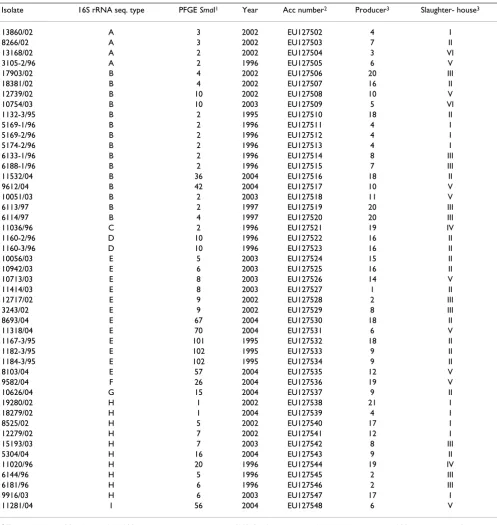
Bacterial strainsAll bacterial strains were isolated from cloacal samples collected at slaughter within the Swedish Campylobacter programmes. The origins of the 47 strains (producer and slaughterhouse) are given in Table 1. The strains were iso-lated from different flocks delivered by 21 broiler produc-ers to 6 different slaughterhouses during two periods, 1995–1997 and 2002–2004. First, two strains from each of the 10 most common SmaI types reported within the Campylobacter program in Sweden 2002–2004 were selected. Then eight new strains found at least four times in a previous Swedish study [18] were also selected for analysis. The selection was based on the SmaI profiles, and the profiles of these strains were similar to those of the 10 most common SmaI types. The 19 strains from 1995– 1997 (Table 1) were chosen from the same producers as those from 2002–2004, which are known to frequently deliver Campylobacter-positive broilers [19]. The SmaI pro-files are numbered according to previous studies in Swe-den [18].
Procedures for sampling, transport and laboratory analy-ses have been described previously [19]. Identification of
Campylobacter spp. was based on colony morphology, microscopic appearance and the following phenotypic characteristics: motility, production of cytochrome C oxi-dase and catalase, and the hippurate hydrolysis reaction [20]. One colony from each positive sample was stored in glycerol broth (15% glycerol and 85% serum broth) at -70°C before further use.
Genotyping of selected strains by PCR/REA and PFGE Species identification of C. jejuni was initially based on a positive hippurate hydrolysis reaction. Isolates that gave a weak or negative hippurate reaction were speciated by the polymerase chain reaction, followed by restriction enzyme analysis (PCR/REA) by which C. jejuni, C. coli, C. lari, and C. upsaliensis can be identified and differentiated [21]. In addition, some strains were tested by PCR for the hippuricase gene [22].
were analysed by computer-assisted identification with GelCompar II (Applied Maths, Kortrijk, Belgium).
Sequencing of 16S rRNA genes
DNA was prepared from the bacteria by lysis of 1–3 colo-nies in 100 µl of water at 100°C for 10 min. The lysate was used as a template for in vitro amplification of the 16S rRNA genes by PCR. The PCR products were used for cycle
Table 1: Forty seven strains of C. jejuni and C. coli from cloacal samples taken within the Swedish Campylobacter programmes for
broilers, for which the 16S rRNA gene sequences were determined in the present study
Isolate 16S rRNA seq. type PFGE SmaI1 Year Acc number2 Producer3 Slaughter- house3
13860/02 A 3 2002 EU127502 4 I
8266/02 A 3 2002 EU127503 7 II
13168/02 A 2 2002 EU127504 3 VI
3105-2/96 A 2 1996 EU127505 6 V
17903/02 B 4 2002 EU127506 20 III
18381/02 B 4 2002 EU127507 16 II
12739/02 B 10 2002 EU127508 10 V
10754/03 B 10 2003 EU127509 5 VI
1132-3/95 B 2 1995 EU127510 18 II
5169-1/96 B 2 1996 EU127511 4 I
5169-2/96 B 2 1996 EU127512 4 I
5174-2/96 B 2 1996 EU127513 4 I
6133-1/96 B 2 1996 EU127514 8 III
6188-1/96 B 2 1996 EU127515 7 III
11532/04 B 36 2004 EU127516 18 II
9612/04 B 42 2004 EU127517 10 V
10051/03 B 2 2003 EU127518 11 V
6113/97 B 2 1997 EU127519 20 III
6114/97 B 4 1997 EU127520 20 III
11036/96 C 2 1996 EU127521 19 IV
1160-2/96 D 10 1996 EU127522 16 II
1160-3/96 D 10 1996 EU127523 16 II
10056/03 E 5 2003 EU127524 15 II
10942/03 E 6 2003 EU127525 16 II
10713/03 E 8 2003 EU127526 14 V
11414/03 E 8 2003 EU127527 1 II
12717/02 E 9 2002 EU127528 2 III
3243/02 E 9 2002 EU127529 8 III
8693/04 E 67 2004 EU127530 18 II
11318/04 E 70 2004 EU127531 6 V
1167-3/95 E 101 1995 EU127532 18 II
1182-3/95 E 102 1995 EU127533 9 II
1184-3/95 E 102 1995 EU127534 9 II
8103/04 E 57 2004 EU127535 12 V
9582/04 F 26 2004 EU127536 19 V
10626/04 G 15 2004 EU127537 9 II
19280/02 H 1 2002 EU127538 21 I
18279/02 H 1 2004 EU127539 4 I
8525/02 H 5 2002 EU127540 17 I
12279/02 H 7 2002 EU127541 12 I
15193/03 H 7 2003 EU127542 8 III
5304/04 H 16 2004 EU127543 9 II
11020/96 H 20 1996 EU127544 19 IV
6144/96 H 5 1996 EU127545 2 III
6181/96 H 6 1996 EU127546 2 III
9916/03 H 6 2003 EU127547 17 I
11281/04 I 56 2004 EU127548 6 V
1 The numbering of SmaI types 1 to 100 is according to other studies [15]. SmaI types assigned numbers greater than 100 have not been found
previously in subtyping of isolates within the Swedish Campylobacter program 2001–2006.
sequencing with fluorescently labelled terminators (Big Dye; Applied Biosystems, Foster City, Calif., USA) as described by the manufacturer and with a set of sequenc-ing primers developed for members of the phylum Proteo-bacteria [24]. The sequencing products were analysed by capillary electrophoresis on an ABI Prism 3100 genetic analyser (Applied Biosystems). Contiguous sequences (contigs) were generated by using the program Contig Express included in the Vector NTI Suite (InforMax, Bethesda, Md., USA). The contigs were checked and edited manually if necessary before phylogenetic analysis and deposition in GenBank. The accession numbers for the sequences in GenBank are given in Table 1.
Phylogenetic analysis
The 16S rRNA sequences determined in this work were aligned manually with prealigned sequences retrieved from the Ribosomal Database Project II [25] and by using the Genetic Data Environment software [26]. The phylo-genetic trees were constructed by neighbour-joining [27] from a distance matrix that was corrected for multiple sub-stitutions at single locations by the two-parameter method [28]. The distance matrix comprised 1417 nucle-otide positions corresponding to positions 36 to 1472 in the 16S rRNA sequence of Escherichia coli.
Results
Identification of the isolates
Forty-five of the 47 strains included in this study were identified as Campylobacter jejuni by a positive hippurate hydrolysis reaction or by PCR/REA or by the presence of the hippuricase gene as judged from PCR. Two strains were identified as C. coli (8693/04 and 11318/04) by the same methods. All isolates were identified as representing either C. jejuni or C. coli by 16S rRNA sequence analysis.
Sequence analysis of the 16S rRNA genes
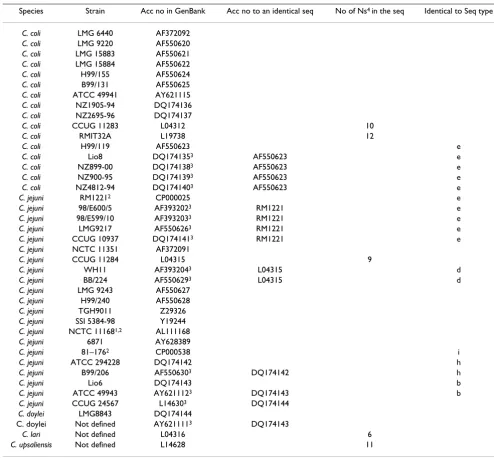
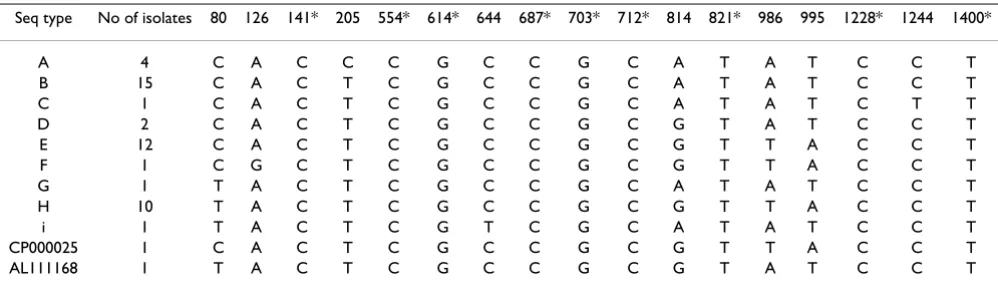
The length of the 16S rRNA gene fragments of the sequenced Campylobacter isolates was 1417 nucleotides. Ambiguities were not found in any of the sequences, which showed that there were no sequence polymor-phisms in the three 16S rRNA genes. However, nucleotide substitutions were found in eight positions of the strains sequenced in the present study, which resulted in nine dif-ferent 16S rRNA sequence types, referred to as a-i in Tables 1, 2 and 3. The nucleotide sequences of the 16S rRNA genes of the 47 strains were determined and compared with 16S rRNA sequences of 21 strains of C. jejuni, 2 strains of C. doylei, one strain each of C. lari and C. upsali-ensis and 16 strains of C. coli retrieved from RDP-II (Table 2). Nine additional positions that were variable were identified in the sequences deposited by other authors (Table 3). The Swedish strains were not variable in these positions. The sequence similarities between the nine dif-ferent sequence types (a-i) were in the range 99.6–99.9%.
The sequence similarities among C. jejuni strains and among C. coli strains were in the range 99.5–99.9% and 98.2–99.9%, respectively. Whole genome sequences are available for four of the C. jejuni strains (accession num-bers, CP000025, AL111168, CP000814 and CP000538). Whole genome sequence data show that the genomes of
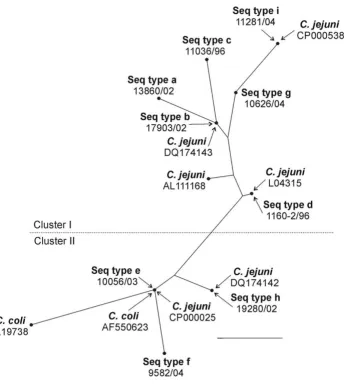
Campylobacter jejuni strains harbour three rRNA operons and we found that the sequences of the three 16S rRNA genes were identical within each individual strain for all 47 strains. Furthermore, the three 16S rRNA genes of C. doylei (CP000768) are also identical. The nine profiles occurred with varying frequencies among the 47 strains analysed here. Three 16S rRNA sequence types (b, e and h) dominated and constituted 79% (37 of 47 strains). The number of nucleotide substitutions varied between one and six among the nine 16S rRNA sequence types. The largest difference was found between the 16S rRNA sequence types f and i (see Fig. 1). Furthermore, five of the sequence types (b, d, e, h and i) had identical 16S rRNA sequence profiles to strains retrieved from GenBank. Sequence type (e) was shared between 12 of the strains in our study and two of these were identified as C. coli by PCR/REA. These strains had an identical 16S rRNA profile to C. jejuni (CP000025), for which the whole genome sequence is available, and also to one strain of C. coli
(AF550623).
Phylogenetic analysis
The strains in the present study were grouped into two major clusters in the radial tree (Fig. 1). The first cluster comprised sequence types a, b, c, d, g and i and contained sequence types of C. jejuni retrieved from GenBank (Fig. 2). The sequence types a, b, c, g and i had the nucleotides A, A and T in the positions 814, 986 and 995, respectively, whereas sequence type d had a G in the first of these posi-tions (Table 3). The SmaI types in this group were 2, 3, 4, 10, 15, 36, 42 and 56. The second cluster comprised sequence types e, f and h and contained both C. coli and
C. jejuni. These strains are characterised by having G, T, and A in nucleotide positions 814, 986 and 995, respec-tively (Table 3). The corresponding SmaI types in this group were 1, 5, 6, 7, 8, 9, 16, 20, 26, 57, 67, 70, 101 and 102.
Phylogenetic relationships of the nine 16S rRNA sequence types obtained in the present study and certain strains of
C. jejuni, C. coli, C. doylei, C. lari and C. upsaliensis reported by other authors are shown in Fig. 2. The taxa in this tree form four clusters (1–4) and one single species line (C. coli, DQ174137). However, due to the high-sequence sim-ilarity, the nodes are not very stable and sequencing errors in some of the older sequences may well affect the topol-ogy of the tree. Cluster 1 contains only C. jejuni and C. doy-lei strains. Cluster 2 contains both C. jejuni and C. coli
The three C. coli strains (AF550620, L04312 and AF372092) have sequence similarities to C. jejuni in the range 98.3–98.6%.
Pulsed-field gel electrophoresis
The 47 strains were subtyped into 22 different SmaI types, including the strains refractory to SmaI digestion (desig-nated SmaI type 10). Of the 22 SmaI types, 11 were found only once, and the remaining 11 subtypes were found at
least twice (Fig. 3). The subtype that was most often observed was SmaI type 2 (11 isolates) and this was also a subtype that was widely spread among producers, slaugh-terhouses and years. No correlation could be found between the different 16S rRNA sequences or SmaI types and the year, slaughterhouse or farm from which the
Campylobacter strain had been isolated. Strains with the same SmaI type but of different sequence types appeared only in one the two phylogenetic clusters (Fig 1).
Table 2: Campylobacter spp. strains for which the 16S rRNA sequences were retrieved from RDP-II or GenBank and used in the
phylogenetic analysis
Species Strain Acc no in GenBank Acc no to an identical seq No of Ns4 in the seq Identical to Seq type
C. coli LMG 6440 AF372092
C. coli LMG 9220 AF550620
C. coli LMG 15883 AF550621
C. coli LMG 15884 AF550622
C. coli H99/155 AF550624
C. coli B99/131 AF550625
C. coli ATCC 49941 AY621115
C. coli NZ1905-94 DQ174136
C. coli NZ2695-96 DQ174137
C. coli CCUG 11283 L04312 10
C. coli RMIT32A L19738 12
C. coli H99/119 AF550623 e
C. coli Lio8 DQ1741353 AF550623 e
C. coli NZ899-00 DQ1741383 AF550623 e
C. coli NZ900-95 DQ1741393 AF550623 e
C. coli NZ4812-94 DQ1741403 AF550623 e
C. jejuni RM12212 CP000025 e
C. jejuni 98/E600/5 AF3932023 RM1221 e
C. jejuni 98/E599/10 AF3932033 RM1221 e
C. jejuni LMG9217 AF5506263 RM1221 e
C. jejuni CCUG 10937 DQ1741413 RM1221 e
C. jejuni NCTC 11351 AF372091
C. jejuni CCUG 11284 L04315 9
C. jejuni WH11 AF3932043 L04315 d
C. jejuni BB/224 AF5506293 L04315 d
C. jejuni LMG 9243 AF550627
C. jejuni H99/240 AF550628
C. jejuni TGH9011 Z29326
C. jejuni SSI 5384-98 Y19244
C. jejuni NCTC 111681,2 AL111168
C. jejuni 6871 AY628389
C. jejuni 81–1762 CP000538 i
C. jejuni ATCC 294228 DQ174142 h
C. jejuni B99/206 AF5506303 DQ174142 h
C. jejuni Lio6 DQ174143 b
C. jejuni ATCC 49943 AY6211123 DQ174143 b
C. jejuni CCUG 24567 L146303 DQ174144
C. doylei LMG8843 DQ174144
C. doylei Not defined AY6211113 DQ174143
C. lari Not defined L04316 6
C. upsaliensis Not defined L14628 11
1 Strain for which the whole genome sequence is available. 2 The sequence without deletions was used in the tree.
Discussion
Genomes of C. jejuni and C. coli only harbour three copies of the 16S rRNA genes, whereas E. coli has seven rRNA genomic loci [14,29,30]. The three 16S rRNA gene sequences of the respective 47 strains included in the study were identical as judged from the sequence raw data, which would have revealed any polymorphism. This finding was surprising because bacteria with more than one rRNA operon often have at least a few polymor-phisms in their 16S rRNA genes. The observation that C. jejuni seem to lack polymorphisms in their 16S rRNA genes is also supported by genome sequencing data, because three of the strains (CP000025, CP000814 and AL111168) have identical 16S rRNA genes. The third strain (CP000538) has two deletions in one of the three genes, but except for that, the three genes are also identi-cal. We did not find sequence length polymorphisms and in this respect C. jejuni is very stable. Reparation mecha-nisms for concerted evolution of rRNA genes seem to be very efficient. Furthermore, the whole genome sequence of Campylobacter doylei (CP000768) also contains three identical 16S rRNA sequences.
It was possible to identify eight signature nucleotide posi-tions by which the studied strains of C. jejuni could be dif-ferentiated into nine groups according to their 16S rRNA sequences. The observed nucleotide substitutions at dif-ferent positions in the 16S rRNA genes of Campylobacter
spp. were compared with the positions of the nucleotide substitutions that appear as mutations in E. coli [31]. However, none of the nucleotide substitutions was found at the homologous positions. Restriction analysis by SmaI digestion and PFGE was, however, a more discriminatory typing method, detecting 22 subtypes as compared with nine different 16S rRNA sequence types. The
discrimina-tory power of PFGE for genotyping of Campylobacter spp. has been reported previously [32,33]. One sequence type (e) had identical 16S rRNA sequence as one of the whole genome sequenced C. jejuni strains (RM1221) and C. coli
strain (Lio8), (Table 2, Fig 2). Furthermore, sequence type e differed in only two nucleotide positions from C. coli
(L19738). Two of the isolates (8693/04 and 11318/04) belonging to16S rRNA type e were also identified as C. coli
by PCR/REA. This observation shows that phylogenetic analysis based on 16S rRNA cannot always be used to dif-ferentiate between C. jejuni and C. coli, although in cluster 3 (Fig. 2), three of the C. coli sequences are significantly different from the C. jejuni sequences. However, the results must be interpreted with care, because sequences of many mistyped bacterial strains have been deposited in GenBank. The results in the present study confirm the lim-itations of the 16S rRNA gene for resolving close, relation-ships.
The common SmaI types identified in Swedish broilers in 2002–2004 were also found among isolates from 1995– 1997, a fact that indicates that these common types are also stable over time. Furthermore, the whole genome sequenced C. jejuni (CP000025) with an identical profile to sequence type e originates from chickens in the USA [34]. This raises the question whether certain clones are more common than others and whether those clones have a higher ability to survive in the environment around the broilers or within animals around the broiler houses over a very long time. Bacteria with relatively small genomes, such as C. jejuni, may undergo genetic variation to increase their potential to adapt to new environments [14]. Such genotypic variation could result in phenotypic changes. These variations are probably important in the
Table 3: Polymorphic positions in the nine different 16S rRNA sequence types obtained from C. jejuni isolated from cloacal samples
taken within the Swedish Campylobacter program for broilers.
Seq type No of isolates 80 126 141* 205 554* 614* 644 687* 703* 712* 814 821* 986 995 1228* 1244 1400*
A 4 C A C C C G C C G C A T A T C C T
B 15 C A C T C G C C G C A T A T C C T
C 1 C A C T C G C C G C A T A T C T T
D 2 C A C T C G C C G C G T A T C C T
E 12 C A C T C G C C G C G T T A C C T
F 1 C G C T C G C C G C G T T A C C T
G 1 T A C T C G C C G C A T A T C C T
H 10 T A C T C G C C G C G T T A C C T
i 1 T A C T C G T C G C A T A T C C T
CP000025 1 C A C T C G C C G C G T T A C C T
AL111168 1 T A C T C G C C G C G T A T C C T
*Positions where some of the C. jejuni 16S rRNA sequences deposited in GenBank by other authors differed from the sequences determined in this study
transmission route from broiler to man, where Campylo-bacter spp. must survive several hostile environments.
Conclusion
Bacterial genomes could harbour up to fifteen 16S rRNA operons. Polymorphisms in the 16S rRNA gene are com-mon in bacteria with more than one 16S rRNA operon. Genomes of Campylobacter spp. harbour three copies of the 16S rRNA genes. Polymorphisms were not found in the 16S rRNA genes from any of the 47 Campylobacter spp. strains sequenced. The three rRNA operons in the ana-lysed Campylobacter jejuni strains were identical within each individual strain for all 47 strains, which indicates that C. jejuni and C. coli are very stable in this respect.
Genotyping of 47 strains by 16S rRNA gene sequencing resulted in nine sequence types, whereas PFGE after diges-tion with SmaI resulted in 22 subtypes. Phylogenetic anal-ysis based on 16S rRNA sequences is not always sufficient for differentiation between C. jejuni and C. coli. A poten-tial correlation was found between the SmaI profiles and the 16S rRNA sequences, as a certain SmaI type only appeared in one of the two major phylogenetic groups.
Authors' contributions
IH, EOE and KEJ participated in the discussion on the study design, the collection of isolates, analysis and inter-pretation of data, and in the writing of the manuscript, EOE and LS carried out the analysis and interpretation of PFGE data. Analysis and interpretation of sequence data
Radial representation of a phylogenetic tree constructed by the neighbour-joining method showing the relationships between the different sequence types (Seq type), C. coli and C. jejuni
Figure 1
Evolutionary tree showing the phylogenetic relationships between C. lari, C. doylei, C. coli and C. jejuni retrieved from RDP-II and the nine sequence types (Seq type) of Campylobacter spp
Figure 2
of the 16S rRNA gene were carried out by IH, MP and KEJ. All authors read and approved the final manuscript.
Acknowledgements
The authors gratefully acknowledge the staff at the Department of Bacteri-ology, National Veterinary Institute, and the Department of Biomedical Sci-ences and Veterinary Public Health, Swedish University of Agricultural
Sciences, for assistance with the microbiological analyses and the staff at the slaughterhouses participating in the study and thus making this work possi-ble. This work was supported by the Ivar and Elsa Sandberg Research Foun-dation and the Swedish Farmers' FounFoun-dation for Agricultural Research.
Dendrogram of the PFGE profiles obtained after SmaI digestion of DNA from Campylobacter jejuni and C. coli strains from cloa-cal samples taken within the Swedish Campylobacter program for broilers
Figure 3
Dendrogram of the PFGE profiles obtained after SmaI digestion of DNA from Campylobacter jejuni and C. coli strains from cloa-cal samples taken within the Swedish Campylobacter program for broilers. The numbering of SmaI types 1 to 100 is according to other studies [15]. SmaI types assigned numbers greater than 100 have not been found previously in subtyping of isolates within the Swedish Campylobacter program.
100
98
96
94
92
90 10 5.00
.0 0 20 .0 0 30. 00 40. 00 60. 00 80 .0 0 100. 00 150 .00 180. 0 0 250 .00 300. 0 0 350 .00 4 00. 00 450 .00 6 00. 00 800. 0 0 1000 1500 2 000 kb
PFGE 16S-rRNA Id Producer Slaug. house
SmaI gr 6 h 6181/96 B III
SmaI gr 6 e 10942/03 P II
SmaI gr 6 h 9916/03 Q I
SmaI gr 5 h 6144/96 B III
SmaI gr 5 e 10056/03 O II
SmaI gr 5 e 8525/02 Q I
SmaI gr 16 h 5304/04 I II
SmaI gr 7 h 12279/02 M I
SmaI gr 7 h 15193/03 H III
SmaI gr 9 e 12717/02 B III
SmaI gr 9 e 3243/02 H III
SmaI gr 8 e 10713/03 N V
SmaI gr 8 e 11414/03 A II
SmaI gr 26 f 9582/04 T V
SmaI gr 4 b 6114/97 U III
SmaI gr 4 b 17903/02 U III
SmaI gr 4 b 18381/02 P II
SmaI gr 36 b 11532/04 R II
SmaI gr 101 e 1167-3/95 R II
SmaI gr 2 b 1132-3/95 R II
SmaI gr 2 a 13168/02 C VI
SmaI gr 2 b 5169-1/96 D I
SmaI gr 2 b 5174-2/96 D I
SmaI gr 2 c 11036/96 T IV
SmaI gr 2 a 3105-2/96 F V
SmaI gr 2 b 5169-2/96 D I
SmaI gr 2 b 6113/97 U III
SmaI gr 2 b 6133-1/96 H III
SmaI gr 2 b 6188-1/96 H III
SmaI gr 2 b 10051/03 K V
SmaI gr 3 a 13860/02 D I
SmaI gr 3 a 8266/02 G II
SmaI gr 42 b 9612/04 J V
SmaI gr 10 d 1160-2/96 P II
SmaI gr 10 d 1160-3/96 P II
SmaI gr 10 b 10754/03 E II
SmaI gr 10 b 12739/02 J V
SmaI gr 56 i 11281/04 F V
SmaI gr 102 e 1182-3/95 I II
SmaI gr 102 e 1184-3/95 I II
SmaI gr 15 g 10626/04 I II
SmaI gr 1 h 18279/02 D I
SmaI gr 1 h 19280/02 S I
SmaI gr 20 h 11020/96 T IV
SmaI gr 57 h 8103/04 L V
SmaI gr 70 e 11318/04 F V
Publish with BioMed Central and every scientist can read your work free of charge "BioMed Central will be the most significant development for disseminating the results of biomedical researc h in our lifetime."
Sir Paul Nurse, Cancer Research UK
Your research papers will be:
available free of charge to the entire biomedical community
peer reviewed and published immediately upon acceptance
cited in PubMed and archived on PubMed Central
yours — you keep the copyright
Submit your manuscript here:
http://www.biomedcentral.com/info/publishing_adv.asp
BioMedcentral
References
1. Skirrow MB: Diseases due to Campylobacter, Helicobacter and
related bacteria. J Comp Pathol 1994, 111(2):113-149.
2. Bryan FL, Doyle MP: Health risks and consequences of Salmo-nella and Campylobacter jejuni in raw poultry. J Food Prot 1995,
58:326-344.
3. Altekruse SF, Stern NJ, Fields PI, Swerdlow DL: Campylobacter jejuni – an emerging foodborne pathogen. Emerg Infect Dis
1999, 5:28-35.
4. Blaser MJ, Taylor DN, Feldman RA: Epidemiology of Campylo-bacter jejuni infections. Epidemiol Rev 1983, 5:157-173.
5. Sebald ER, Véron M: DNA base content and classification of vibrios (In French; Teneur en bases da lÀDN et classification
des Vibrions). Annales de L'institut Pasteur (Paris) 1963, 105:897-910.
6. Goodwin CS, Armstrong JA, Chilvers T, Peters M, Collins MD, Sly L, McConnell W, Harper WES: Transfer of Campylobacter pylori
and Campylobacter mustelae to Helicobacter gen. nov. as Heli-cobacter pylori comb. nov. and Helicobacter mustelae comb.
nov., respectively. J Syst Bact 1989, 39:397-405.
7. Vandamme P, Falsen E, Rossau R, Hoste B, Segers P, Tytgat R, De Ley
J: Revision of Campylobacter, Helicobacter, and Wolinella
tax-onomy: Emendation of generic descriptions and proposal of
Arcobacter gen. nov. Int J Syst Bacteriol 1991, 41:88-103. 8. Vandamme P, On SLW: Recommendations of the
subcommit-tee on the taxonomy of Campylobacter and related bacteria.
Int J Syst Evol Microbiol 2001, 51:719-721.
9. List of procaryotic names with standing in Nomenclature
[http://www.bacterio.cict.fr/]
10. Woese CR: Bacterial evolution. Microbiol Reviews 1987,
51:221-271.
11. Ludwig W, Klenk HP: A phylogenetic backbone and taxonomic
framework for procaryotic systematics. In Bergey's Manual of
Systematic Bacteriology. The Archaea and the Deeply Branching and Pho-totrophic BacteriaVolume 1. Edited by: Boone DR, Castenholz RW. Berlin, Springer; 2001:49-65.
12. Gorkiewicz G, Feierl G, Schober C, Dieber F, Köfer J, Zechner R, Zechner EL: Species-specific identification of campylobacters
by partial 16S rRNA gene sequencing. J Clin Microbiol 2003,
41:2537-2546.
13. Parkhill J, Wren BW, Mungall K, Ketley JM, Churcher C, Basham D, Chillingworth T, Davies RM, Feltwell T, Holroyd S, Jagels K, Karlyshev AV, Moule S, Pallen MJ, Penn CW, Quail MA, Rajandream MA, Rutherford KM, van Vliet AH, Whitehead S, Barrell BG: The
genome sequence of the food-borne pathogen
Campylo-bacter jejuni reveals hypervariable sequences. Nature 2000,
403:665-668.
14. Taylor DE, Eaton M, Yan W, Chang N: Genome maps of Campy-lobacter jejuni and C. coli. J Bacteriol 1992, 174:2332-2337. 15. Kim NW, Lombardi R, Bingham H, Hani E, Louie H, Ng D, Chan VL:
Fine mapping of the three rRNA operons on the updated
genomic map of Campylobacter jejuni TGH9011 (ATCC
43431). J Bacteriol 1993, 175:7468-7470.
16. Heldtander Königsson M, Bölske G, Johansson KE: Intraspecific
variation in the 16S rRNA gene sequences of Mycoplasma
agalactiae and Mycoplasma bovis strains. Vet Microbiol 2002,
85:209-220.
17. Heldtander M, Wesonga H, Bölske G, Pettersson B, Johansson KE:
Genetic diversity and evolution of Mycoplasma capricolum
subsp. capripneumoniae strains from eastern Africa assessed
by 16S rDNA sequence analysis. Vet Microbiol 2001, 78:13-28.
18. Hansson I, Vågsholm I, Svensson L, Engvall EO: Correlations
between Campylobacter spp. prevalence in the environment
and broiler flocks. J Appl Microbiol 2007, 103:640-649.
19. Hansson I, Engvall EO, Lindblad J, Gunnarson A, Vågsholm I: The
Campylobacter surveillance program for broilers in Sweden,
July 2001–June 2002. Vet Rec 2004, 155:193-196.
20. Nachamkin I: Campylobacter and Arcobacter. In Manual of Clinical Microbiology Edited by: Murray PR, Baron EJ, Pfaller MA, Tenover FC, Yolken RH. ASM Press, Washington, DC; 1995:113-117.
21. Fermér C, Engvall EO: Specific PCR identification and
differen-tiation of the thermophilic campylobacters, Campylobacter
jejuni, C. coli, C. lari, and C. upsaliensis. J Clin Microbiol 1999,
37:3370-3373.
22. Linton D, Lawson AJ, Owen RJ, Stanley J: PCR detection,
identifi-cation to species level, and fingerprinting of Campylobacter
jejuni and Campylobacter coli direct from diarrheic samples.
J Clin Microbiol 1997, 35:2568-2572.
23. Standardised Campynet procedure [http://www.svs.dk/
campynet/PFGE.html]
24. Båverud V, Nyström C, Johansson KE: Isolation and identification of Taylorella asinigenitalis from the genital tract of a stallion,
first case of a natural infection. Vet Microbiol 2006, 116:294-300.
25. Cole JR, Chai B, Farris RJ, Wang Q, Kulam SA, McGarrell DM, Garrity GM, Tiedje JM: The Ribosomal Database Project (RDP-II): Sequences and tools for high-throughput rRNA analysis.
Nucleic Acids Res 2005, 33(Database issue):D294-D296.
26. Smith S: GDE: Genetic Data Environment. In Version 2.2. Milli-pore Imaging Systems Ann Arbor, MI, USA; 1992.
27. Saitou N, Nei M: The neighbour-joining method: A new
method for reconstructing phylogenetic trees. Mol Biol Evol
1987, 4:406-425.
28. Kimura M: A simple method for estimating evolutionary rates of base substitutions through comparative studies of
nucle-otide sequences. J Mol Evol 1980, 16:111-120.
29. Nuijten PJM, Bartels C, Bleumink-Pluym C, Gaastra W, Zeijst BAM van der: Size and physical map of the Campylobacter jejuni
chromosome. Nucleic Acids Res 1990, 18:6211-6214.
30. Kim NW, Bingham H, Khawaja R, Louie H, Hani E, Neote K, Chan VL:
Physical map of Campylobacter jejuni TGH9011 and
localisa-tion of 10 genetic markers by use of pulsed-field gel
electro-phoresis. J Bacteriol 1992, 174:3494-3498.
31. Triman KL: The 16S ribosomal RNA mutation database
(16SMDB). Nucleic Acids Res 1996, 24:166-168.
32. Wassenaar T, Geilhausen B, Newell D: Evidence of genomic
instability in Campylobacter jejuni isolated from poultry. Appl
Environ Microbiol 1998, 64:1816-1821.
33. de Boer P, Duim B, Rigter A, Plas J van der, Jacobs-Reitsma WF, Wagenaar JA: Computer-assisted analysis and epidemiological
value of genotyping methods for Campylobacter jejuni and
Campylobacter coli. J Clin Microbiol 2000, 38:1940-1946. 34. Parker CT, Quinones B, Miller WG, Horn ST, Mandrell RE:
Com-parative genomic analysis of Campylobacter jejuni strains
reveals diversity due to genomic elements similar to those
present in C. jejuni strain RM1221. J Clin Microbiol 2006,