International Journal of Educational Methodology
Volume 3, Issue 2, 93 - 102.
ISSN: 2469-9632 http://www.ijem.com/
Examining Mathematics Classroom Interactions: Elevating Student Roles
in Teaching and Learning
Laura Kent *
University of Arkansas, USA
Received: November 11, 2017 ▪ Revised: December 12, 2017 ▪ Accepted: December 20, 2017
Abstract: This article introduces a model entitled, “Responsive Teaching through Problem Posing” or RTPP, that addresses a type of reform oriented mathematics teaching based on posing relevant problems, positioning students as experts of mathematics, and facilitating discourse. RTPP incorporates decades of research on students’ thinking in mathematics and more recent research on responsive teaching practices. Two classroom case studies are presented. A high school unit on functions is explored utilizing individual research on the part of the teacher to enact RTPP lessons. A middle school teacher enacts a RTPP lesson on proportions and utilizes this model to bridge students’ incorrect additive reasoning strategies with correct multiplicative reasoning strategies. The results showed that both teachers were able to elevate students’ roles in classroom discussions through implementation of RTPP. Individual research conducted by the high school teacher informed his RTPP approach while participation in professional development sessions with a classroom embedded component influenced the middle school teacher’s enactment of RTPP lessons. Both teachers used specific teacher moves within RTPP to relinquish their role as mathematics experts in order to elevate their students’ roles in classroom discussions. The RTPP cycle is offered as a potential model for studying mathematics teaching and learning across a variety of secondary mathematics classrooms.
Keywords: Problem posing, responsive teaching, identity, mathematics teaching and learning.
To cite this article: Kent, L. (2017). Examining Mathematics classroom interactions: Elevating student roles in teaching and learning. International Journal of Educational Methodology, 3(2), 93-102. https://doi.org/10.12973/ijem.3.2.93
Introduction
The study of teaching and learning within mathematics classrooms can be characterized through a variety of lenses. Large scale comparative studies provide information on the effectiveness of curricular materials or specific teaching methods. Small scale studies provide a more detailed analysis of interactions over time and document learning trajectories of both students and teachers. Case study research designs specifically capture the nuances of “in the moment” experiences of those being studied. This study utilized what Stake (1994) described as a “collective case” research design (p. 237). Specifically, the goal was to describe the particulars of how students make sense of complex content, in the moment, of pivotal mathematics discussions. Two classrooms, a high school pre-calculus class and a sixth grade mathematics class, were chosen as the case studies. While the nature of the mathematics content was vastly different, similar elements such as problem posing and orchestrating discourse were evidenced in both classrooms.
Responsive Teaching through Problem Posing Cycle
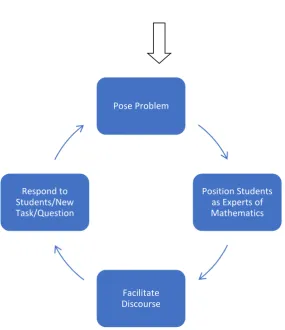
The study of mathematics instruction, learning, and classroom interactions captures the essence of teaching for understanding in secondary classrooms (e.g. Dyer & Sherin, 2016; Staples, 2007). “Responsive teaching through problem posing” or RTPP, is a cyclical model of instruction in which a problem is initially posed without providing instructions on which strategies students should use to solve problems. The teacher initially decides who might share and students are positioned as experts to critique the reasoning of their peers. This cycle involves teachers’ implementation of mathematically, culturally and personally relevant problems, positioning of students as “experts of mathematics”, and orchestrating students’ sharing of ideas (Figure 1). Teachers design/adapt their own curriculum materials based on the cultural and age specific interests of their students. They enact the problems using open ended approaches such as, “solve this problem in any way that makes sense to you”, and sequence the sharing of strategies
*Correspondence:
around substantial mathematical ideas. They also position students as experts of mathematics by requiring them to justify their solutions/thinking to their peers and not telling students right or wrong on their answers.
Figure 1. Responsive Teaching through Problem Posing Cycle
Relevant Tasks (Mathematically/Culturally/Personally)
Relevant tasks incorporate three components. The first component is the mathematical significance of the task. Within elementary mathematics lessons, research has shown that problem posing involving whole number operations and attention to children’s strategies is a formidable guide to planning future instruction (Carpenter, et al., 1989). Certain middle level topics such as proportional reasoning have been researched and linked to instructional practice and problem posing (Lamon, 1993; Steinthorsdottir, 2006). While developmental trajectories of students’ learning of more advanced mathematics topics is less detailed, high school teachers learn in real-time by “going with the students’ thinking” to gauge their understanding of the content (Staples, 2007).
The second component of a relevant task should be culturally relevant. It considers students of all backgrounds as capable learners. Particularly in the area of mathematics, culturally responsive teaching goes beyond particular teaching practices and embraces a rich learning environment in which students are encouraged to question, critique, and at the same time value the contributions of others in the classroom. Howard (2010) argues that an important aspect of culturally relevant pedagogy is to reject deficit models of students if they are of a different culture than the classroom teacher.
Finally, the personal relevance of the task is required to bridge students’ knowledge of the contextual or mathematical situation to more formal ideas of mathematics. Personal relevance can be achieved by consideration of mathematics as a human activity initially and through horizontal and vertical mathematization connecting to more formal notations and concepts of mathematics (Freudenthal, 1994; Treffers, 1991). One example of a widely used task is the well-known “fair” or “equal” sharing task to initiate and build understanding of fractions (e.g. Streefland, 1991; Empson, 2003).
Pose Problem
Position Students as Experts of Mathematics
Facilitate Discourse Respond to
Students/New Task/Question
International Journal of Educational Methodology Problem Posing
Simon (1997) recommended that problem posing becomes central to building on students' informal knowledge. Once solutions have been attempted for the problem, the teacher formulates new problems or sequences existing problems based on the information he/she gathers from students' current thinking. A similar approach to using students' informal knowledge as the basis for secondary mathematics instruction would encourage teachers to engage them in problem-solving activities that build on their intuitive understandings of a given topic. Teachers, through general knowledge of their students' mathematical thinking, can find and/or create problems or tasks that will give them access to the underlying mathematical concepts. However, as will be described in this article, adapting this approach to instruction of secondary topics will also require teachers to gain a deeper understanding of the topic than what they might have as a result of their college level mathematics content courses (Ball & McDiarmid, 1990).
The grades 9-12 standards also include topics that are content specific such as algebra, functions, and geometry. Functions, in particular, have been analyzed from the students' perspective (Dreyfus & Eisenberg, 1982; Even, 1993; Tall, 1992). Tall (1992) approached the idea of informal knowledge by defining a cognitive root as an approach or problem that builds on students' informal knowledge and also provides a foundation for mathematical development (p. 497). For example, the "equal sharing" situations in the Empson (2003) and Streefland (1991) studies are cognitive roots since they are familiar to students and they can be used to develop fraction and ratio concepts.
Whereas cognitive roots have been found in much of the research described here for elementary grades topics, they may be difficult to find for more advanced topics. One reason for this is the focus on formal definitions at the secondary level, which may or may not coincide with students' initial understandings of the topic (Tall, 1992). For example, the definition of function is often presented in symbolic form or in a way that is vastly removed from the students' informal understandings. The classroom example in this article focused specifically on functions. The pre-calculus teacher developed the lessons and tasks from his own research and classroom experience.
“Students as Experts” Identity
Recommendations for added attention to students’ thinking reappeared in national documents (National Govenor’s Association, 2014; National Council of Teachers of Mathematics, 2014). The Principles to Actions document recommends that teachers elicit and use evidence of student thinking to encourage the purposeful exchange of ideas in the mathematics classroom can create opportunities to elicit and use evidence of student thinking (p.12). In the elementary grades, taxonomies of problem types can be used to guide students’ thinking. In grades in which these taxonomies are not available teachers are guided by their experience and knowledge of their students (Hill, et al., 2008).
Establishing sociomathematical norms such that students are able and willing to contribute to mathematical discussions allows for the production of shared understandings of big ideas (McClain & Cobb, 2001). While the Standards for Mathematical Practice offer general guidelines for mathematical dispositions of students within mathematics lessons, the particular teacher moves that initiate student contributions are more challenging to characterize. An additional challenge that secondary teachers grapple with is what Nathan & Petrosino (2003) call “the expert blind spot” or EBS. Secondary teachers with EBS potentially perceive students to attain higher performance on procedures rather than actual student performance on conceptual tasks (p. 918).
There has been some comparison to the activity of mathematicians and identified gifted students (Tjoe, 2015), less is known about how general populations of students show capacity for behaving and thinking “like a mathematician”. Even less is known about teacher actions/reactions that facilitate these behaviors within a given mathematics lesson. Cobb, Grasalfi, & Hodge (2009) described an interpretive framework negotiating students’ identities in a classroom. They described both normative and personal identities associated with student participation in mathematics classes.
Responding to Students
Responsive teaching entails an approach to lesson planning that focuses on the responses and thinking of students in lieu of predefined procedures and teacher moves. While these lessons may differ in certain aspects, similarities include posing a mathematical situation that students interpret as open rather than closed. In other words there may be a variety of correct approaches to interacting with the mathematics (Boaler, 1998).
of noticing such as attending to how well students are able to make sense of the story contexts designed to elicit and extend students’ understandings of fraction concepts.
Dyer & Sherin (2016) analyzed the responsive teaching strategies of two secondary mathematics teachers to explore how they listened and responded to students’ thinking and mathematical descriptions. Empson (2014) examined second grade students’ learning of base 10 concepts through a responsive teaching approach. Kiefer, Ellerbrock, & Alley (2014) examined the effects of responsive teaching strategies on middle school students in a variety of content areas. Responsive teaching has also been associated widely with teaching and learning mathematics and science concepts across the grade spectrum (e.g. Robertson, Scherr, & Hammer, 2015).
Method
Two teachers were chosen from 30 teachers observed over a two year period. Their two classrooms were considered instrumental cases (Stake 1994) in that they provide particular insights into the RTPP model. The differences in the two teachers relate to the pathways in which their own learning occurred. The high school teacher conducted his own action research on his teaching through problem posing, while the sixth grade teacher learned from a regional professional development program focused on problem posing and responsive teaching. Both teachers were observed approximately once a month, either within their classes or as part of their participation in their professional development. Both teachers were also selected for lesson study type professional development and were acknowledged by their respective districts for their innovative instructional methods.
Lessons were video-taped and whole class discussions were transcribed. Samples of student work were collected. Field notes were taken to supplement the video tapes and informal conversations with the classroom teacher prior to and following observed lessons. Analysis of data focused on the key aspects of the RTTP cycle such as teacher moves that positioned students as experts and their contributions to the classroom discussions and mathematics content.
Results
Case 1: Mr. R’s Pre-Calculus Class
Mr. R taught at a suburban-rural high school in the southeastern part of the United States at the time of the study. He researched the topic of functions and conducted an initial interview with a student on exponential functions. While the student was not in the class in which the instruction was videotaped, this interview provided Mr. R with baseline information about students' knowledge of function concepts that he would later use in his instruction.
Mr. R's class consisted of 18 students, 13 African-American students and five Caucasian students, seven male students and 11 female students. Students were admitted into this pre-calculus class on the basis of their successful completion of Algebra II and Geometry.
The range of grade point averages on a 4.0 scale was 2.43 to 3.68 at the time of the study. All students, except one, met the requirements for the state's high school exit exam in mathematics.
Mr. R was in his fourth year of high school teaching at the time of the videotaping. He completed a masters and bachelors degree in mathematics education. He was the chair of the math department at his school. He has also taught introductory Algebra at a local technical college. A total of seven 90 minute blocks of whole class instruction were videotaped.
Personally Relevant Function Problems
Mr. R surveyed his students prior to instruction to determine tasks that might serve as good cognitive roots for the function concept. He was surprised that many of the students did not make connections to the "birthday function" which is common in many secondary mathematics textbooks. Based on the results of the survey, he decided to use the following "coke machine" example in his introductory lesson on functions.
Suppose you and a friend go to get a drink from a COKE machine. When you hit the COKE button, you get a COKE. Your friend pushes the same button and gets a SPRITE. Obviously, the machine is broken. Is this broken function useful? What would be more useful?
International Journal of Educational Methodology
Eisenberg (1982) describe the objectification of the function concept as the "transition to the conception of a function as a single mathematical entity" (p. 120). Others have used similar language in their discussions of students' processes of symbolizing mathematical ideas (Sfard, 1995; Cobb, Boufi, McClain, & Whitenack, 1997). One of Mr. R's primary instructional goals was for students to understand "functions as an objectified relationship", that is, the relationship itself is the object rather than the function as two objects (ie., domain and range).
Positioning Students as Experts of Mathematics
Mr. R first provided an overview of the main ideas related to the concept of functions, such as domain, range, independent and dependent variable, etc. He then referred back to the "Coke Machine" example that they had discussed earlier.
Mr. R: What is the independent variable on the coke machine?
Students: The buttons.
Mr. R: What is the dependent variable? IJ?
IJ: The kind of pop that comes out.
Mr. R: Would you say this is a good-working soda machine? Why or why not?
MP: Yes. You put your money in and a soda comes out.
IJ: No. I don’t think it works well. If I push the COKE button, I don’t know whether I will get a COKE or a sprite. (IJ goes up to the board and draws a picture of a coke machine with two different types of sodas coming out of the machine).
Mr. R: What would a functioning soda machine look like? (IJ makes another drawing showing that a COKE comes out if the coke button is hit, and a sprite comes out if a sprite comes out.)
In this discussion, IJ is positioned as the expert and given the opportunity to illustrate the univalence component of functions.
Mr. R then asked students to create their own examples of functions. Students were quick to come up with examples such as: a job function that relates salaries to different occupations, a "height" function that relates a person to their height, and a pet function that relates pet owners to the type of pet. Through this assignment and a discussion of these examples, Mr. R was also able to convey the arbitrary nature of functions.
Mathematical conventions related to functions were introduced only after an in-depth discussion of functions that relate non-numerical sets occurred with students. Mr. R was able to help students mathematize the concept of functions by having them notate their real-life examples in conventional function notation. For example, Mr. R asked the students to express the domain of the "height" function in mathematical language if no students in the class were 5'4". Throughout the transitions from non-mathematical to mathematical examples of functions, Mr. R encouraged students to recognize the symbolic representations of functions as mathematical examples.
Facilitating Discussions of Compositions of Functions
Mr. R focused his instruction on the modern definition of functions. This knowledge base and how the soda machine could be mathematized to illustrate both the univalence and arbitrary nature of functions provided an opportunity to anchor his instruction on assessing student responses which in turn positioned IJ to describe these components in his own words and scaffold other students’ thinking about the overarching concepts. Mr. R went on to introduce notations for both functions and composition of functions in subsequent lessons. He continually referenced this initial example as needed throughout the rest of the unit.
Case 2: Mrs. G’s Sixth Grade Class
Professional development for middle school mathematics teachers focused on students’ thinking has begun to equip teachers to teach responsively in the middle grades (see Kent 2015, for a description of this type of professional development). Mrs. G, a sixth grade teacher, participated in a three-year professional development program that focused on students’ thinking about proportional reasoning and various algebra topics. As Mrs. G studied ways in which students solve various proportion problems, she began to pose problems involving proportions to her students prior to telling them it was a proportion problem or any method for solving the problem. She also participated in classroom embedded lessons in which she as part of a team of teachers assisted the host teacher in observing students’ constructed strategies for proportion problems and decide who the sharers should be to highlight significant proportion ideas such as unit rate (Nielsen, Steinthorsdottir, & Kent, 2016).
Mrs. G was in her fourth year of teaching sixth grade. Her class was comprised of 24 students, 14 Caucasian, six Latino, and two African-American, 13 female and 11 male. The middle school in which she teaches generally contains heterogeneously ability groups of students prior to seventh grade. The students in her class ranged from advanced to basic on the prior years’ standardized test.
The sociomathematical norms established in Mrs. G’s class included a focus on students generating their own strategies for solving problems and cultivating personal identities in which they became experts at explaining their own strategies and critiquing the strategies of their peers. She would purposefully ask questions in a manner that suggested that she did not genuinely know the answer to ensure that students would gain confidence in their own logical thought patterns and strategy paths. For example, even if she knew herself that an answer was incorrect, she might claim the answer was correct to challenge students to justify why an answer might be incorrect.
Mrs. G knew her students had informal experiences solving proportion problems and wanted to see how they would solve a problem that involved converting US Dollars to Euros. At the time of the lesson, the conversion rate was 1$ was worth about .9 €. She posed a problem in Table 1 and asked students to determine the different amounts based on the above information. The students in her class knew they could figure out the answers in the chart in any way that made sense to them but that they would have to justify their answers.
As students were working on their solutions, Mrs. G noticed that some students were using non-constructive additive or pattern building strategies and therefore were getting incorrect answers, while other students were using multiplicative strategies.
Table 1. Conversion activity in Mrs. G’s sixth grade class
Dollars ($) Euros (€)
1 .9
5
18
10
900
36
She first called on a student, AK, who had used an additive strategy to share her thinking. The following discussion occurred as AK shared her strategy:
Mrs. G: AK, how did you decide to fill in the amounts of money?
International Journal of Educational Methodology
Immediately several students disagreed with her answer and argued that the answer was €4.5 because “one-tenth of $5 is $0.5 and five minus five tenths is four and a half euros”. Having read about Lamon’s (1993) strategy levels as part of her professional development, Mrs. G realized that some of her students had incorrectly determined that the unit conversion rate was 0.1 instead of 0.9. She decided to explore the possibility that they might be able to make a connection between their answers to determine a general formula to complete the rest of the chart.
Mrs. G. (She wrote two equations on the board, 1 – 0.1 and 5 – 0.1 (5)). What do you think of these two expressions?
EM: They are kind of the same but the second is five times the first.
Mrs. G: What do you think about what EM said? (About half the class agreed and half disagreed)
EM: (walked up to the board and began writing 5 x (1- 0.1)) Five times the first expression is the same as this one (pointing to 5-0.1 (5))
AK: How is that different from what I did?
EM: You can’t just subtract one tenth because that is just the difference between one dollar and nine-tenths euros. For each dollar, you have to subtract another one tenth so if you have five dollars you have to subtract five-tenths.
Mrs. G: So given what EM said, how many euros would ten dollars be worth?
DW: Nine
Mrs. G: How did you get nine DW?
DW: I multiplied ten by nine tenths.
Mrs. G: How is that strategy related to what AK and EM talked about?
EM: Ten minus ten times one tenth is nine.
They tested both methods with several other numbers. Mrs. G then asked, “is that true for any dollar amount that I want to convert to euros?”. After students said that that was true, Mrs. G, asked them how they could prove that this was a true statement. Students were not sure how to show this for all cases. She then wrote, “d – 0.1d = 0.9d” and asked them if that was true. Students looked at the equation for a minute.
DW: I believe its true because subtracting one tenth of a number from that number gives you nine tenths of the number.
KP: One-tenth of a number plus nine-tenths of a number equals that number.
Mrs. G was able to quickly assess the students who had used incorrect additive reasoning and those who had used proportional reasoning strategies and use positioning of students like EM and DW as experts to engage them in a discussion of the difference between subtracting one tenth and subtracting one tenth of a number. She initially “pretended” that she believed that €4.9 was correct in order for students who were confident in their correct answers the opportunity to use logical mathematical arguments to justify their answers. EM used the language of one tenth for every dollar to help students like AK make a connection between their additive reasoning and his multiplicative reasoning to convert the money amounts.
Conclusions
These case studies illuminate the RTPP cycle of instruction. In both classes, an entire class period was typically devoted to one or two problems that were launched ahead of any type of hints or methods for solving or thinking about the problem. Both teachers waited for students to respond prior to questioning or scaffolding with any time of formal mathematical notations. Prior to utilizing this cyclical approach, Mr. R, as a high school teacher with a degree in mathematics, acknowledged his own “expert-blind” spot as an impediment to allowing students the opportunity to think about the ideas prior to interjecting his own mathematical thoughts. This is consistent with challenges many secondary mathematics teachers face as they attempt to change their instructional methods.
solving problems in a variety of ways. Additionally, she reported that the classroom embedded sessions gave her confidence to see that teachers could pose problems to students without first showing them a method to start with. She also served as a host teacher to other teachers and gained additional practice posing problems and orchestrating the sharing of strategies toward a mathematical learning goal determined by the work of the students.
Discussion
Responsive Teaching through Problem Posing shows promise in secondary mathematics classrooms as teachers assume new roles as problem posers and facilitators of important mathematical ideas. Mr. R launched most of his lessons by posing personally relevant tasks, responding to his students’ thinking and positioning students as capable learners during class discussions. In Simon's (1997) discussion of the Mathematics Teaching Cycle, he asserts that "the mathematics teacher's actions are at all times guided by his or her current goals for student learning, which are continually being modified based on interactions with students" (p. 77). He also points to the importance of teachers knowing "how particular mathematics is learned, derived from formal research in the field and from reflection on the teacher's own work with students ..." (p. 78).
New types of professional development models such as classroom embedded professional development support RTPP by providing opportunities for teachers to learn methods for problem posing and engaging students rich mathematical discussions (Nielsen, Steinthorsdottir, & Kent, 2016). Classroom embedded professional development sessions involve teachers in the construction of problems and observation of problem posing lessons in peer-teacher’s classrooms. The structure of classroom embedded sessions offer examples in “real time” of responsive teaching and ideas for constructing/adapting mathematics problems based on authentic assessments of students’ current understandings. Mrs. G participated in and eventually began hosting classroom embedded sessions which increased her confidence with RTPP.
Providing space for students to be positioned as experts of mathematics also may require secondary teachers to remove their “expert-blind spots”. Mr. R and Mrs. G were willing to base their instructional decisions on students’ responses. By elevating the roles of students during class discussions, these teachers improved the participation of their students in both learning about and talking about important mathematical ideas.
In order to position students as experts in mathematics, teachers need to accept that students generally possess the capability to solve problems and reason logically about mathematical ideas consistent with culturally relevant pedagogies (Howard, 2010). Responsive teaching involves a deeper exploration into the content of mathematics at the core of the lesson based on the students’ understandings and interpretations. Encouraging “expert-like” behavior from students may enhance all students in the classroom to gain a deeper understanding of the content.
Additional cognitive research in secondary mathematics topics will continue to expand the opportunity for teachers to incorporate the RTPP cycle. The more exposure teachers have to the how students learn specific concepts, the more confidence they will have in problem posing. Whether through their own action research as in the case of Mr. R or participation in focused professional development as in the case of Mrs. G, the RTPP cycle has promise for elevating student roles and potential learning opportunities in mathematics classrooms.
References
Ball, D. L., & McDiarmid, G. W. (1990). The subject-matter preparation of teachers. In W. R. Houston (Ed.), Handbook of research on teacher education (pp. 437-448). New York: MacMillan Publishing Company.
Boaler, J. (1998). Open and closed mathematics: Student experiences and understandings. Journal for research in mathematics education, 29 (1), 41-62.
Carpenter, T. P., Fennema, E., Peterson, P. L., Chiang, C. P., & Loef, M. (1989). Using knowledge of children's mathematical thinking in classroom teaching: An experimental study. American educational research journal, 26 (4), 499-531.
International Journal of Educational Methodology
Cobb, P., Gresalfi, M., & Hodge, L. L. (2009). An interpretive scheme for analyzing the identities that students develop in mathematics classrooms. Journal for research in mathematics education, 40 (1), 40-68.
Dreyfus, T., & Eisenberg, T. (1982). Intuitive functional concepts: A baseline study on intuitions. Journal for research in mathematics education, 13, 360-380.
Dyer, E. B., & Sherin, M. G. (2016). Instructional reasoning about interpretations of student thinking that supports responsive teaching in secondary mathematics. ZDM, 48(1-2), 69-82.
Empson, S. B. (2014). Responsive teaching from the inside out: teaching base ten to young children. Investigations in mathematics learning, 7(1), 23-53.
Empson, S. B. (2003). Low-performing students and teaching fractions for understanding: An interactional analysis. Journal for research in mathematics education, 34 (4), 305-343.
Even, R. (1993). Subject-matter knowledge and pedagogical content knowledge: Prospective secondary teachers and the function concept. Journal for research in mathematics education, 24 (2), 94-116.
Freudenthal, H. (1994). Thoughts on teaching mechanics: Didactical phenomenology of the concept of force. In L. Streefland,(ed.), The legacy of Hans Freudenthal. Springer: Dordrecht, The Netherlands: Kluwer Academic Publishers.
Hill, H. C., Blunk, M. L., Charalambous, C. Y., Lewis, J. M., Phelps, G. C., Sleep, L., & Ball, D. L. (2008). Mathematical knowledge for teaching and the mathematical quality of instruction: An exploratory study. Cognition and instruction, 26(4), 430-511.
Howard, T. C. (2010). Why race and culture matter in schools. New York: Teachers College Press.
Jacobs, V. R., Empson, S. B., Krause, G. H., & Pynes, D. (2015). Responsive teaching with fractions. In Annual meeting of the research conference of the national council of teachers of mathematics, Boston.
Kent, L. B. (2015). Change in the era of common core standards: A mathematics teacher’s journey. International journal of learning, teaching and educational research, 12(2), 48-63.
Kiefer, S. M., Ellerbrock, C., & Alley, K. (2014). The role of responsive teacher practices in supporting academic motivation at the middle level. RMLE Online, 38(1), 1-16.
Lamon, S. 1. (1993). Ratio and proportion: Connecting content and children's thinking. Journal for research in mathematics education, 24 (1), 41-61.
Leinwand, S. (2014). Principles to actions: Ensuring mathematical success for all. National Council of Teachers of Mathematics.
McClain, K., & Cobb, P. (2001). An analysis of development of sociomathematical norms in one first-grade classroom. Journal for research in mathematics education, 32(3), 236-266.
Nathan, M. J., & Petrosino, A. (2003). Expert blind spot among preservice teachers. American educational research journal, 40(4), 905-928.
National Council of Teachers of Mathematics (2014). Principles to actions: Ensuring mathematical success for all. Reston, VA: NCTM.
National Governors Association. (2014). Common core state standards initiative. Washington, DC: National Governors Association.
Nielsen, L., Steinthorsdottir, O. B., & Kent, L. B. (2016). Responding to student thinking: Enhancing mathematics instruction through classroom based professional development. Middle school journal, 47(3), 17-24.
Sfard, A. (1995). Symbolizing mathematical reality into being. Paper presented for the symposium Symbolizing, communicating, and mathematizing, Nashville, September, 1995.
Simon, M. (1997). Developing new models of mathematics teaching: An imperative for research on mathematics teacher development. In E. Fennema & B. S. Nelson (Eds.), Mathematics teachers in transition. New Jersey: Lawrence Erlbaum Associates.
Stake, R. E. (1994). Case studies. In N. K. Denzin & Y. S. Lincon (Eds.), Handbook of qualitative research. Thousand Oaks, CA: Sage Publications.
Staples, M. (2007). Supporting whole-class collaborative inquiry in a secondary mathematics classroom. Cognition and instruction, 25(2-3), 161-217.
Steinthorsdottir, O. B. (2006, July). Proportional reasoning: Variable influencing the problems difficulty level and one’s use of problem solving strategies. In Proceedings of the 30th conference of the international group of Psychology of Mathematics Education (Vol. 5, pp. 169-176).
Streefland, L. (1991). Fractions in realistic mathematics education: A paradigm of developmental research. Dordrecht, The Netherlands: Kluwer Academic Publishers.
Tall, D. (1992). The transition to advanced mathematical thinking: Functions, limits, infinity, and proof. In D. Grouws (Ed.), Handbook of research on mathematics teaching and learning, NCTM, 495-511.
Treffers, A. (1991). Realistic mathematics education in the Netherlands 1980-1990. Realistic mathematics education in primary school, 11-20.