Goal-Oriented Model Driven Enterprise
Architec-ture Validation Approach
Joe Essien
School of Computing and Technology,
University of West London, St Mary’s Road, Ealing, London
Abstract: Enterprise Architecture (EA) has been defined as the organization of a system embodied in its components, relationships to each other, environment, the principle guiding its design and evolution (IEEE, 2000). Thus an important characteristic of EA is to provide a ho-listic view of the enterprise visualizing the relevant aspects of the business for specific stakeholders. However, one of the many concerns of this interest has been how to deal with the complex challenges of implementing the models with the ability to validate its integrated compo-nents to ensure conformity with individual stakeholder’s motivation. To achieve this, methodologies that describe compocompo-nents in relation to their behavioral attributes, impact on other elements in the domain and their dependencies have been postulated. Albeit, studies show that these taxonomies do not adequately address validation requirements (Lankhorst, 2013). This article analyzes the EA concepts of ArchiMate, focusing on the business and application layers with the objective to extend motivation with tests specifications using the model-driven approach thus offer descriptive semantics for validation. The paper contributes to a better understanding on how EA models can be validat-ed thus improve alignment with the business vision and strategy. Student Internship Program case study is usvalidat-ed to exemplify this hypothe-sis.
Keywords: Goal-Oriented, Enterprise Architecture, Framework, Business Processes, Motivation, Validation, Modeling.
1 Introduction
Enterprise Architecture has been defined as consisting of coherent principles, methods, and models used in the design and realisation of organisational structure, business process-es, information systems and infrastructure (Fischer et al, 2010). Good enterprise architecture provides the insight needed to balance requirements and facilitates translation from corporate strategy to daily operations (Lankhorst, 2013). The multi-dimensional interests and unstructured principles that tagged EA from inception culminated in use of heterogeneous set of approaches and modelling languages (Sessions, 2007). However, most EA practitioners recognize four facets of EA and agree that it comprises of the business, application, information, and technology perspectives (Sal-mans et al., 2010). Other practitioners such as Venkatraman in their review identified eight perspectives in which EA alignment can be achieved (Venkatraman et al., 2010,). In addition to these eight perspectives, four other fusion per-spectives are described, formed from the combination of two of the individual perspectives (Coleman and Papp, 2006). In many efforts to implement EA, and definitions that specify perspective, harmonization and alignments, the issues of validation are completely ignored or at best remain rudimen-tary. The positions do not consider the behavioral attributes of the model’s components as a process that should undergo test itself. In many organizations, EA patterns exist that en-capsulate business concerns such as maintenance, upgrades, procurement, integration, acquisition and mergers, compli-ance in a regulatory environment and strategic planning (Weston et al., 2004), but literal analysis of these patterns shows many disparate architectures, understood by each stakeholder from different perspectives. The connections and dependencies that exist among these different views can be extremely complex in some cases (McGovern, 2004) requir-ing validation. Despite this, validation of Enterprise Archi-tecture Framework (EAF) has been an aspect of EA that has been of enormous concern to practitioners though very little ideologies of how this can be carried out has been postulat-ed. Most authors believe EA models are not reusable and are designed to actualize a specific goal after which it is
2 Validation Consideration in Existing EAF
Though the practice of EA continues to evolve new tech-niques and collaborations, one other issue facing enterprise architects today is that none of the single practices is capa-ble of satisfying all necessary aspects of the enterprise identified collectively (Noran 2003). Attempts to mix and match rather, has resulted in EAs with inconsistent seman-tics and weak ontology. Therefore issues regarding system-atic validation become inconsequential as architects do not need to stringently scrutinize models to see the gaps in the composition of structural layers, artifacts types and de-pendencies. The introduction of advance modelling tech-niques to automate EA practices also requires the need to test and validate those models. Further evidence shows that early frameworks such as the popular Zachman Framework (ZF), Generalized Enterprise Reference Architecture and Methodology (GERAM), Federal EA Framework (FEAF), The Open Group Architecture Framework (TOGAF) did not create extendable models that support validation (Fischer et al., 2010; Salmans et al., 2010; Urbaczewski et al., 2006). Consequently, attempts to introduce them at a later stage through improved versions and sometimes out-right extension such as TOGAF with ArchiMate leave inconsistencies, omissions and gaps between the various layers of abstraction. Most practitioners tend to concede that it is not possible for a single Enterprise Architecture framework to completely present the enterprise in its en-tirety as comprising of business objectives, business pro-cesses, roles, organizational structures, organizational be-haviors, information, software applications, computer sys-tems and the relationships between these various entities (Chen et al., 2008). Though efforts still continue to be made towards standardization (TOGAF, 2012, OMG, 2012), many frameworks are specific in scope and purpose and apply to specific domains, generally weighted towards planning and business process analysis without commensu-rate emphasis on validation and change management.
3 Behavior-Driven Modelling Approach
Primarily, driven modelling focuses on behavior-al specification of the abstracts of a model from a specific viewpoint of a stakeholder. Essentially, it specifies that for each abstract of a model under test, the following activities can be achieved (Essien, et al, 2013):
Definition of a test set for the abstract; Implement the test set and; finally
Verification that the implementation of the tested abstraction yields set goals.
This definition is specific as it allows validation to be car-ried out in terms of high-level goals specifications leaving out low-level requirement details and unrelated model components exertions. By this approach, validating a mod-el allows specific structural test for appropriateness of model taxonomy to be made more specifically rather than depend on inferences from generic maturity matrices. The advantage is that it allows a model to be used for its ability to create value, enhance compliance visibility and change management rather than another metaphoric documentation requirement. Validating a model by concept of Behavior-driven modelling ensures that tests of any abstraction are specified in terms of the desired behavior of the abstracted component. The "desired behavior" in this case consists of
the requirements set by the business, derived from the en-terprise motivation concerns and restricted by its con-straints. The validation scenarios are phrased declaratively rather than imperatively in a ubiquitous language with no reference to elements of the user interface through which the interactions take place (Mabey 2008). Following this approach, reference is made to how the desired behavior of the model abstract should be specified. To actualize this, the approach proffers the use of a semi-formal format for behavioral specification borrowed from problem domain specifications of the object-oriented analysis and design to develop a conceptual model that can be used to complete tasks that realize specific goal. This method recommends specification of behavior in terms of concerns and specifies the business value, explicitly written and annotated with constraints (Essien et al., 2013). The problem domain spec-ifications adopts the following steps
Title
The problem domain should have a clear, explicit ti-tle.
Narrative
A short, introductory section that specifies;
The primary stakeholder of the problem domain which can be the actor, department or business pro-cess that benefits from the model abstract valida-tion.
Goals that are derived through the business behavior The components that are to be validated
The relationship between the components, business behavior and the goal.
Validation criteria or scenarios
A description of validation test carried out on a specific case. Such a scenario would have the following structure;
It starts by specifying the initial condition that is as-sumed to be true at the beginning of the scenario. This may consist of a single clause, or several. It then states which event triggers the start of the
scenario.
It states the input parsed to validate the component attributes, how the input is accepted, and the logic that characterizes the component and response channels.
Acceptance criteria or scenarios
Finally, it states the expected outcome, in one or more clauses.
4 Specifications for Component Validation and Data Requirement
Model Validation by behavior specification validates sce-narios of instance model from a logical model incremental-ly, across different views and layers of EA by testing com-ponent attributes against goals in the motivation Extension. This method though deploys the same principles of Behav-ior Driven Development (BDD) (North, 2006), differs as it focuses on behavioral specification of the EA artifacts rather than objectives. Three steps are iterated;
Validation of artifact is based on the desired behavior with
attributes set for the related motivational goal. The ap-proach uses structure and behavior to establish patterns for traceability thus ensuring that the right design decisions are taken at the modeling stages. Not only can the method improve the quality and design of the framework, it also simplifies the alignment process. The validation scenarios describe the behavior and attributes of the component to be validated in order to realize set motivation goal thus ensur-ing better conformity with set goals. With the approach two aspects of model validation consisting of active and passive levels are identified. The Active Level of Model Validation is focused on the functionality of the artefact as defined by the scope of specified validation metrics and component under test. It identifies of business behaviour that the EA model artefact is expected to exhibit. The input (test) data is conceptualized based on the behaviour speci-fied and goals to be achieved. On execution of a test sce-nario, the actual result based on the behaviour specified is determined and compared with expected goal. The Passive level of valuation examines the collaboration between models and interactions with different parts of the Business Architecture. This includes;
The interface of business artefacts with motivational goals from view abstractions.
The interface of business artefacts with constraints to enforce cohesiveness.
Interactions on a view from views within the same viewpoints.
Collaboration from views within the same viewpoint to achieve same goals.
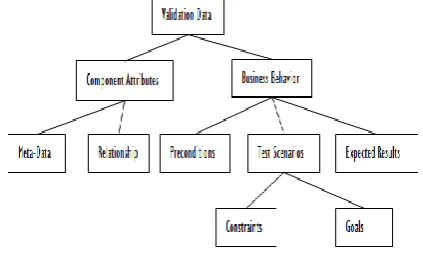
Validation Data for a model is data specifically identified for use in testing the model. In this context, validation data are grouped as attributes of the model components and specifications from the business behavior; consisting of stakeholders concerns, test scenarios and constraints and expected outcomes. The component’s attributes may also consist of meta-data definitions for the object and relation-ship types with other artefacts. The test scenarios contain data segregation from constraints and goals in relationship with some measurement metrics. Figure 1 illustrates this classification.
Figure 1: Classification of Validation Data
Test scenarios specify procedural data used in a confirma-tory way to verify that a given set of constraints to a given business behavior for given goal produces expected result. Test data is produced in a focused or systematic way adopt-ing the VPEC-T concepts.
5 Modelling Languages and Validation
tion as it is also domain specific. The representation of
business rules is dependent on prevalent use and imple-mentation. Maintenance and knowledge enhancement is key requirement to its usability. Another popular means of validating the EA is the use of maturity matrix commonly referred to as Dynamic Architecture Maturity Matrix (Dy-AMM) (Noran, 2003). DyAMM is used as an instrument to assess the level of Enterprise Architecture Maturity (EAM) in organizations and covers many key areas that represent a different dimension within EAM. The DyAMM assessment method makes it possible to assess organizations on an overall maturity level as well as a specific level. The in-formation for assessments is gathered through a survey questions that relate to one of the identified key areas (Coleman, 2006). However, this method which is purely qualitative has limitations as lack of a comprehensive ap-proach to data gathering can affect judgement. The re-searcher's presence during data gathering, which is often unavoidable, can affect the subjects' responses. Issues of ethics, anonymity and confidentiality can present problems when presenting findings. Among other concerns, the ques-tionnaires are sometimes not well understood by the re-spondents and the CIO bias undoubtedly may influence the outcome. The Open Group Architecture Framework (TOGAF) is one of the most popular frameworks in EA. To provide a uniform representation for diagrams that describe enterprise architectures, the ArchiMate EAML is devel-oped to support TOGAF Architecture Development Meth-od (ADM) and to offer an integrated architectural approach that describes and visualizes the different architecture do-mains, their underlying relations and dependencies (TOGAF, 2012). However, assessment methodology is not integrated with ArchiMate Core or its extension. Maturity assessment discussed earlier is also deployed in TOGAF ArchiMate to identify the level of compliance between business vision and business capabilities. However, we adopt TOGAF and ArchiMate for the implementation of EA validation on the basis that ArchiMate actually sets the platform for achieving this by offering formal descriptions of components that support reasoning about the structural and behavioral properties of the organization. ArchiMate provides a graphical language for the representation of EA models and enables the introduction of annotations and semantics for validation.
6 Motivation Driven Validation Approach
The Motivation Driven Validation Approach (MDVA) validates viewpoints of a model iteratively, across the three aspects (Information, Business and Structure) of the Ar-chiMate business layer by testing attributes of the model elements against goals in the motivation Extension. This method though deploys the same principles of Behavior Driven Development (BDD), differs as it focuses on behav-ioral specification of the EA artifacts rather than require-ments specifications. Three steps are iterated; Specification of model validation rules; Validation of the rule on the model instance; Validation of result with motivational goal;
Validation of artifact is based on the desired behavior with attributes set for the related motivational goal. The MDVA also establishes structural and behavioral patterns to ensure traceability thus ensuring that the right design decisions are taken at the modeling stages. Not only does the MDVA
improve the quality and design of the framework through goals to component association, it also simplifies the trace-ability process. The validation scenarios for MDVA de-scribe the behavior and attributes of the component to be validated in order to realize set motivation goal. MDVA ensures better conformance to user goals and provides the means for model traceability required for artifact valida-tion.
6.1 MDVA Methodology
The MDVA consist of both the behavioral and the structur-al attributes of the EA components. Physicstructur-al models of business behavior are created as derivative instances with different stakeholder perspectives for validation. Unlike BDD, test basis created are not based on the business be-havior itself but on the attributes of the artifacts that consti-tute the model instance at a high level of abstraction.
6.2 MDVA Design
The MDVA is conceptualized from the ArchiMate Motiva-tion Extension by deploying motivaMotiva-tional element across the business and application layers. The methodology iter-ates correlations of motivational elements over the taxon-omy to establish extent and coverage of the business be-havior defined. Through the process, gaps and overlapping functionalities are identified allowing the model to be vali-dated.
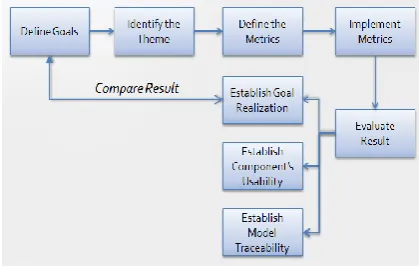
Figure 2: An Overview of Validation Derivatives
Figure 2 shows the artifacts that constitute the MDVA concept proposed in this paper. Validation themes are de-fined by set of metrics which specify what components are to be tested. By iterative refinement of business behavior on the Business Layer, components are modelled into views to aggregate viewpoints for a particular test require-ment. Constraints are then applied on the components to derive test attributes for the logical model. These compo-nents form the test basis for the logical model design. The diagram depicts realization of physical model instances from the conceptual and logical models. These are valida-tion from different views with test scenarios specified from constraints. Goals are part of the motivation extension of ArchiMate and ensure alignment and integration with the core EA. Through an iterative process, these models are revalidated through each test attribute of the artifact, gener-ating traceability from specific view for each stakeholder.
7.0 The Case Study
used to illustrate the MDVA. A system is required with the
aim to implement a program that offer student placement. The objective is to automate the process of matching stu-dents with employers and internships, allowing stustu-dents to manage their CV, search for internship listings, request and apply for internship and store their feedback once the in-ternship has taken place. The system allows employers to manage internship listings, track progress on internship listing and provide feedback on student internships once they have taken place. Administrators create users, search and match student CV with opportunities, forward student CV to employers, track student visits and generate reports on system usage. For this paper, a motivational model is required that can validate models created for student’s viewpoint.
7.1 ArchiMate Modeling
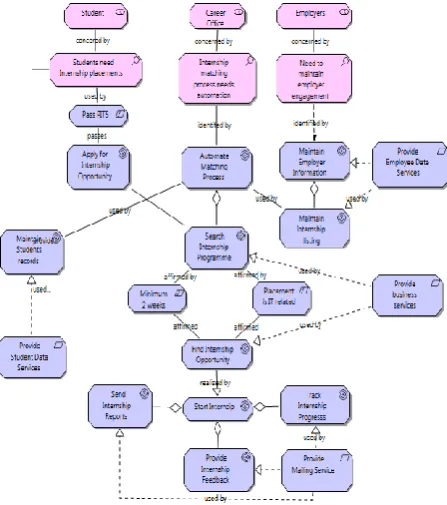
The ArchiMate language provides a means to handle mod-eling complexities of modern information-intensive enter-prises. For our modelling concepts ArchiMate enterprise modeling language is used with the objective to extend the motivation attributes with tests specifications using the Model Driven Approach. Figure 3 shows the complete goals and aggregation refined for all the viewpoints in the SIP based on the requirements specified in the case study. Here the views of Student, Employer and Career Office are integrated to establish congruency and to ensure that there are no gaps. The student needs to be able to search for in-ternship program and provide feedback; the employer needs to be able to provide the available internship oppor-tunities as well as feedback; Career Office automates the match process as well as generates reports. The overall goal of the enterprise is to be able to guarantee that “Stu-dent Start Internship”. Constraints are modeled into the design and Goals are realized through Requirements.
Figure 3: SIP Motivation Model.
In the following subsections, the preliminary process for implementation of the MDVA is carried out. Models from the motivational Requirements establish constraints and
associations with Business Role, Business Function, Busi-ness Process and BusiBusi-ness objects at the BusiBusi-ness Layer. For the purpose of this paper, only the student’s abstraction will be used with associated Goals.
7.2 Constraints
Though some of the constraints can also apply to the career office as the career office match students with placement opportunities also, we focus on student’s view and present constraint associated with students only to create our vali-dation scenario.
Figure 4: Realization of Constraints within Goals.
Figure 4 illustrates the modelling of constraints that affect the goal “Start Internship” for students. The Goal “Start Internship” is realized though five Requirements which also present the validation conditions. These are Relevance to study (CM1), Uploaded CV (CM2), Internship Oppor-tunity is available (CM3), student is currently in a year of study permitted for the internship (CM4) and prerequisite approvals obtained (CM5) Figure 4. These conditions form the basis for criteria and scenario descriptions and the tests procedure needed to validate the model.
7.3 Business Role
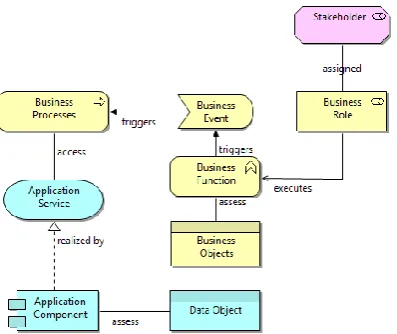
Figure 5: Assignment of Relationships across the Business Application Layers.
With reference to our case study, the architecture model can be interpreted from the perspective of the student as follows; the student as the stakeholder is assigned the Business Role “Personal Information Provider” in order to meet the requirement CV upload CM2 and realize the Goal “Start Internship Programme” see Figure 4. The Business Function “Update Details” is executed using predefined Business Object “Data Templates”. On completion of the task, a Business Event “Update Records” is triggered which initiates Business Processes through the Application Service to update the Data Objects.
7.4 Business Object
Business objects are manipulated by behavior in this study. The behaviors under consideration are Business Processes, Business Function and Business Objects. Here Business Process triggers Business Function while Business Object grants access only to associated artifacts.
Figure 6: Validation of Business Objects with Business Processes from Student’s Perspective.
The model in Figure 6 shows an identification of Business Objects associated with the case study from the student’s perspective. There is a process chain for PIT5 exams in T7 to Search for Internship only after validation through test conditions defined in the Business Objects T8 and T5. The “Search for Internship” (T3) triggers “Apply for Intern-ship” (T4) but both objects collaboratively access “Intern-ship Listing” T6.
7.5 Business Process
Business Process describes a flow of activities in the model represented in Figure 5 and 6. The Business Processes T1, T2 and T3 trigger the Business Function element T4 (Fig-ure 6) represented as Business Process in Fig(Fig-ure 5 and provides access to the Application service. Figure 6 shows aggregation and composite relationship attributes of the passive Business Function access relationship with Busi-ness Process. In the case study, the BusiBusi-ness Process repre-sents a workflow consisting of smaller processes leading to a Business Function “Apply for Internship”.
8 MDVA Implementation Approach
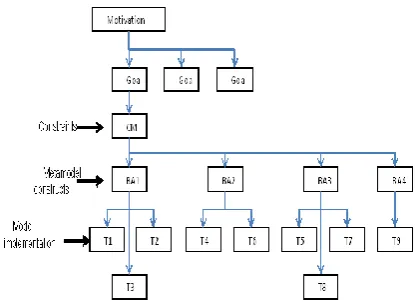
Harnessing the techniques described in previous sections, MDVA is grounded on the establishment of concrete test basis, defined at business level scenarios and annotated with constraints from the motivation concepts to support comparison between obtained and expected results. Figure 7 shows the transformation of Figure 5 relative to Figure 6 to include constraints defined in Figure 4.
Figure 7: Model transformation of business objective inte-grated with motivational constraints.
In implementation of MDVA, we adopt the first step which is the creation of the conceptual model from the Goals requirements as a perspective to be validated, Fig 2 and Fig 7. Then, the next step transforms the conceptual model into a logical model based on constraint integrated into the taxonomy, specifying artefacts of the model that are to be tested. During this transformation, the test basis is generat-ed explicitly including relations mappings with a traceabil-ity of model defined. The third step defines test scenarios with constraints and creates test conditions for validation of the EA artifacts. This is shown in Table 1 where in the model in Figure 4, constraints associated with the Goal “Start Internship” are extrapolated and cross-referenced with the business object model in Figure 6 and the architec-ture model in Figure 7. The constraints CM1, CM2, CM3, CM4 and CM5 are validated through CM constraints paths in the model transformation defined in Figure 7 and associ-ated with corresponding objects in the actual implementa-tion model. The constraints are applied on the defined arti-facts to identify the existence of the object as well as vali-date stated conditions. Some of the test conditions defined in the goal motivation construct are exemplified on the table using business readable domain specific mnemonics.
Artifact map/
Constraints Descrip-tion
Low level Definition of Test conditions for Artifacts
Valida-tion
CM1:on BA1<T1>,BA3<T8 >
Relevance to Study
If Object.T1 = pass PIT5 then result =True else object.T1 =false endif if Object.T8->notEmpty()
then result = true else result =false endif
CM2:on BA1<T2>,BA3<T5>
CV Uploaded
If Object.T5 ->notEmpty() then result = true else result =false endif
if uploadcv().T2=true then object.T2 ->not empty
result =true endif CM4: on BA3<T8>
Year of Study
1<year of study<3
CM5: on BA1<T3>
Requisite approvals
CM1+CM2+CM4 = True
At a higher level of abstraction, this can also be expressed using a BDD notation such as Gherkins for each of the constraints; For Example, CM1:BA1<T1>, BA3<T8 > is validated as;
Given that artifact T1 exist in BA1 And artifact T8 exist in BA3
When Constraint CM1 is parsed in T1 and T8 Then the result shall be True
A simple traceability model to demonstrate this notation usability is shown in Figure 8.
Figure 8: Traceability model for artefact validation.
The MDVA technique addresses the traceability problem by creating relationships between transformed models and artefacts as part of the conversion process, externalizing the relationships among the test-artefact models to allow for comparison with expected outcome.
9 Conclusions
MDVA presented in this paper is an approach that decom-poses business processes and develops constructs for the models to allow validation. Modelling motivational goals involve the conceptualization of different aspects of the enterprise from different viewpoints and levels of abstrac-tion during the life cycle of the architecture. This article includes such conceptualizations derived through model-ling and descriptions of models of the business behavior; specifying concepts of intentions in terms of goals,
con-straints and requirements. The models offer description of integrated components and illustrate the relationships be-tween the various artifacts that constitute the taxonomy, relating business vision, mission and strategy with infor-mation systems through modeling extensions of Archi-Mate. Enterprise Architecture and its management have continued to be a topic of ongoing and increasing interest to practitioners. Standardization of concepts (considering disparities in ZF), methodology (as consolidated by TOGAF) would facilitate stabilization and leverage with new innovations to extend EA with validation models, notations and semantics. New technological trends such as cloud computing and big data pose challenge to EA inte-gration. Creation of more EA management roles within enterprise needs to be embraced to allow evolution and provide more information for further research.
REFERENCES
[1]. Bahill, A. T., Botta, R., & Daniels, J.,2006. The Zachman framework populated with baseball models. Journal of EA, 2(4), 50-68.
[2]. Chen, D., Doumeingts, G., Vernadat, F., 2008. Architectures for enterprise integration and in-teroperability: Past, present and future. Computer and Industrial Engineering, 59:647659.
[3]. Clark, T., Barn, B. S., Oussena, S., 2011. Leap: a precise lightweight framework for enterprise ar-chitecture. In Proceedings of the 4th India Soft-ware Engineering Conference (pp. 85-94). ACM.
[4]. Coleman, P., Papp, R., 2006. Strategic Alignment: Analysis of Perspectives. Proceedings of the 2006 Southern Association for Information Systems Conference.
[5]. Davenport, T., 1993. Process Innovation: Reengi-neering work through IT. HBS School Press, Bos-ton.
[6]. Essien, J., Oussena, S., 2013. Enterprise Architec-ture Models for Description of Integrated Compo-nents for Validation - A Case Study of Student In-ternship Programme. In the 15th International
Conference on Enterprise Information System 2013.
[7]. Fischer, C., winter, R, Aier, S., 2010. What Is an Enterprise Architecture Principle? Towards a Consolidated Definition, Computer and Infor-mation Science 2010, SCI 317, pp. 193–205. springerlink.com Springer-Verlag Berlin Heidel-berg.
[8]. GARTNER, 2013. Available at
http://www.gartner.com. Accessed April, 2013
[9]. IEEE Computer Society. IEEE Recommended Practice for Architectural Description of Software Intensive Systems. IEEE Standard 1471-2000.
to Process Networks. Hershey, PA: IGI
Publish-ing.. p.58-61.
[11].Krogstie, J., 2008. Using EEML for Combined Goal and Process Oriented Modeling: A Case Study. Proceedings of EMMSAD 2008.
[12].Krogstie, J., Sindre, G., & Jorgensen, H. D. 2006. Process models representing knowledge for ac-tion: A revised quality framework. European Journal of Information Systems 15 91-102.
[13].Lankhorst, M., 2013. Enterprise Architecture at Work: Modelling, Communication and Analysis. Springer, Berlin, Heidelberg, New York.
[14].Mabey, B., 2008. Imperative vs. Declarative Sce-narios in user stories; Available at: http://benmabey.com/2008/05/19/imperative-vs-declarative-scenarios-in-user-stories.html; Ac-cessed 19 May 2013.
[15].McGovern, J., 2004. A practical guide to enter-prise architecture. Prentice Hall Professional.
[16].Noran, O., 2003. An Analysis of the Zachman Framework for Enterprise Architecture from the GERAM perspective, Annual Reviews in Control, 27, 163-183
[17].North, D., 2006. Introducing BDD. Available at: http://dannorth.net/introducing-bdd/. Accessed on:
March 2013.
[18].OMG, http://www.omg.org/. Assessed 2013.
[19].Polgreen, J., 2012. Using TOGAF to Develop and Implement Enterprise Architecture in Government - U.S. Federal Agencies as Example.
[20].Quartel, D., Engelsman, W., Jonkers, H. 2009. A Goal-Oriented Requirements Modelling Language for Enterprise Architecture. Proceedings of the 13th IEEE International Enterprise Distributed Object Computing Conference, EDOC 2009, New Zealand.
[21].Salmans, B., Kappelman, L. A.,2010. The State of EA: Progress, Not Perfection. The SIM guide to enterprise architecture, 165-187.
[22].Sammuelsson, E.,2003, UML Testing Profile RFP, Telelogic, Rational, SofTEAM, FOKUS, Ericsson,
[23].Sessions, R., 2007. A Comparison of the Top Four Enterprise-Architecture Methodologies, Ob-jectWatch, Inc.
[24].TOGAF, The Open Group. ArchiMate Version 2. http://www.opengroup.org/archimate, Oct, 2012.
[25].SIP, 2012, University of West London,Available at: http://samsa.uwl.ac.uk/mdse/. Accessed 07/01/2103
[26].Urbaczewski, L., & Mrdalj, S. 2006. A compari-son of enterprise architecture frameworks. Issues in Information Systems, 7(2), 18-23.
[27].Venkatraman, N., Henderson, J., 2010. Strategic Alignment: Leveraging IT for Transforming Or-ganisations, IBM Systems Journal, Vol 32 No 1.
[28].Weston, J., Defee, J., 2004. Performance Based Enterprise Architecture Planning – A white Paper, 2004, http://www.caci.com/.
[29].Zachman, J. 2008. John Zachman’s Concise Defi-nition of The Zachman Framework. Zachman
In-ternational. 2008. Available at: