Specific exercise testing in judo athletes
Elena Pocecco
ABCD
, Hannes Gatterer
D
, Gerhard Ruedl
CD
, Martin Burtscher
ABD
Institute of Sport Science, Medical Section, University of Innsbruck, Austria
Source of support: Departmental sources and authors’ own financial resources
Received: 15 May 2012; Accepted: 9 July 2012; Published online: 13 July 2012
Abstract
Background
All-out exercise tests lasting the duration of a judo match, i.e., 5 minutes, regarding arm and leg performance have barely been introduced. We hypothesised that, besides body composition, arm and leg performance, derived from 5 minutes lasting all-out ergometric tests, would be of importance for success in judo competitions.Material/Methods:
The groups investigated consisted of eight juvenile (15.3±0.9 years) and six adult (25.2±4.9 years) male Austrian judokas of different ranks. In addition to body composition, power output and peak oxygen uptake (VO2peak) were determined during 5-min all-out tests on an arm crank and a cycle ergometer.Results:
Relative VO2peak during cranking was about 18% higher in juvenile than in adult men (35.5±4.3 ml∙kg–1∙min–1 vs. 30.0±3.5 ml∙kg–1∙min–1, p≤0.05). However, neither body composition nor arm and leg performance was relat-ed to competition success in juvenile judo athletes. In contrast, in adult judokas percentage of body fat (r=–0.83) and relative maximum arm power (r=0.83) were both related to competition rank (p≤0.05).Conclusions:
As these results indicate age-related differences in the assessed determinants of success for judo competition per-formance, they may have practical importance and should be considered in planning the training for male judo athletes of different age classes.Key words: ergometry • upper and lower body performance • judo performance • determinants of success • martial art • combat sport
Author’s address: Elena Pocecco, Department of Sport Science, Medical Section, University of Innsbruck, Fürstenweg 185, 6020 Innsbruck, Austria; e-mail: [email protected]
B
ackgroundJudo is a martial art and an Olympic sport that has re-cently, in August 2010, been enclosed in the program of the inaugural Summer Youth Olympic Games, for ju-veniles aged 14–18 years. Competitors are organized in age classes and weight divisions. Besides psychological and emotional components, technical skills, and tacti-cal strategies, certain physiologitacti-cal characteristics are dispensable for success in training and competition, in-cluding coordination, flexibility, strength, velocity, and aerobic and anaerobic endurance [1–3]. A high level of physical fitness is required to support technical ability and offset fatigue to maintain performance and to pre-vent injuries throughout the combat with a regular du-ration of 5 minutes for adults.
The assessment of physical fitness of judo athletes us-ing field tests, even if sport-specific, has the inconve-nience of a low validity and reliability in comparison to the assessment in a laboratory setting. Only a few stud-ies tried to assess male adult judokas performance using sport-specific ergometric tests with regard to total dura-tion and time structure, i.e. intermittent effort [4–6]. However, peak oxygen uptake (VO2peak) was not de-termined and other maximal performance parameters, not being the primary aim of those studies, could hard-ly be assessed using such protocols.
To our knowledge, only Little [7] and Franchini et al. [8] have investigated age-dependent differences be-tween male judo competitors, but the ergometric tests used where not of combat duration.
and Study Aim:
Authors’ Contribution:
A Study Design
B Data Collection
C Statistical Analysis
D Manuscript Preparation
E Funds Collection
Whereas most of these studies did not investigate the re-lationship between assessed parameters and judo com-petition performance, Callister et al. [9] identified body fat percentage as a discriminator of success in adult male weight-limited divisions. Taylor and Brassard [10] reported a low correlation between success in international compe-titions and adult elite judokas’ physiological performance parameters, such as maximum oxygen uptake (VO2max), leg strength, muscular endurance, flexibility, blood lac-tate, and time to exhaustion during an anaerobic run. Also for younger competitors determinants of success
could hardly be detected. Lech et al. [11,12] identified just one parameter, i.e. time to reach maximal anaerobic power, to be related to the level of achievement in judo competitions only among junior (16–18 years) but not among cadet (14–16 years) contestants. Unfortunately, the laboratory tests used during these researches were generally different in duration compared to judo fights. Our previous study [13] is the only one which compared performance of male judo athletes belonging to differ-ent age classes by a sport-specific ergometry. However, it has not been verified if the assessed parameters corre-lated with competition performance. To our knowledge, no study has focused on determinants of success in judo athletes derived from sport-specific ergometric testing.
Thus, the aim of this study was to evaluate body com-position and performance parameters of male judo ath-letes, derived from 5 minutes lasting all-out arm and leg ergometric tests, as potential determinants of suc-cess for judo performance in two different age classes.
M
aterialandM
ethodsExperimental approach to the problem
The present work was designed to study the differenc-es in most commonly assdifferenc-essed body composition and ergometric performance parameters between juvenile and adult male judo athletes and to relate these re-sults to judo performance. Therefore, the test protocols were developed to reproduce competition-like physical loads concerning intensity, duration, and involved mus-cle groups. Even if judo fights in the adult class typi-cally lasts near to 3 minutes of effective time plus 1 min-1 min 40 sec of brakes [6,14,15], adult competi-tors have to be prepared to sustain a 5-min (+3 min in case of parity) regular duration match, and juvenile ju-doka, in the age class under 17 years, a 4-min (+2 min in case of parity) match. Moreover, also training fights generally adopted by judo coaches, in particular at the highest level of this sport (i.e., training camps of the International Judo Federation), last 5 min. Therefore, a 5-min all-out test on a cycle ergometer was used to assess leg performance and a body weight-depending
incremental test on an arm crank ergometer was used to assess arm performance.
Even if allometric scaling techniques may allow a more appropriate method to adjust VO2max and other per-formance parameters for body size, normative data are not as readily available as for ratio standard techniques [16]. Furthermore, as in judo competitors are organized in weight divisions, performance parameters related to body weight seem to be determinant for judo perfor-mance and were therefore calculated in the present study.
Subjects
The group investigated consisted of 14 healthy, male judo athletes from an Austrian sports club of different ages and experience: 8 juveniles (age class: cadets, U17), and 6 adults (age class: seniors, +20). Amateurs as well as com-petitive, non-professional judokas from regional up to the international level participated in this study. One athlete of the Austrian National Team was included in each age class. Juveniles trained judo 3.3±2.0 times a week, adults 5.8±2.9 times a week. Each judo-training session was used to be of quite high intensity and lasted 1.5 hours for both age classes. Moreover, 6 juvenile and 4 adult judokas ab-solved an additional strength training 1 to 3 times a week. The rank order was based on regional ranking lists spe-cific for each age class. Main characteristics of the partic-ipants involved in this study are summarized in Table 1.
All testing procedures were conducted in the afternoon and in the first stage of the competitive period. Athletes were normally hydrated at the time of testing, had a light meal at least 2 hours before, and avoided heavy exer-cise on the day prior to and day of testing. Informed consent was obtained from each participant or the ents, if the athlete was a minor, prior to voluntary par-ticipation in the performance assessment program. The study was approved by the Institutional Review Board and conducted in accordance with the guidelines of the Declaration of Helsinki.
Procedures
First of all the spirometer was calibrated according to the manufacturers’ instructions.
Anthropometry and body composition
After clinical routine examinations, body height, and body mass were assessed using standard techniques. A tetrapo-lar, multi-frequency bioelectrical impedance analysis (BIA 2000, Data Input GmbH, Germany) was used to determine percentage of body fat (%fat) following manufacturers’ rec-ommended procedures before starting the exercise tests. Determinants of success
– Factors which concur to and are fundamental for the victory in a sports competition, i.e., a judo competition.
Ergometry – “The study of physical work activity, including that performed by specific muscles or muscle groups. The studies may involve testing with equipment such as stationary bicycles, treadmills, or rowing machines” [29].
Test for the upper body
The upper body test has been used in our laboratory for several years to evaluate upper body performance of dif-ferent athletes, such as judokas and climbers [13]. It was preceded by a standardized, non-specific warm-up (10 min running or cycling followed by 5 min of stretching exercises) and a specific warm-up (2 min cranking at 25 W on the test-ergometer immediately before starting the assessment program). The protocol consisted of a con-tinuous incremental test using an arm crank ergometer (Ergometrics er800SH, Ergoline, Germany). While the starting power of 25 W was the same for all participants, the increment of power per minute corresponded to half of the value of the body mass, with gradual increment units of 5 W at regular time intervals, intending to reach a test duration of about 5 min. As power output is in-fluenced by muscle mass and therefore by body weight, body weight-dependent power increments aimed to a similar test-duration for all participants, independent from their body mass and absolute power. The test end-ed when, due to exhaustion, a cranking frequency above 40 revolutions per minute could no longer be maintained. Maximum power at the end of the test (Pmax) and to-tal crank time to exhaustion (Time) were recorded. The highest oxygen uptake and minute ventilation (VO2peak and VEpeak) were determined as the averages of 30 s during the final phase, i.e., 4th and 5th min, shortly be-fore breaking off the test by breath-by-breath measure-ments (Oxycon Alpha, Jaeger, Germany). Heart rate was monitored continuously during the exercise test (Polar, Finland). The highest heart rate observed was defined as peak heart rate (HRpeak). Heart rate reserve (HRR) was calculated using the formula: (220-age)-HRpeak.
Test for the lower body
The lower body test was performed after at least a 1-hour break following the upper body test. Because of the larg-er muscle mass involved during the test on the cycle ergometer, to reduce the negative effect of fatigue on
performance, the sequence of the two tests was always the same. The protocol consisted of a 5-min maximum test on an electrodynamically-braked cycle ergometer (Excalibur Sport, Lode, Netherlands) [17]. The test-re-test reliability is quite good, having intra-class correla-tion coefficients of r>0.94, p<0.001 [17]. The handle bar and saddle of the cycle were individually adjusted. The specific warm-up consisted of pedalling at a self-selected pace for 3 min at a power of 70 W immediate-ly before starting the test. On the basis of pre-tests and of our broad experience in testing athletes of different age, the braking torque was then set at 0.3 and 0.5 N∙m × body mass for juveniles and adults, respectively, and was held constant throughout the test. Participants con-trolled power output via the pedalling rate. The accel-eration and decelaccel-eration of the flywheel mass were au-tomatically taken into consideration for power output determination. Participants were encouraged to choose a maximal pedalling rate that could be maintained for the entire test duration. Mean power was the average power output for the 5-min period. VO2 and VE were measured breath-by-breath during the 4th and 5th min of the test in order to determine peak values (VO2peak and VEpeak) using an open spirometric system (Oxycon Alpha, Jaeger, Germany). The highest heart rate regis-tered during the test (Polar, Finland) was defined as HRpeak. Heart rate reserve (HRR) was calculated us-ing the formula: (220-age)-HRpeak.
Statistical analysis
Standard descriptive statistical procedures were used to determine mean ± standard deviation (mean ±SD) val-ues for juvenile and adult men. Because the sample size was small and the data were not homogeneous, Mann-Whitney U-tests were used to evaluate differences be-tween means of the two groups. Simple correlation co-efficients by Spearman and by Pearson were determined for qualitative and for quantitative variables, respectively. To assess effect size, Cohen’s d was calculated for differ-ences between two means. Statistical significance was set
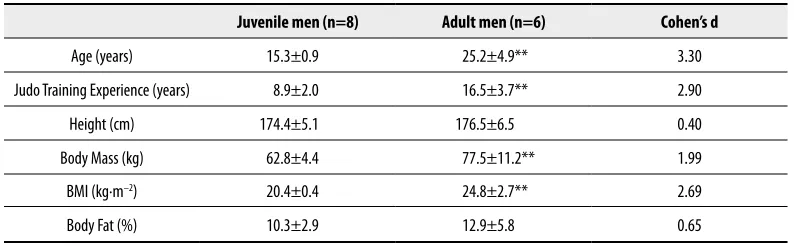
Juvenile men (n=8) Adult men (n=6) Cohen’s d
Age (years) 15.3±0.9 25.2±4.9** 3.30 Judo Training Experience (years) 8.9±2.0 16.5±3.7** 2.90 Height (cm) 174.4±5.1 176.5±6.5 0.40 Body Mass (kg) 62.8±4.4 77.5±11.2** 1.99 BMI (kg∙m–2) 20.4±0.4 24.8±2.7** 2.69
Body Fat (%) 10.3±2.9 12.9±5.8 0.65 Table 1. Judokas’ main characteristics.
Values are mean ±SD for age, judo training experience, height, body mass, body mass index (BMI) and percentage of body fat, and judo training experience. Significant differences between juvenile and adult men: * p≤0.05; ** p≤0.01.
Sports Performance–
“Carrying out of specific physical routines or procedures by one who is trained or skilled in physical activity. Performance is influenced by a combination of [physical], physiological, psychological, [emotional], and socio-cultural factors” [30].
Martial arts – “Systems of codified practices and traditions of combat, initially created for warrior purposes, and nowadays practiced for a variety of reasons, including self-defence, competition, physical conditioning etc.” [31].
Combat sports –
“Competitive contact sports where two combatants fight against each other using certain rules of engagement” [32].
at p≤0.05. The program used for statistical analysis was SPSS (version 15.0.1; SPSS Inc., Chicago, USA, 2006).
r
esultsAnthropometry and body composition
Comparisons between the two age groups showed that juvenile men differed from adult men in body mass (62.8±4.4 kg vs. 77.5±11.2 kg, p≤0.01) and body mass index (BMI) (20.4±0.4 kg∙m2 vs. 24.8±2.7 kg∙m2, p≤0.01), but not in body height and %fat (see Table 1). Among adult men, %fat was positively related to age (r=0.905, p≤0.05).
Arm and leg ergometric performance
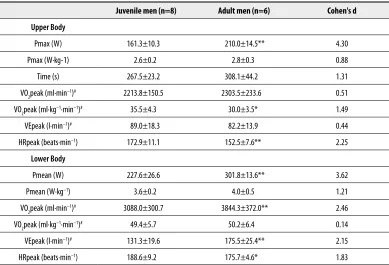
Table 2 shows the results of ergometric testing of upper and lower body (arms and legs).
The test duration at the arm crank ergometer was approx-imately 5 min for adults and close to 4.5 min for juvenile men, which corresponds roughly to the regular duration of a judo match for the respective age classes (see Table 2).
Absolute power values of juveniles were lower than those of adults in both tests (Pmax: 161.3±10.3 W
vs. 210.0±14.5 W, p≤0.01; Pmean: 227.6±26.6 W vs. 301.8±13.6 W, p≤0.01). Relative maximal power of the arms was negatively related to %fat only in juveniles (r=– 0.809, p≤0.05). Among adult men, relative power of upper and lower body were closely related (r=0.923, p≤0.01).
Concerning HRpeak values, juveniles yielded higher val-ues compared to adults (during arm cranking: 172.9±11.1 beats∙min–1 vs. 152.5±7.6 beats∙min–1, p≤0.01; during cy-cling: 188.6±9.2 beats∙min–1 vs. 175.7±4.6 beats∙min–1, p≤0.05). In contrast, juveniles’ and adults’ heath rate reserve (HRR) was similar in both groups (during arm cranking: 31.9±11.2 beats∙min–1 vs. 42.3±8.5 beats∙min–1 respectively, n. s.; during cycling: 16.1±9.5 beats∙min–1 vs. 19.2±2.6 beats∙min–1 respectively, n. s.).
Relative VO2peak during arm ergometry was significantly different between the two groups, being about 18% high-er among the younghigh-er athletes (35.5±4.3 ml∙kg–1∙min–1 vs. 30.0±3.5 ml∙kg–1∙min–1, p≤0.05). During cycling, ju-veniles had lower absolute values of peak oxygen uptake and peak minute ventilation than did adults (VO2peak: 3088±301 ml∙min–1 vs. 3844±372 ml∙min–1, p≤0.01; VEpeak: 131.3±19.6 l∙min–1 vs. 175.5±25.4 l∙min–1, p≤0.01). In both age classes, relative VO2peak on the cycle ergometer was negatively related to age (juveniles: r=–0.741, p≤0.05; adults: r=–0.826, p≤0.05).
Juvenile men (n=8) Adult men (n=6) Cohen's d
Upper Body
Pmax (W) 161.3±10.3 210.0±14.5** 4.30 Pmax (W∙kg-1) 2.6±0.2 2.8±0.3 0.88 Time (s) 267.5±23.2 308.1±44.2 1.31 VO2peak (ml∙min–1)# 2213.8±150.5 2303.5±233.6 0.51
VO2peak (ml∙kg–1∙min–1)# 35.5±4.3 30.0±3.5* 1.49
VEpeak (l∙min–1)# 89.0±18.3 82.2±13.9 0.44
HRpeak (beats∙min–1) 172.9±11.1 152.5±7.6** 2.25
Lower Body
Pmean (W) 227.6±26.6 301.8±13.6** 3.62 Pmean (W∙kg–1) 3.6±0.2 4.0±0.5 1.21
VO2peak (ml∙min–1)# 3088.0±300.7 3844.3±372.0** 2.46
VO2peak (ml∙kg–1∙min–1)# 49.4±5.7 50.2±6.4 0.14
VEpeak (l∙min–1)# 131.3±19.6 175.5±25.4** 2.15
HRpeak (beats∙min–1) 188.6±9.2 175.7±4.6* 1.83
Table 2. Judokas’ ergometry performance.
Values are mean ±SD for maximum power (Pmax), mean power (Pmean), test duration (Time), peak oxygen uptake
(VO2peak), peak ventilation (VEpeak), and peak heart rate (HRpeak) assessed during upper and lower body ergometry.
Significant differences between juvenile and adult men: * p≤0.05; ** p≤0.01. # These parameters were measured during
the 4th and 5th min of the tests.
Determinants of success
Judo performance, i.e., the rank in judo competitions, of adult men was negatively related to %fat (r=–0.829, p≤0.05) and positively related to relative Pmax of the upper body (r=0.829, p≤0.05). No such determinants of success could be identified for juvenile men.
d
iscussionThe objective of the present study was to evaluate body composition and performance parameters of male judo athletes, derived from 5 minutes lasting all-out arm and leg ergometric tests, as potential determinants of suc-cess for judo performance in two different age classes. The main results obtained showed that percentage of body fat and relative maximum arm power were both related to rank only in adult judokas. These parameters can therefore be considered as discriminators of success only for judo performance in adult men.
Anthropometry and body composition
Anthropometric parameters showed a large inhomoge-neity between and within the tested groups. This as-pect is typical of judo and of sports with weight divi-sions in general [1,2].
The BMI of the adult men in our study (24.8±2.7 kg∙m–2) was somewhat lower than that of Polish elite senior male judokas (26.4±1.6 kg∙m–2) [18].
Percentages of body fat in this study (10.3±2.9% and 12.9±5.8% for juvenile and adult men, respectively) were comparable to data reported in the literature: 10.2% in juvenile male judokas [7] and from 8.3% to 16.2% in adult male competitors [1,2]. However, it should be mentioned that body fat values in the literature were mostly derived from skinfold measurements, making di-rect comparisons difficult.
Anthropometric parameters of the tested judokas re-flected typical age differences. Indeed, body mass and BMI were higher among adult athletes. In contrast, %fat showed no significant differences between age class-es, despite the age-dependent increase in %fat among adults. This is also in accordance with trends reported in the literature where juvenile, junior, and senior male judokas had similar values for body fat [7].
Arm and leg ergometric performance
Since it seems that no one has studied power measure-ments during continuous or incremental laboratory tests lasting approximately the duration of a judo match,
comparisons with the literature are difficult. The only available maximal power values of juvenile and adult male judokas, though determined during a 3-min step test at the arm crank ergometer, are of 1.63±0.11 W∙kg–1 and 1.94±0.38 W∙kg–1 respectively (n.s.) [8]. These val-ues are somewhat lower than those of the present study, probably due to a longer testing duration.
Relative maximal power of the arms was negatively re-lated to %fat among young men. As body composition influenced upper body performance, a loss in fat mass, primarily achieved through a higher training volume, could be useful to maximize relative muscle power. The strong relation between relative power of the upper and lower body among adult men seems to underline the general state of whole-body fitness of the tested ath-letes and could be considered a training adaptation, as both arms and legs are involved in judo. Correlations between upper and lower body performance parameters are reported in literature, but were significant only for absolute and not for relative values [19].
Because of the similar HRR, group-related differences in peak heart rate during both tests can be attributed to the age difference [20].
Even if methods of VO2max assessment used in other studies on judo athletes are somewhat different from those used in the present study, from our experience in testing we can consider the VO2peak measured during cy-cle ergometry to be very close to the VO2max. Therefore, taking into consideration that the VO2peak measured at the cycle ergometer could be 3–6% lower than values from the treadmill test [21,22], a comparison with data from the literature should be possible. Mean values of rel-ative VO2peak for the lower body of juvenile (49.4±5.7 ml∙kg–1∙min–1) and adult (50.2±6.4 ml∙kg–1∙min–1) male judo athletes in the present study fall within the lower region of the range of values reported in literature for age-matched male judokas of different competitive lev-els, from provincial to international level, ranging be-tween 43.5 and 58.7 ml∙kg–1∙min–1 for juveniles [7,11,23] and between 40.0±5.5 and 64.9±5.5 ml∙kg–1∙min–1 for adults [1,2]. Values of tested athletes could roughly be compared to those of lower ranked, i.e., national-lev-el, judo athletes.
Relative lower body VO2peak decreased with age in each of the two groups. This trend is in accordance with data reported in the international literature which identi-fies the highest relative VO2max values in males aged 15–20 years [20,21]. Similar results were also report-ed by Little [7], where juvenile (14.7±0.9 years) and junior (17.3±0.8 years) competitors had significantly higher relative VO2max values, measured on a treadmill,
compared to senior judo athletes (26.0±5.3 years). As a possible explanation, the author proposed that train-ing emphasis on technical and tactical skills in judo may be a more important performance factor for male judokas when progressing from junior to senior levels of competition. Despite these results [7], differences in relative VO2peak during lower body work between groups did not reach significance in the present study. Nevertheless, these findings are in accordance with our previous results [13].
In contrast to lower body work, a higher relative VO2peak during upper body work distinguished juvenile male judo athletes from adult judokas. These findings are perfectly in line with other studies performed at our institute us-ing the same testus-ing-protocol [13], but are in disagree-ment with Franchini et al. [8], who didn’t find differ-ences in upper body relative VO2peak values between juvenile (16.3±0.8 years), junior (19.4±0.5 years), and senior (23.5±2.2 years) male judokas. To explain the present results, it could be speculated that more years and training volumes of judo practice of adults com-pared to juveniles (16.5 years, 5.8±2.9 times a week vs. 8.9 years, 3.3±2.0 times a week, respectively) and of strength training, with more emphasis of the upper body compared to the lower body, could have lead to specific muscle adaptations. Physiological mechanisms supposed to be involved have already been discussed in our recent investigation [13].
Determinants of success
Judo performance was inversely related to %fat and di-rectly related to maximal upper body power relative to body weight (arm cranking) only among adult men. The first relation is in accordance with a study where the only parameter significantly related to elite judokas’ rank was the %fat among male competitors in weight-limited di-visions [9]. Moreover, male junior elite wrestlers could also be distinguished from non-elite wrestlers on the ba-sis of skinfold thickness [24]. However, the authors did not hypothesise if this trend was due to differences in training or in making weight [24].
The higher relative arm Pmax among more successful adult male judokas could contribute to the relevance of upper body power in the grip fight and during the combat in general, when competitors have to maintain an advantageous distance from the opponent, extend-ing or flexextend-ing the elbow [25]. This findextend-ing may also be partly due to the higher importance focused on strength training and to a higher amount and frequency of judo practice with increasing age and rank. Apparently, only one study on judo athletes reported similar results dur-ing an aerobic-anaerobic task for the upper body [26]
and such findings were also reported for wrestlers [24]. Moreover, Callister et al. [9] identified a similar, although not significant, trend among adult female judokas con-cerning arms strength, especially at higher velocities. Similar results are also reported by Kubo et al. [25], who measured larger arms muscle thicknesses in judo athletes with a higher performance level. However, the majority of studies concerning judokas did not clearly define variables that discriminate between higher and less successful athletes [10,11,27]. Moreover, from the results of prior studies, it can be assumed that judokas do not represent a homogeneous group and their phys-ical and physiologphys-ical parameters show specific trends across the different weight divisions [9,19]. Because of these differences, further studies are necessary to eval-uate predictors of success related to competitive weight divisions [9].
As no such determinants of success were identified for the juvenile age class, which is in accordance with litera-ture [11], we assume that ergometric predicting param-eters differ between young age and adulthood in a quite homogeneous group of non-elite male judokas. Maybe the identified determinants of success could distinguish between competitors whose judo experience is in gener-al quite high, but not between younger athletes, whose judo performance could probably depend more on oth-er factors like technical and tactical level [11], compe-tition experience or psychological factors.
Because of different testing protocols, it is not possible to compare all measured parameters to those found in the literature. It would be interesting to carry on this research by performing the same tests, or a similar test protocol for arms and legs, to compare upper and low-er body plow-erformance parametlow-ers. Furthlow-er parametlow-ers, i.e., blood lactate, should be measured in order to de-termine the contribution of the anaerobic lactic energy system. Moreover, the chosen test-protocols, even if of match duration and quite easy to be reproduced, don’t reflect exactly the intermittent nature of judo matches and of judo competition. However, it should be men-tioned that the minimal recovery time of 15 min typ-ically reported in judo competitions [26] seems to be long enough for a full performance recovery of highly trained judokas [28]. Moreover, the meaning of the obtained results could be limited by the small sample size, which may influence some correlations. A high-er numbhigh-er of participants among each subgroup, pos-sibly representing all weight divisions, would be ad-vantageous, especially for defining the predictors of success. However, this study represents a first step in the development of simple, specific ergometric tests for upper and lower body performance designed for judo athletes.
c
onclusionsOur results demonstrate an important role of specific ergometric testing especially in adult male judo athletes and indicate age-related differences in the assessed de-terminants of success for judo competition performance. These results may have practical importance and should
be considered in planning the training for male judo ath-letes of different age classes.
Acknowledgements
The authors would like to acknowledge all the judo ath-letes who volunteered for this study and their trainers for the kind collaboration.
1. Franchini E, Del Vecchio FB, Matsushigue KA, Artioli GG: Physiological profiles of elite judo ath-letes. Sports Med, 2011; 41: 147–66
2. Hernández García R, Torres Luque G: Perfil fisi-ológico del judoka. Una revisión [Physiological pro-file of judokas. A review]. CCD, 2007; 3: 25–33 [in Spanish, English abstract]
3. Pierantozzi E, Muroni R: Judo high level competi-tions injuries. Medit J Musc Surv, 2009; 17: 26–29 4. Krogulski A, Mickiewicz G, Wisniewska A et al:
A comparison of growth hormone and cortisol re-sponses to high intensity intermittent exercise be-tween two different training periods. Biol Sport, 1986; 3: 91–101
5. Markowska L, Mickiewicz G, Wojczuk J et al: Activity of sympatho-adrenal system in athletes during an year’s training cycle. Biol Sport, 1987; 4: 109–19
6. Sanchís C, Suay F, Salvador A et al: An experience concerning the physiological evaluation of judo competition. Educ Fís Deportes, 1991; 18: 51–58 7. Little NG: Physical performance attributes of ju-nior and seju-nior women, juvenile, juju-nior, and seju-nior men judokas. J Sports Med Phys Fitness, 1991; 31: 510–20
8. Franchini E, Takito MY, Lima JRP et al: Características fisiológicas em testes laboratoriais e resposta da concentração de lactato sangüíneo em três lutas em judocas das classes juvenil-A, júnior e sênior [Physiological characteristics in laboratorial tests and blood lactate response in three fights in juvenile, junior and senior judo players]. Rev Paul Educ Fís, 1998; 12: 5–16 [in Portuguese] 9. Callister R, Callister RJ, Staron RS et al:
Physiological characteristics of elite judo athletes. Int J Sports Med, 1991; 12: 196–203
10. Taylor AW, Brassard L: A physiological profile of the Canadian judo team. J Sports Med Phys Fitness, 1981; 21: 160–64
11. Lech G, Pałka T, Sterkowicz S et al: Effect of physi-cal capacity on the course of fight and level of sports performance in cadet judokas. Arch Budo, 2010; 6: 123–28
12. Lech G, Tyka A, Pałka T, Krawczyk R: Effect of physical endurance on fighting and the level of sports performance in junior judokas. Arch Budo, 2010; 6: 1–6
13. Pocecco E, Faulhaber M, Franchini E, Burtscher M: Aerobic power in child, cadet and senior judo ath-letes. Biol Sport, In press
14. Castarlenas JL, Planas A: Estudio de la estructu-ra tempoestructu-ral del combate de judo [Study of tempo-ral structure of judo combat]. Educ Fís Deportes, 1997; 47: 32–39 [in Spanish, English abstract] 15. Sikorski W, Mickiewicz G, Majle N, Laksa C:
Structure of the contest and work capacity of the judoist. In: Mickiewicz G editor. Proceedings of the European Judo Union International Congress on Judo: Contemporary problems of training and judo contest; 1987 Nov 9–11; Spala, Poland 16. Barker AR, Armstrong N: Exercise testing elite
young athletes. Med Sport Sci, 2011; 56: 106–25 17. Burtscher M, Faulhaber M, Flatz M et al: Effects
of short-term acclimatization to altitude (3200 m) on aerobic and anaerobic exercise performance. Int J Sports Med, 2006; 27: 629–35
18. Laskowski R, Wysocki K, Multan A, Haga S: Changes in cardiac structure and function among elite judoists resulting from long-term judo prac-tice. J Sports Med Phys Fitness, 2008; 48: 366–70 19. Thomas SG, Cox MH, LeGal YM et al: Physiological
profiles of the Canadian national judo team. Can J Sports Sci, 1989; 14: 142–47
20. Åstrand PO, Rodahl K, Dahl HA, Strømme SB: Textbook of work physiology: Physiological bas-es of exercise. 4th ed. Champaign (IL): Human Kinetics; 2003
21. Dal Monte A, Faina M: Valutazione dell’atleta [Evaluation of athlete]. Torino: UTET; 1999 [in Italian]
22. O’Toole ML, Douglas PS, Hiller WD: Applied phys-iology of a triathlon. Sports Med, 1989; 8: 201–25 23. Laskowski R, Ziemann E, Grzywacz T: Comparison
of aerobic capacity in various groups of adolescent athletes. Arch Budo, 2009; 5: 21–24
24. Horswill CA, Scott JR, Galea P: Comparison of max-imum aerobic power, maxmax-imum anaerobic power, and skinfold thickness of elite and nonelite junior wrestlers. Int J Sports Med, 1989; 10: 165–68 25. Kubo J, Chishaki T, Nakamura N et al: Differences
in fat-free mass and muscle thickness at various sites according to performance level among judo athletes. J Strength Cond Res, 2006; 20: 654–57 26. Franchini E, Takito MY, Nakamura FY et al: Effects
of recovery type after a judo combat on blood lac-tate removal and on performance in an intermit-tent anaerobic task. J Sports Med Phys Fitness, 2003; 43: 424–31
27. Borkowski L, Faff J, Starczewska-Czapowska J: Evaluation of the aerobic and anaerobic fitness in judoists from the Polish national team. Biol Sport, 2001; 18: 107–17
28. Franchini E, Bertuzzi RCM, Takito MY, Kiss MAPDM: Effects of recovery type after a judo match on blood lactate and performance in specif-ic and non-specifspecif-ic judo tasks. Eur J Appl Physiol, 2009; 4: 377–83
29. http://medical-dictionary.thefreedictionary.com/ergometry. Accessed 4 May 2012
30. http://dictionary.sensagent.com/sports+performance/en-en/. Accessed 4 May 2012
31. Franchini E, Huertas JR, Sterkowicz S et al: Anthropometrical profile of elite Spanish Judoka: Comparative analysis among ages. Arch Budo, 2011; 7: 239–45
32. Foretić N, Karninčić H, Uljević O: The influence of the wrestling technique on contact efficiency of young male team handball players. Arch Budo, 2011; 7(2): 87–91