DOI: 10.14738/abr.512.3796.
Aduamoah, M., Yinghua, S., Anomah, S., & Ahmed, F. (2017). Riding the Waves of Technology: A Proposed Model for the Selection of Appropriate Computerized Accounting Software for Implementation in SMEs in Developing Countries. Archives of Business Research, 5(12), 156-179.
Riding the Waves of Technology: A Proposed Model for the
Selection of Appropriate Computerized Accounting Software for
Implementation in SMEs in Developing Countries
Maurice Aduamoah
Schools of Management, Wuhan University of Technology, Wuhan P.R. China, 430070
Department of Accountancy & Accounting Information Systems, Kumasi Polytechnic. Post Office Box 856, Kumasi,-Ghana.
Song Yinghua
Schools of Management, Wuhan University of Technology, Wuhan P.R. China, 430070
Sampson Anomah
Department of Accountancy & Accounting Information Systems, Kumasi Polytechnic. Post Office Box 856, Kumasi,-Ghana.
Fawad Ahmed
Schools of Management, Wuhan University of Technology, Wuhan P.R. China, 430070
ABSTRACT
Currently, SMEs are looking for ways to select Computerised Accounting Software packages to better improve their business process capabilities, economies of scale and competitive edge over rivalry companies in the market. CAS is seen as the optimal preference as it is now a dominant, powerful and integrated software package embedded with all the modules needed to process and generate accounting information on a timely, high precision and error free manner for management decisions. However, choosing the appropriate CAS has become a critical problem for many SME entities in developing countries as the past and continuous selection of sub-optimal CAS application had brought mischance’s to SMEs leading to massive financial losses and arguably bankruptcies. Some critical and vital considerations such as vendor credentials, CAS selection and implementation financing option by the CAS vendor, Maintenance overheads, Functionality, Flexibility and Implementation are most often marginalised during the selection process which have negatively affected SMEs ability to select the best breeds of CAS among the proliferated software in the software market in Ghana. This study fills this gap by proposing an appropriate integrated buying framework leading to a mathematical model that may guide SMEs in their quest to selecting an optimal CAS package for implementation where the software market is fuzzy and unclear regarding the best CAS package available. Business processing needs of SMEs are varied so it is expected that the suggested model would support SMEs in developing countries select the “most appropriate” CAS that may meet their respective financial transaction processing needs.
INTRODUCTION
Taking advantage of the new waves of technology benefits immensely from the world of business dynamics have caused many SMEs in developing countries also look for new ways to collect, process, store and disseminate accounting information to all relevant users of for quick decision making as it pertains advanced countries. As results, SMEs have resorted to the use of business processing application called Computerised Accounting Software (CAS) to help them achieve their respective financial transaction processing which has become the norm of doing business fast changing global environment. CAS is a dominant accounting information system software application, embedded with all the normal physically operational activities of SME entities interrelated together to facilitate the processing and generation of financial information such as comprehensive income statement, the statement of financial position, accounts receivable schedules to facilitate debt collection, inventory management, sales analysis, all forms of tax returns and payroll for employee salaries etc. [1] asserts that CAS facilitates information flows and sharing within the business entity among each operational module which ultimately leads to the summary generation of the information above. This according to[2], successful selection and implementation of CAS enables the SME benefit from easy access and retrieval of the same data and information for quick decision making. However, the software market is proliferated with many CAS application packages with different brand names and information, making the selection very challenging for implementation. These phenomena have become stumbling barriers for SMEs according in their quest to implement CAS application in developing countries such as Ghana [3-4].
Recent software implementations across government’s strategic businesses such as the computerisation of all business processing’s at the Ghana Ports and Harbours (GHPOHA), The Ghana Revenue Authority (GRA)[5]; The Social Security and Insurance Trust (SSNIT)[6] and the entire overhaul of the banking sector through computerization [6-7]. [8] suggest that SMEs should take advantage of software adoption revolution by government to also implement CAS package systems into their financial data processing’s to complete an element of the payment cycle. The adoption and implementation of CAS for financial data processing will enable SMEs have easy interaction with these statutory government agencies and the banking sector to propel the country achieve a paperless society status; SMEs receipts and payment cannot be successful if they fail to automate their business processing to hook their computerised networks to that of government business and the banking sector. The trade cycle must be completed by the interaction of the customers banking networks and the vendor’s bank networks. However, this is not the case in Ghana so far as the trade cycle is concerned. A case example is where Telco’s in collaboration with banks in Ghana have introduced money transfer systems. The system rolls out demands that SMEs must be provided with handy payment devices at their respective business locations to enable potential customers buy and then render fees for goods and services provided to them on that computerised platform. SMEs in their efforts to complete the business processing cycles by implementing CAS packages are overwhelmed with massive lots of accounting software packages in the software market with the risk of selecting the inappropriate one very high to an SME manager or owner who is novice in the market. There is no single published determinant which must guide SMEs in their desire to selecting for installation a CAS package. The results have seen many SMEs managers and their accounting staff getting disappointed in witnessing a CAS package underperforming to requirements in Ghana.
which are not relevant, time consuming, and non-cost effective (Kimberling, 2006)[10]. To achieve the above needs appropriate selecting and implementation techniques that bring all SME business processing requirements needs expected to be provided by a selected CAS service provider with full integration of all the functional operations in the software package. To enable the SMEs in Ghana mitigate the risks of selecting the wrong CAS package for implementation this research study adopts the Delphi techniques which requires knowledgeable and expert contributors to individually respond to questions regarding the dimensions of selecting an optimal package and submitting the results to a central coordinator. The coordinator then processes the contributions, looking for central and extreme tendencies and their rationales. The results are then sent back to the specialist participating respondents to resubmit their views based on the refined questionnaires by the moderator. This process continues until the coordinator sees that a consensus has been formed. The technique aims at removing biases that are possible when diverse groups of experts meet together. In the Delphi technique, the experts do not know who the others experts are during the process [11]. This process will contribute to an applicable buying model which is more consensuses in nature from diverse specialist stakeholders hence reducing the risks of selecting inappropriate CAS packages for implementation.
SMEs sector have been preferred for this study for various motivations: since the inception of CAS literature into SMEs business processing’s, there have not been enough literature because it is seen as young and up and coming [12-13], hence we are of the view that focusing only on the fusion of CAS into SME businesses, would add to existing literature by providing academic and practical viewpoints to balance out with how SMEs select and implement their CAS package. Many SMEs have blindly made selection of sub-optimized CAS products.[14], posit that there is not much research work on how respective SMEs coordinate the migration of their manual or existing accounting functions (legacy systems) to a newly implemented computerized accounting system. Examining the existing literature uncovered neither the existence of a framework, interrelated and integrated theoretically regarding the major dimensions and sub-features that needs to be taking into accounts in selecting suitable CAS for SMEs in Ghana. Many SMEs in Ghana nowadays have perceived as a results of the frustrations they go through in acquiring CAS packages that nobody can assure that using certain criteria in choosing CAS application will meet its business processing and regulatory requirements until the CAS is totally set up and effectively running. This research study therefore fill this gap by coming out with an integrated buying framework and model which may lead to the “appropriate” selection of CAS by respective SMEs for implementation at a mitigated reduced risks to an acceptable risks tolerance.
Related Research Work on Computerized Accounting Software Implementation in SMEs
of SMs is now automated. It also looked at user’s perception and actual functioning of CAS system to SMEs. The results revealed a massive increase in knowledge about accounting software usage of small companies. [19] in his case study approach, investigated into the teaching of computerized Accounting course by using real-life case study in accounting or finance which allowed students to complete their final projects in the area of Accounting, Medical Billing, payroll, accounts receivable and payables etc. at the end of the study each students mastered new skills and were able to find employment in both big and smaller companies. [20] and his colleagues conducted a study into “Computer-Based Accounting Systems in SMEs with a practical substantiation from a Randomized Trial in Nigeria” using finance and accounts personnel of companies or executives whose sole responsibility is the processing financial transactions in entities such as manufacturing, agriculture, construction and mining, hotel and hospitality, IT services, medical services, wholesale and retail trade, and general services industries. The research findings revealed a marginal increase in usage of CAS by Nigerian SMEs. The suggested outcome implored professional accountants to continually mix their accounting skills with that of CAS to enable their relevance and impact to be felt in the business community and also their profession Again these studies have not come out with any framework that brings together the view points from specialist stakeholders like consultants, practicing personnel like accountants, internal auditors and CAS vendor suppliers and academia to develop a one-stop –shop model to aid respective SMEs in their desire to implement an accounting software.
LITERATURE REVIEW Small and Medium Enterprises (SMEs)
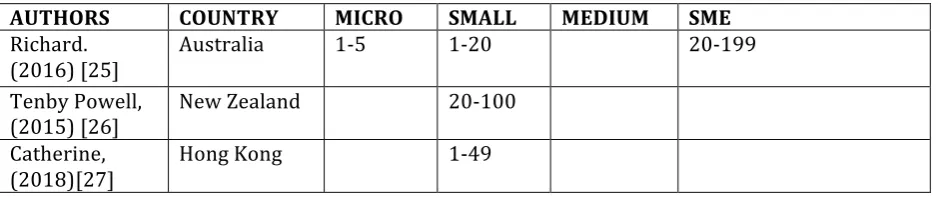
Businesses are regarded as Small and Medium Seized (SME), if it fulfils certain requirement ceilings for staff, a turnover value found in a statement of comprehensive income and financial position ceiling. For example Small and Medium sized Enterprises (SMEs) are of paramount significant to scores of countries. In the US for instance, SME, entities with fewer than 500 employees, are the backbone of the economy which offer employment to over 50 percent of the private sector employees in various career disciplines and also generate over 65 percent of net new private sector jobs according to[21].. Across the EU28, the contributions of SMEs business make up 99.8% of all enterprises, 57.4% of value added, and 66.8 % of employment [22]. This requirement has made the definition of SME somewhat vague and incomprehensible as it does not have a uniform criterion across countries [23]. As a result of a non-convergence criteria and definition, SMEs definition in Ghana is largely based on the number of employees in the fold of the business. In Ghana, [24], defines firms with more than 10 workers as SMEs. It could be seen from the definition and scope that SMEs could have many workforces when it’s operational activities expands. The expansion of business activities in SMEs necessitates the fusion of CAS technologies to process its large financial data set with ease and on time for management decisions. The reason being that it would be a requirement that the SME business files a statutory financial statement, VAT returns, employee Pay as You Earn (PAYE), employee pension insurance etc with appropriate authorities under the umbrella of the Ghana Revenue Authority (GRA).
Table 2: Employee sizes used in defining micro, small, medium enterprises bya sample of IT researchers.
AUTHORS COUNTRY MICRO SMALL MEDIUM SME
Richard.
(2016) [25] Australia 1-5 1-20 20-199 Tenby Powell,
(2015) [26] New Zealand 20-100 Catherine,
(2018)[27]
Computerized accounting systems
The theory and concept of CAS broadly come under Accounting Information System (AIS) which is defined as computer software application which is used for recording and processing accounting transactions such as: accounts receivable module; accounts payable module; trial balance module; payroll module; and all-purpose functional financial report module [28]. According to [29], AIS in general is defined as the interrelation and integration of an entity’s components parts that are joined collectively to gather raw data and information relating to that business discipline such as sales ledger, purchase ledger, value added returns, payroll returns etc, and convert these data sets into a summary of financial information in the form of statement of reports for distribution to relevant users within and outside the entity to make decisions. AIS could be applied in Health, Education, Banking and Metrological administration etc in general to collect data and process them into meaningful information for relevant users’ consumption. In such circumstances, we have Health accounting information system, education information systems, banking information systems and metrological accounting information systems respectively. In relation to financial reporting in these entities AIS could replicate itself to collect data relating specifically to financial transactions process it to produce an output in the form of information and then report to relevant users for decision making. To comprehend the term ‘AIS appropriately’, three expressions represented in AIS would need to be detailed individually. In the first instance, available literature has asserted that accounting could be classified into three components parts, namely information system, “words of commerce” and basis of financial information reporting’s [30]. Also, information must be seen as important data processing which is augments a base for decisions making such as taking action to retrieve ageing debtors when the schedule has been presented to management in the form of report. Finally, any system should be seen as integrated entity joining all the relevant sub-components, where the conceptual framework is focused on a set of objective achievement as asserted by [31, 32, and 33]. The CAS package may be developed in-house (bespoke) by the entity or be purchased from a third party software developer (off-the-shelf). CAS application packages hugely vary based on cost and complexity. In contemporary and dynamic business environment, packaged CAS application is not only restricted to recording and processing of financial data, but also provides expert functional modules that support easy managerial decision making with the ultimate aim of breeding in competitive advantage.
The Origin of Computerized Accounting Software
reinvented since into this present day where Sage Accounting Software of Canada and Tally of India emerged.
Current use of Computerized Accounting Software
The use of CAS is increasing day by day. However, there are a few literatures available in this field of study concerning the application of accounting software among SME business as most persons within academia and industry believes that it is related to technicians and so must be discussed at a technical level within and outside their purview. Computerized accounting is defined [36] as a total suit of components that together comprises all inputs, storage, transactions, processing, collecting and reporting of financial information to stakeholders. Modern computerized accounting systems are based on the concept of database. A database is implemented using a database management system, which is defined as a set of computer programmes (or software) that manage and organise data effectively and provide access to the stored data by the application programmes. There is offline-based CAS software that needs installing into a computer or laptop and the computer need not to be connected to the Internet. It needs one time installation; however, the software needs updating on a regular basis to perform efficiently. It is recommended to back-up the data on a regular basis to secure any potential loss. The most recent development in the CAS is going online and cloud-based. Such online software can be accessed from anywhere and any devise provided there is an Internet connection. There is no requirement for data backup as it is taken care by the software provider.
Accounting Software Proliferation and Selection
In small businesses, before computerization of accounts, typically only two people managed the accounts: the owner/manager and the business’ external accountant. The work involved and the costs associated in ‘doing the books’ are clear and there are no uncertainties or risks to the owner / manager. With computerization of accounts involving DOS based software, the number of people involved in the management of accounts grows to three or more people: the owner/manager, the accountant, the IT consultant and a few employees. The software is purpose built. There are no automatic updates to the software, unless it is requested by the owner. The initial costs are usually high, but there are no hidden costs. With the currently available packaged software, benefits such as affordability and high functionality come with potential complexity, risks, uncertainties and dependency. For example, the owner / manager is now dependent on several specialized experts (sometimes on ongoing basis): the accountant, the software consultant, the IT consultant and IS/IT auditors/ training of software employees. The cost of coordination for the small business owner / manager increases and the risk of something going wrong in maintaining and using the accounting software also increase [37].
SMEs and Computerized Accounting Systems Implementation
quick-shifting business environment to gain competitive advantages. To mitigate the risks in selection and installation, CAS package desired and purchase by SMEs must best serve the entities requirement needs and must have the capacity to be customized to also meet statutory and regulatory requirements to avoid the entity’s time and resources and budgets which may ultimately affect the entity’s profit and loss accounts and balance sheet figures. To this end, it’s suggested that organizations undertake an effective and efficient due diligence regarding every facet of the CAS desired prior to acquisition and implementation as it will be too late to reverse during roll the out stage of usage.
[38], argue that selecting the optimal CAS for installation has become risky venture as the software market has becomes proliferated with more and more fuzzy CAS packages with varied information. They are of the view that in most circumstances, more merchandize information creates choice-making very difficult for reporting entities desiring to buy some. These situations put SMEs into thinking that a costly CAS may perform to business requirements which are sometimes the opposite and difficult to evaluate[39]. also discovered that choosing the right CAS for an SME needs a profound examination of numerous diverse criteria’s. It is noted that, during the selection of CAS, numerous stakeholders stress on the selected application meeting entities present and future critical requirements needs.
Table 1: Increase in System Complexity When Switching from Manual Accounting to IT Based Accounting
Item Internal
(Owner) External (Accountant) IT Trained Accountant/Internal Auditor IS/IT Auditor IS Vendor
Manual ü ü
Use of DOS based software
ü ü ü ü
Used of AIS/CAS
package ü o ü o o ü
Model for the Selection of an Appropriate CAS packages
Figure 1: Criteria for the Selection of Optimal CAS Service Provider
Vendor Reputation
Debt Financing Options
Maintenance Overhead
CAS Functionality
CAS Flexibility
CAS Customisation
Optimal CAS Selection
CAS
Vendor credentials
Nearly every the literature on the CAS selection process make mention of vendor credential no matter large or small the entity is. These imply that there is no distinction between large, medium and smaller entities when it comes to the selection of CAS packages for implementation. However there are three distinctive attributes in Vendor credentials when it comes to a decision to select CAS for implementation from a supplier. These are Vendor's reputation, market share and the demonstration of previously successful CAS implementation for another reporting. The vendor credentials can be used by SMEs to perform due diligences about the desiring CAS providers, because reputation and current market share are possible indicators of CAS suppliers performance. The exhibition of previous implementation can be applied to check on the efficiency of suppliers CAS system. Moreover, vendor credentials depicts the fame of the CAS Provider in the market and how the committed the vendor is in quality of CAS, implementation and periodic maintenance [40].
Financing option
CAS application cost, Consulting and Maintenance/upgrade revenue expenditure and how to fund the CAS investment are the three major sub-criteria’s in this dimension. To select an appropriate CAS provider, expenditure relating to implementation is always ranked high in the decision making process for SMEs desiring to automate their accounting function, together with after-sales service in case there occur unpredicted challenges after implementation, and the quality of employee’s training regarding the use of the CAS package and cost of training should there be any upgrade of the software subsequently.. A research study conducted by [41] shows that the annual maintenance costs of ERP hooves around 25% of the initial ERP implementation costs, and upgrade costs as much as 25-33% of the initial ERP implementation. In relation to SMEs, it will look too expensive and so they might not be able to pay these huge revenue expenditures. As a result, this criterion is very important for any organization desiring to purchase CAS for implementation. In conclusion, financing option represents the whole capital and revenue expenditure and the options available to pay for it by an SME entity.
Maintenance overheads
Subsequent CAS repairs and maintenance service needs should be taken into accounts in the early stages of selecting the CAS supplier [42]. Maintenance aspect of CAS selection deals with After-sale service and the level training that will be given to SME staff as part of the implementation process including Real-time CAS reviews and online inquiry which must be seen to be operational on the part of the desiring CAS supplier. As part of the training and maintenance users should clearly understand the software’s features and its capability how to use it to effect transaction using the double entry bookkeeping principles. If maintenance terms are not properly negotiated, may lead to mischance on the part of the SME entity if vendor display unwillingness to upgrade the CAS in subsequent years to comply with new regulatory requirements. SMEs business operations may be frozen by authorities if the CAS system displays non-compliance [43]. Obviously, this criterion shows the services renders by the CAS vendor supplier after the CAS system has been implemented.
Functionality
paying for functionalities they don’t need but have been implemented and they are paying for it as maintenance fees periodically. According to Butler Group the functionality is not only about how many functions a CAS has but how efficient the functions of CAS system can provide to achieve the business processing needs of an entity.
Flexibility
This selection criterion simply means the easiness with which the CAS system users can work with desired software application in real time. The CAS system should not be too complex in design and development but have a user-friendly and well-managed interface. The CAS must be embedded capability to process and generate the needed report of the SME entity over its lifetime prior to its subsequent upgrade and maintenance, in order to meet the SMEs culture and business strategy, although some business strategies are reviewed as the needs comes out in the ordinary course doing business. Ease of use is, possibly, more significant for SMEs, as they normally do not have sufficient in-house IT personnel to support them use complex application [49]. As such, the flexibility nature of CAS represents the level of ease of use and how well the system can work along with the business over its life expectancy.
Customization Capabilities
The most essential determinants of CAS that should be factored in choosing appropriate CAS application is its capability to be customized to satisfy an entity’s particular business processing requirements. Most of the current CAS packages enable the end user of these packages to modify them with ease. According to [50] customization abilities of CAS application are typical concerns to SMEs desiring the selection and implementation of any software. However, some off-the-shelf applications are supplied with little or no prospect for customization to support a reporting entity’s needs, but other CAS vendors do offer support with the end users to modify the software applications to meet their entity’s business processing requirement needs. It is argued that the greater the chance for customization the higher the capital and revenue payment burden to the SME in terms of the CAS software. [39] put in a strong argument that the most optimal question an SME manager, accountants or whoever is in charge of business processing needs to decide before desiring a CAS application is whether it could be tailor-made, and if it could, whether the bespoken will meet the user needs. The expected main customization levels are: company set up customisation, VAT and other taxes customisation, financial statement customization from say twelve months to six months, forms-level customization, screen-level customization, blank user definable fields, default settings, database-level customization, third party integration customization, help-level customization and systems administration customisation.
Implementation
have shorter implementation and delivery times [53-54]. Implementation describes how the new CAS system can be bespoken and integrated with SMEs current system as well as the time spent during the course of the implementation, including customization capabilities in harmony with SMEs strategic objectives.
The Delphi Technique
Dalkey et al (1950) at the Rand Corporation firstly came out with the concept of the Delphi technique which was named after an ancient Greek sanctuary where an oracle was assumed to be located. This process requires that knowledgeable and expert in a specialist field of enquiry be contacted independently for their contributions individually by responding to questions in their specific field and submitting the outcome to an assigned central coordinator who is also a specialist in that field on examination. The coordinator then processes input collected from specialist. The coordinator mainly looks for extreme tendencies and their rationales from these contributors. The results are then returned to the respondents. The respondents are then again requested to resubmit their views, assisted by the inputs given by the coordinator as may be a review of the original as a result of the outcome derived from that questionnaire survey. The process continues in anticipation that the coordinator will note that a consensus has agreed after processing. The aim of this technique is to remove the bias that emerges when group of experts meet for a consensus building on certain issues. The Delphi technique demands that the solicited experts do not have to know each other during the investigation [55].
[56], posits that one clear time of application of the Delphi technique is when the subject under examination does not does not have a formal analytical method – subjective in nature, but can benefits the study on a collective basis from the experts. [55] provide a critique of the Delphi application in nursing, and concluded that “It is obvious from examining the benefits and criticisms of the Delphi technique that the arguments are no stronger or no more valid on one side than the other. It was rather recommended that the technique be evaluated against the proposed study to determine the benefits which can be accrued by applying this method as against the other for the study. [57], characterize the classical Delphi method by four key features:
1. Secrecy of Delphi participants: this demand allows the expert participants to freely express their opinions without undue influence to kowtow from others in the group. Decisions must be evaluated on their worth instead of who proposed the thought. 2. Iteration: this method also allows the participants to re-examine their viewpoints in
light of the advancement of the group’s work from stage to stage.
3. Controlled feedback: It also requires that participants be informed of the views of other participant’s, to provide the chance for other Delphi participants to make clear or re-evaluate their views if possible.
4. Aggregation of statistical group response: this process allows for a quantitative analysis and interpretation of data.
[57], further point forward a suggestion that it is only when the issue under study has the four attributes that it should be classified as Delphi technique. However, others [58- 60] argue that the technique can be modified to meet the needs of the given issue under study. They put forward that a distinction be made by using the term Classical Delphi to describe a type of approach that adheres to the attributes of the original Delphi as summarized by [57].
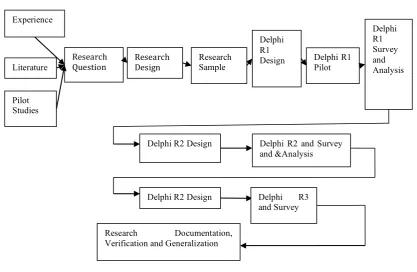
Typical Delphi Process
reaching consensus regarding the sub-features of the independent variables in the framework for selecting an appropriate CAS application.
Figure 3 Three Round Delphi Process
RESEARCH METHODOLOGY
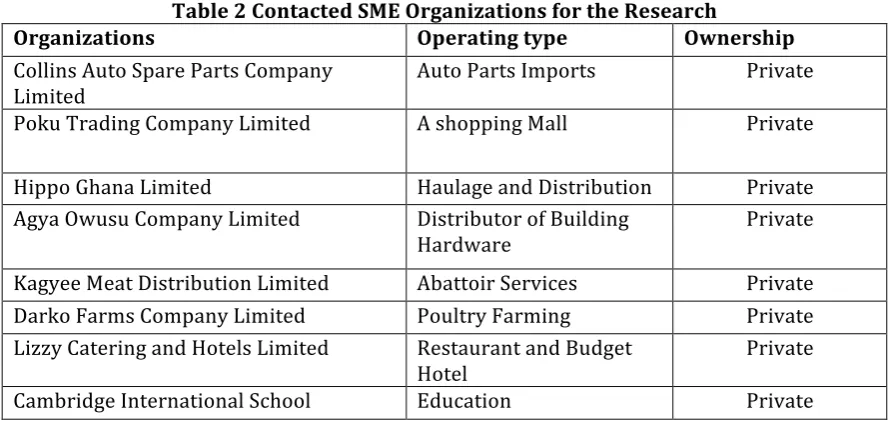
The research study was undertaken using some reporting entities in the Auto Spare Parts distribution industry of Ghana, Shopping Mall Operators, Haulage Distribution Companies, Construction Hardware equipments wholesaling and retailing companies, Abattoir services Poultry farming and Restaurant and Hotel businesses (See Table 2) especially those in Kumasi in the Ashanti Region and the Greater Accra Region of Ghana who are all members of th Ghana Association of Small Businesses (GASB, 2015)[62]. Most of these SMEs are clients to our accounting firms so it was easy to get their accountants and bookkeepers together for the research study. The aim was to understand how these randomly selected SMEs choose their CAS packages for implementation as most of them have implemented different brands of CAS packages with different challenges in usage. The Institute of Chartered Accountant of Ghana (ICAG, 2015)[63], The Institute of Internal Auditors of Ghana (IIAG, 2015),[64] Price Waterhouse Coopers (PWCG, 2015)[65] in Ghana, some selected CAS vendors and other local chartered accounting firms operating mainly in Ghana had their respective representations. Even though employee accountants and internal auditor and other stakeholders from the Ghana Association of Rural Banks (APEX, 2015)[66] and Ghana Association of Microfinance Institutions (GAMFI, 2015)[67] were not invited they willingly opted to be part of this critical survey to offer some inputs. We were made to be aware that they have and currently being confronted with challenges relating to their already installed ERP (T24) package failures as such deemed themselves as also a experience stakeholders in this research study to offer practical inputs. The overwhelmed patronage clearly showed the importance these entities attached to the selection and implementation of CAS packages in developing countries such as Ghana. Table 2 shows patronised business entities who willingly gave us the authority to add their names as part of the research to find a model solution to CAS selection and implementation.
Experience
Literature Revie
Pilot Studies
Research
Question Research Design Research Sample
Delphi R1
Design Delphi R1 Pilot
Delphi R1 Survey and Analysis
Delphi R2 Design Delphi R2 and Survey and &Analysis
Delphi R2 Design Delphi R3 and Survey
Table 2 Contacted SME Organizations for the Research
Organizations Operating type Ownership
Collins Auto Spare Parts Company
Limited Auto Parts Imports Private Poku Trading Company Limited A shopping Mall Private
Hippo Ghana Limited Haulage and Distribution Private Agya Owusu Company Limited Distributor of Building
Hardware Private Kagyee Meat Distribution Limited Abattoir Services Private Darko Farms Company Limited Poultry Farming Private Lizzy Catering and Hotels Limited Restaurant and Budget
Hotel Private
Cambridge International School Education Private
The methodology adopted was to segregate member participants into their respective area of specialization both in academia and in practice. They were made to be in ten respective rooms for to respond to questions on major dimensions and sub-features of CAS packages that may influence their decisions to select accounting software for implementation. The questions were selected from within the model we have developed which was deemed subjective in nature for selection. After lengthy inputs from these skilful and experienced specialist participants we the coordinators realised there were some inconsistencies from some member participants and so way for the adoption of the Delphi techniques to refined the questions to member participants in their respective rooms for resubmission. This took us to the second round of certain sub-features of CAS that may influence their decision to select it for implementation. This time round we gave them specific accounting software which is competing in the software market. We made some specialist participants be aware of the stance of majority of other members in other for them to review their opinion subjectively to reach a general consensus on the major dimensions and sub-features of CAS for potential selection and implementation. The coordination was effective so consensus was reached on round two To ensure speedy consensus building to proof the variables in the model a Likert scale question was chosen to formulate the questionnaire to collect the primary data capturing all the independent variables and sub-features that were identified. The Delphi technique sets the following which our member participants all met:
i) knowledge and experience with the issues under investigation; ii) capacity and willingness to participate;
iii) sufficient time to participate in the Delphi; and iv) Effective communication skills.
Dimensions of Selecting Appropriate Accounting Software: A Proposed Model
Upon reaching consensus of the theoretical examination in the research study, it was agreed amongst participants that selecting the most appropriate CAS for business organization would be a function in the following variables: Vendor Credentials (VC), Debt Financing (DF), Maintenance Overhead (MO), CAS Functionality (CF¹), CAS Flexibility (CF²), CAS Customisation (CC), and CAS Implementation (CI) (See figure 1).However, the real shape of the function could not be determined without using real empirical data. So, the questionnaire designed were distributed to participants with a list of accounting software packages available in the market that are expected to satisfy their organization’s business processing needs. This technical committee studied the main features and attributes of each CAS application taking into consideration the independent variables above. The technical committee members were instructed to exclude CAS which does not have some of the main and important features. Finally, the committee prepared a short list of thestrongly recommended accounting software for selection and implementation.
The Proposed mathematical Model for Arriving at CAS Selection Decision
The selecting committee moderator to member participants the estimated maximum points that should be assigned to each of the selected sub-features in the proposed model according to its relative importance or materiality for an organization by filling in the required data of the respective column in the suggested evaluation statement of accounting software. To ensure consistency in their evaluation of the independent variables and the sub-features, The Delphi technique was employed to reach a reasonable and acceptable level of consensus in their assessment regarding the relative significance of each variable dimension and its components. With the application of the Delphi’s technique the aggregate number of assigned points for each independent variable identified in selecting the best CAS by all evaluation committee members were calculated, then the average point assigned for each CAS was also calculated (total number of points assigned for a specific CAS by all the committee members divided by the total number of the evaluation committee members). The committee then selected the accounting software that obtained the highest average of points that were calculated in the previous step which achieve the best matching which was assumed to have fulfilled the organization's financial business processing requirements needs.
Next, the average number of points for each dimensional item and its inherent components were calculated by dividing the total number of points assigned for that dimensional item by all committee members divided by the total number of the committee members. The maximum points assigned for the selecting dimension in the proposed evaluation statement were used as a yardstick for evaluating the competitive accounting software. However, significant variations emerged among the committee members concerning their evaluation of the materiality of the dimensional items which, accordingly, affected the maximum points assigned to each sub-features within the variable item. The moderator then redesigned the questionnaire and re-submitted it to each member (round two) to fill. This process led to a reasonable consensus with regards to the points ultimate points assigned to each independent variable.
For the purpose of this research it is convenient to assume the existence of a multi-linear relationship between selecting appropriate accounting software (Y) and the independent variables in figure1 which is formulated in equation (1) below.
* =M) S PQ R
TU) M
VU) (General equation of the proposed model) (1)
Y = Average number of points assigned to desired accounting software in the market; i = Index of the evaluation participant members from 1 to n;
n = Total number of evaluation participants members;
k = Index of variables that goes into the selection of optimal CAS from 1 to m; m = Total number of selected Items in the variables; and
D = Total number of points assigned Items in CAS application selection.
we subtituted our dimensional views basic functionality of selecting an appropriate CAS package into above equation, which depicts the model equation for selecting an optimal CAS as follows:
(2)
Where:
OPCS = Average number of points assigned to desired accounting software in the market; i = Index of the evaluation participant members from 1 to n;
n = Total number of evaluation participants members;
VC = Total number of points assigned to the Vendor Credentials of CAS packages;
DF = Total number of points assigned to Debt Financing aspect of CAS selection and Implementation;
MO = Total number of points assigned to subsequent maintenance aspect of CAS selected; CF¹ = Total number of points assigned to CAS Functionality;
CF² = Total number of points assigned to CAS Flexibility; CC = Total number of points assigned to CAS Customization; CI = Total number of points assigned to CAS Implementation;
The assumption is that the main characteristics of the selected CAS should have gone through the above variable scrutiny (VC, DF, MO, CF¹, CF², CC, and CI).Further, the selected accounting software should be competitive and compatible with the existing information systems and integrated with other programs in place.
Vendor Credentials
To determine the optimum points for Vendor credentials the following three attributes were concluded: Vendor's reputation VR, market share (MS) and the demonstration of previous implementation (DPI). This is depicted in the following mathematical modelling:
(3) Where:
VC = Average number of points assigned to Vendor credentials in the software in the market; i = Index of the evaluation participant members from 1 to n;
n = Total number of evaluation participants members;
VR = Total number of points assigned to the Vendor Reputation in the software market;
MS = Total number of points assigned to Market Share aspect of the CAS supplier in the software market
DPI = Total number of points assigned to Demonstration of Previous Implementation of CAS by the vendor;
Debt Financing
mathematical function was derived:
(4)
Where:
DF = Average number of points assigned to Debt Finance in the software in the market; i = Index of the evaluation participant members from 1 to n;
n = Total number of evaluation participants members;
CAC = Total number of points assigned to the Software Cost in the software market;
CM = Total number of points assigned to Consulting, Maintenance and upgrade aspect of the CAS supplier in the software market
CI = Total number of points assigned to payment options provided by the CAS vendor;
Maintenance Overheads
The maintenance overheads concern itself with After-sale service (AFSS), hands-on training (HOT) as well as the instantaneous change and online inquiry (OLI). To determine the optimum points assigned to maintenance overheads the sub-features derived above were used to model the following equation:
(5)
Where:
MO = Average number of points assigned to Maintenance Overheads provided by the CAS vendor in the software in the market;
i = Index of the evaluation participant members from 1 to n; n = Total number of evaluation participants members;
AFSS= Total number of points assigned to the After Sales Services by the CAS vendor supplier; HOT = Total number of points assigned to Hands-on Training provided by the CAS supplier in the software market;
OLI = Total number of points assigned to Online Enquiry services provided by the CAS vendor;
Functionality
Different businesses do request for diverse CAS system functions due to their distinctive business set up and processing requirements needs, which normally include: Statement of Comprehensive Income (SI), Statement of Financial Position (SFP), Tax Returns (TX), Payroll Preparation (PP), Bank Reconciliation Statement (BRS), Cash Bookkeeping (CBK), Accounts Receivable Ledger and Payable Ledger (ARPL) Expenses Accounts (EXP) and Inventory Management (IM). These sub-features of functionalities were used to derive the maximum points obtained from functionality variable which is depicted below:
(6)
Where:
CF¹= Average number of points assigned to desired accounting software function in the market;
i= Index of the evaluation participant members from 1 to n; n= Total number of evaluation participants members;
SI= Total number of points assigned to the ability of the CAS to process and generate statement of Comprehensive Income;
TX= Total number of points assigned to the ability of the CAS to process and generate varied tax returns such as VAT, PAYE, SNNIT, NHIS etc;
PP= Total number of points assigned to the Payroll Functionality of the CAS;
BRS= Total number of points assigned to the ability of the CAS to process and generate periodic Bank Reconciliation Statement;
CBK= Total number of points assigned to the keeping of Cash Book of the SME entity by the software application;
ARPL= Total number of points assigned to the ability of the CAS to process and generate Accounts Receivable and Payables controls accounts and their respective ledgers to determine ageing debtors and creditors respectively;
EX= Total number of points assigned to the keeping of all expenditures (both capital and revenue) of the SME entity and also generate a summary total to reflect in the trial balance and subsequent financial statements by the CAS application;
IM= Total number of points assigned to the keeping of all individual inventories in SMEs stores and the ability to generate a closing inventory and cost of sales by the CAS application;
Flexibility
In terms flexibility (CF²) it was concluded that the CAS should have the following sub-features: Easy to use (EU); not be too complex in design (NCD), well-managed user interface (WMUI), capability to support the needs of the business over its lifetime (CSNB). This is reflected in the following mathematical model equation:
(7)
Where:
CF² = Average number of points assigned to Flexibility embedded in the desired CAS packager in the software in the market;
i = Index of the evaluation participant members from 1 to n; n = Total number of evaluation participants members;
EU= Total number of points assigned to Ease of use of the CAS package;
NCD = Total number of points assigned to “not be too complex in design” of the desired CAS package;
CNSB = Total number of points assigned to capability to support the needs of the business over its lifetime of the CAS.
Implementation
Accounting software implemented across an organization should be able to affect almost all of the business processes of that reporting entity. The following sub-features were considered essential in allocating maximum points to Implementation: Customization and Ease of integration (CEI), be able to Exchange data with the current application (EDCA), the time it takes during the implementation process (TIME), the CAS customization strengths to uniquely meet SMEs strategic business goals. The sub-features identified above, we believe would enable maximum allocation of points to Implementation as a variable in determining best CAS selection as shown below:
(8) Where:
IM = Average number of points assigned to Implimentation of the desired CAS packager in the software in the market;
CEI= Total number of points assigned to Customization and Ease of use of the CAS package; EDCA = Total number of points assigned to the ability of the installed CAS” to exchange data with any existing accounting software package for easy migration onto the new system
TIME= Total number of points assigned to the time it takes to implement the CAS package and the depth of training the CAS vendor will give to the SMEs
CNSB = Total amount of points allocated to customization strengths of CAS to uniquely meet SMEs strategic business goals.
THE PROCEDURES FOR IMPLEMENTING THE PROPOSED MODEL
The real practicable process for the implementation the proposed model for choosing an appropriate CAS package for any business entity could use the following approach:
1. A commission made up of all the functional heads of the entity should be formed to study and specify Vendor Reputation, Debt Financing, Maintenance Overhead, CAS Functionality, CAS Flexibility, CAS Customisation, CAS Implementation The heads of the accounting, internal audit, and computing departments should be represented in the committee’s composition.
2. A market research should be embarked upon in the software to gather data and information the currently available CAS packages which competing among themselves with the inclusion of end users to see those CAS packages which can process data and information to meet the organisation’s strategic objectives.
3. The commission as a result of (2) above should come out with CAS software packages in the software market that are without duress expected to meet the business entities financial processing requirements (Appendix 1).
4. The selection and implementation commission should be made to exclude CAS which does not have the main significant attributes. At the end of the day, the commission would need to prepare a list of the highly recommended CAS applications in the markets.
5. The commission should take into consideration of currently available information technology infrastructure in the reporting entity to enable compatibility of the desired CAS with the available personal computers (PCs)
6. Gathering data and information about the vender reputation, capital expenditure on CAS purchase, periodic maintenance overheads and other important factors are to be considered very essential and fundamental for the selection and implementation of the proposed model.
7. The selecting and implementation commission should come out with the maximum points that should be designated to each of the selecting dimensional and sub-features of the CAS in the proposed model according to its comparative preference and for the business organization by filling in the required data of the respective column in the proposed evaluation of the CAS software package (Appendix 1).
8. The average number of points for each dimensional feature and its embedded sub-features should be computed by dividing the total number of points assigned for that dimensional feature by all the commission’s members divided by the total number of the commission’s members.
9. The highest points assigned for the selecting dimension in the suggested evaluation form should then be used as a yardstick for evaluating the competitive CAS package 10.Each commission’s member must be made to learn and appraise the independently
should be made for each individual proposed CAS by each member of the evaluation commission.
11. If significant tendencies appear among the commission members as regards their evaluation of the materiality of the dimensions, then the maximum points allocated to each dimension should be used. Delphi technique should therefore be implemented in those circumstances to reach a reasonable and acceptable level of consensus in their evaluations as regards the relative significance of each dimension and its sub-features. 12. Consultants, professionals and academia could participate – if it need be - in the
selection process and to offer suggestions if such expertise knowledgeable inputs are readily available internally within the entity.
13.The aggregate number of allotted points to each CAS by all evaluation commission members should be computed, after that the average points allocated to each CAS should be computed (aggregate number of points assigned for a specific CAS by all the committee members divided by the total number of the evaluation committee members)
14.The commission should choose the CAS application that obtains the highest average of points which have been computed in the previous step. It is likely that the selected CAS will achieve the best matching which will meet the financial data processing of the organisation in the short to the long term. In the nutshell, it is of high expectation that, the best satisfactory CAS would be selected based on the criteria and dimensions used in the suggested model.
LIMITATIONS OF THE PROPOSED MODEL
The proposed model is beneficial in assisting an SME who desires in choosing an optimal CAS packages among the many packages in the software market. However, the following limiting factors should be taken into account in applying the model:
1. That the proposed model is largely designed to assist a newly established business entity like an SME that is determined purchase and implement a CAS application for the first time, as well as business organisations wanting to migrate their financial processing’s from manual to computerized accounting platform in choosing the most optimally appropriate CAS. It does not support those entities that have already implemented CAS packages unless entity is discarding the old software to buy a new one from scratch.. The suggested model does not involve the selection of CAS supplier for maintenance and upgrade to an existing CAS package already installed.
2. That the highest number of points allocated to each dimension of selecting CAS and its sub-features in the suggested evaluating statement (Appendix 1) have been computed using Delphi technique. Delphi technique was used by accountants, internal auditors, bookkeepers and some SME managers who have vested interest in the processing of financial statement in their respective business organisation It also included representation from the Institute of Chartered Accountants of Ghana (ICAG), The Institute of Internal Auditors of Ghana (IIAG), The Ghana Association of Small Business (GASM) and the Kumasi Technical University from Ghana. Therefore, the highest number of points assigned to each dimension in the proposed evaluation statement (Appendix 1) represents an input from academics, professionals and practitioners as regards the substance of the dimensions in selecting appropriate CAS in the suggested model.
heterogeneous sample. Moreover, the substance of each dimension could be different from one organization to the other according to size, type, present and future processing requirement needs, IS/IT environments and infrastructure, Strategic direction and other factors as it is discussed in this paper.
4. This research study does to evaluating which accounting software in the market is the best for SMEs to select for implementation. The authors are of the firm believed that there is no specific CAS package which is deemed as best in the software market. “Appropriate” CAS package for an SME organisation may not be “appropriate” for another reporting entity. With this in mind it could be concluded that, there is no particular CAS package that may fit and please every entity’s particular business processing needs, but as the model could be modified to include other dimensions can possibly enable reporting entities to select an appropriate CAS which suites their unique circumstances and needs among the many in the software market.
CONCLUSION
The continuous reduction in information systems and technology (IS/IT) infrastructure coupled with the rapid emergence of off- the -shelf CAS packages have enabled business entities of to computerised all their accounting processing’s. Consequently, choosing and continuously depending on the optimally the best CAS package for business processing’s have become crucially critical issue among reporting entities such as SMEs in developing countries these days. This research study brought into the fore an integrated framework of the major dimensions that should be taken into account in the selecting among the competitive CAS applications in the software market.
APPENDIX 1
Variables in Selecting an Appropriate Computerised Accounting Software Package for Implementation
Name of Evaluation Member: ……… Name of Accounting Software: ………. 1 Vendor Credentials
Vendor Credentials Allocated
Points Maximum Points Gained 1) Total number of points assigned to the Vendor
Reputation in the software market
250
2) Total number of points assigned to Market Share
aspect of the CAS supplier in the software market 200 3) Total number of points assigned to Demonstration of
Previous Implementation of CAS by the vendor
250
2 Debt Financing
Debt Financing Allocated Points
Maximum Points Gained
1) Total number of points assigned to the Software Cost in the software market 140 2) Total number of points assigned to Consulting,
Maintenance and upgrade aspect of the CAS supplier in the software market
140
3) Total number of points assigned to payment options provided by the CAS vendor;
100
3 Maintenance Overheads
Vendor Credentials Allocated
Points Maximum Points Gained 1) Total number of points assigned to the Vendor
Reputation in the software market
2) Total number of points assigned to Market Share aspect of the CAS supplier in the software market
200
3) Total number of points assigned to Demonstration of Previous Implementation of CAS by the vendor
250
Maintenance Overheads Allocated
Points Maximum Points Gained 1) Total number of points assigned to the After Sales
Services by the CAS vendor supplier
120
2) Total number of points assigned to Hands-on Training provided by the CAS supplier in the software market 3) Total number of points assigned to Online Enquiry
services provided by the CAS vendor
120
Functionality
Functionality Allocated
Points Maximum Points Gained 1) Total number of points assigned to the ability of the CAS
to process and generate statement of Comprehensive Income
150
2) Total number of points assigned to the ability of the CAS
to process and generate Statement of Financial Position 120 3) Total number of points assigned to the ability of the CAS
to process and generate varied tax returns such as VAT, PAYE, SNNIT, NHIS
150
4) Total number of points assigned to the Payroll Functionality of the CAS
150
5) Total number of points assigned to the ability of the CAS to process and generate periodic Bank Reconciliation Statement
100
6) Total number of points assigned to the keeping of Cash
Book of the SME entity by the software application 100 7) Total number of points assigned to the ability of the CAS
to process and generate Accounts Receivable and Payables controls accounts and their respective ledgers to determine ageing debtors and creditors respectively
150
8) Total number of points assigned to the keeping of all expenditures (both capital and revenue) of the SME entity and also generate a summary total to reflect in the trial balance and subsequent financial statements by the CAS application
100
9) Total number of points assigned to the keeping of all individual inventories in SMEs stores and the ability to generate a closing inventory and cost of sales by the CAS application
130
Flexibility
Flexibility Allocated
Points Maximum Points Gained 1) Total number of points assigned to Ease of use of the CAS
package
150
2) Total number of points assigned to “not be too complex
in design” of the desired CAS package 120 3) Total number of points assigned to capability to support
Implementation
Implementation Allocated
Points Maximum Points Gained 1) Total number of points assigned to Customization and
Ease of use of the CAS package 150 2) Total number of points assigned to the ability of the
installed CAS” to exchange data with any existing
accounting software package for easy migration onto the new system
120
3) Total number of points assigned to the time it takes to implement the CAS package and the depth of training the CAS vendor will give to the SMEs
150
4) Total amount of points allocated to customization Capabilities of CAS to uniquely meet SMEs strategic business goals
100
References
Hildreth, S., 2004. Big-time ERP in a small-business box. [Online] (Updated 22 July 2004). Available
at:http://searchciomidmarket.techtarget.com/news/article/0,289142,sid183_gci995065,00.html. [Accessed: 22 March 2017]
Muscatello, R.J. Small, H.M. & Chen, J.I., 2003. "Implementing enterprise resource planning (ERP) systems in small and midsize manufacturing firms". Emerald Group Publishing Limited, Ebsco, Vol. 23, Issue. 8, pp. 850-872. Umble, E. Haft, R. & Umble, M., 2003. Enterprise Resource Planning: Implementation Procedures and Critical Success Factors. European Journal of Operational Research, Vol. 146, No. 2, pp. 241 - 257.
Liu, T., 2009. Talking about the ERP of SMEs ( ERP), [Online] (Updated 4 December 2009). Available at: http://www.accesscn.com/offspace/html/70/n-170.html. [Accessed: 22 April 2017]
Michael.B, Dainese.F (2015)"The Status of Computerized Accounting Software in Small American Businesses" Miami University (Ohio)
Venkateswarlu P. , “Implementing Accounting Software In Small Businesses In New Zealand: An Exploratory Investigation” Accountancy Business and the Public Interest, Vol. 9, 2010 (J)
Richmell B.A., Alfred M., Kwaku A., “Computerized Accounting Systems Usage by Small and Medium Scale Enterprises in Kumasi Metropolis, Ghana” Research Journal of Finance and Accounting www.iiste.org ISSN 2222-1697 (Paper) ISSN 2222-2847 Vol.7, No.16, 2016 (J)
Oladipupo.M., Tijani. A., Kayode.M., “Computer-Based Accounting Systems in Small and Medium Enterprises: Empirical Evidence from a Randomized Trial in Nigeria” Universal Journal of Management 1(1): 13-21, 2013 http://www.hrpub.org DOI: 10.13189/ujm.2013.010103 (J)
Ahmad A. A-Ma., "The Determinates Of Selecting Accounting Software: A Proposed Model" The Review of Business Information Systems – Summer 2005 Volume 9, Number 3(Email: [email protected]), King Fahd University of Petroleum & Minerals, Saudi Arabia
Patrice et al, (2003) “European Union,. Commission Recommendation of 6 May 2003 concerning the definition of micro, small and medium-sized enterprises”. Official Journal of the European Union, pp.36–41 2003 (J)
Saleh. A.S (2011) "A Study On The Use Of Computerised Accountinting Systems In Small Business: A Case Of Small Business In Libya"
Hall, J., Accounting Information Systems, South-Western Centage Learning, U.S., 2011
Waburoko, E. S. Introduction to Information Technology. 2nd Edition ed. s.l.:I.A.C.E, Makerere University. 2001, (B) Wood, F. & Sangster, A. Business Accounting. Illustrated ed. s.l.:Financial Times/Prentice Hall, 2005. (Bulleting) Matzler, K., Waiguny, M. & Füller, J. “Spoiled For Choice: Consumer Confusion In Internet-Based Mass
Customization,” Innovative Marketing, 3:3, 2007, pp.719.(J)
Donald K. Hsu (2007) "Case Studies in Financial Accounting Software" E-Leader Prague, 2007 Division of Business Administration Dominican College Orangeburg, NY USA [email protected]
Economics, 29(4), pp.415–434
Ghana Statistical Service (GSS) 2010 Population and Housing Census: Summary Report of Final Results, s.l.: http//:www.statsghana.gov/docfiles/2010phc/December 23, 2012 [Online]
Richard. H (2016) “ Is small business really the engine room of Australia’s economy?” UNSW Australia provides funding as a member of The Conversation SMB World, (2017), “HK’s small-sized firms offer higher average pay rise than biggercompanies“https://www.enterpriseinnovation.net/article/hks-small-sized-firms-offer-higher-average-pay-rise-bigger compani[es-205421692
Tenby.P 2016 Small and Medium Businesses in New Zealand Report of the Small Business Development Group P ISBN: 978-0-947497-78-1
Catherine. L (2008) Legislative Council Panel on Commerce and Industry Small and Medium Enterprise (SME) Funding Schemes" LC Paper No. CB(1)1849/06-07(03)
Mathew. W, Chris. R (2014) "Small businesses and the UK economy" Section Economic Policy and Statistics Standard Note: SN/EP/6078
Shara L.A, Daniel R.P, Deanna.T.O, Charlotte R.L, Irving A.W, Dean A.P (2010)."Small and MediumSized Enterprises: Overview of Participation in U.S. ExportsInvestigation No. 332-508 USITC Publication 4125 Washington, DC 20436 www.usitc.gov
Mahdi.S,Vahab.R, Abdolkarim.M (2010)"Usefulness of Accounting Information System in Emerging Economy: Empirical Evidence of Iran" International Journal of Economics and Finance Vol. 2, No. 2;
Wilkinson, J. W. (1993). Accounting Information Systems: Essential Concepts and Applications. Second Edition. New York: John Wiley & Sons Inc.
Bhatt, G. D. (2001). Knowledge management in organizations: examining the interaction between technologies, techniques, and people. Journal of Knowledge Management, 5(1), 68-75.
http://dx.doi.org/10.1108/13673270110384419
Thomas, V., & Kleiner, B. H. (1995). New developments in computer software. Industrial Management & Data Systems, 95(6), 22-26. http://dx.doi.org/10.1108/02635579510091296
Langfield-Smith, K. (1997). Management Control Systems and Strategy: A critical Review. Accounting, Organizations and Society, 22(2), 207-232. http://dx.doi.org/10.1016/S0361-3682(95)00040-2
Ben. S (2015) “The Accounting Journal: the Univac changes everything” www.myob.com/nz/blog/the-accounting-journal-the-univac-changes-everything/ [Accessed 13/10/2017]
Honig.l (1999)"Literature Review of Accounting Software/ Packages in Australia"Read more at:
https://bigassignments.com/samples/literature-essay-of-accounting-software-packages-in-australia [accessed 13/10/2017]
Medalia A, Revheim N, Herlands T. (2009) Selecting Appropriate Software. Cognitive Remediation for Psychological Disorders: 43–60
Alanbay, O., (2005). ERP Selection: Using Expert Choice Software. Honolulu, Hawaii, July 8-10.
Celeste, S.P.N. Gable, G. & Chan, T., 2003.An ERP Maintenance Model. hicss, vol. 8, pp.234b, 36th Annual Hawaii International Conference on System Sciences (HICSS'03) - Track 8, 2003
Gross, J., 2010. ERP Maintenance: Consider During ERP Planning Phase. [Online] (Updated 2 April 2010). Available at: http://it.toolbox.com/blogs/junction/erpmaintenance-consider-during-erp-planning-phase-36772, [Accessed: 29 April 2017]
Kimberling, E., 2006. Do Small Businesses Need ERP?, In Search of Business Value and ROI: Achieving IT Benefits Realization. [Online] (Updated 29 June 2006). Available at: http://it.toolbox.com/blogs/erp-roi/do-small-businesses-need-erp10215. [Accessed: 22 March 2017]
Ehie, I.C. & Madsen, M., 2005. Identifying critical issues in enterprise resource planning (ERP) implementation, Computers in Industry 56 (6) pp. 545–557
Avraham S., 2002. Enterprise. Resource Planning (ERP): The Dynamics of Operations Management, Kluwer Academic Publishers.