ABSTRACT: One of the key elements to make a metal casting of high quality is the design of a good gating system. The gating system refers to those channels through which the metal flows from the ladle to the mold cavity. The use of a good gating system is even more important if a casting is produced by a gravity process. If poor gating techniques are used, invariably, lower casting quality is achieved, because of damage on the molten metal received during the flow through the gating system. It could be even worse, if the molten material is a sensitive metal for receiving damage during the filling, because of dross and slag formation. The purpose of this study is to identify the problem associated with gating system for the manufacturing of ginning dead weight which is used for their machineries at Jadhao Steel Alloys, Amravati . The typical casting defects were identified at M/s Jadhao Steel Alloys, Amravati in which the shrinkage defect ,blow holes, pin holes, gas holes, sand inclusion and misrun defects etc. are prominent. The total percentage of defect is around 25-30 % of the total casting produced. It means total % of rejection is around 25-30% which is very high and not acceptable. After careful investigation of the casting process, it was found that all the above defects can be considerably reduced by using a proper gating system. Hence optimization of gating system is considered as a main topic of investigation. According to deep study and analysis of existing gating system used by industry, it was found that old gating ratio was incorrect and after gating system calculations it was found that the total of weight of gating system is very high that has to reduce considerably. After careful observation and analysis of existing gating system used by industry, it was decided to make necessary changes in the design and dimension of gating system. By using proposed gating system the experiment has been carried out at Jadhao Steel Alloys, Amravati. The result found after experimentation are very sound and productive. By using standard gating ratio as per ISO, it was found that the total percentage of productivity improved from 42% to 74% by reducing total weight of gating system from 4.68 kg to 2.39 kg with reducing total percentage of rejection from 25% - 30% to 7.5% - 10%, With % of yield increases from 86% to 92%, with keeping flow laminar through all sections of gating system which is most essential to reduce casting defects.
Keywords – Gating Ratio, Gating System, Jadhav Steel Alloys, Casting Defects, Productivity.
INTRODUCTION
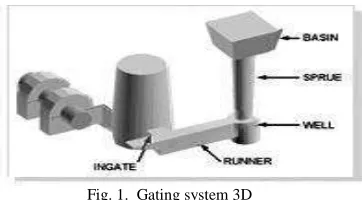
GATING SYSTEM
The term gating system includes all the passage ways through which molten metal enters in to the mould cavity.
The gating system is made up of the following parts: - a) Pouring basin b) Sprue c) Runner bar d) In gates e) Riser
Fig. 1. Gating system 3D
The design of gating system is important and the main requisites of gating system are: The gating should be so designed that it avoids the mould or core erosion by reducing metal velocity within the cavity and avoiding direct impingement on mould walls or cores. The flow of metal to the mould cavity should occur with as minimum as possible turbulence, because if turbulence is excessive, the aspiration of mould gases will occur which will oxidize the mould metal.
The flow of molten metal must be laminar so as to reduce the casting defects like shrinkage, porosity, blow holes, gas holes, misrun, sand inclusion etc.
IMPORTANCE OF GATING SYSTEM
The design of gating system is as important as rise ring of a steel casting. It is well known that improper gating practice can result in defects like , ceroxide, inclusions, cold shuts, misruns, hot tears, local shrinkages, and gas cavities in a steel casting. A gating system should be pre-designed and incorporated in method drawing as is the case of rise ring and not left to the discretion of the molder.
CONSTITUENTS OF GATING SYSTEM
A gating system for steel castings can be broadly divided into: - The entry section – consisting of the pouring basin, sprue and sprue base. The distribution section consists of the runners and in gates.
FUNCTIONS OF A GATING SYSTEM
The entry section of a gating has two functions:-
Effects of Improved Gating System by Using
Standard Gating Ratio
Shashank V. Gulhane
#1, A. D. Shirbhate
*2#1 Asst. Professor, Department of Mechanical Engineering
GWCET, Nagpur, India
#2Professor, Department of Mechanical Engineering
a) To supply liquid metal free of entrapped gases, slag and eroded sand.
b)To establish a hydraulic pressure head, this will force the
metal through the rest of the gating system and into the casting.
The distribution section has three functions:-
a) To decrease the velocity of the metal stream, to minimize turbulence, both in the gating system as well as in the mold cavity.
b) To avoid mold and core erosion, to establish the best
possible thermal gradient in the casting.
c)To regulate the rate of flow of metal into the mold cavity.
In addition to these, the gating system should be of such simple design as to facilitate molding, particularly with mechanical methods, at the same time involving minimum fettling cost and affording maximum casting yield. Many of these requirements and functions are conflicting with each other. Effort should be to harmonize these so as to create conditions conducive to the production of a defect free casting.
PROBLEM IDENTIFICATION
During our industrial visit at M/s Jadhao Steel Alloys, Amravati it was found that so many types of steel casting jobs are produced. The typical casting defects observed like Shrinkage, Blow Holes, Pin Holes, Gas Holes, Sand Inclusion, Misrun etc. are prominent. It was found that industry was facing the problem of rejection particularly for ginning weight steel casting used as dead weight for their machineries.
Following table shows the inspection report for ginning weight at quality desk.
TABLE I: Inspection report for GW. By using existing gating system
Blow
Job shrink holes Sand
Misrun Total % of
Qty age & gas inclusion rejection
holes
20 3 2 1 6 30%
20 1 1 1 2 5 25%
20 1 1 1 1 4 20%
20 2 2 1 - 5 25%
20 2 1 - 2 5 25%
20 1 3 1 - 5 25%
Average percentage of rejection is around 25% to 30%
After observation of inspection report and discussion had with GM production Jadhao Steel Alloys, Amravati regarding with the percentage of rejection and various casting defects observed for the manufacturing of Ginning weight which is use as a dead weight for ginning machine it was decided to follow actual procedure of casting manufacturing in relation with the gating system used. In order to reduce percentage of rejection and casting defects. It was decided to
study and analysis of existing Gating System used by industry.
STUDY AND ANALYSIS OF EXISTING GATING SYSTEM
The study and analysis of existing Gating System and Proposed Gating System for the manufacturing of Ginning Dead Weight at Jadhao Steel Alloys Amravati. The main objective of this study is to follow standard casting procedure in relation with standard gating system as per researcher’s research in the field of casting technology. As per the discussions with Mr. G. M. (PROD.) at Jadhao Steel Alloys Amravati regarding with casting defects and percentage of rejection for the manufacturing of ginning dead weight, it was observed that all the above defects can be considerably reduced by using a proper gating system. Hence optimization of gating system is considered as a main topic of investigation.
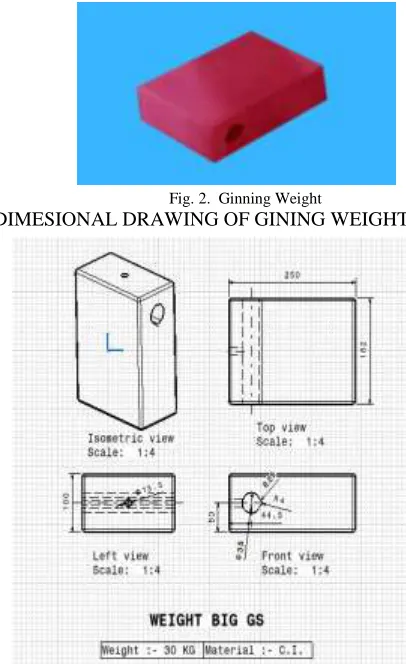
GINNING DEAD WEIGHT
Ginning dead weight used as a dead weight for ginning machine which is agro based machine. To provide extra load on machine during vibration of ginning machine in order to remove cotton seeds from cotton fiber
Fig. 2. Ginning Weight
DIMESIONAL DRAWING OF GINING WEIGHT
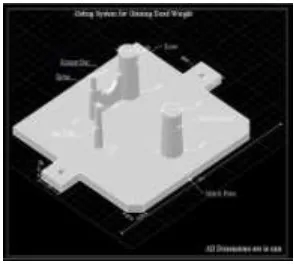
DESIGN & DIMENSION OF EXISTING GATING SYSTEM
As per the discussion had with G. M. (PROD.) at Jadhao Steel Alloys Amravati regarding with casting defects and percentage of rejection for the manufacturing of ginning dead weight, it was observed that all the above defects can be considerably reduced by using a proper gating system. Hence optimization of gating system is considered as a main topic of investigation. In order to reduce casting defects it was decided to follow deep study and analysis of existing gating system.
Fig. 4. Design and Dimension of Existing Gating System
Total volume of gating = 6.51 × 10⁻⁴ m3
Total weight of gating = Total volume of gating × density
=6.51×104×7.2×103
=4.68 kg
GATING RATIO AND ITS CALCULATIONS FOR EXISTING GATING SYSTEM
The typical gating system made by industry found typical casting defects which has increased percentage of rejection and which has affected productivity. In order to reduce percentage of rejection it was decided to follow standard gating ratio as per ISO in foundry technology.
Gating ratio: - The rate of flow of molten metal through the sprue is a function of the cross sectional areas of the sprue, runners and in gates. Gating ratios recommended by various theoreticians in the literature vary over a wide range. The Dimensional characteristics of any gating system can be generally expressed in terms of gating ratio.
TABLE II: Gating area with Dimension for existing gating system.
Existing Gating Existing Gating System
Sr. No. Part Area
Dimensions (mm2 )
(mm)
1 Sprue D1= 20 491
D2= 25
2 Runner L= 60, H= 65, 920
T= 23
L=30, H=15,
3 In gates w=40, L=30, 1050
H=5,W=40
Gating ratio becomes 1:1.87:2.13
But as per standard gating ratio suggested by many researchers (i.e. 1:2:1, 1:2:0.5, 1:4:1, 2:7:1) for grey cast iron. Hence obtained gating ratio is not matched with standard gating ratio as per researchers in foundry technology.
PROPOSED GATING SYSTEM
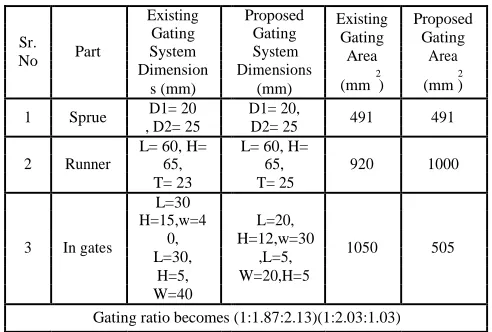
According to deep study and analysis of existing gating system it was found that industry has used improper gating system. The result found after calculation and analysis of existing gating system are very typical in which, gating ratio 1:1.87:2.13 which is not matched with standard gating ratio as per researcher’s research in foundry technology. The further result after calculation of existing gating system are, the weight of gating system is around 4.7 Kg. which is very high it has to reduce considerably. Along with this calculation it was found that the flow pattern for existing gating system is laminar. On the basis of above results found for existing gating system it was decided to made necessary changes in the dimensions of runner and in gates with riser in order to maintain standard gating ratio as per researchers research in foundry technology. Necessary changes in the dimensions of runner and in gates with riser proposed in order to maintain standard gating ratio as per researchers in foundry technology and to reduce total weight of gating system in order to improve total productivity.
TABLE III: Gating area with Dimension for existing & proposed gating system
Existing Existing
Proposed Proposed
gating gating gating
Section gating in
volume in weight in weight in
(m3)
(m3) (kg) (kg)
Sprue 4.19 X10⁻⁵ 301.68X10⁻³ 4.19 X10⁻⁵ 301.68X10⁻³
483.264
--5 7.2956X10
Runner 6.712 X10 -3 0.5252
5 X10
In gates 72 X10-6 518.4X10⁻³ 14.4X10⁻⁶ 103.68X10⁻³
Riser 5 X10⁻⁴ 3.6 2.034 X10⁻⁴ 1.4646
TOTAL
4.68 kg 2.398 kg
GATING RATIO AND CALCULATION FOR PROPOSED GATING SYSTEM
According to changes in the dimensions of existing gating system, the followings calculations are made in order to maintain standard gating ratio. With these calculations for proposed gating system gating ratio will changes to
Cross sectional area of runner = 1000 mm2
Cross sectional area of in gates = 505 mm2
Therefore 491: 1000: 505 = 1:2.03: 1.02
TABLE IV: Gating area for existing & proposed gating system
Existing Proposed Existing Proposed
Gating Gating
Sr. Part System System Gating Gating
Area Area
No
Dimension Dimensions 2 2
s (mm) (mm) (mm ) (mm )
1 Sprue D1= 20 D1= 20, 491 491
, D2= 25 D2= 25
L= 60, H= L= 60, H=
2 Runner 65, 65, 920 1000
T= 23 T= 25
L=30
H=15,w=4 L=20,
3 In gates 0, H=12,w=30 1050 505
L=30, ,L=5,
H=5, W=20,H=5
W=40
Gating ratio becomes (1:1.87:2.13)(1:2.03:1.03)
Hence It was found that proposed gating ratio, becomes (1:2.03:1.02) is matched with std. gating ratio i.e. 1:2:1 as per researchers research in foundry technology.
FLOW PATTERN ANALYSIS IN BETWEEN PROPOSED & EXISTING GATING SYSTEM
According to necessary changes in the design & dimension of existing gating system it was found that the proposed gating ratio matched with standard gating ratio & the total weight of gating system reduced from 4.7 kg to 2.4 kg. In order to reduced casting defects and percentage of rejection it was decided to check flow pattern for the proposed gating system. Following are the calculations made to check molten metal flow pattern for the individual section of proposed gating system.
TABLE V: Comparative analysis of flow pattern in between proposed and existing gating system
For Existing Gating For Proposed
System Gating System
Section Flow
Mean Mean pattern
Reynolds Reynolds
Velocity Velocit
Number Number
in m/s y in m/s
Sprue 580 4.214 580 4.214 Laminar
Runner 108 1.3756 103 1.3040 Laminar
In gates 141 3.5877 265 6.7270 Laminar
Riser 96 0.6966 246 1.7845 Laminar
The above comparative analysis for flow pattern and mean velocity in between existing and proposed gating system
produced flow pattern is laminar through all typical section of existing and proposed gating system with typical variation in mean velocity because of changes in the dimension of existing gating system. In order to reduce various casting defects by using existing gating system this flow pattern analysis plays an important role during manufacturing of Ginning Dead Weight.
EXPERIMENTAL RESULTS, ANALYSIS AND DISCUSSION
By using proposed gating system the experiments has been carried out at Jadhao Steel Alloys, Amravati. The result found after experimentation are very sound and productive. By using standard gating ratio as per ISO, it was found that the total weight of gating system reduced from 4.68 kg to 2.39 kg with reducing total percentage of rejection from 25% - 30% to 7.5% - 10%, With % of yield increases from 86% to 92%, with productivity increases from 42% to 74%, with keeping flow laminar through all sections of gating system which is most essential to reduce casting defects.
INSPECTION REPORT
TABLE VI: Inspection Report by using proposed gating system
Job Qty Blo w hole s shrinka ge Gas holes & pin holes Sand inclusio n Misru n Tot al
% of defects
20 - - - 1 1 2 10%
20 - - - - -- - -
20 - - 1 - -- 1 5%
20 - - - 1 11 2 10%
20 1 - 1 2 10%
20 - - - 2 -- 2 10%
Average percentage of rejection is around 5% to 10%
ACTUAL WEIGHT OF EXISTING & PROPOSED GATING SYSTEM
TABLE VII: Comparison for Actual weight of existing & proposed gating system
S
Seeccttiioo n
n
E
Exxiissttiinngg
g
gaattiinngg
v
voolluummeeiinn
(
(mm33))
E
Exxiissttiinngg ggaattiinngg w
weeiigghhttiinn((kkgg))
P
Prrooppoosseedd
g
gaattiinnggiinn (
(mm33))
P
Prrooppoosseeddggaattiinngg
w
weeiigghhttiinn((kkgg))
S
Spprruue e 4
4..1199XX1100
--55
330011..6688XX1100
--33
44..1199XX1100
--55
330011..6688XX1100
--33
R
Ruunnnnee
r
r 66..771122XX1100
--55
448833..226644XX1100
--33
77..22995566XX1100
--55
00..55225522
I
Inn
g
gaatteess 7722XX1100
--66
551188..44XX1100
--33
1144..44XX1100
--66
110033..6688XX1100
--33
R
Riisseerr
5
5XX1100
--44
33..66 22..003344XX1100
--44
11..44664466
T
TOOTT
A
ALL
4
According to necessary changes in the design & dimension of existing gating system it was found that the proposed gating ratio matched with standard gating ratio & the total weight of gating system reduced from 4.7 kg to 2.4 kg. This is most economical for every manufacturing industry in mass production.
The above comparative analysis for flow pattern and mean velocity in between existing and proposed gating system produced flow pattern is laminar through all typical section of existing and proposed gating system with typical variation in mean velocity because of changes in the dimension of existing gating system.
BUNCH WEIGHT ANALYSIS
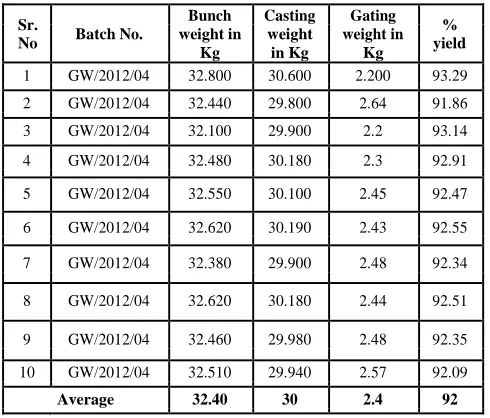
TABLE VIII: Bunch Weight analysis after experimentation by using proposed gating system
Sr. Bunch Casting Gating %
Batch No. weight in weight weight in
No yield
Kg in Kg Kg
1 GW/2012/04 32.800 30.600 2.200 93.29
2 GW/2012/04 32.440 29.800 2.64 91.86
3 GW/2012/04 32.100 29.900 2.2 93.14
4 GW/2012/04 32.480 30.180 2.3 92.91
5 GW/2012/04 32.550 30.100 2.45 92.47
6 GW/2012/04 32.620 30.190 2.43 92.55
7 GW/2012/04 32.380 29.900 2.48 92.34
8 GW/2012/04 32.620 30.180 2.44 92.51
9 GW/2012/04 32.460 29.980 2.48 92.35
10 GW/2012/04 32.510 29.940 2.57 92.09
Average 32.40 30 2.4 92
The bunch weight analysis by using proposed gating system produced the average weight of casting found 30 kg with average bunch weight of casting found 32.40 which produced average percentage of yield 92% with average
weight of existing gating system 2.4 kg.
TABLE IX: Bunch Weight Analysis for existing gating system
Sr. Bunch Casting Gating %
Batch No. weight in weight weight
No yield
Kg in Kg in Kg
1 GW/2011/10 34.650 29.800 4.85 86.00
2 GW/2011/10 34.720 29.920 4.8 86.17
3 GW/2011/10 34.710 30.100 4.61 86.71
4 GW/2011/10 34.590 29.920 4.67 86.49
5 GW/2011/10 34.690 29.880 4.81 86.13
6 GW/2011/10 34.750 29.930 4.82 86.12
7 GW/2011/10 34.670 29.900 4.77 86.24
8 GW/2011/10 34.850 30.180 4.67 86.59
9 GW/2011/10 34.580 29.980 4.6 86.69
10 GW/2011/10 34.660 30.100 4.56 86.84
Average 34.687 29.971 4.716 86%
The average weight of casting found 29.971 kg with average bunch weight of casting found 34.687 which produced average percentage of yield 86% with average weight of existing gating system 4.716 kg. The typical bunch weight analysis in between existing and proposed gating system produced percentage of yield increases from 86% to 92% which is most economical for manufacturing industry.
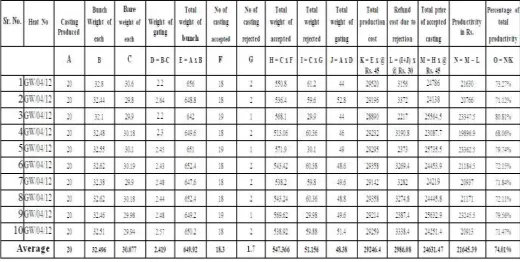
COST ANALYSIS IN BETWEEN EXISTING AND PROPOSED GATING SYSTEM TO MEASURE TOTAL
PRODUCTIVITY
This cost analysis in between existing and proposed gating system produced percentage of productivity increases from 42% to 74% which is most essential for every manufacturing industry.
TABLE XI:-Cost Analysis by using proposed gating system
DISSCUSSION
The purpose of this study is to identify the problem associated with gating system for the manufacturing of ginning dead weight which is used for their machineries at Jadhao Steel Alloys Amravati. After observation, inspection and analysis of every factor of gating system it has found that, the small change in the dimension of gating system results large effects on the production cost. The average total percentage of rejection for existing gating system is around 25% to 30% of total casting produced. The average total percentage of rejection for proposed gating system is around 7.5% to 10% of total casting produced. This major change in the average percentage of rejection plays an effective role on production cost. After careful investigation of the casting process, it was found that all the above defects can be considerably reduced by using a proper gating system. Hence optimization of gating system is considered as a main topic of investigation.
The number of factors influencing the gating design is numerous. But out of all these factors can be considered as a important one. According to deep study and analysis It was decided to follow standard gating ratio as per ISO suggested by many researchers in the field of casting .In order to maintain standard gating ratio It was found that old gating ratio was incorrect. After gating system calculation it was found that the total weight of gating system is very high, that
has to considerably reduce. After careful observation and analysis it was decided to make necessary changes in the design and dimension of gating system.
By using proposed gating system the experiments has been carried out at Jadhao Steel Industry, Amravati. The result found after experimentation are very sound and productive. By using standard gating ratio as per ISO, it was found that the total percentage of productivity improved from 42% to 74% by reducing total weight of gating system from 4.68 kg to 2.39 kg with reducing total percentage of rejection from 25% - 30% to 7.5% - 10%, With % of yield increases from 86% to 92%, with keeping flow laminar through all sections of gating system which is most essential to reduce casting defects.
CONCLUSION
The result found after experimentation are very sound and productive .By using standard gating ratio as per researcher’s research in foundry technology, it was found that the total percentage of productivity improved from 42% to 74% by reducing weight of gating system from 4.68kg to 2.39 kg with reducing total percentage of rejection from 25% - 30% to 7.5% - 10% , with increasing % of yield from 86% to 92% with keeping flow laminar through all sections of gating system which is most essential to reduce casting defects.
To design a gating system for steel casting standard gating ratio plays a crucial role during manufacturing. In ordered to reduce casting defects & percentage of rejections, typical optimization technique must be follow. Design of typical elements of gating system must be produced optimum weight of gating system. Flow pattern analysis is very important in order to check molten metal flow pattern is laminar or turbulent during casting with optimum velocity of molten metal in order to reduce various casting defects. To optimize the gating system for steel casting percentage of yield and percentage of productivity must be improve.
REFERENCES
[1] Shamsuddin Sulalman and Tham Chee Keen, department of mechanical and systems engineering university pertanian malaysia, serdang, Selangor, Malaysia. Flow analysis along the runner and gating system of a casting process. Journal of material processing technology. Vol. 63 (1997) 690-695.
[2] B. Senthilkumar, S.G. Ponnambalam, N. Jawahar. Process factor optimization for controlling pull-down defects in iron castings Published by Elsevier B.V., 2008.
[3] Zhizhong Sun, Henry Hu, Xiang Chen, casting with multiple performance characteristics Numerical optimization of gating system parameters for a magnesium alloy Published by Elsevier B.V., 2007.
[4] Chinmay Das, Manufacturing Science-I, Casting defects, NPTEL website 2004.
[5] Carlos E. Esparza NEMAK S.A. de C.V. Libramiento Arco Vial, Optimal Design of Gating Systems by Gradient Search Methods, Km. 3.8 García, NL 66000, México December 2004 Revised April 2005. [6] P. R Beeley P.R, 'Foundry Technology', The Butteworth Group
(London Butterworths), (1972).
[7] P. N. Rao, Manufacturing Technology, TMH Publication, page 195 -198.
[8] A. Ghosh and A. K. Mallik, Manufacturing Science, East-West Press Private Limited, page 90-92.
[9] Kalpakjian and Schmid, Pearson Education, Manufacturing Engineering and Technology, page 253-254.
[10] E. P. Deganno, Y. T. Black and R. A. Kohser, 'Materials and Processes in Manufacturing', Mac Millan Publishing Co. 7th Edition (1990).
[11] T. R. Vijayaram, S. Sulaiman, A. M. S. Hamouda, M. H. M. Ahmad, 2006. Foundry quality control aspects and prospects to reduce scrap rework and rejection in metal casting manufacturing industries. J. Mater. Process. Technol. 178, 1–3.
ISSN: 2231-5381
http://www.ijettjournal.org
Page 177Appendix
Photo copies for types of defects observed by using existing gating system