Publication Date: May. 25, 2019
DOI: 10.14738/abr.75.6545.
Khamri, A., & Heryanto. (2019). The Influence Of The Work Environment, Work Discipline On The Spirit Of Work And Its Impact On Employee Performance At The Dharmasraya District Health Office. Archives of Business Research, 7(5), 205-216.
The Influence Of The Work Environment, Work Discipline On
The Spirit Of Work And Its Impact On Employee Performance At
The Dharmasraya District Health Office
Aprial Khamri
Master of Management, STIE “KBP “, JL Khatib Sulaiman No. 61 Lolong Belanti, Padang Utara 25136, West Sumatra, Indonesia
Heryanto
Lecturer in Management Master Program, STIE “KBP”, JL Khatib Sulaiman No. 61 Lolong Belanti, Padang Utara 25136, West Sumatra, Indonesia
ABSTRACT
This study tries to test the effect of work environment, work discipline and work spirit on employee performance at Dharmasraya District Health Office. This study uses descriptive quantitative methods. The study population consisted of 52 people from employees. To obtain a valid and realistic instrument, the validity and reliability test, normality test, multicollinearity test and heterocedasticity test were tested. The data analysis technique used is linear regression analysis, t test, f test, determination coefficient, and path analysis using the SPSS program, with α = 0.05. The results showed that the Work Environment and Work Discipline had a partially significant effect on the Work Spirit of the Dharmasraya District Health Office Staff. Work Spirit, Work Environment and Work Discipline partially have a significant effect on the Employee Performance of the Dharmasraya District Health Office. Work Spirit as an intervening variable has a significant effect between Work Environment and Work Discipline on the performance and performance of the Health Office Staff in Dharmasraya Regency. The empirical findings indicate that to increase Community Satisfaction, the Dharmasraya District Health Office needs to pay attention and focus more on improving work morale and work environment.
Keywords: Work Environment, Work Discipline, Work Spirit, Employee Performance
INTRODUCTION
Human resources are one of the important elements in driving the progress of an organization. Every organization has various goals to achieve. This goal is achieved by utilizing existing resources .The problem is how to create human resources that can produce optimal performance so that the company's goals can be achieved. Performance is the main demand for the company so that its survival or operation can be guaranteed.
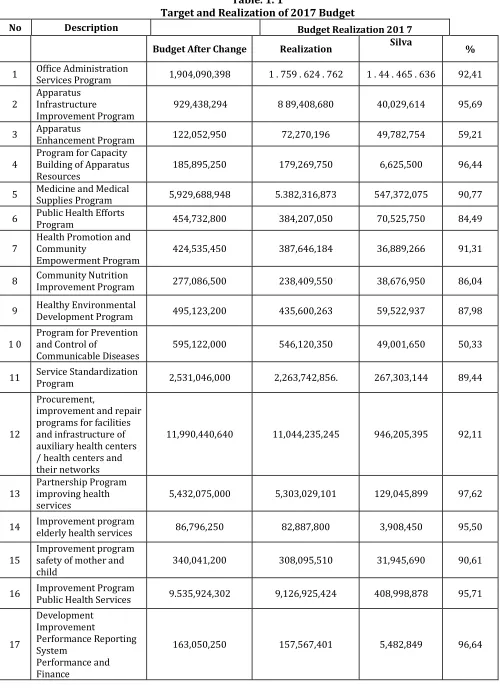
Table. 1. 1
Target and Realization of 2017 Budget
No Description BudgetRealization2017
Budget After Change Realization Silva %
1 Office Administration Services Program 1,904,090,398 1 . 759 . 624 . 762 1 . 44 . 465 . 636 92,41
2 Apparatus Infrastructure
Improvement Program 929,438,294 8 89,408,680 40,029,614 95,69 3 Apparatus Enhancement Program 122,052,950 72,270,196 49,782,754 59,21
4 Program for Capacity Building of Apparatus
Resources 185,895,250 179,269,750 6,625,500 96,44 5 Medicine and Medical Supplies Program 5,929,688,948 5.382,316,873 547,372,075 90,77
6 Public Health Efforts Program 454,732,800 384,207,050 70,525,750 84,49
7 Health Promotion and Community
Empowerment Program 424,535,450 387,646,184 36,889,266 91,31
8 Community Nutrition Improvement Program 277,086,500 238,409,550 38,676,950 86,04
9 Healthy Environmental Development Program 495,123,200 435,600,263 59,522,937 87,98
1 0 Program for Prevention and Control of
Communicable Diseases 595,122,000 546,120,350 49,001,650 50,33
11 Service Standardization Program 2,531,046,000 2,263,742,856. 267,303,144 89,44
12
Procurement,
improvement and repair programs for facilities and infrastructure of auxiliary health centers / health centers and their networks
11,990,440,640 11,044,235,245 946,205,395 92,11
13 Partnership Program improving health
services 5,432,075,000 5,303,029,101 129,045,899 97,62
14 Improvement program elderly health services 86,796,250 82,887,800 3,908,450 95,50
15 Improvement program safety of mother and
child 340,041,200 308,095,510 31,945,690 90,61
16 Improvement Program Public Health Services 9.535,924,302 9,126,925,424 408,998,878 95,71
17
Development Improvement
Performance Reporting System
Performance and Finance
18 Childbirth Assurance Program
(Jampersal) 2,297,303,300 383,394,483 1,913,908,817 60,60
19 Operational Assistance Program
health 5,847,901,750 4,961,116,974 886,784,776 84,84
total 19.259.577.916.00 11,559,896,339.67 60.02
Source: Dharmasraya District Health Office 2017
Research purposes
The objectives of this study are:
1. To determine the effect partially between the work environment and the morale of the staff of the Dharmasraya District Health Office.
2. To determine the effect partially between work discipline and the morale of the staff of the Dharmasraya District Health Office.
3. To find out the effect partially between the morale and performance of the staff of the Dharmasraya District Health Office.
4. To determine the effect partially between the work environment and the performance of the staff of the Dharmasraya District Health Office.
5. To determine the effect partially between work discipline and the performance of the staff of the Dharmasraya District Health Office.
6. To find out the effect of work spirit as an intervening variable between the work environment on the performance of the staff of the Dharmasraya District Health Office
7. To find out the effect of work morale as an intervening variable between work discipline and the performance of employees of the Dharmasraya District Health Office.
LITERATURE REVIEW Performance
In an organization whatever its form, it will certainly be faced with what is called performance or (performance) . Performance is the manifestation and outcome of work or artwork from a member of the organization which in turn will determine the overall and success of the organization. So that it can also be said that whether or not an organization's goals are achieved is mainly determined by the performance of the members of the organization, both in quality and quantity. The Republic of Indonesia Institute of State Administration (LAN RI) Sedarmayanti (2012)argues that " Performance is translated into performance, also means work performance, work implementation, work achievement or work outcome / for work / work performance, work performance". According to Hariman and HilgertMangkuprawira (2004), performance is "therealization of work carried out by the apparatus which is usually used as a basis for evaluating apparatus or organizations". To take measurements of performance, according to Mitchell Sedarmayanti (2012) are as follows: "Performance = ability x motivation". The meaning is that performance is determined by ability and motivation.
Furthermore Robbins (2006)suggests: "performance = f (mxaxo)". The point is function performance from motivation, ability and opportunity.
Performance is also determined by motivation combined with the ability possessed and the right placement
Work Environment
overall facilities and infrastructure that are around employees who are carrying out work that can affect the implementation of the work itself. This work environment will include the workplace.
Work discipline
One of the most important factors in supporting the success of development, especially governance, is the factor of employee discipline, namely employees who have good and right attitude and behavior in fulfilling all aspects of life in society, nation and state. In addition, employee discipline is an embodiment of compliance and compliance with the law and employees will strive to leave all forms of violations in accordance with applicable regulations.
In the opinion of Saydam(2011), discipline is an attitude of willingness and willingness to obey and obey all regulatory norms that apply around it. Whereas Atmosudirdjo (2005)defines discipline as a unity of certain mental attitudes which is obedient and orderly. An agency or organizational unit is said to be good if the employee or employee complies with the applicable provisions in the organization with full awareness of all the rules and working norms that govern it.
Spirit at work
The spirit of work illustrates the willingness and enthusiasm of someone to serve and carry out their duties as well as possible. According to Hasibuan (2006) work morale is the attitude of an individual and group towards his work environment and on his voluntary cooperation to be able to devote his abilities thoroughly in accordance with the main needs of the organization.
Purwanto (2012) explains that work morale is something that makes people serve their duties and jobs. While work morale according to Rivai & Basri (2011) is overall satisfaction obtained by someone from his job, work group, leader, organization and environment.
Picture 1 Frame Of Conceptual
Based on the theoretical foundation and framework stated above, the following hypotheses can be put forward:
1. It is assumed that there is a partial influence between the work environment and the morale of the staff of the Dharmasraya District Health Office
3. It is suspected that there is a partial influence between the morale and performance of the staff of the Dharmasraya District Health Office
4. It is suspected that there is a partial influence between the work environment and the performance of the staff of the Dharmasraya District Health Office
5. It is assumed that there is a partial influence between the work discipline and the performance of the staff of the Dharmasraya District Health Office
6. It is suspected that there is influence of work morale as an intervening variable between the work environment and the performance of the staff of the Dharmasraya District Health Office
7. It is suspected that there is an influence of work morale as an intervening variable between work discipline and the performance of the staff of the Dharmasraya District Health Office
RESEARCH METHODOLOGY Population and Sample Determination
The population in this study were all employees of the Dharmasraya District Health Office , which numbered 52 employees both civil servants and non-civil servants, which were divided into several occupational fields and groups and ranks to be surveyed using questionnaires which were research instruments.
The technique in taking this sample uses a total sampling technique (overall sample), total sampling is a sampling technique where the number of samples is the same as the population (Sugiyono, 2006). The reason for taking total sampling is because according to Sugiyono (2006) that total population of less than 100 all of the population is all research samples.
Based on the opinions outlined above, because the population is smaller than 100. This study set the entire population as a sample of 30 people as saturated samples.
Types and Data Sources
The questionnaire was used to obtain primary data that was distributed directly to selected samples by visiting respondents. In the questionnaire it contains questions about the demographics of respondents such as gender, age, occupation, and length of work of the State Civil Apparatus, specifically there are Budget Users at the Dharmasraya Health Office . In addition, the questionnaire also contains statements about respondents' perceptions relating to competence, workload, motivation and performance.
The measurement in this study uses the Interval scale with a Likert scale technique. Erlina (2011) defines the Likert scale in design to assess the extent to which the subject agrees and disagrees with the statement submitted. To measure the opinions of respondents used a Likert scale that contains 5 ( five ) answer preferences and is made in the form of a check (√) or cross (X) with details as follows: Score 1 (STS = Strongly Disagree), Score 2 (TS = Disagree , Score 3 (N = Neutral), Score 4 (S = Agree) and Score 5 (SS = Strongly Agree).
Data Analysis Techniques
Partial hypothesis testing (t test)
Simultaneous Hypothesis Testing (Test F)
The F test aims to determine whether or not there is an influence simultaneously (together) given the independent variable (X) to the dependent variable (Y). The basis of decision making is if the value of sig <0.05, or F count> F table then there is the influence of X variable simultaneously on variable Y, and vice versa.
Path Analysis
Path analysis alone does not determine causal relationships and also cannot be used as a substitute for researchers to see causality between variables. Inter-variable causality relationships have been formed with models based on theoretical foundations. What is done by path analysis is to determine the pattern of relationships between three or more variables and cannot be used to confirm or reject the hypothesis of imaginary causality.
Test Direct and Indirect Effects
Besides using independent variables (X) more than one variable, this study also uses intervening variables. Intervening variable is a intermediate / mediating variable, its function mediates the relationship between the independent variable and the dependent variable. To test the effect of intervening variable analysis method path (path analysis).
RESULTS AND DISCUSSION
The t test is intended to determine whether or not there is a partial (own) influence given by the independent variable (X) to the dependent variable (Y). The basis of decision making is if the value of sig <0.05, or t-count> t-table then there is an influence of variable X partially on variable Y, and vice versa.
It is known that t table = t (α / 2; nk-1) = t (0,025; 49) = 2,009, then the table will be obtained as follows:
Table 4.18 Test Results t
Variable Relationships t-count t-table Sig. Alpha Results Work
environment Spirit at work 2,153 2009 0.036 0.05 significant Work
Discipline Spirit at work 5,705 2009 0,000 0.05 significant Spirit at work Performance 6,347 2009 0,000 0.05 significant Work
environment Performance 1,793 2009 0.079 0.05 significant Work
Discipline Performance 3,139 2009 0.003 0.05 significant
Based on the table above can be explained as follows:
a. Testing the first hypothesis (H1) is accepted.
There is a partial influence between the variables of Work Environment and Work Spirit .
b. Testing the second hypothesis (H2) is accepted.
There can be a partial influence between the variables of Work Discipline and Work Spirit .
c. The third hypothesis testing (H3) is accepted.
There is a partial influence between the variable Work Spirit and Performance .
d. Testing the fourth hypothesis (H4) is accepted.
There can be a partial influence between the variables of the Work Environment and Performance .
e. Testing the fifth hypothesis (H5) is accepted.
Simultaneous Hypothesis Testing (Test F)
The F test aims to determine whether or not there is an influence simultaneously (together) given the independent variable (X) to the dependent variable (Y). The basis of decision making is if the value of sig <0.05, or F count> F table then there is the influence of X variable simultaneously on variable Y, and vice versa.
It is known that F table = F (k; nk) = F (2; 50) = 3.18
Table 4.19 Test Results f
ANOVAa
Model Sum of
Squares df Mean Square F Sig.
1
Regression 502,590 2 251,295 14,577 , 000 b
Residual 844,717 49 17,239 Total 1347,308 51
a. Dependent Variable: PERFORMANCE
b. Predictors: (Constant), WORK DISCIPLINE, WORK ENVIRONMENT
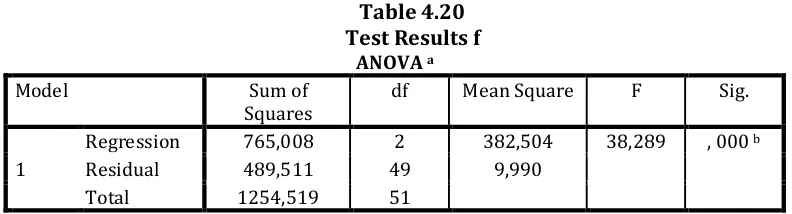
Table 4.20 Test Results f
ANOVAa
Model Sum of
Squares df Mean Square F Sig.
1
Regression 765,008 2 382,504 38,289 , 000 b
Residual 489,511 49 9,990 Total 1254,519 51
a. Variable Dependent: WORK SPIRIT
b. Predictors: (Constant), WORK DISCIPLINE, WORK ENVIRONMENT
Based on the table above can be explained as follows:
a. Based on the above output it is known that the significance value for the effect of X1 and
X2 simultaneously on Y is equal to 0,000 <0,05 and F count 38,289 > 3,18 , so it can be
concluded that there is a simultaneous influence of Work Environment and Work Discipline on performance.
b. Based on the above output, it is known the significance value for the effect of X1 and
X2 Simultaneously towards I is 0,000 <0,05 and F count 38,289> 3,18 , so it can be
concluded that there is a simultaneous influence of Work Environment and Work Discipline on Work Spirit.
PATH ANALYSIS Path Model Coefficient 1
Table 4.21 Significant level results
Coefficientsa
Model Unstandardized
Coefficients Standardized Coefficients t Sig. B Std. Error Beta
1
(Constant) 3,010 5,461 , 551 , 584 WORK ENVIRONMENT , 233 , 108 , 235 2,153 , 036 WORK DISCIPLINE , 719 , 126 , 622 5,705 .000 a. Variable Dependent: WORK SPIRIT
Based on the table above, it was obtained that:
1. significance value of Work Environment variable (X 1 ) = 0,036 < 0.05, This means that
directly there is a significant effect of Work Environment (X 1 ) on Work Spirit (I).
2. While the Work Discipline variable (X 2 ) = 0,000 < 0.05 which means Work
Discipline (X 2 ) This means that directly there is a significant effect of Work
Discipline (X 2 ) on Work Spirit (I).
Table 4.22 Coeficient Determinant
Model Summary
Model R R Square Adjusted R
Square the Estimate Std. Error of 1 , 781 a , 610 , 594 3,16070
a. Predictors: (Constant), WORK DISCIPLINE, WORK ENVIRONMENT
3. S value R 2 (R Square) found in the Summary Model table is 0, 610 which gives the
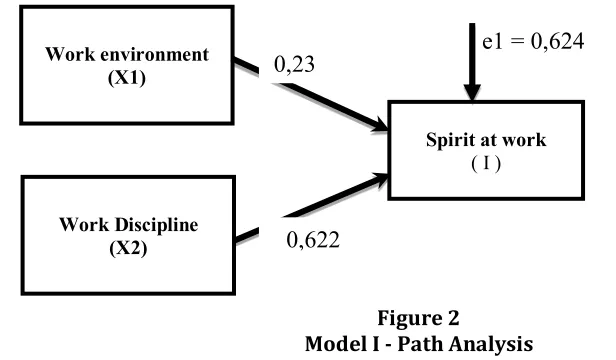
meaning that the contribution of variables X1 and X2 to I is 61 , 0 % and the rest is 39 , 0 % is the contribution of other variables which was not included in the study. And from the value of R 2 (R Square), obtained e1 by means of e1 = √ (1 - 0, 610 )
= 0, 624
Based on the results above, the structural equation is obtained:
I = 0, 235. X 1 + 0, 622. X 2 + 0, 624
From the processing of the data above, it can be obtained Model I Path Diagram, as follows:
Figure 2
Model I - Path Analysis Work environment
(X1)
Work Discipline (X2)
0,23 5
Spirit at work
( I )
0,622
Path Model 2 coefficient
Multiple linear regression analysis is still used in the next study to obtain the model two path coefficients, with the aim to determine whether there is an influence of independent variables (work environment and work discipline) and intervening variables (work spirit) on the dependent variable ( performance ). It can be seen in the following table:
Table 4.23
Linear regression test results
Coefficientsa
Model Unstandardized
Coefficients Standardized Coefficients t Sig. B Std. Error Beta
1
(Constant) 9,998 6,695 1,493 , 142 WORK
ENVIRONMENT , 136 , 138 , 132 , 979 , 332 WORK DISCIPLINE , 151 , 199 , 126 , 761 , 451 SPIRIT AT WORK , 512 , 175 , 495 2,935 , 005 a. Dependent Variable: PERFORMANCE
Based on the table above obtained :
1. The significance value of the Work Environment variable (X1) = 0, 332 > 0.05, This
means that directly the Work Environment (X1) does not have a significant effect
on Performance (Y).
2. The significance value of the Work Discipline variable (X2) = 0.451 > 0.05 which
means that it is directly Work Discipline (X 2 ) does not have a significant effect on
Performance (Y).
3. The value of significance of the variable Work Spirit (I) = 0.00 5 < 0.05 which means that directly Work Discipline (X2 ) has a significant effect on Performance (Y) .
Table 4.24
Model Summary
Model R R Square Adjusted R
Square the Estimate Std. Error of 1 , 684 a , 468 , 435 3,86265
a. Predictors: (Constant), WORK SPIRIT, WORK ENVIRONMENT, WORK DISCIPLINE
4. N value R2 (R Square) contained in the Table Model Summary is 0, 468 which gives the
meaning that the contribution of variables X1, X2 and I to Y is equal to 46 , 8 % and the remainder of 53 , 2 % is the contribution of variables others not included in the study. And from the value of R 2 (R Square) obtained e 2, by means of e 2 = √ (1 -
0, 468 ) = 0, 729
Based on the results above, the structural equation is obtained:
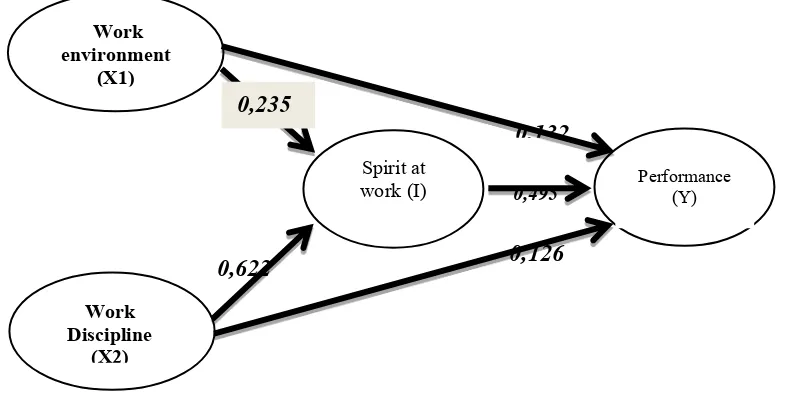
Y = 0, 132. X 1 + 0, 126. X 2 + 0,495.I + 0,729
Figure 3
Model I - Path Analysis
Test Direct and Indirect Effects
Besides using independent variables (X) more than one variable, this study also uses intervening variables. Intervening variable is a intermediate / mediating variable, its function mediates the relationship between the independent variable and the dependent variable. To test the effect of intervening variable analysis method path (path analysis). Path analysis is an extension of regression analysis to estimate the causality relationship between previously defined variables based on theory(Ghazali, 2013). The following is a path analysis to examine the relationship between the Work Environment and Work Discipline on performance and whether the relationship between the Work Environment and Work Discipline towards performance is mediated by the Work Spirit with the image below:
Figure 4 : Path Analysis Model
Based on the picture above can be calculated indirect effects between independent and bound variables through intervening variables as follows:
Sixth hypothesis testing (H6) is accepted .
Analysis of the effect of X1 through I on Y. It is known that the direct effect given X1 to Y is 0, 132 . While the indirect effect of X1 through I on Y is the multiplication between the value of beta X1 to I with the value of beta I to Y, namely: 0, 235 x 0, 495 = 0.1 16 . Then the total
0,235
0,622
Spirit at work (I)
(I)
Work environment
(X1)
ork
Performan c 0,132
0,126
0,495
Work Discipline
(X2)
influence given X1 to Y is the direct effect added by indirect effects namely: 0, 132 + 0.1 16 = 0, 232 . Based on the results of these calculations it is known that the direct effect value is 0, 132 and the indirect effect is 0, 232 which means that the value of indirect influence is greater than the value of direct influence, this result shows that indirectly X1 through I has a significant influence on Y.
Testing the seventh hypothesis (H7) is accepted.
Analysis of the effect of X2 through I on Y. It is known that the direct effect given X2 to Y is 0, 126 . While the indirect effect of X2 through I on Y is the multiplication of the value of beta X2 to I with the value of beta I to Y, namely: 0, 622 x 0, 495 = 0.3 07 . Then the total effect given X2 to Y is the direct effect added by indirect effects, namely: 0.126 + 0.307 = 0.433 Based on the results of these calculations it is known that the direct effect value is 0.126 and the indirect effect is 0.433 which means that the value of indirect influence is greater than the value of direct influence, this result shows that indirectly X2 through I has a significant effect on Y.
CONCLUSION
Based on the results of testing and discussion of the hypotheses described in the previous chapter, some conclusions can be drawn as follows:
1. There is no partial influence between the variables of the Work Environment and Work Spirit. This means that the work environment does not have a positive effect on increasing work morale at the staff of the Dharmasraya District Health Office.
2. There is a partial influence between the variables of Work Discipline and Work Spirit. This means that work discipline has a positive influence on increasing work morale at the staff of the Dharmasraya District Health Office.
3. There is a partial influence between the variable Work Spirit and Performance. This means that work morale has a positive influence on improving employee performance at the Dharmasraya District Health Office.
4. There is a partial influence between the variables of the Work Environment and Performance. This means that the environment has a positive influence on improving employee performance at the Dharmasraya District Health Office.
5. There is a partial influence between the variables of Work Discipline and Performance. This means that work discipline has a positive influence on improving employee performance at the Dharmasraya District Health Office.
6. This result shows that indirectly the work environment through work morale has a significant influence on performance. This means that the existence of vaiabel work spirit is needed to increase the influence of the environment on employee performance at the Dharmasraya District Health Office.
7. These results indicate that indirectly the discipline of work through work morale has a significant effect on performance. This means that the existence of vaiabel work spirit is needed to increase the influence of work discipline on the performance of employees at the Dharmasraya District Health Office.
SUGGESTION
Based on the findings and conclusions of the study. For this reason, the authors propose the following suggestions:
1. If seen from the lowest TCR value is found in the work environment variable. therefore leaders need to consider increasing the number of employees because the number of employees is less than the work that needs to be completed.
and significant effect on the performance of the staff of the Dharmasraya District Health Office .
3. For the variable work morale, the leadership is expected to maintain the enthusiasm of work work given to employees because the spirit of work as an intervening variable of employees is proven toincrease the significance of the performance of employees of the Dharmasraya District Health Office .
BIBLIOGRAPHY
Atmosudirdjo. 2005. Manajemen Dasar Pengertian Dan Masalah. Melayu: Rineka Cipta. Ghazali, Imam. 2013. Atik Septi Winarsih. Semarang: Badan Penerbit Universitas Diponegoro.
Hasibuan. 2006. Manajemen Dasar, Pengertian, Dan Masalah. edited by E. Revisi. Bumi Aksara:Jakarta. Mangkuprawira. 2004. Manajemen SDM Strategik. Jakarta: PT. Ghalia Indonesia.
Nitisemito, Alex S. 2011. Manajemen Personalia (Manajemen Sumber. Daya Manusia. Cetakan Keempat Belas, Ghalia.
Purwanto. 2012. Metodologi Penelitian Kuantitatif. Yogyakarta: Pustaka Pelajar.
Rivai & Basri. 2011. Performance Appraisal: Sistem Yang Tepat Untuk Menilai Kinerja Karyawan Dan Meningkatkan
Daya Saing Perusahaan. Jakarta: PT. Raja Grafindo Persada.
Robbins, Stephen P. 2006. Perilaku Organisasi. Jakarta: PT Indeks Kelompok Gramedia. Saydam. 2011. Manajemen Sumber Daya Manusia. Jakarta: Gunung Agung.