Use Of High-Technological Gadgets And Computer
Literacy As Correlates Of Student Nurses
Informatics Skills
Hamdoni K. Pangandaman
College of Health Sciences, Mindanao State University, Main Campus, Marawi City Marawi City, MSU Campus, 9700, Philippines
Abstract: Research shows that nursing informatics greatly improves patient’s outcome in a technologically driven health care arena. The purpose of this descriptive correlation research was to assess whether the use of high-technological gadgets - smartphones, pocket WiFi, and tablet; and, computer literacy significantly correlates to student nurse’s informatics skills in terms of charting and health teaching. This study utilized a validated and reliably tested researcher made questionnaire to a sample of 181 graduating nursing students in Marawi City. The instrument measured the use of high-technological gadgets based on the hours spent for academic and leisure purposes, 100-items computer literacy exam, and nursing informatics skills in a 5-point Likert scale format. IBM-SPSS version 21 used in analyzing the gathered & tabulated data. Results revealed that student nurses spend more time in the use of high-technological gadgets for leisure twice higher than for academic purposes and scored a beginner literacy in the use of computers. Findings on nursing informatics skills shows moderately skillful for health teaching and less skillful for charting. Correlation reveals that use of high-technological gadgets for leisure purposes and computer literacy has proportional significant relationship with the nursing informatics skills. The study recommends faculty training in Nursing Informatics, an updated Information & Technology infrastructure in the institution, and provision of informatics skills simulation both in the school and in the clinical area.
Keywords: High-technological Gadgets, Computer Literacy, Nursing Informatics Skills.
1.
Introduction
The embodiment of nursing informatics in the health care arena for the past five decades has proven to have significant effects on quality health care outcome and organizational success in general [1]-[3]. Studies show that nursing inforamtics improves access to patients records, decreases time spent in documentation, increases time of nurse-patient interaction [1], and the total quality of patient care [3] Given that nursing informatics has been shown to benefit patients health in myriad ways, there were less evidence of significant relationship between computer literacy and use of high-technological gadgets to the informatics skills of the soon to be healthcare professionals. The notion that the use of high-technological gadgets that might significantly influence nursing informatics skills could be traced with the time spent and the purpose of using the technology. For example, numerous study show that active use of smartphones became a part of daily routine and make connectivity with healthcare professionals to seek services [4]. It is however a lack of research in the significant relationship of how high-technological gadgets and literacy in computer shapes nursing skills of student nurses. Research on skills in nursing informatics is majorly based on the theory of skills acquisition: novice to expert by Patricia Benner (1982) [5] and cognitive theory of multimedia learning by Stephen Sorden (2016) [6]. The theory of Benner proposes that skills acquisition developed over time with a certain process. It involves continuous exposure to a certain stimuli and concept in order to gain mastery. In the theory of Sorden, cognitive learning of multimedia formally develops at institutional level, as in nursing curriculum, nursing informatics has its role. Theory of Sorden contends that cognitive development acquires primarily before skills in nursing informatics. Drawing primarily from the theory of Benner (1982) and Sorden (2016) proposed that computer literacy and use of high-technological gadgets may
context of charting and health teaching. In lieu to this, the
study hypothesized that there is no relationship between the variables under investigation.
2.
Framework
Based on the diverse concepts assembled from the rich field of literature discovered, the framework of this research was conceptualized: How much time spent by student nurses in use of high technological gadgets for academic and leisure purposes; what is their level of computer literacy; and their level of nursing informatics skills in terms of charting and health teaching. This study was formed in the quest to discover the level of nursing informatics skills of the students as perceived by themselves in the different nursing institutions in Marawi city. Two sets of variables were identified. The first set consists of the independent variables which are the time spent and purpose of use of high-technological gadgets (computer [e.g. desktop & laptop], smartphones, tablet, Wi-Fi, & iPad) and the level of their computer literacy as measured through test or exams. Then the second set consists of the dependent variable
which is the level of nursing informatics skills in the context of charting and health teaching. The researcher also aims to discover significant correlation relationship between independent and dependent variables. Different concepts were combined in this part of the study. First, Patricia Benner’s Skills Acquisition: Novice to Expert (Benner, 1982) merits discussion of the level of nursing informatics skills of the student nurses. Benner’s identified students as novice in the nursing realm where critical thinking skills are yet to developed in order to advance to succeeding level such as advance beginner, competent, proficient, and expert. She further expounds that skills are to be developed and honed in a process bounded by time. As this theory applied to millennials may have varying level of skills as there are student nurses who owned several forms of high-technological gadgets which are being used regularly as part of their natural day-to-day routines. The use of computers such as laptop or desktop and other form of gadgets are part of essential or prerequisite of skills in nursing informatics. Increased proficiency of the use of high-technological gadgets and literacy to computers over time results in enhanced competencies reflecting mastery and the ability to cope with and manage many contingencies. On the other hand, the Cognitive Theory of Multimedia Learning by Stephen Sorden (2016) was adopted to explore the extent of competency developed by student nurses in the use of computers as part of nursing informatics skills. The integration of nursing informatics in the nursing curriculum presumes that graduating student nurses are computer literate which is required for the documentation or charting of patients information and in relaying important information to patients relating to the progress of his or her condition.
3.
Study Objectives
The motivation in the conducting the study on nursing informatics was an interest in examining use of high-technological gadgets, computer literacy, and nursing informatics skills in terms of charting and health teaching by graduating students’ nurses in Marawi City. This study also investigated the significant relationship between the use of high-technological gadgets and computer literacy on the nursing informatics skills of student nurses. Using the descriptive-correlational approach, this study contributes to
the growing body of knowledge on nursing informatics in global perspectives.
4.
Methodologies
4.1 Research Design
The data for this study was generated from a cross-sectional self-administered survey of 181 graduating student nurse-respondents in the nursing schools in Marawi City. A correlation descriptive research design was selected for fulfilling the aim of this study. It is descriptive in purpose, gathering salient data on the use high-technological gadgets for leisure and academic purposes, computer literacy, and the nursing informatics skills in terms of charting and health teaching of graduating student nurses in Marawi City. Correlation in nature as it aims to correlate use of high-technological gadgets and computer literacy as independent variable to the nursing informatics skills as dependent variable to determine if there is significant
4.2 Research Locale & Respondents
The study was conducted in three nursing schools, one government and two private schools, all situated in Marawi City, Lanao del Sur, Philippines. The nursing schools are Mindanao State University- College of Health Sciences (MSU-CHS), Mindanao Institute of Healthcare Professionals (MIHP), and Safrullah M. Dipatuan Foundation, Inc. (SMDFI). These nursing schools were chosen because it has computer laboratory, with enough ratio of computer per student nurses, and have at least more than one faculty trained in nursing informatics. The respondents of the study were graduating student nurses who are officially enrolled in the aforementioned nursing schools at the time of conduct of the study. Using Slovin’s formula, the computed total sample of student nurses as respondents is 181 (n=181) out from 331 (N=331) total population that has been evenly distributed on the said nursing school based on equivalent percentage as follows: n of MSU-CHS=115, n of MIHP=35, and n of SMDFI=31.
4.3 Instrumentation of Data Collection
The research instrument of this study was composed of three (3) parts answered by student nurses as respondents. The first part dealt the use of high technological-gadgets such as Computer Desktop, Laptop, Smartphone, Tablet, iPad, and Pocket Wifi. The use of the said high technological-gadgets was categorized for leisure and academic purposes. In each category, it composed of primary and secondary questions. Primary questions asked about the amount of time spent for a Table 2 Weight, Continuum and Responses for the Level
of Nursing Informatics Skills
Weight Continuum Response Interpretation
4 3.26-4.0 Highly Skillful
Demonstrates high level of competence and can demonstrate skills thoroughly.
3 2.51-3.25 Moderately Skillful
Demonstrates moderate level of competence and can give
few steps or fact about the skill.
2 1.76-2.50 Slightly Skilful
Demonstrates partial level or some steps of doing the stated
skill.
1 1-1.75 Not Skilful
Lacks competence or cannot execute or answer when being
weekly basis in the use of high-technological gadgets.
Secondary then contains 30 questions formatted through Likert-type five-point rating scale. Table 1 shows the weight, continuum, responses and interpretation for measuring or ascertaining the extent of the use of high-technological gadgets for academic and leisure purposes.
The second part of the questionnaire which dealth with computer literacy level was an exam type format, graphically assisted, containing 100 multiple-choice questions related to the basic operation of computer; identification of computer parts or hardware; use of software such as Microsoft Word, Excel, and PowerPoint; and internet navigation or surfing. Summed scores of the computer literacy of respondents were levelled and described based on the following scaling as follows: 96-100=Excellent; 94-95.9=Superior; 91-93.99=Very Good; 89-90.99=Good; 86-88.99=Very Satisfactory; 83-85.99=High Average; 80-82.99=Average; 77-79.99=Below Average; 75-76.99=Satisfactory; and, below 75=Unsatisfactory computer literacy level. This second part of the questionnaire has undergone a series of item-analysis to ensure that every item as questions in the exam matched the knowledge level of the respondents. Since the respondents of the study were graduating student nurses, it is expected that they possess considerable nursing informatics skills. Then the third part of the instrument was Liker-type four-point rating scale dealth with nursing informatics skills of student nurses in terms of charting and health teaching. It contained a fifty (50) items or statement indicators – twenty-seven (27) for charting and twenty-three (23) for health teaching. Table 2 shows the weight, continuum, responses and interpretation for measuring the level of nursing informatics skills of student nurses.
4.4 Validation of Instrument
Content and face validity of the questionnaire in this study was achieved by a process of revision by research supervisors who are experts in the field of nursing informatics. It was established by one Doctorate in Nursing, one Doctorate in Statistics, two Information and Technology (IT) faculty members, and two Masters of Arts in Nursing experts. The appropriateness of use and relevance of every item were assessed to measure the dimensions of the constructs. The experts were asked to assess whether individual items would be applicable and appropriate in relation to the construct, and whether the items would effectively measure all aspects of the construct. The
comments, suggestions and recommendations of the experts were integrated into the construct. After the content validation, the instruments were pilot tested to the respondents. Fifteen participants were asked to comment on questionnaire and most of the comments gained stated that the items were easy to understand and were appropriate to gain the data necessary to answer the objectives of the study. After pilot study, questions that were found unclear or drew skewed responses were eliminated or replaced. Comments from the pilot test were incorporated into the final questionnaire. In this study, construct validity was achieved by pilot testing, review by experts and using literature review as a basis for questionnaire development. Reliability was also achieved by obtaining Cronbach’s alpha (0.89) value for the Likert-type responses.
4.5 Data Analysis
The content of each scale was analyzed, categorized and then coded by the researcher. Statistical analysis of data has been done through IBM-Statistical Package for the Social Sciences (IBM-SPSS) Statistics software version 20. Quantitative data variables were represented using descriptive statistics in the form of frequencies, percentages, means, and standard deviations. For the correlation analysis, Pearson r was used in determining significant relationship between independent and dependent variables. Statistical significance was considered at p-value ≤ .05.
5.
Results and Discussion
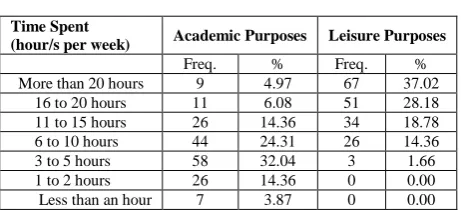
Table 3 shows the time spent in the use of high-technological gadgets for academic and leisure purposes of the studied student nurses as sample respondents. It shows that most of the time spent by student nurses in the use of gadgets are for leisure purposes with an average of 3 to 4 hours a day or more than 20 hours a week, greatly outweighs academic purposes of 1 to 2 hours a day or 6 to 10 hours in a week. It correlates with the study of Wong et al. (2013) and Duque et al. (2017) that Filipinos spent an average of 4.17 hours daily on social media, a way higher compared to the country of Brazil (3.45 hrs.), Argentina (3.32 hrs.), Mexico (3.32 hrs.), United Arab Emirates (3.24 hrs.), Malaysia (3.19 hrs.), Indonesia (3.16 hrs.), Egypt (3.1 hrs.), Turkey (3.01 hrs.), and Saudi Arabia (2.55 hrs.). Higher time spent in the use of high-technological gadgets such as smartphones, tablets, Wi-Fi, desktop, and laptops are majorly used for leisure purposes is not surprising because it is how its features have been designed – surfing internet, watch videos, play games, and call or text for communication. These finding accords with that of Wong et al. [12] that the use of smartphone, tablets, and computers such as desktop and laptop were the most preferred leisure activity of students. This poses challenge of bringing the use of high-technological gadgets from leisure to academic purposes. It could be realized through intensifying the flipped classroom model of learning in which students are required by instructors to surf the net, watch videos, and utilize social medias (e.g. Facebook, Instagram, etc.) in lined with the topic to be discussed prior to classes [14].
Table 1 Weight, Continuum and Responses for the Extent of Use of High-Technological Gadgets
Weight Continuum Response Interpretation
5 4.21-5.0 Always
Uses high-technological gadgets most of the time or almost every day
4 3.41-4.20 Often
Uses high-technological gadgets oftentimes or almost every other day
3 2.61-3.40 Sometimes
Uses high-technological gadgets sometimes or at least three times in a week.
2 1.81-2.60 Seldom
Uses high-technological. gadgets occasionaly or as needed or once in a week.
1 1-1.8 Never
Never use Uses high- technological gadgets or less
Table 3. Time Spent in the Use of High-technological
Gadgets
Time Spent
(hour/s per week) Academic Purposes Leisure Purposes
Freq. % Freq. % More than 20 hours 9 4.97 67 37.02 16 to 20 hours 11 6.08 51 28.18 11 to 15 hours 26 14.36 34 18.78 6 to 10 hours 44 24.31 26 14.36 3 to 5 hours 58 32.04 3 1.66 1 to 2 hours 26 14.36 0 0.00 Less than an hour 7 3.87 0 0.00
Table 4 shows the summary of the respondents use of high-technological gadgets both for academic and leisure purposes. The findings in the table is almost significantly similar with that of the national survey and reports which shows that on the 2016 report of Globe Telecommunications as Cited by Rappler News (2012) [15] shows that 3.2 hours spent on mobile phones (smart phones) and 5.2 hours on Desktop and Tablet/iPad in a day and having on line activities ranked as most famous as follows: social media (47%), videos (19%), Online mobile games (15%), Online shopping (15%), and location-based search (13%). Literature reveals the users of Facebook has steadily increases across several years [16]-[17]. Through multimedia socialization in Facebook, it could be used as a portal in upbringing academic activities such as posting schedules for teleconferencing, sharing reports and electronic books, and other academic matters.
Table 4. Summary of the Respondents Use of High-technological Gadgets
Indicators Mean SD Descriptive Rating For Academic Purposes:
Downloading and reading e-books 2.51 .724 Seldom Teleconferencing 1.17 .726 Never Multimedia reporting (e.g. PowerPoint) 2.05 .634 Seldom Making of requirements (e.g. encoding) 2.89 .642 Sometimes Research work (e.g. internet surfing) 2.78 .742 Sometimes For Leisure Purposes:
Wathcing movies 3.46 .653 Always Listening music 3.25 .858 Always Social media (e.g. facebook) 4.67 .735 Always Calling & texting 3.31 .734 Always Capturing image (e.g. selfie) 3.43 .572 Always Scaling: 4.21 – 5.00 = Always 3.41 – 4.20 = Often 2.61 – 3.40 = Sometimes
1.81 – 2.60 = Seldom 1.00 – 1.80 = Never
Literature reveals that though there is having access in computers among students in the college, there are anecdotal reports revealing low level of internet and computer literacy [3], [16]-[17]. There is also confounding reports about healthcare work places requiring entry level employees be equipped with essential computer skills [18]. Table 5 shows the level of computer literacy of graduating student nurses measured through taking 100-items exams. The average level of computer literacy by the student nurses suggest a need for improvement and point of inquiry about factors affecting the said computer literacy level. According to authors [19]-[20], almost all work in the industry including health sector adapts and updates in the fast paced transition of technology. As an example, highly sophisticated computer operated technology and being integrated in the healthcare workplace to keep
abreast in maintaining the delivery of quality healthcare services.
Table 5. Cumulative Scores in the Examination of Respondents Level of Computer Literacy
Cumulative scores Level (description)
80.25 Average
Scaling: 96-100=Excellent; 94-95.9=Superior; 91-93.99=Very Good; 89-90.99=Good; 86-88.99=Very Satisfactory; 83-85.99=High Average; 80-82.99=Average;
77-79.99=Below Average; 75-76.99=Satisfactory; and, below 75=Unsatisfactory
Table 6 shows the summary of the respondents nursing informatics skills. It reveals that student nurses are moderately skillful in charting information about patient’s condition and progress. Charting as defined in this study involves the use of computer desktop or laptop in encoding information’s and the use of electronic health record during clinical exposure in a secondary and tertiary hospital. Based on literature [3], [7], [19], there is a mismatch in the integration of informatics in the curriculum and the needs of the local healthcare system due to lack of skills and training of the healthcare workforce, lack of credentialing programs in the post-graduate level, and scarcity of local nursing informatics experts. Moreover, the health teaching as part of the context of nursing informatics skills defined in this study is the use of electronic gadgets in providing information to patient. As an example, is the use of tablet, iPad or laptop to project an image or video which aid in providing clear explanation and understanding of information being relayed to the patient. Literature unveils that health teaching provide numerous benefits to patients which includes compliance to treatment regimen [21], decreases patients tension and stabilizes vital signs [22], and increases time of recovery thus decreasing length of stay in the hospital [23].
Table 6. Summary of the Respondents Nursing Informatics Skills
Nursing Informatics Skills Mean SD Descriptive Rating
Charting 2.61 0.825 Moderately Skillful
Health Teaching 2.12 0.831 Slightly Skillful Scaling: 3.26 – 4.00 = Highly Skillful 2.51 – 3.25 = Moderately Skillful
1.76 – 2.50 = Slightly Skillful 1.00 – 1.75 = Not Skillful
that as the student nurses as respondents spent more time in
the use of high-technological gadgets and higher literacy level, slightly increases skills in nursing informatics skills both in the context of charting and health teaching. Thus, the null hypothesis as stated “there is no significant relationship between use of high-technological gadgets of the respondents is rejected.
Moreover, with the use of Pearson’s r Correlation, the independent variable which is the respondent’s computer literacy level has been correlated to their nursing informatics skills in terms of charting and health teaching to determine if there is significant relationship between the two variables. Table 8 below shows that nursing informatics skills in terms of charting has significant relationship with the computer literacy level of the respondents (p-value = 0.35 < 0.05 value) but not significant in terms of health teaching (p-value = 0.64 > 0.05 value) The positive Pearson’s r value for charting and health teaching (r=0.021 indicates positive low correlation between the two variables which means that as literacy level of the student nurses in computers, their charting skills in nursing informatics slightly improves. Then the decision also for the second null hypothesis for the study is to reject the claim that there is no significant relationship between computer literacy level and nursing informatics skills in terms of charting; however, retain or not rejected in terms of health teaching. The findings of this study provided impetus to the researcher designing a proposed action and/or intervention plan. The proposal necessarily includes steps that need to be taken to be able to achieve the specified goals and objectives. By this, the researcher aimed to address the problem related to the perceived inadequacy in the competence and skill of student nurses, especially in the context of the proper use of high-technological gadgets for academic purposes and their computer literacy as part of competency needed to possess in building a considerable nursing informatics skill. It is also highly suggested in nursing institutions to utilize Technology Informatics Guiding Education Reform (TIGER) competencies guidelines to improve informatics practice.
6.
Conclusion and Recommendations
The findings of this study derived from the responses and data gathered from the respondents basically suggest that that the use of high-technological gadgets and computer literacy significantly influences the nursing informatics skills of student nurses essential for ensuring and promoting a safer and quality practice in the profession. However, the practice of nursing informatics as competencies guidelines laid down by no less than the Technology Informatics Guiding Education Reform (TIGER) do not transpire in the institutional settings as the recommended international standards. Though it is acknowledged that training in the
clinical area of student nurses may have insufficiency equipment or limitations not ideal for the practice of honing skills in informatics, institutional level shall take necessary interventions in preparing soon to be professional nurses be well-equipped not only with knowledge but also skills in the veritable ongoing revolution of information technology which consistently invading and integrated in the healthcare system. An implication derived from the findings of this study has to do with the competency and quality of Filipino nurses that could be hired and deployed in the international nursing arena, especially now that ASEAN Integration of Professionals has been set to mobilize. The stance of the country’s present nursing curriculum focuses on producing top-notch and high-caliber nurses who are capable of rendering nursing services that are at par with all the other nurses in the global community. Contrariwise, if Filipino nurses perceive themselves as lacking in perhaps some of the aspects of the competencies, by international standards, then the export value of Philippine nurses stand to be compromised. Hence, the researcher believes that there is really a need to strengthen and intensify the nursing informatics skills or competencies of healthcare professionals both in the institution and clinical level. Since the study scope is in the institutional level, it would be more attuned and meaningful to suggest adopting guidelines in informatics competencies by TIGER, trained faculty workforce in informatics, upgrade and update information and technology facilities of the institution, and more research related to nursing informatics.
References
[1]. Higgins TC, Crosson J, Peikes D, McNellis R, Genevro J, Meyers D. (2015). Using Health Information Technology to Support Quality Improvement in Primary Care. AHRQ Publication No. 15-0031- EF. Rockville, MD: Agency for Healthcare Research and Quality. https://bit.ly/2tR4C2T
[2]. Chirani, Ebrahim & Somayeh Moghim Tirgar (2013). Information Technology’s Role in Organizations Performance. Kuwait Chapter of Arabian Journal of Business and Management Review. Vol. 3, No.1. https://bit.ly/2U8P6bN
[3]. Parthasarathy, Rangarajan & Theresa Steinbach (2015). Health Informatics for Healthcare Quality Improvement: A Literature Review of Issues, Challenges and Findings. Health Informatics for Healthcare Quality Improvement. Twenty-first Americas Conference on Information Systems, Puerto Rico, 2015. https://bit.ly/2AZ5WCO
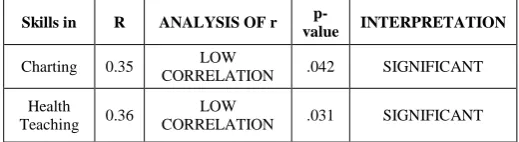
Table 7. Relationship Between Respondent’s Use of High-technological Gadgets and Nursing Informatics Skills in
terms of Charting and Health Teaching
Skills in R ANALYSIS OF r
p-value INTERPRETATION
Charting 0.35 CORRELATION LOW .042 SIGNIFICANT
Health Teaching 0.36
LOW
CORRELATION .031 SIGNIFICANT
Table 8. Relationship Between Respondent’s Computer Literacy and Nursing Informatics Skills in terms of Charting
and Health Teaching
Skills in: R ANALYSIS OF r
p-value INTERPRETATION
Charting 0.21 LOW
CORRELATION .035 SIGNIFICANT
Health
Teaching 0.34
LOW
[4]. Camacho E, LoPresti M, Appelboom G, Dumont ELP,
Taylor B, et al. (2014) The Ubiquitous Role of Smartphones in Mobile Health. Biom Biostat Int J 1(1): 00004. DOI: 10.15406/bbij.2014.01.00004
[5]. Benner, Patricia (1982). From Novice to Expert. The American Journal of Nursing, Vol. 82, No. 3 (Mar., 1982), pp. 402-407. Lippincott Williams & Wilkins. http://www.jstor.org/stable/3462928.
[6]. Sorden, Stephen D. (2016). The Cognitive Theory of Multimedia Learning. https://bit.ly/2AXZBr0
[7]. Commission on Higher Education (CHED), 2009. CHED Memorandum Order No. 14, Series of 2009: Policies and Standards for Bachelor of Science in Nursing (BSN) Program.
[8]. Button, P., Androwich, I., Hibben, L., Kern, V., Madden, G., Marek, K., Westra, B., Zingo, C., … Mead, C. N. (1998). Challenges and issues related to implementation of nursing vocabularies in computer-based systems. Journal of the American Medical Informatics Association : JAMIA, 5(4), 332-4.
[9]. ZechariahJebakumar, A.; Nondo, Hassan S.; Samuel K. Sarfo (2014). European Journal of Nursing.
Volume-1, Issue-1, pg. 6-10.
http://mcmed.us/downloads/ejn_5180325238.pdf
[10]. Dones, L.B.P. & Paguio, Jenniffer & Bonito, Sheila & Balabagno, A.O. & Pagsibigan, J.S.. (2016). Work environment of nurses in the Philippines: A preliminary study. Philippine Journal of Nursing. 86. 4-10. https://bit.ly/2HsF5Vv
[11]. Alsulaimani, Adnan Amin; Vicencio, Daisy A.; Ruiz, Fred B.; Hatim A. Elsheikh (2014). Cognitive Competency of Filipino Nurses Working in Some Hospitals of Taif City, Kingdom of Saudi Arabia. The Egyptian Journal of Hospital Medicine. Vol. 57, Page 384-394. DOI: 10.12816/0008472
[12]. Wong, L.-H. et al. (Eds.) (2013). Proceedings of the 21st International Conference on Computers in Education. Indonesia: Asia-Pacific Society for Computers in Education. https://bit.ly/2t4fYO3
[13]. Duque, Gelzalis; San Antonio, San Antonio & Leonora Brazil (2017). A Correlational Study on Social Media Involvement and Parental Relationship among Students of Asia Pacific College. DLSU Research Congress. The ASEAN Ecosystem @50: Change for a more inclusive growth. https://bit.ly/2S0NnIc
[14]. Pangandaman, Hamdoni (2018). Effects of Flipped Classroom Videos in the Return Demonstration Performance of Nursing Students. Sch J Appl Sci Res
2018, Volume 1: 4.
http://innovationinfo.org/articles/SJASR-4-142.pdf
[15]. Rappler News (2012). Philippine smartphone growth
fastest in Southeast Asia
https://www.rappler.com/bulletin-board/13131- philippine-smartphone-growth-fastest-in-southeast-asia
[16]. Owusu-Acheaw, M. & Agatha Gifty Larson (2015). Use of Social Media and its Impact on Academic Performance of Tertiary Institution Students: A Study of Students of Koforidua Polytechnic, Ghana. Journal of Education and Practice. Vol.6, No.6, 2015. https://files.eric.ed.gov/fulltext/EJ1083595.pdf
[17]. Kolan, Bernard John and Dzandza, Patience Emefa, "Effect of Social Media on Academic Performance of Students in Ghanaian Universities: A Case Study of University of Ghana, Legon." (2018). Library Philosophy and Practice (e-journal). https://digitalcommons.unl.edu/libphilprac/1637
[18]. Singh, Brijendra & Senthil, J. (2015). Use of Information Technology by Nurses in Private Hospitals in the State of Tamil Nadu in India. Mediterranean Journal of Social Sciences. 6. 10.5901/mjss.2015.v6n4s2p658.
[19]. Thimbleby, H. (2013). Technology and the future of healthcare. Journal of public health research, 2(3), e28. doi:10.4081/jphr.2013.e28
[20]. Canadian Medical Association (2018). The future of Technology in the Health and Health Care: A Primer. https://bit.ly/2DtRV1y
[21]. Gold, Deborah T. & Betsy McClung (2006). Approaches to Patient Education: Emphasizing the LongTerm Value of Compliance and Persistence. The American Journal of Medicine (2006) Vol 119 (4A), 32S-37S. doi:10.1016/j.amjmed.2005.12.021
[22]. Raingruber, B. (2012). Health education, health promotion, and health: What do these definitions have to do with nursing. In B. Raingruber (Ed.), Contemporary Health Promotion in Nursing Practice (pp. 1–24). Jones & Bartlett.
[23]. Fredericks, Suzanne & Guruge, Sepali & Sidani, Souraya & Wan, Teresa. (2010). Postoperative Patient Education: A Systematic Review. Clinical nursing research. 19. 144-64. 10.1177/1054773810365994.