International Journal of Management & Information Systems – Third Quarter 2011 Volume 15, Number 3
IT, CSR And Industry Relationships:
A Descriptive Study
Margaret L. Andersen, North Dakota State University, USA Yongtao (David) Hong, North Dakota State University, USA
Limin Zhang, North Dakota State University, USA
ABSTRACT
From the resource-based perspective, corporate social responsibility (CSR) and investment in information technology (IT) are both associated with a firm’s profitable performance. Corporations, taking socially responsible actions, can create valuable intangible assets such as improved relations with stakeholders. In a similar fashion, effective investment in and use of information technology can positively impact a firm’s competitive advantage. Both CSR and IT investments consume organizational resources and each may lead to a competitive advantage separately. This paper explores if one complements or opposes the other.
Investment in information technology and the socially responsible activities of companies vary across industries. The purpose of this paper is to offer an exploratory analysis into a possible association between IT investment and CSR at the industry level. The findings indicate that there is no discernible relationship.
Keywords: investment in information technology; corporate social responsibility; industry; ANOVA
INTRODUCTION
large body of empirical literature supports the finding that investments in information technology (IT) can lead to a competitive advantage. Similarly, a vast empirical literature stream provides evidence that investments in corporate social responsibility (CSR) help a firm’s competitive advantage. Both streams show that each one is affected by industry. Our research question is, “Is there a discernible relationship between CSR and IT investment across industries?” The answer could provide additional insight to academic researchers who may need to control for such a relationship and to managers who may be looking for synergies when making investment decisions.
The resource-based-view (RBV) of the firm, as articulated by Barney (1991, 2001), is used as the foundation for this paper. With this view, a firm that possesses resources which are valuable, rare, inimitable and unsubstitutable can use them to gain a sustained competitive advantage. In his earlier paper, Barney (1991) identifies an information processing system as a resource with the possibility of possessing such characteristics. But such information technology must go beyond just the machines because those are not rare, nor are they inimitable. However, if the information system is part of the “firm’s informal and formal management decision-making process” (Barney 1991 p.114), it has the potential to be a source of competitive advantage. In the same paper, he observes that using resources that are heterogeneous and immobile efficiently and effectively can promote social welfare. This paper expands that basic idea of social welfare to the entire spectrum of behaviors that constitute corporate social responsibility. Finally, in a more recent paper (Barney 2001), he states that the RBV does not claim the ability to identify a list of critical resources that firms must possess in order to achieve a sustained strategic advantage. This is because “... the value of particular resources depends on the specific market context in which they are applied (p.51).” As a result, we include industry as an important variable in this study.
INVESTMENT IN INFORMATION TECHNOLOGY (IT)
With the resource-based view of the firm, the performance of an organization is related to its resources and skills that are firm-specific and difficult to substitute (Barney 1986, 1991). With this perspective, information-technology-related resources can serve as sources of competitive advantage that allow a firm to outperform its competitors. For example, researchers have found that strong managerial IT skills, a reusable technology base, and a relationship between a firm’s IT and business unit as partners can help the company achieve its organizational objectives (Mata et al. 1995, Ross et al. 1996).
Bharadwaj (2000) classifies key IT-based resources as follows: IT infrastructure, human IT resources, and intangible IT-enabled resources. IT infrastructure is a major business resource that consists of shareable technical platforms (hardware and software), telecommunication technologies and databases (Broadbent & Weill 1997, Duncan 1995). A flexible IT infrastructure has been positively linked to competitive advantage because it gives a firm’s management control over its competitive environment (Byrd and Turner 2001).
Human IT resources include managerial and technical IT skills that are time-consuming to accumulate and difficult to imitate (Bharadwaj 2000). Management of human IT resources is critical in making sure that information technology benefits the companies (Keen 1993, Mata et al. 1995). Furthermore, managerial IT skills are highly firm-specific and have been found to be important to organizations’ strategic gain and economic benefits (Keen 1993, Sambamurthy and Zmud 1992).
Teece (1998) finds that the organizational intangible of “know-how” is key in achieving superior performance. IT is critical for creating and managing a firm’s key intangible assets such as customer service, organizational knowledge, and synergy (Bharadwaj 2000, Quinn and Baily 1994). Information systems - such as customer relationship management (CRM) systems, group support systems, knowledge management systems, and data warehouses serve as important enablers for a firm to collect, process, integrate, and transform information (Grantham and Nichols 1993, Sabherwal and King 1991). In general technologies designed to foster collaboration among workers can aid in the effective communication across the organization by removing physical, spatial, and temporal barriers (Brown and Duguid 1991). Furthermore, environmental orientation (Russo and Fouts 1997) and corporate reputation (Vergin and Qoronfleh 1998) and other IT-enabled intangibles help companies thrive financially.
Effectively combining a firm’s IT resources creates a firm-wide IT capability and in turn, superior IT capability is associated with significantly higher profit ratios (Bharadwaj 2000). In addition, the rise of internet and enterprise systems in the mid-1990s has created a new competitive dynamicin many sectors, particularly those that have spent the most on IT (McAfee and Brynjolfsson 2008). In summary, research in the management and IT literature indicates that there is a strong link between information technology and competitive advantage.
INVESTMENT IN CORPORATE SOCIAL RESPONSIBILITY (CSR)
A.B. Carroll, one of the earliest writers on corporate social responsibility (CSR), identifies four expectations that society has of a business: economic, legal, ethical and discretionary (Carroll 1979). He describes a company engaging in CSR as one which will work to make a profit, obey the law, behave ethically, and be a good corporate citizen (Carroll 1991). Corporate social responsibility highlights the fact that businesses and society are interdependent (Porter and Kramer 2006, Stewart 2006).
International Journal of Management & Information Systems – Third Quarter 2011 Volume 15, Number 3
The resource-based-view of the firm (RBV) suggests another way that companies can translate their CSR into a competitive advantage. Harting et al. (2006) emphasize that intangible assets play a role in gaining a competitive advantage. One of these intangible assets particularly relevant to corporate social responsibility is reputation (McWilliams et al. 2006). Customers, employees, suppliers, investors and creditors respond favorably to a company with a good reputation (Vergin and Qoronfleh 1998).
A vast empirical literature has found a positive relationship between corporate social responsibility and financial performance (e.g., Preston and O’Bannon 1997, Waddock and Graves 1997 and Margolis and Walsh 2001). A positive association between “doing good” and “doing well” simply reinforces the linkage between CSR and a competitive advantage.
THE IMPACT OF INDUSTRY
In a recent paper, Godfrey et al. (2010 p.322) state the following: “We begin with the unremarkable yet robust observation that industries differ along materially important dimensions, both economically (Porter, 1980) and sociologically (Scott, 1995).” Two aspects of their discussion are particularly relevant to this paper. Industries differ in their intrinsic structure including their use of technology. This is likely to cause differences in investments in technology across industries.
Industries also differ in their regulatory environment. The opportunity set for socially responsible behavior is likely to be dependent on industry and results in similar CSR actions throughout an industry (Rowley and Berman 2000). Many social issues are defined at the sector or industry level.
Similarly, IT spending varies significantly across different industries. Each industry is subject to a unique set of circumstances, including governmental regulations, consumer orientation, and public visibility. As a result, we will investigate the relationship between CSR and IT investment and explicitly incorporate the role of industry.
THE RELATIONSHIP BETWEEN CSR AND IT INVESTMENT
It is difficult to predict the direction of the relationship between investments in IT spending and CSR. One possibility is the existence of a positive relationship between them based on the “good manager” argument. Supported in the previous literature review, a good manager will invest in information technology to gain a competitive advantage and a good manager will also invest in CSR to achieve a competitive advantage. Thus, the relationship between IT and CSR will be positive.
An equally plausible expectation concerning the direction of the relationship is that it will be negative. Investments in IT require the expenditure of scarce resources; similarly, CSR activities require the use of scarce resources. Thus, with limited funds to invest, managers may need to choose between investments in IT and investments in CSR. This paper has no a priori expectations concerning the existence of a relationship or its direction. Our research question remains: is there an observable relationship between CSR and IT investment across industries?
KLD DATA
In this study, the sample data for CSR consists of over 3,800 firms from the time period of 2004-2007. For each company in the sample, the sum of the strengths for each area is calculated. In a similar fashion, the concerns for each area are summed. Thus, each company will have fourteen CSR measures: community relations (total) strengths, community relations (total) concerns, corporate governance (total) strengths, corporate governance (total) concerns, and so on. The average number of total strengths in each issue area, as well as the average number of total concerns in each issue area, is calculated by industry. Margolis and Walsh (2001) urge the use of multiple CSRs and the separation of positive (strengths) and negative (concerns) social actions. Our measures satisfy both suggestions.
Each company is identified as belonging to an industry based on the first digit of its SIC code. While this is a very broad classification, the resulting ten industry/sector classifications are manageable for this descriptive study.
The research question for this study asks if there is a relationship between CSR and IT investment at the industry level. Specifically, we are interested in the effect of industry on CSR activities and on IT expenditures. Because of the nature of our data, we use ANOVA to determine if there are significant differences in average total strengths and average total concerns for the seven issue areas across industries. The IT expenditures by industry are reported by Gartner and were obtained from the following website: http://www.gartner.com/it/page.jsp?id=1219723.
FINDINGS
International Journal of Management & Information Systems – Third Quarter 2011 Volume 15, Number 3
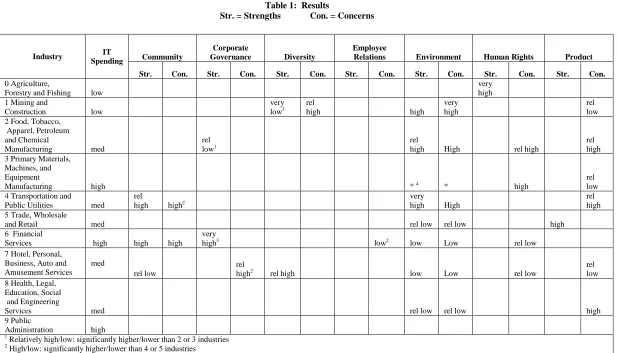
Table 1: Results
Str. = Strengths Con. = Concerns
Industry IT
Spending Community
Corporate
Governance Diversity
Employee
Relations Environment Human Rights Product Str. Con. Str. Con. Str. Con. Str. Con. Str. Con. Str. Con. Str. Con.
0 Agriculture,
Forestry and Fishing low
very
high
1 Mining and
Construction low
very low3
rel
high high
very
high
rel low 2 Food, Tobacco,
Apparel, Petroleum and Chemical
Manufacturing med
rel
low1
rel
high High rel high
rel high 3 Primary Materials,
Machines, and Equipment
Manufacturing high * 4 * high
rel low 4 Transportation and
Public Utilities med
rel
high high2
very
high High
rel high 5 Trade, Wholesale
and Retail med rel low rel low high
6 Financial
Services high high high
very
high3 low2 low Low rel low
7 Hotel, Personal, Business, Auto and Amusement Services
med
rel low
rel
high2 rel high low Low rel low
rel low 8 Health, Legal,
Education, Social and Engineering
Services med rel low rel low high
9 Public
Administration high
1
Two industries are classified as low in IT investment; they spent less than $26 billion in 2009. Five industries, with expenditures between $160 billion and $215 billion, are identified as making a medium level of investment. The three industries classified as high in IT spending invested more than $270 billion.
In this study, the two industries which are identified as being low in IT spending are Agriculture, Forestry and Fishing (0) and Mining and Construction (1). The Agriculture, Forestry and Fishing industry (0) is classified as low in IT spending and very high in product concerns. Industry 1 (Mining and Construction) is also low in IT spending and very low in diversity strengths; relatively high in diversity concerns; high in environment strengths; very high in environment concerns and relatively low in product concerns. Thus, for the two industries which have in common a relatively low level of IT spending, they share no similarities in their CSR behaviors.
Five industries are classified as medium in IT spending. They are the following: Food, Tobacco, Apparel, Petroleum and Chemical Manufacturing (2); Transportation and Public Utilities (4); Trade, Wholesale and Retail (5); Hotel, Personal, Business, Auto and Amusement Services (7); and Health, Legal, Education, Social and Engineering Services (8). These industries will be discussed next.
Food, Tobacco, Apparel, Petroleum and Chemical Manufacturing (2) is relatively low in corporate governance strengths; relatively high in environment strengths; high in environment concerns; relatively high in human rights concerns; and relatively high in product concerns. Transportation and Public Utilities (4) is relatively high in community strengths; high in community concerns; very high in environment strengths; high in environment concerns; and relatively high in product concerns. Trade, Wholesale and Retail (5), is relatively low in environment strengths; relatively low in environment concerns; and high in product strengths. Hotel, Personal, Business, Auto and Amusement Services (7) is relatively low in community strengths; relatively high in corporate governance concerns; relatively high in diversity strengths; low in environment strengths; low in environment concerns; relatively low in human rights concerns; and relatively low in product concerns. Finally, Health, Legal, Education, Social and Engineering Services (8) is relatively low in environment strengths; relatively low in environment concerns; and high in product concerns.
The only obvious pattern in CSR across these five industries occurs with environmental strengths and environmental concerns. Although the industries range from low in both areas (7) to very high/high in both areas (4), there is an interesting relationship across the industries. Each of the five industries rates in a similar fashion for both environmental strengths and concerns. For example, industry (8) is relatively low in both strengths and concerns for the environment; industry (2) is relatively high in strengths and high in concerns. Environmental strengths tend to be in tandem with environmental concerns for the mid-range IT spending industries.
The following three industries are classified as high in IT spending: Primary Materials, Machines, and Equipment Manufacturing (3); Financial Services (6) and Public Administration (9). Primary Materials, Machines, and Equipment Manufacturing (3) is high in human rights concerns and relatively low in product concerns. Financial Services (6) is high in community strengths; high in community concerns; very high in corporate governance strengths; low in employee relations concerns; low in environment strengths; low in environment concerns; and relatively low in human rights concerns. Public Administration (9) is not significantly different from the other industries in any of the CSR areas.
The three industries with the highest levels of IT spending again have nothing in common with corporate social responsibility. The only CSR issue which appears for two of the industries, human rights concerns, appears almost as opposites. The manufacturing industry (3) has a high level of human rights concerns whereas the financial industry (6) is relatively low. Public Administration has a high level of IT spending but is not significantly higher or lower than the other industries in any of the CSR issue areas. Muniz (2009) also finds that enterprises in public administration invest heavily in management information systems.
International Journal of Management & Information Systems – Third Quarter 2011 Volume 15, Number 3
and Amusement Services (7) is relatively low in community strengths. Financial Services (6) is high in community strengths.
CONCLUSIONS AND LIMITATIONS
Clearly, there are industry differences in information technology investments and in corporate socially responsible actions. In this study, however, we find no relationship between investment in IT and the CSR activities of companies across industries. One possible explanation is that our industry specification is too broad; future studies may find it useful to use a two- or three-digit industry classification. Overall, it remains to be seen, through future research if our finding holds when the variables are operationalized differently and more powerful statistical tests are used.
AUTHOR INFORMATION
Margaret L. Andersen, Ph.D. is an Associate Professor of Accounting at North Dakota State University in Fargo, ND. She teaches managerial accounting. Her research interests are in the area of ethics.
Yongtao (David) Hong, Ph.D. is an Assistant Professor of Accounting at North Dakota State University in Fargo, ND. He teaches financial accounting classes. His publications have been in the area of accrual quality as well as international financial reporting. In addition, he has research interests in auditing and ethics.
Limin Zhang, Ph.D. is an Assistant Professor of MIS at North Dakota State University in Fargo, ND. She teaches both graduate and undergraduate classes in MIS. Her research interests include the improvement of search engines, using technology to support decision-making and ethics.
REFERENCES
1. Alexander, G.J., & Buchholz, R.A. (1978). Corporate social responsibility and stock market performance. Academy of Management Journal, 23(3), 478-486.
2. Barney, J.B. (1986). Strategic factor markets: Expectations, luck, and business strategy. Management Science, 32(10), 1231-1241.
3. Barney, J.B. (1991). Firm resources and sustained competitive advantage. Journal of Management, 17(1), 99-120.
4. Barney, J.B. (2001). Is the resource-based “view” a useful perspective for strategic management research? Yes. The Academy of Management Review, 26(1), 41-56.
5. Bharadwaj, A.S. (2000). A resource-based perspective on information technology capability and firm performance: An empirical investigation. MIS Quarterly, 24(1), 169-196.
6. Broadbent, M. & Weill, P. (1997). Management by maxim: How business and IT managers can create IT infrastructure. Sloan Management Review, 38(3), 77-92.
7. Brown, J.S., & Duguid, P. (1991). Organizational learning and communities-of-practice: Toward a unified view of working, learning, and innovation. Organization Science, 2(1), 40-57.
8. Byrd, T.A., & Turner, D.E. (2001). An exploratory examination of the relationship between flexible IT infrastructure and competitive advantage. Information & Management, 39, 41-52.
9. Carroll, A.B. (1979). A three-dimensional conceptual model of corporate social performance. Academy of Management Review, 4, 497-505.
10. Carroll, A.B. (1991). The pyramid of corporate social responsibility: Toward the moral management of organizational stakeholders. Business Horizons, 34, 39-48.
11. Cohen, W.A. (2009). What Drucker taught us about social responsibility. Leader to Leader, 51, 29-34. 12. Duncan, N.B., (1995). Capturing flexibility of information technology infrastructure: A study of resource
characteristics and their measure. Journal of Management Information Systems, 12(2), 37-57. 13. Godfrey, P. C., Hatch, N.W., & Hansen, J.M. (2010). Toward a general theory of CSRs: The roles of
beneficence, profitability, insurance, and industry heterogeneity. Business & Society, 49(2), 316-344. 14. Grantham, C.E., & Nichols, L.D. (1993). The Digital Workplace: Designing Groupware Platforms. New
15. Harting, T.R., Harmeling, S.S., & Venkataraman, S. (2006). Innovative stakeholder relations: When “ethics pays” (And when it doesn’t). Business Ethics Quarterly, 16(1), 43-68.
16. Heinze, D., Sibary, S., & Sikula, A. (1999). Relations among corporate social responsibility, financial soundness, and investment value in 22 manufacturing industry groups. Ethics & Behavior, 9(4), 331-347. 17. Hillman, A.J., & Keim, G.D. (2001). Shareholder value, stakeholder management, and social issues:
What’s the bottom line? Strategic Management Journal, 22(2), 125-139.
18. Keen, P.G.W. (1993). Information technology and the management difference: A fusion map. IBM Systems Journal, 32(1), 17-39.
19. Margolis, J.D., & Walsh, J.P. (2001). People and profits? The search for a link between a company’s social and financial performance. Mahwah, NJ: Lawrence Erlbaum.
20. Mata, F.J., Fuerst, W.L., & Barney, J.B. (1995). Information technology and sustained competitive advantage: A resource-based analysis. MIS Quarterly, 19(4), 487-505.
21. Mattingly, J.E., & Berman, S.L. (2006). Measurement of corporate social action: Discovering taxonomy in the Kinder Lydenburg Domini ratings data. Business and Society, 45(1), 20-46.
22. McAfee, A., & Brynjolfsson, E. (2008). Investing in the IT that makes a competitive difference. Harvard Business Review, 86(7/8), 98-107.
23. McWilliams, A., Siegel, D.S., & Wright, P.M. (2006). Corporate social responsibility: Strategic implications. Journal of Management Studies, 43(1), 1-18.
24. Muniz, E. J. S. (2009). The investment in management information systems and its effect on the efficiency in public organizations when putting into practice the alignment function of information technologies governance. International Journal of Management and Information Systems, 13(2), 21-28.
25. Pava, M.L., & Krausz, J. (1996). The association between corporate social responsibility and financial performance: The paradox of social cost. Journal of Business Ethics, 15(3), 321-357.
26. Porter, M.E. (1980). Competitive Strategy. New York: Free Press.
27. Porter, M.E., & Kramer, M.R. (2006). Strategy and society: The link between competitive advantage and corporate social responsibility. Harvard Business Review, (December), 78-92.
28. Preston, L.E., & O’Bannon, D.P. (1997). The corporate social – financial performance relationship. Business and Society, 36(4), 419-429.
29. Quinn, J.B., & Baily, M.N. (1994). Information technology: Increasing productivity in services. Academy of Management Executive, 8(3), 28-48.
30. Ross, J.W., Beath, C.M., & Goodhue, D.L. (1995). Develop long-term competitiveness through IT assets. Sloan Management Review, 38(1), 31-45.
31. Rowley, T., & Berman, S. (2000). A brand new brand of corporate social performance. Business & Society, 39(4), 397-418.
32. Russo, M.V., & Fouts, P.A. (1997). A resource-based perspective on corporate environmental performance and profitability. Academy of Management Journal, 40(3), 534-559.
33. Sabherwal, R., & King, W.R. (1991). Towards a theory of strategic use of information resources: An inductive approach. Information & Management, 20(3), 191-212.
34. Sambamurthy, V., & Zmud, R.W. (1992). Managing IT for success: The empowering business partnership. Morristown, NJ: Financial Executives Research Foundation.
35. Scott, W.R. (1995). Institutions and organizations. Thousand Oaks, CA: Sage.
36. Stewart, T.A. (2006). Corporate social responsibility: Getting the logic right. Harvard Business Review, (December), 14.
37. Teece, D.J. (1998). Capturing value from knowledge assets: The new economy, markets for know-how, and intangible assets. California Management Review, 40(3), 55-79.
38. Vergin, R.C., & Qoronfleh, M.W. (1998). Corporate reputation and the stock market. Business Horizons, 41(1), 19-26.
International Journal of Management & Information Systems – Third Quarter 2011 Volume 15, Number 3
APPENDIX A
Components Of The Strengths And Concerns For The Kld Issue Areas
COMMUNITY
Strengths:
Charitable giving
Innovative giving
Non-US charitable giving
Support for housing
Support for education
Indigenous peoples relations
Volunteer programs
Other strengths
Concerns:
Investment controversies
Negative economic impact
Indigenous peoples relations
Tax disputes
Other concerns
CORPORATE GOVERNANCE
Strengths:
Limited compensation
Ownership
Transparency
Political accountability
Other strengths
Concerns:
High compensation
Ownership
Accounting
Transparency
Political accountability
Other concerns
DIVERSITY
Strengths:
CEO
Promotion
Board of Directors
Work/Life benefits
Women and minority contracting
Employment of the disabled
Gay and lesbian policies
Concerns:
Controversies
Non-representation
Other concerns
EMPLOYEE RELATIONS
Strengths:
Union relations
No-layoff policy
Cash profit sharing
Employee involvement
Retirement benefit
Health and safety
Other strengths
Concerns:
Union relations
Health and safety
Workforce reductions
Retirement benefit
Other concerns
ENVIRONMENT
Strengths:
Beneficial products and services
Pollution prevention
Recycling
Clean energy
Communications
Property, plant and equipment
Management systems
Other strengths
Concerns:
Hazardous waste
Regulatory problems
Ozone depleting chemicals
Substantial emissions
Agricultural chemicals
Climate change
Other concerns
HUMAN RIGHTS
Strengths:
Positive record in South Africa
Indigenous peoples human relations
Labor rights
International Journal of Management & Information Systems – Third Quarter 2011 Volume 15, Number 3
Concerns:
South Africa
Northern Ireland
Burma
Mexico
Labor rights
Indigenous peoples relations
Other concerns
PRODUCT
Strengths:
Quality
R&D / Innovation
Benefits to economically disadvantaged
Other strengths
Concerns:
Product safety
Marketing / contracting
Antitrust