www.nat-hazards-earth-syst-sci.net/15/1061/2015/ doi:10.5194/nhess-15-1061-2015
© Author(s) 2015. CC Attribution 3.0 License.
On a report that the 2012
M
6
.
0 earthquake in Italy was predicted
after seeing an unusual cloud formation
J. N. Thomas1,2,3, F. Masci4, and J. J. Love5
1NorthWest Research Associates, Redmond, Washington, USA
2Department of Electrical and Computer Engineering, DigiPen Institute of Technology, Redmond, Washington, USA 3Department of Earth and Space Sciences, University of Washington, Seattle, Washington, USA
4Istituto Nazionale di Geofisica e Vulcanologia, L’Aquila, Italy
5Geomagnetism Program, U.S. Geological Survey, Denver, Colorado, USA
Correspondence to: J. N. Thomas ([email protected])
Received: 17 April 2014 – Published in Nat. Hazards Earth Syst. Sci. Discuss.: 10 September 2014 Accepted: 4 May 2015 – Published: 27 May 2015
Abstract. Several recently published reports have sug-gested that semi-stationary linear-cloud formations might be causally precursory to earthquakes. We examine the report of Guangmeng and Jie (2013), who claim to have predicted the 2012M6.0 earthquake in the Po Valley of northern Italy af-ter seeing a satellite photograph (a digital image) showing a linear-cloud formation over the eastern Apennine Mountains of central Italy. From inspection of 4 years of satellite images we find numerous examples of linear-cloud formations over Italy. A simple test shows no obvious statistical relationship between the occurrence of these cloud formations and earth-quakes that occurred in and around Italy. All of the linear-cloud formations we have identified in satellite images, in-cluding that which Guangmeng and Jie (2013) claim to have used to predict the 2012 earthquake, appear to be orographic – formed by the interaction of moisture-laden wind flowing over mountains. Guangmeng and Jie (2013) have not clearly stated how linear-cloud formations can be used to predict the size, location, and time of an earthquake, and they have not published an account of all of their predictions (including any unsuccessful predictions). We are skeptical of the valid-ity of the claim by Guangmeng and Jie (2013) that they have managed to predict any earthquakes.
1 Introduction
The old notion that earthquakes might be preceded by pecu-liar weather has recently been seemingly supported by sev-eral reports that unusual cloud formations might be causally precursory to earthquakes. Many of these reports have iden-tified linear arrangements of clouds that seem to persist for several hours in a more or less stationary location near earthquake epicenters. For example, Shou (1999) re-ported linear-cloud formations 32 days prior to the 17 Au-gust 1997M7.4 Izmit, Turkey earthquake and 30 days prior to the 4 February 1998M5.9 Afghanistan earthquake. Shou (2006) reported linear-cloud formations 5 days prior to the 26 December 2003 M6.6 Bam, Iran earthquake. Guo and Wang (2008) reported linear-cloud formations 69 days prior to the 22 February 2005M6.4 Zarand, Iran earthquake and 64 days prior to the 28 February 2006M6.0 Tiab, Iran earth-quake. Wu et al. (2009) reported-linear cloud formations prior to the 12 May 2008 M7.9 Wenchuan, China earth-quake.
1062 J. N. Thomas et al.: The 2012M6.0 earthquake in Italy were not advected away by wind. In the case of an Italy
earthquake, Guangmeng and Jie observed linear cloud for-mations on 22–23 April 2012. On the basis of this observa-tion, they predicted that an earthquake would occur some-where in Italy: either M5.5–6.0 within “about” 10 days or if M6.0 in 30 days. They did not give any specific bounds on epicenter or hypocenter location, and they did not give any expression of statistical confidence for their prediction. Nonetheless, it might be interesting that anM6.0 earthquake actually occurred 30 days later on 20 May 2012 in north-ern Italy (epicenter 44.80◦N, 11.19◦E). For two Iran earth-quakes, they observed clouds on 19–20 February 2012, a week prior to anM5.1 earthquake on 27 February, and they observed clouds on 1 March 2012, a week prior to anM5.1 earthquake on 8 March.
Reports of precursory cloud formations have, in turn, mo-tivated the development of physical theories (e.g., Freund et al., 2009; Harrison et al. 2014). And, indeed, if cloud forma-tions could be reliably correlated with impending seismic ac-tivity, this would, as Guangmeng and Jie assert (2013, p. 95), certainly be an important development for the science of earthquake prediction. Our concern, however, is that the ev-idence for precursory cloud formations appears to be vague, anecdotal, of unknown validity, and, so far, unverified in any rigorous way by independent researchers. We are, therefore, motivated to examine the claim by Guangmeng and Jie that earthquakes are sometimes preceded by unusual cloud for-mations.
2 Many clouds and many earthquakes
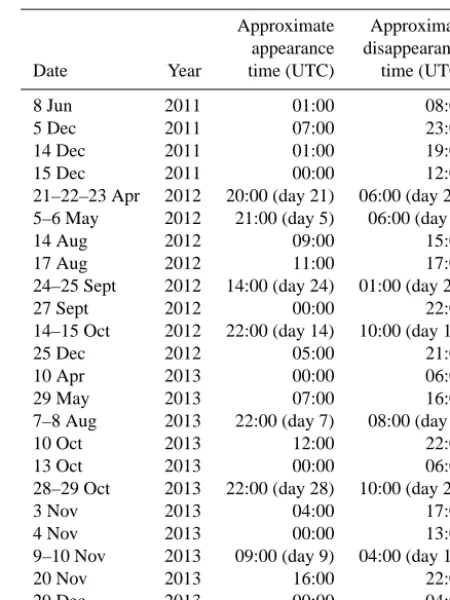
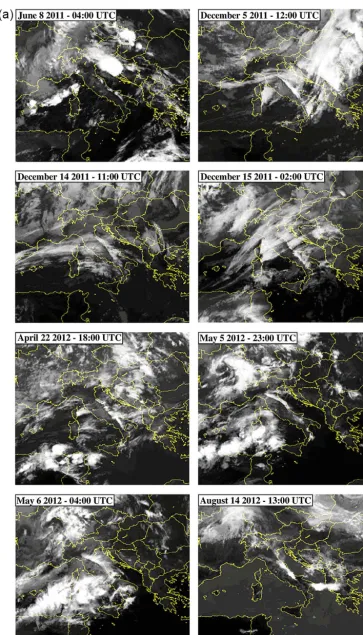
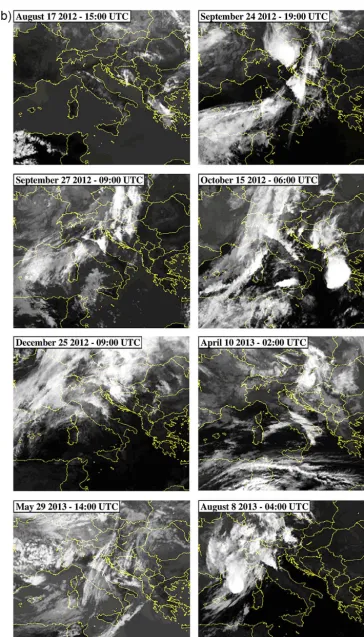
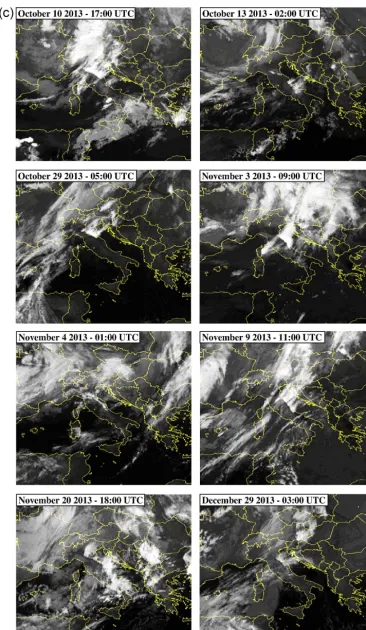
We focus our examination on the report by Guangmeng and Jie (2013) that precursory linear-cloud formations were re-alized over an earthquake fault in Italy prior to the occur-rence of an earthquake. We obtain the same infrared satel-lite images that Guangmeng and Jie obtained from the Meteo Company SAT24, but instead of simply focusing on a short duration of time before the 20 May 2012M6.0 earthquake, as Guangmeng and Jie did, we examine 4 years of satellite images (January 2010–December 2013). In Fig. 1, we sum-marize our identification of 24 separate instances of linear-cloud formations over Italy, each selected independently of any seismic activity. These are enlarged views of the original satellite images and show linear-cloud formations along dif-ferent regions of the Apennine Mountain range in Italy. And we note that the linear-cloud formation identified by Guang-meng and Jie as possibly precursory to the 20 May 2012 Ital-ian earthquake, 22 April 2012, is just 1 of the 24 examples shown in Fig. 1. The resolution of the infrared SAT24 images is 72 pixels/inch, and they are available every 15 min. We ex-amined one image per hour for linear-cloud formations. Ta-ble 1 lists appearance and disappearance times for instances of linear-cloud formations over Italy during January 2010– December 2013. To show how these clouds were formed and
Table 1. Instances of linear-cloud formations that occurred over Italy during 2010–2013.
Approximate Approximate appearance disappearance
Date Year time (UTC) time (UTC)
8 Jun 2011 01:00 08:00
5 Dec 2011 07:00 23:00
14 Dec 2011 01:00 19:00
15 Dec 2011 00:00 12:00
21–22–23 Apr 2012 20:00 (day 21) 06:00 (day 23) 5–6 May 2012 21:00 (day 5) 06:00 (day 6)
14 Aug 2012 09:00 15:00
17 Aug 2012 11:00 17:00
24–25 Sept 2012 14:00 (day 24) 01:00 (day 25)
27 Sept 2012 00:00 22:00
14–15 Oct 2012 22:00 (day 14) 10:00 (day 15)
25 Dec 2012 05:00 21:00
10 Apr 2013 00:00 06:00
29 May 2013 07:00 16:00
7–8 Aug 2013 22:00 (day 7) 08:00 (day 8)
10 Oct 2013 12:00 22:00
13 Oct 2013 00:00 06:00
28–29 Oct 2013 22:00 (day 28) 10:00 (day 29)
3 Nov 2013 04:00 17:00
4 Nov 2013 00:00 13:00
9–10 Nov 2013 09:00 (day 9) 04:00 (day 10)
20 Nov 2013 16:00 22:00
29 Dec 2013 00:00 04:00
their stationary nature over the eastern Apennine Mountain range, in the Supplementary Material we include movies for many of the examples shown in Fig. 1.
Using the online catalog of the National Earthquake In-formation Center of the U.S. Geological Survey (www. earthquake.usgs.gov), in Table 2 we list the 14M≥5.0 earth-quakes that occurred in and near Italy, within the geographic square of 35–48◦N latitude and 6–20◦E longitude, and within the time interval 1 January 2010–31 December 2013. The locations of the earthquakes are shown in the map in Fig. 2. A lower magnitude threshold would lead to the count-ing of a larger number of events; in the same geographic square for the same duration of time there were 68 earth-quake events withM≥4.5. Such a low threshold was not discussed by Guangmeng and Jie (2013), and so we do not consider it further. Figure 3 shows the times of instances of linear-cloud formations listed in Table 1 and earthquake oc-currences listed in Table 2.
3 Discussion and conclusions
1064 J. N. Thomas et al.: The 2012M6.0 earthquake in Italy
1066 J. N. Thomas et al.: The 2012M6.0 earthquake in Italy
Table 2.M≥5 earthquakes that occurred in and near Italy (lat. 35–48◦N, long. 6–20◦E) during 2010–2013.
Date Year Time (UTC) Lat (◦N) Long (◦E) Depth (km) M
22 Aug 2010 10:22:58 37.24 19.95 24 5.5
3 Nov 2010 18:13:11 40.04 13.25 468 5.2
7 July 2011 19:21:46 41.95 7.70 11 5.3
19 July 2011 07:13:12 37.21 19.92 9 5.1
27 Jan 2012 14:53:13 44.48 10.03 60 5.0
20 May 2012 02:03:52 44.89 11.23 6 6.0
20 May 2012 13:18:02 44.83 11.49 5 5.0
29 May 2012 07:00:03 44.85 11.09 10 5.8
29 May 2012 10:55:57 44.89 11.01 7 5.5
29 May 2012 11:00:25 44.87 10.95 10 5.1
3 June 2012 19:20:43 44.90 10.94 9 5.1
25 Oct 2012 23:05:24 39.88 16.01 6 5.3
21 June 2013 10:33:59 44.22 10.11 10 5.2
29 Dec 2013 17:08:43 41.37 14.44 10 5.3
Latitude
Longitude
10 15 20
35 40 45 Legend M 6.0 M 5.5 M 5.0
Figure 2. Map showing locations of magnitudeM≥5 earthquakes listed in Table 2 that occurred in and near Italy (lat. 35–48◦N, long. 6–20◦E) during 2010–2013. The red circle indicates the location of the 20 May 2012 earthquake that Guangmeng and Jie (2013) claim to have predicted. The areas of the circles are scaled with the approximate earthquake energy.
ilar to those that Guangmeng and Jie (2013) claim to have used to predict an earthquake, are frequently seen in Italy. In Fig. 1 we show 24 instances of linear-cloud formations in a 4-year period of time. Outside of theM6.0 earthquake event on 20 May 2012, and its subsequent aftershocks, it is difficult to imagine how the smaller earthquakes might be identified as being associated with a particular “linear”-cloud formation. Indeed, Guangmeng and Jie did not provide any specific cri-teria for classifying cloud formations as possible earthquake precursors, and there were many instances when it would be difficult to say whether or not a particular cloud formation was “linear”, “semi-linear”, “temporarily linear”, etc. How,
specifically, did Guangmeng and Jie manage to predict, even if only vaguely, the magnitude, location, and timing of an earthquake from their examination of cloud formations? We do not know since they have not told us.
Independent of the occurrence of earthquakes, and con-trary to what is stated by Guangmeng and Jie (2013, p. 91), there is a simple meteorological explanation for the cause of the linear-cloud formations. Italy is a mountainous coun-try; most prominently, the Apennine Mountains run along the length of the Italian peninsula. It is well-known that winds flowing towards mountains are lifted causing adiabatic cooling of air masses, and, if the relative humidity reaches 100 %, then “orographic” clouds form on the lee side of the range (e.g., Whiteman, 2000). Since mountain ranges are of-ten aligned with mountain-bounding faults, orographic cloud formations can sometimes appear to be aligned with faults. And, since mountains are, for this discussion, unmoving and stationary, these orographic clouds are not advected away by the winds that are involved with their formation.
Guang-Figure 3. Time series of instances of linear-cloud formations and earthquake occurrences in and near Italy (lat. 35–48◦N, long. 6–20◦E) during 2010–2013.
meng and Jie (2013) and the other linear-cloud formations seen in Fig. 1 are simply orographic clouds, and, thus, unre-lated to the earthquakes. That we have not been able to iden-tify distinctive linear-cloud formations during January 2010– May 2011 in Fig. 1 is possibly just the result of variable atmospheric conditions that happened not to be conducive to orographic cloud formation during this time, even though there were actually two earthquakes during this time in the list given in Table 2.
Signals identified as possibly precursory might have alter-native causes that are unrelated to the earthquake process. Thus, when examining reports of earthquake precursors, it is important to determine if effects similar to the possible precursors are also observed during earthquakes (Park et al., 1993). Since the major energy is released during the earth-quake, and not before the earthearth-quake, if co-seismic changes do not occur, it is unlikely that the cloud formations have any physical relationship with the earthquake. Our analy-sis shows no evidence of co-seismic instances of cloud for-mations. Indeed, only one of the earthquakes listed in Ta-ble 2 (M5.3 on 29 December 2013) was accompanied on the same day by an instance of a cloud formation. And we note that the time of this earthquake was approximately 13 h after the cloud formation disappeared. The lack of co-seismic in-stances of cloud formation suggests that the reports of clouds by Guangmeng and Jie (2013) are unrelated to the earth-quakes.
To objectively evaluate an earthquake-prediction hypoth-esis, each individual prediction should be clearly stated in quantitative terms: (1) a magnitude that the predicted earth-quake is expected to exceed, (2) a specified range of epicenter geographic coordinates and hypocenter depth, and (3) a spec-ified time window in which the earthquake can be expected to occur. To obtain confidence in the statistical significance of a prediction hypothesis, one that is based on the observation of possible precursory phenomena, an alternative null hypoth-esis of a random relationship between the possible precur-sory phenomena and earthquake occurrence should first be
dismissed. This can be done using compilations of predic-tions that have been made prospectively of future earthquake occurrences. On the other hand, a prediction hypothesis can be dismissed with retrospective analysis of observations we already have of possible precursory phenomena and earth-quakes that have already occurred (e.g., Love and Thomas, 2013, Sect. 2). If the hypothesis cannot predict past earth-quakes, then there is no reason to expect that it can predict them in the future.
With that understanding, then, we perform a simple retro-spective examination of the time statistics of the occurrence of the earthquakes listed in Table 2 and the linear-cloud for-mations listed in Table 1. As a null hypothesis we consider a uniform distribution in time. A simple Kuiper test (Press et al., 1996, Sect. 14.3) reveals that the earthquake list would not be a likely realization from a uniform distribution in time, p=0.0239. However, if we “decluster” the list, removing af-tershock events occurring near and after the 20 May 2012 M6.0 event, then the Kuiper test reveals that the remaining events would have a high probability of being realized from a uniform distribution,p=0.8951. In contrast, the occurrence list of linear-cloud formations would not be a likely realiza-tion from a uniform distriburealiza-tion,p=0.0015. If we decluster this list by removing linear-cloud formations seen on consec-utive days, the probability is still small,p=0.0054.
1068 J. N. Thomas et al.: The 2012M6.0 earthquake in Italy and at other times no cloud formations occur prior to
earth-quakes.
One might reasonably conclude from this simple and straightforward examination of the data that linear-cloud for-mation and the occurrence of earthquakes are not evidently related to each other in a statistical sense over the latitude-longitude region we have selected. We imagine that Guang-meng and Jie might feel differently. If they do, then they need to clearly state the statistical relationship that they expect to exist between linear-cloud formations and earthquake occur-rence. They have not yet done that. And, until they do, the rest of the geophysical community cannot test their hypothe-sis against future data.
Although Guangmeng and Jie (2013) report a few success-ful earthquake predictions, we note that they do not mention any unsuccessful predictions. Have all of their predictions been a success? We do not know since they have not told us. Reporting only successful predictions (not reporting all unsuccessful predictions) leads to what is sometimes called “publication bias” in which unsuccessful predictions are sim-ply not published, or “file drawer bias” in which unsuccess-ful predictions are simply “filed away” and not seen again (e.g., Boslaugh, 2013, p. 462). Until Guangmeng and Jie re-port all their predictions, successful and unsuccessful, until each prediction is expressed in quantitatively specific terms, and until these predictions are objectively recorded before the predicted earthquake occurrence, then there is no way for the rest of the scientific community to evaluate the validity of their results. For now, we are skeptical of the validity of the claim by Guangmeng and Jie (2013) that they have managed to predict any earthquakes. And, in the spirit of the time-tested scientific method, we encourage Guangmeng and Jie to scrutinize the validity of their own results.
The Supplement related to this article is available online at doi:10.5194/nhess-15-1061-2015-supplement.
Acknowledgements. We thank W. D. Barnhart, C. A. Finn, G. Guangmeng, J. McCarthy, and E. J. Rigler for reading a draft manuscript. We thank Marco Verdecchia of L’Aquila University, Italy for helpful discussions. This work was supported by the USGS Geomagnetism Program and the USGS Earthquake Hazards Program through external research grants G11AP20177 and G15AP00071 to JNT. We thank SAT24 (www.sat24.com) for permission to use their satellite images. Any use of trade, product, or firm names is for descriptive purposes only and does not imply endorsement by the US Government.
Edited by: B. D. Malamud
Reviewed by: two anonymous referees
References
Boslaugh, S.: Statistics in a Nutshell, O’Reilly Media, Sebastopol, CA, 2013.
Freund, F. T., Kulahci, I., Cyr, G., Ling, J., Winnick, M., Tregloan-Reed, J., and Freund, M. M.: Air ionization at rock surfaces and pre-earthquake signals, J. Atmos. Sol.-Terrest. Phys., 71, 1824– 1834, doi:10.1016/j.jastp.2009.07.013, 2009.
Guangmeng, G. and Jie, Y.: Three attempts of earthquake prediction with satellite cloud images, Nat. Hazards Earth Syst. Sci., 13, 91–95, doi:10.5194/nhess-13-91-2013, 2013.
Guo, G. M. and Wang, B.: Cloud anomaly before Iran earthquake, Int. J. Remote Sens., 29, 1921–1928, doi:10.1080/01431160701373762, 2008.
Harrison, R. G., Aplin, K. L., and Rycroft, M. J.: Brief Commu-nication: Earthquake-cloud coupling through the global atmo-spheric electric circuit, Nat. Hazards Earth Syst. Sci., 14, 773– 777, doi:10.5194/nhess-14-773-2014, 2014.
Love, J. J. and Thomas, J. N.: Insignificant solar-terrestrial trig-gering of earthquakes, Geophys. Res. Lett., 40, 1165–1170, doi:10.1002/grl.50211, 2013.
Park, S. K., Johnston, M. J. S., Madden, T. R., Morgan F. D., and Morrison, H. F.: Electromagnetic precursors to earthquakes in the ULF bands: a review of observations and mechanisms, Rev. Geophys., 31, 117–132, doi: 10.1029/93RG00820, 1993. Press, W. H., Teukolsky, S. A., Vetterling, W. T., and Flannery, B.
P.: Numerical Recipes, Cambridge Univ. Press, Cambridge, UK, 1996.
Shou, Z. H.: Earthquake clouds, a reliable precursor, Science & Utopya, 64, 53–57, 1999 (in Turkish).
Shou, Z. H.: Earthquake vapor, a reliable precursor, in: Earthquake Prediction, edited by: Mukherjee, S., 21–51, CRC Press, Boca Raton, FL, 2006.
Whiteman, C. D.: Mountain Meteorology: Fundamentals and Ap-plications, Oxford University Press, New York, NY, 2000. Wu, L. X., Li, J. P., and Liu, S. J.: Space observed two abnormal