© 2018 IJSRST | Volume 4 | Issue 7 | Print ISSN: 2395-6011 | Online ISSN: 2395-602X Themed Section: Science and Technology
Smart Menu Ordering System in Restaurant
Shreya Umap, Shiwani Surode, Prajakta Kshirsagar , Manjusha Binekar, Prof. Nakul Nagpal
Department of Electronics & telecommunication, Jhulelal Institute of Technology, Lonara Nagpur, Maharastra, India
ABSTRACT
Automation plays a very important role in every field of human life. This paper contains the proposal of a fully automated menu ordering system in which the paper based menu is replaced by a user friendly Matrix keypad based menu card. The system has PIC microcontroller which is interfaced with the input and output modules. The input module is the matrix keypad sensor which is placed on LCD (Graphical Liquid Crystal Display) to have a graphic image display, which takes the input from the user and provides the same information to the microcontroller. The output module is a NRF module which is used for communication between system at the table and system for receiving section. Microcontroller also displays the menu items on the LCD. At the receiving end the selected items will be displayed on the LCD and by using the conveyer belt the received order will send to the particular table.
Keywords : NRF, ARM, Restaurant Management
I.
INTRODUCTIONIn the past 10 years India as a country has developed significantly. Standard of living of people has also improved. Now more and more people are willing to spend money on food in restaurants, so they expect sophisticated system, because of which competition in the catering industry is becoming increasing very fast. These industries need to update with some new innovative ideas or else they will find themselves lagging behind the others in our society. Also India is an overly populated country; very often people find themselves standing in long queues to place their orders in fast food restaurants. Having placed their order, the customer waits near the counter until their order is ready for collection.
In order to solve this issue here there is an idea of Matrix keypad based ordering system for restaurants. Our goal is to develop a user friendly matrix keypad based menu card which will be placed on every table
at the customer side. Now the customer will need to select the menu items by pressing on items displayed on LCD.
The order is then received by the receiver section (kitchen section) and by using the conveyor belt; the ordered items will be supplied to the customer. After the whole order is placed, bill is displayed in the billing section.
II.
LITERATURE SURVEYA. Other Available Ordering System :
Moreover, Starting from the time when it was realized that hospitality, service have great impact on restaurant business transactions, many new ordering and serving scheme has been proposed up till now. These menu ordering techniques are as follows – 1) Paper based menu card.
B. Traditional Ordering System (Paper Based Menu Card)
It is the method in which customers specify their desired menu to the waiter who takes the order on a paper. Personally he then takes the order to the kitchen department and then he supply the food item to the customer. So it was a time consuming process. It leads to wastage of paper and also it requires reprinting of all menu cards. Also, in many cases for small change to be making in menu card it is not convenient to print all menu cards again and again. Simply saying that the menu card once printed can’t be changed. After some days the menu card lost its worthy look and attractiveness.
C. Self Service
Self-service or self-ordering systems in restaurants refer to the restaurants taking order from customers using technologies such as the internet, kiosks etc. Usually the users prefer self-service because of speed and convenience in making order and transaction while minimizing the miscommunication. The advantage is that there are no money related issues as the transactions are done online. The disadvantage is that high installation cost, authorization cost and the development of custom software.
III.
RELATED WORKSThe previous method involves the study about the wireless technologies in the market, alternatives for display methods and also about the bill processing. There are various wireless technologies available in their category of communication ranges. While choosing a communication technology for our implementation, the first concern to make the need of communication ranges. The communication technology to be used should always be capable of providing the range of communication as per the application needed and the frequency band should be carried by the hardware.
The next concern is to choose the less expensive technology which will also satisfy the frequency range. Apart from this, one more concern is about the modulation technique using in the communication technology. The modulation technique will affect the service quality in data exchange.
The next step of research is about the interface/display technologies, the interface which involves in displaying the menu items on any output device. Since our proposed system consists of a portable device for menu display at every table, It should be less expensive and user friendly[1], The portable interfaces can be used with PIC microcontroller are having the choices like alphanumeric LCD display, that it will display alphanumeric characters on it with the help of inbuilt microcontroller in it.
The next stage from alphanumeric LCD’s is graphical LCD; it will display the monochrome images along with the alphanumeric characters. The next step of research about the billing methods in restaurants is all manual billing method which is done by monitoring the items issued to a particular table, but in our proposed system bill will be calculated by the processor and displayed in PC.
IV.
PROPOSED METHODA. Comparison with other System
B. Block Diagram
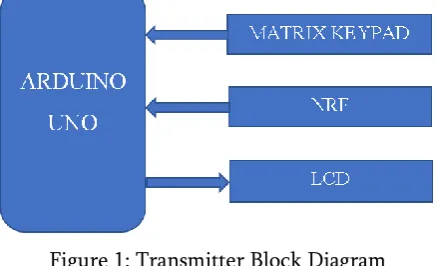
Figure 1: Transmitter Block Diagram
Figure 2: Receiver Block Diagram
C. Project Scope
There is a major scope in enhancing the visual experience by replacing paper menu with electronic menu card. To avoid delay in ordering process, wireless communication can be used here to replace the waiter who manually delivering the order to kitchen. Currently due to a increased literacy, awareness of advance communication technology among people, they are crazy about the latest technology and they are eager to automated their routine tasks. So introducing new technology and new approach in conventional food ordering system will lead to improved experience of a customer.
V.
SYSTEM DEVELOPMENTA. PIC Microcontroller
8051 is Complex instruction set based old Microcontroller. Some instructions require more than 1cycle. But PIC is a reduced instruction set and most
of the instructions execute in a single cycle. So PIC is faster than 8051 and it is rich in peripherals, consume less power, smaller pin count. So here in the proposed system PIC18F452 is used as the main processor for transmitting and receiving sections. The heart of the system is the PIC Microcontroller. The 40pin dip is used to control the activities of all other sections. PIC Microcontroller was selected due to its good features of being cheap and readily available in the market and it has inbuilt ADC port, PWM and different kinds of serial interface, such as USART, SPI, I2C, etc. Its operating voltage is 5v.This PIC Microcontroller will monitor & control all the peripheral devices or components connected to this unit.
B. Matrix keypad
The matrices are actually an interface technique. It can be used to interface inputs like the PC keyboard keys, but also to control multiple outputs like LEDs. According to this technique, the I/O are divided into two sections: the columns and the rows. You can imagine a matrix as an excel sheet. Here is a 4 x 4 matrix.
C. Graphical LCD
In this project 128*64 pixel graphic LCD is used. This graphical LCD provides the user a simple serial interface to a full range of control.The LCD shows the picture of the menu items. As the matrix keypad interfaced with LCD the item displayed in the LCD will be selected by pressing the matrix keypad
D. NRF
self controlled and completely transparent to user interface. The module can be embedded to your current design so that wireless communication can be set up easily.
VI.
WORKINGA. Transmitter Section
Transmitter section is used for ordering from the menu.
A 4X3 keypad is used to select the items. Four rows of the keypad are connected to PORT C of the microcontroller, while the three columns are connected to PORT D.
NRF transmitter is connected to the transmit and receive pins of the microcontroller. Here the transmitter pin of the microcontroller is connected to the transmitter of the NRF transmitter module. No need of connecting receive pin, as the module only transmits the data.
LCD is also connected in order to view the selected items. Here LCD is used in 4 bit mode.
B. Receiver Section
• The receiver section is connected in the kitchen.
• The order placed by the customer is received by the NRF receiver.
• In real one can form a NRF network in which single receiver is used to receive data from different transmitters
• Thus received data is decoded and is displayed on the LCD.
C. Algorithm
a.
Initialization of peripheral devices like LCD module & matrix keypad.b.
Initialization of serial port of UART of microcontroller at 9600 bit/sec.c.
Matrix keypad & LCD module with calibration Logical division of matrix keypadinto 9 locations.
d.
Wait till user tapping.e.
Get tapping coordinate X, Y & resolve the location that has tapped.f.
Generate a code for command based upon location & send to serial port.g.
Repeat the above all steps.E. Circuit Diagram
VII.
IMPLEMENTATIONHere in the proposed methodology implementation in the transmitter section is done using interfacing matrix keypad with LCD were menu icons are shown in LCD which can touched using matrix keypad interfaced to it and this is connected with the PIC microcontroller processor. Here NRF is used as a wireless communication device. Two switches are used in the transmitter section where the user have to press the red colour switch for placing new orders and another green colour switch must be pressed after placing the orders. After pressing the switch the selected orders will be sent to the kitchen section through the NRF module which attached to it. The matrix keypad, LCD, NRF and the 2 switches are connected to the PIC controller. This connected kit will be placed in user table. Then in the receiver section, NRF is used for wireless communication by receiving the information from the NRF used in the transmitter, LCD is used for displaying the orders in the kitchen section with the table number, relay circuit is used for controlling the movement of the conveyor belt in forward and reverse direction. Here 4 switches are used in a separate board where the chef has to press the switch if any ordered items are not present. These switches are used here because of demonstration 4 items are taken. Then the ordered items will be placed in the conveyor belt and sent to
the user table. Then in the billing section NRF is used for receiving the bill which is calculated by the PIC microcontroller present in the receiving section. The received bill will be display on the PC.
VIII.
CONCLUSIONIntegrating all the hardware components used has been developed in it. The presence of each and every module has been reasoned out and placed here very carefully, thus contributing to the best and efficient working of the unit. Secondly, using very highly advanced IC’s with the help of up growing technology, the project has been successfully developed and implemented. This project provides an efficient device that helps to all people, especially dumb/illiterate to communicate easily and also it is a user friendly device. This is our proposed system which reduces the cost of running the restaurant as it does not require any waiters. This project also helps in transforming the whole catering industry in the world. This system will help in reducing the waiting time of customer in the restaurants. It will also reduce manual service given by waiters and serving staff, and also eliminating the human mistakes.
IX.
REFERENCES1. Jeetender Singh Chauhan, Sunil Semwal," Microcontroller Based Speed Control of DC Geared Motor Through RS-232 Interface With PC ", International Journal of Engineering Research and Applications(IJERA) Vol. 3, Issue 1, January -February 2013, pp.778-783.
2. Sarat Kumar Sahoo, W. Razia Sultana," Matrix keypad based Speed Control of Single Phase Induction Motor ", International Journal of Engineering and Technology Vol.2 (6), 2010, 392-396.
4. VSridhar," Image based password authentication for illiterates with matrix keypad ", International Journal of Science, Engineering and Technology Research (IJSETR) Volume 1, Issue 3, September 2012.
5. Snehal S. Dambhare, Mangesh A. Pm:iane, Dhananjay M. Deore," Matrix keypad based menu ordering and displaying system for restaurants", International Journal of Computer Engineering and Technology Volume 3, Issue 2, July- September (2012), pp. 297-307.
6. NRF Alliance Document 053474r06, NRF Specification, Version 10, 2005.
7. Liu, C. L, Layland, J, ‘Scheduling algorithms for multiprogramming in a hard real - time environment,’ Journal of the ACM, vol. 20.
8. Hangci Zhou, Guangwen Wu, ‘the programming based on embedded real time operating system,’ Beijing: Beihang University press, 2006.