© 2018 IJSRST | Volume 4 | Issue 7 | Print ISSN: 2395-6011 | Online ISSN: 2395-602X Themed Section: Science and Technology
Improving Efficiency in High Dimensional Datasets Using Booster
Dharmavaram Maheshkumar1, Jasti Sireesha2
1Computer Science Deportment, Mallareddy Enginerring College(MREC), Hyderabad, Telangana, India
2Associate Professor, Computer Science Deportment, Mallareddy Enginerring College(MREC), Hyderabad,
Telangana, India ABSTRACT
The information retrieving in high dimensional data with the couple of recognitions is winding up more run of the mill, especially in microarray data. In the middle of the latest twenty years, heaps of doable/possible game plan Flows and FS calculations, this is higher for proposed to educated guess rightness, the result of an FS calculation with (thinking about/when one thinks about) desire (quality of being done perfectly or being totally correct) can be unsteady among the mixed groups of things in the readiness set, especially with high dimensional data. This paper recommends another (process of figuring out the worth, amount, or quality of something) count Q-measurement that combines the strength and health of the picked incorporate subset (even though there is the existence of) the estimate (quality of being very close to the truth or true number). By then and the (happening sometime in the future) (the) unavoidable, already-decided future of the Booster of an FS calculation that lifts the guess of Q-measurement of the count connected. (Related to watching or recording something) examinations show that Booster helped in the guess of the Q-measurement and also the desired (high) quality of the count connected unless the (teaches things) list is clearly very hard to suspect with the given calculation.
Keywords : Accuracy, Prediction algorithms, Redundancy, Q-statistic, FS, Booster
I.
INTRODUCTIONa The approach of different spaces of new application like online business and bioinformatics, social insurance and training excreta, underscores the require for investigating high dimensional information. In this manner mining high dimensional information is a convincing situation of excellent businesslike essentialness. Clearly, mining of information (every so often called information Feature Selection [1][2] (FS) is connected to decrease the quantity of highlights (characteristics) where information constitutes of numerous highlights. Verily choice process decreases the numerous highlights by expelling the unimportant and loud factors and in this manner makes the entire examinations more possible, precise and canonical
[11]. The vital disbenefit of FS is that it isn't perfect for homogeneous information. FS when connected to homogeneous datasets brought about inconstancy in stability [3].So proposed estimations are Q-statistic [5] and Booster with a classifier individually, which solidifies the steadiness of the highlights. Proposed framework gives the high gauge display as well as soundness is accomplished. The entanglements with the current framework and predominance of the proposed frameworks are talked about in this paper.
II.
EXISTING SYSTEM This is because of finding vital features in perspective of the discretized MI[9] are respectably clear.
When finding the correct[11] reasonable highlights particularly from the boundless records. These records are with high consistency through
using the tireless information is a great procedure[20].
Several inspects in perspective of resampling[15] system have been done to create unmistakable educational records.
For game plan issue and a segment of the examinations utilize resampling on the component space.
The inspirations driving each one of these examinations are on the estimate accuracy of collection without thought on the strength of the picked featured subset.
DRAWBACKS OF EXISTING SYSTEM:
Majority of the viable FS calculation [1] in multi-dimensional issues have utilized forward decision system yet not considered backward end procedure since it is nonsensical to execute backward end process with tremendous number of features.
A certifiable inalienable issue with forward assurance is, in any case, a flip in the decision of the basic segment may incite an absolutely uncommon component subset and along these lines the security of the picked incorporate set will be low despite the way that the decision may yield high precision[9].
Devising a beneficial technique to secure an all the more relentless part subset with high accuracy is a trying region of research.
III.
PROPOSED SYSTEM This paper proposes a Q-statistic[4] to survey the
execution of a FS with no less than one classifier.[13][14].
It is a blended calculative measure[5] of the estimate exactness of the classifier and the steadfastness at that particular point.
Proposes execution supporter on the decision inside the FS Algorithm is utilized.
The crucial idea of boosting an application is to obtain a couple of educational accumulations from exceptional instructive record by resampling[7] on test space.
At that point FS calculation is associated with each of these resampled educational indexes[7][12] to gain different component subsets.
The mix of subsets will be the segment subset got by the Booster of FS calculation.
Advantages of Proposed system:
Empirical contemplates exhibit that the Booster of a count helps the estimation of Q-statistic[9] and additionally the desire precision of the classifier associated.
Particularly, the execution of mRMR-Booster[19]was seemed, by all accounts, to be noteworthy both in the progressions of figure exactness and Q-statistic[4].
IV.
FEATURE SELECTIONstate that it is excess information generally the application will enter the patient points of interest into the database. There are 6500 datasets incorporated into the undertaking.
[14][17]Featuresincludesprovider_id,Hospital_name,A ddr,city,state,measure_startingdate,ending_date,meas ure_name,phone_number,Compared_national,Denom inator,Score,Lower_estimate,Higher_estimate,and Measure_id. The point of the task is to discover the demise rate of patients in the separate healing facilities.
V.
METHODOLOGYIn methodology the work process of the task going to be talked about. Here, the portrayal of the
accompanying advances are [1][11][14][15].
Firstly, gazing the procedure,
Loading the 6500 datasets.
In the third step if any duplication of information discovered then it is evacuated.
Feature Selection has two lay-offs for the most part Forward Selection and Backward Elimination.
Forward Selection includes the information where as it brings about dimensionality[5] issue. On the opposite side expelling of highlights is such a tricky errand and unrealistic with Backward Elimination.
Then solid redundancy [22] check is done .In this progression it de copies the information totally. Data gets grouped lastly assessed include choice is
acquired.
It for sure outcomes in exactness.
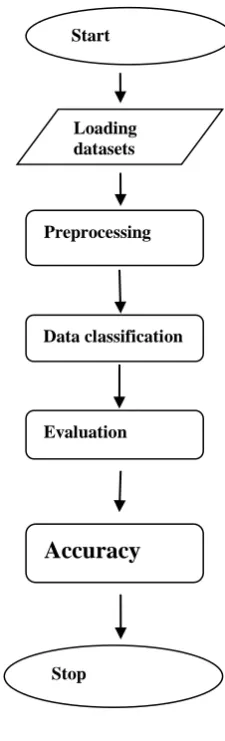
Fig 3.1. Workflow of the process
VI.
IMPLEMENTATIONIn this paper Booster set of computer instructions used for successful execution of the project. And based on the Booster set of computer instructions the testing and connected results are carried out.
Modules:
Dataset Collection
Feature Selection
Removing Irrelevant Features
Booster accuracy.
Modules Description: -Dataset Collection:
Start
Loading datasets
Preprocessing
Data classification
Evaluation
Accuracy
To gather as well as recover information about exercises, results, setting, and different (numbers that change/things that change). And the information is stored in the (computer file full of information). -Feature Selection:
This is a needed/demanded combination measure of the forecast (quality of being done perfectly or being totally correct) of the classifier and the dependability of the chose asked data. At that point, the paper proposes Booster on the strong desire/formal decision about something of highlight of the FS calculation is given to the subset. FS in high dimensional information needs preprocessing procedure to choose just significant highlights or to sift through unnecessary highlights. Removing Irrelevant Features: The unrelated/unimportant features are removed during the preprocessing step. The unrelated/unimportant features in this project are the entry of many records.
Booster accuracy:
The Booster of an FS calculation that lifts the guess of the Q-statistic of the calculation connected. Exact examinations because of manufactured information (based on actually seeing things) (acts of asking questions and trying to find the truth about something) (show or prove) that the Booster of a calculation supports the guess of Q-measurement as well as the forecast (quality of being done perfectly or being totally correct) of the classifier connected. The test/evaluation of the relative execution for the effectiveness of s-Booster of the first FS calculations in view of the forecast (quality of being done perfectly or being totally correct) and Q-statistic.Two Boosters, FAST-Booster, FCBF-Booster, and mRMR-Booster. MRMR-Booster improves (quality of being done perfectly or being totally correct) a lot: general (usual/ commonly and regular/ healthy) (high) quality. One (very interesting) focus to point here is that mRMR-Booster is many effective in the boosting the (quality of being done perfectly or being totally
correct).The FAST-Booster also improves (high) quality, mRMR is not high.
ALGORITHM:
Booster Algorithm: Booster b
Input: FS algorithm + Data Set + total number of partitions.
Output: Feature subset selected is V*
1. Split D into partitions
2. V*=0
3. for i=1 to b do
4. D-i = D-Di # remove Di from
5.V-i <- s(D-i) # obtain V-i by applying s on D-i
6. V*=V*u Vi
7 .end for
8. return V*
The workflow of the set of computer instructions starts:
The whole data is divided into dividing walls/walls off/sections.
If any (making copies of something/more than one person or company doing the same thing) happens then eliminates.
Then the strong unnecessary thing check is carried out.
If any (unexpected differences, missing things, or mistakes) then removed in 3rd step and Process ends.
VII.
Table and resultsVIII.
REFERENCES
1. Blurton, C. (2000). New Directions of ICT-Use in Education.United National Education Science and Culture Organization (UNESCO).
2. Chetia, B.(2015) “Technical Communication for Engineering Students-relevance in the Indian context” International Journal of Management and Applied Science, 1(2) 17-19.
3. Kent, Allen., (1997).Encyclopedia of Library and Information Science. New York: Marcel Dekkar. 19.
4. ToAnyakoha, M.W. (2005).Information and Communication Technology (ICT) in library services. Coal City Libraries, 2(1&2) 2-12.
5. Ahmad, N., & Fatima, N. (2009). Usage of ICT products and services for research in social sciences at Aligarh Muslim University. DESIDOC journal of Library and Information Technology, 29(2) 25-30.
6. Ebijuwa, A.A. (2005). Information and Communication Technology in university libraries: The Nigeria experience. Journal of Library and Information Science, 7(1&2) 23-30. 7. Khan, J. (2016). Impact of Information
Communication Technology on library users and its services. International Journal of Research – GRANTHAALAYAH, 4(9): 97-100.