© 2016 IJSRST | Volume 2 | Issue 6 | Print ISSN: 2395-6011 | Online ISSN: 2395-602X Themed Section: Science and Technology
Classification of Components in Software Engineering and Objectives of
Component Based Software Engineering
Ramu Vankudoth1, Dr. P. Shireesha2
1Research Scholar, Department of Computer Science, Kakatiya University, India 2Assistant Professor, Department of CSE, Kakatiya Institute of Technology and Science, India
ABSTRACT
The significance of Component Based advancement depend on its efficiency. It takes just a couple of minutes to construct the stereo system due to the fact that the components are created to be integrated easily. Although software is significantly a lot more intricate, it follows that component-based systems are simpler to assemble and also therefore much less costly to construct than systems constructed from distinct part. This paper concentrates on the facilities offered by the system for component classification, an essential method for recovering multiple-use software. It is shown that the inherently fragile as well as complicated procedure of classification is streamlined and considerably assisted in by incorporating it right into a broader documents setting and also, particularly, by attaching it with software static evaluation.
Keywords : Classification, Software Engineering, Components.
I.
INTRODUCTION
CBSD is a latest modern technology for the advancement the complex or big software system with the help of making use of the COTS software components or reusable components. For substantial big as well as barely intricate application, that time, some components or items need to be created separately specifically customized to the demand of the application and also some components are chosen from the 3rd party repositories. So CBSE is latest technology which is made use of to improve the reusability capability to pick the ideal software components from components.
Component-based software engineering (CBSE), also called components-based growth, is a branch of software engineering that highlights the splitting up of concerns relative to the comprehensive performance offered throughout a provided software system. It is a reuse-based strategy to defining, implementing as well as composing loosely combined
independent components into systems. This technique aims to bring about a similarly considerable degree of advantages in both the temporary and the lasting for the software itself and also for companies that sponsor such software.
Software engineering experts pertain to components as part of the beginning system for service-orientation. Components play this role, as an example, in web services, and a lot more just recently, in service-oriented architectures ( SOA), wherein a component is transformed by the internet solution into a solution and also ultimately inherits further attributes beyond that of an average component. Components can create or take in occasions as well as can be utilized for event-driven styles.
believed that encountering some troubles with traditional as well as OO standards inspire shift towards CBSE. CBSE emphasizes on structure system by recycling excellent quality configurable software components. This reduces its development price as well as time-to- market and makes sure higher dependability, boost efficiency, better maintainability; improve reliability and high quality by making use of reusability. This strategy, when a software system is going to be created, the implementation/coding needs to be completed from scratch. Object-Oriented Innovation, reusable software components have actually ended up being an essential part of shows language knowledge.
For large and also hardly intricate application, some components require to be established separately specifically customized to the requirement of the application as well as some components are selected from the 3rd party databases. So CBSE is newest modern technology which is primarily unbiased to boost the reusability performance with the growth of CBS from the COTS software components. This chapter offers a new optimum procedure to choose a subset of components for specific application domain or ideal components which fulfill the requirements of customer.
The inspiration for "developing systems from components" in CBSE comes from other engineering techniques, such as mechanical or electrical engineering, software style. The methods as well as modern technologies that develop the basis for component versions come from primarily from object-oriented layout and Design Interpretation Languages. Considering that software is in its nature various from the physical world, the translation of principles from the classic engineering self-controls into software is not unimportant. For example, the understanding of the term "component" has never ever been a problem in the classic engineering self-controls, because a component can be with ease
comprehended and also this understanding fits well with basic concepts as well as innovations. This is not the case with software. The notation of a software component is not clear: its intuitive understanding may be rather different from its version as well as its implementation. From the beginning, CBSE dealt with an issue to get an usual as well as a sufficiently accurate definition of a software component. An early and also possibly most frequently made use of definition coming from [1] (" A software component is a system of composition with contractually defined user interfaces as well as explicit context dependencies just. A software component can be released independently and also undergoes composition by third party") concentrates on characterization of software component. Despite its generality it was revealed that this definition is not valid for a variety of component-based technologies (for instance those which do not support contractually specified interface or independent release). In the interpretation of [2] (" A software component is a software element that conforms to a component model and also can be separately deployed and also made up without modification according to a make-up requirement"), the component interpretation is more general-- in fact a component is specified via the requirements of the component design.
II.
DEFINITION AND CHARACTERISTICS OF
COMPONENTS
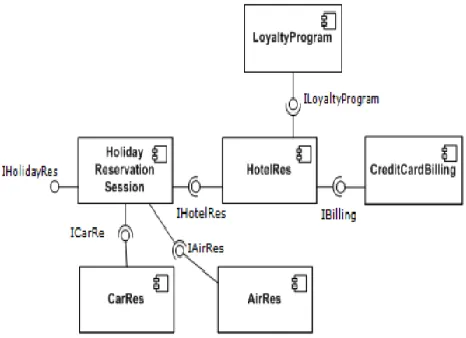
communicate with each other via interfaces. When a component uses services to the remainder of the system, it embraces a supplied interface that defines the services that components can use, as well as exactly how they can do so. This user interface can be seen as a trademark of the component - the client does not require to learn about the inner operations of the component (implementation) in order to take advantage of it. This principle causes components referred to as encapsulated. The UML illustrations within this short article stand for offered interfaces by a lollipop-symbol attached to the external side of the component
However, when a component requires to utilize another component in order to function, it takes on a made use of user interface that specifies the services that it requires. In the UML images in this article, used user interfaces are represented by an open socket sign connected to the external side of the component.
Figure 1 : Example of several software components
One more essential attribute of components is that they are substitutable, to make sure that a component can change another (at design time or run-time), if the follower component fulfills the requirements of the first component (shared through the user interfaces). As a result, components can be replaced with either an upgraded version or a choice without breaking the system in which the component operates. As a rule of thumb for engineers replacing components,
component B can right away replace component A, if component B gives at the very least what component A provided and utilizes no greater than what component A made use of.
Software components often take the form of items ( not courses) or collections of objects (from object-oriented shows), in some binary or textual type, adhering to some user interface description language ( IDL) to make sure that the component may exist autonomously from other components in a computer. Simply put, a component acts without changing its resource code. Although, the habits of the component's resource code may alter based on the application's extensibility, supplied by its writer.
When a component is to be accessed or shared throughout execution contexts or network web links, techniques such as serialization or marshalling are often utilized to deliver the component to its destination.
Reusability is a crucial attribute of a high-quality software component. Designers must create and execute software components as if several programs can recycle them. Additionally, component-based functionality testing must be considered when software components straight interact with users.
It takes significant effort and also understanding to create a software component that is efficiently recyclable. The component needs to be:
➢ fully recorded
➢ thoroughly evaluated
➢ durable - with thorough input-validity checking ➢ able to pass back proper error messages or return
codes
In the 1960s, programmers constructed scientific subroutine collections that were reusable in a wide selection of engineering as well as scientific applications. Though these subroutine collections reused distinct formulas in an efficient manner, they had a minimal domain name of application. Commercial sites routinely produced application programs from reusable components written in assembly language, COBOL, PL/1 as well as various other 2nd- and third-generation languages utilizing both system and customer application collections. As of 2010, modern multiple-use components encapsulate both information structures as well as the algorithms that are put on the information frameworks. Component-based software engineering builds on prior concepts of software objects, software architectures, software structures as well as software style patterns, as well as the comprehensive theory of object-oriented shows and also the object-oriented layout of all these. It declares that software components, like the idea of hardware components, made use of for example in telecommunications, [1] can inevitably be made interchangeable and reliable. On the other hand, it is argued that it is an error to concentrate on independent components rather than the structure (without which they would not exist).
Component-based software engineering (CBSE) is a procedure that emphasizes the layout and also construction of computer-based systems making use of recyclable software "components." Clements * CLE95+ explains CBSE in the following way: CBSE is changing the way huge software systems are created. CBSE embodies the "buy, don't construct" approach embraced by Fred Brooks and also others. In the same way that very early subroutines liberated the programmer from thinking of details, CBSE moves the emphasis from programs software to composing software systems. Execution has paved the way to assimilation as the emphasis. At its structure is the presumption that there suffices commonality in lots of
big software systems to validate developing recyclable components to exploit and please that commonality.
Component-based software growth technique is based on the suggestion to develop software systems by selecting ideal off-the-shelf components and then to assemble them with a well-defined software design.
III.
THE CLASSIFICATION FRAMEWORK
The regulations a component model defines for the layout and make-up of components cover various principles as well as hide lots of complicated execution devices. Furthermore, various component designs cover different phases in the component life cycle; while some sup- port just the modelling and layout stage, others support mainly the execution and run-time stages. Because of this, we can not merely list all possible component versions qualities, yet we group the characteristics according to their comparable issues as well as aspects. Beginning with these premises, we divide the fundamental qualities as well as principles of component versions right into the adhering to 3 measurements:
Life cycle. The life cycle dimension determines the assistance provided by a component version and the component develops throughout the life cycle of components. CBSE is defined by a separation of the growth processes of private components from the advancement procedure of the total system. A component life cycle covers stages from the component requirements up until its combination right into the systems as well as potentially its execution and replacement.
and the means of publications, i.e. communications in between the components.
Extra-Functional Properties. The extra-functional properties dimension identifies the centers a component version uses for the specs, administration and composition of extra-functional properties.
The Classification Scheme
Principles
Given a collection of entities (items, concepts) stood for by descriptors (key phrases), the collection of those entities right into disjoint courses according to some criterion of descriptor matching is called classification. Matching might express some kind of semantic resemblance. A classification plan determines how to carry out classification in an offered setup, prescribing the sets of descriptors and also feasible internal ordering, matching requirements, as well as rules for class task. Depending on the number of descriptors used, a classification plan can be uni- or multi-dimensional. An instance of a unidimensional system is the Universal Decimal Classification. In library science, multidimensional (faceted) classification, was introduced by [5], breaking down information right into a number of categories thus dealing with equivalent elements of the classified entities. These elements are called facets.
Prieto-Diaz and Freeman established a faceted classification scheme for software reuse in which they use 6 elements to define software: feature, things, medium/ representative, system type, practical area, and setup. They primarily define component performance, the last three elements referring to the internal and outside atmosphere. Each fac- et has a term room, i.e. a fixed set of legal values (ideas), in the sense of a regulated vocabulary, as well as an extensible collection of customer terms. Ideas are organized by a routed acyclic specialization
relationship, and terms are designated as leaves to ideas. Subjective theoretical distances in between ideas as well as terms are defined, to support recovering soft- ware components by their level of matching.
In the SIB classification system the REBOOT aspects are embraced, except that facets are appointed not necessarily to a class overall however, rather, to the pertinent parts. Specifically, the contents of the SIB classification facets are as complies with:
Abstraction
Abstraction terms are nouns standing for energetic object types. Commonly these abstractions suggest the duty that the item plays in its interactions with various other objects of an application. An object-oriented software course as a whole is designated an abstraction, such as 'String', 'Establish', 'Window System', 'Index' or 'NameList'. Abstraction terms do not consist of expressions that represent processing, such as 'String concatenation' or 'String conversion'. Given that object types are assumed to be active, the Abstraction terms do not reflect handling as a whole either (e.g. 'String adjustment').
Operation
Operation terms are spoken kinds representing specific tasks. The active part of a class comprises its techniques. Hence we associate Operation terms with each individual technique in charge of an activity, e.g. 'Solve', 'Invert', 'Lock-Unlock', 'Open-Close'. Sets of inverse buildings, such as 'Open-Close', are considered as one term, to maintain the term area little.
Operates-On
input/output gadgets, which might or may not be stood for as objects.) Operates-On terms are nouns standing for the object types acted upon by techniques, including Abstractions, standard information types as well as gadgets. Keep in mind that Operates-On is a superset of Abstraction which the abstraction of a course need to be a default 'Operates-On' for its own operations. Operates-On represents the role an object kind has fun with regard to various other types.
Dependency
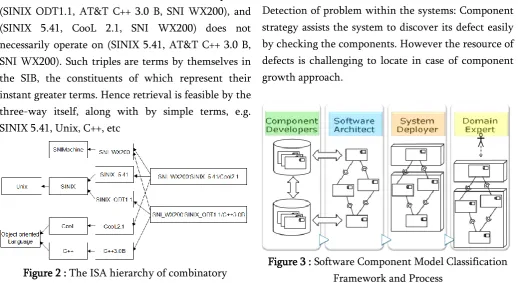
Dependency terms stand for environmental problems, such as equipment, operating system or language. It is good practice in software development teams to test and also launch full collections for a certain environment. As necessary we appoint Dependency terms to class collections all at once. The courses of the library are after that indirectly connected to a dependency through the collection itself. Each mix of programming language, system soft- ware and equipment forms a various environment. Dependency terms are provided in the SIB which reflect solitary environmental conditions, along with combinations of those. For instance, a collection tested, for example, on (SINIX ODT1.1, AT&T C++ 3.0 B, SNI WX200), and (SINIX 5.41, CooL 2.1, SNI WX200) does not necessarily operate on (SINIX 5.41, AT&T C++ 3.0 B, SNI WX200). Such triples are terms by themselves in the SIB, the constituents of which represent their instant greater terms. Hence retrieval is feasible by the three-way itself, along with by simple terms, e.g. SINIX 5.41, Unix, C++, etc
Figure 2 : The ISA hierarchy of combinatory Dependency terms
IV.
OBJECTIVES OF COMPONENT BASED
SOFTWARE ENGINEERING
The primary objectives of component based software engineering are given below.
Decrease of cost and time for constructing large and also challenging systems: major goal of Component based method is to develop complicated software systems making use of off the shelf component to make sure that the time to construct the software lessen substantially. The price efficiency of the current method can be assessed using function point or various other methods.
Improving the high quality of the software: The top quality of the software can be boosted by boosting the top quality of the component. Though the principle is not real as a whole. Often top quality of the assembled systems might not be directly related to high quality of the component in feeling that improving the quality of the component does not necessarily indicate the renovation of the systems.
Detection of problem within the systems: Component strategy assists the system to discover its defect easily by checking the components. However the resource of defects is challenging to locate in case of component growth approach.
With the advancement in technology and also the way software applications are programmed, a lot of software component designs have actually been seen in the last few decades. Each of such versions makes use of a various approach and also concepts. Each design has some certain goal; as a result, there are many resemblances along with differences among the different versions. Component based designs have actually relieved the process of software advancement; nevertheless the designs still encounter a difficulty in giving conventional principles. In order to give a far better understanding of the method, and also the potential differences in between various versions, we will talk about and also compare some basic concepts of component version with the help of a Component Design Classification Framework based upon the various concepts.
Component based software engineering (CBSE) is a known as well as evaluated technique in software engineering. The technique was inherited from the object based method. Furthermore, it includes the idea of middleware, software architectures and also Architecture Meaning Languages. The software engineering self-control was not component based till somebody took the inspiration from other branches of engineering like civil and also electrical to develop systems from components. It was challenging to make a straight change of principles of traditional engineering into software engineering. The term component was not as problematic for timeless engineering as its significance was well comprehended within the essential principles. However, with software engineering, there have been different presumptions on components. Ever since the evolvement of components in software engineering, CBSE has failed to define a clear concept of software components. Though there are various study operating in this field, the majority of them have actually struggled to bring out an usual understanding of the components.
According to Szyperski:
" A software component is a device of composition with contractually defined interfaces and specific context dependencies only. A software component can be released separately as well as is subject to make-up by 3rd party.". The declaration states a basic understanding of the strategy, however it does not capture a broader visualization of the idea. This has actually brought about some other presumptions as well as concept.
According to Heineman and Council:
" A software component is a software component that adapts a component version and also can be separately released and also composed without modification according to a composition standard."
The above declaration was in some way able to move presumptions to component designs from components. He further included by giving a full meaning of the component design. "A component version specifies a set of criteria for component implementation, naming, interoperability, customization, make-up, development, and also implementation".
It was extremely clear from the declaration that component version brings a collection of steps in a software advancement life cycle. The various phases in the entire development cycle consist of the adhering to actions.
V.
VARIOUS RULES REQUIRED TO
CONSTRUCT INDIVIDUAL COMPONENTS
health care, transportation, and so on. Nevertheless, there are other domain names based on particular technical systems like Java Beans, DCOM, etc
While applying different component designs, some offer versatility at the implementation degree while others implement some stringent rules to guarantee a system degree. This is the reason component based software engineering has actually been successfully carried out in big application domain names with each having their own collection of demands. Nevertheless, there are differences similar to ADLs, yet that could be only discovered at greater degree of abstraction. In order to comprehend the differences in execution, a structure has actually been proposed to understand the distinctions between numerous component models.
A framework aids in understanding the various software component versions based on the underlying key principles. It assesses the provided collection of demands in addition to the target application domain and after that makes a decision the compatibility of the component design. In addition, taking the essential offerings of a component design, it assists in developing of new component models. Given that, there are different phases of the advancement process, covering various series of modern technologies, a multidimensional framework is additionally needed, and also this can describe different functions of component versions. Such a structure has been used to check different component versions based on repetitive model of different actions, including observations, evaluation, classification, recognition. The observations and analysis consists of the research of essential principles as well as associated classifications of the component versions. The classification could be fine-tuned with a set of component designs. It was feasible with the growth of various component models like SaveCCM, ProCom, and Robocop in addition to the participation with sectors like Ericsson, Philips, Volvo, and Arcticus, where such versions were made use of. Additionally,
validation entails conversation with researchers, scholastic specialists, and CBSE professionals. Additionally, different component models can take responses based on the classification in the component versions. This has likewise resulted in a refinement of the framework.
VI.
CONCLUSION
Classification of software things is a time-consuming task. We say that the numerous derivation mechanisms provided in the SIB will certainly lower considerably the time required for classification. They additionally improve the uniformity of the code with the terms applied, particularly the upkeep of the used terms after updates of the software items. Both elements are necessary for the commercial usage of such a system. This paper is focussed on the centers used by the system for component classification.
VII.
REFERENCES[1]. Crnkovic, Larsson, Michel Chaudron Component-based Development Process and Component Life cycle, ABB Corporate Research , Vasteras, Sweeden
[2]. Jifeng, Xiaoshan Li, Zhiming Liu Component Based Software Engineering – The Need to Link Method and their Theories, UNU IIST Report No 330
[3]. Martin Wirsing, A Component Based Approach to Adaptive User-centric Pervasive, 13th International Symposium on Component Based Software Engineering, 2010
[4]. G. Kotonya, I. Sommerville and S. Hall, Towards A Classification Model for Component-Based Software Engineering Research, Proc. of the IEEE 29th EUROMICRO Conference, September 2003 [5]. Kung-Kiu Lau and Zheng Wang, Software
[6]. Stephen J. Mellor, Marc J. Balcer, Executable UML: A Foundation for Model-Driven Architecture, Addison-Wesley Professional, 2002 [7]. Hongyu Pei Breivold, Magnus Larsson, Component-Based and Service-Oriented Software Engineering: Key Concepts and Principles. Proc. of the 33rd IEEE EUROMICRO conference, SEAA 2007, pages, 13-20
[8]. H. J. Reekie, S. Neuendorffer, C. Hylands, and E. A. Lee. Software practice in the Ptolemy project. Technical Report GSRC-TR-1999-01, Gigascale Silicon Research Center, April 1999.
[9]. Anusha Medavaka, P. Shireesha, "Review on Secure Routing Protocols in MANETs" in "International Journal of Information Technology and Management", Vol. VIII, Issue No. XII, May-2015 ISSN : 2249-4510]
[10].Anusha Medavaka, P. Shireesha, "Classification Techniques for Improving Efficiency and Effectiveness of Hierarchical Clustering for the Given Data Set" in "International Journal of Information Technology and Management", Vol. X, Issue No. XV, May-2016 ISSN : 2249-4510] [11].Anusha Medavaka, P. Shireesha, "Optimal
framework to Wireless Rechargeable Sensor Network based Joint Spatial of theMobile Node" in "Journal of Advances in Science and Technology", Vol. XI, Issue No. XXII, May-2016 ISSN : 2230-9659]