Nat. Hazards Earth Syst. Sci., 9, 1815–1821, 2009 www.nat-hazards-earth-syst-sci.net/9/1815/2009/ © Author(s) 2009. This work is distributed under the Creative Commons Attribution 3.0 License.
Natural Hazards
and Earth
System Sciences
Relation between integral effect of sub-surface temperature
variation (I) and seismic effects
H. Jalal Kamali1, A. A. Bidokhti2, and H. Amiri1
1Physics Department, Shahid Bahonar University of Kerman, Kerman, Iran 2Geophysics Institute, University of Tehran, Tehran, Iran
Received: 23 August 2009 – Revised: 5 October 2009 – Accepted: 6 October 2009 – Published: 5 November 2009
Abstract. There will be a change in the Earth’s local sub-surface thermal structure before and/or after an earthquake. In this work we have introduced a new parameter (I) which relates integral effect of temperature variation and seismic activity. This parameter in its various forms integrates the temperature variations during one year before and after earth-quake. Some recent earthquakes are chosen throughout Iran on Alps-Himalayas fault zone with magnitudes 4.5 and more. Subsurface temperatures up to one meter depth measured in nearby weather stations are used as there is no deeper data available. We found the new defined parameter (I) has a direct relation with earthquakes magnitude (M) and reverse relation with distance (d) between earthquake focus and sta-tion in which temperature is measured. Suitable formulas for these relations are suggested regarding the magnitude ranges and time period with respect to the earthquake time. There may be a way to use this new parameter as a quake precursor.
1 Introduction
Earthquake prediction has always been an effect in many relevant researches, though there has been usually no desir-able results. This is because of the complicated behaviour of Earth’s mechanical and dynamical structure and a limita-tion of interior data. But there are reports on physical and even chemical variation during an earthquake which may re-lates many parameters to earthquake activities; e.g. changes in Radon flux (Ulomov and Mavashev, 1967), groundwa-ter flow (Yamaguchi and Otaka, 1978), electrical resistivity (Mazella and Morrison, 1974; Quian, 1985)), vertical move-ments (Mogi, 1982 and temperature variation related to tec-tonic activities (Notsu et al., 1980; Shimamura et al., 1985;
Correspondence to: H. Jalal Kamali
Kitagawa et al., 1996; Hamza, 1997, 1998, 2001; Rezapour et al., 2007). Thermal anomalies on time and places of earth-quakes are also reported by satellite studies with desirable resolution (Tronin, 1996, 2000; Tronin et al., 2002; Saraf and Choudhury, 2005; Chen et al., 2006).
In fact due to earthquake activities changes in Earth’s lo-cal sub-surface resistivity, electric and magnetic potentials, Radon gas, stress and strain, friction, water flow and so on altogether cause change in local thermal structure. No matter how much each may affects the temperature, but the integration of their effects in time of earthquake can have some effect on sub-surface temperature. The key question is whether there is a parameter relating this thermal anomaly to the earthquake parameters. Here by introducing a parameter we test the seismic thermal anomaly for some earthquakes in Iran.
2 TheI parameter
Due to a shortage of data especially deep soil and water temperatures, the nearest earthquakes to weather stations are chosen. In these stations soil temperatures are measured only up to a maximum one meter. To define the parameterI by which the variation of temperature (caused by earthquake activities) relates to the quake parameters the deadly Bam earthquake, south-east of Iran is chosen. This earthquake of magnitude 6.5 happened on 26 December 2003 and killed close to 40 000 people.
1816 H. Jalal Kamali et al.: Relation between I and seismic effects
(a)
2
but the integration of their effects in time of earthquake can have some effect on sub-surface
temperature. The key question is whether there is a parameter relating this thermal anomaly to
the earthquake parameters. Here by introducing a parameter we test the seismic thermal anomaly
for some earthquakes in Iran.
2. The I parameter
Due to a shortage of data especially deep soil and water temperatures, the nearest earthquakes
to weather stations are chosen. In these stations soil temperatures are measured only up to a
maximum one meter. To define the parameter I by which the variation of temperature (caused by
earthquake activities) relates to the quake parameters the deadly Bam earthquake, south-east of
Iran is chosen. This earthquake of magnitude 6.5 happened on 26 Dec. 2003 and killed close to
40,000 people.
Sub-surface temperatures measured in Bam weather station indicate that surface and
atmospheric conditions have a smooth influence on deep temperatures (Fig. 1-a) though the city
is situated the desert. For more stability the time is chosen about sun rise (03:00 UT)
during
November 2002, a year before the earthquake. The nine years average temperature at one meter
depth (T
av) with consideration of seasonal effects has a smooth sine like graph (Fig. 1-b).
(a) (b)
Fig. 1: a) Temperature variation at 5, 10, 20, 30, 50 and 100 centimeter depth at 03:00 UT during November 2002. b) A nine years average temperature at one meter depth in Bam
Annual variation of temperature in this graph is due to heat conduction from the surface
according to the Fourier’s law;
= −(
⁄ )
(1)
0 5 10 15 20 25 30
10 15 20 25 30 35 40 T ( c ) Time (day) 100 cm 50 cm 30 cm 20 cm 10 cm 5 cm Bam (Nov.2002)
30 60 90 120 150 180 210 240 270 300 330 360
15 20 25 30 35 40 Bam, T
av (1996-2005)
Ta
v
(
c
)
Time (day) Tav
(b)
2
but the integration of their effects in time of earthquake can have some effect on sub-surface
temperature. The key question is whether there is a parameter relating this thermal anomaly to
the earthquake parameters. Here by introducing a parameter we test the seismic thermal anomaly
for some earthquakes in Iran.
2. The I parameter
Due to a shortage of data especially deep soil and water temperatures, the nearest earthquakes
to weather stations are chosen. In these stations soil temperatures are measured only up to a
maximum one meter. To define the parameter I by which the variation of temperature (caused by
earthquake activities) relates to the quake parameters the deadly Bam earthquake, south-east of
Iran is chosen. This earthquake of magnitude 6.5 happened on 26 Dec. 2003 and killed close to
40,000 people.
Sub-surface temperatures measured in Bam weather station indicate that surface and
atmospheric conditions have a smooth influence on deep temperatures (Fig. 1-a) though the city
is situated the desert. For more stability the time is chosen about sun rise (03:00 UT)
during
November 2002, a year before the earthquake. The nine years average temperature at one meter
depth (T
av) with consideration of seasonal effects has a smooth sine like graph (Fig. 1-b).
(a) (b)
Fig. 1: a) Temperature variation at 5, 10, 20, 30, 50 and 100 centimeter depth at 03:00 UT during November 2002. b) A nine years average temperature at one meter depth in Bam
Annual variation of temperature in this graph is due to heat conduction from the surface
according to the Fourier’s law;
= −(
⁄ )
(1)
0 5 10 15 20 25 30
10 15 20 25 30 35 40 T ( c ) Time (day) 100 cm 50 cm 30 cm 20 cm 10 cm 5 cm Bam (Nov.2002)
0 30 60 90 120 150 180 210 240 270 300 330 360
15 20 25 30 35 40 Bam, T
av (1996-2005)
Ta
v
(
c
)
Time (day) Tav
Fig. 1. (a) Temperature variation at 5, 10, 20, 30, 50, and 100 cm
depth at 03:00 UT during November 2002. (b) A nine years average temperature at one meter depth in Bam.
Annual variation of temperature in this graph is due to heat conduction from the surface according to the Fourier’s law;
H= −k
∂T
∂z
(1)
∂T
∂t =κ
∂2T ∂z2
!
(2)
whereH is the ground heat flux, T temperature, k coeffi-cient of thermal conductivity,κ=k/ρcis thermal diffusivity,
ρdensity andcis specific heat. These, subjected to a sinu-soidal heat wave at the surface (with amplitudeTs) lead to relations for temperature at different depths and also surface heat flux;
T (z,t )=T+Tsexp
− z
D0
cosωt− z D0
(3)
Hz=0=ρc(κω)1/2cos
ωt+π
4
(4)
whereT=T (z→∞), ω is wave angular frequency of heat wave,t is time andD0=(2κ/ω)1/2is damping depth (Arya,
(a)
3
(
⁄ ) = (
⁄
)
(2)
where H is the ground heat flux, T temperature, k coefficient of thermal conductivity,
=
⁄
is thermal diffusivity,
density and
is specific heat. These, subjected to a sinusoidal heat wave
at the surface (with amplitude T
s) lead to relations for temperature at different depths and also
surface heat flux;
(, ) = +
exp(− ′) cos( − ′)
⁄
⁄
(3)
= ()
! ⁄cos ( + # 4)
⁄
(4)
where
= ( → ∞)
,
is wave angular frequency of heat wave, t is time and
′ = (2 )
⁄
! ⁄is damping depth (Arya 1998). D' is the damping depth for daily temperature variation if rather
small, typically 0.1 to 0.15 m. So that the surface heat wave due to daily variation damps very
quickly below the surface. Hence any changes in temperature in deeper parts are not due to short
period surface heat wave.
We will therefore work on temperatures at one meter depth. To eliminate seasonal effects we
detrend the record and hence acquire
∆ = −
)*which is a better indicator, where T is
temperature at one meter depth at the time t and T
avis the daily mean trend temperature for nine
years at the same depth (Fig. 2). One reason for the change of
∆
may be seismic activities
especially during time period of around of an earthquake. For example, considerable
∆
anomaly
can be seen during the time period of Bam (26 Dec. 2003) earthquake (Fig. 2). There is an
advantage here that this temperature anomaly consists of the integrated effects of all physical
processes that may change due to the seismic activities and affect the sub-surface temperature.
(a) (b)
Fig. 2: a) T (temperature) and Tav (nine years daily average temperature) versus time (t) during 2003-2004 one
year before and a year after Bam disaster that is shown by ∗. b) ∆ versus time in same period as 2-a, M is earthquake magnitude, D focus depth (hypocenter) and R' is the epicentral distance to the weather station.
0 90 180 270 360 450 540 630 720
15 20 25 30 35
40 Bam (2003-2004), R'< 4 km, D=13 km
Ta
v
(
c)
Time (day)
Tav T M 0 1 2 3 4 5 6 7 Mag.
0 90 180 270 360 450 540 630 720
-3 -2 -1 0 1 2 3 4 ∆∆∆∆ T
Time (day)
T-Tav M 0 1 2 3 4 5 6 7 Mag.
Bam (2003-2004), R'<4km, D=13km
(b)
3
( ⁄ ) = ( ⁄ ) (2)
where H is the ground heat flux, T temperature, k coefficient of thermal conductivity, = ⁄
is thermal diffusivity, density and is specific heat. These, subjected to a sinusoidal heat wave
at the surface (with amplitude Ts) lead to relations for temperature at different depths and also
surface heat flux;
(, ) = + exp(− ′) cos( − ′)⁄ ⁄ (3)
= ()! ⁄ cos ( + # 4)⁄ (4)
where = ( → ∞), is wave angular frequency of heat wave, t is time and ′ = (2 )⁄ ! ⁄
is damping depth (Arya 1998). D' is the damping depth for daily temperature variation if rather small, typically 0.1 to 0.15 m. So that the surface heat wave due to daily variation damps very quickly below the surface. Hence any changes in temperature in deeper parts are not due to short period surface heat wave.
We will therefore work on temperatures at one meter depth. To eliminate seasonal effects we
detrend the record and hence acquire ∆ = − )* which is a better indicator, where T is
temperature at one meter depth at the time t and Tav is the daily mean trend temperature for nine
years at the same depth (Fig. 2). One reason for the change of ∆ may be seismic activities
especially during time period of around of an earthquake. For example, considerable ∆ anomaly
can be seen during the time period of Bam (26 Dec. 2003) earthquake (Fig. 2). There is an advantage here that this temperature anomaly consists of the integrated effects of all physical processes that may change due to the seismic activities and affect the sub-surface temperature.
(a) (b)
Fig. 2: a) T (temperature) and Tav (nine years daily average temperature) versus time (t) during 2003-2004 one
year before and a year after Bam disaster that is shown by ∗. b) ∆ versus time in same period as 2-a, M is earthquake magnitude, D focus depth (hypocenter) and R' is the epicentral distance to the weather station.
0 90 180 270 360 450 540 630 720
15 20 25 30 35
40 Bam (2003-2004), R'< 4 km, D=13 km
Ta
v
(
c)
Time (day)
Tav T M 0 1 2 3 4 5 6 7 Mag.
0 90 180 270 360 450 540 630 720
-3 -2 -1 0 1 2 3 4 ∆∆∆∆ T
Time (day)
T-Tav M 0 1 2 3 4 5 6 7 Mag.
Bam (2003-2004), R'<4km, D=13km
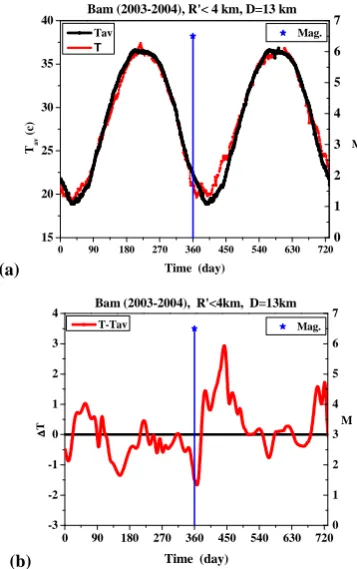
Fig. 2. (a)T (temperature) andTav(nine years daily average
tem-perature) versus time (t) during 2003–2004 one year before and a year after Bam disaster that is shown by∗. (b)1T versus time in same period as 2a,M is earthquake magnitude,Dfocus depth (hypocenter) andR0is the epicentral distance to the weather sta-tion.
1998). D0is the damping depth for daily temperature varia-tion if rather small, typically 0.1 to 0.15 m. So that the sur-face heat wave due to daily variation damps very quickly be-low the surface. Hence any changes in temperature in deeper parts are not due to short period surface heat wave.
We will therefore work on temperatures at one meter depth. To eliminate seasonal effects we detrend the record and hence acquire1T=T−Tav which is a better indicator, whereT is temperature at one meter depth at the timet and
Tavis the daily mean trend temperature for nine years at the same depth (Fig. 2). One reason for the change of1T may be seismic activities especially during time period of around of an earthquake. For example, considerable1T anomaly can be seen during the time period of Bam (26 December 2003) earthquake (Fig. 2). There is an advantage here that this temperature anomaly consists of the integrated effects of all physical processes that may change due to the seismic activities and affect the sub-surface temperature.
H. Jalal Kamali et al.: Relation between I and seismic effects 1817
(a)
4
In order to compare the temperature variation due to seismic processes with ones resulting
from seasonal fluctuations and other effects, the Fourier filtering applied to the T (quake year
temperatures) and Tav functions and their frequency spectrum obtained. Comparison showed that
the relative amplitude of the spectrum components corresponding to the short-term variations in the quake year is greater than ones associated with seasonal fluctuations that have a longer
period. As an example, Fig. 3depicts this analysis for Ardabil intense quake (28 Feb. 1997 with
magnitude 0f 6.1). Part (a) of fig. 3 shows the temperature variation among the year of
earthquake passed through a low pass Fourier filter. Fig. 3-b shows the Fourier transform of T expressed as the amplitude of its frequency components relative to the ones of the Fourier
transform of the mean annual temperature signal (Tav). It is evident from the spectrum that the
components which, regarding their periods, could be attributed to seismic effects are one or two order of magnitudes larger than ones due to seasonal fluctuations that have a distinct and larger period (lower frequencies). This can be considered as a confirmation of the proposition that around the time of earthquake there is a distinguishable subsurface temperature variation.
(a) (b)
Fig. 3: a) Filtered temperature variation with time during the year of earthquake for Ardabil quake (28 Feb. 1997,
with magnitude of 6.1). b) Fourier transform of T signal relative to the Fourier transform of Tav for this earthquake.
To find the relation between this temperature anomaly and the seismic activities the
integration of ∆() function (such as Fig. 2-b) is used. We have used time period of a year
before and one after the earthquake for the symmetry of seasonal effects on both side of the main
quake time (tq). This may also take account of the whole physical parameters contribution in
thermal energy variation and all shocks in an earthquake. There upon we can define Ib , Ia and Iba
as integration on time periods of before, after and whole time as;
+,= - ∆().
/0
1234 (5)
+)= - ∆().
5234
/0 (6)
0.00 0.05 0.10 0.15 0.20 0.25 0.30 0.35 0.40 0.45 0.50 0 10 20 30 40 50 60 AT / AT (a v )
Frequency (1/day)
Ardabil , M=6.1 , 1997
0 30 60 90 120 150 180 210 240 270 300 330 360 -3 -2 -1 0 1 2 3 ∆Τ∆Τ∆Τ∆Τ
Time (day)
Filtered (∆T) Ardabil (1997)
(b)
4
In order to compare the temperature variation due to seismic processes with ones resulting
from seasonal fluctuations and other effects, the Fourier filtering applied to theT (quake year
temperatures) and Tav functions and their frequency spectrum obtained. Comparison showed that
the relative amplitude of the spectrum components corresponding to the short-term variations in the quake year is greater than ones associated with seasonal fluctuations that have a longer
period. As an example, Fig. 3depicts this analysis for Ardabil intense quake (28 Feb. 1997 with
magnitude 0f 6.1). Part (a) of fig. 3 shows the temperature variation among the year of
earthquake passed through a low pass Fourier filter. Fig. 3-b shows the Fourier transform of T expressed as the amplitude of its frequency components relative to the ones of the Fourier
transform of the mean annual temperature signal (Tav). It is evident from the spectrum that the
components which, regarding their periods, could be attributed to seismic effects are one or two order of magnitudes larger than ones due to seasonal fluctuations that have a distinct and larger period (lower frequencies). This can be considered as a confirmation of the proposition that around the time of earthquake there is a distinguishable subsurface temperature variation.
(a) (b)
Fig. 3: a) Filtered temperature variation with time during the year of earthquake for Ardabil quake (28 Feb. 1997,
with magnitude of 6.1). b) Fourier transform of T signal relative to the Fourier transform of Tav for this earthquake.
To find the relation between this temperature anomaly and the seismic activities the
integration of ∆() function (such as Fig. 2-b) is used. We have used time period of a year
before and one after the earthquake for the symmetry of seasonal effects on both side of the main
quake time (tq). This may also take account of the whole physical parameters contribution in
thermal energy variation and all shocks in an earthquake. There upon we can define Ib , Ia and Iba
as integration on time periods of before, after and whole time as;
+,= - ∆().
/0
1234 (5)
+)= -/52340 ∆(). (6)
0.00 0.05 0.10 0.15 0.20 0.25 0.30 0.35 0.40 0.45 0.50 0 10 20 30 40 50 60 AT / AT (a v )
Frequency (1/day)
Ardabil , M=6.1 , 1997
0 30 60 90 120 150 180 210 240 270 300 330 360 -3 -2 -1 0 1 2 3 ∆Τ∆Τ∆Τ∆Τ
Time (day)
Filtered (∆T) Ardabil (1997)
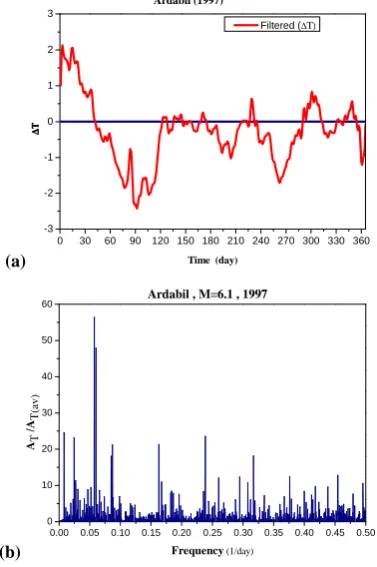
Fig. 3. (a) Filtered temperature variation with time during the year
of earthquake for Ardabil quake (28 February 1997, with magnitude of 6.1). (b) Fourier transform ofT signal relative to the Fourier transform ofTavfor this earthquake.
spectrum obtained. Comparison showed that the relative am-plitude of the spectrum components corresponding to the short-term variations in the quake year is greater than ones associated with seasonal fluctuations that have a longer pe-riod. As an example, Fig. 3 depicts this analysis for Ard-abil intense quake (28 February 1997 with magnitude of 6.1). Part (a) of Fig. 3 shows the temperature variation among the year of earthquake passed through a low pass Fourier filter. Figure 3b shows the Fourier transform ofT expressed as the amplitude of its frequency components relative to the ones of the Fourier transform of the mean annual temperature signal (Tav). It is evident from the spectrum that the components which, regarding their periods, could be attributed to seismic effects are one or two order of magnitudes larger than ones due to seasonal fluctuations that have a distinct and larger pe-riod (lower frequencies). This can be considered as a confir-mation of the proposition that around the time of earthquake there is a distinguishable subsurface temperature variation.
To find the relation between this temperature anomaly and the seismic activities the integration of1T (t )function (such as Fig. 2b) is used. We have used time period of a year before and one after the earthquake for the symmetry of seasonal ef-fects on both side of the main quake time (tq). This may also
take account of the whole physical parameters contribution in thermal energy variation and all shocks in an earthquake. There upon we can defineIb,Ia, andIba as integration on time periods of before, after and whole time as;
Ib=
Z tq
−365
1T (t )dt (5)
Ia=
Z +365
tq
1T (t )dt (6)
Iba=
Z +365
−365
1T (t )dt (7)
wheretq=0.
3 Data analysis
Seventeen earthquakes with magnitude of 4.5 and larger (1996–2005) are selected (Table 1) all over Iran plateau (Fig. 4) in a manner to find meteorological data stations nearby. Table 1 consists of earthquakes specifications includ-ing locus, date, magnitude (Mag.) and hypocentral depth (D) with sites of data stations.
Some 62 000 temperature data at different soil depths measured by 17 weather stations near epicenters are anal-ysed. Graphs of f (1T ,t )functions for all 17 earthquakes are drawn. Distances from stations to epicenters (R0) and to hypocenters (d) are calculated by plane and spherical geom-etry. The Hayford geoid mean radius (6376.65 km) for Iran is used. The resulted values ofI parameter,R0andd for all these earthquakes are tabulated in Table 2.
In this table two key variable parametersdandMaffectI. A logical assumption is direct relationship ofI withMand in reverse withd. Therefore, as a first step the variations of
Iba/Mis plotted with respect to 1/d(orIversusM/d). This is shown in Fig. 5 indicating a meaningful relation. A marked point in this graph is the separation of intense earthquakes,
M>5.8 (shown by squares) from small ones, 4.5<M<5.3 (shown by circles). This may indicates that there is a more meaningful relationship ofI withMthand.
The best fit for the graph (Fig. 5) confirms the accuracy of our assumption thatI∝(M/d), among many attempts. In addition, there is a better correlation between points related to the large earthquakes as it was expected. This is due to the fact that larger earthquakes have probably more effects on temperature variation and cause larger thermal anomalies. Thereafter we study two groups of earthquakes separately. 3.1 Intense earthquakes (M>5.8)
1818 H. Jalal Kamali et al.: Relation between I and seismic effects
Table 1. Earthquakes with magnitude of 4.5 and larger happened in Iran 1996–2005 selected for this study with sites of data stations.
No. City Lon. Lat. Date Mag. D Lon. Sta. Lat. Sta. (km)
1 Ardabil 48.07 38.11 28 Feb 1997 6.1 12 48.283 38.25 2 Bam 58.38 29.08 26 Dec 2003 6.5 13 58.35 29.1 3 Bandare Daier 51.69 27.8 13 Sep 2000 5 15 51.93 27.83 4 Bushehr 51.17 28.9 2 Mar 2004 5.1 15 50.83 28.98 5 Dehloran 46.99 32.86 26 May 1997 4.6 20 47.27 32.68 6 Ghaen 59.43 33.92 25 Jun 1997 5.9 17 59.17 33.72 7 Jiroft 57.7 28.46 25 May 1999 4.5 30 57.8 28.58 8 Kahnouj 57.72 27.98 6 Jul 2003 5 22 57.7 27.97 9 Kangan Jam 52.26 27.66 15 Feb 2004 4.6 15 52.22 27.49 10 Kashmar 58.21 35.24 2 Feb 2000 5.3 23 58.47 35.2 11 Kermanshah 47.35 34.49 24 Apr 2002 4.8 25 47.15 34.35 12 Khoor Birjand 58.2 33.13 19 Jun 2005 5.2 15 58.43 32.93 13 Lordegan 50.83 31.62 15 Jun 1998 5.2 25 50.82 31.52 14 Mianeh 47.8 37.35 26 Sep 2005 4.8 16 47.7 37.45 15 Nehbandan 59.8 31.55 23 Oct 2000 5.3 37 60.03 31.53 16 Torbate Jam 60.75 35.41 3 Jul 2003 5.2 15 60.58 35.25 17 Zarand 56.76 30.8 22 Feb 2005 6.4 14 56.57 30.8
Fig. 4. Sites of earthquakes (Table 1) on Iran’s map.
Ia, andIba). In this graph the Bam earthquake has the closest epicentral distance (R0=3.7 km) to the Bam weather station (Table 2). Eliminating the Bam earthquakes from Fig. 6a leads to a better correlation between the other three earth-quakes in this group (Fig. 6b).
The best fitting point for these three (Ardabil, Ghaen and Zarand) earthquakes is nearly straight lines with coefficient of determinationR2=1. A considerable point in these two
H. Jalal Kamali et al.: Relation between I and seismic effects 1819
Table 2. CalculatedIparameters, epicentral (R0) and hypocentral (d) distances together with magnitude (Mag) and hypocentral depths (D) of earthquakes in Table 1.
No. City Mag R0 D d Ib Ia Iba
(km) (km) (km)
1 Ardabil 6.1 24.6 12 27.1 −139.8 −194.9 −334.7 2 Bam 6.5 3.7 13 13.5 −87.7 177.2 89.5 3 Bandare Daier 5 23.8 15 28.2 251.8 34.8 286.5 4 Bushehr 5.1 34.2 15 37.4 94.2 −188.5 −94.3 5 Dehloran 4.6 32.9 20 38.5 6.9 −269.9 −263.1 6 Ghaen 5.9 32.7 17 36.9 −284 −296.9 −580.9 7 Jiroft 4.5 16.5 30 34.3 −21.5 93.9 72.4 8 Kahnouj 5 2.3 22 22.1 268.6 199.3 468 9 Kangan Jam 4.6 19.3 15 24.4 157.3 172.7 330 10 Kashmar 5.3 24 23 33.3 53.4 97.7 151.1 11 Kermanshah 4.8 24.1 25 34.7 185.9 −64.8 121.1 12 Khoor Birjand 5.2 30.9 15 34.3 −343.4 169.6 −173.8 13 Lordegan 5.2 11.2 25 27.4 −88.6 213.5 125 14 Mianeh 4.8 14.2 16 21.4 52.5 306.8 359.3 15 Nehbandan 5.3 21.9 37 43 120.3 117.3 137.6 16 Torbate Jam 5.2 23.5 15 27.9 −5.1 119.4 114.3 17 Zarand 6.4 18.1 14 22.9 −102.3 −63.5 −165.8
Fig. 5. Graph ofIba variation withMand d, magnitude and
di-rect distance station to hypocenter (Table 2). Larger earthquakes (M>5.8) are shown by squares and small ones by circles.
3.2 Small earthquakes (4.5<M<5.3)
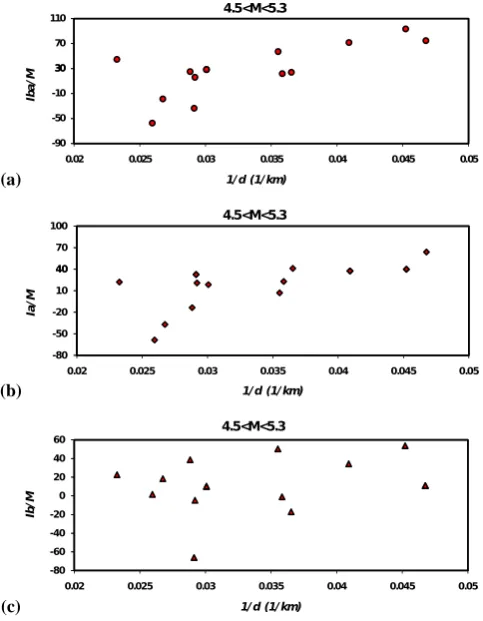
Earthquakes studied in the range of magnitude 4.5 to 5.3 (Ta-ble 2) are Bandare Daier, Bushehr, Dehloran, Jiroft, Kahnouj, Kangan Jam, Kashmar, Kermanshah, Khoor Birjand, Lorde-gan, Mianeh, Nehbandan, and Torbate Jam. TheIparameter in this group is also related toM/d, although not as clearly as the intense group (Fig. 7). The correlation is much better forIa (and henceIba) as is expected. This is due to more energy release and considerable temperature variation after earthquake than before. This also indicates the difference betweenIaandIbas the indication of thermal variation after and before earthquakes.
(a)
(b)
Fig. 6. (a) Graphs of (Ib, Ia, Iba) versusM/d for earthquakes
with magnitude larger than 5.8. The lines formula and coefficient of correlation (R2) are shown. (b) Same as (a) with elimination of Bam earthquake (from fitting procedure).
1820 H. Jalal Kamali et al.: Relation between I and seismic effects
(a)
(b)
(c)
Fig. 7. Same as Fig. 6 for earthquakes of 4.5<M<5.3.
4 Conclusions
Despite the variant surface conditions it seems seismic activ-ities affect sub-surface temperatures as shallow as one me-ter up to some distances from epicenme-ters. Data temperature from the nearest weather stations to 17 earthquake epicen-ters all over Iran plateau indicate considerable temperature deviation from long period average values (1T=T−Tav) in time of earthquakes. There appears that at least for some earthquake as Bam which occurred in winter time there is a reduction in temperature before the quake. If water table be-fore the quake is lowered due to seismic effects, colder near surface air may inter the ground through the pores and leads to temperature drop. After the quake the reverse could occur as we have a temperature rise. These require further study.
A new parameterI as the integration of1T (t )on time periods around earthquake time is defined. It is shown thatI
is logically related to seismic parameters. Data analysis in-dicates a direct relation ofIwithM(earthquake magnitude) and inverse relation withd(distance to hypocenter). We sug-gest the following suitable formula for Iran plateau to relate
Table 3. Values ofα,βandR2for earthquakes ofM>5.8 shown in Fig. 6a including catastrophic Bam earthquake (+) and Fig. 6b without Bam earthquake (–).
Diagram Bam α β R2
earthquake
Ib/Mvs. 1/d – 1992 −100.5 0.957 Ia/Mvs. 1/d – 2402 −116.9 0.974 Iba/Mvs. 1/d – 4397 −217.5 1
Ib/Mvs. 1/d + 585.2 −51.72 0.558 Ia/Mvs. 1/d + 1620 −89.84 0.965 Iba/Mvs. 1/d + 2205 −141.5 0.889
thermal variations to seismic parameters;
I
M=α
1
d
+β (8)
or
I (T ,t )=αM
d +βM (9)
whereα andβ values are defined in Table 3 depending on time periods with respect to earthquakes time (Ib, Ia and
Iba). The coefficient of determinationR2 close to one in-dicates a good certainty of relations. Further studies may concentrate on deeper temperature data for more accuracy and better correlation. Furthermore we may try to find that whether there is a way thatIb as a pre-earthquake thermal anomaly indicator can be used as a precursor.
Acknowledgements. The seismological and meteorological data
used in this work were obtained through kindly help of the Interna-tional Institute of Earthquake Engineering and Seismology (IIEES) and Islamic Republic of Iran’s Meteorological Organization (IRIMO), respectively.
Edited by: M. E. Contadakis
Reviewed by: O. Molchanov and L. Telesca
References
Arya, S.: Introduction to Micrometeorology, Academic Press, 1998. Chen, H., Parnel, J., and Gang, Z.: Large-scale seismic thermal anomaly linked to hot fluid expulsion from a deep aquifire, J. Geochem. Explor., 89, 53–56, 2006.
Hamza, V. M.: Thermal anomalies induced by tectonic fluid flows: a method of investigating physical processes in earthquake source regions, Bull. Seismol. Assoc. Far east, 3, 60–84, 1997. Hamza, V. M.: Models of short-lived thermal pulses generated by
H. Jalal Kamali et al.: Relation between I and seismic effects 1821
Hamza, V. M.: Tectonic leakage of fault bounded aquifers subject to non-isothermal recharge:a mechanism generating thermal, Phys. Earth Planet. In., 126, 163–177, 2001.
Kitagawa, Y., Koizumi, N., and Tsuskuda, T.: Comparision of post-seismic groundwater temperature changes with earthquake-induced volumetric strain release: Yudani hot spring, Japan, Geophys. Res. Lett, 23, 3147–3150, 1996.
Mazella, A. and Morrison, F.: Electrical resistivity variations asso-ciated with earthquakes on the San Andreas fault, Science, 185, 855 pp., 1974.
Mogi, K.: An interpretation of leveling data before the Niigata eartquake of 1964, Japan, J. Seismol. Soc. Jpn., 35, 478–482, 1982.
Notsu, K., Abiko, T., and Wakita, H.: Co-seismic temperature change of well water related to volcanic activities of the Usu vol-cano, J. Phys. Earth, 28, 617–624, 1980.
Quian, J.: Regional study of the anomalous change in apparent re-sistivity before the Tangshan earthquake (m=7.8, 1976) in China, Pure Appl. Geophys., 122, 901–920, 1985.
Rezapour, N., Bidokhti, A., and Fattahi, M.: Study of some relation-ship between thermal properties of the ground and earthquake ac-tivity in Alborz region, in: International earthquake symposium Kocaeli, Turkey, 2007.
Saraf, A. K. and Choudhury, S.: Thermal Remote Sensing Tech-nique in the Study of Pre-Earthquake Thermal Anomalies, J. Ind. Geophysics, 9, 197–207, 2005.
Shimamura, H., Ino, M., Hikawa, H., and Iwasaka, T.: Groundwater micro-temperature in earthquake regions, Pure Appl. Geophys., 122, 933–946, 1985.
Tronin, A.: Thermal IR Satellite sensor data application for earth-quake research in China, Int. J. Remote Sens., 21, 3169–3177, 2000.
Tronin, A. A.: Satellite thermal survey – a new tool for the studies of seismoactive regions, Int. J. Remote Sens., 17, 1439–1455, 1996.
Tronin, A. A., Hayakawa, M., and Molchanov, O.: Thermal IR satellite data application for earthquake research in Japan and China, J. Geodyn., 33, 519–534, 2002.
Ulomov, V. and Mavashev, B.: A precursor of a strong tectonic earthquake, Dokl. Akad. Sci. USSR Earth Sci. Sect, 179, 9–11, 1967.