University of Pennsylvania
ScholarlyCommons
Publicly Accessible Penn Dissertations
2017
Methods For Survival Analysis In Small Samples
Rengyi Xu
University of Pennsylvania, [email protected]
Follow this and additional works at:
https://repository.upenn.edu/edissertations
Part of the
Biostatistics Commons
This paper is posted at ScholarlyCommons.https://repository.upenn.edu/edissertations/2649 For more information, please [email protected].
Recommended Citation
Xu, Rengyi, "Methods For Survival Analysis In Small Samples" (2017).Publicly Accessible Penn Dissertations. 2649.
Methods For Survival Analysis In Small Samples
Abstract
Studies with time-to-event endpoints and small sample sizes are commonly seen; however, most statistical
methods are based on large sample considerations. We develop novel methods for analyzing crossover and
parallel study designs with small sample sizes and time-to-event outcomes. For two-period, two-treatment
(2x2) crossover designs, we propose a method in which censored values are treated as missing data and
multiply imputed using pre-specified parametric failure time models. The failure times in each imputed
dataset are then log-transformed and analyzed using ANCOVA. Results obtained from the imputed datasets
are synthesized for point and confidence interval estimation of the treatment-ratio of geometric mean failure
times using model-averaging in conjunction with Rubin's combination rule. We use simulations to illustrate
the favorable operating characteristics of our method relative to two other existing methods. We apply the
proposed method to study the effect of an experimental drug relative to placebo in delaying a symptomatic
cardiac-related event during a 10-minute treadmill walking test. For parallel designs for comparing survival
times between two groups in the setting of proportional hazards, we propose a refined generalized log-rank
(RGLR) statistic by eliminating an unnecessary approximation in the development of Mehrotra and Roth's
GLR approach (2001). We show across a variety of simulated scenarios that the RGLR approach provides a
smaller bias than the commonly used Cox model, parametric models and the GLR approach in small samples
(up to 40 subjects per group), and has notably better efficiency relative to Cox and parametric models in terms
of mean squared error. The RGLR approach also consistently delivers adequate confidence interval coverage
and type I error control. We further show that while the performance of the parametric model can be
significantly influenced by misspecification of the true underlying survival distribution, the RGLR approach
provides a consistently low bias and high relative efficiency. We apply all competing methods to data from two
clinical trials studying lung cancer and bladder cancer, respectively. Finally, we further extend the RGLR
method to allow for stratification, where stratum-specific estimates are first obtained using RGLR and then
combined across strata for overall estimation and inference using two different weighting schemes. We show
through simulations the stratified RGLR approach delivers smaller bias and higher efficiency than the
commonly used stratified Cox model analysis in small samples, notably so when the assumption of a constant
hazard ratio across strata is violated. A dataset is used to illustrate the utility of the proposed new method.
Degree Type
Dissertation
Degree Name
Doctor of Philosophy (PhD)
Graduate Group
Epidemiology & Biostatistics
First Advisor
Pamela A. Shaw
Second Advisor
Keywords
Crossover Trials, Proportional Hazards, Small samples, Survival analysis
Subject Categories
METHODS FOR SURVIVAL ANALYSIS IN SMALL SAMPLES
Rengyi Xu
A DISSERTATION
in
Epidemiology and Biostatistics
Presented to the Faculties of the University of Pennsylvania
in
Partial Fulfillment of the Requirements for the
Degree of Doctor of Philosophy
2017
Supervisor of Dissertation Co-Supervisor of Dissertation
Pamela A. Shaw Devan V. Mehrotra
Associate Professor of Biostatistics Adjunct Associate Professor of Biostatistics
Graduate Group Chairperson
Nandita Mitra, Professor of Biostatistics
Dissertation Committee
Sharon X. Xie, Professor of Biostatistics
Warren B. Bilker, Professor of Biostatistics
METHODS FOR SURVIVAL ANALYSIS IN SMALL SAMPLES
c
COPYRIGHT
2017
Rengyi Xu
This work is licensed under the
Creative Commons Attribution
NonCommercial-ShareAlike 3.0
License
To view a copy of this license, visit
ACKNOWLEDGEMENT
I would like to express my deepest appreciation to my dissertation advisors, Dr. Pamela Shaw
and Dr. Devan Mehrotra, for their guidance, dedication and support throughout the process of
completing this thesis. I thank them for devoting an incredible amount of energy and time into my
dissertation research, and also for teaching me become an independent biostatistician. I would
also like to thank my committee members, Dr. Sharon Xie, Dr. Warren Bilker and Dr. Shannon
Maude, for their insightful suggestions and feedbacks that greatly improved my dissertation.
My sincere appreciation goes to the faculty, staff and students in the Divison of Biostatistics,
in-cluding my research advisors, Dr. Mary Putt, Dr. Kathleen Propert and Dr. Sarah Ratcliffe, and
my master’s thesis advisor, Dr. Rui Feng, for the collaborative research opportunity and the
in-valuable advice and guidance. I would also like to thank Dr. Wei-Ting Hwang and the Superfund
Research Program for providing me with the opportunity to collaborate on interesting projects in
environmental health. I would also like to acknowledge the friendship and support from my fellow
students; my graduate school journey would not be complete without the lovely people I have met
at the University of Pennsylvania.
Finally, I would like to give my most appreciative and loving gratitude to my parents for their
uncon-ditional love and support throughout my life. I thank them for always being there for me every step
ABSTRACT
METHODS FOR SURVIVAL ANALYSIS IN SMALL SAMPLES
Rengyi Xu
Pamela A. Shaw
Devan V. Mehrotra
Studies with time-to-event endpoints and small sample sizes are commonly seen; however, most
statistical methods are based on large sample considerations. We develop novel methods for
an-alyzing crossover and parallel study designs withsmallsample sizes andtime-to-event outcomes.
For two-period, two-treatment (2×2) crossover designs, we propose a method in which censored
values are treated as missing data and multiply imputed using pre-specified parametric failure time
models. The failure times in each imputed dataset are then log-transformed and analyzed using
ANCOVA. Results obtained from the imputed datasets are synthesized for point and confidence
interval estimation of the treatment-ratio of geometric mean failure times using model-averaging in
conjunction with Rubin’s combination rule. We use simulations to illustrate the favorable
operat-ing characteristics of our method relative to two other existoperat-ing methods. We apply the proposed
method to study the effect of an experimental drug relative to placebo in delaying a symptomatic
cardiac-related event during a 10-minute treadmill walking test. For parallel designs for comparing
survival times between two groups in the setting of proportional hazards, we propose a refined
gen-eralized log-rank (RGLR) statistic by eliminating an unnecessary approximation in the development
of Mehrotra and Roth’s GLR approach (2001). We show across a variety of simulated scenarios
that the RGLR approach provides a smaller bias than the commonly used Cox model, parametric
models and the GLR approach in small samples (up to 40 subjects per group), and has notably
better efficiency relative to Cox and parametric models in terms of mean squared error. The RGLR
approach also consistently delivers adequate confidence interval coverage and type I error control.
We further show that while the performance of the parametric model can be significantly influenced
by misspecification of the true underlying survival distribution, the RGLR approach provides a
con-sistently low bias and high relative efficiency. We apply all competing methods to data from two
RGLR method to allow for stratification, where stratum-specific estimates are first obtained using
RGLR and then combined across strata for overall estimation and inference using two different
weighting schemes. We show through simulations the stratified RGLR approach delivers smaller
bias and higher efficiency than the commonly used stratified Cox model analysis in small samples,
notably so when the assumption of a constant hazard ratio across strata is violated. A dataset is
TABLE OF CONTENTS
ACKNOWLEDGEMENT . . . iii
ABSTRACT . . . iv
LIST OF TABLES . . . ix
LIST OF ILLUSTRATIONS . . . xi
CHAPTER 1 : INTRODUCTION . . . 1
1.1 Background . . . 1
1.2 Novel Developments . . . 4
CHAPTER 2 : INCORPORATING BASELINE MEASUREMENTS IN CROSSOVER TRIALS WITH TIME-TO-EVENT ENDPOINTS . . . 6
2.1 Introduction . . . 6
2.2 Methods . . . 8
2.3 Simulation . . . 12
2.4 Data Application . . . 16
2.5 Discussion . . . 18
CHAPTER 3 : HAZARDRATIOESTIMATION INSMALLSAMPLES . . . 24
3.1 Introduction . . . 24
3.2 Methods . . . 25
3.3 Simulation Study . . . 31
3.4 Application to Two Real Datasets . . . 38
3.5 Discussion . . . 42
CHAPTER 4 : HAZARDRATIOESTIMATION IN STRATIFIED PARALLEL DESIGNS UNDER PRO-PORTIONAL HAZARDS . . . 45
4.1 Introduction . . . 45
4.3 Simulations . . . 49
4.4 Application . . . 52
4.5 Discussion . . . 55
CHAPTER 5 : DISCUSSION. . . 57
5.1 Summary . . . 57
5.2 Future Directions . . . 58
APPENDICES . . . 60
LIST OF TABLES
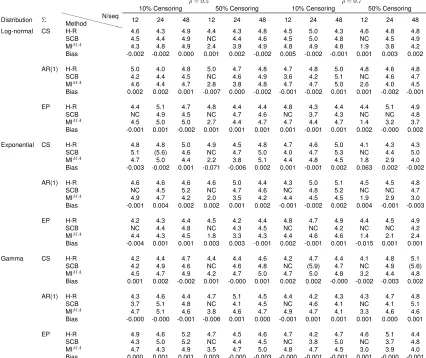
TABLE 2.1 : Type I error (target=5%) for the hierarchical rank test (H-R), stratified Cox model with baseline adjustment (SCB) and proposed multiple imputation with model averaging and ANCOVA (MIM A) for log-normal, exponential and
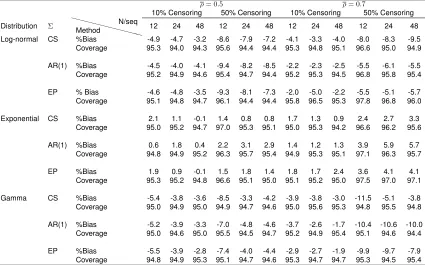
gamma distributions under the null hypothesisH0 : θ = 1 and bias in the estimate oflogθusing the proposed method (5000 simulations). . . 17 TABLE 2.2 : Percentage bias and 95% C.I. coverage probability under the alternative
hy-pothesisH1 : θ 6= 1 for the estimate of logθ using the proposed method under log-normal, exponential and gamma distributions (5000 simulations). 18 TABLE 2.3 : Event times (minutes) for a 10-minute treadmill test in a 2×2 crossover
clin-ical trial. . . 22
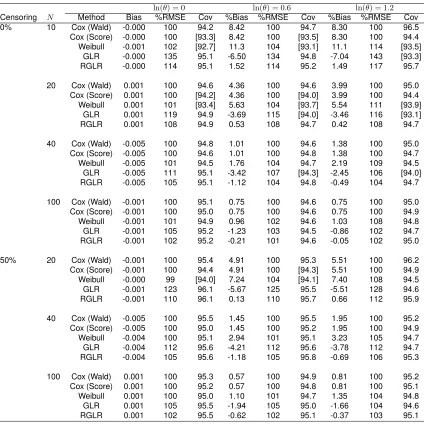
TABLE 3.1 : Empirical bias, percent ratio of MSE relative to Cox model and coverage probability for 95% C.I. forln(θ) = 0,0.6,1.2based on 5000 simulations and an underlying Weibull distribution for the survival times. . . 33 TABLE 3.2 : Empirical bias, percent ratio of MSE relative to Cox model and coverage
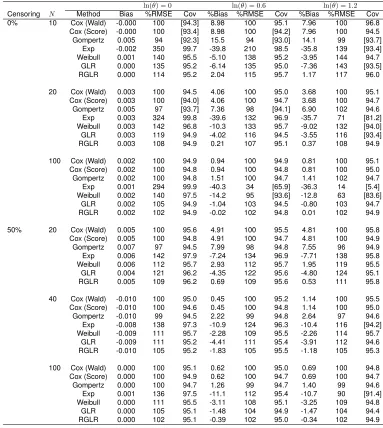
probability for 95% C.I. forln(θ) = 0,0.6,1.2based on 5000 simulations and an underlying Gompertz distribution for the survival times. . . 36 TABLE 3.3 : Empirical bias, percent ratio of MSE relative to Cox model and coverage
probability for 95% C.I. forln(θ) = 0,0.6,1.2based on 5000 simulations and an underlying Weibull distribution for the survival times with tied observations. 39
TABLE 4.1 : True log hazard ratio in each stratum and overall under the null and alterna-tive hypotheses. . . 51 TABLE 4.2 : Bias (% bias), percent ratio of MSE relative to one-step stratified Cox model
and coverage probability for 95% C.I. for overall log hazard ratioβ¯for 2 strata based on 5000 simulations. . . 53 TABLE 4.3 : Bias (% bias), percent ratio of MSE relative to one-step stratified Cox model
and coverage probability for 95% C.I. for overall log hazard ratioβ¯for 4 strata based on 5000 simulations. . . 54 TABLE 4.4 : Power comparisons among the competing methods based on 100 subjects
per treatment group and 50% censoring with 5000 simulations for 2 strata (top panel) and 4 strata (bottom panel). . . 55 TABLE 4.5 : Log hazard ratio estimates for the Colon cancer data example in Lin et al.
(2016). . . 55
TABLE A.1 : Trueθ values used in the simulation study under the alternative hypothesis for each combination of distribution, covariance structure,ρ¯, censoring and sample size per sequence (θ= 1under the null hypothesis.) . . . 61 TABLE A.2 : Power (%) for the hierarchical rank test (H-R), stratified Cox model with
base-line adjustment (SCB) and proposed multiple imputation with model aver-aging and ANCOVA (MIM A) under log-normal distribution based on 5000
simulations. . . 61 TABLE A.3 : Power (%) for the hierarchical rank test (H-R), stratified Cox model with
base-line adjustment (SCB) and proposed multiple imputation with model aver-aging and ANCOVA (MIM A) under exponential distribution based on 5000
TABLE A.4 : Power (%) for the hierarchical rank test (H-R), stratified Cox model with base-line adjustment (SCB) and proposed multiple imputation with model averag-ing and ANCOVA (MIM A) under gamma distribution based on 5000
simula-tions. . . 62
LIST OF ILLUSTRATIONS
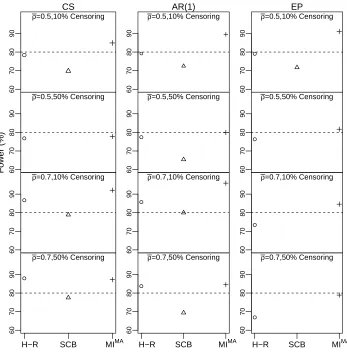
FIGURE 2.1 : Power comparison for the Hierarchical Rank test (H-R), stratified Cox model (SCB) and proposed multiple imputation with model averaging and AN-COVA (MIM A) under a log-normal distribution and varying assumptions
for the true variance structure (compound symmetry (CS), first-order au-toregressive (AR(1)), equipredictability (EP), mean pairwise correlation of baseline and post-treatment values across the two periods (ρ¯ = 0.5,0.7) and percentage censoring (10%,50%), with 24 subjects per sequence. Stratified Cox model had non-convergence issues under CS structure with ¯
ρ= 0.5and 50% censoring, and under EP structure withρ¯= 0.5and 50% censoring, ρ¯ = 0.7 and 10% censoring and ρ¯ = 0.7 and 50% censoring, and hence power is not reported. . . 19 FIGURE 2.2 : Power comparison for the Hierarchical Rank test (H-R), stratified Cox model
(SCB) and proposed multiple imputation with model averaging and AN-COVA (MIM A) under an exponential distribution and varying assumptions
for the true variance structure (compound symmetry (CS), first order au-toregressive (AR(1)), equipredictability (EP), mean pairwise correlation of baseline and post-treatment values across the two periods ( ¯ρ = 0.5,0.7) and percentage censoring (10%,50%), with 24 subjects per sequence. Stratified Cox model had non-convergence issues under EP structure with ¯
ρ= 0.7and 50% censoring, and hence power is not reported. . . 20 FIGURE 2.3 : Power comparison for the Hierarchical Rank test (H-R), stratified Cox model
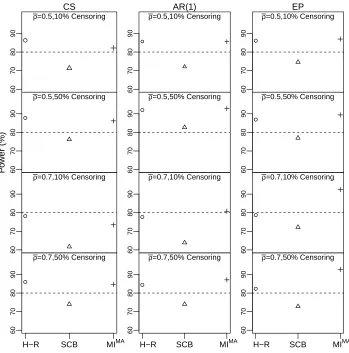
(SCB) and proposed multiple imputation with model averaging and AN-COVA (MIM A) under a gamma distribution and varying assumptions for the
true variance structure (compound symmetry (CS), first order autoregres-sive (AR(1)), equipredictability (EP), mean pairwise correlation of baseline and post-treatment values across the two periods (ρ¯ = 0.5,0.7) and per-centage censoring (10%,50%), with 24 subjects per sequence. . . 21 FIGURE 2.4 : Kaplan-Meier curves for the time to a symptomatic cardiac-related event
by treatment group from a 2×2 crossover trial; (a) is for period 1 and (b) is for period 2. . . 23
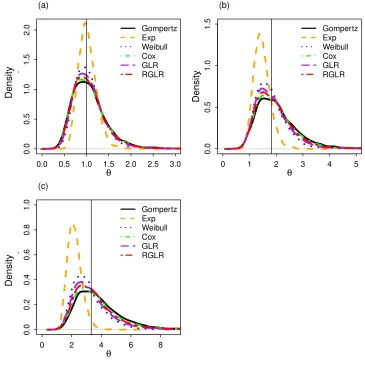
FIGURE 3.1 : Empirical densities of estimators from the Gompertz, exponential, and Weibull parametric survival models, Cox model, generalized log-rank (GLR) and refined GLR (RGLR) (5000 simulations for 20 subjects per group with 0% censoring and an underlying Gompertz distribution) with a true hazard ratio of (a) 1 (b) 1.82 (c) 3.32. A vertical line is drawn at the true hazard ratio. . 37 FIGURE 3.2 : Lung cancer data example: Kaplan-Meier curves for time to death
compar-ing test to standard chemotherapy by cell types. . . 40 FIGURE 3.3 : Lung cancer data example: Estimated hazard ratio and 95% confidence
interval comparing test to standard chemotherapy by cell types. . . 41 FIGURE 3.4 : Bladder cancer data example: Kaplan-Meier survival curves and estimated
hazard ratio and 95% confidence interval comparing placebo and chemother-apy by number of tumors removed at surgery. . . 43
FIGURE A.1 : Density curves for survival time under lognormal(µ = 0, σ = 1), whereµ andσdenotes the mean and standard deviation on the log scale, exponen-tial(rate=0.5) and gamma(shape=2, scale=0.7), respectively. . . 60
CHAPTER 1
I
NTRODUCTIONMost statistical methods are developed based on large sample considerations. In real data
applica-tions, however, clinical trials and epidemiological studies with time-to-event outcomes do not always
meet the large sample size requirement due to various reasons. In fact, trials with small samples
are often encountered, due to reasons such as rarity of the disease and nature of the trial design
(e.g., an early phase or pilot clinical trial). Commonly used methods in a typical survival analysis
include Cox proportional hazards model (Cox, 1972) and parametric regression. Inference is
typi-cally based on large sample theory, and may not be appropriate under small samples. Crossover
trials also often have small samples, as every subject serves as his or her own control to help
achieve higher efficiency than parallel designs. However, there is a lack of existing methods for
an-alyzing crossover studies with time-to-event outcomes. We focus on three specific types of designs
with time-to-event response variables and small sample sizes: two-period two-treatment crossover
trials, two-group parallel designs in the setting of proportional hazards without stratification, and
two-group parallel designs with stratification and proportional hazards.
1.1. Background
1.1.1. Crossover Designs
Crossover designs compare treatment effects on the same subject over different treatment
peri-ods. For trials with limited recruitment, crossover designs are ideal to use for higher efficiency than
parallel designs. Under the commonly used two-period, two-treatment (2×2) crossover designs,
patients are randomized to one of two sequences, AB or BA, where A and B are the treatment
labels. A ‘washout’ period is included between the two periods to ensure no carry-over effects. The
use of a period-specific baseline measurement, which is taken before the subject is given the
treat-ment in each period, has been shown to increase statistical power (Chen, Meng, and Zhang, 2012;
Kenward and Roger, 2010; Senn, 2002). There are many existing methods for handling baseline
information in the analysis of crossover trials withcontinuous endpoints, including ignoring
base-line measurements, analyzing the change from basebase-line, using a function of the basebase-lines as a
2012; Hills and Armitage, 1979; Kenward and Roger, 2010; Metcalfe, 2010; Yan, 2013). Some
recommended methods for providing higher efficiency than others include analysis of covariance
(ANCOVA) and joint-modeling of the within-subject difference in treatment responses and
differ-ence in baseline responses (Mehrotra, 2014). The commonly used method, analysis of the change
from baseline, suffered from poor efficiency, as also discussed by Kenward and Roger (2010) and
Metcalfe (2010).
All methods mentioned above are for continuous endpoints, but crossover trials with time-to-event
endpoints are also commonly encountered in research. Existing literature for examining treatment
differences in crossover trials with censored time-to-event endpoints includes both
regression-based and test-regression-based approaches. France, Lewis, and Kay (1991) used stratified Cox regression,
where each subject was treated as a stratum. Feingold and Gillespie (1996) proposed an approach
based on the generalized Wilcoxon test. More recently, Brittain and Follmann (2011) proposed a
hierarchical rank (H-R) test, where each patient is assigned a rank based on whether and when he
or she has an event. The first ordering of the rank is determined by whether the individual has an
event during any of the two periods, and the second ordering of the rank is based on the times of
the events. A two-group Wilcoxon test is performed using the assigned ranks to test for the
treat-ment effect. Brittain and Follmann (2011) showed that the H-R test has similar or greater power
than both the Feingold and Gillespie’s method and stratified Cox method under certain censoring
patterns. However, none of these approaches utilizes baseline information, and whether and how
to utilize baseline information in crossover trials with time-to-event outcomes has not been studied.
1.1.2. Parallel Designs under Proportional Hazards without Stratification
In parallel designs with time-to-event outcomes comparing two treatment groups, the parameter of
interest is usually the hazard ratio, also referred to as relative risk. Under the proportional
haz-ards assumption, i.e., the hazard ratio is constant throughout time, it is conventional to use the
Cox proportional hazards model for estimation of relative risk and the log-rank test for hypothesis
testing (Cox, 1972). However, Cox regression is a large sample method, and may not provide an
appropriate result in small samples. Johnson et al. (1982) investigated the Cox model with one
binary indicator as the covariate, and found that in small samples, there are non-trivial differences
between the actual and asymptotic formula-based variances for the estimated log(hazard ratio).
bias when the true underlying survival distribution is misspecified. Therefore, it is important to
study analysis methods for failure time data in small samples, which are quite common in real data
applications. Early phase clinical trials usually have less than 100 subjects per treatment group
(Pocock, 1983), and cancer trials might have limited recruitment as well if the disease is rare.
Mehrotra and Roth (2001) proposed a method based on a generalized log-rank (GLR) statistic for
the 2-group comparison to improve estimation and inference of hazard ratio in small sample studies.
They showed that even though asymptotically the GLR method has similar performance to the Cox
approach, when the sample size is small, GLR is notably more efficient than the Cox approach,
in terms of mean squared error (MSE) for the log relative risk when there are no tied event times.
A deficiency in the GLR method is that it uses an unnecessary approximation involving nuisance
parameters which contributes to bias in the estimated hazard ratio. Furthermore, estimation of the
nuisance parameters follows a non-intuitive path. These collectively offer opportunities to improve
the GLR method in a tangible way with practical benefits.
1.1.3. Parallel Designs with Stratification and Proportional Hazards
In parallel designs comparing two treatments, when the risk of having an event is known to be
af-fected by a prognostic factor, such as gender or race, stratification is employed in the design stage.
Subjects are first divided into each stratum based on his or her prognostic factor characteristics,
and then within each stratum, randomized to receive one of the treatments. The goal is estimation
and inference involving the true‘overall’ hazard ratio, defined as the exponent of the weighted mean
of the stratum-specific true log hazard ratios using population relative frequency weights. Under the
assumption of proportional hazards in each stratum, stratified Cox model is used to analyze such
data. The stratified Cox model assumes that the hazard ratio is constant across strata, which is not
always true. If there exists a stratum-treatment interaction, the conventional stratified Cox model
tends to provide biased and less efficient results. Mehrotra, Su, and Li (2012) proposed a two-step
stratified Cox approach to allow for different hazard ratios across strata, and combine the
stratum-specific log hazard ratio by two weighting options, sample size weights and minimum risk weights
(Mehrotra and Railkar, 2000). The two-step analysis provides comparable power to the one-step
Cox analysis when there is no stratum-treatment interaction, but notably higher power when there
is an interaction. It also delivers a point estimator for the overall treatment effect with very small
hence not ideal for small studies.
1.2. Novel Developments
In this dissertation, we focus on developing methods for analyzing studies with time-to-event
out-comes in small samples, and specifically in three settings: 2×2 crossover designs with baseline
measurements, parallel designs for two group comparison under proportional hazards without
strat-ification, and stratified parallel designs under proportional hazards.
In Chapter 2, we propose a regression-based method using multiple imputation (MI) of censored
event times in conjunction with analysis of covariance (ANCOVA) to incorporate baseline
measure-ments into the analysis of crossover studies with time-to-event outcomes. In the imputation step,
we propose to fit multiple candidate survival models, and use frequentist model averaging to pool
the final results. Unlike Bayesian model averaging (Bates and Granger, 1969; Raftery, Madigan,
and Hoeting, 1997), which requires setting a prior probability to each candidate model, frequentist
model averaging does not need any priors (Buckland, Burnham, and Augustin, 1997; Burnham and
Anderson, 2003; Hjort and Claeskens, 2003). The final point estimator is obtained by averaging
across the imputations and a variance estimator is created that accounts for the uncertainty from
both model averaging and imputation. We show that there can be a great efficiency gain in
us-ing baseline information for time-to-event endpoints in crossover trials, compared to H-R test and
stratified Cox model. Furthermore, our proposed method delivers a point and confidence interval
estimate with small-to-no-bias of the treatment-ratio of geometric mean event times.. We
demon-strate the impressive performance of our proposed method through simulation studies and apply it
to data from a crossover trial studying a new drug’s effect on delaying a symptomatic cardiac-related
event during a 10-minute treadmill walking test.
In Chapter 3, we focus on the parallel design for the two group comparison without stratification
and propose a refined GLR (RGLR) method by replacing the‘approximate’ nuisance parameters
with‘exact’ counterparts in the original GLR statistic. We develop the RGLR statistic for settings
with and without tied event times, and show through extensive simulations that our proposed RGLR
method provides notably smaller bias than GLR, Cox and parametric models, and provides a high
relative efficiency and adequate 95% confidence interval coverage rate. We also provide further
the GLR statistic. Finally, we illustrate the method in two clinical trials studying lung cancer and
bladder cancer.
We further extend the RGLR method to allow for stratification factors in the analysis of a parallel
two-group design in Chapter 4. Instead of assuming a constant hazard ratio across all strata as done by
the commonly used stratified Cox model analysis, we allow the hazard ratio to vary across stratum,
and use two weighting schemes to combine the stratum-specific estimates of the log(hazard ratio).
We show through simulations that RGLR-based estimators provide smaller bias and higher relative
efficiency than both the conventional one-step and the two-step stratified Cox model estimator. We
apply the proposed method to a simulated data example for illustration.
CHAPTER 2
I
NCORPORATINGB
ASELINE MEASUREMENTS IN CROSSOVER TRIALS WITHTIME
-
TO-
EVENT ENDPOINTS2.1. Introduction
Crossover designs are commonly seen in clinical trials to compare the treatment effects on the
same subject over different treatment periods. For trials with limited recruitment, crossover designs
are ideal to use for higher efficiency than parallel designs. The ability of each person to serve as
his or her own control also mitigates the influence of potential confounding factors. In commonly
used two-period, two-treatment (2×2) crossover designs, subjects are randomized to one of two
sequences, AB or BA, where A and B are the treatment labels. A ‘washout’ period is included
between the two periods to ensure no carry-over effects. The use of a period-specific baseline
measurement, which is taken before the subject is given the treatment in each period, is often
con-sidered. However, whether and how to use a baseline measurement is often challenging, given the
extra cost and the need to determine which statistical methods can be used to fully utilize the
in-formation from the baselines. For a 2×2 crossover trial, each subject has four responses: baseline
(i.e., pre-treatment) in period 1, post-treatment in period 1, baseline in period 2 and post-treatment
in period 2. There are many existing methods for handling baseline information in the analysis of
crossover trials withcontinuous endpoints, including ignoring baseline measurements, analyzing
the change from baseline, using a function of the baselines as a covariate, and joint-modeling of
baseline and post-treatment responses (Chen, Meng, and Zhang, 2012; Hills and Armitage, 1979;
Kenward and Roger, 2010; Metcalfe, 2010; Senn, 2002; Yan, 2013).
Mehrotra (2014) evaluated and compared 13 different methods for analyzing 2×2 crossover trials
to incorporate baseline measurements with continuous endpoints. Among all the competing
meth-ods, two methods were shown to have the highest efficiency: analysis of covariance (ANCOVA)
with the within-subject difference in baseline responses used as a covariate, and joint-modeling
of the within-subject difference in treatment responses and difference in baseline responses. The
commonly used method, analysis of the change from baseline, was shown to have poor efficiency,
All methods mentioned above are for continuous endpoints, but crossover trials with time-to-event
endpoints are also commonly encountered in research. For example, blood thinners like Warafin
are important in preventing outcomes such as blood clots and stroke, but can also induce
undesir-able increases in bleeding time from simple cuts or other injuries. In this setting, researchers are
sometimes interested in studying the effect of an experimental anticoagulant drug on bleeding time
using a crossover design with a baseline measurement at the beginning of each period. Kimchi et
al. (1983) and Markman et al. (2015) both studied a drug’s effect in a crossover trial with a
time-to-event outcome and collected baseline meausurements. However, neither incorporated the baseline
information into their analysis. Our motivating data example is a crossover trial studying a drug’s
effect in preventing cardiac-related symptoms in a treadmill walking test. The outcome of interest
for each subject is time to a specific cardiopulmonary event, with the outcome recorded as ’>10
minutes’ (i.e., right censored) if the event has not yet occurred after 10 minutes of observation.
Ex-isting literature for examining treatment differences in crossover trials with censored time-to-event
endpoints includes both regression-based and test-based approaches. France, Lewis, and Kay
(1991) used a stratified Cox regression, where each subject was treated as a stratum. Feingold
and Gillespie (1996) proposed an approach based on the generalized Wilcoxon test. More recently,
Brittain and Follmann (2011) proposed a hierarchical rank (H-R) test, which they showed to have
similar or greater power than both the Feingold and Gillespie’s method and stratified Cox method
under certain censoring patterns. The main idea behind the H-R test is that avoiding an event is
more clinically meaningful than delaying an event. Therefore, each patient is assigned a rank that
orders how much better an individual does on the novel treatment. The first order of ranking is
based on whether patients have an event, and second order of ranking is based on the times of
the events. Patients who do not have an event on either treatment receive the same rank. With
assigned ranks for everyone, a two-group Wilcoxon test is then performed to test for a treatment
effect. However, none of these Wilcoxon-type approaches utilizes baseline information.
In this research, we propose a regression-based method using multiple imputation (MI) of
cen-sored values and analysis of covariance (ANCOVA) to incorporate baseline measurements into
the analysis of 2×2 crossover studies with censored time-to-event response outcomes. There is
often uncertainty about the true underlying survival distribution in real data applications, and
mis-specification of the distribution can lead to a biased point estimator and/or inefficient analysis. To
fre-quentist model averaging to pool the final results from the ANCOVA step. Unlike Bayesian model
averaging (Bates and Granger, 1969; Raftery, Madigan, and Hoeting, 1997), which requires setting
a prior probability for each candidate model, frequentist model averaging does not require any
pri-ors (Buckland, Burnham, and Augustin, 1997; Burnham and Anderson, 2003; Hjort and Claeskens,
2003). To implement model averaging in the presence of multiple imputation, we need to account
for both the uncertainty from model averaging and imputation.
We show that there is a great efficiency gain in using baseline information for time-to-event
end-points in crossover trials compared to the H-R test and stratified Cox model. Furthermore, our
proposed method is also able to provide a point and confidence interval estimate of a meaningful
parameter of interest (treatment-ratio of geometric mean event times). Section 2.2 presents details
of the proposed method. In Section 2.3, we contrast the numerical performance of our proposed
method with that of the H-R test and stratified Cox model through simulation studies. Section 2.4
in-cludes results from applying the different methods to our motivating real data example. Section 2.5
includes conclusions.
2.2. Methods
We consider a 2×2 crossover trial with two treatments, denoted by A and B. Subjects are
random-ized to either the AB or BA sequence, with a wash-out period between period 1 and 2. LetXijk
andYijkdenote baseline and post-treatment event times, respectively, for subjectjfrom sequence
k in periodi, wherei = 1,2; j = 1,2, . . . , n; andk = 1,2. It is sufficient to assume that, after a
log transformation, (X1j1, Y1j1, X2j1, Y2j1)T and(X1j2, Y1j2, X2j2, Y2j2)T follow a multivariate
dis-tribution with different means and same variance-covariance structureΣ. We assume there is no
censoring at baseline, and in each period, subjects without a post-treatment event are censored at
the end of period, denoted by timeτ.
We propose a three-step procedure using multiple imputation and ANCOVA to estimate the ratio
of geometric means of the event times for treatment A relative to B, denoted as θ, and test the
null hypothesisH0 : θ = 1. For distributions that are symmetric on the log scale, the geometric
mean is equivalent to the median. Thus, our parameter of interest can be used to approximate the
ratio of median survival of the two treatments, which is commonly of interest in survival analysis.
details of which are given in the sub-sections below.
Step 1: Fit two candidate parametric event models, log-normal and Weibull, to impute the
post-treatment censored values sequentially, conditioning on the baseline event time in period 1 for
period 1 imputation, and both baseline event times and post-treatment event time in period 2 for
period 2 imputation.
Step 2: With the completed dataset from each candidate model, perform ANCOVA on the
log-transformed event times to estimatelogθand obtain its standard error.
Step 3: Average across thelogθestimates based on weights associated with Akaike information
criterion (AIC) from each parametric model fit to get a model averaged estimate and standard error,
and synthesize for overall point and confidence interval estimation across the multiply imputed
datasets using Rubin’s rule.
It is important to note that although we consider only two distributions in Step 1, our method can
be easily generalized to include more pre-specified candidate models in the imputation step. We
chose log-normal and Weibull because they are very flexible and in our experience provide
rea-sonable fitting models for capturing commonly seen event time data. Through numerical studies
in Section 2.3, we show that even averaging over a small number of models can deliver a good
performance.
2.2.1. Imputation
We generateM imputed data sets for each candidate model. LetZijk = 0,1denote treatment A
and B, respectively for subject j in periodi and sequencek. We impute the censored values in
period 1 first, and then impute the censored values in period 2. In them-th imputed data set, we
use the baseline value in period 1 and treatment indicator,Z1jk, as covariates and fit two candidate
parametric survival models, log-normal and Weibull, respectively, toY1jk.
logY1jk=βs,0+βs,1Z1jk+βs,2Us,1jk+σs,1Ws,1jk, (2.1)
where s = 1,2 denotes the log-normal and Weibull model, respectively, Ws,1jk is the error
dis-tribution and Us,1jk is the baseline covariate in thes-th model. W1,1jk has the standard normal
distribution for the log-normal distribution and W2,1jk has the standard extreme value distribution
the Weibull distribution; sample R code for implementation is provided in Appendix A. Equation (2.1)
is a representation of the log-normal and accelerated failure time (AFT) model framework for the
Weibull model that highlights the common linear regression model on the log-scale. For fitting the
parametric model, we analyze the log event times for the log-normal model and fit the traditional
Weibull model for the event times on the original scale. We use robust sandwich standard errors in
both candidate models to correct for potential model misspecification.
Letβˆs = ( ˆβs,0,βˆs,1,βˆs,2,σˆs,1)T andΣˆs denote the estimated coefficients and variance-covariance
matrix in thes-th candidate model, respectively. We drawβˆ∗sfrom a multivariate normal distribution
N( ˆβs,Σˆs). For subject with a censored post-treatment value, we then impute a right-censored
value with an uncensored value by usingβˆs∗, treatment indicatorZ1jkand subject-specific period 1
baseline values in equation (2.1). The corresponding uncensored post-treatment values in period
1 are denoted byYs,(m1jk).
Now, with complete data in period 1, we can then use the observed/imputed post-treatment values
in period 1, baseline values in both period 1 and period 2 as covariates, to impute post-treatment
censored values in period 2 by fitting thes-th model,
logY2jk=αs,0+αs,1Z2jk+αs,2Us,1jk+αs,3Vs,2jk+αs,4R (m)
s,1jk+σs,2Ws,2jk, (2.2)
where U1,1jk = logX1jk, V1,2jk = logX2jk, R
(m)
s,1jk = logY
(m)
s,1jk for log-normal distribution, and
U1,1jk = X1jk, V2,2jk = X2jk, R
(m)
s,1jk = Y
(m)
s,1jk for Weibull distribution, and Z2jk is the treatment
indicator in period 2.
The imputation procedure described above for period 1 is now implemented using random draws
from the assumed multivariate normal distribution of the vector of estimated regression coefficients
in equation (2.2) for each of the two parametric models. The corresponding uncensored
post-treatment values in period 2 are denoted byYs,(m2jk).
2.2.2. ANCOVA
After each imputation, we have two sets of complete data on every subject from the two candidate
models, normal and Weibull. Each imputed dataset is analyzed using ANCOVA on the
times, ∆(s,jkm) = logYs,(m1jk) −logYs,(m2jk) on the difference between baseline measurements, Djk =
logX1jk−logX2jkand the sequence indicatorQj.
∆(s,jkm) =γs,0+γs,1Djk+γs,2Qj+s,jk, (2.3)
wheres,jk∼N(0, η2).
The point estimator from thes-th model in them-th imputed data set islog ˆθs(m) = ˆγs,(m2)/2, which
is the logarithm of the ratio of geometric means for treatment A relative to B. The corresponding
variance estimate forlog ˆθ(sm)from thes-th model in them-th imputed data set isˆvs(m).
2.2.3. Model Averaging and Rubin’s Combination Rule
For overall estimation and inference, we first combine the two estimators from the candidate
mod-els in each imputed data set, then pool the model-averaged estimators from all the imputed data
sets and obtain the pooled variance estimate that accounts for both the uncertainty from model
averaging and imputation (Schomaker and Heumann, 2014).
For model averaging, we need to assign a standardized weight. There are many different options
for the choice of weights, including an information criterion (Buckland, Burnham, and Augustin,
1997), Mallows’ criterion (Hansen, 2007; Mallows, 1973) and cross-validation criterion (Hansen
and Racine, 2012). We propose to use the straightforward and commonly used Akaike Information
Criterion (AIC) (Akaike, 1974) to assign weights. LetIsdenote the AIC for the ANCOVA regression,
equation (3), from thes-th candidate model, then the weight is defined as (Buckland, Burnham, and
Augustin, 1997)
ws=
exp(−Is/2) P2
i=1exp(−Ii/2) .
The model averaged estimator in the m-th imputed data set is log ˆθ(m) = P2
s=1wslog ˆθ (m)
s , and
the variance for the model averaging estimator is estimated by (Buckland, Burnham, and Augustin,
1997)
ˆ
Var(log ˆθ(m)) =
" 2 X
s=1 ws
q
ˆ
Var(log ˆθ(sm)) + (log ˆθs(m)−log ˆθ(m))2 #2
. (2.4)
estimator calculated as (Schomaker and Heumann, 2014)
logθ¯ˆ= 1 M
M X
m=1
log ˆθ(m). (2.5)
When there is no model averaging, we can use Rubin (1987) to combine the results from multiple
imputation. As noted earlier, with the presence of model averaging, the uncertainty from both model
averaging and imputation needs to considered. The between-imputation variance is
vbtw = 1 M −1
M X
m=1
(log ˆθ(m)−logθ)¯ˆ2.
The within-imputation variance is the average of the estimated variance from equation (4) across
M imputed data sets
vwithin= 1 M M X m=1 ˆ
Var(log ˆθ(m)).
Therefore, the total variance of the estimator after multiple imputation is (Schomaker and Heumann,
2014)
vtotal=
M+ 1 M(M−1)
M X
m=1
(log ˆθ(m)−logθ)¯ˆ2+1 M M X m=1 " 2 X s=1 ws q ˆ
Var(log ˆθs(m)) + (log ˆθs(m)−log ˆθ(m))2 #2
.
(2.6)
To test the null hypothesisH0 : θ =θ0 (withθ0 = 1in our application), we carry out a t-test with
test statistic(logθ¯ˆ−logθ0)/
√
vtotal. To calculate the degrees of freedomd∗for the t-test, we follow
Barnard and Rubin (1999) so thatd∗= (1/d+ 1/dˆobs)−1, whered= (M−1)[1 +(1+1vwithin/M)v
btw] 2and
ˆ
dobs= (1−(1 + 1/M)vbtw/vtotal)(ddcom+1
com+3)dcom, anddcomis the degrees of freedom for
¯ ˆ
θwhen there
are no missing values.
2.3. Simulation
2.3.1. Simulation Set-up
To compare the performance of our proposed approach to the H-R test and stratified Cox model,
we carried out a simulation study to examine type I error and power among all three methods.
times, in addition to the treatment indicator, as covariates in the stratified Cox model to make a
fair comparison. The H-R test, however, does not incorporate baseline information, and thus, we
used the method as is. We also examined the bias and 95% confidence interval (C.I.) coverage
probability from our proposed estimator; of note, the other two methods cannot deliver an estimate
of our parameter of interest (θ).
We simulated three underlying distributions for event times, namely log-normal, exponential and
gamma. Two of the distributions, log-normal and exponential (a special case of the Weibull),
are included in the candidate models in our method, while the gamma distribution is not. The
density curves for each of the three distributions are shown in Supplementary Figure A.1 in
Ap-pendix A. Under the log-normal distribution, for each of the N subjects in sequence AB and BA,
we generated correlated log event times from a multivariate normal distribution with mean
param-eter(0,logθ,0,0)T for AB sequence and (0,0,0,logθ)T for BA sequence and common
variance-covariance structure with common variance 1 and correlation coefficientsρ12, ρ13, ρ14, ρ23, ρ24, ρ34.
We considered three correlation structures, compound symmetry (CS), first-order autoregressive
(AR(1)), and equipredictability (EP), where ρ12 = ρ13 = ρ14 = ρ23 = ρ24 = ρ34 = ρ for CS,
ρ12=ρ23 =ρ34=ρ, ρ13 =ρ24=ρ2, ρ14 =ρ3for AR(1), andρ23=ρ14, ρ24=ρ13, ρ34 =ρ12for EP.
The correlation structures are as follows:
ΣCS =
1 ρ ρ ρ
ρ 1 ρ ρ
ρ ρ 1 ρ
ρ ρ ρ 1
ΣAR=
1 ρ ρ2 ρ3
ρ 1 ρ ρ2
ρ2 ρ 1 ρ
ρ3 ρ2 ρ 1
ΣEP =
1 ρ12 ρ13 ρ14
ρ12 1 ρ14 ρ13
ρ13 ρ14 1 ρ12
ρ14 ρ13 ρ12 1
.
We assumed no censoring in baseline event times in each period, and the post-treatment event
times were right-censored at timeτ. As discussed in the previous section, the parameter of interest
θis the ratio of the geometric means of the event times for treatment A and treatment B, and under
the log-normal distribution, it is equivalent to the ratio of median event times.
For the exponential distribution, we used copulas (Sklar, 1973) to generate correlated event times
from a multivariate exponential with mean(2,2θ,2,2)T for AB sequence and(2,2,2,2θ)T for BA
se-quence and common variance-covariance structure and correlation coefficients as specified above.
expo-nential distribution. Since copulas only preserves the rank correlation coefficient but not the linear
correlation coefficient (Genest and MacKay, 1986), the correlated exponential data follows
approx-imately, but not exactly, the specified variance-covariance structure.
To further illustrate the performance of our proposed method, we also considered an underlying
gamma distribution, which is not included in our two candidate models from the imputation step.
Specifically, we used a gamma distribution with scale of 0.7 and shape of 2 for subjects in
treat-ment B. Event times for subjects in treattreat-ment A was generated from a gamma distribution with
scale of 0.7θ and shape of 2. We again used copulas to generate the correlated event times.
For AB sequence, the simulated event times followed a multivariate gamma distribution with mean
(1.4,1.4θ,1.4,1.4)T, and for BA sequence, the event times follows a gamma distribution with mean
(1.4,1.4,1.4,1.4θ)T. Note that it can be shown that the ratio of arithmetic means is equivalent to the
ratio of geometric means in the setting that event times in treatment A and B follow a gamma
distri-bution with the same shape parameter and ratio of scale parameter ofθ. Again, the event times in
the two sequences followed a common variance-covariance structure and correlation coefficients
as specified above.
We varied the sample size, percentage of censoring, θ, correlation structure, and compared the
performance of the different methods. Sample size per sequence was varied as N = 12,24,48,
and percentage of censoring was controlled by changing the time τ, to generate 10% and 50%
censoring for the total sample.
The mean pairwise correlation coefficientρ¯took values of 0.5 and 0.7. Under CS,ρ= ¯ρ. For AR(1),
ρ= 0.7forρ¯= 0.5 andρ= 0.83forρ¯= 0.7. For EP, we setρ12 = 0.6, ρ13 = 0.5, ρ12 = 0.4when
¯
ρ= 0.5, andρ12= 0.8, ρ13= 0.7, ρ12= 0.6whenρ¯= 0.7. We generatedM = 50imputed datasets
within each of the 5000 replications. Under the null hypothesis, θ = 1. Under the alternative
hypothesis, we chose a value ofθsuch that the power was about 80% for the H-R test, given the
true underlying distribution,Σ,ρ¯and percentage censoring.
2.3.2. Simulation Results
Table 2.1 reports type I error for the three distributions for the H-R test, stratified Cox model with
baseline adjustment and our proposed multiple imputation and model averaging and ANCOVA
under several scenarios when the sample size was 12 and 24 subjects per sequence with 50%
censoring, and had an inflated type I error when there were 24 subjects per sequence with 10%
censoring,ρ¯= 0.5and CS structure under exponential distribution. When the true distribution was
gamma, the stratified Cox model analysis was associated with inflated type I error under CS
struc-ture with 24 subjects per sequence andρ¯= 0.7, 10% censoring, and with 48 subjects per sequence
andρ¯= 0.7, 50% censoring. The H-R test and our proposed model averaging method controlled
type I error throughout all the scenarios considered. Table 2.1 also reports the bias in the estimate
of logθusing our proposed method under the null hypothesis. The bias was negligible under all
simulated scenarios.
Figures 2.1, 2.2 and 2.3 show the power for the three different methods forN = 24subjects per
sequence and different combinations of percentage censoring and variance-covariance structure
under the log-normal, exponential and gamma distributions, respectively; results for other sample
sizes are provided in Appendix A.
As shown in Figure 2.1, when the true distribution was log-normal, our proposed method always
provided a higher or similar power than the H-R test and stratified Cox model. For cases where the
H-R test or stratified Cox failed to deliver 80% power, our method was able to achieve power close
to or above 80%. The increase in power using our method was more significant under AR(1) and
EP structures than under CS structure. The power gain compared to the H-R test likely comes from
the fact that the H-R test fails to utilize baseline information. Likewise, our proposed method has a
substantially higher power than the stratified Cox model that adjusts for baseline covariates in part
because our method makes better use of the baseline information. In addition, the model averaging
aspect provides the flexibility of assuming more than one distribution and further improves the
efficiency of the analysis. Results from assuming only one distribution, either log-normal or Weibull,
is more prone to model misspecification in the imputation step.
Figure 2.2 displays the results when the true distribution was exponential. In this case, the true
variance-covariance structure and percentage censoring affected the relative performance of the
considered methods. When the true structure was CS, H-R test delivered higher power than the
other considered methods. Of note, CS structure usually does not capture the true correlation
pattern in most real data examples, since it assumes equal correlation among all pairs of
are a more realistic representation of the correlation structure in real data applications, our method
again showed a substantial power gain compared to the H-R test and stratified Cox model under
50% censoring. When the percentage censoring was 10%, our method delivered similar power
as the H-R test. For all the other scenarios, where the stratified Cox model did not have
non-convergence issues, our proposed method was consistently more powerful than the stratified Cox
model.
Finally, when the underlying distribution was gamma, our proposed method still provided higher
power than the stratified Cox model throughout all scenarios, but slightly lower power than the H-R
test under CS structures, as shown in Figure 2.3. Under AR and EP structures, using multiple
imputation, model averaging and ANCOVA approach delivered a more efficient analysis than both
the H-R test and stratified Cox model. Recall that the true distribution, gamma, is not included
as one of the candidate models in the imputation step; however, we are still able to provide a
comparably efficient result. Additionally, our proposed method is able to provide a point and CI
estimate of the treatment effect, while the other two methods do not.
Table 2.2 reports percentage bias and 95% C.I. coverage probability forlogθusing our proposed
method under the alternative hypothesis. Our method was able to control bias within 10% under
log-normal and exponential distribution. When the true distribution was gamma, it controlled bias
within 10% under 10% censoring, and under 50% censoring, bias was no larger than 11%.
Impor-tantly, the 95% C.I. coverage probability was maintained at or above the nominal level under all the
scenarios considered.
2.4. Data Application
We apply the three methods considered to a 2×2 crossover clinical trial of an investigation drug.
The trial recruited 40 subjects in total, and randomly assigned 20 to the placebo then drug sequence
and 20 to the drug then placebo sequence. The outcome variable was time until a symptomatic
cardiac-related event of interest during a 10-minute treadmill walking test. Each subject also had a
measurement at baseline before taking the treatment. Figure 2.4 displays the Kaplan-Meier curves
for post-treatment event times for placebo and drug in period 1 and period 2, separately.
two-Table 2.1: Type I error (target=5%) for the hierarchical rank test (H-R), stratified Cox model with baseline adjustment (SCB) and proposed multiple imputation with model averaging and ANCOVA (MIM A) for log-normal, exponential and gamma distributions under the null hypothesisH
0 :θ = 1 and bias in the estimate oflogθusing the proposed method (5000 simulations).
ρ= 0.5 ρ= 0.7
10% Censoring 50% Censoring 10% Censoring 50% Censoring
Distribution Σ XXXX XX
XXXX Method
N/seq
12 24 48 12 24 48 12 24 48 12 24 48
Log-normal CS H-R 4.6 4.3 4.9 4.4 4.3 4.8 4.5 5.0 4.3 4.6 4.8 4.8
SCB 4.5 4.4 4.9 NC 4.4 4.6 4.5 5.0 4.8 NC 4.5 4.9
MIM A 4.3 4.8 4.9 2.4 3.9 4.9 4.8 4.9 4.8 1.9 3.8 4.2
Bias -0.002 -0.002 0.000 0.001 0.002 -0.002 0.005 -0.002 -0.001 0.001 0.003 0.002
AR(1) H-R 5.0 4.0 4.8 5.0 4.7 4.8 4.7 4.8 5.0 4.8 4.6 4.8
SCB 4.2 4.4 4.5 NC 4.6 4.9 3.6 4.2 5.1 NC 4.6 4.7
MIM A 4.6 4.4 4.7 2.8 3.8 4.8 4.7 4.7 5.0 2.6 4.0 4.5
Bias 0.002 0.002 0.001 -0.007 0.000 -0.002 -0.001 -0.002 0.001 0.001 -0.002 -0.001
EP H-R 4.4 5.1 4.7 4.8 4.4 4.4 4.8 4.3 4.4 4.4 5.1 4.9
SCB NC 4.9 4.5 NC 4.7 4.6 NC 3.7 4.3 NC NC 4.8
MIM A 4.5 5.0 5.0 2.7 4.4 4.7 4.7 4.4 4.7 1.4 3.2 3.7
Bias -0.001 0.001 -0.002 0.001 0.001 0.001 0.001 -0.001 0.001 0.002 -0.000 0.002
Exponential CS H-R 4.8 4.8 5.0 4.9 4.5 4.8 4.7 4.6 5.0 4.1 4.3 4.3
SCB 5.1 (5.6) 4.6 NC 4.7 5.0 4.0 4.7 5.3 NC 4.4 5.0
MIM A 4.7 5.0 4.4 2.2 3.8 5.1 4.4 4.8 4.5 1.8 2.9 4.0
Bias -0.003 -0.002 0.001 -0.071 -0.006 0.002 0.001 -0.001 0.002 0.063 0.002 -0.002
AR(1) H-R 4.6 4.6 4.6 4.6 5.0 4.4 4.3 5.0 5.1 4.5 4.5 4.8
SCB NC 4.5 5.2 NC 4.7 4.6 NC 4.8 5.2 NC NC 4.7
MIM A 4.9 4.7 4.2 2.0 3.5 4.2 4.4 4.5 4.5 1.9 2.9 3.0
Bias -0.001 0.004 0.002 0.002 0.001 0.002 -0.001 -0.002 0.002 0.004 -0.001 -0.003
EP H-R 4.2 4.3 4.4 4.5 4.2 4.4 4.8 4.7 4.9 4.4 4.5 4.9
SCB NC 4.4 4.8 NC 4.3 4.5 NC NC 4.2 NC NC 4.2
MIM A 4.4 4.3 4.5 1.8 3.3 4.3 4.4 4.6 4.6 1.4 2.1 2.4
Bias -0.004 0.001 0.001 0.003 0.003 -0.001 0.002 -0.001 0.001 -0.015 0.001 0.001
Gamma CS H-R 4.2 4.4 4.7 4.4 4.4 4.6 4.2 4.7 4.4 4.1 4.8 5.1
SCB 4.2 4.9 4.6 NC 4.6 4.8 NC (5.9) 4.7 NC 4.9 (5.6)
MIM A 4.5 4.7 4.9 4.2 4.7 5.0 4.7 5.0 4.8 3.2 4.4 4.8
Bias 0.001 0.002 -0.002 0.001 -0.000 0.001 0.002 0.002 -0.000 -0.002 -0.003 0.002
AR(1) H-R 4.3 4.6 4.4 4.7 5.1 4.5 4.4 4.2 4.3 4.3 4.7 4.8
SCB 3.7 5.1 4.8 NC 4.1 4.5 NC 4.6 4.1 NC 4.1 5.1
MIM A 4.7 5.1 4.6 3.8 4.6 4.7 4.9 4.7 4.1 3.3 4.6 4.6
Bias -0.000 -0.000 -0.001 -0.006 0.001 0.000 -0.001 0.001 0.001 0.001 0.000 0.001
EP H-R 4.9 4.6 5.2 4.7 4.5 4.6 4.7 4.2 4.7 4.6 5.1 4.4
SCB 4.3 5.0 5.2 NC 4.4 4.5 NC 3.8 5.0 NC 3.7 4.8
MIM A 4.7 4.3 4.9 3.5 4.7 5.0 4.8 4.7 4.5 3.0 3.9 4.0
Bias 0.000 0.001 0.001 0.003 -0.000 -0.003 -0.000 -0.001 -0.001 0.001 -0.000 -0.001 Type I error more thanZ0.975standard errors above 5% level is in parentheses. NC: non convergence. CS: compound symmetry covariance structure. AR(1): first-order
autoregressive covariance structure. EP: equipredicability covariance structure.ρ¯: mean pairwise correlation.
tailed 5% level of significance to show a difference between the drug and placebo in delaying the
event of interest. On the other hand, stratified Cox model adjusting for period-specific baseline and
our proposed method deliver a p-value of 0.020, and 0.005, respectively. The ratio of geometric
mean of time to the cardiac-related event for patients taking the drug to patients on placebo was
estimated to be 1.67, with 95% C.I of (1.18, 2.35). The raw data from this trial are provided in
Table 2.3, and R code used to generate the analysis results for all the three methods are provided
Table 2.2: Percentage bias and 95% C.I. coverage probability under the alternative hypothesis H1 :θ6= 1for the estimate oflogθusing the proposed method under log-normal, exponential and gamma distributions (5000 simulations).
ρ= 0.5 ρ= 0.7
10% Censoring 50% Censoring 10% Censoring 50% Censoring Distribution Σ XXXX
XX
XXX
X Method
N/seq
12 24 48 12 24 48 12 24 48 12 24 48 Log-normal CS %Bias -4.9 -4.7 -3.2 -8.6 -7.9 -7.2 -4.1 -3.3 -4.0 -8.0 -8.3 -9.5
Coverage 95.3 94.0 94.3 95.6 94.4 94.4 95.3 94.8 95.1 96.6 95.0 94.9 AR(1) %Bias -4.5 -4.0 -4.1 -9.4 -8.2 -8.5 -2.2 -2.3 -2.5 -5.5 -6.1 -5.5 Coverage 95.2 94.9 94.6 95.4 94.7 94.4 95.2 95.3 94.5 96.8 95.8 95.4 EP % Bias -4.6 -4.8 -3.5 -9.3 -8.1 -7.3 -2.0 -5.0 -2.2 -5.5 -5.1 -5.7 Coverage 95.1 94.8 94.7 96.1 94.4 94.4 95.8 96.5 95.3 97.8 96.8 96.0 Exponential CS %Bias 2.1 1.1 -0.1 1.4 0.8 0.8 1.7 1.3 0.9 2.4 2.7 3.3
Coverage 95.0 95.2 94.7 97.0 95.3 95.1 95.0 95.3 94.2 96.6 96.2 95.6 AR(1) %Bias 0.6 1.8 0.4 2.2 3.1 2.9 1.4 1.2 1.3 3.9 5.9 5.7
Coverage 94.8 94.9 95.2 96.3 95.7 95.4 94.9 95.3 95.1 97.1 96.3 95.7 EP %Bias 1.9 0.9 -0.1 1.5 1.8 1.4 1.8 1.7 2.4 3.6 4.1 4.1
Coverage 95.3 95.2 94.8 96.6 95.1 95.0 95.1 95.2 95.0 97.5 97.0 97.1 Gamma CS %Bias -5.4 -3.8 -3.6 -8.5 -3.3 -4.2 -3.9 -3.8 -3.0 -11.5 -5.1 -3.8 Coverage 95.0 94.9 95.0 94.9 94.7 94.6 95.0 95.6 95.3 94.8 95.5 94.8 AR(1) %Bias -5.2 -3.9 -3.3 -7.0 -4.8 -4.6 -3.7 -2.6 -1.7 -10.4 -10.6 -10.0 Coverage 95.0 94.6 95.0 95.5 94.5 94.7 95.2 94.9 95.4 95.1 94.6 94.4 EP %Bias -5.5 -3.9 -2.8 -7.4 -4.0 -4.4 -2.9 -2.7 -1.9 -9.9 -9.7 -7.9 Coverage 94.8 94.9 95.3 95.1 94.7 94.6 95.3 94.7 94.7 95.3 94.5 95.4
CS: compound symmetry covariance structure. AR(1): first-order autoregressive covariance structure. EP: equipredicability covariance structure.¯ρ: mean pairwise correlation. True values ofθused for all the simulated scenarios are provided in Table A.1 in Appendix A.
2.5. Discussion
While there are many methods for analyzing crossover trials with continuous endpoints, there are
few studying crossover trials with time-to-event outcomes, which are often seen in practice. In this
paper, we have proposed a method using multiple imputation, assuming two candidate parametric
event time models, to impute censored post-treatment values. For each imputed dataset, ANCOVA,
with difference in period-specific baseline responses as a covariate, is applied to log-transformed
event times to estimate the log treatment-ratio of geometric means. Frequentist model averaging
with AIC weighting in conjunction with Rubin’s combination rule for multiple imputation is used for
overall estimation and inference. We showed that by utilizing baseline information, our method
pro-vided a more efficient or as efficient result than some other existing methods, including H-R test
and stratified Cox model, across different combinations of variance-covariance structures,
percent-age censoring and sample sizes. By using model averaging, we are able to provide a more flexible
mis-●
ρ=0.5,10% Censoring
60 70 80 90 CS ●
ρ=0.5,50% Censoring
60
70
80
90
●
ρ=0.7,10% Censoring
60 70 80 90 ● 60 70 80 90
H−R SCB MIMA
P
o
w
er (%)
ρ=0.7,50% Censoring
●
ρ=0.5,10% Censoring
60 70 80 90 AR(1) ●
ρ=0.5,50% Censoring
60
70
80
90
●
ρ=0.7,10% Censoring
60 70 80 90 ● 60 70 80 90
H−R SCB MIMA
ρ=0.7,50% Censoring
●
ρ=0.5,10% Censoring
60 70 80 90 EP ●
ρ=0.5,50% Censoring
60
70
80
90
●
ρ=0.7,10% Censoring
60 70 80 90 ● 60 70 80 90
ρ=0.7,50% Censoring
H−R SCB MIMA
Figure 2.1: Power comparison for the Hierarchical Rank test (H-R), stratified Cox model (SCB) and proposed multiple imputation with model averaging and ANCOVA (MIM A) under a log-normal
dis-tribution and varying assumptions for the true variance structure (compound symmetry (CS), first-order autoregressive (AR(1)), equipredictability (EP), mean pairwise correlation of baseline and post-treatment values across the two periods (ρ¯= 0.5,0.7) and percentage censoring (10%,50%), with 24 subjects per sequence. Stratified Cox model had non-convergence issues under CS struc-ture withρ¯= 0.5 and 50% censoring, and under EP structure withρ¯= 0.5 and 50% censoring, ¯
ρ= 0.7and 10% censoring andρ¯= 0.7and 50% censoring, and hence power is not reported.
specification of the true underlying distribution. Furthermore, the H-R approach does not provide a
point estimator, while our regression-based method delivers an estimated ratio of geometric means
of event times for one treatment relative to the other with small or no bias and adequate 95% C.I.
coverage. The ratio of geometric means is a useful parameter in that it is equivalent to the ratio of
median event times under a log-normal distribution and other distributions that are symmetric on
●
ρ=0.5,10% Censoring
60 70 80 90 CS ●
ρ=0.5,50% Censoring
60
70
80
90
●
ρ=0.7,10% Censoring
60 70 80 90 ● 60 70 80 90
H−R SCB MIMA
P
o
w
er (%)
ρ=0.7,50% Censoring
●
ρ=0.5,10% Censoring
60 70 80 90 AR(1) ●
ρ=0.5,50% Censoring
60
70
80
90
●
ρ=0.7,10% Censoring
60 70 80 90 ● 60 70 80 90
H−R SCB MIMA
ρ=0.7,50% Censoring
●
ρ=0.5,10% Censoring
60 70 80 90 EP ●
ρ=0.5,50% Censoring
60
70
80
90
●
ρ=0.7,10% Censoring
60 70 80 90 ● 60 70 80 90
ρ=0.7,50% Censoring
H−R SCB MIMA
Figure 2.2: Power comparison for the Hierarchical Rank test (H-R), stratified Cox model (SCB) and proposed multiple imputation with model averaging and ANCOVA (MIM A) under an exponential
dis-tribution and varying assumptions for the true variance structure (compound symmetry (CS), first order autoregressive (AR(1)), equipredictability (EP), mean pairwise correlation of baseline and post-treatment values across the two periods( ¯ρ= 0.5,0.7) and percentage censoring (10%,50%), with 24 subjects per sequence. Stratified Cox model had non-convergence issues under EP struc-ture withρ¯= 0.7and 50% censoring, and hence power is not reported.
For our model-averaging approach, we only used two candidate models, log-normal and Weibull, to
impute censored post-treatment values. More distributions can readily be used. The candidate
dis-tributions should include those that cover a spectrum of anticipated plausible shapes of the survival
distribution for the outcome of interest. The relative success of our method, like other applications
of multiple imputation, is not expected to perform well if the imputation model is grossly
●
ρ=0.5,10% Censoring
60 70 80 90 CS ●
ρ=0.5,50% Censoring
60
70
80
90
●
ρ=0.7,10% Censoring
60 70 80 90 ● 60 70 80 90
H−R SCB MIMA
P
o
w
er (%)
ρ=0.7,50% Censoring
●
ρ=0.5,10% Censoring
60 70 80 90 AR(1) ●
ρ=0.5,50% Censoring
60
70
80
90
●
ρ=0.7,10% Censoring
60 70 80 90 ● 60 70 80 90
H−R SCB MIMA
ρ=0.7,50% Censoring
●
ρ=0.5,10% Censoring
60 70 80 90 EP ●
ρ=0.5,50% Censoring
60
70
80
90
●
ρ=0.7,10% Censoring
60 70 80 90 ● 60 70 80 90
ρ=0.7,50% Censoring
H−R SCB MIMA
Figure 2.3: Power comparison for the Hierarchical Rank test (H-R), stratified Cox model (SCB) and proposed multiple imputation with model averaging and ANCOVA (MIM A) under a gamma
distribution and varying assumptions for the true variance structure (compound symmetry (CS), first order autoregressive (AR(1)), equipredictability (EP), mean pairwise correlation of baseline and post-treatment values across the two periods (ρ¯= 0.5,0.7) and percentage censoring (10%,50%), with 24 subjects per sequence.
settings considered, and thus, more candidate models could potentially improve these results.
Al-though there is no upper limit on the number of models that can be fit, having an unnecessarily
large amount of models is also not recommended, as it may increase the overall computation time
without improving the power. It is also important to note that in order to properly use the model
av-erage approach to combine the parameter estimates, all of the candidate models need to estimate
Table 2.3: Event times (minutes) for a 10-minute treadmill test in a 2×2 crossover clinical trial.
Placebo-drug sequence Drug-placebo sequence Period 1 (placebo) Period 2 (drug) Period 1 (drug) Period 2 (placebo) Subject X1 Y1 X2 Y2 Subject X1 Y1 X2 Y2
1 1.5 1 1 1.5 2 1 1 1 2.5
3 6 4 3.5 >10 4 6 >10 2.5 2.5
5 1 1 1.5 4.5 6 3 2 1 0.5
7 3.5 1.5 0.5 3 8 2.5 2.5 1.5 2
9 0.5 1 3.5 8 10 2 2.5 2.5 3
11 6 10 6 >10 12 1.5 4.5 2.5 1
13 0.5 0.5 1 >10 14 3.5 5.5 4.5 9.5
15 1 1 1 2.5 16 1 2 2 >10
17 1.5 1 0.5 0.5 18 6 >10 5 3.5
19 1 1.5 2 4 20 2 3 1.5 1.5
21 5 5.5 3 1.5 22 1.5 2.5 1.5 0.5
23 2.5 5 6 4.5 24 1.5 3.5 2.5 3
25 5 5.5 4.5 6 26 3.5 9 6 6
27 1 2 2.5 8.5 28 2 5.5 3.5 8
29 5 5.5 3.5 2 30 2.5 2.5 1 0.5
31 0.5 1 2 7.5 32 2.5 3.5 2.5 4
33 5 4 2 2 34 5.5 3 1 0.5
35 0.5 0.5 1 1.5 36 3 5.5 5 0.5
37 1.5 2 3 3 38 0.5 1 1 5.5
39 6 4 1.5 0.5 40 2.5 5 2.5 0.5
Median 1.5 1.75 2 3.5 Median 2.5 3.25 2.5 2.5
X1: baseline response in period 1.Y1: post-treatment response in period 1.X2: baseline response in period
0 2 4 6 8 10
0.0
0.2
0.4
0.6
0.8
1.0
Time (a)
Drug Placebo
P
ercent of No Cardiac Ev
ent
0 2 4 6 8 10
0.0
0.2
0.4
0.6
0.8
1.0
Time (b)
Drug Placebo
P
ercent of No Cardiac Ev
ent