Performance Analysis Between Distance Vector
Algorithm (DVA) & Link State Algorithm (LSA) For
Routing Network
Asmaa Shaker Ashoor
Abstract: In this paper, we survey the public presentation between two adaptive routing algorithms: Link state algorithm (LSA), which is centralized algorithm and Distance vector algorithm (DVA), which is distributed algorithm. The primary purpose of this paper is to compare two dynamic routing algorithms. Besides, we represent an overview of these algorithms distinguish similarities and differences between (LSD) & (DVA). A major part of this paper is surveys of these algorithms, and analysis the results.
Index terms: LSA, DVA, routing, network traffic, comparison, simulation, analysis.
————————————————————
1.
Introduction
A router is used to supervise network traffic and find the best route from source to destination in a network (1, 2). A router should have some information about the network position to carry any determination. The router uses a routing algorithm to calculate the best route from source to destination. A routing is a rule that is stored in the router's memory. The role of the routing algorithm is to work, determination for the router to determine the best paths. In this paper, identifies two cases of adaptive routing algorithms. These are Link State Algorithm (LSA) (2, 3) and Distance Vector Algorithm (DVA) (2, 4), as well known global and un-global routing. In bout the algorithms, every node have a routing table to save the information around the position of the network. The routing tables, like: fixed table, fixed central table and dynamic table can be established in dissimilar path, relying on the algorithm utilized (1,2).
2. Survey of routing algorithms
Routing algorithms are dependable for furtherance the data packets through routes to offer a carrying out. In this paper, we explain the important aspects that relate to the two cases of adaptive routing algorithm (LSA and DVA). They are called next-hop routing, that is, all data packet has its have a destination node ID and each node ensures a neighboring node ID can denote to the next hop to follow the packets. The next hop of a node can too be nil, in this instance, the node does not recognize where to followed data packets to that destination. The primary concept in the end comparison between LSA and DVA is introduced and improvements for briefly.
3. Distance Vector Algorithm
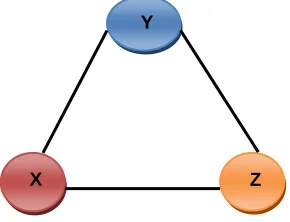
The original routing algorithm, designed in 1969, was a distributed adaptive algorithm using estimated delay as the performance criterion and a version of Bellman-Ford algorithm (DBF) (5). A distributed adaptive algorithm that calculates shortest path between all the pairs of nodes in the dynamic network. The DVA demands each node to keep a distance vector. A distance vector has an entry for every probable destination, consisting of the case of the better usable path to pass the destination and the next hop in the path. The better path can change based on administrative policies like shortest path or lowest cost path. To better illustrate of DVA, Figure (1) explain a sample topology of three nodes. Regard a node X explain in Figure (1) that is concerned with routing to destination Y by its immediately linked neighbor Z.
Figure (1) sample topology of three nodes
Node X's distance table entry, Dx(Y, Z) is the sum of the cost of the direct one hop link between X and Z, c (X, Z), plus neighbor Z's presently known minimum cost path from itself (Z) to (Y) [4] that is:
Dx(Y,Z)=c(X,Z)+minw{D Z
(Y,W)}………….(1)
Then, the Dz (Y, W) is the shortest path from the Z to the neighbor W. A simple algorithm can calculate the metrics based on this precept. Immediately connected networks are constantly specified metric 0. DVA does not store information about a route to calculate a minimum cost, while it calculates the cost gradually. Whenever DVA sees a route with a smaller metric than the one in its table, it substitutes it with the new one. However, the nodes will
Y
X Z
______________________________
Asmaa Shaker Ashoor
Babylon of University
choose the shortest route for information about various paths [3, 6].
4.
Links-State Algorithm
In the LSA each node keeps a perfect picture of the network topology with a cost for each link (1, 2). For that, to maintain these views up-to-date, each node orderly broadcast the local case of every node to every other node in the network utilizing a protocol like flooding. Hence, that every node informs the topology of the network and the case of every link. The algorithm is identified as observed:
Detected each node its neighbors and the matching link costs.
Each node propagates this information to all other nodes (utilizing flooding). The requisite estimate of flooding is that each node follows its link case information to its integral, immediate connected links and each node receives this information, following it out on its integral links exclude for the one that sent the information (1, 2). This procedure goes on until the information has passed all the nodes in the network.
Utilizes each node link state packet (LSP) from all other nodes to calculate map of network and better routes to any destination utilizing one of the shortest-path algorithms from graph theory. To calculate the shortest path from a given source node to all other nodes by developing the paths in order of increasing path length uses Dijkstra's algorithm (5).
5. Comparison LSA and DVA
There are similarities and differences are linked with the two adaptive routing algorithms, which are LSA & DVA. In LSA, each node has a calculate picture of the each network topology. Each node examines the cost of the link to each of its neighbor nodes and floods periodically
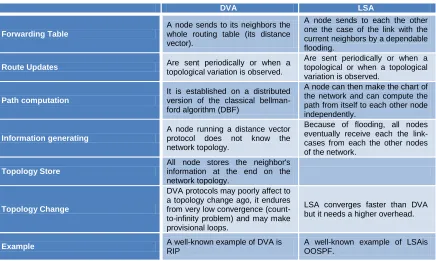
updated information to all other nodes in the network. After each node receives this updated information about the cost of each link in the network, each node calculates the shortest path to each potential destination. When each node needs to forward a packet to some destination, it transmits the packet to the next hop node based on the best path to the destination acquired from the update information. In general, compared to the distance vector algorithm, this protocol requires more CPU time for computing the complete shortest route to each potential destination and more network bandwidth for sending the routing updates from each node to all other nodes in the all network. Each node in DVA has information about neighboring nodes exclusively, hence to calculate the route on distributed way. Therefore, the two routing algorithms can be like in the following phases. They are both dynamic routing algorithms that are every node preserve up-to-date information in terms of the best passing any other destination in the network. Every node in the network incessantly observes variation in topology and it knows the other nodes of those cases utilizing route updates. The network has the most current picture of the network topology at every node, so every node can be capable to make the best routes at any time. Therefore, in LSA, every node must have whole information about other nodes in the network. It stores each topology information at every node. It computes the route from the source to the destination at the center. While, in DVA all nodes have information about neighboring nodes only. It computes the route on distributed mode(7,8). In the table 1.1 explain a abbreviate characterized of some of the primary specifications of these algorithms. The comparisons explain standard and some of the suitable specifications that a routing algorithm should achieve for in the dynamic manner environment(9,10).
DVA LSA
Forwarding Table
A node sends to its neighbors the whole routing table (its distance vector).
A node sends to each the other one the case of the link with the current neighbors by a dependable flooding.
Route Updates Are sent periodically or when a topological variation is observed.
Are sent periodically or when a topological or when a topological variation is observed.
Path computation
It is established on a distributed version of the classical bellman-ford algorithm (DBF)
A node can then make the chart of the network and can compute the path from itself to each other node independently.
Information generating
A node running a distance vector protocol does not know the network topology.
Because of flooding, all nodes eventually receive each the link-cases from each the other nodes of the network.
Topology Store
All node stores the neighbor's information at the end on the network topology.
Topology Change
DVA protocols may poorly affect to a topology change ago, it endures from very low convergence (count-to-infinity problem) and may make provisional loops.
LSA converges faster than DVA but it needs a higher overhead.
Example A well-known example of DVA is RIP
A well-known example of LSAis OOSPF.
0 5 10 15 20 25 30 35 40
C
on
v
e
rg
e
nc
e
T
im
e
No. of Nodes LSA DVA
0 5 10 15 20 25 30 35 40
C
onv
e
rg
e
nc
e
T
im
e
No. of Nodes
LSA DVA
6. Simulation Method of Topology
In this paper, simulation work beginning with four nodes completely connected topology mesh, five nodes and so until the numbers of nodes up to 13 nodes. A simulator of the network supplies appropriate manner to estimate and check a network protocol's implementation before it utilized in the real network. In this simulation, we want to carry out comprehensively simulations to assure the veracity and generality of the results. A simulation is to take a packet from a source nodes function and transfer it to the destination node functions. Moreover, links are warranted to transfer packets in order and without loss. Thus, to prepare the estimate more efficient, we analyze the results with the assist of statistical to guarantee the illustrations of the results are proper.
7. Analysis the results work
In this paper, a simulation experiments between two adaptive routing algorithms LSA & DVA by using variety mesh topologies. The network topology of simulator model starts out with four nodes and increments them, to reach sequence, to third nodes in which the cost of outgoing link is variable from that of the cost of incoming links. This study was done only in two cases. In the first case we explain, the cost of a link has been changed and in the second case we explain, when a link has failed. So note that the DVA broadcasts the updated information only to
those nodes, which are fluctuate by the single link-cost change. Thus, the total number of packets sent from the node can be varied from that of those received by some other nodes. On the other hand, explain fixed manner roughly of the LSA because the same link-cost update must be sent to each the node. All changes in two algorithms prepare one at a time and the algorithms have time to converge before the next change happens.Therefore, the following parameters are used to compare between these algorithms, to make this evaluation more effective: Time to converge, number of steps to reach the convergence, total number of messages: (number of messages sent by each node, the number of messages received by each node), time delay for each packet sent. We can show simulation model results for two adaptive routing algorithms (DVA & LSA). First one, we can compute the time that the algorithms take to pass the convergence, for that case the algorithm stops sending and receiving packets, for that there is no packet in the medium, each packet are sent, and it will be prepared to represent with any occurs varieties or failures in the links. Each the computations have been made in two stages. When the cost of the link is changed and in case of link failure. All changes are performed one by one at a time and the algorithms have time to converge before the next change can occur.
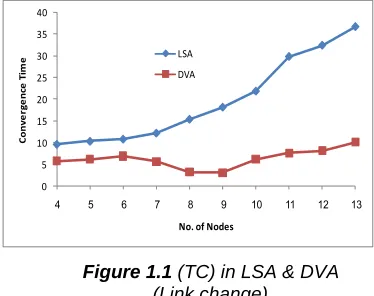
Figure 1.1 (TC) in LSA & DVA Figure 1.2 (TC) in LSA & DVA (Link change) (Link failure)
The two algorithms in the Figure 1.1 & Figure 1.2 looking for about the other links from that node to other nodes. Recalculates the shortest path to each node in the network for LSA, it engages more time to pass the convergence time. For that, this time will increments with the increments in topology size. Whereas, DVA re-calculates the path only to some destination, therefore it appears to be better than LSA. Thus, it does not need more time to pass to the
0 50 100 150 200 250 300
Tot
al
no
.
of
M
e
ss
ag
e
s
se
nt
No. of Nodes
LSA DVA
0 50 100 150 200 250
Tot
al
no.
of
M
e
ss
ag
e
s
Se
nt
No. of Nodes
LSA DVA
0 50 100 150 200 250
N
o.
of
S
te
ps
No. of Nodes
LSA DVA
0 50 100 150 200 250
N
o.
of
S
te
ps
No. of Nodes
LSA DVA
0.8 0.9 1 1.1 1.2 1.3 1.4 1.5
A
ve
ra
ge
D
e
la
y
No. of Nodes
LSA DVA
0.5 0.8 1.1 1.4 1.7 2 2.3
A
ve
ra
ge
D
e
la
y
No.of Nodes
LSA DVA
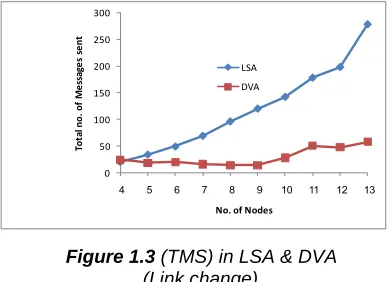
Figure 1.3 (TMS) in LSA & DVA Figure 1.4 (TMS) in LSA & DVA (Link change) (Link failure)
In the Figure 1.4 illustrates No. of nodes versus Total Message Sent (TMS). Moreover, these patterns are utilized to present expected value of any number of nodes. The algorithms have time to converge before the next change can happen and all changes are executed one by one at a
time. The Figure 1.5 illustrates the number of steps for LSA increments when the size of topology increments. Furthermore, the patterns can be utilized to give an expected value for any number of nodes verses the number of steps needed.
Figure 1.5 No. of steps Figure 1.6 No. of steps convergence in LSA & DVA convergence in LSA & DVA
(link change) (link failure)
Furthermore, we can calculate the average delay each packet required to pass the destination. For that, we can illustrate the computation in Figures 1.7 & 1.8 when the cost of the link is changed and when the link failure by using the patterns for the average time delay. The Figure 1.7 illustrates that there is no big difference in time delay
between the two algorithms in case of link change and Figure 1.8 illustrate the results of time delay between the two algorithms in case of link failure. Furthermore, these Figures below illustrate that the DVA is better than the LSA.
Figure 1.7 (ADT) for LSA & DVA Figure 1.8 (ADT) for LSA & DVA (Link change) (Link failure)
8. Related Work
Different characteristics of LSA and DVA protocols are introduced in [11]. It besides mentions modifications to the basic DVA protocol that presents DVA best suitable for the Internet[12]. Introduced a performance analysis of an effective distance vector based routing protocol. Lately,
9. Conclusion
In this paper, to compare between two adaptive routing algorithms, DVA distributed algorithm and LSA centralized algorithm they are based on the most routing algorithms utilities in the internet. The DVA distributed algorithms need some calculation for every node in the network, but centralized algorithms are fast to pass to network changes and have a chance of failure in this algorithm slight. In DVA, each node has local information, but in LSA, each node has general information and also, DVA is utilities to update link case table. In this paper, illustrate simulation for dissimilar network sizes as mesh topology with estimate to dissimilar parameters, which are convergence time, number of steps to pass a convergence, average delay. The simulation results illustrate that the DVA is best convergence than LSA and it takes a number of steps to pass convergence, on the other hand, the DVA is better than LSA in average delay and the traffic load by sending and receiving messages. Moreover, the DVA give better results than LSA because it does not require storing all topology information as LSA does for mesh topology. Then the results illustrate, DVA has the step by step for this type of a network.
References
[1] Larry L. Peterson, Bruce S. Davie, "Computer Networks: A Systems Approach," 3rd Edition, Morgan Kaufmann, MIT, 2003.
[2] Andrew S. Tanenbaum, "Computer Networks, "Fourth Edition, New jersey, Prentice Hall, Inc., 2003.
[3] James F. Kurose & K. W. Ross, "Computer Networking: A Top-down Approach Featuring the internet," 2nd Ed, Peaison Education Asia, 2003.
[4] V. Gambiroza, P. Yuan, L. Balzano, Y. Liu, S. Sheafor, and E. Knightly, "Design, Analysis, and Implementation of DVSR: A Fair High-Performance Protocol for packet Rings," In IEEE/ACM Transaction on Network, Vol. 12, No. 1, 2004.
[5] William Stalling, "Data and Computer Communications, pearson Education, Inc., Publishing as Prentice Hall, New Jersey, 2011.
[6] Z.Xu and et.al, "A more Efficient Distance Vector Routing Algorithm," In proc. IEEE MILCOM '97 Proceeding, Vol.2, 1997.
[7] Roch Guerin and Ariel Orda, " Computing Shortest Paths for any Number of Hops," In IEEE Transaction on Network, Vol. 10, No. 5, 2002.
[8] T.H Comrmen, C.E. Leiserson, and R.L. Rivest, "An Introduction to Algorithms," Second Edition, MIT Press, Boston, 2002.
[9] Y. Mourtada,"Routing Basics & Protocol," Internet draft, 2000.
[10]D. Bertsekas And R. Gallager, "Data Network," Prentice-Hall Inc, 2nd edition, 1992.
[11]Distributed Scalable Routing Based on Link State Vectors’, Jochen Behrens, J.J.Garcia-Luna-Aceves, 1994.
[12]S. Keshav. An Engineering Approach to Computer Networks. Addison-Wesley Publishing Company, 1997.
[13]Udaya Shankar, Cengiz Alaettinoglu, Ibrahim Matta,and Klaudia Dussa-Zieger. Performance comparison of routing protocols using mars: Distance-vector versus linkstate. At ACM SIGMETRICS Conference on Performance, June 1992.
[14]Labovitz, G. Malan, and F. Jahanian. Internet routing instability. IEEE/ACM transactions on Networking, 1998.
[15]Craig Labovitz, Abha Ahuja, and Farnam Jahanian. Experimental study of internet stability and wide-area backbone failures. In FTCS, 1999.