Prospective Study of Sunburn and Sun Behavior
Patterns During Adolescence
WHAT’S KNOWN ON THIS SUBJECT: Childhood UV light exposures, specifically sunburns, have been shown to be associated with melanoma development later in life.
WHAT THIS STUDY ADDS: To date, most studies in this age group have been cross sectional in nature. This is thefirst prospective study of sunburn and sun behaviors in this age group.
abstract
OBJECTIVES:Early childhood UV light radiation (UVR) exposures have been shown to be associated with melanoma development later in life. The objective of this study was to assess sunburn and changes in sun-burn and sun behaviors during periadolescence.
METHODS:A prospective, population-based study was conducted infi fth-grade children (∼10 years of age) from Framingham, Massachusetts. Surveys were administered at baseline (September–October 2004) and again 3 years later (September–October 2007). Surveys were analyzed to assess prevalence of reported sunburn and sun behaviors and to examine changes in response over the follow-up period.
RESULTS:Data were analyzed from 360 participants who had complete information regarding sunburn at both time points. In 2004,∼53% of the students reported having at least 1 sunburn during the previous
summer, and this proportion did not significantly change by 2007
(55%, P = .79), whereas liking a tan and spending time outside to
get a tan significantly increased (P,.001). In 2004, 50% of students reported“often or always”use of sunscreen when outside for at least 6 hours in the summer; this proportion dropped to 25% at the follow-up evaluation (P,.001).
CONCLUSIONS: With at least 50% of children experiencing sunburns before age 11 and again 3 years later, targeting children in pediatric
offices and community settings regarding unprotected UV exposure
may be a practical approach. Because periadolescence is a time of volatility with regard to sun behaviors, learning more about children who receive sunburns versus those who avoid them is a critical re-search task. Pediatrics2012;129:309–317
AUTHORS:Stephen W. Dusza, DrPH,aAllan C. Halpern, MD,a
Jaya M. Satagopan, PhD,bSusan A. Oliveria, ScD, MPH,a
Martin A. Weinstock, MD, PhD,c,d,eAlon Scope, MD,a
Marianne Berwick, PhD, MPH,fand Alan C. Geller, RN, MPHg
aDepartment of Medicine, Dermatology Service, andbDepartment
of Epidemiology and Biostatistics, Memorial Sloan-Kettering Cancer Center, New York, New York;cDermatoepidemiology Unit,
VA Medical Center Providence, Providence, Rhode Island;
dDepartment of Dermatology, Rhode Island Hospital, Providence,
Rhode Island;eDepartments of Dermatology and Epidemiology,
Brown University, Providence, Rhode Island;fDivision of
Epidemiology and Biostatistics, University of New Mexico, Albuquerque, New Mexico; andgSociety, Human Development, and
Health, Harvard School of Public Health, Boston, Massachusetts
KEY WORDS
sunburn, suntan, adolescent, melanoma
ABBREVIATIONS
CI—confidence interval OR—odds ratio UVR—UV light radiation
Drs Dusza, Halpern, Satagopan, Oliveria, Weinstock, Berwick, and Geller made substantial contributions to conception and design and to analysis and interpretation of data; and Drs Dusza and Geller made substantial contributions to acquisition of data. All of the authors contributed to drafting or revising the article for important intellectual content. All authors gavefinal approval of this version of the article to be published. www.pediatrics.org/cgi/doi/10.1542/peds.2011-0104 doi:10.1542/peds.2011-0104
Accepted for publication Oct 12, 2011
Address correspondence to Stephen W. Dusza, DrPH, Memorial Sloan-Kettering Cancer Center, Dermatology Service, 160 East 53rd St, 2ndFloor, New York, NY 10022. E-mail: [email protected] PEDIATRICS (ISSN Numbers: Print, 0031-4005; Online, 1098-4275). Copyright © 2012 by the American Academy of Pediatrics
FINANCIAL DISCLOSURE:The authors have indicated they have nofinancial relationships relevant to this article to disclose.
Melanoma is a significant and growing public health concern with an esti-mated 70 230 incident cases and 8790 associated deaths in the United States
in 2011.1 Between 2004 and 2008 in
the United States, the age-adjusted in-cidence rate was 20.8 per 100 000 men and women per year based on Sur-veillance Epidemiology and End Results (SEER) estimates.2,3 UV light radiation
(UVR) exposure is the most important modifiable melanoma risk factor. Stud-ies have shown that intense, intermit-tent exposures to UVR, as measured by sunburn frequency, have a higher melanoma-attributable risk than chronic UVR exposure.
UVR exposures at an early age are par-ticularly important for the development of cutaneous melanoma in adulthood.4,5
A recent meta-analysis of 51 studies found that ever reporting a sunburn during childhood almost doubled the risk for the development of cutaneous
melanoma in adulthood.6 During the
past decade, there have been numerous public health efforts to increase the use of sun protection at a multitude of sites, including beaches,7 schools,8
pediatri-cian offices,9pools,7and ski slopes,10to
name a few.11–14Despite these efforts,
reported prevalence of recent sunburn in children and adolescents remains high.15Studies in this age group have
shown that skin cancer knowledge increases with age; however, practices often trail behind.16Because of the
im-perative for protecting youth during these years, understanding more about their sun exposure and protection hab-its is critical to effective delivery of this important public health message.
Many of the studies evaluating sun-burning rates in adolescents have been cross-sectional designs, and are subject to limitations. Understanding patterns of UVR exposure during adolescence can inform primary prevention strate-gies. The Study of Nevi in Children is a prospective population-based study
exploring the natural history of nevi in periadolescence. Before receiving pho-tographs and dermoscopic examination of the skin, questionnaires regarding sun exposure and sun behaviors were administered to the study cohort at baseline (fifth grade); photographs and dermoscopic examination of the skin occurred again 3 years later (eighth grade), along with repeat question-naires. We report the results of these questionnaires and explore changes in reported sun exposure, sun behaviors, and attitudes related to sun exposure during this important time of de-velopment.
METHODS
The Study of Nevi in Children (SONIC) is a population-based longitudinal study exploring the natural history of nevi during adolescence. Detailed descrip-tions of the recruitment procedures are described elsewhere.17,18 In brief, all
fifth-grade students (n= 691) and their parents residing in Framingham, Mas-sachusetts, in 2004 were approached for participation in the study. Institu-tional review board approval was pro-vided at Boston University, Harvard School of Public Health, and the Me-morial Sloan-Kettering Cancer Center.
Data on student demographics, in-cluding race/ethnicity, were provided by the school district. Seventy percent of thefifth graders were white, 20.5% were nonwhite Hispanic, 4.3% were black/African American, and 5.2% were Asian American and other. The 2000 US census estimates for children ages 10 to 14 are as follows: white, 63%; nonwhite Hispanic, 17%; black/African American, 16%; and Asian American and other, 4%.19A total of 443 parents
provided consent for their children and 443 students (64%) provided assent to enroll in the study. First, a study nurse
broadly classified each student for
phenotypic characteristics, such as skin color (7-point scale, ranging from
very fair to very dark/black) and hair color (7-point scale, ranging from blonde to black) and recorded these observations on a study data entry form. Students were asked to com-plete a self-administered survey regard-ing sun exposure and sun-protection practices. Survey questions were se-lected from numerous prior studies ex-ploring sun exposure and sun behaviors in children.7,11,12,20
Surveys were distributed to the par-ticipants during the early autumn se-mester in 2004,,1 month after the end of the summer. The surveys included questions regarding sunburning epi-sodes, outdoor exposure, sun behav-iors, and attitudes about tanning during the previous summer. In the autumn semester of 2007, the same instrument was distributed to the cohort (now in eighth grade) for completion. A total of 366 students from the original cohort completed the survey. In both 2004 and 2007, all consented students underwent high-resolution imaging of the back af-ter completion of the survey.
For this study, data obtained from the surveys and the nurse assessments were used. To quantify sunburning, the students were asked,“How many times in the past summer did your skin stay pink or red after going out in the sun?” Responses were recorded on a 5-point scale, ranging from “none” to “5 or
more.” Based on the distribution of
survey responses, sunburning was grouped into 3 levels:“none,” “1,”and
“2 or more.”General outdoor exposure
was assessed with the question, “On
a typical day during the week in the past summer, how many hours did you
spend outside?” The same question
was asked regarding weekend expo-sures. Because weekday and weekend exposures were correlated (Spearman
r = +0.61), a composite variable to
each student by their relative contri-butions. This composite variable was further categorized into low, medium, and high levels of exposure by creating cut points at tertiles of the distribution. Sunscreen use when outside for at least 6 hours in the summer was assessed on a 5-point Likert scale, ranging from
“never” to “always.” Responses were further categorized to 2 categories, combining never, rarely, and sometimes, versus often and always. Students were also asked if they got a tan, spent time in the sun to get a tan in the previous summer, and whether they liked a tan. The potential responses to these ques-tions were yes and no.
Descriptive statistics were used to characterize the study population and
survey responses. Pearson x2 tests
were used to evaluate differences in participant characteristics for those who were retained between baseline (2004) and follow-up (2007) and those who were lost to follow-up. To assess change in reported sunburn, sun be-haviors, and tanning attitudes between baseline and follow-up, univariate anal-yses of the paired responses were com-pleted using the McNemar test or the Stuart-Maxwell statistic for variables coded on 3 or more levels. In addition, a dichotomous variable was created and coded as 0 for participants who did not report an increase in sunburn between baseline and follow-up eval-uations and 1 for those who did. Lo-gistic regression models were used to assess the association between in-creased sunburn and participant char-acteristics, behaviors, and attitudes. To assess the change in sunburning and sun behaviors in this cohort, random-effect logistic regression models were used. Assessment time point was used at the outcome variable, where baseline (2004) was coded as 0 and follow-up (2007) was coded as 1. In these mod-els, factors such as skin color, race, and gender do not vary between time points,
and hence are not included as potential covariates. To assess potential effect modification, interaction terms were created and models stratified by stu-dent gender and skin color were ex-plored. In these analyses, the student identification variable was included in the model as a random effect. All sta-tistical analyses were performed in Stata v.10.1 (Stata Corp, College Station, TX).
RESULTS
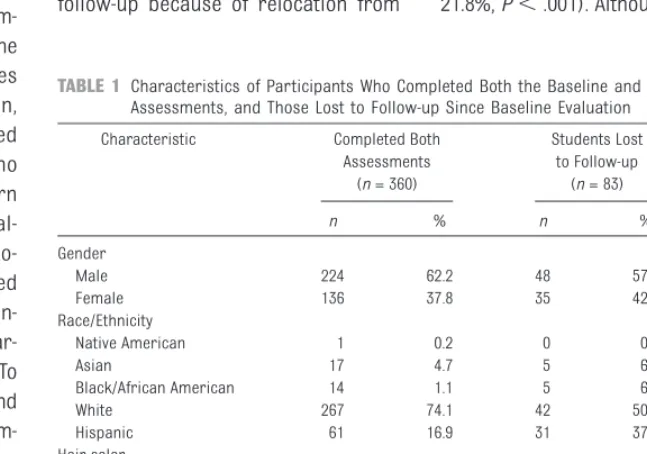
A total of 366 students were evaluated both at baseline, September to October 2004, and follow-up assessments, Sep-tember to October 2007. Of these, 360 had complete information regarding sun protection, sun exposure, and sunburn at both time points. Thefinal analysis is based on the 360 paired observations. Table 1 presents the de-mographic characteristics of the study population. Most of these students were male (62%), white (74%), and had
“very fair” to“fair” skin color (68%). A total of 83 students completed the 2004 assessment but were lost to follow-up because of relocation from
the Framingham area. At baseline, the students who were lost to follow-up in 2007 were more likely to report
be-ing “nonwhite” as reported by the
school district, and accordingly had a darker phenotype. Retention rates were similar for male and female study participants. The average age of the cohort at baseline was 10 years 8 months (SD = 4 months) and 13 years 8 months (SD = 4 months) at the follow-up assessment.
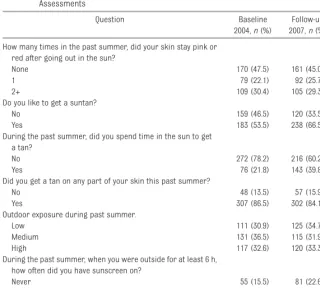
Sunburn, Sun Behaviors, and Sun Attitudes at Baseline and Follow-up In 2004,∼53% of the students reported having at least 1 sunburn during the summer, and there was little change at follow-up evaluation (Table 2). Many other sun-related behaviors and atti-tudes changed substantially. For exam-ple, 53% of students reported “liking a tan” at baseline; this proportion in-creased to 66% 3 years later (P,.001). Similarly, a higher proportion of stu-dents reported spending time in the sun to get a tan at the follow-up evalu-ation compared with baseline (39.8% vs 21.8%,P,.001). Although participants
TABLE 1 Characteristics of Participants Who Completed Both the Baseline and Follow-up Assessments, and Those Lost to Follow-up Since Baseline Evaluation
Characteristic Completed Both Assessments
(n= 360)
Students Lost to Follow-up
(n= 83)
Pa
n % n %
Gender
Male 224 62.2 48 57.8 .46 Female 136 37.8 35 42.2
Race/Ethnicity
Native American 1 0.2 0 0.0 ,.001 Asian 17 4.7 5 6.0
Black/African American 14 1.1 5 6.0 White 267 74.1 42 50.6 Hispanic 61 16.9 31 37.3 Hair color
Blonde/Light brown/Red 155 43.1 12 14.4 ,.001 Medium brown 101 28.0 28 33.7
Dark brown/Black 104 28.9 43 51.8 Skin color
Very fair/Fair 244 67.8 33 39.8 ,.001 Light olive/Light brown 81 22.5 36 43.4
reported increases in liking a tan and spending time in the sun to get a tan, no overall differences were observed for getting a tan or for the amount of total outdoor exposure between baseline and follow-up. Student responses indicate a sharp decrease in the use of sun-screen between baseline and follow-up. At baseline, 50% of students reported
“often or always” use of sunscreen
when outside for at least 6 hours in the summer; this proportion dropped to 25% at the follow-up evaluation 3 years later (P,.001).
Sunburns Stratified by Student Characteristics, Behaviors, and Attitudes
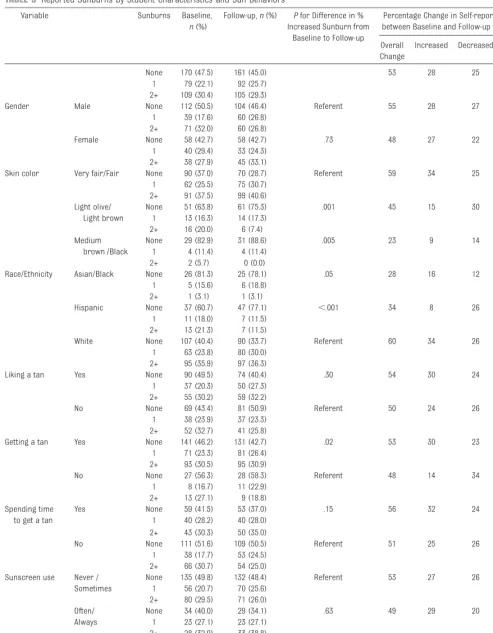
Table 3 presents self-reported sunburn stratified by student characteristics, sun behaviors, and attitudes. Overall, during this period, 28% of children in-creased their number of sunburns, 25% experienced a decrease, and 47%
had no change. Subgroups at highest risk of skin cancer experienced the sharpest increase in sunburns. For ex-ample, 34% of respondents with“very fair to fair”skin reported increased sunburning by follow-up; in contrast,
only 15% of respondents with “light
brown to light olive”skin reported more sunburns (P, .001). A similar trend was observed for race/ethnicity, where
“white” participants were more likely to report an increase in sunburning by the follow-up evaluation, whereas“ His-panics”reported a significant decrease in sunburn (P, .001). Similarly, chil-dren who got a tan versus those who did not were more likely to increase their number of sunburns (P= .02).
Sunburn, Sun Behaviors, and Sun Attitudes Stratified by Student Gender and Skin Color
Homogeneity of effect for sunburns, sun behaviors, and sun attitudes was
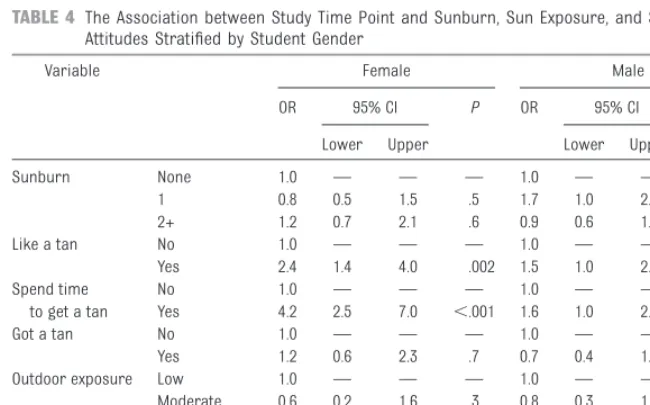
evaluated by student gender and skin color. Since interaction terms for (1) stu-dent gender and spending time in the sun, and (2) skin color and reported sunburn indicated the presence of statistical interaction, with P-values of 0.005 and 0.007, respectively, stratified results are presented in Tables 4 and 5. Girls were more than 2 times more likely (odds ratio [OR] = 2.4; 95%
con-fidence interval [CI]: 1.4–4.0) to report liking a tan in 2007 compared with 2004 (Table 4). They were also significantly more likely in 2007 to report spending time in the sun in the previous summer to get a tan (OR = 4.2; 95% CI: 2.5–7.0, Table 4). Similarly, boys were also more likely to report liking a tan (OR = 1.5; 95% CI: 1.0–2.2) and spending time in the sun to get a tan (OR = 1.6; 95% CI 1.0–2.5) in 2007 compared with 2004; however, there was not a significant increase in actually getting a tan be-tween baseline and follow-up evalua-tions. A dramatic reduction in reported sunscreen use between 2004 and 2007 was observed for both girls and boys, with girls being 60% less likely to report
“often or always”sunscreen use when at the beach or pool during the past summer (OR = 0.4; 95% CI: 0.2–0.6), and boys 70% less likely (OR = 0.3; 95% CI: 0.2–0.4) compared with their baseline responses. For boys and girls, reports of getting a tan did not increase.
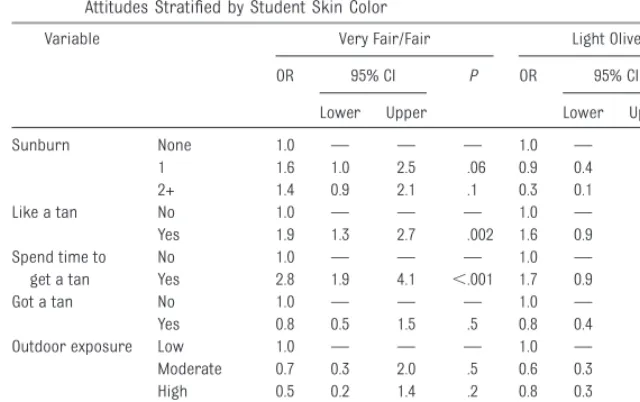
Students with very fair to fair skin were 40% more likely to report 2 or more sunburns in 2007 than 2004 (OR = 1.4; 95% CI: 0.9–2.1, Table 5), whereas those students with light olive to black skin were 70% less likely to report 2 or more burns at follow-up compared with baseline (OR = 0.3; 95% CI: 0.1– 0.8). The other sun behaviors and sun attitudes did not differ in magnitude between skin colors.
DISCUSSION
The purpose of this study was to assess self-reported sunburn, sun behaviors, TABLE 2 Reported Sunburn and Sun Behaviors at Baseline (2004) and Follow-up (2007)
Assessments
Question Baseline 2004,n(%)
Follow-up 2007,n(%)
Pa
How many times in the past summer, did your skin stay pink or red after going out in the sun?
None 170 (47.5) 161 (45.0) .79 1 79 (22.1) 92 (25.7) 2+ 109 (30.4) 105 (29.3) Do you like to get a suntan?
No 159 (46.5) 120 (33.5) ,.001 Yes 183 (53.5) 238 (66.5)
During the past summer, did you spend time in the sun to get a tan?
No 272 (78.2) 216 (60.2) ,.001 Yes 76 (21.8) 143 (39.8)
Did you get a tan on any part of your skin this past summer?
No 48 (13.5) 57 (15.9) .39 Yes 307 (86.5) 302 (84.1) Outdoor exposure during past summer.
Low 111 (30.9) 125 (34.7) .55 Medium 131 (36.5) 115 (31.9) High 117 (32.6) 120 (33.3) During the past summer, when you were outside for at least 6 h,
how often did you have sunscreen on?
Never 55 (15.5) 81 (22.6) ,.001 Rarely 47 (13.2) 89 (24.9)
Sometimes 76 (21.4) 103 (28.8) Often 108 (30.3) 54 (15.1) Always 70 (19.7) 31 (8.7)
aPvalue based on the paired comparison from baseline to follow-up evaluation. For dichotomous variables, the McNemar’s
TABLE 3 Reported Sunburns by Student Characteristics and Sun Behaviors
Variable Sunburns Baseline,
n(%)
Follow-up,n(%) Pfor Difference in % Increased Sunburn from
Baseline to Follow-up
Percentage Change in Self-reported Sunburn between Baseline and Follow-up Assessments
Pa
Overall Change
Increased Decreased Remained the Same None 170 (47.5) 161 (45.0) 53 28 25 47 .79
1 79 (22.1) 92 (25.7) 2+ 109 (30.4) 105 (29.3)
Gender Male None 112 (50.5) 104 (46.4) Referent 55 28 27 45 .92 1 39 (17.6) 60 (26.8)
2+ 71 (32.0) 60 (26.8)
Female None 58 (42.7) 58 (42.7) .73 48 27 22 52 .49 1 40 (29.4) 33 (24.3)
2+ 38 (27.9) 45 (33.1)
Skin color Very fair/Fair None 90 (37.0) 70 (28.7) Referent 59 34 25 41 .09 1 62 (25.5) 75 (30.7)
2+ 91 (37.5) 99 (40.6) Light olive/
Light brown
None 51 (63.8) 61 (75.3) .001 45 15 30 55 .02 1 13 (16.3) 14 (17.3)
2+ 16 (20.0) 6 (7.4) Medium
brown /Black
None 29 (82.9) 31 (88.6) .005 23 9 14 77 .28 1 4 (11.4) 4 (11.4)
2+ 2 (5.7) 0 (0.0)
Race/Ethnicity Asian/Black None 26 (81.3) 25 (78.1) .05 28 16 12 72 .74 1 5 (15.6) 6 (18.8)
2+ 1 (3.1) 1 (3.1)
Hispanic None 37 (60.7) 47 (77.1) ,.001 34 8 26 66 .01 1 11 (18.0) 7 (11.5)
2+ 13 (21.3) 7 (11.5)
White None 107 (40.4) 90 (33.7) Referent 60 34 26 40 .26 1 63 (23.8) 80 (30.0)
2+ 95 (35.9) 97 (36.3)
Liking a tan Yes None 90 (49.5) 74 (40.4) .30 54 30 24 46 .52 1 37 (20.3) 50 (27.3)
2+ 55 (30.2) 59 (32.2)
No None 69 (43.4) 81 (50.9) Referent 50 24 26 50 .65 1 38 (23.9) 37 (23.3)
2+ 52 (32.7) 41 (25.8)
Getting a tan Yes None 141 (46.2) 131 (42.7) .02 53 30 23 47 .16 1 71 (23.3) 81 (26.4)
2+ 93 (30.5) 95 (30.9)
No None 27 (56.3) 28 (58.3) Referent 48 14 34 52 .03 1 8 (16.7) 11 (22.9)
2+ 13 (27.1) 9 (18.8) Spending time
to get a tan
Yes None 59 (41.5) 53 (37.0) .15 56 32 24 44 .29 1 40 (28.2) 40 (28.0)
2+ 43 (30.3) 50 (35.0)
No None 111 (51.6) 109 (50.5) Referent 51 25 26 49 .54 1 38 (17.7) 53 (24.5)
2+ 66 (30.7) 54 (25.0) Sunscreen use Never /
Sometimes
None 135 (49.8) 132 (48.4) Referent 53 27 26 47 .76 1 56 (20.7) 70 (25.6)
2+ 80 (29.5) 71 (26.0) Often/
Always
None 34 (40.0) 29 (34.1) .63 49 29 20 51 .26 1 23 (27.1) 23 (27.1)
2+ 28 (32.9) 33 (38.8)
Outdoor Exposure Low None 57 (46.0) 61 (48.8) .25 49 22 27 51 .42 1 27 (21.8) 30 (24.0)
2+ 40 (32.3) 34 (27.2)
Medium None 50 (43.5) 50 (43.5) .20 59 30 29 41 .72 1 29 (25.2) 33 (28.7)
2+ 36 (31.3) 32 (27.8)
and sun exposure among the same children during periadolescence. We found that students, regardless of skin color or gender, reported more time spent in the sun to get a tan and in-creased positive tanning attitudes by our follow-up evaluation; however, we did not observe a commensurate in-crease in reported burning or tanning. Overall, we found that rates of sunburn, which exceeded 50% at around age 11, remained high at our follow-up evalu-ation 3 years later.
This study describes a period of notable changes in tan-promoting attitudes and practices, whereby half of children using sunscreen routinely in 2004 no longer did so in 2007. In fact, only 25% of children in this population-based sample were still using sunscreen routinely in 2007. We did not observe an increase in sunburning rates during
these 3 years and this may be explained
by the fact that students’ reported
number of hours of sun exposure did not increase. The observation that more than 50% of the children received sun-burns in both the summers of 2004 and 2007 is troublesome. However, efforts should be made to intensify current sun-protection programs while devising new and creative messages for children of this age, especially because the use of tanning beds, particularly for girls, begins at age 14.21A recent review of
sun behavior counseling in children highlights the difficulties of changing these behaviors, but demonstrates that it is possible to decrease midday sun exposure and increase sunscreen use via counseling in the primary care setting.22With more than 80% of
chil-dren in 2004 and 2007 reporting that they got a tan the previous summer
and tan-promoting attitudes and prac-tices increasing substantially from ages 11 to 14, new approaches must be taken to discourage tan-promoting attitudes that drive the desire for tan
seeking from natural and artificial
sources of UVR.
Melanoma incidence continues to rise and sunburns have been consistently shown to be an important risk factor for melanoma development. Attitudes re-garding intentional tanning have im-portant implications for the effective delivery of primary prevention cam-paigns. There is mounting evidence that excessive UVR exposure, particularly during youth, is shifting some of the melanoma burden to younger popula-tions.23One of the hypothesized reasons
for this has been increased intentional UVR exposure (ie, tanning and tanning bed use). The current public health pri-mary prevention message for skin can-cer is focused on sun protection, and a large proportion of that is sunscreen use. Sunscreen is the most common form of sun protection for children and parents18,24,25and to date is the only
sun-protection measure to demonstrate a reduction in melanoma incidence in
a randomized trial.26 Determining
current gaps and deficits in the use of sunscreen will be useful in targeting future interventions to children and their families, to promote proper sun-screen use and, by extension, likely provide important insights into the overall use of sun protection.
Sunburn is an observable response to a high dose of UVR and is implicated in TABLE 3 Continued
Variable Sunburns Baseline,
n(%)
Follow-up,n(%) Pfor Difference in % Increased Sunburn from
Baseline to Follow-up
Percentage Change in Self-reported Sunburn between Baseline and Follow-up Assessments
Pa
Overall Change
Increased Decreased Remained the Same 1 23 (19.3) 30 (25.0)
2+ 33 (27.7) 39 (32.5)
Percentage change in reported sunburns for each category is based on the paired observations from baseline and follow-up evaluations.
aPvalue based on the paired comparison from baseline to follow-up evaluation. For dichotomous variables, the McNemar test was used. For variables with 3 or more categories, the
Stuart-Maxwell statistic was calculated.
TABLE 4 The Association between Study Time Point and Sunburn, Sun Exposure, and Sun Attitudes Stratified by Student Gender
Variable Female Male OR 95% CI P OR 95% CI P
Lower Upper Lower Upper Sunburn None 1.0 — — — 1.0 — — —
1 0.8 0.5 1.5 .5 1.7 1.0 2.7 .04 2+ 1.2 0.7 2.1 .6 0.9 0.6 1.4 .7 Like a tan No 1.0 — — — 1.0 — — —
Yes 2.4 1.4 4.0 .002 1.5 1.0 2.2 .04 Spend time
to get a tan
No 1.0 — — — 1.0 — — — Yes 4.2 2.5 7.0 ,.001 1.6 1.0 2.5 .03 Got a tan No 1.0 — — — 1.0 — — —
Yes 1.2 0.6 2.3 .7 0.7 0.4 1.2 .2 Outdoor exposure Low 1.0 — — — 1.0 — — —
Moderate 0.6 0.2 1.6 .3 0.8 0.3 1.8 .5 High 0.6 0.3 1.5 .3 0.6 0.3 1.4 .3 Sunscreen use Never /
Sometimes
the chain of causation leading to skin cancer. Therefore, a key priority for skin cancer prevention programs should be to understand the factors needed to reduce the occurrence of sunburn; in particular, frequent sunburns that are strongly implicated in the development of skin cancer, especially melanoma. One possible yardstick for the success of a specific sun-protection program is its ability to influence behaviors of at-risk children. Rates of sunburning found in this current study fall within those reported in the literature, ac-counting for differences in the ages and specific wording from other sur-veys. In a national survey of children ages 11 to 18, Cokkinides et al15found
the prevalence of sunburn to be 72% in 1998 and 69% in 2004. Higher rates of sunburning (83%) were found among children of nurses. Hall et al27
reported the prevalence of sunburn in the previous summer was 46.2%, but the cohort was younger and this study showed an increasing prevalence with age.
In prior studies, the relationship be-tween the occurrence of sunburns and the use of sun protection has been mixed. A national study of the parents of younger children (ages 6 months to 11 years)
found that among children who burned, 64% had 1 sunburn, 21% had 2 sunburns, and 16% had 3+ sunburns. Sunburning was less common in children who always used sunscreen and who never used sunscreen, compared with those who often, sometimes, or rarely used sun-screen.27In a national study of older
children (ages 11–18), Davis et al28
found that children who never, rarely, or sometimes used sunscreen were more likely than often or always users to have had 5+ sunburns compared with no sunburns. In a study of the
correlates of sunburn, Hall et al27
found the reduced likelihood of sun-burning among people who wore hats always, or most of the time; however, there were no differences by sunscreen use.
There were several limitations of this study. First, obtaining accurate and objective assessments of UVR exposure is difficult. In this study, all sun behav-iors are self-reported. Self-reported sun behaviors have been shown to have fair to moderate agreement with direct observation, and in these stud-ies there was no substantial over-reporting or underover-reporting of sun behaviors.29Second, by 2007, 19% of
the students were no longer in the
study, and a disproportionate percent-age of these participants were “ non-white.” Although darker phenotype is generally protective against skin
can-cer, this understudied population
could have provided unique and in-valuable information regarding sun behaviors. Third, it was beyond the scope of this study to ascribe reasons for the drop in sunscreen use during these 3 years. We did not include questions on peer or parent infl uen-ces30–32 or the potential effect news
stories highlighting the benefits of vitamin D and the downsides of sun-screen may have played a role. Fu-ture studies should explore reasons for decline in the use of sunscreen. Fourth, the children who participated in this study were aware that the goal was to examine their moles and to undergo photographic evaluation of their entire back. The nurse evalua-tion and photography occurred im-mediately after completing the baseline
survey as fifth graders. Although no
education on sun protection was pro-vided, there is the possibility that some children may have changed their sun practices as a result of greater attention to their moles; however, this is unlikely, as we observed a precipitous drop in sunscreen use over the study follow-up period. We also did not collect any in-formation on the school’s sun-protection policies and practices, and are un-aware if these policies changed over the course of the study follow-up period. Study participation was strongest among white boys and weakest among girls and Hispanic children. Anecdot-ally, some of the parents of girls who did not participate commented that their daughters were reluctant to show their backs, particularly in the pres-ence of a male photographer. Major strengths include the population-based sampling, the prospective study de-sign, the retention of 86% of the white children for 3 years, survey comple-tion soon after the end of the summer, TABLE 5 The Association Between Study Time Point and Sunburn, Sun Exposure, and Sun
Attitudes Stratified by Student Skin Color
Variable Very Fair/Fair Light Olive/Black OR 95% CI P OR 95% CI P
Lower Upper Lower Upper Sunburn None 1.0 — — — 1.0 — — —
1 1.6 1.0 2.5 .06 0.9 0.4 1.9 .8 2+ 1.4 0.9 2.1 .1 0.3 0.1 0.8 .01 Like a tan No 1.0 — — — 1.0 — — —
Yes 1.9 1.3 2.7 .002 1.6 0.9 2.7 .08 Spend time to
get a tan
No 1.0 — — — 1.0 — — — Yes 2.8 1.9 4.1 ,.001 1.7 0.9 3.0 .08 Got a tan No 1.0 — — — 1.0 — — —
Yes 0.8 0.5 1.5 .5 0.8 0.4 1.5 .5 Outdoor exposure Low 1.0 — — — 1.0 — — —
Moderate 0.7 0.3 2.0 .5 0.6 0.3 1.4 .2 High 0.5 0.2 1.4 .2 0.8 0.3 1.7 .5 Sunscreen use Never/
Sometimes
and the opportunity to simultaneously assess sun-protection practices, sun ex-posure, and rates of sunburn.
CONCLUSIONS
Melanoma is 1 of the 2 most common cancers of young Americans,33
there-fore establishing comprehensive sun-protection practices at early ages are
strongly needed. We have identified
a crucial period of periadolescence in which students increase time spent in the sun to get a tan and strengthen tan-promoting attitudes. Rates of sun-burn, which exceeded 50% at age 11, remained high at our follow-up evalu-ation 3 years later. Furthermore, we
have shown that the time between ages 11 and 14 is one of volatility, as more than 50% of at-risk children increase or decrease their use of sun protection, obtain sunburns, or change their tan-promoting attitudes. Of most concern, it appears that groups at highest risk of skin cancer, very fair/fair children and those who obtained tans, were more likely to increase their number of sunburns during this crucial period.
Along with educational efforts in physicians’offices and schools, further studies are required to learn how to interweave enhanced sun-protection policies in settings such as beaches, after-school sites, and sporting events
frequented by preadolescents and adolescents. Adolescence and teenage years are tremendously difficult because it is a period offlexing independence, coupled with feelings of invincibility. With at least 50% of children experiencing sunburns before age 11, complementing outreach to adolescents by targeting children at an earlier age is a potential approach.
ACKNOWLEDGMENT
This study was funded through Na-tional Institutes of Health/NaNa-tional In-stitute of Arthritis and Muskuloskeletal and Skin Diseases grant AR049342-02:
“The Framingham School Nevus Study.”
REFERENCES
1. Siegel R, Ward E, Brawley O, Jemal A. Cancer statistics, 2011: the impact of eliminating socioeconomic and racial dis-parities on premature cancer deaths.CA Cancer J Clin. 2011;61(4):212–236 2. National Cancer Institute. SEER Stat Fact
Sheets: Melanoma of the Skin. Available at: http://seer.cancer.gov/statfacts/html/melan. html#incidence-mortality. Accessed June 2, 2011
3. Edwards BK, Ward E, Kohler BA, et al. Annual report to the nation on the status of cancer, 1975–2006, featuring colorectal cancer trends and impact of interventions (risk factors, screening, and treatment) to reduce future rates.Cancer. 2010;116(3):544–573 4. Thomas NE, Edmiston SN, Alexander A, et al.
Number of nevi and early-life ambient UV exposure are associated with BRAF-mutant
melanoma. Cancer Epidemiol Biomarkers
Prev. 2007;16(5):991–997
5. Veierød MB, Adami HO, Lund E, Armstrong BK, Weiderpass E. Sun and solarium expo-sure and melanoma risk: effects of age, pigmentary characteristics, and nevi. Can-cer Epidemiol Biomarkers Prev. 2010;19(1): 111–120
6. Dennis LK, Vanbeek MJ, Beane Freeman LE, Smith BJ, Dawson DV, Coughlin JA. Sunburns and risk of cutaneous melanoma: does age matter? A comprehensive meta-analysis.
Ann Epidemiol. 2008;18(8):614–627 7. Glanz K, Geller AC, Shigaki D, Maddock JE,
Isnec MR. A randomized trial of skin cancer prevention in aquatics settings: the Pool Cool program.Health Psychol. 2002;21(6):579–587
8. Kyle JW, Hammitt JK, Lim HW, et al. Eco-nomic evaluation of the US Environmental Protection Agency’s SunWise program: sun protection education for young children.
Pediatrics. 2008;121(5). Available at: www. pediatrics.org/cgi/content/full/121/5/e1074
9. Dietrich AJ, Olson AL, Sox CH, Winchell CW, Grant-Petersson J, Collison DW. Sun pro-tection counseling for children: primary care practice patterns and effect of an intervention on clinicians. Arch Fam Med. 2000;9(2):155–159
10. Scott MD, Buller DB, Walkosz BJ, Andersen PA, Cutter GR, Dignan MB. Go Sun Smart.
Commun Educ. 2008;57(4):423
11. Cokkinides VE, Johnston-Davis K, Weinstock M, et al. Sun exposure and sun-protection behaviors and attitudes among U.S. youth, 11 to 18 years of age.Prev Med. 2001;33(3): 141–151
12. Miller DR, Geller AC, Wood MC, Lew RA, Koh HK. The Falmouth Safe Skin Project: evalu-ation of a community program to promote sun protection in youth.Health Educ Behav. 1999;26(3):369–384
13. Olson AL, Gaffney C, Starr P, Gibson JJ, Cole BF, Dietrich AJ. SunSafe in the middle school years: a community-wide interven-tion to change early-adolescent sun pro-tection.Pediatrics. 2007;119(1). Available at: www.pediatrics.org/cgi/content/full/119/1/e247
14. Saraiya M, Glanz K, Briss PA, et al. Interven-tions to prevent skin cancer by reducing exposure to ultraviolet radiation: a sys-tematic review.Am J Prev Med. 2004;27(5): 422–466
15. Cokkinides V, Weinstock M, Glanz K, Albano J, Ward E, Thun M. Trends in sunburns, sun protection practices, and attitudes toward
sun exposure protection and tanning
among US adolescents, 1998-2004. Pediat-rics. 2006;118(3):853–864
16. Wright C, Reeder AI, Gray A, Cox B. Child sun protection: sun-related attitudes mediate the association between children’s
knowl-edge and behaviours. J Paediatr Child
Health. 2008;44(12):692–698
17. Geller AC, Oliveria SA, Bishop M, Buckminster M, Brooks KR, Halpern AC. Study of health outcomes in school children: key challenges and lessons learned from the Framingham Schools’Natural History of Nevi Study.J Sch Health. 2007;77(6):312–318
18. Oliveria SA, Satagopan JM, Geller AC, et al. Study of Nevi in Children (SONIC): baseline findings and predictors of nevus count.Am J Epidemiol. 2009;169(1):41–53
19. US Census Bureau. Overview of race and Hispanic origin: 2010. Available at: www. census.gov/prod/cen2010/briefs/c2010br-02. pdf. Accessed June 2, 2011
20. Weinstock MA. Assessment of sun sensi-tivity by questionnaire: validity of items and formulation of a prediction rule. J Clin Epidemiol. 1992;45(5):547–552
21. O’Riordan DL, Field AE, Geller AC, et al. Frequent tanning bed use, weight con-cerns, and other health risk behaviors in adolescent females (United States).Cancer Causes Control. 2006;17(5):679–686 22. Lin JS, Eder M, Weinmann S, et al.
Systematic Evidence Review to Update the 2003 U.S. Preventive Services Task Force Recommendation 2011 Feb. Available at: www.ncbi.nlm.nih.gov/books/NBK53508/pdf/ TOC.pdf. Accessed June 2, 2011
23. Purdue MP, Freeman LE, Anderson WF, Tucker MA. Recent trends in incidence of cutaneous melanoma among US Caucasian young adults. J Invest Dermatol. 2008;128 (12):2905–2908
24. Bränström R, Kasparian NA, Chang YM, et al. Predictors of sun protection behaviors and severe sunburn in an international online study.Cancer Epidemiol Biomarkers Prev. 2010;19(9):2199–2210
25. de Maleissye MF, Beauchet A, Aegerter P, Saiag P, Mahé E. Parents’attitudes related to melanocytic nevus count in children.Eur J Cancer Prev. 2010;19(6):472–477
26. Green AC, Williams GM, Logan V, Strutton GM. Reduced melanoma after regular sunscreen use: randomized trial follow-up.
J Clin Oncol. 2011;29(3):257–263
27. Hall HI, McDavid K, Jorgensen CM, Kraft JM. Factors associated with sunburn in white children aged 6 months to 11 years.Am J Prev Med. 2001;20(1):9–14
28. Davis KJ, Cokkinides VE, Weinstock MA, O’Connell MC, Wingo PA. Summer sunburn and sun exposure among US youths ages 11 to 18: national prevalence and associ-ated factors.Pediatrics. 2002;110(1 pt 1): 27–35
29. O’Riordan DL, Nehl E, Gies P, et al. Validity of covering-up sun-protection habits: association of observations and self-report.J Am Acad Dermatol. 2009;60(5): 739–744
30. Mewse AJ, Lea SE, Ntala E, Eiser JR. Asso-ciations between authoritative parenting and the sun exposure and sun protective behaviours of adolescents and their friends. Psychol Health. 2011;26(5):549– 565
31. Potente S, Coppa K, Williams A, Engels R. Legally brown: using ethnographic meth-ods to understand sun protection attitudes and behaviours among young Australians‘I didn’t mean to get burnt—it just hap-pened!’Health Educ Res. 2011;26(1):39–52 32. van Osch L, Reubsaet A, Lechner L, de Vries
H. The formation of specific action plans can enhance sun protection behavior in moti-vated parents.Prev Med. 2008;47(1):127–132 33. Linabery AM, Ross JA. Trends in childhood cancer incidence in the U.S. (1992-2004).
Cancer. 2008;112(2):416–432
FLYING CUDDLE CLASS:Ifly frequently, and while most of myflights are fairly short, occasionally I have much longer ones. During these longflights, I always try tofind a comfortable position so I can sleep. If the plane is full, there really is no way to spread out (like most in the 99%, Ifly coach). If the plane has many empty seats, passengers claim, as quickly as possible, two or three seats in a row so they can stretch out and snooze. I tend to be slower than most (or less savvy) and usually wind up pinned in my own seat for hours on end. However, according to an article inThe Wall Street Journal(Life & Culture: December 15, 2011), at least one major airline has recognized the need or desire for passengersflying coach to stretch out and sleep during longflights. Dubbed“cuddle class”, two passengers can spread out over three seats. While this seems to be a fairly straightforward idea, it took months of research and many hours of time in a simulation labo-ratory tofigure out what worked best. The challenge for the airline was to create something a little bit more comfortable, but not too comfortable. The airline did not want to deter passengers from paying additional money tofly business or first class. The solution was to allow passengers, usually a couple, to purchase the middle seat of a three-row section, at a reduced price. Additionally, the seats in this section have a padded foot rest that can be locked into positionflush with the seat. Because the armrests are fully retractable, the couple can now spread out over the three seats or sky couch. For the airline, passengers are happy and middle seats, previously often unsold, are now generating revenue–usually $500 - $800 for an overnightflight. For passengers, an opportunity to sleep is wel-comed. Of course,“cuddle class”is not like sleeping at home. Couples still only have approximately 4.5 feet in which to extend their bodies so both parties will need to scrunch up a bit. Additionally, even with the foot rest in place, the width of the sky couch is approximately 32 or 33 inches long. On mostflights offering sky couches, a trip down the aisle includes dodging feet extending into the aisle. Still, the option has proven so popular that many other airlines are looking into their own versions. I have a longflight with my wife planned for next May. Maybe we will try“cuddle class.”
DOI: 10.1542/peds.2011-0104 originally published online January 23, 2012;
2012;129;309
Pediatrics
A. Weinstock, Alon Scope, Marianne Berwick and Alan C. Geller
Stephen W. Dusza, Allan C. Halpern, Jaya M. Satagopan, Susan A. Oliveria, Martin
Prospective Study of Sunburn and Sun Behavior Patterns During Adolescence
Services
Updated Information &
http://pediatrics.aappublications.org/content/129/2/309
including high resolution figures, can be found at:
References
http://pediatrics.aappublications.org/content/129/2/309#BIBL
This article cites 29 articles, 8 of which you can access for free at:
Subspecialty Collections
_sub
http://www.aappublications.org/cgi/collection/environmental_health Environmental Health
http://www.aappublications.org/cgi/collection/dermatology_sub Dermatology
following collection(s):
This article, along with others on similar topics, appears in the
Permissions & Licensing
http://www.aappublications.org/site/misc/Permissions.xhtml
in its entirety can be found online at:
Information about reproducing this article in parts (figures, tables) or
Reprints
http://www.aappublications.org/site/misc/reprints.xhtml
DOI: 10.1542/peds.2011-0104 originally published online January 23, 2012;
2012;129;309
Pediatrics
A. Weinstock, Alon Scope, Marianne Berwick and Alan C. Geller
http://pediatrics.aappublications.org/content/129/2/309
located on the World Wide Web at:
The online version of this article, along with updated information and services, is
by the American Academy of Pediatrics. All rights reserved. Print ISSN: 1073-0397.