Page | 1
STUDYING ‘COST AS INFORMATION’ TO ACCOUNT
FOR CONSTRUCTION IMPROVEMENTS
Abigail Robson, David Boyd & Niraj Thurairajah School of Engineering and the Built Environment Birmingham City University, UK
Contractors throughout the construction supply chain develop and use cost information. By treating ‘cost as information’, insights are generated into how cost information is created and flows from work carried out to a client cost. A case study of a main contractor's supply chain involved semi-structured interviews, workshops and document reviews. We considered whether contractors’ current costing practices used for the purpose of pricing and cost control could support decision-making about improvements through the supply chain. The results show that firms recognise that current costing practices do not provide a good representation of work carried out. Cost information that is useful in a narrative that seeks to improve site operations is either not created or hidden in layers of assumptions and lost as it does not cross the boundaries between organisations. This implies that the implementation of current practices of costing in building information modeling will not increase the effectiveness of modeling construction costs for the purpose of improvements. However cost information that is useful in decision-making about improvements could be created. This could be achieved but requires a systemic change, where new representations of cost are tied to work processes used within more stable
procurement relationships.
Keywords: cost information, contractor, building information modelling
Please reference as:
Robson, A., Boyd, D., and Thurairajah, N. (2016), Studying ‘cost as information’ to account for construction improvements, Construction Management and Economics, 34:6, 418-431
The final, definitive version of this paper has been published in Construction
Page | 2
INTRODUCTION
The authority of costs appears everywhere in every day life and cost information plays a central role in construction projects.The industry is challenged to innovate and reduce costs around the globe (Best and Meikle, 2015) and the digital representation and exchange of building information through Building Information Modelling (BIM) is advocated across the world as an enabling technology to meet this aim (Eastman et al., 2008). In the UK the Cabinet Office (2011) called for a reduction of construction costs by 20% and the Department of Business Innovation and Skills (2014)
additionally called for a reduction in construction times and whole life costs. Both reports propose the uptake of BIM to enable change to meet their cost reduction targets. A review of international guidelines on the definition and expected outcomes of BIM undertaken by Succar (2009) included the potential for the adoption of BIM to reduce construction costs. Succar (2009) suggested that through BIM the cost of collection, storage and manipulation of information is reducing dramatically and consequently it should be easy to exchange integrated information that can be used to change the industry. However a better understanding is needed of the type and
purpose of contractors’ cost information in current use in the UK and an assessment of its relevance for use in more integrated decision-making that will be possible in BIM to support change.
In this empirical study the perspective of ‘cost as information’ is taken to seek to uncover the types of information that are behind the ‘representations of costs’ used in everyday practice. The findings reflect on the methods of calculation and the
interpretations people put on the everyday representations of cost, in order to describe the actual praxis of cost reporting. The findings are then analysed to ask whether the representations of cost in everyday use by contractors and subcontractors are suitable to evaluate and reward improvements in subcontracting organisation and practice? In seeking to understand the meaningfulness of cost information against its uses, the findings from current practice are analysed using the terms of Dean (1993) who, working in the aerospace and space industry at NASA and looking into firms’ ability to compete in emerging world markets, describes the ‘variables behind cost
information’ and the ‘types of information the cost of those variables are derived from’ and ‘the judgements people make’ as cost information flows through their supply chain. Interviews, workshops and document reviews explore contractors’ estimating, tendering and post-contract cost control practices and narratives in a case study of a supply chain involving a national UK main building contractor and five subcontractors from across three tiers of the supply chain. The findings suggest that cost information that flows up the supply chain consists of accepted representations of cost for the purposes of establishing market price, payment and budgeting. But
Page | 3
addition the study explores how the complex nature of costing and procurement practices makes improvements difficult.
COST AS INFORMATION
Cost models in construction
Cost is one type of information used in the construction industry. The costing
practices that produce this information differ around the world, however construction everywhere is criticised for its high cost and low predictability (Best and Meikle, 2015). The practices used by contractors to establish price and control costs in construction projects fall within the general sphere of management accounting. Johnson and Kaplan (1987) in their seminal management accounting textbook in the US, drew attention to the shortcomings of management accounting arguing that it had become uninterested in direct measures of activities in the firm, relying instead on what they call ‘surrogate’ financial numbers, and thus reducing the instrumental value of cost information in providing management with a tool to better manage a business. This problem of ‘surrogate’ financial numbers, where there is a gap between the representation of cost and its meaning for activities, has been little addressed in construction research, even in the UK and its many Commonwealth countries that share a detailed and specialised costing process.
Formal costing models proposed by researchers for UK contractors’ estimating, tendering and post-contract cost control practices reside substantially in quantity surveying textbooks. In the sphere of estimating and tendering, these textbooks (Kirkham, 2007; Towey, 2012 and Greenhalgh, 2013) draw on the Chartered Institute of Building’s (2009) code of estimating practice. All the texts identify the same cost model with three categories of cost as described by Kirkham (2007): estimates of the use of their own resources, quotations for work from subcontractors and overarching strategic tendering decisions. Kirkham (2007) contends that regardless of the project delivery method main contractors and subcontractors have the same task of building up a tender price from these three distinct categories of cost information.
Even as these formal cost models proposed in textbooks work on the detail, the gap between the representations of cost created and their meaning for practice is not acknowledged. For example, Greenhalgh (2013) analyses the three categories of cost in the model. Firstly in terms of a firm’s estimates of the use of their own resources: he explains that cost estimates for work directly carried out by a contracting firm can be built up from ‘first principles’; that is from the activities that consume internal resources of labour, materials and plant. These internal resource costs can be allocated to either site overheads (in preliminaries) or ‘end items’ (in unit costs). He explains that an ‘end item’, such as a brick wall, has a measured quantity and specification that influences the resources required. The materials required can be calculated by a simple mathematical relationship that includes allowances for material waste. The labour and plant required can be based on standardised rates for labour and plant productivity that are either captured in a work study or published in price books, and the estimator’s expert judgement to adjust these for project factors. He argues that how a contractor makes best use of their internal resources is the main competitive differential between competing contractors.
Page | 4
the calculation and interpretation of the use of labour, material, plant in activities and the apportionment of risk contingencies, overheads and profit are usually all hidden from the receiving buyer who can only compare subcontractor quotations, negotiate and include the most favourable quotation on the basis of either lowest price or best value. In other words, the cost information available is based on comparative prices received.
Greenhalgh (2013) describes the third type of cost information in the model: the overarching strategic tendering decisions that convert an estimate into a tender. He describes how contractors must make expert judgments and best guesses about allowances for design and other risk contingencies and about the required margin to recover company overheads and earn a profit that the market will bear. The allocation of company overheads in the model is based on the use of internal resources allocated to the project using a calculation based on predicted company annual turnover. The allowance for design and other risk contingencies in the model is based on thinking about the degree of project uncertainty. The allowance for profit in the model is based on thinking about competition within the complex and dynamic project market. In other words, with the exception of company overheads, the costs in this category are based on expert judgement and best guesses.
The models proposed by academic researchers have sought to prescribe how project costs are built up to bidding price. However even as the models describe the types of information that costs are derived from, the meaning of this for practice is not clearly documented and the transition in thinking made by Johnson and Kaplan (1987) towards a recognition that accounting uses ‘surrogate’ numbers rather than a direct measure of activities is not reflected.
Effects of commercial management on cost models
Researchers who have documented contractors’ commercial management practices see the world differently and better recognise the problem of how the use of
‘surrogate’ numbers, based on expert judgement, comparative prices and best guesses, reduces the efficacy of cost information for accounting for improvements. Brooke (2008) documents his experience of how contractors’ standard estimating guidelines are used in practice and argues that ‘sometimes contractors have difficulty finding time to apply ‘first principle’ costing to tenders’.
Ross and Williams (2013), draw on their experience and past research on commercial accounting in construction firms, to look at the flow of cost information up the supply chain from the firm that will do the physical work. They identify that it is unlikely that ‘first principle’ cost information that shows how a subcontractor makes best use of their internal resources will pass up the supply chain, so a contractor may not have a detailed understanding of their subcontractors’ costing basis and decision-making. They also point out that as cost information flows up the supply chain many contractors are guarded when it comes to conversations about risk and margins so information on assumptions about contingencies, overheads and profit may be obscured in the allocation of costs in a cost model.
Others have shown that as information flows up the supply chain, information about use of resources may be obscured when the allocation of costs is treated as an
Page | 5
Catell (2012) in empirical studies found that many contractors implement tactical pricing by using weighting strategies to manipulate cashflow in their favour. Rooke et al. (2004), in an ethnographic study of contractors across seven construction projects, found a culture of planning for claims. In extreme instances illegal practices may be used to distort cost models; such as ‘bid shopping’ in which the lowest price is disclosed to competitors who are invited to beat it (Vee and Skitmore, 2003) or overpricing, also known as ‘cover pricing’, an extreme instance of which is collusion (Lowe and Skitmore, 2006). These examples show how cost information that is tied to activities may be lost when it is obscured before it is passed across the boundaries between organisations.
The increase in the extent of subcontracting increases information loss across the boundaries between organisations. In a review of specialist trade contracting Hughes et al. (1997) explain that main contractors’ general reduction in directly employed workforce and general increase in the level of subcontracting has been driven by technological, political, social and economic change since the 1970s. In a review of the construction industry structure from government statistics, Abdel-Razek and McCaffer (1987) suggest that success in obtaining tighter and tighter quotations from subcontractors during the recession of the early 1980s is amongst these factors contributing to the increase in the extent of subcontracting. Fryer et al., (2004) found that subcontractor quotes made up the majority of a main contractor’s costs with main contractors typically subcontracting over 80% of their work. Ross and Williams (2013) argue that this fundamental change in the industry’s structure means that the contractor’s skill in negotiating quotations with subcontractors is now ‘a significant competitive differential between competing contractors’. However Hughes et al., (2006) suggest that the imperfect market, in which main contractors negotiate within a limited pool of subcontractors, acts as a limit to the competitive differential between main contractors. This, and the work of Ross and Williams (2013), contrasts with Greenhalgh’s (2013) assertion that ‘contractors main competitive advantage lies in how they make best use of their internal resources’. However the increased use of subcontracting acts as a limit to this source of competitive advantage.
Ross and Williams (2013) describe how once the estimators have won a project the site team has the job of post-contract cost control to build the project within the budget they have been given. They describe how the site team will often get new material and subcontractor prices and compare these to the budget. This opportunistic, but standard, practice of undertaking a secondary competitive process with
subcontractors near the commencement of the works often requires subcontractors to give an ‘additional’ trading discount on top of the standard trading discount offered in the first competitive process. As new prices are obtained, the site team carries out regular reconciliation of costs to completion against the budget allowance in a ‘cost value reconciliation’. Ross and Hugill (2006), in an empirical study that involved a detailed examination of contractors’ post-contract cost reporting processes in practice, found that the effectiveness of modeling ‘true’ construction costs during the post-contract stage is reduced due to ‘entanglement of cost and price data’. They further argue that few organisations have formalised systems for capturing and analysing data from site to refresh standard ‘surrogate’ numbers in estimating.
Thus researchers who have documented contractors’ commercial management practices from empirical studies about what contractors actually do have recognised that representations of the costs of activities that would help to prescribe
Page | 6
strategies to recover the cost of risks, maximise cashflow or maximise income post contract.
Moves to costing that accounts for improvements
Within the debate on construction improvement there is a move towards building financial incentives for improvements into construction delivery models. Target costing became a widespread strategic management tool in manufacturing (Ansari et al., 1997) and has been adapted to construction through ‘target value design’ (TVD) (Zimina et al. 2012). This requires early involvement in design, and seeks efficiency savings by rewarding contractors and key subcontractors with a financial pain/gain share. It achieves this by using a ‘cost plus incentive fee’ method that uses open book accounting to establish cost and share the difference between target cost and actual cost. Amongst the body of research into target costing in construction (Ansari et al., 2007; Ballard, 2011) there is a strand of empirical research into the application of target costing from the contractors’ perspective. These empirical studies from
contractors’ viewpoints report significant limitations. Nicolini et al. (2000), in a study
of two demonstration projects that used target costing and allowed praxis to become available for analytical description and critical account, conclude that UK commercial and cost management practices are a major barrier to rewarding efficiencies through a pain/gain sharing payment process. Pennanen et al. (2011) looked at TVD in theory and conclude that more transparency of information is needed to gain commitment, but do not address specifically the problem of cost information. Zimina et al. (2012) looked at TVD in practice and conclude its application is limited by factors including the cost information available for setting a target cost. Only Nicolini et al. (2000) focus specifically on limitations due to the type of cost information available.
A simpler way to build financial incentives into a construction delivery model is the decoupling of profit margins from savings in a lump sum contract through supply chain cost management (Pryke, 2009). Used in conjunction with early involvement in design, this facilitates design savings by decoupling margin from each unit cost in the cost model so that design savings can be made without eroding margin. This would mean that contractors and key subcontractors are guaranteed a total margin upfront. Ross and Williams (2013) argue that this alternative way to reduce costs directly addresses the disincentive to make savings created by the predominant business model adopted by contractors, to maximise cash flow. However they conclude that lack of transparency in UK costing practices is a major barrier to rewarding cost and waste reduction through a payment process that protects each company’s margin. Thus studies of the use of cost information in practice have shown that the improvement aims of these two new delivery methods are compromised by the representations of cost in current use that rely on ‘surrogate’ financial numbers.
Better information on costs is promoted as an end point for developments in BIM. But this is a fallacy, as it does not address the problem of ‘surrogate’ financial numbers.
Page | 7
to create project related data, has been slower to develop. Lawrence et al. (2014) argue that development of CAE software that reproduces current representations of cost and do not challenge the way that cost information is interpreted will not lend itself well to automation.
Researchers who have looked at the cost information available to support the types of cost models proposed in incentive contracts, have recognised the current
representations of cost may be inadequate for motivating improvements. Thus the use of current representations of cost in BIM will not motivate improvements.
Alternative cost models from other industries
Addressing the accounting problem in other industries researchers Chapman et al. (2007), explain in a management accounting textbook that the field of management accounting emerged to facilitate financial budgeting and control but broadened over time to encompass new types of analytical cost reduction practices. The main source for these analytical costing practices has been Williamson’s (1981) analytical research that produced a theoretical model of transaction cost economics (TCE), which sought to compensate for flaws in the market-oriented view of perfect competition by
focusing on how organisations can avoid dependence and deal with opportunism. TCE has been criticised for sticking to the limited solutions of make or buy, ignoring the possibility of intermediate solutions based on relational contracts (Goshul and Moran, 1996). Nevertheless the new analytical tools for costing that emerged in
manufacturing and retail sectors alongside TCE during the 1990s provide an array of analytical tools that span different levels of accounting, but nevertheless have the potential to uncover some models for cost information that are tied more closely to physical work as advocated by Johnson and Kaplan (1987). LaLonde and Pohlen (1996) compared four such models: (i) Kaplan and Cooper’s (1988) Activity Based Costing (ABC) method of assigning accurate costs to products or services based on the resources they consume; (ii) Carr and Christopher’s (1992) Total Cost of
Ownership (TCO) method that looks at the total costs between two neighbouring firms in a supply chain; (iii) Kurt Salmon Associates’, (1993) Direct Product Profitability (DPP) method that considers the logistics of moving items between supply chain firms and (iv) Weeks and Crawford’s (1994) Efficient Customer Response (ECR) method that focuses on reducing whole supply chain costs through a better transfer of
information, automating administration processes and unifying replenishment cycles. LaLonde and Pohlen (1996) argue that a hybrid of these tools offers a new costing system that reflects the several different facets of supply chain relationships that need to be accounted. Of these analytical tools ABC has been most researched and applied in practice as a means of providing costs that are a good representation of work carried out. Dean (1993) also took a similar position to Johnson and Kaplan (1987) concluding that project cost information has little relationship to the work carried out and advocated ABC as a way of better representing work carried out. However he also described the accounting ‘noise’ inherent in even the most detailed ABC costing tools. He described the competent estimator as someone who uses a combination of
Page | 8
Despite this shift in cost accounting in manufacturing, retail and aerospace industries, and the pressure for the construction industry to embrace learning from other sectors such as the automotive industry as advocated by Egan (1998) and the aerospace industry as advocated by Green et al., (2005), construction project cost accounting literature has remained largely within the realm of establishing representations of cost for the purpose of pricing and budgeting. The few exceptions include O’Brien and Fisher (2000) who used a practice based case example and applied ABC to calculate the capacity costs to account explicitly for the cost of fixed expenses within firms in the construction supply chain. Also Staub-French et al. (2003), who carried out a practice based case study and applied ABC to account more explicitly for the cost of design features in construction projects based on the preferences estimators had for when to adjust standard costs. This aimed to help estimators customise early stage construction cost information based on design features. Lawrence et al. (2014) subsequently developed this approach, enabling this in BIM. However, even with major changes in delivery methods e.g. early contractor involvement and relational contracts, and in technology e.g. BIM, the industry is still largely locked into its current practices of costing and the basis of this and its consequences needs
investigating further in order for it to benefit from the changes. Understanding how contractors derive and use cost as information is key to developing cost information in BIM for the purpose of supporting decision making on improvements across the supply chain.
METHOD AND METHODOLOGY
Methodology
The research is grounded in the interpretivist tradition and explores the narrative around cost and costing, in order to know what organisations and individuals do and why they act as they do (Walliman, 2006; Easterby-Smith et al., 2008). The research uses the concept of 'cost as information' to challenge the basis and practicalities of costing practices. Cost, then, is merely a representation of resources, purchasing possibilities and risk, but this is made problematic when unit costs are given meaning by people and become fixed reference points in construction projects. This research did not therefore start from propositional knowledge of current practices, but rather looked at the variables behind cost information, where that cost information is derived from and how it is used, seeking to better understand what cost information means to different people. The research did use propositional knowledge from costing
documents and reports but explored this from an experiential and performative
perspective. This allowed the study to explore narratives from the calculative world of costing. Its objective was to explain current approaches to costing and explore the potential for accounting for improvements. The research questions addressed were: how does cost accounting currently work in relation to work processes in the supply chain; how do subcontractor accounting processes facilitate knowledge transfer, integration and management of the supply chain; and how can information
infrastructure and platforms such as BIM more accurately represent net supply chain benefits through accounting?
Research method
Page | 9
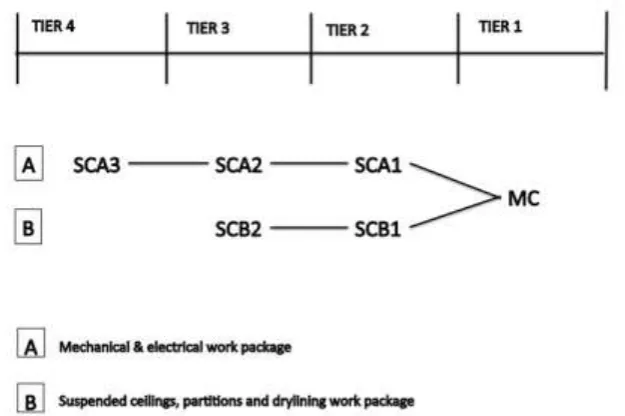
subcontractor (tier 2) in link A is a large, national mechanical and electrical contractor with and an annual turnover of over £350m of which 60 to 70% is spent in their supply chain. This subcontractor facilitated access to one of their subcontractors (tier 3), who in turn facilitated access to one of their subcontractors (tier 4). The
subcontractor (tier 2) in link B is a small, regional suspended ceilings, partitions and dry-lining subcontractor with an annual turnover of under £10m. This subcontractor facilitated access to one of their subcontractors (tier 3). The relationships between the organisations is shown in figure 1 where the main contractor is notated as MC and the subcontractors are notated as SCA1, SCA2, SCA3, SCB1, SCB2 to reflect links A and B and the tiers in the supply chain.
Figure 1: The relationship between organisations in the case study
The sample represents two typical links of a main contractor’s supply chain in the UK. The two trades studied are similarly subservient to the same financial, contractual and procedural control of the main contractor. The major difference between the two trades is that the mechanical and electrical subcontractor has significant design
contribution, which adds vulnerability to the main contractors design programme. This difference has been taken into account in the analysis of the findings.
This case study involved the main researcher as a non-participant observer, observing, listening and following decisions through projects as part of the main contractor’s organisation and carrying out semi-structured interviews and workshops with the main contractor and subcontractors involved. This allowed access to detailed data on each company's costing practices in a case study of a supply chain. A contractor’s supply chain is an ephemeral, temporary organisational relationship and as such it is difficult to investigate the problems of construction supply chains. The conflicts of interest and the ethics that the study involved were carefully managed to be sensitive to the
Page | 10
established that similar processes are carried out on all similarly large, complex, one-off projects.
Data collection and analysis
The researcher observed ten of the main contractor’s site meetings over two projects in order to follow decisions. Data collection with the main contractor and tier 2 subcontractors then involved semi-structured interviews to evidence what people do when sourcing and using cost information and document collection to evidence cost processes through written cost reports. The interviews firstly asked questions about how the company goes about putting a price together for a project and controlling costs once a project has been won. This aimed to find out what cost information is created and how methods of costing reach through the supply chain. The interviews then asked questions about how key relationships work to find out about
organisational behaviour and decision-making in relation to the supply chain. The interviews gave the researcher the opportunity to get participants ideas, thoughts and intentions on current practice and on changes to current practice. The documents collected consisted of the full estimating build-ups, priced tender documents and post-contract cost control documents for a completed project from the main post-contractor and the two tier 2 subcontractors. Access to this confidential data was provided on the basis of confidentiality conditions being met.
Two workshops were held during the course of the project. In the middle of the project a reflective group discussion took place with five key participants in the main contractor’s pre-construction and site operation teams. Towards the end of the project participants from each of the four tiers of the mechanical and electrical supply chain were brought together for a reflective group discussion. These discussions gave the researcher the opportunity to help the participants explore the use and implications of cost information across the firms and in projects.
The interviews and workshops were recorded and transcribed by a member of the research team. In order to describe, understand and explain contractors’ practices of costing and compare these to literature thematic coding was used in alignment with the four main themes established in the literature review: estimates of use of internal resources, quotations for work from subcontractors, overarching strategic tendering decisions and post-contract cost control. Through focused coding each main theme was further categorised to identify examples of methods of costing, organisational behaviour and decision-making, help or hindrance to improvements in site operations. The work of Dean (1993) was used as a framework to analyse the cost information that contractors create to determine, in Dean’s (1993) terms, the variables behind cost information used in the practice of costing, the types of information the costs of those variables were derived from (which might be data, analogies, expert opinion, best guesses, comparative prices) and the flow of cost information through the supply chain.
REAL PRACTICES OF COSTING: EMPIRICAL FINDINGS
Page | 11
Documents and interviews established that, once the main contractor or subcontractor had decided to submit a tender, their estimating and buying functions face the task of building up project costs from a number of constituent parts and their commercial function has the task of synthesising the information into a commercial tender. Once a project has been won the site team has the job of building to the budget. It was seen that because subcontractors themselves subcontract work, the distinction between main contractor and the subcontractors falls away in terms of their practices of costing. The practices of costing described in these results therefore show no
distinction between those of the main contractor and the five subcontractors. The only exception is SCB2, the labour-only subcontractor at the end of link B.
Estimates of use of internal resources
Participants explained that the estimator creates ‘first principle’ cost information to forecast their direct costs for work that will be carried out using their company’s internal resources. To establish the scope of these works the estimator checks, and hence improves, data received on quantities and specifications for ‘end items’ of work and customises these for work that is under or over measured, or under or over
specified. Once the scope of the works has been established, the estimator sets about creating project cost information based on, in Dean’s (1993) terms, variables in ‘the cost basis of the firm's resources’. The cost basis for directly employed labour is derived from annually updated company schedules on salaries that are based on national wage agreements and salary on-costs. The cost basis for directly owned plant comes from company schedules. The cost basis of regularly used of materials and hired plant is derived from regularly updated company schedules of negotiated prices from suppliers. The estimator’s information about the supply cost of direct labour, material and plant was thus found to be derived from, in Dean’s (1993) terms, a high level of detailed cost ‘data’ closely related to final cost.
The estimator then forecasts the activities, resources and resource productivity rates for ‘end items’. The cost basis of labour productivity rates, plant utilisation rates and materials wastage are derived from either company or industry standard rates based on previous project experience. One contractor explained how feedback on company standard productivity rates from colleagues working on site was treated as a way to build in contingencies, so that the relationship between productivity rates used to the actual work done was obscured.
“There are industry standard resource and productivity rates for activities but we create our own. We reviewed our labour productivity four years ago with our site operatives. We identified efficiencies, but then we didn’t change our productivity rates because we were in a rising market and all costs were going up.” SCA1
The estimator’s information about the productivity of direct labour, material and plant was thus found to be derived from, in Dean’s (1993) terms, a high level of detailed cost ‘analogies’. It was found the original industry or company standard analogies were based on detailed data from site operations, but the context of any particular project and sometimes a layer of commercial decisions, somewhat lowered the relationship of this type of cost information created to the actual work done and thus became ‘surrogate’ numbers to represent activities.
Quotations from subcontractors
Page | 12
subcontract as much as 60% to 70% of their work. Within the main contractor and subcontractors, the buyer, sets about creating project cost information knowing that the variables include their judgements about the firm they are buying from, their skill at negotiating and the existence of discounts.
Participants explained that the existence of discounts has a unique hold on the
construction industry. One of the features of subcontracting is a two-stage competitive tendering process, where competition is imposed on subcontractors both before a bid is placed and again before an order is placed. The secondary competitive process takes place much nearer to the commencement of the subcontract works. Participants
explained that it is standard practice that a selected subcontract price comes with a stipulated level of ‘standard trading discount’ that recognises trade business. On top of this, the buyer often assumes a further level of ‘additional trading discount’. The discount is usually passed down the supply chain to the dis-benefit of the
subcontractor at the bottom. However participants explained how knowledge of additional trade discounts were treated as a way to obtain competitive advantage before the discount was secured from a subcontractor through the secondary
competitive process. Two contractors explained that they usually take the risk that an additional trading discount, or more, will be realised in further negotiations if and when an order is placed. Thus participants recognised that trade discounts are part of the ‘noise’ in the accounting system that may or may not make cost information closer to the ‘real’ cost of work carried out.
“Subcontractors never give their best price first. We pre-discount our price when we put our price in. So we take a discount off their prices so you add all these subbie costs. We'll pre-discount ours before we sell it.” SCA1
“Quite often it's pre-discounted so already the client has had the benefit. The person carrying the risk [that the additional discount will be realised when an order is placed for the subcontract] is us.” MC
As explained by one contractor, the relationship between the buyer’s information on cost obtained through quotations and the final work carried out is largely unknown. “Some contractors will make double the margin they expected to make and other contractors, they'll make half the margin they expect to make. You can guarantee only one of them is going to bang your door.” MC
SCB1 explained they subcontract all their site labour to labour-only subcontractors, such as SCB2. They engage SCB2 on an output related incentive scheme. A daily price is set based on an expected output and SCB2, the end of the supply chain, takes the full risk of exceeding or falling short of the expected output rate. Tier 2 does not need an accurate output rate as they pass the risk on to tier 3. When the risk of poor productivity is passed on in this way the ‘real’ productivity on site remains largely unknown
“All the labour instead of being paid on day rate is paid on price. The more they put up the more they earn. It gives them an incentive. If they bust a gut they will earn more than on a day rate. But if they slack off, it doesn’t hit our pockets, it hits them.” SCB1
The buyer’s information about the cost of subcontracted works was thus found to be derived from comparative prices, in Dean’s (1993) terms, costs of ‘perceived
Page | 13
actual work done, becoming ‘surrogate’ numbers to represent activities as cost information was passed between firms in the supply chain.
Strategic tendering decisions
Within the main contractor and subcontractors, an analysis of estimated direct costs and subcontract prices is passed from the estimators and buyers to the commercial managers, who review the information and establish the project mark up. The mark up is made up of expert opinion on (i) anticipated cost of ‘design contingencies’ for uncertainty and level of risk (ii) a margin to recover head office overheads and a level of profit that is expected to be earned from the project and (iii) desire to win the project to deliver cashflow. One contractor explained how mark up information relies heavily on risk analysis and market intelligence to come to a figure that best accounts for project uncertainties and what the market will bear.
“We've had some vigorous debates about what the correct level of risk contingency should be on those jobs. We’ve had similar debates on every single job and it's the most subjective point that you could take.” MC
The commercial manager’s information about the cost of the project was thus found to be derived from, in Dean’s (1993) terms, costs based on ‘expert opinion’ and
sometimes ‘best guesses’. It was found that commercial decisions about mark up, even at the lowest level of the supply chain, impart a weak relationship of this type of cost information created to the actual work done. The commercial manager reports to the director’s team, who establish the total price to be tendered for the work in question.
When a tender is presented in a standardised format, such as a bill of quantities or schedule of rates, the contractor decides a gross price to be passed up in the unit cost for each ‘end item’ in the cost model. The gross price is made up of the net price of the measured item plus a share of the ‘mark up’. Both the net and gross prices can be manipulated across cost items in a model.
“We like to have overvalue in our orders. So we get paid more than we pay out every month and that generates a surplus for our business.” MC
The interviews establish that participants recognised that the cost information that is created and the price information that is passed on throughout the supply chain has many forces acting on it. Participants saw project costing as a process in which the relationship between cost information and work carried out can be slim and one that results in firms in the supply chain winning and losing on projects at each other’s expense.
“There are two layers. Some people might take a few bob off to win a job but the figure they take that from is a figure which people have already made assumptions on.” MC
Page | 14
One participant described the limitations of current cost data in supporting improvements through value engineering exercises that are superimposed on traditional procurement models based on transactional forms of contract and competitive tenders.
“When you get involved in the value engineering process, you start off with the job that's been well considered, but then we embark upon this period when we undo all that work and we pick at all the edges of it. So that the coordinated piece of design now has got different assumptions.” MC
Post-contract cost control on site
Participants explained how a successful tender becomes a target for the site team to budget and control costs against, providing cost envelopes for the post-contract project phase on site.
“We apply risk costs, overheads and profit, as agreed in the settlement meeting with directors and this form becomes the financial record of our tender. If successful this passes to the project delivery team and particularly procurement as a record of decisions made at tender stage to come to our offer.” SCA1
Participants showed that information on variances from the budget comes from records of internal resources and records of buying losses or gains for subcontracted work. The focus is on overall predicted profit on the job.
“I look back at jobs and think, oh, we made a good percentage margin on that, we did really well. But actually, what should we have made if we had been more effective at design coordination and sequencing?” SCA1
“When we get invoices in, we record the invoice date, who its from, and the value and each month we do an application to the main contractor that goes in the sales figure rather than purchases and we keep a running tally which will give us our profit at the end of a job.” SCB1
Participants recognised that firms across the supply chain each hold their own version of project cost and even the cost information held by the firm that carries out the physical work has many factors acting on it. The result is so much accounting ‘noise’ that a ‘true’ project cost that is an accurate representation of the costs of production and useful for discussions about improvements, remains unknown.
DISCUSSION
The problem of current practises of costing
The literature on costing substantively fails to ask important questions about the efficacy of cost information for assessing work processes across the supply chain and
Page | 15
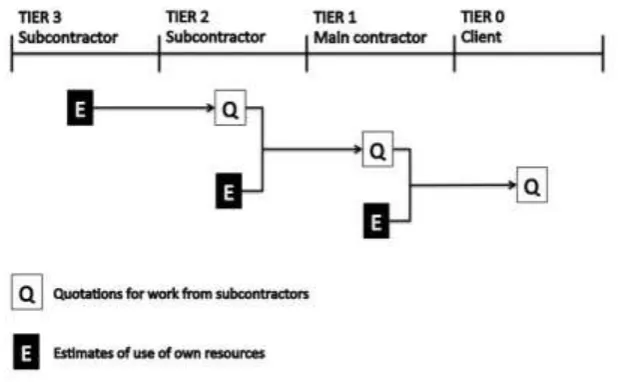
to an increasingly multi-tiered system of subcontracts in which each subcontractor in turn parcels out smaller and smaller packages of work as illustrated in figure 2.
Figure 2: The flow of cost information through the supply chain.
This information loss is not a problem when merely using cost information for client reporting, buying, payment and budgeting purposes, but when cost information is used for the purpose of reflecting improvements across the supply chain, the information loss matters because the cost information available does not adequately reflect the work carried out. Because of this, getting more of this current cost information in no way improves the industry’s ability to inform decisions that improve processes across the supply chain. Even worse, current cost information discriminates against
improvement by driving perverse incentives and creating unintended consequences through cost information being wrongly used or underused.
The construction world is currently dominated by the advent of BIM, which presents an opportunity to handle a greater volume of information more meaningfully. BIM may therefore be the opportunity to use cost information that has a strong relationship to work carried out as an analytical tool. However, the main software applications for costing in BIM, such as BIM Measure, Cost X and QTO, all connect costs to objects. This limits the possibility of connecting costs to work methods. Thus the introduction of BIM that will facilitate, and in some cases automate, information analysis will not meet a purpose of improving construction site operations if it only reproduces current cost information. Incorporating current practices of costing in BIM is in fact
dangerous as more detailed information is assumed to be more ‘accurate’ and more ‘valuable’ but will only produce more convoluted details that are not tied to what people do.
Different accounting practices
This being the case, then efforts to consider alternative costing practices that better represent work done are required. The problems of costing in construction can be illustrated by considering work from management accounting practices on process costs of transactions in supply chains, as adopted by other industries through the 1990s in response to increased competition and alongside the emergence of
Page | 16
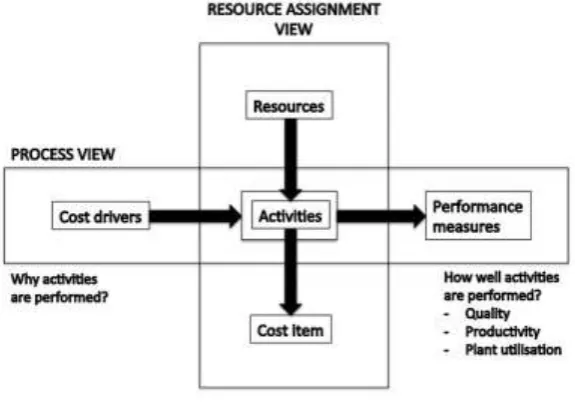
costing (ABC) is the most developed method of assigning accurate costs to products or services based on the resources they consume (Kaplan and Cooper, 1988). Tsai (1998) presented a conceptual framework for measuring quality costs under ABC in a two dimensional model, which can be adapted for construction as in figure 3.
Figure 3: Two-dimensional model of ABC. Source: Adapted from Tsai (1998)
The first dimension, the cost assignment view as represented in a bill of quantities or schedule of rates, incorporates information on labour, plant and materials that is related to the volume of work done in an activity (such as building a brick wall) but does not contain information on method (other than in labour which only assumes a measure of productivity). Without information on method the cost assignment view does not represent improvements in work processeswell. However the second dimension, the process view, adds information on method, in the form of cost drivers that explain why activities are performed and performance measures that explain how well activities are performed. Tsai (1998) defines a process as ‘a series of activities
that are linked to perform a specific objective’. Although this is a careful perception,
this overlooks the fact that there is an important difference in the meaning of
‘activities’ between the resource and process views. For example a typical activity in a resource assignment view would be ‘building a brick wall’. An activity in a process assignment view would in fact be series of linked activities, which are themselves part of an overall system that brings about the brick wall. Dean (1993) recognized that systemic costs can be derived from ‘measurable characteristics’ of either the ‘product’ or the ‘system to develop the product’ and that both need to be controlled and
managed. If the product and the system to develop the product are described, then the ‘measurable characteristics’ that drive cost can also be described: such as company standards, the degree to which participative management is used, requirements in method statements, the degree and type of training and contractual obligations. This difference between discrete ‘activities’ related to volume and systemic linked ‘activities’ unrelated to volume and part of an overall system is lost in Tsai’s (1998)
two-dimensional model, where the ‘activities’ appear to be common between the resource assignment and process views.
Page | 17
will struggle to support improvement because continued use of ‘surrogate’ cost information does not represent a good understanding of work done. Thus, this study supports the conclusions of Nicolini et al. (2000) and Ross and Williams (2013) that these accounting practices are not immediately transferrable to the construction industry.
Future opportunities
The complexity of the situation of costing must also be seen in relation to the operation of the industry. Green (2011) shows that the continued problems of the construction industry demonstrate the fallaciousness of merely adopting a different management tool (or costing practice) and to argue that solutions are 'just round the corner'. The solutions are not 'just round the corner' by adopting the rhetoric of supply chain costing or target costing. This study argues that the solution needs to be much more meaningful for the purpose of assessing improvement in site operations and that this needs to be rewarded in procurement and displayed in BIM if this is to be useful in improving supply chain practices.
Robson et al. (2014) undertook work on the attitudes of construction subcontractors to the advent of BIM. They found that BIM and new forms of cost information were attractive only in more stable supply chains. However, they used evidence from Green et al. (2008) that the industry works effectively and sustainably because of its dynamic capabilities, i.e. the flexibility to form short-term project supply chains associated with the fragmented structure of the industry. Thus, this research contends that the
challenge for costing is to find a model where multi-layered supply chains can see the value in, and be rewarded for, working differently. If a new cost accounting system is to have any impact, it needs to be applicable to one-off, project based supply chains as well as longer-term supply chains.
The implication from this is that future opportunities in costing that can account for improvements lie in better understanding the realities of construction projects. The ability of systems thinking to comprehend and address the whole (people, processes, information and structures) offers a way forward through taking an information approach to learning to improvement within the supply chain. Thus, information on ‘measurable characteristics’ of both the product, and the system to create the product, needs to be used to account for improvements in construction projects. For example, as participants in this study revealed there is the expectation that subcontractors doing the physical work will cover the costs of poor collaboration and others will side step these costs, but the costs of this are currently unacknowledged, so at the moment costing is not fit for the purpose of accounting for improvements in work processes. BIM may offer the opportunity to implement change but only if it can work with more transparent cost information that has not just a strong relationship to the product, but also to the system that brings about the product. A future system of cost accounting that ties costs to both the product in the BIM design model and the system that brings about the product in connected BIM models would be a powerful tool for
Page | 18
CONCLUSIONS
This research has produced unique knowledge about the real costing practices of a main contractor and subcontractors. The empirical research ascertained what a main contractor and two of their subcontracting trades at tiers 1 and 2, and in one case tier 3, actually do about costing across the estimating, tendering and post-contract cost control processes. This was achieved through a case study with a comprehensive method for observing and reflecting on what participants do when they produce and use cost information. Whilst the case study is of a single contractor’s supply chain, and variations certainly occur in other contractors and internationally, the parties reiterated that these practices were universal in the projects they work on. This might not be the case elsewhere but , other studies, in both construction and other industries, have found that the same problem of ‘surrogate’ numbers is a barrier to implementing improvements. The findings establish how current costing practices both may not create information about site operations and methods and may lose this information as it is transferred during a tendering situation. Current cost information is produced, really only, for buying, payment and budgeting purposes. The industry faces a problem for achieving improvements in supply chain practices, as costing tools, such as target costing with open book accounting, are inadequate for the job when based on current representations of cost. The problems with costing and the actual management practices in the industry require a systemic change to effect improvement involving not just a new templates, but new cost information and changed supply chain relationships. The advent of BIM has been presented as enabling more accurate information in formal analytical models. BIM could be part of this; but if BIM is used to merely reproduce current cost information, BIM will not produce any better
Page | 19
REFERENCES
Abdel‐Razek, R. and McCaffer, R. (1987) A change in the UK construction industry structure: implications for estimating. Construction Management and Economics, 5(3), 227‐42.
Ansari, S., Bell, J. and the CAM-1 target cost core group (1997) Target Costing: The Next Frontier in Strategic Cost Management, Irwin, Chicago.
Ansari, S., Bell, J. and Okano, H. (2007) Target Costing: Unchartered Research Territory, Handbook of Management Accounting Research, Elsevier, Oxford
Ballard, G. (2011) Target Value Design: Current Benchmark, Lean Construction Journal, 79-84
Best, R. and Meikle, J. (2015) Measuring Construction: Prices, Output and Productivity, Routledge, Abingdon.
Brooke, M. (2008) Estimating and Tendering for Construction Work, 4th edn, Butterworth Heinemann, Oxford.
Cabinet Office (2011) Government Construction Strategy, Cabinet Office, London.
Carr, L. P. and Christopher, D. I. (1992) Measuring the cost of ownership. Journal of Cost Management, 6(3), 42-51.
Cattell, D. W. (2012) An overview of component unit pricing theory. Construction Management and Economics, 30(1), 81-92.
Chapman, C. S., Hopwood, A. G. and Shields, M. D. (2007) Handbook of Management Accounting Research, Elsevier, Oxford.
Chartered Institute of Building (2009) Code of Estimating Practice, 7th edn, Wiley-Blackwell, Oxford.
Dean, E. B. (1993) “Why does it cost how much? In Procs AIAA Aerospace Design, Systems and Operations Conference, 11-13 August, Monterey CA US,AIAA 93-3966.
Department of Business, Innovation and Skills (2014), Construction 2025: Industrial Strategy: Government and Industry in Partnership, Department of Business Innovation and Skills, London.
Easterby-Smith, M., Thorpe, R. and Lowe, A, (2008). Management Research: An Introduction, 3ed, Sage, London.
Eastman, C., Teicholz, P., Sacks, R. and Liston, K. (2008) BIM Handbook: A Guide to Building Information Modelling for Owners, Designers, Engineers and Contractors, Wiley, New York, NY.
Egan, J. (1998) Rethinking Construction, Construction Task Force, Department of the Environment, Transport and the Regions, London
Fryer, B., Egbu, C., Ellis, R. and Gorse, C. (2004) The Practice of Construction Management, 4th edn, Blackwell, Oxford
Ghoshal, S. and Moran, P. (1996) Bad Practice: A Critique of the Transaction Cost Theory, Academy of Management Review, 21(1), 13-47
Green, S. D. (2011) Making Sense of Construction Improvement: A Critical Review, Wiley-Blackwell, Oxford
Page | 20
Green, S. D., Larsen, G.D. and Chung-Chin K. (2008) Competitive strategy revisited: contested concepts and dynamic capabilities. Construction Management and Economics. 26(1), 63-78
Greenhalgh, B. (2013) Introduction to Estimating for Construction, Routledge, London.
Hughes, W., Gray, C., Murdoch, J. (1997) Specialist Trade Contracting. A Review, Construction Industry Research and Information Association, London.
Hughes, W., Hillebrandt, P.M., Greenwood, D and Kwawu, W. (2006) Procurement in the Construction Industry, Taylor and Francis, London
Johnson, H. T. and Kaplan, R. S, (1987) Relevance lost. The Rise and Fall of Management Accounting, Harvard Business School Press, Boston, MA.
Kaplan, R. S. and Cooper, R. (1988) Cost and Effect, Harvard Business School Press, Boston, MA.
Kenley, R. (2003) Financing Construction Cash Flows and Cash Farming, Spons Press, London.
Kirkham, R. J. (2007) Ferry and Brandon's Cost Planning of Buildings, 8th edn, Blackwell, Oxford.
Kurt Salmon Associates (1993) Efficient Customer Response: Enhancing Customer Value in the Grocery Industry, Food Marketing Institute, Washington, DC.
LaLonde, B. J. and Pohlen, T. L. (1996) Issues in supply chain costing. The International Journal of Logistics Management, 7(1), 1-12.
Laryea, S. and Hughes, W. (2011) Risk and price in the bidding process of contractors. Journal of Construction Engineering and Management, 137(4), 248-258.
Lawrence, M., Pottinger, R., Staub-French, S. and Nepal, M. P. (2014) Creating flexible mappings between building information models and cost information. Automation in Construction, 45(0), 107-118.
Lowe, D. and Skitmore, M. (2006) Bidding, in Lowe, D. and Leiringer, R. (eds) Commercial Management of Projects, Blackwell, Oxford, pp. 356-389.
Monteiro, A. and Poças Martins, J. (2013) A survey on modelling guidelines for quantity take off-oriented BIM-based design, Automation in Construction, 35, 238-53.
Nicolini, D., Tomkins, C., Holti, R., Oldman A. and Smalley M. (2000) Can target costing and whole life costing be applied in the construction industry?: evidence from two case studies. British Journal of Management, 11, 303-24.
O'Brien, W. J. and Fischer, M. A. (2000) Importance of capacity constraints to construction cost and schedule. Journal of Construction Engineering and Management, ASCE. 126, 366-73.
Pennanen, A., Ballard, G. and Haahtela, Y. (2011) Target costing and designing to targets in construction. Journal of Financial Management of Property and Construction, 16(1), 52-63.
Pryke, S. (2009) Construction Supply Chain Management, John Wiley and Sons, Chichester
Robson, A., Boyd, D. and Thurairajah, N. (2014) UK construction supply chain attitudes to BIM. In: Sulbaran T (Ed) Procs 50th Annual International Associated Schools of Construction Conference, 26-28 March 2014, Washington, DC.
Page | 21
Ross, A. and Hugill, D. (2006) Signals from site: embodied logic and management accounting in construction projects, in Lowe, D. and Leiringer, R. (eds) Commercial
Management of Projects, Blackwell, Oxford, pp. 417-499
Ross, A. and Williams, P. (2013) Financial Management in Construction Contracting, Wiley-Blackwell, Oxford.
Staub-French, S., Fischer, M. A., Kunz, J., Ishii, K. and Paulson, B. (2003) A feature ontology to support construction cost estimating. Artificial Intelligence for Engineering Design, Analysis and Manufacturing, 17, 133-54.
Succar, B. (2009) Building information modelling framework: a research and delivery foundation for industry stakeholders. Automation in Construction. 18(3), 357-75.
Towey, D. (2012) Construction Quantity Surveying: A Practical Guide for the Contractor’s QS, Wiley, New York, NY.
Tsai, W. (1998) Quality cost measurement under activity based costing. International Journal of Quality and Reliability Management, 15(7), 719-52.
Vee, C. and Skitmore, R. M. (2003) Professional ethics in the construction industry. Engineering Construction and Architectural Management, 10(2), 117-27.
Walliman, N. S. R. (2006) Social Research Methods, Sage, London.
Weeks, D. and Crawford, F. A. (1994) Efficient customer response: a mandate for food manufacturers? Food Processing, 55(2), 34.
Williamson, O. E. (1981) The economics of organisation; the transaction economics approach. American Journal of Sociology, 87, 548-77.
Wu, S., Wood, G,. Ginige, K. and Jong, S. (2014) A technical review of BIM based cost estimating in UK quantity surveying practice, standards and tools. ITcon. 19, 534-562