INTERNATIONAL RESEARCH JOURNAL OF PHARMACY
www.irjponline.com
ISSN 2230
–
8407
Research Article
THE STUDY OF PHYSICOCHEMICAL PARAMETERS OF SOME DETERGENTS WITH THE
ANIONIC NATURE
Petrovska Ludmila
1, Baranova Inna
2, Bezpala Yulia *
2, Kovalenko Svitlana
21
Department of Cosmetology and Aromalogy, National University of Pharmacy, Kharkov, Ukraine
2Commodity Science Department, National University of Pharmacy, Kharkov, Ukraine
*Corresponding Author Email: [email protected]
Article Received on: 29/01/17 Approved for publication: 18/02/17
DOI: 10.7897/2230-8407.080222
ABSTRACT
The physico-chemical parameters of detergents with the anionic nature, namely sodium myreth sulfate and sodium lauryl sarcosinate used most often when developing domestic foaming products for personal hygiene, at the cosmetic enterprises of Ukraine have been studied and analyzed. The indica-tors of the foaming ability (foam number, foam stability) of the test samples at different pH values, namely at the neutral pH (5.5-6.0) and at the acid рН (3.5-4.0), have been determined and studied. The study of the foam structure at the pH intervals under research has been also conducted using the method of microphotography. According to the results of the study, the conclusion has been made that different pH values do not affect the foaming ability; however, they affect the foam structure.
Key words: sodium myreth sulfate, sodium lauryl sarcosinate, foaming ability, рН value, foam structure
INTRODUCTION
It is well known that detergents are the base for any foaming product – shampoo, liquid soap, gel, etc1. This group of
sub-stances affects the skin protective barrier to a greater or lesser extent. But if some substances only alter permeability of the protective barrier for a period of time, the others, damage its structure in varying degrees. It is the degree of this damaging effect that is defined as hardness of a surfactant. The hardness of sodium lauryl sulfate (SLS) is used as a specific reference standard. It is one of the first semi-synthetic surfactants, applied since the 30s of the twentieth century. Therefore, it is common practice to put SLS at the beginning of the “hardness – softness of the surfactant’s action” scale (though there is a number of surfactants, which are much harder)2,3.
In general, most hard emulsifiers are laundry detergents. Deter-gent surfactants action are intended for dissolving fats, for ex-ample, when washing clothes or washing dishes. The mecha-nism of their action is as follows: detergents "stick" to fat depos-its and break them to droplets, which are easily washed off with water. However, in contact with the skin, these detergents act on the protective barrier and fat contamination: they are embedded in the lipid layers, disrupt their structure and break up into indi-vidual microdroplets, which are then removed by water4,5.
However, in foaming detergents with the cleansing action, the mechanism of action of surfactants is fundamentally different: surfactants do not change the formula of fat – do not saponify it; moreover, they bind it into a colloidal (micellar) structure, which is easily washed from the surface of the skin or hair6.
When analyzing the formulations of detergents, in particular shampoos for children and gels for intimate hygiene, that are presented at the Ukrainian market, it has been found that exactly anionic surfactants, such as sodium laureth sulfate (SLES) and
sodium lauryl sulfate (SLS), takes the three-fourths of the sur-factant market2,7. A surface-active anion – a negatively charged
particle of the molecule – provides their detergent properties. In water, it decomposes up into a positively charged sodium ion and a negatively charged ion (anion) of lauryl sulfate. The ani-ons produce huge amount of foams. Although, the surface of our skin has a polymosaic charge, the cleaning efficiency with such surfactants is not ideal. Therefore, in recent years, modern man-ufacturers most often replace the so-called “aggressive” surfac-tants by the mild ones, such as sodium myreth sulfate and sodi-um lauryl sarcosinate8,9.
The main aim of our work, was to study and compare the physico-chemical properties of mild detergents with the anionic nature, namely sodium myreth sulfate and sodium lauryl sar-cosinate at different pH values.
MATERIALS AND METHODS
Mild detergents with the anionic nature, used in manufacturing products for cleansing of the skin and its appendages, we choose 70 % sodium myreth sulfate and 35 % sodium lauryl sarcosinate (“EОС”, Belgium)2,3.
Sodium myreth sulfate is one of the anionicsurfactants, contain-ing in many products for personal hygiene (soaps, shampoos, toothpastes etc.). Sodium myreth sulfate is a cheap and very effective foaming agent and emulsifier. The main advantage of this surfactant, is that, it possesses satisfactory detergent proper-ties, namely it effectively dissolves dirt and sebum, forms a stable foam when dissolved in water, easily washable from the surface of the skin and its appendages.
ammonium compounds and phenolic resins used as bactericides; for example in antibacterial foaming hand cleaners. Unlike many other anionicsurfactants, sodium lauryl sarcosinate is also classified as a substance that is easily decomposed and harmless to the environment.
The samples of the substances selected were given by the Phar-maceutical Science and Research Centre “Aliyance Krasoty” (Beauty Alliance, Kyiv, Ukraine). A pH regulator for the foam-ing base value of lactic acid (Lactic Acid, “Galactic”, Belgium) is allowed for use in foaming detergents for children, according to the EU Regulation No.1907/2006.
The test samples were prepared according to the conventional technology: the required amount of the surfactant was calculated and dissolved in water at the desired temperature (40 – 45 °С). For further studies, 5 % aqueous solutions of the surfactant ob-tained were adjusted to the required temperature (37 °С). The time for preparing the samples was from 30 to 60 min. All sam-ples were prepared and calculated with reference to 100 % sub-stance10. These studies were conducted at the Research
laborato-ry of the Commodity Science Department of the National Uni-versity of Pharmacy.
One of the main physico-chemical parameters of any detergents is the foaming ability, namely the foam number (mm) and the foam stability (c.u.). According to the current normative docu-ments, namely the State Standard of Ukraine – DSTU “Cosmet-ic products for cleansing the skin and hair” and specif“Cosmet-ications of Ukraine – TU U 24.5-31640335-002:2007 “Skin care cleaning products” the foam number should be not less than 145.0 mm, and the foam stability – 0.8-1.0 c.u.11,12.
Determination of the above parameters were performed using the Ross-Miles foam analyzer, as a standard device for measur-ing the foammeasur-ing ability of soaps and synthetic detergents. The foaming ability of the test samples was determined by the meth-od given in DSTU ISO 696:2005 “Determination of the foaming ability by the modified method of Ross-Miles”13 and GOST
22567.1-77 “Synthetic detergents. The method for determining the foaming ability”. To conduct this test using Ross-Miles foam analyzer, we used ultrathermostat UT-15, a stopwatch timer, a rubber squeeze bulb, the analytical balance of the accuracy class
solution of the surfactant in the volume of 200 cm3 was
intro-duced into the pipette in such a way that no foam could form. The pipette with the solution was fixed to the stand so that its outlet was at a distance of 900 mm from the level of the liquid in the cylinder, and the flow could get to the center of the liquid. Then the tap of the pipette was opened. When there was no solu-tion in the pipette, a stopwatch timer was switched on, and the height of the foam column formed (mm) was measured. The measurement was carried out in 30 sec. In 5 minutes the height of the foam column, formed (mm) was measured.
In the process of our work, the following indicators were also studied: appearance, organoleptic indicators (color, odor), de-termination of the рН value. These indicators were considered for the qualitative assessment of modern foaming products, according to DSTU 4315:2004 and TU U 24.5-31640335-002:2007.
The level of the pH value of the foaming test samples was de-termined by potentiometry (SPhU 1.2, 2.2.3) using a “рН Meter Metrohm 744” device (Germany)14.
Additionally, the microscopic analysis of the foam was also conducted using a “Konus-Akademy” laboratory microscope with the ScopeTek DCM510 eyepiece camera. For the visualiza-tion of the images obtained by the ScopePhoto™ software (ver-sion 3.0.12.498), it allowed measuring linear dimen(ver-sions in real time and static image15,16,17.
RESULTS AND DISCUSSION
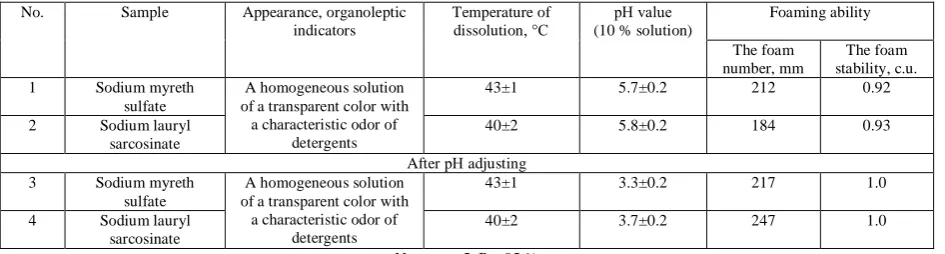
As known, depending on the application of foaming products, there are two ranges of рН – the neutral pH (5.5-6.0) (e.g., shampoos for children) and the acid рН (3.5-4.0) (e.g., gels for intimate hygiene). Therefore, our initial objective was to study the foaming ability of the detergents, choosen at the neutral рН value (5.5-6.0). The foaming bases were prepared with sodium myreth sulfate and sodium lauryl sarcosinate, according to the above technology, homogeneous liquids of a transparent color with a characteristic odor of surfactants and without impurities, they corresponded to the requirements of the current normative documents. The results of the study of the test samples are given in Table 1.
Table 1: The physicochemical parameters of sodium myreth sulfate and sodium lauryl sarcosinate
No. Sample Appearance, organoleptic indicators
Temperature of dissolution, °С
рН value (10 % solution)
Foaming ability
The foam number, mm
The foam stability, c.u. 1 Sodium myreth
sulfate
A homogeneous solution of a transparent color with
a characteristic odor of detergents
43±1 5.7±0.2 212 0.92
2 Sodium lauryl sarcosinate
40±2 5.8±0.2 184 0.93
After рН adjusting 3 Sodium myreth
sulfate
A homogeneous solution of a transparent color with
a characteristic odor of detergents
43±1 3.3±0.2 217 1.0
4 Sodium lauryl sarcosinate
40±2 3.7±0.2 247 1.0
Figure 1а: The spherical structure of the foam bubbles with sodium myreth sulfate
Figure 1b: The structure of Plateau–Gibbs canal with sodium myreth sulfate
Figure 1c: The polyhedral form of the foam bubbles with sodium lauryl sarcosinate
Figure 1d: The structure of Plateau–Gibbs canal with sodium lauryl sarcosinate
Figure 1: Microscopy of the foam with sodium myreth sulfate and sodium lauryl sarcosinate at рН (5.5-6.0)
Figure 2a: Microscopic analysis of the foam with sodium myreth sulfate at the acid рН value (3.3)
Figure 2b: The process of coalescence of the foam with sodium myreth sulfate at the acid рН value (3.3)
Figure 2c: Microscopic analysis of the foam with sodium lauryl sarcosinate at the acid рН value (3.7)
Figure 2d: The process of coalescence of the foam with sodium lauryl sarcosinate at the acid рН value (3.7) Figure 2: Microscopy of the foam with sodium myreth sulfate and sodium lauryl sarcosinate at рН (3.5-4.0)
When analyzing the data obtained from the foaming ability of the test samples from the surfactant chosen, it was determined that sample 1 had the higher value of the foam number (212 mm), than sample 2, but its value of the foam stability was less (0.92 c.u.).
However, in spite of that, both samples have satisfactory values of the foam number and the foam stability (they correspond to
the requirements of the current normative documents of Ukraine).
considered when developing various detergents in the ranges of рН studied, since the рН value of the foaming ability in different ranges is regulated within the current normative documents of Ukraine.
It is well known, the presence of a thick, soft and stable foam is the main requirement of modern consumer for foaming prod-ucts. Therefore, presently the foam must meet the following requirements: it should be rich, finely divided, creamy, pleasant to the touch, easily washed away, have structural strength, should not slide spontaneously from the surface of the skin and its appendages. Hence, the final stage of our research was de-voted to the study of the foam structure, using the method of microphotography. The test samples of the foaming bases with the anionicsurfactants were prepared according to the technolo-gy mentioned above. Immediately before the study, a massive foam was formed using a “Deluxe Cordless Mini Mixer” manual mixer (China), which was then put on a glass slide, and the foam was examined under the microscope with the above mentioned characteristics.
When studying the freshly prepared massive foam, it was de-termined that in the samples with sodium myreth sulfate and sodium lauryl sarcosinate at рН (5.5-6.0), the main structural elements of the foam were gas bubbles systematically arranged, i.e. small bubbles were around large bubbles joining together and creating an equilibrium structure in the foam volume (a pseudocrystalline system) (Figure 1а). When studying the foam of the test samples, the conclusion was also made that it’s cells had a spherical shape transforming into a polyhedral shape in the course of time. The films of the liquid between the bubbles formed the so-called Plateau triangles (Figure 1b, Figure 1d). Three thin films converged on each edge of the polyhedron; they were the walls of the bubbles. These films formed angles of approximately 120°С between themselves. In the places of the film joints, the thickenings called canals were formed. Canals in cross section were in the form of triangles with concave sides. As a result, the capillary pressure causing the flow of liquid from the films into the canals appeared. Under the action of gravity, the liquid collected in the canals flowed into the lower part of the foam along cross links. It was coalescence (combina-tion of several bubbles into a larger one) that occurred when the liquid flowed through these canals. After that, the bubble shape began slowly changing from spherical to polyhedral (Figure 1c).
The next stage of our research was to study the structure of the foam at the acid рНvalue (3.5-4.0), in the test samples with the detergents selected.
Analyzing the microscopic pictures, we obtained the conclusion that the foaming base with sodium myreth sulfate at the acid рН value had unstable foam. As can be seen from Figure 2a, the foam had the shape of polyhedron, while films separating them were of the same thickness throughout the volume of the foam. As a result, (Figure 2a), the structure that was similar to a hon-eycomb in section was observed. However, because of a rapid flow of the liquid through Plateau–Gibbs canals, a rapid coales-cence – combination of adjoining gas bubbles – was observed (Figure 2b).
CONCLUSIONS
According to the results of the experiment conducted, it has been concluded that all samples within the рН ranges during the research, comply with the standard values of the existing state standards of Ukraine, by their physico-chemical parameters studied (appearance, organoleptic indicators, foaming ability).
It has been determined that when studying the structure of the massive foam in the samples at the рН ranges of 5.5-6.0 using microscopy, the foam has a stable structured system, namely it has a spherical shape and is characterized by the minimal sur-face energy; therefore, it indicates the foam stability. Analyzing the foaming bases after adjusting pH with lactic acid (3.5-4.0), it has been found that the foam in these samples is unstable with a short life cycle due to a rapid coalescence. The data obtained will be considered, when developing parapharmaceutical prod-ucts within the рН ranges studied.
REFERENCES
1. Lange KR. Surfactants: Synthesis, Properties, Analysis, application. Publishing House “Profession”, Saint Peters-burg; 2007. Page No. (240).
2. Pletnevа MYu. Surface-active substances and compositions. Handbook. Publishing House «Firm Clavel», Moscow; 2002. Page No. (768).
3. Abramson AA, Bocharov VV, Gaevoi DA. Surfactants Handbook, Chemistry, Lviv: 1979.
4. Chiu CH, Huang SH, Wang HM. A Review: Hair Health, Concerns of Shampoo Ingredients and Scalp Nourishing Treatments. Curr Pharm. Biotechnol. 2015; 16:1045-1052. 5. Trüeb RM. Shampoos: ingredients, efficacy and adverse
effects J. Dtsch Dermatol Ges. 2007; 5:356-365.
6. Draelos ZD. Shampoos, conditioners, and camouflage tech-niques. Dermatol. Clin., 2013; 3(31): 173–178.
7. Nagase S. Influence of internal structures of hair fiber on hair appearance. I. Light scattering from the porous structure of the medulla of human hair. J. Cosmet. Sci., 2002; 53(2): 89–100.
8. Davis MG. A novel cosmetic approach to treat thinning hair. Br. J. Dermatol., 2013; 165 (3): 24–30.
9. Telofski LS. The Infant skin barrier: can we preserve, pro-tect, and enhance the barrier. Dermatol. Res. Pract., 2012; 20 (12): 198–200.
10.Shueller R, Romanowski P. Multifunctional Cocmetic., Cambridge University Press: Cambridge; 2003. Page No. (250)
11.DSTU 4315: 2004 «Cosmetic products for cleansing the skin hair». State enterprise, Kiev; 2005. Page No. (12) 12.TU U 24.5-31640335-002:2007 «Skin care cleaning
prod-ucts». Pharmaceutical Science and Research Centre “Ali-yance Krasoty”, Kiev; 2007. Page No. (18).
14.State Pharmacopoeia of Ukraine. State enterprise «Scientific expert Pharmacopeial center», Kharkiv; 1–st. ed., 2 ad. 2008. Page No. (535).
15.Li X, Karakashev SI, Evans GM. Effect of environmental humidity on static foam stability. Langmuir. 2012; 28: 4060-4068.
16.Pugh RJ. Experimental techniques for studying the structure of foams and froths. Advances in Colloid and Interface Sci. 2005; 114: 239–251.
17.Langevin D., Vignes-Adler M. Microgravity studies of aqueous wet foams. Eur. Phys. J. E. 2014; 37:2-8.
Cite this article as:
Petrovska Ludmila et al. The study of physicochemical parame-ters of some detergents with the anionic nature. Int. Res. J.
Pharm. 2017;8(2):39-43
http://dx.doi.org/10.7897/2230-8407.080222
Source of support: Nil, Conflict of interest: None Declared