391
Design Of A Small-Scale Hulling Machine For
Improved Wet-Processed Coffee.
Adeleke, S.A., Olukunle, O. J., Olaniran, J. A., Famuyiwa, B. S.
Abstract: The method of primary processing of coffee is a vital determinant of quality and price. Wet processing method produces higher quality beans but is very labourious. This work outlines the design of a small scale, cost-effective, ergonomic, and easily maintained and operated coffee hulling machine that can improve quality and productivity of green coffee beans. The machine can be constructed from locally available materials at a relatively low cost of about NGN 140,000.00 with cheap running cost. The beaters are made from rubber strip which can deflect when in contact with any obstruction causing little or no stresses on drum members and reducing the risk of damage to both the beans and machine. The machine is portable and detachable which make it fit to be owned by a group of farmers who can move it from one farm to the other, making affordability and running cost easier. The easily affordable and relatively low running cost may be further reduced by the fact that the machine is powered by 3.0 Hp petrol engine, which is suitable for other purposes among the rural dwellers. The eventual construction of the machine will encourage more farmers to go into wet processing of coffee and reduce the foreign exchange hitherto lost to this purpose.
Index Terms: Hulling machine, Rubber beater, Coffee beans, Wet-process, Improve, Nigeria
————————————————————
1. INTRODUCTION
Coffee is a member of the large Rubiacea family which constitutes about 500 genus and 6,000 species with probably at least 25 major species, all indigenous to tropical Africa and certain Islands such as Madagascar [1]. Coffee species are woody shrubs or large trees of over 10 m tall. The growing and drinking of coffee started in Ethiopia, where it probably originated from Kaffa province. The succulent outer berry flesh was eaten by slaves taken from present day Sudan into Yemen and Arabia, through the great port of its day, Mocha. Coffee was certainly being cultivated in Yemen by the 15th century and its production in Nigeria dated back to early 1920, but on a less significant commercial level, although records indicated that it had been cultivated for a much longer period. Coffee grows in tropical forest between latitudes 250 N and 250 S. According to Hicks [1], the two most important economic species are highland C. Arabica (arabica) and the lowland C. Canephora (robusta). The other species cultivated on a smaller scale are C. Liberica (liberica) and C. dewevrei
(excelsa). Coffee cultivation and green coffee production represent an important source of income for many developing countries in the tropical regions of Middle and South America, Africa and Asia [2].
Although, coffee has little or no nutritional values, it is widely consumed, particularly in Europe and North America, for its stimulating effects [3]. It also has some health benefits, though recommended for further study [4]; waste and by-products of coffee have successfully been used for 10 – 30% in the diets of ruminants [5], including other uses reported by Akinwale and Oduwole [6]. In the years preceding oil boom of 1970s, Nigeria was a good producer of some cash crops like cocoa, coffee, oil palm, rubber, cotton and groundnut. These crops were the mainstay of the national economy. Report of CBN [7] indicated that Nigeria produced more tonnes of coffee than some other similar crops from early 1990s, even cocoa; currently the country is third producer of the crop in Africa and tenth in the World. Coffee was particularly renowned to be the second traded commodity after oil in the world and also the second consumed liquid after water [8]. Nevertheless, record shows that coffee production was below what Nigeria can conveniently produce according to FGN [9]. The current instability in oil price and its non-renewability, the attendant dwindling national economy coupled with growing poverty level calls for urgent solution to the perennial problems of agriculture. ICO [4] believed that the deterioration in coffee quality means that it cannot meet the demands of customers an. d exporters. They reported further that it is necessary to identify appropriate technologies and other means of improving coffee quality for marketing and to prevent crop losses with emphasis on reducing input and energy costs. They also agreed with [10] that production of coffee can be used to reduce poverty and create millions of jobs. Postharvest processes are very important in coffee production, having significant effects on quality and price determination. Coffee harvesting and processing were mostly handled by using manual methods in Nigeria despite its economic values. IACO [11] identified poor technology and inadequate equipment for postharvest processing of coffee as causes of poor quality and high production cost .The major problem of coffee in Nigeria is processing. Famaye and Ibiremo [12] reported that lack of processing machinery was one of the causes of the abandonment of coffee production in Nigeria. Ipinmoroti et al, [13] also reported that coffee farmers in Nigeria abandoned their coffee farming for other crops such as cassava and yam due to low technical know-how on coffee
_____________________________
Adeleke, S.A. is a Research Scientist in Dept. of End Use Research, Cocoa Research Institute of Nigeria, (CRIN), Ibadan, Nigeria
Olukunle, O.J. is a Professor in the Dept. of Agricultural Engineering, Federal University of Technology (FUTA), Akure, Nigeria
Olaniran, J.A. is a Senior Lecturer in the Dept. of Agricultural Engineering, Ladoke Akintola University of Technology (LAUTECH), Ogbomoso, Nigeria
Famuyiwa, B.S. is a Senior Research Scientist in Dept. of Economics and Extension, Cocoa Research Institute of Nigeria, (CRIN), Ibadan, Nigeria
392 processing. This gap necessitates the need to design
machines to handle operations at various stages of processing to improve coffee production and quality. Coffee passes through various stages of primary processing, which is mainly to separate the beans from the skin and the pulp, before it is exported as unroasted green coffee. These stages are currently centralized in some producing regions where coffee production is more developed to economize resources and maintain quality. Correct primary processing is one of the key determinants of coffee quality. Unfortunately, it is often at the processing stage that the coffee is ruined and loses the qualities that have been so labouriously obtained [14]. Damaged or broken bean, any piece of bean smaller in size than an average half bean [3], crushed bean and foreign materials have serious adverse effects on quality of coffee and products. Broken beans cause non-uniform drying and roasting, and become charred while impurities such as twigs, soil, and pulp and parchment debris are very dangerous in coffee market. Broken and crushed beans frequently occurred during primary processing, especially hulling, due to improper machine adjustment and excessive cylinder rotation; impurities are unconsciously introduced during harvesting, pulping, drying and hulling due to improper fan adjustment [3]. It is believed that it is quite illogical not to devote as much care to the preparation of the final product resulting from so much hard work of berry production. It is in this regard that an indigenous machine affordable by low income farmers and industrialists to effectively and efficiently handles the hulling (shelling) and cleaning of parchment coffee was designed. The two methods of processing coffee fruits (berries) are wet and dry, but the wet method has become more popular, produces quality green beans [15] and fetches higher prices [1]. The wet method preserves instinct qualities of coffee, such as aroma, and produces beans that maintain natural quality better [1], mostly preferred by consumers. The wet method currently varies depending on the degree of fermentation [2]. Any of the methods employed, which depends on locality, types of coffee and prevailing weather conditions, is followed by hulling which is the removal of hull or parchment to obtain two usual beans from cherry. The beans are then roasted at an appropriate temperature and time. The stages in wet method is reported by [15]involves removing the skin (exocarp) pulp/mucilage (mesocarp) while the parchment coffee (endosperm with endocarp) produced is then dried to maximum moisture contents of 12-12.5%. The simplest traditional method of hulling parchment coffee (seeds) involves the use of pestle and mortar as reported [3], [16]. This method involves using impact and frictional forces to rupture and shear the hull as they also apply to threshing and decortications. A threshing machine usually consists of a rotating drum in a cylinder or concave with a pneumatic separating unit using blower or aspirator and mechanical decortications can be achieved through hand/pedal or motorized equipment with or without a winnower. Adewumi [17] grouped factors that affect threshing of crops into crop parameters, machine parameters and operation parameters. These parameters are generally crop size, shape, density, strength and moisture content; machine‘s drum speed, feed rate, cylinder-concave clearance, fan capacity, and crop and MOG/grain feed rates. According to [18] and [17], important
primary factors for efficient pneumatic separation include drag co-efficient, terminal velocity and density while factors such as area of opening, frequency of oscillation, amplitude are essential for screen separation. These researchers believed that optimum combination of relevant design parameters is important for efficient crop cleaning. High amplitude and low oscillation frequency will result in looseness of materials and lower grain loss [18]. Information on the design and operation of decorticating machine for other seeds showed that the use of impact involving rubber is efficient for threshing tender crops. According to [19], it is essential to understand the physical laws governing the response of biological materials so that machines, process and handling operations can be designed for maximum efficiency in order that the highest quality of the end-product can be obtained. However, there is very little or no report on the physical and engineering properties of coffee, especially wet-processed beans (parchment coffee) and indigenous processing machines. This work intends to design an affordable machine for an average low-income [20] and small scale [8] coffee farmer for improved hulling of wet-processed coffee in Nigeria, considering the current high foreign exchange and danger in compatibility of foreign hullers with local environment.
2. MATERIALS AND METHOD
2.1 Design Considerations and Concept
The design philosophy is to use rubber beaters to achieve sufficient impact force that can break the hull of green parchment coffee and detach the beans through impact and shearing forces caused by rubber beaters. The beaters arranged around the circumference of a hollow mild steel pipe rotate with relatively high speed to achieve sufficient impact force and also move the broken materials against the concave to release the beans from the hulls. The design considerations are minimum bean damage, portability, affordability, ergonomic, and simple operational and minimum power requirement.
2.2 Design Analysis
393 Table1: Engineering properties of coffee seeds and beans
at 10.7% moisture content.
Properties
Range of values Mean values Standard deviation
Seed Bean seed Bean seed Bean
Length (mm)
8.10 – 10.5
7.30 –
9.40 9.78 8.19 0.67 0.80
Width (mm) 6.10 – 8.30
5.40 –
7.30 7.24 6.11 0.59 0.59 Thickness
(mm)
4.50 – 6.00
3.60 –
5.30 5.23 4.60 0.49 0.50 Geometric
mean diameter (mm)
- - 7.18 6.13 - -
Sphericity - - 0.73 0.75 - - Coefficient
of static Friction on mild steel
0.38 – 0.42
0.29–
0.36 0.40 0.33 0.02 0.02
Angle of repose (00
)
22.7 – 29.6
23.8 –
26.70 25.5 24.8 2.18 0.90 Bulk density
(g/cm3
)
0.40 – 0.42
0.59-
0.61 0.41 0.60 0.00 0.00 True density
(g/cm3
)
0.60 – 0.86
0.91-
1.25 0.71 1.06 0.09 0.09
Porosity - - 0.43 0.44 - -
2.2.1 Hulling drum
[21] and [22] reported important parameters to be considered for the design of thresher‘s drum as; the drum diameter, number of beaters, the drum length and velocity. Too low velocity will cause insufficient hulling while too high velocity results in high bean damage which may render beans unsuitable for use. Reported peripheral drum velocity for threshers is 8.17-13.6 m/s [21]. The following equation given by [20] was used to obtain drum diameter:
Applying ⁄ (1)
V = drum peripheral velocity (m/s), D = drum peripheral diameter (m) and n = rotational speed of the drum (rpm) The drum length was obtained from the relationship reported by [21], [23] to achieve good hulling efficiency. They reported permissible feed rate of 0.4 - 0.6kg/s for threshers.
(2)
q = feed rate (kg/s), qo=permissible feed rate (kg/s), L
=drum length (m) and M = number of beaters.
2.2.2 Concave
Concave-drum clearance was determined using the relationship for least clearance at 95% level of confidence reported [17].
(3)
Ct = concave-drum clearance, m =geometric mean
dimension of bean and = standard deviation of bean dimension The concave diameter was obtained from the relationship below:
Cd = D + 2lp + 2Ct (4)
Cd –concave diameter; lp– length of beater
2.2.3 Power required for hulling
Centripetal force which results from the rotation of the drum breaks the hull and separates it from the bean. This force was determined according to [23] as follows:
F = mω2
r (5)
w = 2πn/60 (6)
F – Force produced by each beater (N) ω – Angular velocity of the drum (rad/sec) m – Mass of rubber beater (kg)
r – Peripheral radius of the hulling drum (m)
The angular velocity is made high considering the lightness in weight of rubber beater so as to obtain reasonable impact force.
According to [22]:
P = Tω (7)
T = Fr (8)
P = Power required for hulling and T = Torque produced by the drum
Drum Shaft Diameter
This is to determine the size of the shaft that will withstand applied loads in terms of rigidity and strength during operation under various loading conditions. Considering a solid shaft with little or no axial load, the ASME code equation (9) reported by [23] was applied:
*( ) ( ) + (9)
d = Shaft diameter (m),Ss = allowable stress (N/m2), Mb & Mt = Bending and torsional moment respectively (Nm) and Kb &Kt = Combined shock and fatigue factors for bending and torsional moments respectively A shaft with a keyway and minor shocks was considered and the following as reported [23] was assumed: Kb = 1.5 – 2.0; Kt = 1.0 – 1.5 and Ss = 40MN/m2
2.2.3 The Blowing Fan
A centrifugal fan was employed because of its ability to produce high volume and pressure air stream at relatively low power requirement. The velocity of the cleaning air must be less than the terminal velocity of crop to be cleaned in order not to blow away the crop as observed by researchers such as [18] and [17]. The terminal velocity, VT
of a spherical particle was reported by [18] as:
( ⁄ ) (10)
= Geometric mean diameter, g = gravitational pulls, and are particle and air densities respectively. Coffee bean sphericity is 0.75 (Table 1) and was assumed a spherical particle according to [24].
394 QA = Actual air flow rate (m3/s), D = Depth of air stream (m)
and W = width of air stream (m) The outside diameter of the impeller was determined, adopting the following equations reported [18]:
(12)
⁄ (13)
QA = 0.3Qt (14)
Qt = theoretical air flow rate, v1 = tangential component of
absolute velocity, b1 = blade width, d1 = impeller outside
diameter and na = fan speed.
2.2.4 Reciprocating Screen
The important factors considered were the amplitude, frequency of oscillation, driving power and distance between successive holes. Olukunle [18] reported widely-used amplitude of 20 mm and oscillating frequency of 5 HZ for high feed rates and acceptable grain loss but added that better results could be achieved by using larger amplitude and lower oscillating frequency. The optimum coefficient of screen open area is reported to be 0.4 – 0.45. The following relationship was applied:
( ⁄ )( ) (15)
Co =coefficient of screen open area; Do = diameter of
screen hole and Ds = distance between successive screen
holes.
2.2.5 Belts and Pulleys
The nominal belt length was determined to know the actual belt sizes to drive the hulling drum, the fan and the screen shaker. Belt tensions and torsional moment are important for shaft size determination and for effective power transmission to components. The expected belt power was estimated from the loads on the component to drive which was used for selecting the right belt type according to standard tables given by [25]. Type A, V- belts are recommended for this design accordingly. The following expressions reported by [25] were applied.
( ) ( ) ⁄ (16)
( ) (17)
Lp = Nominal pitch length, D2 = Bigger pulley diameter, D 1
= Smaller pulley diameter and C = Centre distance between two matched pulleys
N1D1 = N2D2 (18)
N1& N2 = rotational speeds of matched pulleys
T1/T2 = e Kθ
(19)
θ = π + 2Sin-1
[(D2 – D1)/2C] (20)
T1& T2 = Tight and slack sides belt tensions respectively, K
= coefficient of friction between belt and pulley and θ = angle of contact between the two pulleys.
P = (T1 – T2) V (21)
Mt = (T1 – T2) R (22)
P = Power transmitted by belt (W), Mt = Torsional moment
of the belt, V = belt velocity (m/s) and R = radius of bigger pulley The horizontal component of the resultant belt tensions which is the horizontal load on the shaft was calculated from the expression [17]:
(T1 + T2)cosβ (23)
2.3 Machine Description
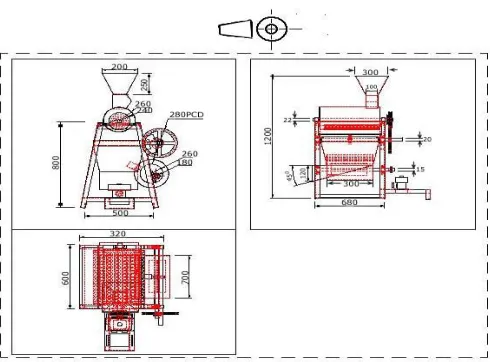
The main units of the machine are the hulling cylinder, cleaning unit, the frame and power transmission system as shown in Fig. 1 with their dimensions in Fig. 2.
Fig. 1: Exploded view of the machine
Fig. 2: Orthographic views of the machine
2.3.1 Hulling Unit
395 top such that the beans are released easily by the beaters
to minimize bean breakage. It could be constructed from galvanized iron because of its resistance to corrosion, moderate high tensile strength and relatively low cost.
2.3.2 Cleaning Unit
The separation/cleaning unit combines the use of a vibrating screen and a centrifugal fan. The screen which is oscillated by an eccentric motion is supported by 4 (20 mm) roller bearings to reduce friction. The eccentric is made from 50 mm roller bearing into which a solid shaft is forced, which in turn carries the driving shaft to give oscillation of 25 mm. The fan assembly consists of 3 blades equally spaced and welded on a solid mild steel shaft.
2.3.3 The Frame
The frame holds other components in their right positions, consisting of upright reinforced members for rigidity and engine seat as in Fig. 2. It is constructed from 50 mm x 50 mm, 3 mm thick angle iron. It is made collapsible for easy transportation and the legs spread out for stability.
Fig. 3: Isometric of the Hulling Machine
2.3.4 Power Transmission System
The power to drive all the components is supplied by a 3.0Hp Single-cylinder Gasoline engine through 3 different sizes of type A V-belts. Belt drive is used in this design because of its ability to tolerate high speeds, long shaft centre distance and slight misalignment, and relatively low cost and no maintainance requirement. This engine is expected to supply sufficient power to drive the machine considering the calculated design power of 1.2Hp.
2.3.5 Ergonomic Consideration
Ergonomic is the applied science involving the design of a machine in relation to the health, safety and comfort of the operator as affected by his work conditions (body posture). Ergonomic is very vital in machine operation [26];
ergonomic and safety is very important especially for the use of tribal women worker [27] and all the variation in ergonomic data contributed to the total variation in the machine performance parameter [28] Rubber is expected to produce lesser friction than mild steel on galvanized iron. Bearings were used in rotating shafts because of their little or no noise compared to cone despite the relative higher cost of the former. Eccentric and screen assembly were
supported by roller bearings to reduce vibration and noise. The cleaning chamber is covered with a plate to deflect chaffs, which would constitute health hazards, away from the operator. The total height of the machine was selected according to reported 1.638 m average height of a Nigerian adult man for convenient operation. Belt and pulley drive produces less noise due to low friction involved compared to alternative sprocket-chain drive. This design provides for durability and easy maintainance for comfortable operation.
2.4 Mode of Operation
The parchment coffee is fed through the hopper and moves into the hulling unit by gravity where the beating and rubbing actions caused by the rotation of the drum inside the concave remove the parchment (endocarp). Mixture of coffee beans and pieces of broken hulls resulting from these actions pass through the holes of the concave on to a reciprocating screen. The broken hulls and other lighter materials are blown away by air current produced by a centrifugal fan located below the screen while the beans pass through the screen holes onto the grain outlet and larger materials than the beans fall to the front of the machine, owing to difference in their terminal velocities. Clean coffee beans are collected from grain outlet located at the lower part of the machine.
2.5 Estimated Cost of the Machine
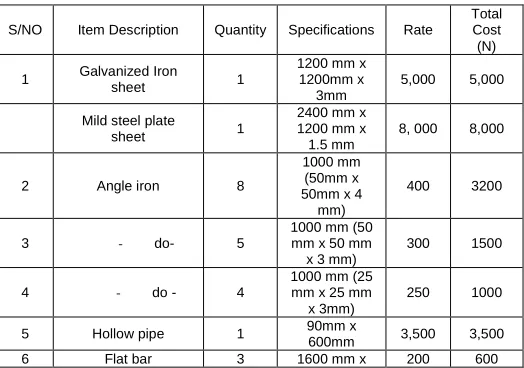
The total estimated cost of the coffee hulling machine with the component parts as shown in Fig. 7was arrived at after considering the cost of all the components of the machine. This comprises the cost of the material for the component parts, the cost of its construction or fabrication and other items necessary to make the component. The logistic is to cater for the transport for the purchase and materials conveyance to the fabrication workshop while miscellaneous is to take care of the contingencies and possible increase in cost of materials. Considering the tenderness of parchment coffee and relative low stresses involved in its hulling, components of the machine could be fabricated from scraped (fairly- used) materials available in large quantities in local markets in order to reduce cost of machine production and make affordability easier. The detail of the estimated cost of construction of the coffee hulling machine is given in Table 2 below:
Table 2: Estimated cost of production of the machine
S/NO Item Description Quantity Specifications Rate
Total Cost (N)
1 Galvanized Iron
sheet 1
1200 mm x 1200mm x
3mm
5,000 5,000
Mild steel plate
sheet 1
2400 mm x 1200 mm x 1.5 mm
8, 000 8,000
2 Angle iron 8
1000 mm (50mm x 50mm x 4
mm)
400 3200
3 - do- 5
1000 mm (50 mm x 50 mm x 3 mm)
300 1500
4 - do - 4
1000 mm (25 mm x 25 mm
x 3mm)
250 1000
5 Hollow pipe 1 90mm x
396 25mm x 5mm
7 Solid shaft 2 30 mm x
1600 mm 1500 3,000
8 - do - 1 20 mm x
1600 mm 1200 1200 9 Pillow bearings 2 pairs 30 mm 3, 500 7,000 10 - do - 1 pair 20 mm 3,000 3,000 11 Roller bearings 2 pairs 20 mm 1,000 2000 12 V-Pulley 1 280 mm 1,500 1,500
13 - do - 3 80 mm, 70
mm & 60 mm 500 1,500 14 V-Pulley (Twin) 1 100mm 1,800 1,800
15 V-Belts 3
55 mm, 63 mm & 74
mm
500 1,500
16 Petrol engine 1 3 Hp 30,000 30,000
17 Workmanship for
fabrication 45,000 45,000
18 Logistic 10,000
19 Miscellaneous 10,000
Total 140,300
3. RESULTS AND DISCUSSION
The design concept of a, cost-effective, efficient, ergonomic, easily maintained and operated wet-processed coffee hulling machine has been developed. Rubber strip from scrapped tyres and other similar engineering materials which are usually wastes are utilized by the design; this will reduce construction cost compared to similar machines where relatively more expensive products are used, and support environmental cleanliness. The ability of rubber beater to deflect when met with obstruction reduces stresses on drum members and coffee beans reducing probability of damage to both the machine and coffee beans. Productivity and quality of wet-processed coffee resulting from prompt processing will also be increased with the use of the machine. The reduced tendency of rubber beater to tear due to friction and contaminate coffee beans as compared to metal beater, which particles can easily break, is an advantage for better quality. The machine is collapsible; easily and quickly assembled and/or disassembled. This situation aids its transportation from one place to the other. This implies that the machine can be acquired, used, maintained and patronized by a group of farmers who can easily bear the cost of the machine as well as the cost of running and maintenance. Moreover, the powering engine is suitable for alternative purposes possible among the rural dwellers, such as milling pepper and cottage processing of some other crops, which will further reduce the running cost and better spread the initial cost. Eventual construction of this machine will ensure prompt processing of parchment coffee just before export as normally practiced in recognized producing regions and encourage farmers to handle this aspect of primary processing which is usually handled by merchants or middlemen. The effect of this is that farmers‘ profit is increased. Mechanical handling of hulling operation will encourage development of other relevant equipment to handle some other stages in wet processing of coffee such that there may be a fully mechanized wet processing method. Mechanical processing of the crop will also encourage engagement of many members of the rural communities of the growing regions in production of coffee which will automatically improve their economy. Raghu [15] has observed that coffee was an important occupation in the rural economics with massive participation of marginal, poor and down trodden class of rural communities. Mechanical processing of coffee will also lead to handling
its large quantity and production of reasonable amount of by-products. Production of coffee by-products in large quantities may result in the development of various processes of utilizing such by-products as animal feeds, bio-fuel, fertilizer and soil conditioner. This may also has significant effects on the income and livelihood of the farmers. The machine is expected to be safe in operation in terms of noise, health hazards and comfort. It is also expected to be durable as material selection and design have followed the guiding principles and standards.
4. CONCLUSION
This work has considerably met the dire need of the farmers to have an efficient, cost-effective, ergonomic, and durable and easily operated coffee processing machine which is also suitable for small scale industrialists that may boost productivity and enhance quality. It is expected that the construction of the hulling machine will reduce the drudgery experienced in coffee production and encourage wet coffee processing which has been reported to be highly laborious but produces better quality beans which is more acceptable and attract higher price. Processing at agreed centres closed to farms will reduce cost of transportation and may economize usually scarce resources, such as water, which are very essential in wet coffee processing. The economy of the farmers will be improved through possible increased profit and income. National income through increased coffee exportation will also improve. More farmers, especially the youths, may be encouraged to go into coffee production due to introduction of mechanical processing and profitable production. This development may engender in reasonable mechanized wet coffee processing method. Generally, the production of this machine, supported by relevant others, may open employment opportunities, especially for rural dwellers..
REFERENCES
[1]. A. Hicks. ―Post-harvest Processing and Quality Assurance for Speciality/Organic Coffee Products‖. Paper presented at FAO Regional Office for Asia and the Pacific, Bangkok, Thailand, pp. 15-20, 2002.
[2]. P. Palmiro and R. Franca. ―Review: Challenges in Specialty Coffee Processing and Quality Assurance‖. Callenges, 7, 19, pp. 1- 22, 2016.
[3]. R. Coste. ―Coffee: The Plant and the Product ―. Macmillan Press Ltd, London, pp. 222-226, 1992.
[4]. International Coffee Organization (ICO). ―Health Effects from Coffee Consumption‖. Coffee Futures: A Source Book of Some Critical Issues Confronting the Coffee Industry, Baker, P.S Eds., The Commodities Press, pp. 8 – 15, 2001.
[5]. Habtamu Lemma Didanna, ―A Critical Review on Feed Value of Coffee Waste for Livestock Feeding‖. World Journal of Biology and Biological Sciences Vol. 2 (5), pp. 072-086, 2014.
0794-397 6456 (57–60), Cocoa Res. Inst. of Nigeria, Ibadan,
Nov. 2001.
[7]. Central Bank of Nigeria (CBN). ―Domestic, Production, Consumption and Prices‖. Statistical Bulletin, Vol.18, pp.131-151, Dec. 2007.
[8]. Famers‘ Information Flyer. Cocoa Research Institute of Nigeria (CRIN), Coffee, ISBN NO: 978-978-50656-8-8, 2016.
[9]. Federal Government of Nigeria (FGN). ―Towards Increased Production of ‗Cash‘ Crops in Nigeria‖. Report of the Study Group on Rehabilitation of ‗Cash‘ Crops, pp. 34 – 48, April 1985.
[10]. O.O. Oduwole and R.A. Sanusi. ―Coffee Marketing Problems and Prospects‖. Training Manual, Coffee Production Technology ISSN 0794-6456 (11–16), Cocoa Res. Inst. of Nigeria, Ibadan, Nov. 2001.
[11]. Interafrican Coffee Organization (IACO). ―Reducing Poverty in Africa by Strengthening Coffee Projects‖. Summary Report of Workshop, Ronald J. Onzima. and P. Mbondji Mbondji Eds., 13th – 17th
Nov, 2001, Abidjan, Cote D‘Ivore, pp, 1 – 17, 2006.
[12]. A.O. Famaye and O.S Ibiremo. ―Coffee Rehabilitation and Routine Farm Management‖. Training Manual, Training Manual, Coffee Production Technology ISSN 0794-6456 (51–55), Cocoa Res. Inst. of Nigeria, Ibadan, Nov. 2001.
[13]. R. Ipinmoroti, A.A. Oloyede, B.S. Famuyiwa, M.A. Daniel and A.O. Famaye. ―Coffee Production in a Diversifying Economy‖, unpublished. Paper presented at 3rd All Africa Horticultural Conference, International Society for Horticultural Science, IITA, Ibadan, Nigeria. 2016
[14]. P. Potchet. ―The Quality of Coffee from Plantlet to Cup‖. Agricultural Publications, No 21, (1-43), 1990.
[15]. N.S. Raghu. ―Comparative Analysis of Dry And Wet Processing of Coffee with Respect to Quality and Cost in Kavre District, Nepal: A Case of Panchkhal Village‖. International Research Journal of Applied and Basic Sciences. Vol. 2 (5): 181-193, available at http://www.irjabs.com, accessed 01/10/2016, March, 2011,
[16]. Practical Action. ―Small-scale Coffee Processing‖. Technical Brief, (1-8), available at https://practicalaction.org/docs/technical_information_ service/coffee.pdf
[17]. B.A. Adewumi. ‖Development and Performance Evaluation of Equipment for Threshing and Cleaning Legume Crops‖. .P.hD dissertation, Department of Agricultural Engineering, Federal University of Technology, Akure, Nigeria, 2005.
[18]. O.J. Olukunle. ―Development and Evaluation of an Indigenous Grain Combine Harvester‖, PhD
dissertation, Dept. of Agric. Engineering, Federal University of Technology, Akure, Nigeria, 2002.
[19]. A. Bart-Plange, A. K. Dzisi, A. Addo, E. Teye and F. Kumi. ―A Comparative Study of Some Physical Properties of Large and Medium Size Cocoa Beans from Ghana‖. ARPN Journal of Science and Technology, Vol. 2 No 3, pp. 135 – 141, 2012.
[20]. M. Idirisu, F.D. Babalola, I.U. Mokwunoye, C.F. Anagbogu, I.A. Aderolu, O. Ugioro, E.U. Asogwa, I. Ndagi and F.C. Mokwunye. ―Adaptive Measures for the Factors Affecting Marketing of Coffee (Coffea robusta Rio Numez) in Kogi State, Nigeria‖. Agrosearch, 12 No 1, Pp. 37-49, 2012.
[21]. A.O. Raji and D.I. Akaaimo. ―Development and Evaluation of a Threshing Machine for Prosopis africana Seed‖. Journal of Applied Science, Engineering and Technology. Vol. 5, No 1 & 2, 56-62, 2005
[22]. G. Gbabo, I. M. Gana and M. S Amoto. ―Design, Fabrication and Testing of a Millet Thresher‖. Net Journal of Agricultural Science. Vol. 1(4),100–106, available at www.netjournals.org/pdf/NJAS/2013/4/13-033.pdf, 2013.
[23]. T.A. Adekanye, A.B. Osakpamwan and I.E. Osaivbie.. ―Evaluation of a Soyabean Threshing Machine for Small Scale Farmers‖. Agric. Eng. Int.: CIGR Journal. Vol.18(2), 426–434, available at http://www.landmarkuniversity.academia.edu/TIMOTH YADEKANYE, 2016.
[24]. A. Sessiz, R. Escgici and S. Kizil. ―Moisture-dependent Physical Properties of Caper (Capparis ssp.) Fruit‖. Journal of Food Engineering, 79, pp. 1426 – 1431, 2007.
[25]. R.L. Mott. ―Machine Elements in Mechanical Design‖. 4th edition, Prentice Hall, pp. 388-400, 2005.
[26]. S.A. Adeleke, A.E. Agbongiarhuoyi, A.V. Oyedokun, K.A. Oluyole, M.O. Okeniyi and A.A. Oloyede. ‗‘Implication of Sprayer Types Used by Farmers for Controlling Insect Pests and Diseases of Cocoa in South West Nigeria‖. International Journal Of Innovative Research & Development, Vol 6 Issue 6, doi:. 10.24940/Ijird/2017/V6/I6/Jun17058,221— 228,available at www.ijird.com, Jun. 2017
[27]. K.P. Singh, R.R. Poddar, K.N. Agrawal, S. Hota and M.K. Singh. ―Development and Evaluation of Multi millet Thresher‖. Journal of Applied and Natural Science (JANS) 7 (2), 939 – 948, 2015.