IJEDR1702280 International Journal of Engineering Development and Research (www.ijedr.org) 1781
Big Data Computing Framework: A
Compact Review
R K Jena,
Institute of Management Technology, Nagpur
___________________________________________________________________________
Abstract-Advances in infor mation technol ogy and i ts wi des pre ad growth in se veral areas of business, engineering,me dic al, and scientific studies are resulting in infor mati on/ data e xpl osion. Knowle dge discover y anddecision-making from such rapi dly growi ng voluminous data are a challenging task in terms of data organiz ati onand pr ocessing, which is an emerging trend known as big data computing, a ne w paradig m thatcombi nes large-scale compute, ne w data-inte nsive techni ques, and mathe matical models to buil d data anal ytics.Big data c omputing de mands a huge storage and computing for data curati on and processing thatc oul d be deli vere d fr om on -pre mise or clouds infr astructures. Therefore a ne w r obust arc hitecture is nee de d to store and process infor mati on. Initiall y ne w progr aming appr oaches de velope d base d on par allel pr ocessing and then distribute d computing progr aming models were de velope d. This is where Hadoop, S park,Flinkand Stor m fr ame works are de vel ope d and de pl oye d for big data processing since last few ye ars. These platfor ms are showi ng promising results.This paper discusses the e vol ution of big data c omputing pl atfor ms and c ompare Hadoop, S park, Flink and Stor m fr ame work.
Index Terms-Wor ds: Big Data, Hadoop, S park, Flink and Stor m
__________________________________________________________________________________________
I. INTRODUCTION
Big data computing is an emerging data science paradigm of mult idimensional informat ion mining for scientific discovery and business analytics over large-scale infrastructure. The data collected/produced from several scientific e xplorat ions and business transactions often require tools to facilitate effic ient data manage ment, analysis, validation, visualizat ion, and dissemination , while preserving the intrinsic value of the data [1–5]. The IDC [6] report predicted that there couldbe an increase of the digita l data by 40 times fro m 2012 to 2020. New advancements in semiconductor technologies are eventually leading to faster computing, large-scale storage, and faster and powerful networks at lower prices, enabling large volumes of data preservation and utilizat ion at faster rate. Recent advancements in cloud computing technologies are enabling to preserve every bit of the gathered and processed data, based on subscription models, providing high availability of storage and computation at affordable price. Conventional data warehousing systems are based on predetermined analytics over the abstracted data and employ c leansing and transforming into another database known as data marts ; which are periodica lly updated with the similar type of rolled up data. However, big data systems work on non -predetermined analytics; hence, no need of data cleansing and transformations procedures.
Big Data Applications
As business domains are growing, there is a need to converge a new economic system redefiningthe relationships among producers, distributors, and consumers of goods and services. Obviously, it is not feasible to depend on experience or pure intuition always; however, it is also essential to use critically important data sources for decision-making. The National Institute of Standards and Technology Big Data Public Working Group described a survey of big data architectures and fra mework fro m the industry [7]. The several areas of big data computing are described in the succeeding texts.
Scientific explor ati ons: The data collected fro m various sensors are analyzed to e xtract the useful informat ion for societal benefits. For e xa mp le, physics and astronomical e xperiments – a large nu mber of scientists collaborating for designing, operating, and analyzing the products of sensor networks and detectors for scientific studies. Earth observation systems – information gathering and analytical approaches about earth’s physical, chemical, and biological systems via remote-sensing technologies – to improve social and economic well-being and its applications for weather forecasting, monitoring, and responding to natural disasters, climate change predictions, and so on.
IJEDR1702280 International Journal of Engineering Development and Research (www.ijedr.org) 1782 Governance: Surveillance system analyzing and classifying streaming acoustic signals, transportation
departments using real-time traffic data to predict traffic patterns, and update publictransportation schedules. Security departments analyzing images fro m ae ria l ca me ras, news feeds, and social networks or ite ms of interest. Social progra m agencies gain a clearer understanding of beneficiaries and proper payments. Tax agencies identifying fraudsters and support investigation by analyzing co mple x identity information and tax returns. Sensor applications such stream air, water, and temperature data to support cleanup, fire prevention, and other programs.
Financi al and business analytics: Retaining customers and satisfying consumer e xpectations are among the most serious challenges facing financial institutions. Sentiment analysis and predictiveanalysis would play a key role in several fie lds like travel industry – for optimal cost estimations and retail industry – products targeted for potential customers. Forecast analysis – estimating the best price estimations and so on.
We b analytics: Severa l websites are e xperienc ing millions of unique visitors per day, in turn creating a large range of content. Increasingly, companies want to be able to mine this data to understand limitations of their sites, improve response time, offe r more targeted ads, and so on. This requires tools to perform co mplicated analytics on data that far e xceed the me mory of a single mach in e or even in c luster of machines.
The big data challenges
Performing co mputation on big data is quite a big challenge. To work with huge volume of data that easily surpass several terabytes in size, requires distributing parts of data to several systems to ha ndle in para lle l. By doing it, the probability of fa ilu re rises . In a single single-system, fa ilure is not something that usually program designers explic itly worry about [10]. Ho wever, in a distributed n scenario, partial fa ilu res are expected and common, but, if the rest of the distributed system is fine, it should be able to recover fro m the co mponent failure or transient error condition and continue to make progress. Providing such resilience is a ma jor software engineering challenge and concern [10].In addit ion, to these sorts of bugs and challenges, there is also the fact that the computer hardware has finite resources available. The ma jor hardwa re restrictions include; Processor time, Me mo ry, Hard drive space and Network bandwidth.
Individual systems usually have few gigabytes of me mory. If the input dataset is set several terabytes, then this would require a thousand or more machines to hold it in RAM and even then, no single mach ine would be able to process or address all of the data. Hard drives are a lot bigger than RAM, and a single machine can currently hold multip le terabytes of information on its hard drives. But generated data of a large large-scale computation can easily require more space than what original data had occupied. During this, some of the storage devices, employed by the system may get full, and the distributed system will have to send the data to other node, to store the overflow. Finally, bandwidth is a limited resource. While a pack of nodes directly connected by a gigabit Ethernet generally e xperience high throu ghput between them, if a ll transmit mult i-gigabyte, they would saturate the switch's bandwidth. In addition to that if the systems were spread across mu ltip le rac ks, the bandwidth for the data transfer would be more d iminished[10].
To achieve a successful la rge la rge-scale distributed system, the mentioned resourcesmust be efficiently managed. Furthermo re, it must allocate some of these resourcestoward ma intaining the system as a whole, while devoting as much time as possible tothe actual core co mputation [1 0].Synchronization between mu ltip le systems re mains the biggest challenge in distributedsystem design. If nodes in a distributed system can explic itly communicate with one another, then application designers must be cognizant of risks associatedwith such communicat ion patterns. Finally, the ability to continue computation in the heface of failu res becomes more challenging [1].
II. STATE OF THE ART DEVELOPMENTS
This section will begin to e xpla in the up-to-date solutions for the big data processing challenges. It will focus on what is Apache’s Hadoop framework and how it works, also discuss other Apache alternative fra me works, name ly Spark and Storm.
APACHE HADOOP
IJEDR1702280 International Journal of Engineering Development and Research (www.ijedr.org) 1783 thousands of computers, each with several processor cores processor It’s also designed to effic iently distribute large a mounts of work and data across mult iple systems. It has main ly co mprising of t wo ma jor co mponents, name ly Hadoop Distributed File System( HDFS) and MapReduce. HDFS is used to manage data storage, whereas MapReduce is used as programming paradig m.
Hadoop Distri bute d File Syste m (HDFS)
Hadoop Distributed File System (HDFS) is a system inspired b y Google’s Google File System [11] stores large files in multip le machines in a shared-nothing mechanism. It is developed to handle big data on clusters of commodity hardware. Apache Hadoop is an open -source imp le mentation of Google ’s MapReduce [12] and acquired by many large organizations like Google [11], Facebook [13], Yahoo [14], Orac le [15], and Microsoft [16] for enabling their applications on cloud. It provides an abstract and easy programming model to write parallel p rogra ms instead of worrying about the data distribution, paralle lizat ion, fault tolerance, and computations. MapReduce is a paralle l data-processing fra mework on top of HDFS (provides high throughput and access).Hadoop has the best fault-tolerant, high-throughput, and server-failure survival mechanisms [17].
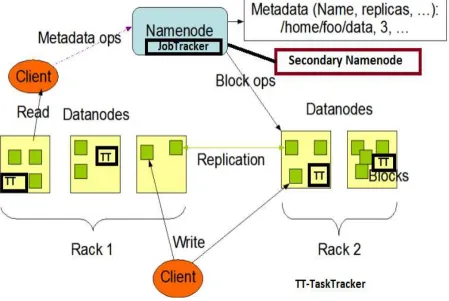
Like Google File System, Hadoop also ma intain rep licas of its data splits across different machinesto provide data locality and reliab ility. Defau lt chunk size of HDFS is 64 M B, and these chunks are once write -mu ltip le-read chunks. Hadoop’s master-slave mechanism is shown in Fig 1. It consists of Na meNode and DataNodes. A Name Node also called MasterNode, is responsible for controlling the whole MapReduce job through a JobTracker and controlling tasks in a job througha TaskTracker(TT) while working as DataNode (e .g., single node cluster). A DataNode, also called SlaveNode, consists of DataNode and TT. A SecondaryName Node in large clusters is used to generate snaps of Na meNode to avoid loss and works as standby Name Node. Na me Node stores meta-data about the files/data chunks stored in DataNodes, while DataNodes store the actual data chunks (64 M B). By defau lt, each data chunk is replicated by a factor of 3.
Figure 1: HDFS Architecture
MapRe duce
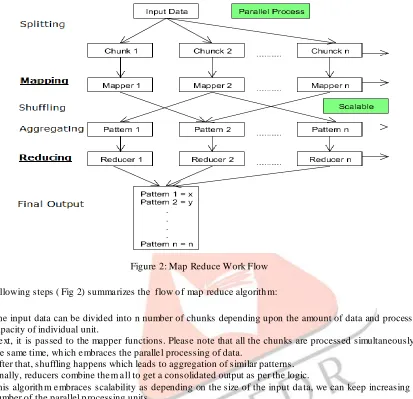
IJEDR1702280 International Journal of Engineering Development and Research (www.ijedr.org) 1784 programs perform. The first is the map job, which takes a set of data and converts it into another set of data, where individual ele ments are broken down into tuples (key/value pairs). The reduce job takes the output fro m a map as input and combines those data tuples into a smalle r set of tuples. As the sequence of the name MapReduce implies, the reduce job is always performed afte r the map job.
Figure 2: Map Reduce Work Flow
The following steps ( Fig 2) summa rizes the flow o f map reduce algorith m:
1. The input data can be divided into n number of chunks depending upon the amount of data and processing capacity of individual unit.
2. Ne xt, it is passed to the mapper functions. Please note that all the chunks are processed simultaneously at the same time, wh ich e mbraces the paralle l processing of data.
3. After that, shuffling happens which leads to aggregation of similar patterns. 4. Finally, reducers combine the m a ll to get a consolidated output as per the logic.
5. This algorith m e mbraces scalability as depending on the size of the input da ta, we can keep increasing the number of the parallel p rocessing units.
APACHE SPARK
IJEDR1702280 International Journal of Engineering Development and Research (www.ijedr.org) 1785 Spark holds intermediate results in me mory rather than writing them to disk which is very useful especially when you need to work on the same dataset multip le times. It’s designed to be an execution engine that works both in-me mory and on-disk. Spark operators perform e xterna l operations when data does not fit in me mory. Spark can be used for processing datasets that larger than the aggregate memo ry in a cluster. Spark attempts to store as much as data in me mory and then will spill to disk. It can store part of a data set in me mo ry and the re main ing data on the disk. You have to look at your data and use cases to assess the me mory require ments. With this in-me mo ry data storage, Spark comes with performance advantage. There are many Spark features, which include:
Supports more than just Map and Reduce functions. Optimizes arbitrary operator graphs.
La zy evaluation of b ig data queries which helps with the optimization of the overall data processin g workflow.
Provides concise and consistent APIs in Scala , Java and Python.
Offers interactive shell for Scala and Python. This is not available in Java yet.
Spark is written in Scala Progra mming Language and runs on Java Virtual Machine (JVM ) environ ment. It currently supports the Scala, Java, Python, Clojure and R .
APACHE STORM
Apache Storm [10] is a distributed real-time big data-processing system. Storm is designed to process vast amount of data in a fault-tolerant and horizontal scalable method. It is a streaming data frame work that has the capability of highest ingestion rates. Though Storm is stateless, it manages distributed environment and cluster state via Apache ZooKeeper. It is simple and you can execute all kinds of manipulat ions on real-time data in parallel.Apache Storm is continuing to be a leader in real-time data analytics. Storm is easy to setup, operate and it guarantees that every message will be processed through the topology at least once.
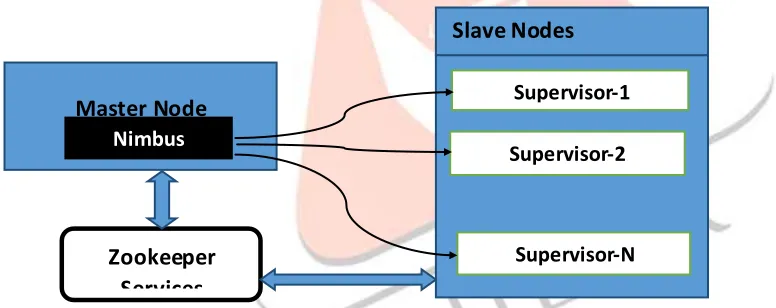
Figure 3: Apache Stro m Architecture
There are fo llowing two types of nodes s ervices shown in above diagram (Fig. 3)
1. Nimbus Ser vice on Master Node - Nimbus is a daemon that runs on the master node of Storm c luster. It is responsible for distributing the code among the worker nodes, assigning input data sets to machines for processing and monitoring fo r fa ilures. Nimbus service is an Apache Thrift service enabling you to submit the code in any programming language. This way, you can always utilize the language that you are proficient in, without the need of learning a new language to utilize Apache Storm.Nimbus service relies on Apache ZooKeeper service to monitor the message processing tasks as all the worker nodes update their tasks status in Apache ZooKeeper service.
2. Super visor Ser vice on Worker Node - All the worke rs nodes in Storm cluster run a daemon called Supervisor. Supervisor service receives the work assigned to a machine by Nimbus service. Supervisor manages worker processes to complete the tasks assigned by Nimbus. Each of these worker processes e xecutes a subset of topology that we will talk about next.
Master Node
Nimbus
Slave Nodes
Supervisor-1
Supervisor-2
Supervisor-N
Zookeeper
IJEDR1702280 International Journal of Engineering Development and Research (www.ijedr.org) 1786
APACHE FLINK
Apache Flink[20] is the next generation Big Data tool also known as 4G of Big Data. It is the true stream processing framework (doesn’t cut stream into micro-batches). Flin k’s kernel (core) is a streaming runtime which also provides distributed processing, fault tolerance, etc. Flin k processes events at a consistently high speed with lo w latency; it processes the data at lightning fast speed. It is the large scale data processing fra me work which can process data generated at very high velocity. Apache Flink is the powerful open source platform which can address following types of require ments effic iently:
Batch Processing Interactive processing Real-time stream processing Graph Processing
Iterative Processing In-me mory processing
Apache Flink[20] is a streaming data flow engine that provides commun ication, fault -tolerance, and data-distribution for distributed computations over data streams. Flink is a top level project of Apache. Flink is a scalable data analytics frame work that is fully compatib le to Hadoop. Flink can e xecute both stream processing and batch processing easily.Apache Flin k was started under the project called The Stratosphere. In 2008 Vo lker Markl formed the idea for Stratosphere and attracted other co -principal Investigators fro m HU Be rlin, TU Berlin, and the Hasso Plattner Institute Potsdam. They jo intly worked on a vision and had already put the great efforts on open source deployment and systems build ing. Later on, several decisive steps had been so that the project can be popular in commerc ia l, research and open source community. A comme rcia l entity named this project as Stratosphere. After applying for Apache incubation in April 2014 Flink na me was finalized. Flink is a German word wh ich means swift or agile. The key vision for Apache Flink is to overcome and reduces the comple xity that has been faced by other distributed data-driven engines. It is achieved by integrating query optimization, concepts from database systems and efficient paralle l in -me mory and out-of-core algorithms, with the MapReduce fra mework. As Apache Flink is main ly based on the streaming model, Apache Flin k iterates data by using streaming architecture. The concept of an iterative algorith m is tightly bounded into Flink query optimizer. Apache Flink’s pipelined architecture allows processing the streaming data faster with lower latency than mic ro-batch architectures (Spark).
III. DISCUSS ION
Flink is one of the newest players in the big data computing fra mework. Flin k is an alternative of Map Reduce, it processes data more than 100 times faster than MapReduce. Flin k is independent of Hadoop but it can use HDFS to read, write, store, and process the data. Flin k does not provide its own data storage system. It takes data from d istributed storage. Sparkis another newest players in the MapReduce field. Its purpose is to ma ke data analytics fast to write, and fast to run. Unlike many MapReduce systems (Hadoop inclusive), Spark allo ws in-me mo ry querying of data (even distributed across machines) rather than using disk I/O. It’s no surprise that Spark out-performs Hadoop on many iterative algorithms. Spark is imp le mented in Scala, a functional object-oriented language that runs on top of the JVM. Simila r to other languages like Python and Ruby, Scala has an interactive prompt that users can use to query big data straightfrom the Scala interpreter, ma king it a good choice in some scenarios. However, it does not support a distributed file system on its own, it depends on Hadoop, if a HDFS is required. The Storm fra me work is referred as bein g the Hadoop of Real-t ime Processing. Hadoop is a batch-processing system, this means, give it a big set of static data and it will do something with it. Storm is rea l-t ime, it processes data in paralle l as it strea ms. Therefore, Storm is more a comple ment to Hadoop rather than a real replace ment, as Storm fa ils when it comes to process large persistent data, as its focus is to be able to process a large number of streams of data (in real time computation), while Hadoop focus is on large a mount of persistent data (batch processing).
Fr ame work Features and Summar y
This sub-section summarizes the main features and benefits of each of the evaluated fra meworks. The similarities and diffe rences of the discussed fra mework a re presented below[21]:
Similarities
IJEDR1702280 International Journal of Engineering Development and Research (www.ijedr.org) 1787 o Hadoop, Spark, Flink and Storm are open source processing frame works.
o Hadoop, Spark, Flink and Stormcan be used for rea l t ime BI and big data analytics. o Hadoop, Spark, Flink and Storm provide fau lt tolerance and scalability.
o Hadoop, Spark, Flin k and Storm a re prefe rred choice of fra me works a mongst developers for big data applications (based on the requirements) because of their simple imp le mentation methodology.
o Hadoop, Spark, Flink and Storm are imp le mented in JVM based programming languages - Java, Sca la and Clojure respectively.
Differences
The differences between the four platforms are presented with respected to data processing models, performance and ease of deployment.
Data Processing Models
Hadoop: Hadoop MapReduce is best suited for batch processing. For big data applications that require real time options, organizations must use other open source platform like Impa la or Spark. Apache Spark is designed to do more than plain data processing as it can make use of e xisting machine learn ing libraries and process graphs. Thanks to the high performance of Apache Spark, it can be used for both batch processing and real time processing. Spark provides an opportunity to use a single platform for everything rather than splitting the tasks on different open source platforms -avoiding the overhead of learning and ma intaining different platfo rms.
Strom:M icro-batching is a special kind of batch processing wherein the batch size is orders sma lle r. Windowing becomes easy with micro-batching as it offer stateful computation of data. Storm is a complete stream processing engine that supports micro -batching whereas Spark is a batch processing engine that mic ro-batches but does not render support for streaming in the strictest sense.
Flink: Apache Flin k provides a single runtime for the strea ming and batch processing
Perfor mance
Spark processes in-me mory data whereas Hadoop MapReduce persists back to the disk after a map action or a reduce action thereby Hadoop MapReduce lags behind when compared to Spark in this aspect. Spark requires huge memory just like any other database - as it loads the process into the me mory and stores it for cach ing. Ho wever, if Spark runs on top of YARN with various other resources demanding services, then there is a possibility of performance deprivation for Spark. In the case of Hadoop MapReduce, the process is killed as soon as the job is completed , that make it possible to run along with other resource demanding services with just a slight diffe rence in performance.
Similarly, co mparing Spark and Storm both provide fault tole rance and scalability but diffe r in the processing model. Spark strea ms events in small batches that come in short time window before it processes them whereas Storm processes the events one at a time. Thus, Spark has a latency of few seconds whereas Storm processes an event with just millisecond latency.Spark has good performance on dedicated clusters when the entire data can fit in the memory whereas Hadoop can perform we ll along other services when data does not fit in me mory. Storm is a good option when an application needs sub second latency without data loss whereas Spark can be used in such computations where the event is just processed once.Performance of Apache Flin k is e xcellent as compared to any other data processing system. Apache Flink uses native closed loop iteration operators which ma ke mach ine learning and graph processing more faster when we co mpare Hadoop vs Spark vs Flink.
Ease of De velopme nt
IJEDR1702280 International Journal of Engineering Development and Research (www.ijedr.org) 1788 Spark uses Scala tuples and they can only be intensified by nesting the generic types because Scala tuples are difficult to be imp le mented in Java. However, this does not require compro mising on the compile time type safety checks. Spark is easier to program as it has interactive mode which is not possible directly with Hadoop. However many tools are coming up to ma ke progra mming with Hadoop easier. Also, if the project requires an interactive mode for data exp loration through API calls - then it is not supported by Storm. Spark has to be used.
Storm uses DAG’s which are natural to the processing model. Every node in the directed acyclic graph transforms the data in some way and continues the process. The data transfer between the nodes in directed acyclic graphs has a natural interface and this happens through Storm tuples. However, this can be achieved by compromising at the e xpense of compile t ime type safety checks.
Flink iterates data by using its streaming architecture. Flink can be instructed to only process the parts of the data that have actually changed, thus significantly increasing the performance of the job. Apache Flink co mes with an optimizer that is independent with the actual programming interface. The Flink optimizer works simila rly to a relat ional Database Optimize r but applies these optimizat ions to the Flink programs, rather than SQL queries.
IV. CONCLUS ION
Hadoop, Spark and Storm have their own benefits, howev er there are certain aspects like Cost of Develop ment, Performance, and Data Processing models, Message Delivery Gua rantees, Latency, Fault Tolerance and Scalability wh ich play a vital role in deciding which one is better for a particular big data application. Hadoop, Spark or Storm can each be a great choice for big data analytics stack and choosing the ideal solution is mere ly a matter of considering the above mentioned simila rit ies and differences. The beauty of open source tools is that - based on the application require ments, workloads and infrastructure, the ideal choice could be a combination of Spark and Storm together with other open source tools like Apache Hadoop, Apache Kafka, Apache Flume, etc. Based on this research, I understood that the comparison must be made based on use cases oriented view, as the fra meworks end up being more co mple mentary than competitive a mong each other. One thing was made clear, in all re ferences, it does not matter if you choose Hadoop, Spark, Flin k or Storm, having the HDFS is an advantage, because it solves many of storage problems associated with big data computing.
Regardless of what open source tools an organization chooses, either it is Hadoop, Spark , Storm, Flink or a combination of either of the four these tools have changed real time business intelligence, as all midsize to large organizations are e mbrac ing their advantages.
REFERENCE
[1] Dean J, Ghe mawat S.,“Map Reduce: simplified data processing on large cluster”.,Co mmunicat ions of the ACM,2008, vol. 51, no. 1,pp. 107–113.
[2] Chervenak A, Foster I, Kesselman C, Salisbury C, Tuecke S., “The data grid: towards an architecture for the distributed management and analys is of large scientific datasets”, Journal of Network and Co mputer Applications, 2000, vol. 23, no. 3, pp. 187– 200.
[3] Janaki A, KubachT, Loffer M, Sch mid U, “ Data driven management: bringing more science into manage ment”, White Paper, Mc Kinsey Technology Initiative Perspective, 2008, [online] http://www.mc kinsey.com/insights/business_technology/big_data_the_next_frontie r_for_innovation. [4]CRA (Co mputing Research Association), Challenges and opportunities with big data, 2012,[online]
http://www.cra .org/ccc/files/ docs/init/bigdatawhitepaper.pdf
[5] Advancing discovery in science and engineering, the role of basic computing research, 2013,[online] http://www.cra .org/ccc/files/ docs/Natl_Priorities/web_data_spring.pdf
[6] IDC, The digita l universe in 2020: big data, bigger digita l shadows, and biggest growth in the Far East,2014,[online] www.e mc. co m/leadership/digital-universe/index.htm
[7]Survey of big data arch itectures and frame work fro m the industry, NIST big data public working group,2014,[online] http:// jtc1bigdatasg.nist.gov/_workshop2/07_NBD-PWD_Big_Data_Architectures_Survey.pdf
IJEDR1702280 International Journal of Engineering Development and Research (www.ijedr.org) 1789 [9] Ginsberg J.,“Detecting influen za epide mics using search engine query data”. Nature , 2009, vol.457, pp.
1012–1014.
[10] Yahoo! Hadoop Tutorial, 2014 [online] https://developer.yahoo.co com/hadoop/tutorial/. Accessed 20 m/ Dec 2014.
[11] Ghe mawat S, Gobioff H, Leung ST.,“The Google file system”,A CM SIGOPS Operating Systems Revie w,2003, vol.37, no.5,pp.29–43.
[12] Dean J, Ghe ma wat S., “MapReduce: simplified data processing on large clusters ”, Co mmunications of the ACM , 2008 vol.51, no. 1, pp.107–113.
[13] Borthakur D.,“Facebook has the worlds largest Hadoop cluster” [online]. http://hadoopblog.blogspot.in/2010/ 05/facebook-has-worlds-largest-hadoop.html
[14] Kaushik RT, Bhandarkar M.,“ GreenHDFS: towards an energy-conserving, storage-efficient, hybrid Hadoop compute cluster”. Proceedings of the USENIX Annual Technical Conference, Boston, MA, 2010. [15] Dijcks JP.,“ Orac le: big data for the enterprise”,Oracle White Paper, 2012.
[16] Gunarathne T, Wu T-L, Qiu J, Fo x G., “MapReduce in the clouds for science”, In 2010 IEEE Second International Conference on Cloud Co mputing Technology and Science (CloudCo m) . IEEE: Bloo mington, IN, USA, 2010.
[17] Jalote P, Ja lote P. Fault Tolerance in Distributed Systems . PTR Prentice Hall: Engle wood Cliffs, 1994. [18] Apache MapReduce,2015[online] http://hadoop.apache.org/docs/stable/mapred_tutorial.ht ml. [19] Apache Spark, 2014,[online] https://spark.apache.org/. Accessed 26 Dec 2014.
[20] Apache Flin k, 2015,[online]https://flink.apache.org/