Business Students’ Behavior towards Internet Use (A Case Study of University of Education, Okara)
Zeeshan Fareed (Comsats Institute of Information Technology, Sahiwal, Pakistan)
Rai Imtiaz Hussain (Department of Management Sciences, University of Education Lahore, Okara campus, Pakistan)
Shahbaz Hussain (University of education Lahore, Okara campus, Pakistan)
Author(s) Zeeshan Fareed
Comsats Institute of Information Technology, Sahiwal, Pakistan.
E-mail: [email protected]
Rai Imtiaz Hussain
Department of Management Sciences, University of Education Lahore, Okara campus, Pakistan
E-mail: [email protected]
Shahbaz Hussain
Comsats Institute of Information Technology, Sahiwal, Pakistan
E-mail:[email protected]
Business Students’ Behavior towards Internet Use (A Case Study of University of Education, Okara)
Abstract
Internet is becoming more essential for all sectors in all over the world. Use of internet is very much important for education sector. In this research, only use such important factors which tell about the usage of internet by the business students in their universities. These factors also tell about the teachers which use internet daily for research purpose and preparation of most effective lectures. The sample is taken from the University of Education Lahore, Okara Campus. The result shows that the knowledge of internet is very much important for business students. In the questionnaire all the respondents show their ideas in term of 23 factors which effect on the usage of internet. Hence, the results show the positivism about the use of internet. It is essentials for all business students should use the internet for productive purposes.
Keywords: Effective Lectures, Usage of Internet, Positivism, Productive Purposes, Global Networking
Introduction
Internet word is resultant of word “Global Networking”. The definition of internet is “networking of millions of computers that are connected in such a way that we get any type of information from them. We can easily use internet as an additional source. The Internet is a valuable instrument in a technologically complicated world. There is a big use of internet in education sector. The subject of internet is becoming compulsory in all stages of education so that students can be more aware of it and utilize it in their studies (Usun, 2003). Biggest libraries of the world are not providing so much information as the internet. Use of Internet in the universities has a great impact on education (Usun, 2003). Internet is playing a very important role in the education sector so that student’s professors and universities get more and more information from it. All professors get prepared for their lectures with the help of internet (Dede, 1996). Students are not just responding their class
fellows the information got from the internet but also share it with their teachers. With the help of social networking sites students and teachers are on one platform (Chickering & Gamson, 1991). We can easily get information about all latest research projects from the whole world by accessing to internet. Each and every person that is involved in education sector can get more from the internet through the World Wide Web (Molebash, 1999; Wright & Marsh, 2000). Lecturers are giving assignments to their students on specific topics and also get latest information about their lectures from the internet. With the help of internet virtual class rooms are emerged.
603 so that they can discuss their related topics to
each other. With the help of internet we can get or improve excellence education. Internet has also emerged a concept of distance learning programs without visiting to the campuses of the universities within the world (Özgenet al.1996). The internet introduced in the twentieth century and this was the great phenomenon of the world. In 1990 the internet was rapidly growth just due to the immense use of it in the different area of the world. Now a day the internet is seeing as it is supporting and promoting the technology in the education sector. Internet is the complete tool of education which provides ease to students at every doorstep while offering huge guideline for teaching. The theory of internet learning is more sophisticated and multifaceted than those of simple learning (Tsai, 2009), Furthermore, number of students professed knowledge in web-based background to have imminent and facts for the learning viewpoint. This vary the completion of web-based information may be future prediction for boosting up student’s idea of learning.
There is a huge use of internet in education sector then there is essential to understand the behavior of students while using internet. And it should be ensured that all resources which are being used in colleges and universities are legally or not if not then there must some problems are exist and so put such measures which are helpful to overcome the problems. The universities administration must check that what is the student’s attitude about internet applications and what are the purposes for which they are using internet as for social, academic, sports or business purposes. So every university should arrange such factors or sources from which they are unable to judge the students that how much they are using internet for their education purposes. Today the trend of internet technology towards education sectors is more appreciable and in result of this the teachers in every field have precious teaching tools which are more helpful to increase teaching abilities. So to get more advantage from the internet you should know about the problems or hurdles which are the major cause for selecting best resources as internet. Now a day the universities are more
investing in internet facilities. Schools are also making such arrangements for online availability of teaching materials. In Pakistan all universities are making development in internet, a precious learning instrument, While universities and academics are trying to build the Internet, a valuable learning tool, it is essential to realize what are the students’ behavior about internet applications. The majority in Pakistani population is living in rural sector where the facility of internet is not introduced yet and therefore there is no awareness about internet. And the education institutions are not paying any kind of attention about internet education towards rural areas. As the Internet is now the useful tool for students of colleges and professional life and everything which are occurring are certainly made with the help of internet. Although the students which are using Internet can get many benefits from internet, but due to some reasons and factors the trend of internet to the students are negative or somewhat lower. One of these factors is some sites that convert the student’s attention from productive purpose to destructive purpose.
This paper defines all university students which are using the Internet for their study purpose and associated work. It explores to identify about Internet which are used by students of different universities whether it is usage by students of the University whether it is useful learning equipment for teachers and their students. And also interpret the intensity of internet usage and it helpfulness for distance learners.
Literature Review
In the world education has early adopted and gradually increasing the abilities of internet. Universities used internet to support different various activities that starts from research for researchers to the regular administrative works (Bell, 2000). In a latest research, the digital divide: how Hispanic students of college level view internet for education al purposes.
and what they behave when they are using internet and interest’s applications. Men have different attitude towards the use of the native language was also a main reason for different attitude towards the internet. Some of them are using Spanish and English language at their homes, so there was a different language of first generation and also different language of not first generation students studying at college (Foruell & Larckes, 1987)
Students at school, college and universities are experiencing the use of internet. When internet is used for teaching, the students will be more benefited of learning from internet.
However, all the researches on the basic use of internet by the students are not increasing the research with the use of internet (Metzger et al. 2001). When students use internet, they have shown good performance in education, and students consult with their lecturers, good coordination between students, getting more knowledge, saving their time, having positive communication and respect various talents and different methodologies for learning (Applebome, 1999).
More researches on digital future is done and focused by USC center. After four years research a report was presented results in the forgoing inferences. The result of the report is that three forth of Americans are using internet.
In 2000, American consume their time of 6.1hours online and now it is increased up to 12.5 hours per week, and also communicating and browsing different common websites or social networking websites. Now students of different levels are using internet in their different levels of education.
Virtual classes are targeted at under developed courtiers, making arrangements for the development of internet. With the development of internet communications, the quality of distance learning program can be improved in developing countries (Amoroso & Chency 1998). Virtual classroom environments are creating positive, changeable and learning experiences for achieving the available opportunities (Thompson, et al.
1991). When the learner connects with the learning environment of virtual classrooms, so, he must be attracted and motivated towards virtual classroom for greater individual experiences (Lgaria et al., 2000).
Internet is the most important part for communication purposes. It is still researching that how internet is used by the students and the administrative staff and low it can be easily fit into their work environment. The internet is available 24 hours in 365 days i.e. students and researchers use internet when they need of it (Gorman, 2003). The internet is most useful in conference rooms where every person can get each type of information about their specifics subjects, without the presence of their any specific point (Aydn, 2001).
Each and every type of training material is available on internet related to your specific subject that may be articles, PowerPoint slides, pictures, Microsoft word thesis, books and texts. Education sector is grooming day by day with the use of internet (Lakhusina, 2002; Meckenzie, 1998; Shiveley & Vanforssen 2000).
Internet is an amazing source for researchers, and also the students who want conformity about the specific problem investigation and their solutions. Internet is also useful for the finding of specific research projects and also for presenting in front of large audience beside that they may be located all over the world (Dewitt 2003 Risiger 1998, Falvo, 1994; Thompson et al. 2004). Finally, there is a proof that teachers using the internet in their classroom want to move the education from traditional to technology driven. With in internet, teachers are going towards informal teaching style and there is no creative, interactive and coordinated classroom. Internet is leading students away from reality (Bennson 2001, Chadwick 2002).
605 towards other sources and makes its difficult
for use.
People that thinks web base learning is highly favorable behavior towards educations a positive aspect that reinforce the concept of virtual learning. The behavior of students towards the use of internet is studying, exploring internet for research projects and teachers like to consult internet before lecture is having a negative relationship with each other (Oral, 2008). The difference that exists between the behaviors towards the liking use of democracy is silent with reference to the characteristics that are granted by the internet.
Methodology
Sample
The sample of the study was taken from University of Education, Okara Campus. The participants of the study were 200 students taken from Business Education because these students mostly have to use internet for their assignments and projects. The respondents include both male and female from 18-33 years of age.
Tools and Measures
With respect to Slate et al., (2002) he had used 49 items of scale to compute the attitude of students towards application of internet and proved by Usun (2003) to calculate the undergraduate students behavior towards internet usage in education purposes. But currently in this study only 23 items have been used. These all 23 items were suitable in current situation.
There are three sections in questionnaire, the first one consist such information related to respondents having details of their gender,
their age, and education. And second section has the application about Business Students’ Behavior towards Internet Use and the third section includes the frequency of their usage about internet.
By using these items for measuring result 5-point Likert Scale is used in which 5 was most favorable degree and 1 was least favorable degree. The SPSS (Statistical package social science) version 16.0 was used for measuring the result.
Process
The questionnaire was distributed among two hundred respondents. Before distributing the questionnaires, having all questions were fully explained for the ease of participants so that they can able to understand the questions and fill out it well manner so that the authentic result can be achieved through this. Only one questionnaire distributed to each respondent. This questionnaire include such questions which are about what type of holding the degree they are, their age and their gender, but also business students’ behavior towards internet use. It was not easy to distribute the entire questionnaire to a huge number of respondents on account of time constraints, limited resources and shortage of budgets. Hence, convenient method of sampling was used.
Results and Discussion Results
Table-I
Gender
Frequency Percent Valid Percent Cumulative Percent
Valid Male 132 71.0 71.7 71.7
Female 52 28.0 28.3 100.0
Total 184 98.9 100.0
Missing 999 2 1.1
Total 186 100.0
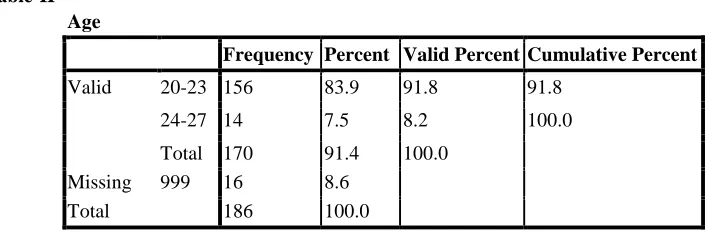
Table II shows the age of respondents. Most of the respondents fall in the category of 20-23 years of age which is 92% of the sample. Because the data was gathered from the students of bachelor and master classes so that
is why they lie in this category. Only 8% of the sample is in the age of 24-27 years. 16 respondents of the sample have not told about their age factor.
Table-II Age
Frequency Percent Valid Percent Cumulative Percent
Valid 20-23 156 83.9 91.8 91.8
24-27 14 7.5 8.2 100.0
Total 170 91.4 100.0
Missing 999 16 8.6
Total 186 100.0
Table III shows about the major subjects taken by the sample respondents. 4% of the sample is from the field of Economics, 56% of the
respondents are from Finance, 30% are from Marketing and 10% are from HRM.
Table-III Major Subjects
Frequency Percent Valid Percent Cumulative Percent
Valid Economics 6 3.2 3.8 3.8
Finance 88 47.3 55.7 59.5
Marketing 48 25.8 30.4 89.9
HRM 16 8.6 10.1 100.0
Total 158 84.9 100.0
Missing 999 28 15.1
Total 186 100.0
Table IV shows the descriptive statistics of the questions asked to respondents. Most of the respondents are agreed from importance of internet like other research tool,
607 of internet is essential for students,
(Mean=3.81) (SD=1.24). Some students shows frequency of internet usage which is more than once a week, (Mean=4.14) (SD=1.13). Some students are neutral about the internet is using for learning fun
(Mean=3.05) (SD=1.30). Some students are disagreed about the use of internet at Cafe (Mean=1.93) (SD=1.42). Most of the students shows that they do not use webcam while using internet (Mean=1.75) (SD=0.43).
Table-IV
Descriptive Statistics
Items N Mean Std. Deviation
Importance of internet 182 3.8901 0.93372
Easier than library 182 3.6484 1.31606
Informative as teacher 180 3.0556 1.18991
Enjoy more than internet 184 3.1630 1.22164 Feel Overwhelmed in studies 172 2.9186 1.28158
Use for learning fun 182 3.0549 1.30754
Internet as an integral part 178 3.6629 0.99653
Access more at university than home 178 2.6404 1.42811 Knowledge of internet 186 3.8172 1.24723
Feel comfortable in using internet 178 3.7303 1.12259
Useless information 174 2.1264 1.19541
Difficult to use 174 2.1264 1.23349 Educational projects 184 2.0217 1.38673
Internet for education 176 2.6364 1.09212
Security concern 170 2.7647 1.20793
Slow at home 174 2.6552 1.33280
Internet confuses me 180 2.5111 1.35568
Frequency of use 184 4.1413 1.13158
Hours of usage 174 2.0920 1.23187
Location of usage 180 1.9333 1.42445 Purpose of usage 174 2.7701 1.23252
Nature of sites 172 2.6977 1.42714
Use of webcam 176 1.7500 0.43425
Valid N (listwise) 200
Discussion
The present results are based on the previous study (slate et al., 2002) and (Usun, 2003). The both studies tell us about the student, who are us strongly agreed about the internet was much important like other research tools.
who had computers at their home, shows more positive behavior in their schoolwork while using computers as compare to the college students who had not computers at their home place.
Bayram and Uzuncarsili (1998) organized a field survey of 356 persons in Turkey about the internet users and the results expressed that there were the problems relating to the Computer hardware, software and the cost. In present case only the 40% of the students observe that internet is not easy to use at their school level.
Conclusions and Recommendations Conclusion
This research is based on the application of Business Students’ Behavior towards Internet Use. The objective of the research is to determine the factors which find the interest of students toward internet use. All the information was collected through questionnaire on Business Students’ Behavior towards Internet Use.
Contribution
As we are all exist in the world of advance technology, so we should keep in view the student future requirement. The current study will help the policy makers to meet the student’s requirements of internet according to their demand. The present research defines the interest which is not only playing a vital role in education sectors but also for research. With the help of internet, we can collect data easily and fast as compared to library. This study will prove helpful for scholars, teachers and students to change the trend of hard books to softcopy of their data so that it can be easily uploaded on the internet and maximum people can get the valuable information.
This study encourages the students who use fewer internets due to its security problems. This study also provides awareness of internet among all aged people who are afraid of internet. There must be providing training and coaching so that they can use internet.
Limitations and Future Research
In present study only the business students of university of education were taken as respondents. Therefore, the small data was collected. Due to the limitations only the method of convenient sampling was used. The MS/PhD. Programmed recently been introduced in Pakistan. So, all the students are busy in research, this kind of study suitable at higher level. This study will prove helpful for future research in security issues during internet usages. The future research should have to identify such ways so that maximum people can use internet. The future research must give the direction to the miss use of computer and internet by students because this big problem effect badly on students and their parents. So, the future researchers must find safe means of using internet.
References
Amoroso, D. L., & Cheney, P. H. (1998). “Testing a Causal Model of end-user Environment:Empirical Investigation” Information and Management, Vol.14, pp.107-113.
Applebome, P. (1999). Distance learning.
[Online] Available:
http://www.education.com. Oct 12, 2009 (April 4, 1999).
Aydn, C. H. (2001). Uses of Internet in Turkey, Educational technology research & development, V 49, Washington. ISSN: 10421629.
Bayram, S., & Uzuncarsılı.U. (1998). Virtual classrooms on the Web: Problems and solution in Turkey. Conference of the European Educational Research Association, Scottish Council for Research in Education (SCRE) and European Conference on Educational Research, 17-28September, Ljubljana, Slovenia.
Bell, P. (2000). “Scientific argument as learning artifacts designing for learning from the Web with KIE,International” Journal of Science Education, Vol.22, pp.797-817.
609 for Learning” Journal ofResearch in Science
Teaching, Vol.38, pp.730-745.
Chadwick, C. (2002). “Why computers are failing in the education of our children” Educational Technology, Vol.42, pp.35-40.
Chickering, A.W., &Gamson, Z. F. (1991). “Applying the seven principles for good practice in undergraduateeducation” New Directions for Teaching and Learning, Vol.47, pp.63-69.
Dede, C. (1996). “Emerging technologies and distributed learning” American Journal of Distance Education, Vol.10, pp.4-36.
DeWitt, S. (2003). “Multicultural democracy and inquiry pedagogy” Intercultural Education, Vol.14, pp.279-290.
Falvo, D.R., (1994), Effective Patient Education: A guide to increased compliance. (2nd ed). An Aspen publication, USA.
Fornell, C., &Larcker, D. (1987). “A Second Generation of Multivariate Analysis: Classification of Methods andImplications for Marketing Research” in Review of Marketing, M. J. Houston (ed.), American Marketing Association, Chicago, pp.407-450.
Forsyth, I. (1998). Teaching and learning materials and the Internet. (2nd Ed.). London: Kogan.
Gladieux, L., &Swail. (1999). The virtual university and educational opportunities: Issues of equity and access for the next generation. Washington, DC: College Board.
Gorman, L. (2003). Unbounded classrooms: NSW HSC. [Online] Available: http://www.global educator.com.
Iakushina, E.V. (2002). “Adolescents on the Internet: A specific charter of information interaction” Russian Education and Society, Vol.44, pp.81-95.
Igbaria, M., Parasuraman, S., &Baroudi, J. J. (1996). “A motivational model of microcomputer usage. Journal of Management Information Systems” Vol.13, pp.127–143.
Lee, S & Kim, B., G (2009). “Factors affecting the usage of intranet: A confirmatory
study” Computers in Human Behavior, Vol.25, No.1, pp.191-201.
McKenzie, J. (1998). Grazing the net: Rising a generation of free-range students. PhiDeltaKappan [Online] Available: http://www.fno.org/text/grazing.html (Sept, 1998).
Metzger, M. J., Flanagin, A. J., &Zwarun, L. (2003). “College student web use, perceptions of information credibility and verification behavior” Computers and Education, Vol.41, pp.271–290.
Molebash, P. (1999). Technology and education: current and future trends, Information Technology Journal. [Online] Available:
http://etext.virginia.edu/journals/itjournal/1999 /molebash.html (December 8, 2000)
Oral, B. (2008). “The evaluation of the student teachers' attitudes toward Internet and democracy” Computers &Education, Vol.50,No.1), pp.437-445.
Özgen, H., Maraslı, H., &Yalçın, A. (1996). “Türkiye'de uzaktanegitimiçin uygulanabilir Bir model önerisi. A Model Proposal for Distance Education through Internet in Turkey” First International Distance Education Symposium, pp.529-535.
Pin, K., C. & Chung, C., T. (2009). “Teachers' attitudes toward web-based professional development, with relation to Internet self-efficacy and beliefs about web-based learning” Computers & Education, Vol.53 No.1, pp.66-73.
Risinger, F. (1998). “Global education and the World Wide Web” Social Education, Vol.62, pp.276-277.
Selwyn, N. (1999). “Students' attitudes towards computers in sixteen to nineteen educations” Education and Information Technology, Vol.4, No2, pp.129-141.
Selwyn, N., Marriott, N., & Marriott, P. (2000).Net gains or net pains? Business students’ use of the Internet.Higher Education Quarterly, Vol.54, No.2.
teaching packets” The Social Studies, Vol.91, pp.244-252.
Slate, J.R., Manuel, M., & Brinson, JR.K. (2002). The “digital divide”: Hispanic college students’ views of educational uses of the Internet. Assessment & Evaluation in Higher Education, Vol.27, No.1), pp.75-93.
Spennemann, D. H. R. (2006). The internet and daily life in Australia: an exploration. The Information Society, Vol.22, pp.101-110.
Thompson, R. L., Higgins, C. A., & Howell, J. M. (1991). “Personal computing: toward a conceptual model of utilization” MIS Quarterly, Vol.15, pp.125–143.
Tsai, C., C. (2009). “Conceptions of learning versus conceptions of web-based learning: The differences revealed by college students” Computers & Education, Vol.53, No.4, pp.1092-1103.
Usun, S. (2003). “Undergraduate Students Attitudes towards Educational Uses of Internet” Interactive Educational Multimedia, Vol.7, pp.46-62.
Wright, V. H., & Marsh, G. E. (2000). Technology and teaching: a turning point.
[Online] Available: