2545
Team Learning In Motion Capture Operations
And Independent Rigging Processes
Ahmad Azaini Manaf, Mohd Rosli Arshad, & Kamal Bahrin
Abstract: This article discusses team learning activities among motion captures operators and how such occasions contribute to the producing successful on recording human movement. This paper specifically monitors between each team behaviors reacts, communicate members in performing successful optical motion capture tasks. Among task‘s component discussed in this article were team members ability to operate the equipment, calibrate, and most significantly, the social interaction between team in avoiding numerous of errors in motion capture operations. The tests were influenced of the reason of high requirement by animation industry in Malaysia, where most graduates are required highly skilled in multiple software platform. This study aim to obtain practice-based factors among team learning , which can be implement to the simulated start-ups environments, which
can be applied and simulate beyond current education systems.
Method— The motion capture test activities were advertised among undergraduate students, with unrestricted level of undergraduate and postgraduate students. Two tasks given, team-based task, and individual-based tasks. All participants were required to attend the tests which in 5 days duration. The required background of all participants skills in Motion Capture operations were not required, only with minimal multimedia knowledge background. Most of demographics were mixture gender participants with 11 animation students of (8 freshmen) and (3 sophomore) and divided into 3 teams. All task was based on test-time learning to all participants. Each team learning activities also observed with repeated Motion Capture operations and include
individual tests.
Results—The time-based team result showed all team successfully calibrated all process setup in Motion Capture accordingly, where the outcome indicated each team member communicate effectively in perform all operations tasks. In opposite of independent tasks, the findings indicated individual tasks took longer duration as compared team-based task. As a result, team of learners positively contributed to efficient productivity than individual learners. As conclusion, the study discovered the importance of practice-based learning in teams for staging production work and found new elements by acknowledging the differences and similarities in each team members work cultures and environments.
Index Terms: Team Learning, motion Capture, Efficiency, Motion Capture Operations, Team management, Test-time team learning.
—————————— ——————————
1.
INTRODUCTION
Motion capture is a tool for animation studios and student alike in increase their production efficiency in creating animations and avoiding lengthy and difficult keyframing processes. The usage of motion capture varied nonetheless it only focuses recording movement of humans or based on humanoids. This is to obtain as realistic movement as possible, as mostly used animation films, games, or for actor replacement purpose in stunts or visual effects. Many gaming
and visual effects studios has embraced advanced technology of the real-time tracking on the human motion process which has performed greater accuracy than the meticulous traditional approach [4]. Also discuss from previous researches, the practice-based learning in motion capture were required constant changes as learning object. In this case, essentially anticipated by a new characteristic recognized by the learners [8]. These classifications demonstrate on how participants perceive understanding of the learning situation, were it was expressed into collaborative tasks and verbal actions. Consequently, it contributed to the participants professional development despite of their various level of educations and background experiences. The summary overview of this test conducted, where the participant was trained by experience facilitator, by performing various teaching methods towards teams and direction towards data management. Then, the team members were left independently to operate the software. The main outcome of this research was to measure
test-time understanding among of team learning. The team learning approach was based on previous studies, [4] where it combines both of supervised learning and test-time optimization, where it was applied with using Motion Capture system.
2 METHOD AND PROCEDURES
2.1 Learning Tasks
Learning tasks can be divided in production- and development-oriented [1] learning tasks. In this test, -oriented learning approach was implemented to obtain a reaction from the common Motion Capture (MoCap) production and setup processes. The researcher found the learning environment studies in nursing environment were adapted in this test. This is to alleviate the learning manner among operators in working together in a team to perform effective Motion Capture process. Based on previous studies, developmental-oriented learning is sparked from the gap between current practice and with technological advanced environment of the nursing team [2] have to some extent have similarity towards animation team, which the concept applied to this test. The test co-organized with collaborative effort from Kuala Lumpur animation company, Kromosomlab Sdn. Bhd. with preparation 3D pre-rigged model in Fig. 1. The model Suri were originally created by the managing director of the company Kromosomlab, in native Blender format and exported into filmbox format or .fbx. Then, the 3D models were converted into Maya format, due to effective operating environment of the lab.
————————————————
Ahmad Azaini is a senior lecturer of Animation program in Universiti
Malaysia Sarawak, PH+60102267064. E-mail:
Mohd Rosli Arshad is a senior lecturer of animation program in
Universiti Kuala Lumpur, PH+60192686875. E-mail:
2546 Figure 1: Model of humanoid name Suri
2.2 Samplings
In order to obtain enough participants for the motion capture test activities. The test was advertised among faculty students, to all undergraduate and postgraduate candidate. However, the participants were required fully committed with the activity, which 5 in days duration. Fundamental multimedia skills were essential, also interests were the key in participating motion capture activities. The background skills in MoCap operations were not required, only with minimal multimedia and 3D modeling background. As gender were not obligatory in the tests, most of demographics were mixture gender participants with 11 animation students of (8 freshmen) and (3 sophomore). They were divided into teams, this was to observe efficiency, understanding, verbal behaviours and learning among the team members.
2.3 Concept Brief and Tutorials
The short brief of tutorial was made on the first day with basic concept, and function of Motion Capture with the usage of Arena Software in Fig. 2. The tutorial of Motion capture camera and tripod assembly and demonstrations continued to the second day, with additional tutorials by the facilitator, with the of using motion capture, and fundamental tutorial of data transfer. The challenges were to ensure all optical cameras were functioned and parallel to the working area as in Fig. 5. Additional on the second day, the contestants were briefed on how to export and ―bake‖ process or in computer graphics terms; uniting a system of data into a simplified into permanent form [6] the skeleton (joints) with the character. The participants also briefed on importing MoCap recording data, identifying directory and textures Calibration process as in Fig. 6.
Initial briefing and tutorial by the facilitator to the participant on motion capture concept.
The second day tutorial on paint weight process of
the skeleton with the polygonal character Figure 2: Participant Briefing: Short Tutorial
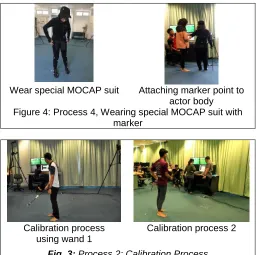
Then, the participants were arranged in a team of 3 individuals. As in Fig. 3 each team members in a group were themselves position as calibrator, Arena MoCaP software operator, and camera operator/Actor. The group required to discuss among themselves, without assistance of facilitator as part of team learning, as main objective to achieve successful data recording.
Wear special MOCAP suit Attaching marker point to actor body Figure 4: Process 4, Wearing special MOCAP suit with
marker
Calibration process using wand 1
Calibration process 2
Fig. 3: Process 2: Calibration Process
2.4 Team-based tasks
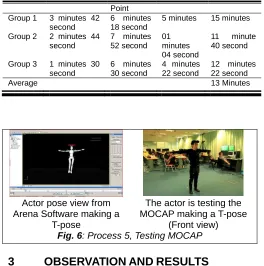
The result in Table 1 indicates of each group in initial motion capture setup, from the point of wearing the motion capture suits, setting MoCap markers on actors displayed in Fig. 4 and initially required to stand T-pose position in Fig. 6. This is to monitor and observe team learning, where team leaders required to verbally instruct and discuss among team members, also to identify efficiency in using the motion capture system.
Motion capture camera and tripod assembly
Optical camera parallel to the working area Fig. 5: Setup and positioning of optical camera
Each group consists of 3 persons was given maximum time necessary to arrange their motion-capture setup. The result for every group took average time to complete the task was about 13 minutes based on the Table 1.
TABLE 1
Recorded test-time learning of each group Group MoCap Suit
wearing
Setting Marker
2547 Point
Group 1 3 minutes 42 second
6 minutes 18 second
5 minutes 15 minutes
Group 2 2 minutes 44 second
7 minutes 52 second
01 minutes 04 second
11 minute 40 second
Group 3 1 minutes 30 second
6 minutes 30 second
4 minutes 22 second
12 minutes 22 second
Average 13 Minutes
Actor pose view from Arena Software making a
T-pose
The actor is testing the MOCAP making a T-pose
(Front view) Fig. 6: Process 5, Testing MOCAP
3
OBSERVATION AND RESULTS
There are certain conditions in operating motion capture with effective results. As calibration often required renewal setup, due to marker error and faulty optical arrangement therefore it effected motion capture recording. Fundamentally all optical based motion capture system requires to operate in unlit and dark spaces without receiving over exposure light from outdoors, as a reason to prevent reflection on the MoCap markers. The effectiveness of movement also depended on the markers on the MoCap suit, where it should place at accurate position as possible according to the requirement.
Selecting all the 3D character skin to build a
skeleton
Binding the character skin with the skeleton
construction
Figure 4: Attaching skeleton and Skin Binding in Autodesk Maya
Calibration is the crucial part of the process, where it will represent the working area for acting where the actors can walk and act. The team showed successful in delivering recommended setup and calibrating in less of 15 minutes. Most of the team, were well coordinate in performing all process from MoCap suit wearing, Setting Marker, T-Pose. In Table 1, group 2 displayed fastest duration in setup and completing all processes. Most of the team as well, successfully calibration process was vital in any new setup of recording, therefore each team required to calibrate the wand effectively in Fig. 3 were used to detect the working area. The calibrating wand should at least estimate 1 to 2 cm of the ground to calibrate the foot movement. The monitoring indicated each team member communicate effectively to
perform unsupervised successful calibration. The test with the member of the team that in preparations of clean up or baking process [6] which was to generate smooth movement of actors and maintained correct virtual skeletal position to the polygonal digital model or 3D mesh. The results based on observation team members found they were successfully performed the baking process, although initially started with minor errors. Each team learning activities also observed with additional recordings in results of the error, continued with repeated recording of varied actions. This common among operators whereas, the operations required of testing to detect the error in matching the vital MoCap setup. This was to retain the best several sets of calibration result for future usage and better, in efficient productivity. The tests among teams also found each personnel understands the accurate marker setup onto MoCap suits, to obtain correct and optimum results. This due to the MoCap suit requires close-fitting to the actor body, to avoid any obstacle that blocking markers from the infra-red camera.
3.1 Independent-based results
The fundamental knowledge of 3D application software among individual in the test were also crucial, this is due to the ―baking method‖ [6] requirement in the test. Baking in definition; that required cleaning MoCap movement data, where all the animation required this process into editable animation. This is to ease modification performed in third party application Autodesk Maya for further paint weight process onto 3D mesh. The function is to ease the operator or animator to performed adjustment on the character movement. MOCAP native data were easier to edit in Autodesk Motion Builder according to observation among participants than using Autodesk Maya that requires intermediate learner level. The RAW file (FBX) from motion capture were mandatory, in order to clean excess data Autodesk Motion Builder, this is to ensure smooth movement of the digital character. Moreover, the 3D model of Suri as in Table 2 required to employ paint weight [21] to ensure the character movement were smooth and produce normal polygon effects. In this case, all the future participants required as a minimum as intermediate user of 3D application.
Table 2.
Time-test Independent Learning Paint Weights on polygonal models Suri
Participant Duration
Participant 1 19 minutes 34 second Participant 2 16 minutes 4 second Participant 3 10 minutes 12 second Participant 4 14 minutes 22 second Participant 5 12 minutes 22 second Participant 6 11 minutes 35 second Participant 7 21 minutes 56 second Participant 8 7 minutes 26 second Participant 9 5 minutes 22 second Participant 10 50 minutes 5 second
2548 were the fastest among all that operate paint weight tools.
Participant 10 took approximately 50 minutes, repeated newly tasks due to hardware error. Based on the observation towards individual and independent tasks, resulted longer duration to finish compared team-based task. As a result, it was often productive and efficiently operated in the team of learners.
4 LIMITATIONS
The research conducted within total of 5 days, with initial of 2 days to encourage team learning, was too brief for the participants. Numerous repeated tutorials and intense supervision required from the facilitator. The selection of 3D digital characters proportions was essential and should have similar volume of the actors. Selecting an actor for MoCap required similar proportions and considerations towards original 3D character. Size and volume would influence the final output of the data. The reason was to prevent an inaccuracy on character joints that match with MoCap data from the actor. For the MoCap actor, the suits required close-fitting to the actor body, to avoid any obstacle that blocking markers. There are discrepancies character and the MoCap character animation result when the joints and the 3d meshes attached. The issue arises when the skeleton (joints) construction were found disparity between 3D model and MOCAP marker, due to the original skeleton in 3D model. Hence, the preparations of this test were made earlier or pre-test to solve the issue. necessary tutorial also was performed to the participants where the learners expected to solve the challenge collectively, whether the learners made the adjustment to attached to the 3D mesh.
5 CONCLUSION
The observations suggested limited to a small number for easier monitoring purposes. This is to obtain the detail in supervising each team effectively, especially in collaborating activity, recording operations, transferring and rigging processes. However, in this research, the author and the researchers found challenges in finding number of participants, consequently this was affecting the number participants in the activity. As a result, only 10 students finally participate, nevertheless, the number was sufficed for motion capture activity. Though, with a larger group with 20 will increase significant discrepancies between efficiency in the test results. Team learning activities presented in this study and the tests broadens creative managers and MoCap teams as instrument of reference and reflection on the learning processes in the team. As imitating and establishing implementors for team learning, such durations and space dedicated for learning activities, creative managers and studios could provide conducive infrastructures for creative-oriented as well as for production-creative-oriented team learning processes especially in animation production. However, the results of this study for gender composition of a team, including aspects such as the proportion between female and male operators does not affected the creative outcome level of the undergraduate MoCap operators in the team. In this study and tests, team-learning activities discovered a potential for delivering creative insights in the benefit of learners, across MoCap teams regardless of gender, but also as an outcome created a part of efficacy and productivity in team learning. In opposite, team members that able handling of emotions appears as critical factor in dealing with challenging
atmosphere [1]. Hence, with the regard to practical implications, there are challenges in order promoting team learning in real practice, where the challenge to organize of joint tasks and manages them, includes problem solving and managing sentiments. However, there are limitations in team members social interaction when it comes to team learning. Although collective reflections appear in connections between the energetic and concrete actions in common practice, but there are potential gaps as regards relations to given tasks to team‘s performance. This study contributes for further benefit of practice-based learning that can be implemented to simulate start-ups environments where, it can simulate beyond current education systems. Therefore, the emphasis on game development, art and visual creation in national higher education sectors (HIE) is very much needed for industry sustainability. HIE should focus on building visual arts talent, especially in game pre-visualization, particularly for multimedia, gaming and including animation sectors [9]. The study identifies the importance of practice-based learning in teams for staging production work that important for animation production pipeline. As suggested in previous studies [3] the discovery of the new elements by acknowledging the differences and similarities in each team members work cultures and environments, therefore that contributes potentials towards on the team learning.
ACKNOWLEDGMENTS
This article and research was supported by UNIMAS AND
PETRONAS P.RAMLEE RESEARCH CHAIR,
F03/PRC/1938/2019
7.3 REFERENCES
[1] O. Timmermans, R. van Linge, P. van Petegem, M. Elseviers, and J. Denekens, ―Team learning and team composition in nursing,‖ J. Work. Learn., vol. 23, no. 4, pp. 258–275, 2011. [2] A. Lantz, N. Hansen, and C. Antoni, ―Journal of Workplace
Learning Participative work design in lean production: A strategy for dissolving the paradox between standardized work and team proactivity by stimulating team learning? Article information:Learning to evolve: A review of contemporary,‖ Int. J. Oper. &, vol. 27, no. 1, p. pp, 2004.
[3] H.-Y. Fish Tung, H.-W. Tung, E. Yumer, and K. Fragkiadaki, ―Self-supervised Learning of Motion Capture.‖
[4] D. L. Flam, D. P. De Queiroz, T. L. A. D. S. Ramos, A. D. A. Araújo, and J. V. B. Gomide, ―OpenMoCap: An open source software for optical motion capture,‖ in SBGAMES2009 - 8th Brazilian Symposium on Games and Digital Entertainment, 2009, pp. 151–161.
[5] E. Raes, A. Boon, E. Kyndt, and F. Dochy, ―Measuring team learning behaviours through observing verbal team interaction,‖ J. Work. Learn., vol. 27, no. 7, pp. 476–500, 2015.
[6] K. Trammell, ―Big Idea: ‗Baking‘ - CG Cookie,‖ 2016. [Online]. Available: https://cgcookie.com/articles/big-idea-baking. [Accessed: 12-Dec-2019].
[7] Autodesk, ―Paint skin weights | Maya 2018 | Autodesk Knowledge Network,‖ Autodesk Knowledge Network, 2018.
[Online]. Available:
https://knowledge.autodesk.com/support/maya/learn-
explore/caas/CloudHelp/cloudhelp/2018/ENU/Maya- CharacterAnimation/files/GUID-7D773C38-F9CF-4141-8ADD-4E0454838BB7-htm.html. [Accessed: 13-Dec-2019].
2549 2013.