INTRODUCTION
This work was stimulated by the necessity to increase the information content of fluorimetry for the analysis of natural organic compounds (NOC) – dissolved organic matter (DOM), oil complexes (films, emulsions), protein compounds etc. The traditional spectral analysis has limited opportunities here. For example, different types of DOM (allochtonous/autochtonous, labile/stable etc.) have close fluorescence bands.
We suggested to use molecular photo-physical parameters – absorption cross sections, lifetimes of excited states etc. for NOC diagnostics, which can be determined by solving the inverse problems of non-linear fluorimetry (1,2) or of kinetic fluorimetry (2,3). These parameters are important not only for NOC diagnostics, but also to study photo-physical processes in these compounds. In the last few years, we have used the technique of artificial neural networks (ANN, (4)) to solve such problems (1,2,3).
Study of laser fluorimetry of complex organic
compounds in water using matrix method
ABDUL RAZIQUE
L.N.M.U., Darbhanga - 846 004, Bihar (India).
(Received: January 06, 2010; Accepted: February 19, 2010)
ABSTRACT
A matrix method synthesizing methods of kinetic and non-linear laser fluorimetry is presented in this paper. It is assumed that in the case of a rational selection of the range for photon flux density of the exciting radiation, and of the range of time for measurements of fluorescence kinetics, it is possible to determine a substantial number of molecular photo-physical parameters of complex organic compounds. This could be achieved by solving the inverse problems with the elements of the suggested matrix as input data. As a first step in the development of this approach, numerical modelling of the direct and inverse problems has been performed using the model of a two–fluorophore complex with intermolecular energy transfer.
Key words: Matrix method of fluorescence, fluorescence of organic compounds, photo-physical parameters.
It is well known that any method of solution of inverse problems requires a priori information about the object of study. The amount of such information available from most types of NOC is very small. In many cases such as DOM, oil complexes etc. there is no reliable information about the number of fluorophores, their fluorescence spectra and the orders of magnitude of the main photo- physical parameters.
The kinetic curves and the fluorescence saturation curves of NOC are of such nature that even when the ANN algorithms are used it is only possible to determine two or three photo-physical parameters with satisfactory precision.
The Matrix Model
with:
n1, n2 concentrations of the excited molecules of the corresponding fluorophores; n01, n02 initial concentrations of the molecules of
the corresponding fluorophores;
τ1, τ2, lifetimes of the excited molecules of the
corresponding fluorophores;
γ1, γ2 constants of singlet-singlet annihilation of
the corresponding fluorophores;
σ1, σ2 excitation cross sections of the
corresponding fluorophores;
F(t) photon flux density of the exciting radiation;
K12 constant of intermolecular energy transfer from the first to the second fluorophore.
Having determined n1(t,F) and n2(t,F), it is possible to calculate the fluorescence intensity l(F,T) in a receiver gate delayed for time T with respect to the exciting laser pulse for the given value of photon flux density F (refer to (3)).
In this model we do not separate intercombinative (S-T) conversion from common channel of intermolecular relaxation of excited state of fluorophores, i.e. from common time of this relaxation τ1 and τ2. Nevertheless, there are nine model parameters, which cannot be determined simultaneously neither with the kinetic fluorimetry method, nor with the nonlinear fluorimetry method, nor by the sequential use of these methods. These considerations have led us to the idea to perform a synthesis of these methods. To do so, the following matrix needs to be measured:
where /FnTm is the fluorescence intensity of the organic compounds mixture for the exciting radiation photon flow density Fn and for the strobe delayed for time Tm with respect to the laser pulse.
The rows of this matrix are the points on kinetic curves at different photon flux densities F; the columns are the points on fluorescence saturation curves at different strobe delays T. The range of F should be selected in such a way that at its minimal value there would be no saturation of fluorescence, and at its maximal value saturation would be significant. The degree of saturation at maximal F is chosen based on the peculiarities of the specific problem.
From physical considerations it may be expected that different matrix elements have different dependences on photo-physical parameters. Consequently, under rational choice of matrix elements, all photo-physical parameters can be determined. In this paper, the first steps in the development of this approach have been made.
It should be noted that this approach is in principle different from the matrix method (5,6), where the following matrix is used:
RESULTS
By numerical modelling, the following blocks (sections) of the full problem of elaboration of the suggested matr ix method have been considered.
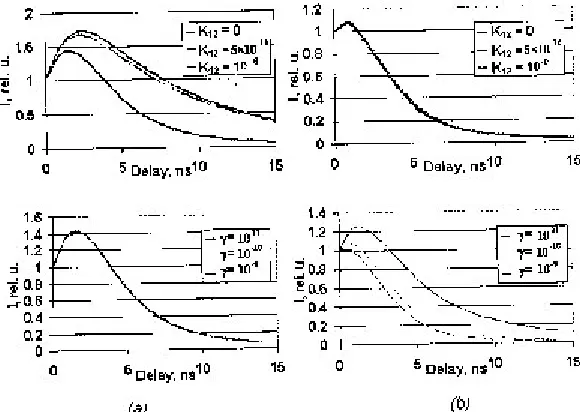
Consideration of the direct problem illustrates the fact that different matrix elements have different dependences on the chosen photo-physical parameters. Such consideration was carried out for the constants of intermolecular interactions, which have never been determined in kinetic and nonlinear fluorimetry before. The corresponding parameters are: K12 and y1n01, y2n02. Figure 1 displays the kinetic curves calculated at different values of F: 1021cm– 2s–1, where fluorescence saturation is absent, and
1025cm–2s–1 where saturation manifests itself
Table 2: The results of solving the five-parameter inverse problem
Fixed parameters: Errors of determination of the target parameters s1=10–16 cm2, s
2=10
–17 cm2, n
01=n02=10
18 cm–3 at different noise level in input data
target parameters and their ranges Noise level 0% Noise level 5%
τ1 (10
–11 ... 10–7) s 2% 25%
τ2 (10
–11 ... 10–7) s 0% 25%
γ1 (10
–11 ... 10–8) cm3/s 10% 30%
γ2 (10
–11 ... 10–8) cm3/s 10% 20%
K12 (10–11 ... 10–8) 20% 60%
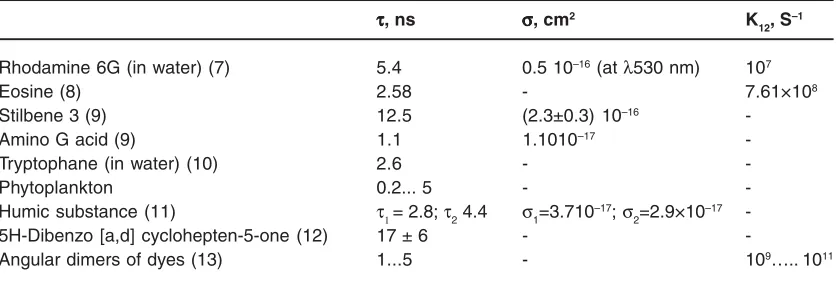
Table 1: Typical values of photo-physical parameters for some organic compounds
τττττ, ns σσσσσ, cm2 K
12, S –1
Rhodamine 6G (in water) (7) 5.4 0.5 10–16 (at λ530 nm) 107
Eosine (8) 2.58 - 7.61×10⁸
Stilbene 3 (9) 12.5 (2.3±0.3) 10–16
-Amino G acid (9) 1.1 1.1010–17
-Tryptophane (in water) (10) 2.6 -
-Phytoplankton 0.2... 5 -
-Humic substance (11) τ1 = 2.8; τ2 4.4 σ1=3.710–17; σ
2=2.9×10 –17
-5H-Dibenzo [a,d] cyclohepten-5-one (12) 17 ± 6 -
-Angular dimers of dyes (13) 1...5 - 109….. 1011
significantly influences the kinetic curves. At the same time, these kinetic curves do not depend on the singlet-singlet annihilation constants at all. At large values of F, the kinetic curves depend on all the three mentioned parameters, but differently.
Our first approbation of the opportunities of the matrix method in the solution of this inverse problem has been performed for 5 parameters: the lifetimes of both fluorophores τ1 and τ2 the constants of singlet-singlet annihilation γ2 and γ2 and the constant of intermolecular energy transfer from the first fluorophore to the second one K12. The remaining four of the above specified nine intermolecular parameters of the mixture of organic compounds were considered to be known, their values are given in Table 2 (upper left corner). The ranges of the target parameters are also presented in Table 2, their determination has been addressed in (3).
For numerical modelling, the following parameters of laser radiation and of the receiver
were used: laser pulse duration tp–10 ns; its shape was considered to be Gaussian; gate integration time tg=10 ns; gate positioning step 2 ns. The matrix elements that were used corresponded to five kinetic curves without noise and with 5% noise, obtained at five photon flux densities of laser radiation.
To solve the five-parameter inverse problem, genetic algorithms (GA, (14)) were used. The advantage of GA in comparison to other methods of solving inverse problems, in particular, in comparison to ANN, is its high efficiency for solution of multi-parameter problems (the ANN technique is successfully used for determination of two or three parameters). The results of solving the five- parameter inverse problem are presented in Table 2.
It should be noted that the higher the number of elements in the matrix, the higher is the precision of determination of the parameters. An increase in the number of the delays primarily causes an increase in the precision of determination of lifetimes; the number of photon fluxes primarily influences the precision of measurement of other parameters. In fact, the dimensions of the matrix should be determined based on the acceptable error levels for all the determined parameters. However, we do not have any formula yet to make an estimation of the required matrix dimensions; the required size of the matrix has been determined by a numeric experiment.
The ANN method gives better precision, but for fewer parameters. Therefore, we suppose to consider the opportunity of implementing the
procedure of step-by-step determination of the parameters by groups of three parameters, using “blocks” of matrix elements chosen on the base of physical considerations.
CONCLUSIONS
The first steps made in the direction of creating a matrix method, synthesizing laser kinetic and non-linear fluorimetr y, demonstrate the perspective of this approach. The experience accumulated while performing this work, has shown that the development of the suggested matrix method would be quite difficult. However, the efforts are justified by the possibility to determine a large number of photo-physical parameters, which can be used to characterize natural organic compounds. At present, no alternative is seen to this approach. Fig. 1: Kinetic curves of the fluorescence of organic compounds, calculated at F=1021
cm–2s1 (a) and F=1025 cm2s1 (b) with different values of intramolecular parameters
REFERENCES
1. Dolenko S, T Dolenko, V Fadeev, E Filippova, O Kozyreva & I Persiantsev, Solution of inverse problem in nonlinear laser fluorimetry of organic compounds with the use of artificial neural networks. Pattern Recognition and Image Analysis, 9(13): 510-515 (1999).
2. Dolenko S, I Gerdova, T Dolenko & V Fadeev, Laser fluorimetry of mixtures of polyatomic organic compounds using artificial neural networks. Quantum Electronics, 31(9): 834-838 (2001).
& M Kompitsas, Time-resolved fluorimetry of two-fluorophore organic systems using ar tificial neural networ ks. Optics Communications, 213(4-6): 309-324 (2002). 4 Hassoun M, Fundamentals of artificial neural networks. (Cambridge, Mass., London. The MIT Press) 511 (1995).
5 Lewitzka F, U Bunting, P Karelischek, M Niederkruger & G Marowsky, Quantitative analysis of aromatic molecules in water by laser induced fluorescence spectroscopy and multivariate calibration techniques. In: Intern. Conf. “Envirosense” (Europto series) (Munich, Germany) 3821: 331-338 (1999). 6 Karlischek P, F Lewitzka, U Bunting, M
Niederkruger & G Marowsky, Detection of aromatic pollutants in the environment by using UV-laser-induced fluorescence. Applied Physics B, 67: 497-504 (1998). 7 Kopylov S & B Lykov. Tunable dye lasers and
their applications. (Moscow, Radio I Svyaz.) 11- 13 (in Russian)
8. Sizyh A, E Tarakanova, & L Tatarinova, Laser induced reduction of a dye with high yield to triplet state, dissolved in a polymer. Quantum Electronics, 30(1): 40-44 (2000).
9. Gerdova I, Laser induced fluorimetry of complex organic compounds in water media. Ph.D. Thesis. (Moscow State University, Physical Dept.) (in Russian) 105 (2002). 10 Levshin L & A Saletsky, Luminescence and
its measurements (Moscow State University) (in Russian) 280 (1989).
11 Kreynin P, Laser spectroscopy of two-component mixture of organic fluorophores. Diploma thesis. (Moscow State University, Physical Dept.) (in Russian) 58 (2001). 12 Parul D, S Bokut, A Milyutin, E Petrov, N
Nemkovich, A Sobchuk, & A Dzhagarov, Time-resolved fluorescence reveals two binding sites of 1,8-ANS in intact human oxyhemoglobin. Journal of Photochemestry and Photobiology B: Biology, 58(2-3): 156-162 (2000).
13 Chibisov A, G Zakharova, H Gerner, & A Tolmachev, Photo processes in dimers of polymethene dyes. Jour nal of Applied Spectroscopy (Zh. Prikladnoj Spektroskopii), 62: 58 (in Russian) (1995).