IJSRR, 9(2) April - June, 2020 Page 62
Research Article Available online www.ijsrr.org ISSN: 2279–0543
International Journal of Scientific Research and Reviews
Phase Vacation Queuing model with Server Breakdown
G.Ammakkannu
1, S.Maragathasundari
2*and M.Manimala
3Department of Mathematics, Kalasalingam academy of research and education, Krishnan koil,Virudhunagar,Tamilnadu,India
1
[email protected], [email protected], [email protected] ___________________________________________________________________________________________
ABSTRACT
This article manages a Queuing framework during which one server offers support to all the showing up clients. Clients show up in batch follows a Poisson conveyance though the administration follows a general dispersion. Administration interference happens aimlessly. It gets into a fix procedure right away. In the wake of completing of the repair system, administration proceeds. Clients because of eagerness, they leave the framework during the hour of repair process. After fruition of the administration, if there aren't any clients inside the line, server will take an obligatory vacation of two stages. In stage I vacation stage, fundamental upkeep work for the server will be managed. In stage II, significant upkeep work will be directed. During these stage vacations, clients may join the line. To stay away from the clog inside the framework, an idea of limited suitability is taken among the appearance of customers during the hour of stage get-aways. Confined suitability might be played dependent on two distinct reasons in every one of the stage excursion. This lining issue is examined through a birth passing procedure of Queuing hypothesis and it's explained by one among the lining issue strategy known to be beneficial variable method. The model is all around clarified very well by methods for reasonable application. The model is all around bolstered by techniques for numerical portrayal and graphical strategy.
KEYWORDS
:
Phases of Vacation, Reneging, Restricted admissibility, Supplementary variable technique___________________________________________________________________________________________
*
CORRESPONDING AUTHOR:
S.Maragathasundari
Department of Mathematics, Kalasalingam academy of research and education, Krishnan koil, Virudhunagar, Tamilnadu, India
IJSRR, 9(2) April - June, 2020 Page 63
1.
INTRODUCTION
Choudhury A and Medhi P1 made a study on Balking and reneging in multi ever markovian queuing
systems. Madan, K. C. and Ebrahim Malalla 2 investigated the work on a single server bulk input queue
with Random failures. Maragathasundari S3 examined a Queuing System of General Service
Distribution with an Establishment Time and Second Discretionary Administration Maragathasundari S
and Dhanalakshmi4 studied the Mobile adhoc networks problem through aqueueing approach. A study
on the performance measures of the non-Markovian model of optional types of service with extended
vacation is well determined by Maragathasundari S and Manikandan P5. Montazer-Haghighi et.al6
investigated a multiserver Markovian queuing system with balking and reneging. Radha S and
Maragathasundari S.7 investigated a mathematical modeling in non markovian queue.
Santhanamahalingam and Maragathasundari S 8 analyzed the F-Dematel method to evaluate criteria for
affecting productivity in HP valve production industries. Balking and reneging of batches in vod
applications was well investigated by Vanalakshmi R et. al9. S. Vignesh and S. Maragathasundari10
made a analysis on a non markovian single server batch arrival queuing system of compulsory three
stages of services with fourth optional stage service.
2.
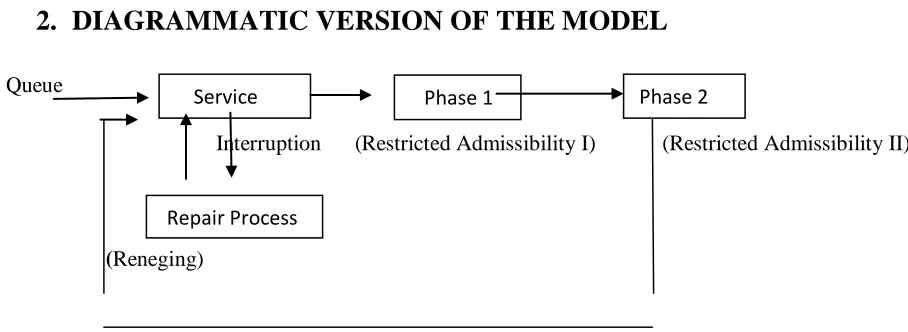
DIAGRAMMATIC VERSION OF THE MODEL
Queue
Interruption (Restricted Admissibility I) (Restricted Admissibility II)
(Reneging)
Figure 1: Queuing model defined in the system
3.
MATHEMATICAL ASSUMPTION OF THE MODEL
Clients arrival follows a Poisson distribution with arrival rate . Service time, vacation time and repair process follows a general distribution.
Let and be the distribution function and the density function of phase service of stage 1. Let be the conditional probability of a completion of service and it is given by,
Service Phase 1 Phase 2
IJSRR, 9(2) April - June, 2020 Page 64
,
∫
Similarly, the process is repeated for Phase 1, Phase 2, vacations and Repair process. Hence we have the
following:
In case of Phase 1, we have,
and
∫
For the Phase 2, we have,
and
∫
For the Repair process,
∫
4.
GOVERNING EQUATIONS OF THE MODEL
The equations governing the system are as follows:
In case of service, we have
∑ (1)
(2)
For vacation phases, we have the following:
( ) ∑ (3)
( )
(4)
( ) ∑
(5)
( )
(6)
In case of repair, we have
∑ (7)
(8)
∫ ∫ (9)
5.
INITIAL AND BOUNDARY CONDITIONS
∫ ∫ (10)∫ (11) ∫ (12)
∫ (13)
6.
DISTRIBUTION OF THE QUEUE LENGTH AT ANY POINT OF TIME
We apply the concept of supplementary variable technique for (1) to (13). As a result we get the probability queue size of the system defined. (14)( ) (15)
( ) (16)
( ) (17)
∫ ∫ (18)
∫ (19)
∫ (20)
(21)
Integrating equation (14) from 0 to x yields ∫ (22)
IJSRR, 9(2) April - June, 2020 Page 66
* + (23)
∫ is the Laplace Stieltjes transform of the service time Multiplying equation (22) by on both sides, and integrating, we get ∫ (24)
Applying the same procedure for equation (15) to (18), we get * + (25)
∫ (26)
* + (27)
∫ (28)
* + * + (29)
∫ * + (30)
Now from equation (18) , we have [ ] (31)
Substituting R(0,z) in equations (23), (25), (27), and (29), we get [ ]* + (32)
[ ] * + (33)
7.
PROBABILITY GENERATING FUNCTION OF THE QUEUE SIZE
Let be the probability generating function of the queue size.
{
* + * + * + * + * + }
[ ]
(36)
8. IDLE TIME AND UTILIZATION FACTOR
Using the Normalization Condition, (37)
We have at z=1 becomes a indeterminate form .
Hence we apply L’ Hopital’s rule to get
From this, the idle time S can be formed
(38)
Also, the utilization factor is determined.
9.
RECITAL MEASURES OF THE QUEUING SYSTEM
To find the steady state average queue length, , we adopt the following method
at
This attains indeterminate form . Consider (36) as
and are the numerator and denominator of the R.H.S. of (36)
IJSRR, 9(2) April - June, 2020 Page 68
( -
( -
(39)
Where
[ ]
{[ ] [ ] [ ]
[ ] [ ]}
{ } (40)
{ [ ] }
(41)
* + (42)
* + { } (43)
Substituting equations 40,41,42 and 43 in equation 39, we get Lq in closed form.
Other performance measures of the queuing system can be found using little’s law.
10.
ARITHMETICAL RATIONALIZATION OF THE MODEL
Consider the following:
( )
( ) ( ) ( ) ( )
Table 1:
d1 M Lq Wq W L
0.2 0.6609 0.3391 0.8839 0.2946 0.4077 1.223
0.4 0.6225 0.3775 1.1518 0.3839 0.5098 1.5293
0.6 0.5743 0.4257 1.5969 0.5323 0.6742 2.0226
0.8 0.5119 0.4881 2.4359 0.8119 0.9747 2.924
1 0.4283 0.5717 4.3759 1.4586 1.6492 4.9476
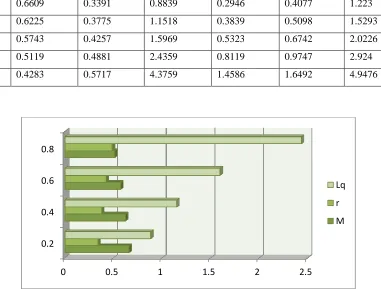
Figure 2: Graphical study on the effect of confined suitability over the queuing system
Table 2 :
M Lq Wq W L
2 0.6609 0.3391 0.8839 0.2946 0.4077 1.223
2.5 0.6559 0.3441 1.1419 0.3806 0.4953 1.486
3 0.6528 0.3472 1.2986 0.4329 0.5486 1.6458
3.5 0.6512 0.3488 1.4421 0.4807 0.5969 1.7909
4 0.6509 0.3491 1.5725 0.5242 0.6405 1.9216
0 0.5 1 1.5 2 2.5
0.2 0.4 0.6 0.8
Lq
r
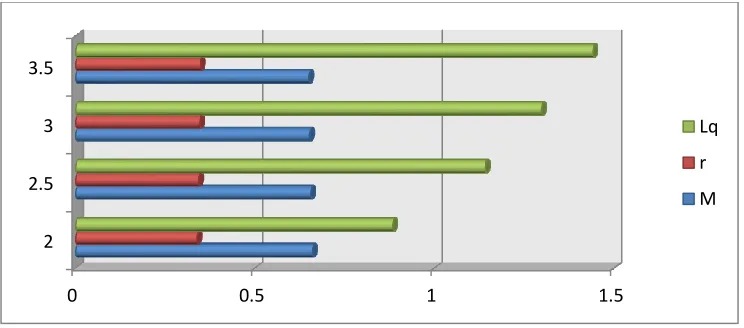
IJSRR, 9(2) April - June, 2020 Page 70 Figure 3: Graphical study on the effect of service interruption over the queuing system
11.
ALGEBRAIC INVESTIGATION DESCRIPTION
From the above table 1,it is obvious that,as the probability of confined suitability increments
during the hour of stage I get-away, it prompts a lessening out of gear time and expands the use factor.In
addition,average number of clients holding up time in the line just as in the framework increases.Also
holding up time of the clients likewise increases.Table II shows the way that as the probability of
administration interference builds, there is an expansion in all the execution proportions of the
framework. Additionally inert time diminishes and henceforth the use factor increments.
12.
CONCLUSION
In the above article, we considered a lining arrangement of two stage get-aways, administration
interference and fix process. Restricted admissibility happens during phase vacation and reneging
happens during fix process. Numerical and graphical image progress the model to a great extend. As a
future work, shying away, phases of administration, shut down planning, defer stage and so forth can be
thought of.
REFERENCES
1. Choudhury A and Medhi P, Balking and reneging in multi ever markovian queuing systems, Int. J
of Mathematics in operational research,2011; 3(4):377-394
2. Madan K. C. and Ebrahim Malalla, A single server bulk input queue with Random failures and
two phase repairs with delay, Revista Investigation Operacional, 2018; 36(1): 45-59.
0 0.5 1 1.5
2 2.5 3 3.5
Lq
r
3. Maragathasundari S, An Examination on Queuing System of General Service Distribution with an
Establishment Time and Second Discretionary Administration, Int. J. Appl. Comput. Math, 2018;
4: 97. https://doi.org/10.1007/s40819-018-0529-3.
4. Maragathasundari S and Dhanalakshmi, Mobile adhoc networks problem A queueing approach,
Int. J. of communication networks and distributed systems, 2018; 21(4); 475-495.
5. Maragathasundari S and Manikandan P, A study on the performance measures of the
non-Markovian model of optional types of service with extended vacation, reneging process and
service interruption followed by phases of repair”, Int. J. Process Management and
Benchmarking, 2020; 10(4): 520-249.
6. Montazer-Haghighi A., Medhi J. and Mohanty S.G, “On a multiserver Markovian queuing system with balking and reneging”, Computers and Operations Research, 1986; 13(4); 421-425,
7. Radha S and Maragathasundari S , A study on the investigation of mathematical modeling in non
markovian queue, AIP Conference Proceedings, 2019; 2177:42. https://doi.org/10.1063/1.5135217
8. Santhanamahalingam and Maragathasundari.S, F-Dematel method to evaluate criteria for affecting
productivity in HP valve production industries, IEEE,DOI:10.1109/INCOS45849.2019.8951400,
2019.
9. Vanalakshmi, R., Maragathasundari, S., &Dhanalakshmi, K. S.,Balking and reneging of batches in
vod applications. 3C Tecnología Innovation glosses applied to SMEs,Special Edition, March
2020; 69-89. http://doi.org/10.17993/3ctecno. 2020; specialissue4.69-89
10. S. Vignesh and S. Maragathasundari, Analysis of a non markovian single server batch arrival
queueing system of compulsory three stages of services with fourth optional stage service, service
interruptions and deterministic server vacations”, Int. J of Mathematics in operational research,
2017;11 (3): 285–309 .