Interdisciplinary Programs Focused
Populations: The Case Of Health
Management Program
Nitza Davidovitch, Ariel University, IsraelRoman Yavich, Ariel University, Israel
ABSTRACT
The Ariel University has a unique interdisciplinary program in healthcare management that targets experienced healthcare professionals who wish to earn an academic degree. Only one academic study has been held so far on the integration of graduates of an academic university-level school in healthcare management in the field. In the current study, the authors sought to investigate points of contact between the academic world and the professional field by following the professional integration of graduates of healthcare management at the Ariel University and their satisfaction with their training, job, and profession from an interdisciplinary perspective. A survey was held among all 1,327 graduates of the Department of Healthcare Management from 2002 to 2011. Data collection was performed through self-completed electronic questionnaires and personally distributed questionnaires, including questions on graduates' current place of work and satisfaction with their degree. The findings indicate that graduates are very satisfied with their interdisciplinary studies at the department. Students from the Arab sector, those who began their studies at an older age, and those who are more affluent, reported higher satisfaction with their studies. Most students intend to continue studying for an advanced degree in the profession.
Keywords: Graduates; Health Care Management; Interdisciplinar
INTRODUCTION
The Healthcare Management Program – From A Research Orientation To A Professional Orientation
ealthcare management studies train people for management positions on various levels of the healthcare system. Today, promotion within the public healthcare system in Israel requires an academic degree. Tools acquired at school allow healthcare personnel to apply for senior management positions and gain promotion.
The Department of Healthcare Management at the Ariel University in Israel trains students for a Baccalaureate degree as part of the School of Health Sciences and aims to help train much-needed administrators for middle and high level management roles in the Israeli healthcare system. The Department of Healthcare Management boasts an innovative interdisciplinary program, one of the few of its kind in Israel. Studies combine classes in administration in different fields with specific professional knowledge related to the needs of the healthcare system. The program is based on the Ariel University’s strong foundation in the fields of teaching and research and social sciences. The faculty hails from different medical and administrative fields and includes senior managers, as well as heads of national health funds and hospital directors. The program imparts to students an extensive base in business management and behavior sciences, together with a focus on components of the healthcare and medical systems. Based on these tools, students learn and practice how to apply management tools to unique problems in the Israeli healthcare system.
Once a year, the department organizes a healthcare conference, held at the Israeli Knesset and focusing on healthcare issues on the public agenda. The conference is attended by senior representatives of the entire healthcare system, such as the chairman of the Knesset, the Minister of Health, Chairman of the Labor and Welfare Committee, directors of health funds and hospitals, Chairman of the Israel Medical Association, top medical officers, as well as Members of Knesset and ministers, and well-known public and academic figures. In addition, studies in diverse fields related to medical administration, health, and medicine are conducted at the Department of Healthcare Management. Some of the subjects studied include public attitudes toward health-promoting and risk behaviors, preparations within the healthcare system for applying the Dying Patient Act, healthcare systems around the world, topics in health education and public health, and topics in the field of policy planning. An annual national survey on core issues within the healthcare system is conducted as well. The department initiates collaborations with researchers of community- and hospital-based medicine and with the pharmaceutical industry.
In the field of healthcare management, graduates are required to demonstrate management skills, comprehension, evaluation, and interpersonal communication skills, an ethical approach to the moral standards of the profession, and the ability to work in a multidisciplinary team. Academization of the profession is relatively new. It has developed over the years, together with the growing demand for evidence based practice [EBP] (Bridges, Bierema, & Valentine, 2007). Academization has led to enhancement through research, an extensive interdisciplinary system of instruction, and the high academic status attained by the profession and its students.
Higher education systems in Israel and elsewhere are required to prove the efficiency of their teaching programs. The authorities, as well as parents and students, wish to ensure that students receive the education guaranteed them. Those in charge of accreditation require the various departments to operate measures for evaluation of outcomes in order to ensure that students have the opportunity to achieve the academic goals and to reach a high level of proficiency in their chosen field. In Israel, as in other western countries, the Council for Higher Education (CHE) operates a quality control system of schools of higher education. However, in order to maintain constant control processes, the initiative for operating this system should come not only from government factors but, rather, from within academic departments. An important component of the quality control process of study outcomes is graduate tracking. Tracking may be based on graduate surveys or on employer surveys, although, for ethical reasons, graduate surveys are more convenient. Richter and Ruebling (2003) state that surveys of healthcare management graduates should include three main components: 1) assessment of graduates' perceptions of the level of training they received at school, 2) gathering information on graduates' professional activities since graduation, and 3) gathering demographic data on graduates, such as their workplace and field of work. Significantly, the purpose of the department is to train graduates to work in a well-defined profession. Therefore, graduates' employment and job satisfaction are particularly important and reflect attainment of the major goal of the program.
In the current study, the authors explore points of contact between the academic world and the professional field by following the professional integration of graduates of the Department of Healthcare Management at the Ariel University and their satisfaction with their training, job, and profession, from an interdisciplinary perspective.
Case Study: The Healthcare Management Program – Academia And The Field At The Ariel University
The Department of Healthcare Management at the Ariel University was established in 1999 as part of the School of Health Sciences.
Rationale For Opening The Department
The department was opened to meet the demand for skilled academic personnel in paramedical professions and to improve the standard of healthcare services in Israel. The program combines interdisciplinary medical management studies with disciplinary studies in paramedical topics.
Program Planners And Faculty
Structure Of The Program
The program includes the main areas that have a significant lack of trained personnel for modern healthcare management.
The interdisciplinary program focuses on academic skills (training graduates to have independent learning and inquiry skills, professional interest, and a wish to learn about innovations in the profession, and who recognize the importance of research as readers, research partners, and independent researchers), ethical-legal knowledge (training graduates in knowledge and awareness of patient rights, who maintain individual confidentiality, rules of professional ethics, legal aspects, and the needs of individuals and of the community; training graduates to be able to work in professional and multidisciplinary teams, as required by modern medicine, and to have the necessary skills and tools to conduct efficient and proper interpersonal communications), and professional practice (training graduates in knowledge and skills in the field, imparting the necessary tools and skills to engage in healthcare management).
Faculty members who teach in the program come both from within the Ariel University, academics engaged in teaching and research in the natural sciences and social sciences, as well as lecturers and expert teaching aides from the field.
In the current study, the authors focused on the satisfaction of department graduates - both with their academic studies and with their work in the field - with the aim of examining the relationship between the academic world and the field, as perceived by graduates, and attempting to strengthen ties between academic studies and graduate achievements by the end of their studies and between the labor market and work conditions that await them in the field.
Health Management As An Interdisciplinary Profession
The term "multidisciplinary"was introduced to the discourse of higher education in the mid-1990s, when a decision was made in Israel to recognize academic colleges as schools of higher education in addition to universities. These were authorized to grant baccalaureate degrees in their own right, without the patronage of a university - degrees recognized by the Council for Higher Education (1995). This development brought about a long-term change in the academic world and widely increased the popular demand for higher education. Opening the gates of higher education to colleges – both public and private – was part of an attempt to increase the accessibility of higher education. However, for certain sectors of the population, this was not enough. One result was the advent of "General BA" programs. These programs had been offered by universities even before the accessibility revolution, but the colleges were the first to give them a prominent place. This type of degree, once considered less attractive, was recast and marketed under the title of "multidisciplinary." Programs offered a new approach to studies – learning a little in a variety of fields. What began as an attempt by colleges to attract potential consumers became a popular and trendy course of study. Moreover, universities also began marketing programs that had previously been played down, adopting the new refined title. At the same time, and with no real connection to "multidisciplinary," a paradigmatic shift began to occur within the academic discourse, which edged closer to an "interdisciplinary" approach. The interdisciplinary approach involves transitions and the crossing of traditional disciplinary borders (Klein, 1990), creating new fields of collaboration between two or more disciplines. The terms "multidisciplinary" and "interdisciplinary" are often mistakenly used interchangeably.
Multidisciplinary Programs
flexibility in presenting contents and messages on construction of identity, adaptation to the oft-changing labor market, opportunities for closing gaps in society and for expanding equal opportunities.
Multidisciplinary programs began emerging throughout the world as early as four decades ago. At first they occupied a minor place, but they have since become a significant part of the academic world. For example, in the US, graduates of such programs numbered 7,000 in 1973, but by 2005, they numbered 30,000 a year (Levitan, 2011). Even programs not considered essentially multidisciplinary incorporate multidisciplinary courses. A survey held among US schools of higher education shows that 40 percent of faculties offer at least one multidisciplinary course (Lindholm, AStin, Sax, & Korn, 2002).
At the same time, there is also a contrasting trend in the US whereby multidisciplinary programs are gradually being discontinued. For example, Arizona International, the multidisciplinary school at Miami University, and the multidisciplinary department at Wayne State University have been closed down, despite reasonable and even high demand. Other places have suffered cutbacks; for example, the Department of Multidisciplinary Studies at the Appalachian State University and at the George Mason University. Some claim that the cutbacks or closure of these institutions stems from the hegemony of the traditional disciplinary approach over the multidisciplinary approach (Henry, 2005).
In Israel,multidisciplinary programs were first initiated with the establishment of academic colleges, which opened multidisciplinary programs for their students. However, they received the stigma of programs intended for students incapable of specializing in a specific discipline. They began as "general studies" - a title later changed to overcome the negative connotations. Multidisciplinary programs first emerged in the social sciences and the humanities, but they are currently offered in many other fields as well. Multidisciplinary programs are characterized by a great deal of flexibility and they include a specialty in one or two fields, as well as study courses and units in diverse areas. The multidisciplinary track - once chosen by default - has become fairly popular in Israel. Multidisciplinary programs at the Bar Ilan University and its satellite colleges (Ashkelon, Western Galilee, Jordan Valley, Safed) alone encompassed 14,870 students from 2001 to 2007. This trend, which began in the colleges, has spread to all academic institutions, and a wide range of multidisciplinary programs are available. For example, Tel Aviv University has a variety of multidisciplinary programs in subjects such as the arts, religious studies, computational linguistics, etc. Ben Gurion University offers combinations between the humanities and the natural sciences, management and safety engineering, as well as a multidisciplinary degree combining social sciences, natural sciences, and the humanities. The Hebrew University offers a multidisciplinary degree in social sciences and the humanities, the arts, psychology and education, etc. Similar programs can be found at other schools which seem to have joined the multidisciplinary trend. Despite the significant function of multidisciplinary programs in academia, the academic concept and the multidisciplinary concept have essential differences at their core.
Academic Disciplines And Multidisciplinary – Are They Compatible?
The multidisciplinary approach is at odds with the academic concept that requires students to go into precise detail on specific subjects, cite sources and scholarly opinions, and present "strictly scientific" facts with no uplifting "deviations". The multidisciplinary approach may be perceived as a realistic necessity stemming from the circumstances, but the challenge posed by this approach is also evident - the need to combine diverse subjects and many aspects requiring generalization, knowledge, and scholarship. There is no choice but to admit that scholars, in their role as erudite intellectuals, are in decline. However, the parallel courses of the multidisciplinary approach and academia fill different - but interrelated - needs, with the former approach mostly seeking to fill the deep chasms of knowledge thirsty students in subjects that interest them (Schiller, 2006).
reserved attitude of the academic world to multidisciplinary programs, which include a variety of subjects in diverse fields, in contrast to academia which prefers narrow expertise (Shiller, 2006).
Today, the west, in general, and the US, in particular, place colleges at the base of the academic pyramid, together with undergraduate studies in very general settings such as "liberal arts" or "sciences". The goal is to provide a tertiary education offering an introduction to the basic concepts of scientific disciplines, practice in reading scientific material, albeit on a basic level, and learning how to write papers based on data gathered from authorized sources (with proper references), as well as initial experience with structured summaries incorporating students' personal conclusions.
At this stage students learn academic reading and written comprehension and at this stage and the next (specialized studies), academic schools are interested in imparting to students two additional skills - learning the "rules of the game" and the research methods of a defined discipline and the critical ability to ask well-defined and logical research questions (not necessarily only in that discipline). At the third stage the school must train students for independent research; i.e., develop the ability to ask questions, formulate a structured plan for finding the answer, and develop tools for exploring the quality and validity of results. These abilities may form in a narrowing field, as students advance in their training and study the subject more intensively, but this is not imperative and certainly not exclusory. Recently, more and more academic settings of a distinct "multidisciplinary" nature are being established in the western world and in Israel as well.
This trend is arousing criticism and sometimes even hostility, derision, and malicious contempt on the part of long-time academic personnel and those who see themselves as keepers of the traditions of "serious" scientific research. However, the CHE has gradually been approving more and more programs of this type. Today, the western academic world is arriving at recognition of the urgent need to train scientific personnel on a high academic level in the entire man-environment complex. There is an increasing need for graduates of schools of higher education with wide knowledge and judgment beyond their defined professional specialty. The instinctive response of many academics is that this trend will necessarily lead to "amateurism" and "superficiality" – but is this indeed true? Does "understanding" necessarily demand "specializing"?
Between The Multidisciplinary And The Interdisciplinary
While the multidisciplinary approach refers to the non-integrative mixing of fields, albeit maintaining the methodology and premises of each discipline, the interdisciplinary approach refers to the crossing of traditional disciplinary borders toward a new collaboration between two or more disciplines. The purpose of interdisciplinary is to create a cognitive advantage that would probably not have been possible by means of the disciplinary approach (Boix Mansilla & Duraising, 2007).
The academic split into disciplines has existed at modern and western universities since the late 19th century (Stein, 1991) when universities underwent processes of secularization and created the discipline (Bracken & Oughton, 2006). Over the years, the accepted conception was that professionalization and scientization occur within the discipline; namely, focus and focusing are the only way of generating professional scientific knowledge (Manicas, 2007).
Nonetheless, despite the hegemony of the disciplinary approach to knowledge, a paradigmatic shift towards the interdisciplinary approach to knowledge may be currently identified in Israel (Shenhar, 1999) and elsewhere (Holley, 2009),and some claim that it has never been more popular (Catney & Lerner, 2009). The adoption of a new approach to knowledge, research, and teaching reflects social and cultural processes that occurred in western society and that have affected the system of higher education as well, creating an intellectual change reflecting the fact that something is happening to how people think about how they think (Geertz, 1982).
There is a built-in conflict between the traditional academic concept and changes occurring in the world of knowledge (e.g., Lattuca, 2011). Researchers involved in interdisciplinary activities must come to terms with the possibility that this course of action will alienate them from the traditional disciplinary community to which they are professionally connected. In addition, they might endanger their professional prestige and legitimacy – strong forces that affect the professional life of faculty members. Thus, it seems that faculty members who identify with academia and strive to advance within it might find themselves between a rock and a hard place when required to act according to organizational norms of academia while recognizing that research within the discipline might limit their range of motion.
The reason for this has to do with the fact that success in contemporary academia depends on researchers' ability to advance within their discipline. This success determines various elements related to their academic position - tenure, promotion, and receiving research budgets. Professional legitimacy in academia is entirely within the disciplinary specialty and researchers are required to develop skills in a certain specific domain (ASHE, 2009).
In contrast to academia, which has not reached a decisive view of interdisciplinatiry, the fields of industry and science consider interdisciplinarity to be highly desirable (Rhoten, 2004). The differences between the demands of academia and of the world at large have created a paradoxical state in which only academic institutions still require by specialization (Caruso & Rhoten, 2001). This matter creates certain problems as faculty members who wish to engage in interdisciplinary activities cannot do so in a void; rather, they need a supportive, sharing, and resourceful academic environment (National Academy of Science, 2004) to encourage interdisciplinary activities and allocate resources.
Some of those who tried and managed to conduct interdisciplinary research, despite the built-in challenges, reached interesting achievements and successes. For example, Tucker (2008) sought to explore the nature of interdisciplinary doctoral studies versus disciplinary studies in social work and social sciences. He sampled interdisciplinary data and compared them to disciplinary studies in social work and social sciences. Based on data from a period of 13 years, he found that students of interdisciplinary doctoral programs eventually gained a higher research orientation and higher levels of research productivity. Some claim that in order to assimilate the interdisciplinary approach both in research and in study programs, there is need for change, not only in the distribution of work within schools of higher education, but rather a more extensive transformation of the organizational culture of academia (Holley, 2009). In this context, one of the difficulties with assimilating the interdisciplinary approach in academia is the vagueness that surrounds the wish and capacity to change what is perceived as a world order – the disciplinary division of knowledge (Chen, Hsu, & Wu, 2009).
In conclusion, the interdisciplinary approach relies on sources from different fields and strives to integrate them. Many of these fields are, at their basis, part of a wider cultural whole from which they are separated in a fairly arbitrary manner in order to create the complex of "multidisciplinary". The multidisciplinary approach often lacks a clear research direction and scientific discipline. This is at odds with the academic orientation, sometimes radically so. For obvious reasons, university institutions striving for excellence find it difficult to come to terms with this. At the major Israeli universities - the Hebrew University and Tel Aviv University, no multidisciplinary tracks have been established but, rather, only multidisciplinary programs. One reason may be the concern that dealing with a wide variety of subjects with no option of intensive study might have a detrimental effect on excellence and result in superficiality.
However, the multidisciplinary tracks, worthy of all encouragement and appreciation, are problematic also for their lack of a defined goal, and most graduates do not end up working in their field. Their academic status is unclear and options of employment and promotion are limited, both in the academic world and elsewhere. Interestingly, the multidisciplinary tracks are nurtured and encouraged by academic schools in Israel as they tend to attract many students, among other things, from the security forces and people who are already part of the work force and have some knowledge of the field. Studies in these tracks are considered relatively easy due to their eclectic nature.
they should theoretically demonstrate more proficiency in several domains, even if it is not possible to study these fields intensively while at school. Studying most subjects from a multidisciplinary perspective requires integration of the various subjects from a maximally wide and balanced general outlook, while taking care to discern between the important and the less important and to superficially avoid deep inquiries and going into too much detail in any specific field.
A primary conception of multidisciplinary studies - maybe even the most significant - is the ability to generalize and to avoid details. A multidisciplinary perspective means dealing with the fundamentals of the topic and forming a general overview. The second most important concept is to convey a message and impart values as much as possible. The third is to focus on the essence and the roots of the topic and its fundamentals from a general multidisciplinary angle that arouses public interest, including connections to current affairs. Multidisciplinary studies, in contrast to disciplinary studies, must be attractive and fascinating since they appeal to a target population who mostly see them as a personal and challenging window of opportunity to the world - one that they could not access otherwise.
Despite the multiplicity of multidisciplinary programs, they should be distinguished from interdisciplinary research. There is still a long way before the interdisciplinary approach can be adopted as a research approach. In order to enable such significant research in a wide setting, it will supposedly be necessary to enlist the academic consensus as well as to change the organizational structure and norms of schools of higher education. To a certain degree, in order for such a change to take place, the academic world must leave the "ivory tower" and recognize the changes that are occurring under its very nose. Today it is clear that interdisciplinary is the world of tomorrow. One can either recognize this trend and join it or be left behind. However, multidisciplinary requires students, as well as researchers, to begin with disciplinarily. Moreover, disciplinarily is not inconsistent with multidisciplinary and it is possible to strive for both at the same time, with fields of expertise forming the basic level; then the sky is the limit. As stated, the Ariel University opened a unique program for training high-class academic health management personnel in 1999 - an essentially interdisciplinary program for managing healthcare systems. The program aims to facilitate improvements in the quality of service through superior management and it includes disciplinary fields such as administration, economics, sociology, psychology, statistics, health, etc. The current study is unique for its attempt to measure the satisfaction of graduates in the Department of Healthcare Management at the Ariel University and their satisfaction with their training, jobs, and profession. Such findings are significant in terms of the impact of an interdisciplinary program designed for students coming from a disciplinary background.
METHODS
For this study, a survey was held among all graduates in the Department of Healthcare Management who graduated during 2002-2011, forming a total of nine classes and 1,327 graduates.
Data collection was performed in two main ways - first, through self-completed electronic questionnaires and, secondly, by questionnaires distributed personally to graduates. Program graduates were asked to answer questions on their current place of work, satisfaction with their degree, how they found their current job, etc., with the aim of exploring trends and directions in the integration of graduates of the baccalaureate degree in healthcare management in Israel's private and public healthcare system from an applied professional, personal, and academic perspective.
The Research Questionnaire
RESULTS
Background Data
As shown in Table 1, most graduates are women and one quarter is men. Some two-thirds are Israeli born and about one-third were born elsewhere, mostly in the CIS. About two-thirds are married with families of their own.
Table 1: Personal-Demographic Characteristics (N=83)
Gender Country Of Birth Marital Status Number Of Children
M F Israel Eastern Europe
& Russia Other Married Single Divorced No Children
1-2 Children
3-5 Children
25% 75% 64% 29% 7% 68% 24% 9% 30% 40% 30%
As shown in Table 2, most of the graduates are Jews and one-quarter are Arabs. Some 70 percent reside in Tel Aviv and central Israel. The financial circumstances of most are good to fair.
Table 2: Socio Demographic Characteristics
Sector Place Of Residence Size Of Family Assessment Of Financial
Circumstances
Jews Arabs Judea And Samaria
T.A. & Central Israel
Remote
Areas Small Medium Large Good Fair Very Bad
75% 25% 13% 71% 16% 43% 32% 25% 52% 44% 4%
As shown in Table 3, almost all graduates are employed and the large majority (96 percent) was employed while studying for their degree. Their work places include hospitals (49 percent and of them, 40 percent nurses), health clinics (27 percent), private medical institutions (9 percent), Magen David Adom - the Israeli equivalent of the Red Cross (6 percent), and the Ministry of Health (1 percent). Only about one-quarter completed their degree in the standard period (three years), about three-quarters prolonged their studies by one year, and sixty percent were aged 31 or older upon beginning their studies.
Table 3: Employment And Studies State Of Employment First Year Of
Academic Studies
Number Of Years Studied At Ariel University
Age Upon Beginning Studies At Ariel University
Employed Unemployed
2000-2007 2008 2009 3 Years 4 Years 5 Years
25 Or
Younger 26-30 31-40 41+
96% 4% 36% 32% 42% 26% 68% 6% 19% 21% 39% 21%
Interestingly, 65 percent reported that they do not plan to change their place of work following their studies, while thirty-five percent reported that they do plan to change their place of work following their studies and are even considering a change of career.
As shown in Table 4, over three-quarters of graduates did not have a psychometric score when beginning their studies. Most had a matriculation certificate. Most had a previous background in the fields of nursing (54 percent), paramedics (20 percent), medical secretary (13 percent), practical engineer (13 percent), medical technology (7 percent), paramedical (3 percent), and dental assistant (2 percent). Notably, most of the graduates (80 percent) reported that a degree in healthcare management was their first choice for academic studies.
Table 4: Circumstances And Status At Admission Had A Psychometric
Score
Had A Matriculation Certificate
Study Track In High School
No Yes Average
Score No Yes
Average
Score Vocational
Techno-logical Social Nursing Literature Scientific
Evaluation Of The Program
As shown in Table 5, most of the graduates (57 percent) chose to study at the Department of Healthcare Management because the field is close to their present occupation and will afford opportunities for promotion. About one-third chose to study health management at the Ariel University because the terms of admission were comfortable and about one-fifth followed the recommendations of friends or other graduates.
Table 5: Reasons For Choosing To Study Health Management At The Ariel University
Reason For Choosing Percentage Of Graduates
The field is close to my occupation and affords opportunities for promotion 57%
Easy terms of admission 35%
Recommended by graduates 22%
Recommended by friends 21%
The field that most interests me 17%
Geographical convenience 15%
Recommended by workplace 12%
Satisfaction With The Baccalaureate Program
Eighty percent of graduates were satisfied or very satisfied with their studies, 20 percent were satisfied to a moderate degree, and none were dissatisfied.
Graduates were asked, “With what were you most satisfied?” Fifty-one percent cited the curriculum, 37 percent the faculty, and 13 percent the personal attitude, atmosphere, and program flexibility.
Graduates were also asked, “With what were you not satisfied?” Thirty-four percent cited the bureaucracy, 23 percent the inflexible or inconvenient curriculum, and twenty-three percent cited repetitions in the curriculum.
Thirty-six percent stated that they felt the curriculum should have had more courses in management (risks, nursing homes, human resources).
At the same time, 22 percent stated that the mathematics course was irrelevant for them and 18 percent stated that, in their opinion, the courses in accounting, economics, and labor laws are unnecessary.
Recommending The Ariel University To Friends
Ninety-one percent of graduates stated that they would recommend the Ariel University to their friends and 80 percent stated that they keep in touch with other graduates. Seventy-nine percent would like the Ariel University to keep in touch with them and 89 percent expressed a wish to attend a reunion.
Image Of The Department As Perceived By Graduates
The department enjoys a good or moderate image, both in absolute terms and in comparison to similar departments in other academic institutions, as perceived by 80 to 90 percent of graduates (see Table 6).
Table 6: Image Of The Department As Perceived By Graduates
Image Perceived Percentage Of Graduates
High – very high 56%
Moderate 42%
Poor 3%
Average Grade
Table 7: Average Final Grade
Average Final Grade Percentage Of Graduates
94 and higher 7%
88 - 93 26%
80 - 87 46%
70 - 79 21%
Level Of Studies And Level Of Difficulty Of The Baccalaureate Program
Two-thirds of the graduates (75 percent) perceived the level of the baccalaureate program as high or very high. Thirty percent reported that they found the studies difficult, sixty-nine percent reported that the level of difficulty was reasonable, and only one percent reported that the studies were very difficult.
Attitude Towards Studies
No differences were found between men and women in their satisfaction with studies – which was high among both genders, although women had more difficulty with their studies. Female graduates have a poorer image of the department than male graduates. Women, more than men, perceive the baccalaureate program as being on a high level (79 percent versus 62 percent). However, more women report that the department has a poor image (see Table 8).
Table 8: Summary Of Attitudes Towards Studies At Ariel University By Gender
Gender High Satisfaction With
Baccalaureate Degree
Good Image Of The Department
Good Image Compared To Other Departments
High Level Of Baccalaureate Studies
High Level Of Difficulty Of Studies
Male 81% 70% 68% 62% 15% Female 78% 51% 53% 79% 37%
Average Grades Upon Graduation – By Gender
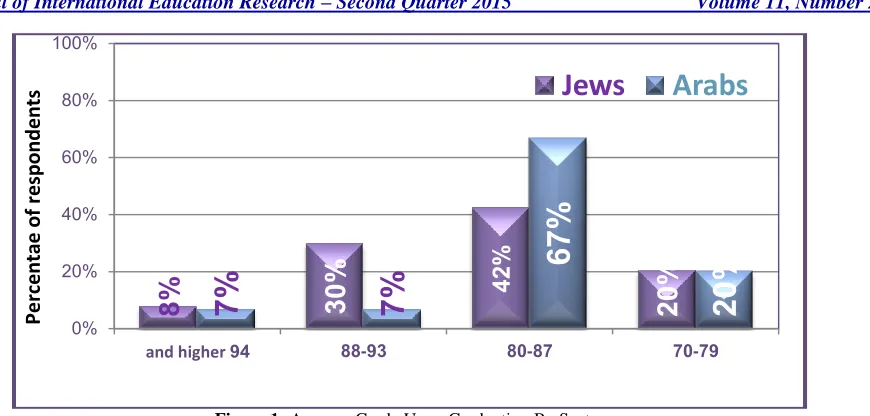
Only small differences were found between men and women in their average grades upon graduation (see Table 9).
Table 9: Average Grades Upon Graduation – By Gender
Average Final Grade Male Female
94 and higher 10% 7%
88 - 93 24% 26%
80 - 87 43% 48%
70 - 79 24% 20%
Attitude Towards Studies At The Ariel University By Sector
Table 10 shows that attitudes of graduates from the Arab sector were much more positive than those of their peers from the Jewish sector: Almost all Arab graduates (93 percent) were satisfied with their studies and perceived the baccalaureate program as being on a high level. Eighty percent think that the department has a very good image. Only 13 percent reported that their studies were difficult (compared to 35 percent in the Jewish sector).
Table 10: Summary Of Attitudes Towards Studies At The Ariel University By Sector
Sector High Satisfaction With
Baccalaureate Degree
Good Image Of The Department
Good Image Compared To Other Departments
High Level Of Baccalaureate Studies
High Level Of Difficulty Of Studies
Jews 74% 48% 49% 69% 35% Arabs 93% 79% 79% 93% 13%
Average Grade Upon Graduation By Sector
Figure 1: Average Grade Upon Graduation By Sector
Attitude Towards Studies At The Ariel University – By Age Upon Beginning Studies
Graduates who began their studies at a relatively advanced age are more satisfied with the degree, perceive it as being on a higher level, and believe that the department has a better image. The difficulties experienced by graduates who began their studies at an older age are slightly higher than those of graduates who began their studies at a younger age (see Figure 2).
Figure 2: Attitude Towards Studies At The Ariel University – By Age Upon Beginning Studies
Average Grade Upon Graduation – By Age Upon Beginning Studies
Older graduates achieved higher grades - 39 percent received a final grade of 88 or higher versus 26 percent of younger graduates, and only 15 percent received low grades versus 29 percent of younger graduates (see Figure 3).
8%
30
%
42%
20
%
7%
7%
6
7
%
2
0
%
0% 20% 40% 60% 80% 100% 94and higher 88-93 80-87 70-79
Perc
en
ta
e
o
f r
es
p
o
n
d
en
ts
Jews
Arabs
71%
45%
57%
60%
30%
83%
62%
53%
85%
34%
0% 20% 40% 60% 80% 100% High satisfaction with baccalaureate degreeGood image of the department
Good image of the department compared to others
Baccalaureate degree on a high
level
Difficult level of studies Pe rc e n tag e o f c o n se n te rs
Aged 30 and younger
Figure 3: Average Grade Upon Graduation – By Age Upon Beginning Studies
Attitude Towards Studies At The Ariel University – By Financial Circumstances
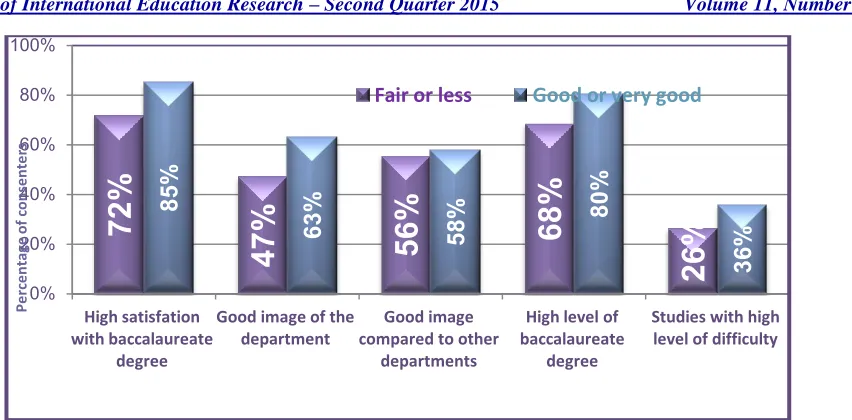
Well-off graduates reported more positive attitudes than less affluent graduates; they are more satisfied with the program and its level and they perceive the department as having a better image. More affluent graduates reported that their studies were harder (see Figure 4).
Figure 4: Attitude Towards Studies At The Ariel University – By Financial Circumstances
Average Grade Upon Graduation – By Financial Circumstances
There are small differences in the average grade upon graduation by financial circumstances as reported by graduates (see Figure 5).
7%
19
%
45%
29
%
8%
31
%
46
%
15
%
0% 20% 40% 60% 80% 100%94
and higher
88-93
80-87
70-79
Per ce n tage o f r e sp o n d e n ts
Aged 30 and younger Aged 31 and older
72
%
47
%
56
%
68
%
26
%
85%
63%
58%
80%
36%
0% 20% 40% 60% 80% 100% High satisfaction with baccalaureate degreeGood image of the department
Good image compared to other
departments
High level of baccalaureate
degree
Studies with high level of difficulty
P e rce nt age of conse nt e rs
Figure 5: Average Grade Upon Graduation – By Financial Circumstances
FURTHER STUDIES
Eighty-seven percent of graduates stated that they intend to continue their studies. Of these, 75 percent wish to continue studying at the Ariel University and 71 percent wish to study for a Master's degree in healthcare management in the thesis track.
Thirty-nine percent further stated that they wish to continue on to doctoral studies and 28 percent said that they would like to join the faculty of an academic institution in the future.
DISCUSSION
In the current study, the authors sought to explore points of contact between academia and the professional field by following the professional integration of graduates of the Department of Healthcare Management at the Ariel University and their satisfaction with their training, job, and profession. The findings of the case study indicate graduates' high satisfaction with the profession and its interdisciplinary approach.
Following the multidisciplinary approach, the healthcare management program derives its sources from various fields and strives to integrate them. Studies at the Department of Healthcare Management, as indicated by this case study, are selected by students for whom this challenging course of study constituted a deliberate choice, and, indeed, graduates reported a high satisfaction with the nature of the interdisciplinary academic program that broadened their horizons rather than focused their attention solely on disciplinary knowledge and skills.
The following characteristics were found: Seventy-five percent of graduates are female, 68 percent are married, 75 percent are from the Jewish sector, most graduates live in central Israel, about one-half are financially well off, and 60 percent began their studies at age 31 or older. Regarding their terms of admission, 87 percent have a matriculation certificate with an average grade of 88, only 29 percent had a psychometric score when beginning their studies and their average score was 526, and 80 percent stated that healthcare management was their first choice of studies. Regarding employment, 96 percent are currently employed and a similar proportion were employed during their studies, 75 percent work at hospitals and clinics, 35 percent of graduates are thinking of changing their workplace following their studies, and 32 percent are considering a change of career.
When evaluating the program in its multidisciplinary format, they referred to their reasons for choosing to study healthcare management at the Ariel University. Most of the graduates chose to study at the Department of Healthcare Management since the field is close to their current occupation and would afford opportunities for promotion, and one-third chose healthcare management at Ariel University due to the easy terms of admission.
72
%
47
%
56
%
68
%
26
%
85%
63%
58%
80%
36%
0% 20% 40% 60% 80% 100%
High satisfation with baccalaureate
degree
Good image of the department
Good image compared to other
departments
High level of baccalaureate
degree
Studies with high level of difficulty
P
e
rce
n
tag
e
of
co
n
se
n
te
rs
Regarding satisfaction with the baccalaureate program in its interdisciplinary format, 80 percent of graduates are satisfied or very satisfied with the program, none expressed dissatisfaction, and 91 percent would recommend Ariel University to their friends. Regarding graduates' image of the department, both in absolute terms and compared to similar departments at other academic institutions, 80 to 90 percent perceive the department as having a good or moderate image.
For average grade upon graduation, the prevalent grade is 80 to 87, while one-third graduated with a grade of 88 and higher. The level of studies and their level of difficulty were perceived by three-quarters of graduates as being high or very high and 30 percent reported that they found the studies difficult.
Attitudes Toward The Program
By Gender
There are no differences between men and women in their satisfaction with the program, which was high among both genders - women had more difficulty with their studies and women, more than men, believe that baccalaureate studies are on a high level (79 percent versus 62 percent).
By Sector
Attitudes of graduates from the Arab sector are much more positive than those of their peers from the Jewish sector - almost all (93 percent) are satisfied with the program and believe that the baccalaureate program is on a high level, 80 percent believe that the department has a good image, and the grades of Jewish graduates upon graduation are higher than those of their peers from the Arab sector.
By Age Upon Beginning Studies
Graduates who began their studies at a relatively older age are more satisfied with their degree, believe that it is on a higher level, and that the department has a better image; older graduates also achieved higher grades.
By Financial Circumstances
More affluent graduates reported positive attitudes than the less affluent; they are more satisfied with the program and its level and perceive the department as having a better image. More affluent graduates reported that studies were very difficult. There are small differences between the average grade upon graduation by graduates' self-reported financial circumstances.
Plans For Further Studies
Most graduates had already taken part in advanced courses, possibly attesting to their motivation to progress in the profession and to their professional interest. Eighty-seven percent intend to continue studying for a Master's degree, seventy-five percent wish to continue studying for a Master's degree at the Ariel University, and seventy-one percent would like to study for a Master's degree at the Department of Healthcare Management. About one-half are interested in a change of career to other healthcare fields, particularly nursing, and some 40 percent are considering a doctoral degree. Nearly 80 percent are interested in continued contact with the Ariel University and nearly 90 percent would come to a reunion.
and includes elements that are not part of their daily practice, has interesting implications for continued education in fields such as healthcare professionals. The significance of the graduates’ satisfaction is highlighted by their desire to continue their studies in a graduate program of a similarly multidisciplinary nature.
RESEARCH LIMITATIONS
In the absence of data on similar surveys in other healthcare management tracks in Israel, the research results could only be compared to surveys conducted in other countries. There is further need for comparative surveys among graduates of departments of healthcare management in Israel.
CONCLUSION
Significantly, graduates who had been working in the field, even before beginning their studies at a relatively older age when they already had families to support, were nonetheless very satisfied with the program, despite - or maybe because of - its interdisciplinary emphasis. Thus, this emphasis obviously plays a crucial part in the adequate training of healthcare professionals.
AUTHOR INFORMATION
Prof. Nitza Davidovich currently serves in teaching and administrative positions at Ariel University and is the Director of Academic Development & Evaluation. Areas of interest include: academic curriculum development; development of academic instruction; Holocaust awareness and Jewish identity; director of student exchange programs with Germany and Poland; preservation of the heritage of Jewish sects; and moral education. Academic administration:Leader of academic assessment process at the Ariel University on behalf of the CHE. Initiation and development of national and international academic collaboration. Curriculum development and Development of curricula for special-needs populations. E-mail: [email protected]
Dr. Roman Yavich specializes in informatics. He deals with the use of the Internet technologies in educational process. Dr. Yavich is the author of technical support concept in the Internet MathOlympiad organization. Dr. tavich is responsible for Computing Systems Support of the Faculty of Natural Sciences, Ariel University and is a member of the Steering Committee of the Israel Mathematical Olympiad (on behalf of the Ministry of Education) Areas of interest include: Distance Education, ELearning, Networked, Education, Pedagogy. Academic administration: Referent of e-learning-Professional consultation for all the Faculties and Departments, in the field of E-learning, developing computer based training software and computers use in teaching process improvement. E-mail: [email protected]
REFERENCES
ASHE Higher Education. (2009). Interdisciplinarity and practice of research, ASHE Higher Education Report, 35(2), 59-74.
Boix Mansilla, V., & Duraising, E. (2007). Targeted assessment of students’ interdisciplinary work: An empirically grounded framework. Journal of Higher Education, 78(2), 215-237.
Bracken, L. J., & Oughton, E. A. (2006). What do you mean? The importance of language in
developing interdisciplinary research. Transactions of the Institute of British Geographers, 31, 371-382. Bridges, P. H., Bierema, L. L., & Valentine, T. (2007). The propensity to adopt evidence-based practice among
physical therapists. BMC Health Services Research, 7(1), 103.
Caruso, D., & Rhoten, D. (2001). Lead, follow, get out of the way: Sidestepping the barriers to effective practice of interdisciplinarity - A new mechanism for knowledge production and re-integration in the age of
information. Hybrid Vigor White Paper. www.hybridvigor.net/interdis/pubs/hv_pub_interdis-2001.04.30.pdf.
Catney, P., & Lerner, D. (2009). Managing multidisciplinarity: Lessons from SUBR: IM. Interdisciplinary Science Review, 34, 290-308.
Council for Higher Education Act. (1995). Amendment 10 [Colleges], Section 8. [Hebrew].
Geertz, C. (1982). The way we think now: Toward ethnography of modern thought. Bull American Academy of Arts and Sciences, 35, 14-34.
Henry S. (2005). Disciplinary hegemony meets interdisciplinary ascendancy: Can interdisciplinary/integrative studies survive, and, if so, how. Issues in Integrative Studies, 23, 1-37.
Holley, K. A. (2009). Interdisciplinary strategies as transformative change in higher education. Innovative Higher Education, 34, 331-344.
Klein, J. T. (1990). Interdisciplinary: History, theory, and practice. Detroit: Wayne State University. Lattuca, L. R. (2011). Creating interdisciplinarity: Interdisciplinary research and teaching among college and
university faculty. Nashville, TN: Vanderbilt University Press.
Levitan D. (2011). Interdisciplinary studies: Only a title or content as well? Paper presented at a seminar in memoriam of the late Prof. Ozer Shield, Ariel University Israel. February 1, 2011. [Hebrew].
Lindholm, J. A., Astin, A. W., Sax, L. J., & Korn, W. S. (2002). The American college teacher: National norms for the 2001-2002 HERI Faculty Survey. Los Angeles: UCLA Higher Education Research Institute.
Manicas, P. T. (2007). The social sciences since World War II: The rise and fall of scientism. In W. Outhwaite and S. P. Turner (eds.), The SAGE handbook of social science methodology (pp. 521-542). London: SAGE. National Academy of Sciences (2004). Facilitating interdisciplinary research. Washington, DC: National
Academies.
Pfirman, S., Collins, J., Lowes, S., & Michaels, A. (2005). Collaborative efforts: Promoting interdisciplinary scholars. Chronical of Higher Education, 11, B15-B16.
Rhoten, D. (2004). Interdisciplinary research: Trend or transition. Items and Issues 5(1-2), 6-11.
Richter, R. R., & Ruebling, I. (2003). Model for development of outcome assessment surveys for allied health educational programs. Journal of Allied Health; 3, 179-84.
Rubinstein, Y. (2001). Disciplinarily, multidisciplinary, and the education in their midst. In T. Karniel and O. Bartana (Eds.), Hachinohe Usvivato [Education and its Environment], pp. 73-90. Tel Aviv: Seminar Hakibbutzim. [Hebrew].
Shenhar, A. (1999). The challenge of education in the postmodern era. Makom Lemahshava Basha'ar, 12, 28–31. [Hebrew].
Shiller, Z. (2006). Academia and knowledge of Israel – two parallels that will never meet. Ariel, Israel: Ariel Academic College.
Stein, M. B. (1991). Major factors in the emergence of political science as a discipline in Western democracies: A comparative analysis of the United States, Britain, France, and Germany. In J. G. Easton, L. Gunnell, and D. Graziano (Eds.), The development of political science: A comparative survey (pp. 169-282). London: Routledge.