Kala et al. World Journal of Pharmaceutical and Medical Research
METHOD DEVELOPMENT AND VALIDATION FOR SIMULTANEOUS ESTIMATION
OF CHLOROPHENIRAMINE MALAETE AND LEVODROPROPAZINE BY USING
RP-HPLC
Gella Sasi Kala*, Gadi Vijaya Lakshmi, Yandamuri Narayudu and Kanchumarti Namratha Department of Pharmaceutical Analysis & Quality Assurance VJ’S College of Pharmacy, Diwancheruvu,
Rajamahendravaram, Andhra Pradesh-533296.
Article Received on 02/08/2019 Article Revised on 23/08/2019 Article Accepted on 13/09/2019
INTRODUCTION
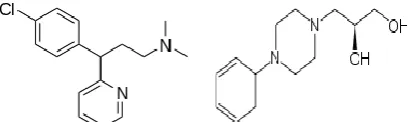
Chemically Chloropheniramine (CLP) was an [3-(4-chlorophenyl)-3-(pyridin-2-yl)propyl]dimethylamine] Molecular weight and molecular formula of CLP were 274.788 g/mole and C16H19ClN2 respectively.
Chlorpheniramine binds to the histamine H1 receptor. This blocks the action of endogenous histamine, which subsequently leads to temporary relief of the negative symptoms brought on by histamine. Structure of the CLP was shown in figure 1 (A)1.
Chemically Levodropropazine (LEV) was an (2S)-3-(4-phenylpiperazin-1-yl) propane-1,2-diol. Molecular weight and molecular formula of LEV were 236.315 g/mole and C13H2ON2O2 respectively.
Levodropropizine is the levo-rotatory (S)-enantiome of dropropizine, a racemic non-opiate antitussive agent. Levodropropizine acts through a mainly peripheral tracheobronchial antitussive effect by inhibition of vagal C-fiber and its sensor neuropeptide.
Compared with dropropizine, levodropropizine exhibits in animal models similar antitussive activity but considerably lower central nervous system (CNS)
depressant effects. It is also less likely to cause sedation in treated patients. Structure of the MET was shown in figure 1 (B)2.
Literature survey reveals there are several methods to estimated two drugs in single or in combination of two drugs.[5-9] but there is only very few HPLC methods are available for simultaneous estimation of CLP and LEV, so the scope of developing and alidating an analytical method is to ensure a suitable method for a particular analyte to be more specific, accurate and precise. The main objective for that is to improve the conditions and parameters, which should be followed in the development and validation processes.
Figure 1: Structure of (A) Chloropheniramine (B) Levodropropazine.
ISSN 2455-3301
WJPMR
AND MEDICAL RESEARCH
www.wjpmr.com*Corresponding Author: Gella Sasi Kala
Department of Pharmaceutical Analysis & Quality Assurance VJ’S College of Pharmacy, Diwancheruvu, Rajamahendravaram, Andhra Pradesh-533296.
ABSTRACT
A simple, Accurate, precise method was developed for the simultaneous estimation of the Levodropropazine and Chloropheniramine Maleate in syrup dosage form. Chromatogram was run through Denali C18 150 x 4.6 mm, 5. Mobile phase containing Buffer 0.02N KH2PO4 (3.47ph): Acetonitrile taken in the ratio 65:35 was pumped through
column at a flow rate of 0.8 ml/min. Buffer used in this method was 0.02N KH2PO4. Temperature was maintained
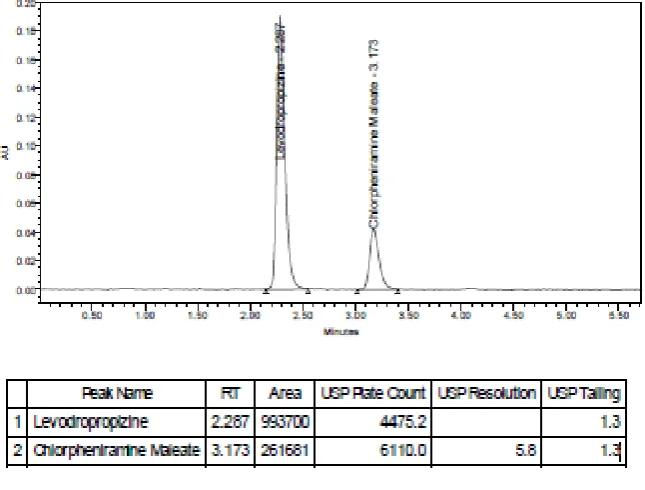
at 30°C. Optimized wavelength selected was 252 nm. Retention time of Levodropropazine and Chloropheniramine Maleate were found to be 2.300 min and 3.187 min. %RSD of the Levodropropazine and Chloropheniramine Maleate were and found to be 0.6 and 0.6 respectively. %Recovery was obtained as 100.12% and 100.40% for Levodropropazine and Chloropheniramine Maleate respectively. LOD, LOQ values obtained from regression equations of Levodropropazine and Chloropheniramine Maleate were 0.63, 1.90 and 0.09, 0.27 respectively. Regression equation of Levodropropazine is y = 16729x + 5154. And y = 52826x + 2622. of Chloropheniramine Maleate. Retention times were decreased and run time was decreased, so the method developed was simple and economical that can be adopted in regular Quality control test in Industries.
MATERIALS AND METHODS
Reagents and Chemicals: The active pharmaceutical ingredient samples of Chloropheniramine and Levodropropazine were obtained from Spectra Pharma Pvt. Ltd., Hyderabad. All the chemicals and solvents used were HPLC grade. The tablet pharmaceutical dosage of combination of these drugs was purchased from local pharmacy.
Instrumentation: Waters HPLC(2695 series) with quaternary pumps, Photo Diode array detector and auto sampler integrated with Empower software-2 was used for separation of these drugs.
Chromatographic conditions: Discovery C18 (4.6 x
150mm, 5µm) Column was used for analytical separation. Potassium dihydrogen ortho phosphate and Acetonitrile was taken in the ratio of (65:35%v/v) mobile phase for the investigation with a flow rate of a 0.8ml/min. The temperature was maintained at 300C. The injection volume was 10μl and the UV detection was achieved at 252nm.
Preparation of potassium dihydrogen ortho phosphate buffer (pH:3.47): Accurately weighed 2.72gm of Potassium dihyrogen Ortho phosphate in a 1000ml of Volumetric flask add about 900ml of milli-Q water added and degas to sonicate and finally make up the volume with water then PH adjusted to 3.47 with dil. Orthophosphoric acid solution.
Preparation of mobile phase
Mixtureof 600 ml of 0.01N KH2PO4 buffer (pH-3.47)
and 400 ml of Acetonitrile in the ration of 60:35 v/v were
mixed and degased in ultrasonic water bath for 15 minutes and filtered through 0.45 µ filter paper. Mobile phase was used as a diluent.
Preparation of mixture Standard stock solution (CLP 600µg/ml and LEV 40μg/ml: Accurately weighed 30mg of Levodropropazine, 2mg of Chloropheniramine Maleate and transferred to individual 50 ml volumetric flasks separately. 3/4 th of diluents was added to both of these flasks and sonicated for 10 minutes. Flasks were made up with diluents and labeled as Standard stock solution 1and 2. The concentrations of 600µg/ml of LEV and 40µg/ml of CLP were achieved respectively.
Preparation of Sample (Tablet) stock solutions: Syrup equivalent to 30mg Levodropropazine and 2mg of Chloropheniramine Maleate was transferred into a 50 ml volumetric flask, 20ml of diluents was added and sonicated for 25min, further the volume was made up with diluent and filtered by HPLC filters (600µg/ml of Levodropropazine and 40µg/ml of Chloropheniramine Maleate).
Optimized chromatographic conditions
Column : Discovery C18 (4.6 x 150mm, 5µm)
Mobile phase : 0.02N KH2PO4 (3.47pH): Acetonitrile
(35:65)
Flow rate : 0.8 ml/min Wavelength : 252.0nm Temperature : 30°C Injection Volume: 10L
Figure 3: Chromatogram of standard mixture of CLP and LEV.
Figure 4: Chromatogram of sample mixture of CLP and LEV. Validation
The above optimized chromatographic method has been validated for the assay of CLP and LEV using the following parameters [International Conference on Harmonization (ICH) 1995]. Linearity was studied to find out the relationship of concentration with Peak area. Six different concentrations of CLP and LEV drug mixtures (600µg/ml of CLP, 40µg/ml of LEV respectively). Each concentration of solution was injected into the HPLC and chromatogram was recorded. The calibration graph was constructed by plotting the peak versus the final concentration of the each drug (µg/ml) and the corresponding regression equation derived. Precision was studied to find out variations in the test methods of mixtures of CLP and LEV 600µg/ml, 40µg/ml respectively. The precision of each method was
RESULT AND DISCUSSION
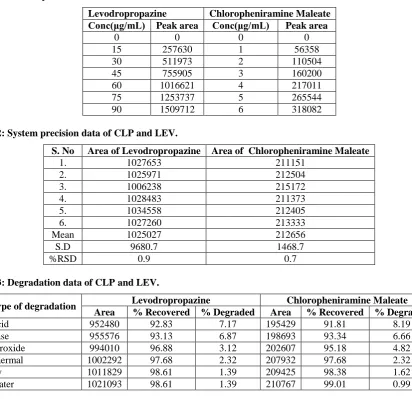
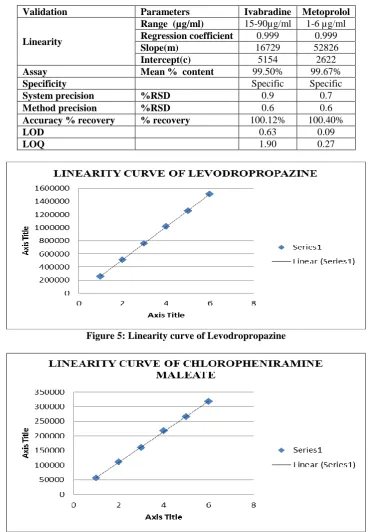
The regression equation for LEV was found to be y = 16729x + 5154 (slope, intercept and correlation coefficient were found to be 16729, 5154 and 0.999 respectively) and linear over beer’s range of 15-90µg/ml. The regression equation for CLP was found to be y = 52826x + 2622 (slope, intercept and correlation coefficient were found to be 52826, 2622 and 0.999 respectively) and linear over beer’s range of 1-6 µg/ml. Linearity graph of CLP and LEV were shown in Figure 5 & 6 respectively. Linearity data was shown in table 1. The percentage of content of CLP and LEV in tablet dosage form was 99.50±0.64% & 99.67±0.6% respectively. The precision and ruggedness were determined using the %RSD of the peak area for six replicate preparations of the drug. The %RSD of precision and ruggedness of LEV were found to be 0.9 and 0.3 respectively and for CLP were 0.7 and 0.4 respectively. The calculated RSD values were less than
2. Precision and ruggedness data are presented in Table 2. In order to verify the accuracy of the described method, recovery studies were carried out by analyzing model mixtures contained 50%, 100% and 150% of standard solution of drug CLP and LEV and along with 5 μg/mL of placebo solution within the linearity ranges. The mean percentage recoveries were found to be 100.33±0.5, 99.53±0.9 and 100.48±0.1% w/w for 50%, 100% and 150% respectively for LEV. The mean percentage recoveries were found to be 99.98±1.0, 99.59±0.4 and 100.28±0.7% w/w for 50%, 100% and 150% respectively for CLP. The results of accuracy were shown that the developed method have a good percentage recovery at different concentrations of drugs. LOD for CLP and LEV was found to be 0.63μg and 0.09μg respectively. LOQ for CLP and LEV was found to be 1.90μg and 0.27 μg respectively. Summary of all the validation parameter shown in table 4.
Table 1: Linearity data of standard mixture of CLP and LEV.
Levodropropazine Chloropheniramine Maleate Conc(μg/mL) Peak area Conc(μg/mL) Peak area
0 0 0 0
15 257630 1 56358
30 511973 2 110504
45 755905 3 160200
60 1016621 4 217011
75 1253737 5 265544
90 1509712 6 318082
Table 2: System precision data of CLP and LEV.
S. No Area of Levodropropazine Area of Chloropheniramine Maleate
1. 1027653 211151
2. 1025971 212504
3. 1006238 215172
4. 1028483 211373
5. 1034558 212405
6. 1027260 213333
Mean 1025027 212656
S.D 9680.7 1468.7
%RSD 0.9 0.7
Table 3: Degradation data of CLP and LEV.
Type of degradation Levodropropazine Chloropheniramine Maleate
Area % Recovered % Degraded Area % Recovered % Degraded
Acid 952480 92.83 7.17 195429 91.81 8.19
Base 955576 93.13 6.87 198693 93.34 6.66
Peroxide 994010 96.88 3.12 202607 95.18 4.82
Thermal 1002292 97.68 2.32 207932 97.68 2.32
Uv 1011829 98.61 1.39 209425 98.38 1.62
Table 4: Summary of validation data of CLP and LEV.
Validation Parameters Ivabradine Metoprolol
Linearity
Range (µg/ml) 15-90µg/ml 1-6 µg/ml Regression coefficient 0.999 0.999
Slope(m) 16729 52826
Intercept(c) 5154 2622
Assay Mean % content 99.50% 99.67%
Specificity Specific Specific
System precision %RSD 0.9 0.7
Method precision %RSD 0.6 0.6
Accuracy % recovery % recovery 100.12% 100.40%
LOD 0.63 0.09
LOQ 1.90 0.27
Figure 5: Linearity curve of Levodropropazine
Figure 6: Linearity curve of Chloropheniramine Maleate. Degradation
Degradation studies were performed with the formulation and the degraded samples were injected. Assay of the injected samples was calculated and all the samples passed the limits of degradation. Degradation data shown in table 3.
CONCLUSION
A simple, accurate, precise method was developed for the simultaneous estimation of the Levodropropazine and
Chloropheniramine in Syrup dosage form was developed and the proposed method as suitable for routine analysis of CLP and LEV.
REFERENCES
1. Chloropheniramine monograph (Online) available on URL: https://www.drugbank.ca/salts/ DBSALT000987.
3. Harika Ramu, Prasanthi Chengalva Aruna Gundala. Analytical method development and validation for simultaneous quantification of levodropropizine and chlorpheniramine maleate in bulk and pharmaceutical formulation by RP-HPLC, International Research Journal of Pharmacy, 2019; 10(4): 161-165.
4. Palakurthi Ashok Kumar, Thummala Veera Raghava Raju,Dongala Thirupathi, Ravindra Kumar and Jaya Shree. Development and validation of stability indicating LC-method for simulataeneous estimation of Levodropropizine, chloropheniramine, methyl paraben, propyl paraben and levodropropizine impurities, Sci Pharm, 2013 Jan-Mar; 81(1): 139– 150.
5. G. Naveen Kumar, M. Sathish Kumar, R.V. Valli Kumari, S. Marakatham. RP-HPLC method development and validation for the simultaneous estimation of Levodropropizine and Chlorpheniramine maleate in pharmaceutical formulations, J. Global Trends Pharm Sci, 2018; 9(2): 5675- 5691.