Retrieving the Real Frederick May
MARK FITZGERALD
Although Frederick May (1911–85) is seen as holding an important position in the history of twentieth-century composition in Ireland, due in the main to his String Quartet of 1936, writing about May has been sporadic. There exists no serious biographical study to date and most of the commentary on his music has been superficial and frequently misleading.1 Much of May’s output—consisting of chamber
works, songs, theatre music, orchestral pieces and numerous arrangements—remains generally unknown, unperformed and in some cases in un-performable condition.2 No
1 These accounts of Frederick May and his music include Joseph Ryan, Nationalism and Music in Ireland
(PhD dissertation, National University of Ireland, Maynooth 1991) and the related work of Philip Graydon—Modernism in Ireland and its Cultural Context in the Music of Frederick May, Brian Boydell and Aloys Fleischmann (MA dissertation, National University of Ireland, Maynooth, 1999) and the eponymous article in Gareth Cox and Axel Klein (eds.) Irish Musical Studies 7: Irish Music in the Twentieth Century (Dublin: Four Courts Press, 2003), 56-79. General descriptions of the String Quartet and Songs from Prison can be found in Axel Klein, Die Musik Irlands im 20. Jahrhundert (Hildesheim: Georg Olms AG, 1996). A more considered attempt to grapple with May’s idiosyncratic harmonic language can be found in Robert W. Wason, ‘Interval Cycles and Inversional Axes in Frederick May’s String Quartet in C minor’ in Cox and Klein, Irish Musical Studies 7, 80-93. A particularly bizarre characterisation of May can be found in David Wright’s article ‘Frederick May’, www.wrightmusic.net/pdfs/frederick-may.pdf, which mixes close paraphrases of newspaper articles and reviews with biographical details diametrically opposed to the facts.
2 Until the time of May’s centenary in 2011, when the national broadcaster Raidió Teilifis Éireann
reliable chronological listing of his compositions has been available.3 The major
primary source is the collection of May’s manuscripts, which ranges from student exercises from his late teens in Dublin and later in London, to sketches, drafts and final scores of the mature work, which was donated by May’s solicitor on his behalf in 1970 to the Manuscripts and Archives Research Library in Trinity College Dublin (TCD). The recent sorting and re-cataloguing of this material has provided us with a more exact listing of the surviving work by May for the first time, enabling one to get a stronger sense of May’s development as a composer.4 Using this material and also
libraries and public collections in Cork, the United States, London, the Czech Republic and Vienna as well as a number of private archives, this essay attempts to build a clearer picture of Frederick May, although there are still a number of gaps and periods for which it has been impossible to find information.5 It also clarifies May’s position on
a number of issues that have been misrepresented or omitted in the literature to date. This essay aims to provide a more reliable basis from which future studies of May’s music and the development of his style can draw.
3 The most important listings until now have been those in two catalogues of Irish music: Edgar M.
Deale (ed.), A Catalogue of Contemporary Irish Composers, 2nd edn. (Dublin: Music Association of Ireland, 1973) and Bernard Harrison (ed.), Catalogue of Contemporary Irish Music (Dublin: Irish Composers Centre, 1982). However, even the more detailed catalogue by Harrison gives an incomplete listing, contains errors and the vast majority of May’s compositions are undated.
4 When the material was originally transferred to TCD, Brian Boydell was asked to catalogue it, but
apart from isolating some of the larger manuscripts, he left the majority of the music unidentified and in a scattered and fragmented form. The recent sorting and re-cataloguing of the material was undertaken by the present author during a period as TCD Long Room Hub Visiting Fellow in 2016– 17. As a result of this work a number of manuscripts thought to have been lost have now been identified within the collection. Boydell was also responsible for failing to transfer May’s personal papers ‘including photographs, an autograph album and drafts of radio scripts etc.’ to the library and as a result these were lost. See TCD MS 11128/1/23/66–70.
5 I am particularly indebted to Anne, Maeve, Ruth and Max Fleischmann, who digitized parts of their
May as student in Dublin and London
Born in 1911, May’s father worked in Guinness’s brewery and both parents were members of the Church of Ireland.6 May studied music theory privately with John
Larchet and piano with Madeline Larchet before transferring to the Royal Irish Academy of Music (RIAM). Here he continued to study harmony and counterpoint with Larchet while Annie Lord and later Michele Esposito became his piano teachers. Lord was responsible for introducing May to the music of César Franck, nurturing a passion which survived his later teacher Vaughan Williams’s dislike of the composer. Esposito’s lessons were described by May as ‘a liberal education in music’ and he also looked over and advised on May’s early attempts at composition.7 In 1925 May won
the Coulson Scholarship and this was followed by the Vandeleur Scholarship for Harmony and counterpoint in 1927 and 1929, as well as the TCD Arthur Oulton Prize and the Stewart Memorial Prize for composition in 1929.8 From 1927 onwards May
began making appearances as a pianist in both solo and chamber competitions, winning the Caroline Elisabeth Reilly Cup at the Feis Ceoil in 1928.9 He was a member
of the Student’s Musical Union (SMU) in the RIAM and it was at their concerts that he had some of his most formative encounters with music. In particular, he recalled being impressed by César Franck’s Piano Quintet in F minor, which was performed in both 1925 and 1926, as well as a performance in 1926 of Vaughan Williams’s On Wenlock
6 May’s father, also named Frederick, is described in the 1911 census as a clerk with Mayo given as his
birth place. May’s mother, Jeannie, was born in Antrim. http://www.census.nationalarchives.ie/pages/1911/Dublin/Pembroke_West/St__Mary_s_Road/9619/
7 Frederick May, ‘Intermezzo’ in Richard Pine and Charles Acton (eds.), To Talent Alone: The Royal Irish
Academy of Music 1848–1998 (Dublin: Gill and Macmillan, 1998), 391–2. In the 1958 broadcast
Composers at Work, the introduction also noted that ‘In Esposito [May] found a constructive critic for his youthful attempts at composition’. Contemporary Music Centre Library Ireland, RTÉ 09. In a letter to Fleischmann regarding Music in Ireland (Cork: Cork University Press, 1952), May noted ‘I’ve always had a great admiration for Esposito, and if this publication of yours is regarded as authoritative and is quoted in the future, I want to make certain that he gets an honoured mention’. May letter to Aloys Fleischmann, 28 April 1947.
8 Pine and Acton, To Talent Alone, 392.
9 Surviving records from the RIAM and the Feis Ceoil suggest that May studied the standard
Edge.10 The impact of the latter piece is clearly demonstrated not only in his decisions
regarding his future studies but also in his 1933 Four Romantic Songs, scored for the same forces of tenor, string quartet and piano.
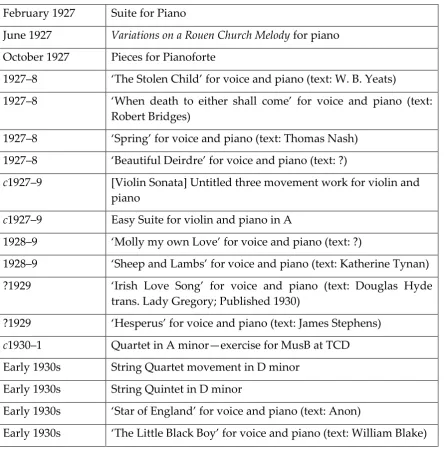
Table 1: Early Compositions February 1927 Suite for Piano
June 1927 Variations on a Rouen Church Melody for piano October 1927 Pieces for Pianoforte
1927–8 ‘The Stolen Child’ for voice and piano (text: W. B. Yeats)
1927–8 ‘When death to either shall come’ for voice and piano (text: Robert Bridges)
1927–8 ‘Spring’ for voice and piano (text: Thomas Nash) 1927–8 ‘Beautiful Deirdre’ for voice and piano (text: ?)
c1927–9 [Violin Sonata] Untitled three movement work for violin and
piano
c1927–9 Easy Suite for violin and piano in A
1928–9 ‘Molly my own Love’ for voice and piano (text: ?)
1928–9 ‘Sheep and Lambs’ for voice and piano (text: Katherine Tynan) ?1929 ‘Irish Love Song’ for voice and piano (text: Douglas Hyde
trans. Lady Gregory; Published 1930)
?1929 ‘Hesperus’ for voice and piano (text: James Stephens)
c1930–1 Quartet in A minor—exercise for MusB at TCD
Early 1930s String Quartet movement in D minor Early 1930s String Quintet in D minor
Early 1930s ‘Star of England’ for voice and piano (text: Anon)
Early 1930s ‘The Little Black Boy’ for voice and piano (text: William Blake)
10 Frederick May, ‘Intermezzo’, 391–2. The 1926 performance of Franck’s 1879 Quintet was part of a
Early 1930s ‘Evening on Road, Dun Laoghaire’ for voice and piano (text: Irene Haugh)
Early 1930s ‘The Voice of Nature’ for chorus and orchestra (text: Robert Bridges)
1930s rev 1950s Idyll for violin and piano
1931 ‘Drought’ for voice and piano (text: Katherine Tynan)
1931 Incidental music for Padraic Colum’s Mogu the Wanderer for voices, flute, violin, cello, double bass and piano
February 1933 Scherzo for Orchestra. (Orchestration of undated movement for strings)
1933 Incidental music for Denis Johnston’s A Bride for the Unicorn May–October 1933 Four Romantic Songs for tenor, string quartet and piano (texts:
John Masefield, D. H. Lawrence & Thomas Hardy)
1933–35 ‘Herdsman’ for voice and piano (text: Seumas O’Sullivan) 1933–35 ‘I sing of a maiden’ for voice and piano (text: Anon) 1933–35 ‘April’ for voice and piano (text: Robert Bridges)
As May was a pianist, it is no surprise that his earliest surviving attempts at composition are for piano and the Suite of 1927—which consists of an Allemande, a Pavane and a Gigue—indicates that he was drawing inspiration from the Bach Suites he was performing at this time. A number of the surviving manuscripts of the songs from this period contain corrections in what is presumably Larchet’s or possibly Esposito’s hand. These corrections focus on harmonic problems but also demonstrated how to vary the piano writing and move away from simple chordal accompaniments. May also arranged a number of pieces ranging from traditional airs (for strings) to Wagner’s Siegfried Idyll (arranged for piano and strings). Along with a series of violin pieces, these may have been partly intended to familiarize May with string writing, in preparation for the MusB examination at TCD.
song, which marks a considerable advance on the simple ‘Spring’, is not far removed from the world of Larchet’s songs, but while the latter tend to be more wedded to periodic phrasing and conventional form, May already shows a certain flair for breaking away from rigid structuring and greater variation of material, despite its short length of 27 bars. The same year he was awarded the Esposito Cup at the Feis Ceoil and as a result of this he was nominated, on the recommendation of the adjudicator in the piano class, Ambrose Coviello, as the first recipient of a new scholarship prize worth £100 to be spent on the further study of piano.11 In July he
took his preliminary examination for the MusB at TCD before departing Dublin to utilize his scholarship in London.
In September, he enrolled at the Royal College of Music (RCM), but chose composition as his principal study and only took piano as a second study. This flexible interpretation of the rules of his bursary was retrospectively ratified by the Feis Ceoil board the following month.12 May’s composition teachers included Charles Kitson,
Ralph Vaughan Williams, R. O. Morris and Gordon Jacob while his piano teacher was Edward Mitchell. He also studied conducting with W. H. Reed and Aylmer Buesst.13
May’s surviving exercise books from this period indicate his progression from species counterpoint exercises to inventions, fugues, madrigals and string quartet textures.14
He continued to work on song writing but whereas his earliest songs demonstrate an interest in literature of the Irish revival, the vocal works written after 1930 demonstrate a shift to English texts by William Blake, D. H. Lawrence, Thomas Hardy and two Poets Laureate, Robert Bridges and John Masefield. Among the few exceptions to this shift is the setting of Katherine Tynan’s ‘Drought’ from 1931, which was commissioned for a memorial broadcast given by Lennox Robinson.15 It is notable
that after 1935 May’s only song to use an Irish text was an entry to the 1940 Feis Ceoil
11 Feis Ceoil Minutes, 29 May 1930, National Library MS 34,915 /5. See also TheIrish Times, 13 May 1930
for details of the programme performed.
12 Feis Ceoil Minutes, 23 October 1930.
13 E-mail from Mariarosaria Canzonieri, Assistant Librarian (Archives), RCM, 5 May 2011.
14 Combined with recently discovered books and printed music belonging to May from this period,
now housed in the Early Printed Books Department of TCD Library, it will be possible to build a more thorough picture of May’s education in London and Dublin and determine how his original work developed in parallel with this.
15 Lennox Robinson papers, 1/4/MSS 091 Series: Non-fiction writings, 1919-1924: Box 12, Folder 2, III -
competition which stipulated the use of a text by an Irish writer.16 In 1931 May entered
a song in the composition competition at the Feis Ceoil but the adjudicator Hamilton Harty decided no first prize should be awarded, giving commendations to the entries of May and Elizabeth Maconchy.17 The Feis Ceoil board however did decide to renew
his scholarship for a second year to enable him to continue his studies in London.18 He
took his final TCD examination in December submitting a string quartet, and on 10 December his degree was conferred.19
The same month he provided songs and incidental music for a new production of Padraic Colum’s play Mogu of the Desert at The Gate Theatre in Dublin.20 It is
intriguing that such a large task was handed to a twenty-year-old with no practical experience of writing for the theatre. As one song for the production was provided by Larchet, it is possible that he was instrumental in acquiring the commission for May, although perhaps May had found it difficult to complete the work on time and asked for assistance from his former teacher. Alternatively, May could have come to the attention of the Gate’s artistic directors Mícheál Mac Liammóir and Hilton Edwards via homosexual, left-wing, literary or theatrical circles. It is also possible that the company needed to find someone who would accept a small fee or possibly no fee as
16 On this basis, it is possible that the setting of Seumas O’Sullivan’s ‘Herdsman’ was also composed
for the Feis Ceoil. The setting of Irene Haugh’s ‘Evening on Road, Dun Laoghaire’ is difficult to date with certainty but May was acquainted with Haugh from the 1920s as May recalled she asked A. E. (George Russell) to contact James Stephens on his behalf when he wished to get permission to set ‘Hesperus’. See Donncha Ó Dúlaing, Interview with Frederick May, Three-O-One, 18 February, 1975 (Contemporary Music Centre Library Ireland, uncatalogued). The lack of a final definitive manuscript and any record of it in any of the catalogues of May’s work suggests ‘Evening on Road’ was never performed. The 1940 song for the Feis Ceoil setting Joseph Campbell’s ‘The Traveller’ was only commended, with the first prize going instead to Lindsay Seymour from Sussex. Should the compositions of Seymour ever surface they would provide a clear insight into what was expected by successive Feis Ceoil adjudicators in Dublin, as he won prizes most years through the 30s and 40s.
17 Feis Ceoil Minutes, 18 June 1931. Unfortunately, no record was taken of the title of the song.
18 Feis Ceoil Minutes, 2 July 1931.
19 E-mail from Roy Stanley, Music Librarian TCD, 25 April 2014.
20 See ‘Mogu of the Desert: New Play at Gate Theatre’, The Irish Times, 28 December 1931. One of the
The Gate Theatre was constantly in financial difficulties at this time.21 Mac Liammóir
and Edwards must have been happy with May’s music as in 1933 he was asked to provide music for the first production of a new play by Denis Johnston, A Bride for the Unicorn. May had to miss the actual production as it opened during the RCM’s term time. Johnston’s surviving papers from the period indicate that the production was not a success and he decided to revise the play radically.22 Music was provided for this
new version by Arthur Duff but it is not clear whether this was because Johnston was not happy with May’s music or because May was not in Ireland at the time the revision was staged. A letter from May to Johnston gives us an insight into May’s character:
I noticed you at one of the rehearsals at which my music was being tried over, and I wanted very much to go up to you and ask whether you liked it at all, but I was too shy to do anything of the sort, but just stood there and pretended not to see you; so that it is delightful to know that the music has given you pleasure.23
During 1932, May’s study in London was funded by the RCM’s Foli Scholarship and in October May was awarded the Octavia Travelling Scholarship, although it would seem that some of this was used to cover the remainder of his sojourn at the RCM, as the Foli Scholarship expired by Easter of 1933.24 We get a further glimpse of May at
this time from the diaries of his fellow student at the RCM, Benjamin Britten. In October 1932, Britten wrote that May was asked to assist with the preparation of parts for a performance of his Phantasy for Oboe and String Quartet.25 May does not appear
in the diaries again until March of the following year when among other encounters
21 For more regarding the financial situation at The Gate Theatre in 1930–31 see Christopher
Fitz-Simon, The Boys (Dublin: New Island Books, 2002), 65–7.
22 See TCD MS 10066/166 and MS 10055/167.
23 Frederick May letter to Denis Johnston, 7 June [1932]. TCD MS10066/287/2083. In other letters, May
sometimes commented on his own personality, such as in 1935 when he noted ‘You know, publicity of this sort always makes me want to run my hands through my hair, a sure sign of embarrassment’ while in 1952 he wrote ‘Whenever I’ve had to write anything about something of my own, I’ve always cut it to a minimum. A combination of modesty and inferiority complex, I suppose’. May letters to Aloys Fleischmann, 4 December 1935 and 5 January 1952, respectively.
24 For more regarding this see Mark Fitzgerald, ‘Inventing Identities’ in Mark Fitzgerald and John
O’Flynn (eds.), Music and Identity in Ireland and Beyond (Farnham: Ashgate, 2014), 89–91.
25 John Evans (ed.), Journeying Boy: The Diaries of the Young Benjamin Britten 1928–1938 (London: Faber,
Britten recorded May’s performance of a ‘bit of Schumann’s Phantasy’ at an RCM chamber music concert. On 17 March he noted ‘After lunch I go to R.C.M. to hear 1st orch. (under G. Toye) run throu [sic] F. May’s Scherzo’.26 The Scherzo was originally
intended to be a multi-movement work for strings but at some stage the unfinished second movement was abandoned and the first movement (Allegro feroce) was rescored for full orchestra as a stand-alone piece. This received its first public performance on 1 December 1933, when it was heard as part of the Patron’s Concert.27
Between the months of May and October 1933, May composed his Four Romantic Songs, a work whose composition overlaps with the completion of his studies at the RCM. Many of the stylistic features of his later work are here in embryo—for example the sudden shifts in harmonic centre by a semitone, textural passages built on trills and the text’s concern with the idea of spring. By this time, May’s harmonic language had become considerably richer and more chromatic, while the contrapuntal working of the individual parts sometimes leads to passages of passing dissonance. Vaughan Williams had come to dislike the original version of On Wenlock Edge, May’s model for these songs, and favoured his later orchestration because of the problems of balance and density of the texture in the original.28 May’s work poses even greater problems
for performers as the piano part contains much dense chordal writing and there are few lightly scored passages. The other problems are structural, as May set the four texts as a continuous work with numerous climaxes, which are difficult to pace. The first performance was given in London at a Macnaghten-Lemare concert on 22 January 1934.29
Vienna and the question of influences
While it is not currently possible to determine exactly the date or duration of May’s trip to Vienna, the weight of evidence suggests that he travelled there in the second half of 1933.30 He brought with him a letter of introduction to Egon Wellesz from
26 Evans, Journeying Boy, 135
27 The Patron’s Fund was established by Ernest Palmer in 1903 ‘for the encouragement of native
composers by the performance of their work’. E-mail from Mariarosaria Canzonieri, 5 May 2011.
28 Michael Kennedy, The Works of Ralph Vaughan Williams (London: Oxford University Press, 1980), 120.
29 [Review], The Times, 26 January 1934.
30 It is unlikely that his Octavia scholarship would have been postponed until 1934 as May had
Vaughan Williams which described May as ‘a young English composer who is making a short stay in Vienna’, before adding ‘Mr May has for some years been a pupil of mine and has, I think, considerable talent’.31 Vaughan Williams’s reference to ‘a short
stay’ would seem to suggest that May’s visit was not protracted and that any study with Wellesz was of a similarly short duration. In addition, one newspaper report suggests that he also travelled to Florence and Rome on his scholarship, although it is impossible to know how accurate this is.32 By contrast, in a letter to Nancy McCarthy
from 1937 May comments in passing ‘I always hated moving my belongings from place to place when I lived in digs on the continent’, which seems to suggest a longer period of time spent abroad.33 Similarly, a newspaper article from 1960 states that
May’s scholarship ‘enabled him to spend about ten months in Vienna under Professor Egon Wellesz.’34 It is also likely that May visited Vienna several times in the 1930s; his
account of an occasion when he was at the opera and ‘gas was poured into the hall and the audience had to take refuge on the roof’, for example seems to refer to a later visit.35
The only concrete information regarding May’s studies in Vienna comes from a 1958 radio broadcast which notes that while there May ‘made an intensive study of Mahler and Hugo Wolf and here he may be said to have completed his period of apprenticeship’.36 This suggests that the emphasis of whatever lessons he received was
on the technicalities of song setting. May frequently referred to Wolf’s songs in later writings and it is also notable that in a radio talk from the early 1950s on Mahler it is the songs that May singled out as Mahler’s most important achievements.37 How much
from 1975 May states that his visit took place in 1933. For more about the debates regarding May’s study in Vienna see Fitzgerald, ‘Inventing Identities’, 89–91.
31 Ralph Vaughan Williams letter to Egon Wellesz, Österreichische Nationalbibliothek, F13 Wellesz
1656.
32 [Untitled] Irish Independent, 25 August 1935.
33 May letter to Nancy McCarthy, 5 November 1937. Boole Library, University College Cork,
BL/PP/NMC/96 (3).
34 ‘“Exciting” is verdict of Irish composer’, Irish Independent, 28 November 1962.
35 ‘Triumph of a Composer,’ Irish Independent, 12 February 1975. A similar description of an attack by
Nazi sympathizers on theatres in Vienna in 1936 is given in Bruno Walter, Themes and Variations: An Autobiography, James A Galston (trans.), (New York: Alfred A Knopf, 1946), 320.
36 Composers at work.
37 I am grateful to Tina Byrne at the RTÉ Written Archive for locating a number of May’s radio
time was spent examining May’s own compositions is not known but if May did work on any compositions while with Wellesz, he would have encountered a very different approach to teaching. Wilfred Mellers noted of Wellesz’s teaching style that ‘he made no attempt to tell me how to write; he rather tried to indicate how what I had written might have been more effectively realized’ and emphasized his focus on ‘the nature of musical textures’ and scoring.38 According to Michael Mulliner, Vaughan Williams in
his lessons would query weak passages in a student’s work and ask that the student reconsider these, but:
If after all you cannot realise that they are weak, and so cannot think his way, he does not wish them to be altered.
If he considers that a work which falls short of being satisfactory could possibly be improved, he will offer his ideas, but only as suggestions, and he will not allow you to adopt them unless you really feel that way and can make the ideas your own. …
His leading advice is, ‘That one must always write what one feels, and never what one thinks one ought to feel’.39
Grace Williams, who like May used an Octavia Travelling Scholarship to study with Wellesz in Vienna in 1930 after studying with Vaughan Williams in the 1920s, summed up the difference in their approaches to teaching:
[Wellesz] was marvellous, and had so different an approach from Vaughan Williams, who was the sort of personality to whom you could only take your best music. Vaughan Williams knew his limitations as a teacher though; he would say ‘I know there’s something wrong, but I can’t put my finger on it’, but Egon Wellesz could. He had a way of saying ‘it begins to get weak at this point, so you will scrap from here onwards and re-write’. But then he’d been a pupil of Schoenberg, whose method this was.40
P260/717, document number 2032–9, RTÉ Written Archives. While the songs may be seen as more suitable as examples for a short broadcast, May also included two excerpts from the Ninth Symphony to represent Mahler’s non-vocal output. May owned scores of Mahler’s
Kindertotenlieder and Das Lied von der Erde and Wolf’s Spanisches Liederbuch and ‘Alles endet, was entstehet’. See TCD MS 1128/1/23/79.
38 ‘Egon Wellesz: An 80th birthday Tribute,’ Musical Times Vol. 106 no. 1472, October 1965, 766–7: 767.
Accounts of Wellesz’s stylistic development and compositions (and as a result his accounts of his influence on May) in Ryan, Nationalism and Music, 412, are incorrect.
39 Jennifer Doctor, ‘Working for her own salvation: Vaughan Williams as teacher of Elizabeth
Maconchy, Grace Williams and Ina Boyle’ in Lewis Foreman (ed.), Ralph Vaughan Williams in Perspective: Studies of an English Composer (Colchester: Albion Music, 1998), 181–201: 187. In this case the ellipsis is part of the quotation.
Determining how much impact Wellesz might have had on May is made somewhat more complicated by the striking fact that no major composition by May can be dated to the period between the completion of the Four Romantic Songs in October 1933 and the completion of the String Quartet in 1936. It is even unclear where exactly May was in 1934 and whether or not he attended the premiere of the Four Romantic Songs in London in January that year.41
1935 is somewhat more clearly documented with a range of concert and radio performances in Ireland at several points through the year, while in June he won the composition prize at the Feis Ceoil for one of his songs.42 In October, along with the
English tenor Steuart Wilson and musicians from the RIAM, he performed the Four Romantic Songs in an SMU concert and a broadcast that evening on Radio Éireann (RÉ). In addition, the Irish Press noted that the broadcast would include ‘a first performance of three other of Mr May’s songs’ by Dorothy Griffith, accompanied by Eileen Buckley.43 A month later, Griffith performed what we can presume are the same three
songs, ‘Herdsman’, ‘I Sing of a Maiden’ and ‘April’, at a further SMU concert along with the early ‘Spring’ and ‘Forest Bird’ from the music for Mogu.44 Around this time
May also began deputising for Larchet at the Abbey Theatre.
Towards the end of 1935 May made contact with Alban Berg and a letter survives from November in which, in somewhat ungrammatical German, May acknowledges a letter received from Berg and outlines his intention of visiting him in Vienna either in March or in the summer of 1936.45 These plans were overtaken by Berg’s death in
December 1935, which was reported in the main Irish newspapers in the ensuing
41 In a letter from Britten to Grace Williams, dated 22 September 1934, he writes ‘Many thanks for
telling Fred May to write to me’. Williams’s original letter is lost so the context is unknown. However, Britten spent October and November travelling in Europe on his scholarship from the RCM and so perhaps May was to impart some advice regarding Vienna. The wording may suggest that Williams had encountered May in London at this time. Donald Mitchell and Philip Reed (eds.)
Letters from a Life: The Selected Letters and Diaries of Benjamin Britten 1913–1976: Volume One 1923–1939
(London: Faber and Faber, 1991), 346.
42 While the Feis Ceoil minutes take the trouble to record a pseudonymused by May for the competition there is
no record of the song’s title.
43 ‘Irish composer’s new songs’, Irish Press, 19 October 1935.
44 May later noted that ‘April’ was to have been published by Augener and Co. but they could not
come to an agreement with the estate of Robert Bridges regarding royalties for the use of Bridges’s text. Catalogue of works, TCD MS uncatalogued.
days.46 It is not clear how much of Berg’s music May was familiar with, although at
some stage he acquired a pre-war score of the Lyrische Suite and most references to Berg in his writings relate to Wozzeck. While there were opportunities to hear the
Lyrische Suite and the Drei Bruchstücke aus Wozzeck in London during May’s period of
study it seems May did not actually attend a performance of the opera until 1975: When I travelled to Vienna in 1933 as a student from the Royal College of Music in order to learn more about composition, I was looking forward with eager anticipation to attending more than one performance of Wozzeck at the Vienna State Opera. However, I reckoned without the composer’s compatriot Chancellor Engelbert Dollfüss, who banned the work as being decadent, and unfit for human consumption. I had passionately desired to be present at a performance of it all during my adult life, but even the fall of Fascism and the restoration of something approaching civilisation left my wishes unfulfilled for many long years. When I saw it was to be revived at Covent Garden this spring [1975], I knew it was a case of ‘now or never’ and Friday, April 11th, will always remain as a red-letter day in my memory ... Infusing it as he did with his own deep compassion and love for suffering humanity, [Berg] produced a work that bids fair to outlast all the changes of fashion, a work that will come to be acknowledged by succeeding generations as one of the glories of the 20th century.47
A letter from 1941 suggests that May had at some point consulted a copy of the vocal score:
A friend of mine has translated Büchner’s Wozzeck into English and it may quite possibly be produced at a Dublin theatre during the coming season. He wants to incorporate certain portions of Berg’s music and he has asked me to collaborate with him in arranging it for a small theatre orchestra; therefore I was wondering if you could let me have the vocal score on loan for a certain period. I suppose this would be more practicable than asking for the full score, and I seem to remember that the instrumentation is fairly clearly marked on the vocal score.48
46 Articles reporting Berg’s death appeared in the Irish Press on 25 December and the Irish
Independent on 27 December.
47 Frederick May, ‘Wozzeck and its Composer’, The Irish Times, 25 June 1975. The Lyrische Suite was
performed in London by the Kolisch Quartet in April 1932 and February 1933 while the Drei Stücke aus der Lyrischen Suite was conducted by Webern alongside the Kammerkonzert in April 1933. The Drei Bruchstücke aus Wozzeck were directed by Henry Wood in May 1932 and again in March 1933 while Adrian Boult performed them in February 1934, a month before conducting the complete opera in a broadcast performance. See Jennifer Doctor, The BBC and Ultra-Modern Music 1922–1936: Shaping a Nation’s Taste (Cambridge: Cambridge University Press, 1999), in particular 337–365.
48 May letter to E. Chapman, 28 August 1941, GB-Lbl Add. 61886, f. 68. While the idea that some of
Whatever May’s level of knowledge of Berg’s music in the 1930s, it seems that he represented to May an ideal of innovative compositional practice. In an article he wrote in 1935, May noted:
The people [in Austria] are worn out by suffering and strife, and they prefer to dream themselves back into the glory of their past than to honour their own fellow-countrymen who are wrestling with contemporary problems of life and art.
The only type of living composer who is honoured by the people is a man like Franz Lehár, who takes the easy path travelled by Johann Strauss and countless other light Viennese composers of last century; those who, like Alban Berg, attempt to open up new territory are met by blank indifference or open hostility.49
However, May’s interest in Berg was not the only one he had at this time or even the dominant one. Vaughan Williams was still a major influence on his music and the 1935 article quoted above refers at another point to Sibelius as ‘the greatest living composer.’ He also admired minor English composers such as George Butterworth and had a particular love for the music of Frederick Delius.50 Within the first few
months of his tenure at the Abbey Theatre he was involved in a production of James Elroy Fletcher’s Hassan, directing a group of instrumentalists in Delius’s 1923 incidental music for the play.51 The musical ambition of this production is so far in
excess of anything else May was involved in during his tenure that one wonders if he had some role in initiating the production.52 It is clear that whatever exposure he had
to Berg’s music and whatever the extent of his experiences in Vienna with Wellesz, these were outweighed in his own music by the formative impact the English school had on his compositional approach.53
the Dublin Drama League in December 1941. The translation was provided by Nigel Heseltine who was to translate the text of May’s Songs from Prison and May’s sister Sheila was in the cast.
49 Frederick May, ‘Music and the Nation’, Dublin Magazine 11 (July–September1936), 50–6: 50.
50 May, ‘Music and the Nation’, 51–2. May’s view of Sibelius was in line with contemporary English
thought. Although published in 1936 the article contains a note stating that it was written while Berg was still alive.
51 Hassan opened on 1 June 1936.
52 In a 1937 letter May noted that he had spent a holiday in Grez-sur-Loing ‘because the composer
Frederick Delius had made Grez his home for over 30 years’. May letter to Nancy McCarthy, undated 1937. Boole Library, University College Cork, BL/PP/NMC/96 (2).
53 In a 1974 interview he listed as his ‘most admired’ composers the Beethoven of the late quartets,
String Quartet and the Abbey: 1936–8
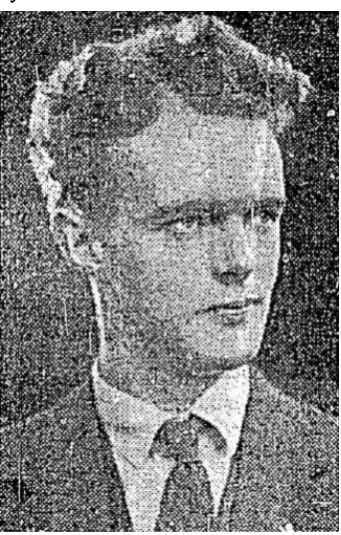
Illustration 1: Picture in Irish Independent 1 January 1936 announcing May’s appointment at the Abbey Theatre (Lafayette)
Table 2: Compositions 1935–7
1935–6 String Quartet in C minor
c1936–7 Symphonic Ballad for orchestra
1936 Incidental Music for Shakespeare’s Coriolanus 1936 Incidental Music for Yeats’s The Shadowy Waters March–August
1937
Spring Nocturne for orchestra
1937 ‘By the Bivouac’s fitful flame’ for voice and piano (text: Walt
Whitman)
1937 Suite of Irish Airs for orchestra
1937 Incidental Music for Louis Dalton’s The Man in the Cloak
On 1 January 1936 May took up the position of Director of Music at the Abbey Theatre.54 His primary duty was to provide musical entertainment during the intervals
of plays as director of the grandly named Abbey ‘orchestra’—in May’s time this was generally a piano trio.55 Occasionally he provided a few bars of original incidental
music, usually to cover scene changes, but it is clear from both the music archive at the Abbey Theatre and surviving material at TCD that pre-existing music was generally used and May never had to provide the sort of extended score that had been demanded at The Gate. It is also clear from contemporary minutes of the Abbey Board that May’s time there was not only artistically completely unfulfilling but was also personally difficult and that the role of Director of Music was viewed by the Board as insignificant.
In June the Board decided to defer confirmation of May’s appointment due to ‘criticisms of the orchestra as conducted by Mr May’.56 They also turned down May’s
application for the appointment of a viola player to the orchestra. May was finally confirmed as director a month later and in August requested a meeting with the Board to persuade them to reverse the decision to reduce the size of the orchestra from its original formation of five instrumentalists to three. However, the Board insisted that any statement could only be made in writing and censured him for his temerity in attempting to approach individual members of the Board in person.57 By the following
year relations had become increasingly strained due to what is described as May ‘continually interfering with the matters in the Theatre which were no concern of his’. On 29 September May was sent a letter suspending him from his job for ‘inattention to duty and interference with the business of the Theatre’ and rather more bizarrely for contemplating ‘the bringing of the Abbey Theatre Company to Carnlough without the
54 Irish Independent, 1 January 1936.
55 For information regarding repertoire see www.abbeytheatremusic.ie
56 Abbey Theatre minutes, 5 June 1936 and Abbey Theatre minutes, 12 June 1936.
www.nuigalway.ie/abbeytheatreminutebooks. It is notable that one board member, Walter Starkie, insisted on minuting that he disagreed with these criticisms
knowledge of the Directors’.58 A letter from May defending himself was dismissed by
the Board as it ‘contained no expression of regret and no promise that he would in future avoid interference with the business of the Theatre complained of’ and May was only reinstated after he had sent a written apology and been interviewed by two members of the Board to gauge his level of contrition.59
Despite the problems May was encountering in the Abbey, this was a notably productive period in his compositional career. Dating exactly when the String Quartet was composed is made difficult by the fact that, uniquely for a large-scale work by May, no sketches or initial drafts have survived. May later stated that the last movement was written first and that the central section of the second movement was inspired by the news of Berg’s death.60 A letter to Aloys Fleischmann casts some
further light on the genesis of the work.
As you probably know, by this time, that movement from my Quartet, owing to a chain of unfortunate circumstances, was never performed at all. Anyway the work is finished, fertig beendet, vollebracht [sic], and I wish we could go over it together on the piano. I think there’s a certain passionate intensity about it, but I’m not sure whether it makes a successful whole. I think you’d agree, however, that it shows a certain development on the part of its composer. I’m sending it in for an American prize, which would come in very handy ... The Abbey closes on Saturday week for a month, and I’m going to Vienna: I’m simply dying for an orgy of music, and also very anxious to see some friends of mine there ... When I come back from Vienna and get the Quartet finally off my chest, I’ll tackle the Suite in earnest.61
58 Abbey Theatre minutes, 22 September 1937 and 29 September 1937. May’s first letter responding to
the allegations notes that he had missed a single rehearsal as he had not been informed that the start time had been changed. Interestingly it happened to be a rehearsal attended by one of the directors of the theatre. The charge of bringing the company secretly away is, I would suggest, clearly wilful distortion of a conversation May had regarding the writer George Sheils. It is difficult not to come to the conclusion that the charge had little or nothing to do with May’s suspension and that putting May firmly back in his place was the real motivation behind the whole affair. See May letter to the Board of the Abbey 4 October 1937, Fleischmann Archive.
59 Abbey Theatre minutes, 6 October 1937 and 20 October 1937.
60 Frederick May, String Quartet in C minor.
61 Frederick May letter to Aloys Fleischmann, 26 May ?1936. Although the letter does not give the year
The references to a single movement that was to be performed separately and concerns regarding whether the piece works as a successful whole, coupled with the stylistic and structural approaches in the work, corroborate the idea that the third movement was written first. There is some ambiguity between the fact that the Quartet is declared finished on the one hand and May’s reference to finally getting the quartet ‘off his chest’ on his return from Vienna; it is not clear whether this latter comment relates to the process of writing out parts or whether there was to be some further revision or tidying of the work after leaving it aside for a time. It could also refer to May’s general practice with large-scale works, which involved writing them first in short score, before producing a fully scored draft and from this a third and final score.62 That the work represents ‘a certain ‘development’ is abundantly clear from
comparison with the Four Romantic Songs; structurally the climaxes are more carefully placed and there is a greater attempt to integrate the three movements motivically than in the song cycle. The work was not to receive a public performance until 1948 when it was performed by the Martin String Quartet at the Wigmore Hall under the auspices of the London Contemporary Music Centre.63
Two original works for orchestra also date from this period: the Symphonic Ballad written for the Belfast Wireless Orchestra and E. Godfrey Brown, premiered in August 1937, and Spring Nocturne, commissioned by Aloys Fleischmann for a concert of Irish compositions he gave with the Radió Éireann Symphony Orchestra (RÉSO) in April 1938. The fact that the first draft of the orchestral score of the Symphonic Ballad was originally entitled Sinfonietta may suggest that, like the Scherzo, it was originally conceived as a multi-movement work, although no trace of any further movements survives. Both titles suggest that May saw the work as being more symphonic in construct than Spring Nocturne, which was bluntly described by May:
Starkie entitled ‘Are we on the eve of an Irish Musical Renaissance?’ as part of a series of broadcasts in which Fleischmann had also taken part.
62 There is also the intriguing possibility that May brought the work to Vienna, perhaps showing it to
Wellesz or someone else; it is noticeable, for example, that the structure in the first two movements of the Quartet is much tighter than in May’s other large-scale compositions. This idea is put forward tentatively as at present there is no evidence that this was the case.
63 The performance was arranged by Edward Clark. The Martin Quartet consisted of David Martin,
I don’t regard it as a masterpiece—it was intended as an evocation of County Meath and is in the same genre, I daresay, as similar idylls by Butterworth and Moeran ... the coda is the best part of it. 64
The Symphonic Ballad is the more ambitious of the two works both in its language and its formal structure, but while Spring Nocturne was eventually to receive relatively regular performances by the RÉSO, the Symphonic Ballad was to suffer a different fate; after a second performance in Dublin under Michael Bowles in 1941, the score of this fifteen-minute piece seems to have been lost and there were no further performances until 2016.65
Nationalist interlude: politics and traditional music
We have little information about May’s upbringing apart from a late interview in which he states that he was reared in ‘a rather Anglo-Irish atmosphere’ and it was only when he was in his late teens, through study of literature and history, that he began to ‘reflect upon what one’s duty as an Irishman was’.66 It is clear from May’s surviving
letters that he remained a staunch republican for the rest of his life and when discussing achievements by himself or others in letters he tends to emphasize the benefit of this for the Irish nation over any personal benefit. In surviving documents we find references to contacts and friendships with left-wing Republicans such as Leslie Daiken and Brendan Behan, while in a letter from 1954 May talks of visiting Cork to meet ‘people like Seamus Murphy whom I haven’t seen for years, and some of my ex-IRA friends’. 67 He also appears in state security files as one of a group along
with Behan, Mick Riordan and Séan Nolan who met with Jim O’Regan in October 1948 upon his release from prison in England for his part in an IRA bombing campaign,68
while May’s sister noted in 1971 that, when she tried to talk to him about rescuing
64 May letter to Clarence Raybould, 20 January 1943, BBC Written Archives.
65 The score was reconstructed from surviving parts by the present author for the performance, given
by the RTÉ Concert Orchestra conducted by Gavin Moloney on 9 September 2016 as part of the Composing the Island Festival at the National Concert Hall, Dublin.
66 Donncha Ó Dúlaing interview with Frederick May. See note 16.
67 May letter to Aloys Fleischmann, 4 January 1954.
68 See DFA A55/1 ‘Communist and other left wing labour groups. Activities. 11/10/1948 Re John
some of his music, he ‘only wanted to talk about Haughey, Boland and Blaney’, who were at this time involved in the Arms Trial.69 Such details help to undermine
comprehensively the simple representations of May as ‘Anglo-Irish’ or even anti-Irish in the literature.
May’s view of traditional music and arrangements of it is also far more nuanced than might be suggested by the selective decontextualized quotation of lines from individual essays by May that one finds in previous published accounts of May’s work. It is not surprising that a pupil of Vaughan Williams would be interested in exploring traditional music throughout his life. As early as 1935 The Irish Times noted:
Mr May tells me he is going to remain in Dublin. He is deeply interested in folk music, especially Irish music, and has come back stimulated by his Viennese experiences, to steep himself in the atmosphere of native music.70
May was certainly not a fan of hunting for Irish inflections in works where they did not exist to justify a composer’s status as an ‘Irish’ composer. This is evidenced by his mild rebuke to Fleischmann who, when performing May’s Scherzo in Cork in 1935, suggested that the trio was ‘Gaelic’ in feeling, presumably in an attempt to appeal to any national sentiment in the audience:
Do you really think there’s a Gaelic atmosphere about the Trio? Personally, I’ve no opinion and I always try to write straight ahead without any prepossessions or theories, but if there is a Gaelic feeling about the section, that’s grand. Still, I feel that the aggressive Daniel Corkery might hit me a blow on the head with his shillelagh if I came within striking distance.71
However, when the opportunity arose to work directly with traditional music May accepted it. In March 1937 he completed the Suite of Irish Airs which was premiered by Fleischmann’s University Orchestra in Cork in a performance that was broadcast by Radio Athlone (the forerunner of RÉ) in December of that year. While this work has been misdated to 1953 by commentators such as Joseph Ryan and Philip Graydon in support of a simplistic narrative of an Anglo-Irish or ‘cosmopolitan’ May being forced
69 Charles Haughey and Neil Blaney were dismissed from the Irish government and put on trial due to
alleged involvement in an attempt to smuggle arms to the IRA in Northern Ireland. Kevin Boland resigned from the government in protest at the sackings. Sheila May to Brian Boydell, 29 May 1971, TCD MS 1128/1/23/74.
70 Kitty Clive, ‘Echoes of the Town, The Irish Times, 22 November 1935.
71 May letter to Aloys Fleischmann, 4 December [1935]. Interestingly, what May dismisses here—
to concede to corrosive national sentiment in the 1950s, May’s letters and writings (and the correct date of composition) directly contradict this view.72 The challenge for May
when composing the Suite was not one of being forced by outside forces to use Irish airs but rather how a composer could do justice to the original airs and not in any way damage their essence:
I must confess that traditional airs always make me feel like a unicorn is said to feel at the sight of a virgin—terribly shy and abashed. I’m always afraid that some error of taste on my part will sully their native, wild beauty.73
On another occasion when he was arranging some songs he noted in a similar vein ‘Arranging these songs is an art in itself, isn’t it, and it is terribly easy to destroy the spirit of the words’.74 It is notable therefore how careful and restrained the settings in
the Suite of Irish Airs are and indeed the newspapers were informed in advance by the composer that ‘the interesting feature of this Suite lies in the fact that it contains scarcely a bar of original music or of ‘padding’—the airs are allowed to speak for themselves’.75 In this way the Suite breaks decisively with the Stanford/Harty tradition
of orchestral fantasies on Irish airs.
May certainly reacted strongly against anyone who dogmatically declared that it was essential to utilize traditional music at the surface of one’s compositions. Instead he insisted that it was crucial for a composer to find their own individual voice, whatever that might be:
The idea that a composer must, to justify his position, write music in a definitely national idiom is manifestly absurd, and there is far too much loose thinking on that subject in many countries,
72 For example, describing the work as being in a ‘prevailing nationalist idiom’ that was ‘foreign to his
accustomed voice’ and ‘without marked personality or commitment’ Ryan adds ‘That such works exist in the canon of a leading cosmopolitan artist is testimony to the perseverance of nationalist sentiment; that May was impelled to write them for practical reasons evidences the true ascendancy of that sentiment.’ Ryan, ‘Nationalism’, 426–7. This is repeated pretty much verbatim by Graydon, who prefaces it with the reproving words ‘May’s firm opposition to the prevailing nationalist idiom ... did not prevent him from directly succumbing to it.’ Graydon, M Phil, 67.
73 May letter to Aloys Fleischmann, 26 May [1936?]
74 May letter to Aloys Fleischmann, 18 November [?late 1940s]
including our own, at the present time. The main thing is that a composer shall have the courage to be himself, because it is by so doing that he can best serve his fellows.76
However, his belief in the value of traditional music for aspiring composers was most clearly expressed when in 1955 Denis Donohue argued that there was no Irish composer ‘whose work an intelligent European musician must know, in the sense in which that musician must be familiar with the work of Walton, Hindemith, Vaughan Williams, Sibelius and other composers’ and declared this was caused primarily by the pernicious influence of traditional music, or as he termed it ‘the trap of folk-music’.77
May responded by first pointing out the irony of Donohue thinking that the solution would be for a composer such as Vaughan Williams to be brought to Ireland to rescue young Irish composers from such an interest: Vaughan Williams was not only heavily influenced by folk music but he actively encouraged his students to engage with it. Acknowledging that some may have used folk music to conceal their lack of creative gifts, May argued:
As Vaughan Williams said in his book ‘National Music’ ‘nobody ever created or ever will create something out of nothing’ and intimate association with the beauties of traditional music and poetry cannot help but fertilise a composer’s mind, and widen and deepen his experience ... But there is really no such rigid dividing line between ‘Folk music’ and ‘Art music’ as Mr Donohue would have us believe ... If a composer had not a touch of that divine fire which Beethoven recognised as burning so brightly in Schubert he will never acquire it from folk-song, but if he has, folk-song will never destroy him—rather, it will widen his sympathies and enrich his art.78
Breakdown: otosclerosis, homosexuality and alcoholism
May’s burst of creative activity was curtailed at the end of May 1938 when he was admitted to Stewart’s Hospital in Palmerstown with a nervous breakdown. Initially leave of three months was requested from the Abbey Theatre, however May remained at Stewart’s until the end of October.79 At this point May’s father appealed to the
Abbey Board to extend May’s leave until the end of the year. One of the directors Frederick Robert Higgins met with May but stated to the Board that:
76 ‘Composers and their Works: Kodály’, Radio Scripts 3.172 Frederick May, P260/717, document
number 2032–9, RTÉ Written Archives.
77 Denis Donoghue, ‘The Future of Irish Music’, Studies: An Irish Quarterly Review of Letters, Philosophy and
Science, 44 (1955): 109–14.
78 ‘Composing and Arranging’, Radio Scripts, P260/718 document number 3466.
79 He was discharged on either 23 or 24 October. E-mail from Joan Rapple, Freedom of Information
In my opinion he is not fit to take over complete charge of the orchestra for some time to come. However, I entered into an arrangement with him that he would come here for two evenings a week, without pay, and take over temporary charge so as he would get used to the work, at the same time keeping on Mrs Gore, our temporary leader so as to watch that nothing awkward occurs under Mr May's direction. Mrs Gore tells me that he is very jiggy and irregular in his attendances ... I have had a rather pathetic letter from Mr May who is very eager to get back but very nervous of his own condition.80
May was allowed back to work in January after his doctor strongly advised it in order to facilitate May’s recovery and by mid-January the Board was informed that May was now working fulltime and that his behaviour was satisfactory.81
The cause of May’s breakdown is unclear and could have been triggered by a number of factors. At some point May began to suffer from otosclerocis, which would eventually result in increased deafness combined with severe tinnitus. Writing about his Quartet in a letter to Boydell May noted:
It was written at a time when I believed that my ear trouble would give me little further prospect of any creative activity, and consequently I was in a state of inner tension. Of course, as you know yourself, musical themes & ideas generate their own logic & certainly I wasn’t thinking along these lines the whole time, but that was the general basis.82
This would place the onset of the otosclerosis to the mid 1930s. While the exact progress of his illness is impossible to chart, by 1942 a letter from Brendan Behan indicates that May was ‘slightly deaf (left ear almost totally so)’.83
Another possible factor was May’s homosexuality. As this was illegal at the time little information survives regarding May’s personal life. Some details regarding his relationship with Brendan Behan have been recorded by Michael O’Sullivan who states that they first met when Behan was 15. If this is correct, it suggests that this meeting occurred shortly before May’s breakdown as Behan’s fifteenth birthday was in February 1938.84 Homosexuals in the arts world who were careful or who
80 Abbey Theatre minutes, 16 December 1938.
81 Abbey Theatre minutes, 20 December 1938 and 13 January 1939.
82 May letter to Boydell, undated. TCD MS 1128/1/23/89.
83 Michael O’Sullivan, Brendan Behan: A Life (Dublin: Blackwater Press, 1997), 93.
84 O’Sullivan, Brendan Behan, 91. I am indebted to John Brannigan for alerting me to the close links
conformed in other ways to society’s expectations frequently managed to live without incurring any legal problems. Composer James Wilson who lived openly with his partner in Dublin from the late 1940s onwards and whose social circle was dominated by ambassadors and other ‘high society’ figures recalled that homosexuals ‘were left more or less alone’ but this was not necessarily the case for less exalted parts of society.85 References that survive suggest that May’s sexual behaviour was less
conformist than Wilson’s. Louis Marcus recalled an occasion when May had not appeared at the hall by the beginning of a concert of the Cork Symphony Orchestra featuring one of May’s works:
Frau Tilly [Fleischmann] determined to find him, and Seamus [Murphy], knowing the composer’s personal predilections, suggested she might try the pubs on the docks which sailors frequented. Quite unabashed, Tilly called a taxi and sallied into a succession of waterside dens until she discovered Freddie, dragged him into the car and had him in the City Hall in time to take his bow.86
Just as it is clear from surviving letters that the String Quartet contains programmatic ideas related to the onset of deafness there are a number of tentative suggestions that other works may have similar autobiographical aspects related to his sexuality. In a letter written while May was completing the orchestration of Spring Nocturne he commented:
Each day you wonder whether you’re hammering a fresh stone into the monument of your immortality or merely beating the air with vain wings. I couldn’t resolve the problem, so I went out and paid Cyril a visit: he showed me a poem which I thought full of beauty and tenderness and I felt glad for his sake though rather envious for my own.87
He later adds that the countryside at Grez-sur-Loing in France is ‘not unlike County Meath, where Cyril and I spent last Sunday’. For the first performance May stated that Spring Nocturne was inspired by the landscape of Meath and the line from a Frank
letter that the Governor of the prison and his wife would be welcome to join the group. See O’Sullivan, 92.
85 Mark Fitzgerald, The Life and Music of James Wilson (Cork: Cork University Press, 2015), 15. For more
on prosecutions in this period see Diarmaid Ferriter, Occasions of Sin: Sex and Society in Modern Ireland
(London: Profile Books, 2009).
86 Louis Marcus, ‘The Cork Symphony Orchestra’ in Ruth Fleischmann (ed.), Aloys Fleischmann: A Life
for Music in Ireland Remembered by Contemporaries (Dublin: Mercier Press, 2000), 135–6. A number of other anecdotes suggest occasions when May’s sexual behaviour resulted in difficulties with police abroad.
O’Connor translation of an Irish poem ‘Meadow lands and Plough Lands, lie in Valleys far away’. 88 This verse continues ‘Where apple-trees and sloe-bushes grow
thickly as at home. / If my love say nothing, what matter what all say?’89 May’s Lyric
Movement similarly may have some personal significance as in the 1950s May attempted to get Fleischmann to mount a performance arguing ‘my main wish is that this work should be heard in Cork, for personal reasons which I’ve explained to you’.90
It is also notable that he selected verse by homosexual poets such as Walt Whitman and Hart Crane. Unless more evidence emerges, however, exploration of this aspect of May’s life and work will remain speculative.
A third possible factor behind May’s breakdown is suggested by the fact that in March 1939 May was given a final warning by the Board, having turned up drunk at the Abbey.91 Heavy alcoholic consumption was to be a recurring problem with May
but at this point it is hard to determine whether this was a factor in May’s behaviour prior to his breakdown or if it was a coping mechanism adopted after his return to work. As May was not dismissed from the Abbey in 1939 it would seem that at this point it was something he was able to keep under control.92
The war years
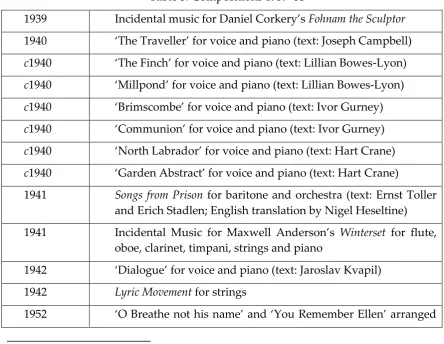
The early years of the war coincide with the next large burst of creative activity on May’s part, including a number of compositions inspired directly by contemporary events in Europe. May stated that six songs were composed ‘immediately prior to Songs from Prison’ and they form a series of pairs with two settings each of poems by Lillian Bowes-Lyon, Hart Crane and Ivor Gurney.93 While Bowes-Lyons’s ‘The Finch’
seems entirely in line with the type of text May usually chose, the darkness of the other songs—most notably Crane’s depiction of a journey towards ‘no Spring, no birth, not death, no time nor sun’ in ‘North Labrador’—is interesting both in the context of the time and in relation to May’s own personal experience. More directly
88 ‘Radio Concert next Sunday’, Irish Press, 21 April 1938.
89 Frank O’Connor, Leinster, Munster and Connaught (London: Robert Hale Ltd, 1950).
90 May letter to Aloys Fleischmann, 16 May [?1955].
91 Abbey Theatre Minutes, 24 March 1939.
92 The fact that Ernest Blythe got May to visit Seán O’Casey in December 1942 to see if it would be
possible to obtain the premiere of Red Roses for Me for the Abbey also suggests that at this point May’s drinking was controlled. See Christopher Murray, Sean O'Casey, Writer at Work: A Biography
(Dublin: Gill and Macmillan, 2004).
related to the war are the two First World War poems by Ivor Gurney, both of which juxtapose the beauty of nature with the destruction of war.
May was also commissioned to provide music for the UCD Dramatic Society’s production of Maxwell Anderson’s Winterset, which opened in March 1941. Written for an ensemble of flute, oboe, clarinet, timpani, strings and piano, this was the most substantial theatre score May had composed since his time working for the Gate Theatre and in it he utilized ideas from other pieces including Songs from Prison, which he would have been completing at the same time. Brian Boydell, who played in the ensemble at the premiere, noted that ‘Fred’s music was first rate—but in spite of huge notices on the programme, the audience talked through most of it, which was most annoying’.94
Table 3: Compositions 1939–55
1939 Incidental music for Daniel Corkery’s Fohnam the Sculptor 1940 ‘The Traveller’ for voice and piano (text: Joseph Campbell)
c1940 ‘The Finch’ for voice and piano (text: Lillian Bowes-Lyon)
c1940 ‘Millpond’ for voice and piano (text: Lillian Bowes-Lyon)
c1940 ‘Brimscombe’ for voice and piano (text: Ivor Gurney)
c1940 ‘Communion’ for voice and piano (text: Ivor Gurney)
c1940 ‘North Labrador’ for voice and piano (text: Hart Crane)
c1940 ‘Garden Abstract’ for voice and piano (text: Hart Crane)
1941 Songs from Prison for baritone and orchestra (text: Ernst Toller and Erich Stadlen; English translation by Nigel Heseltine) 1941 Incidental Music for Maxwell Anderson’s Winterset for flute,
oboe, clarinet, timpani, strings and piano
1942 ‘Dialogue’ for voice and piano (text: Jaroslav Kvapil)
1942 Lyric Movement for strings
1952 ‘O Breathe not his name’ and ‘You Remember Ellen’ arranged
94 Baron Ballybride [Boydell] undated letter [1941] to Charles Acton, Charles Acton Papers ACC6797,