Sunday et al. World Journal of Engineering Research and Technology
APPLICATION OF NUMERICAL OPTIMIZATION AS A TOOL FOR
VALIDATION OF OPTIMIZED RESPONSE OF FLEXURAL
STRENGTH OF WOOD ASH (HARDWOOD) PARTICLES
REINFORCED POLYPROPYLENE WARPP
Aguh Patrick Sunday*1 and Ejikeme Ifeanyi Romanus2 1
Department of Industrial Production Engineering, Nnamdi Azikiwe University, Awka,
Anambra State, Nigeria.
2
Office of the Commissioner, Ministry of Environment, Beautification and Ecology, Awka,
Anambra State, Nigeria.
Article Received on 22/06/2017 Article Revised on 12/07/2017 Article Accepted on 02/08/2017
ABSTRACT
In this study, we investigated the adequacy of approximation of fitted
model to the real system. To meet this objective, the numerical
optimization method was applied as an alternative to the conventional
method by Suresh (2014) for the validation of optimized performance
characteristic (response) model. Box – Behnken design, a spherical
design, with all factorial and axial points at the same distance from the
center of the design was used to build a model for predicting and optimizing the flexural
strength of WARPP. The mathematical model equations (response surface models) were
derived from the response surface methodology (RSM) optimization process using Minitab
16 software. This response surface model is representable with nonlinear power equation and
second order polynomial of the four control factors. In the statistical analysis, the analysis of
variance (ANOVA) table, the coefficient of determination, R2 and the adjusted coefficient of determination, R2adj values and p values indicated that the model was adequate for
representing the experimental data. The p values show that the linear effects of volume
fraction (B), injection force (C), operating temperature (D) and quadratic effects of volume
fraction (B^2), injection force (C^2) and the interaction effects of volume fraction and
World Journal of Engineering Research and Technology
WJERT
www.wjert.org
SJIF Impact Factor: 4.326*Corresponding Author
Aguh Patrick Sunday
Department of Industrial
Production Engineering,
Nnamdi Azikiwe
University, Awka, Anambra
injection force (B*C) and volume fraction and operating temperature (B*D) were highly
significant. To gain a better understanding of the control variables for optimal flexural
performance, the graphical models were presented as 3 – D response surface and 2 – D
contour graphs. The optimal setting for the particle size (A), volume fraction (B), injection
force (C) and operating temperature (D) were found to be 1.40mm, 5%, 200tons and 215oC respectively at the highest flexural strength value of 50.0933MPa. The predicted R2 value of 99.97% and adjusted R2 value of 99.99% are within 0.20 of each other indicating that the predicted response model and experimental data are in reasonable agreement (Mourabet et.
al., 2013).
KEYWORDS: Numerical optimization, Flexural strength, Box – Behnken design, Experimental design, Regression statistics and Validation.
INTRODUCTION
Wood ash particles reinforced polypropylene (WARPP) composite has been investigated to
determine its performance at optimal setting of parameters. The performance of WARPP is
effected by many factors such as wood ash particle size, volume fraction, injection force and
operating temperature of the injection moulding machine.
WARPP is a composite material that consist of polypropylene (PP) resin as the matrix
material and wood ash particles as the filler material. Wood ash engineering application has
been studied relatively by few researchers. Most of the applications had been to cement based
work. Abdullahi (2006) in his paper titled “characteristics of wood ash/OPC concrete”
reported that wood ash obtained from the combustion of wood can be related to fly ash since
fly ash is obtained from coal, a fossilized wood. Okunade (2008) in his research article titled
“the effect of wood ash and saw-dust admixture on the engineering properties of a burnt
laterite – clay brick” stated that wood ash admixture in line with its pozzolanic nature was
able to contribute in attaining denser products with higher compressive strength. Sanusi et.
al., (2013) investigated the influence of wood ash as an additive on the mechanical properties
of polymer matrix composite (fibre glass reinforced epoxy resin). The mechanical properties
investigated include tensile strength, impact and hardness strengths. Result of the research
revealed that addition of the wood ash into fibre glass reinforced epoxy resin composite
improved the tensile strength and impact strength up to 2.3% and 0.8% of wood ash addition
respectively. Hardness strength also increased progressively with the addition of wood ash.
studied the physical, chemical and microstructural properties of wood ash in order to
determine the potential applications for it. Goodman Mark Mendel (1998) conducted research
on the effects of wood ash additive on the structural properties of lime plaster. The objective
of the research was to determine the effects that wood ash imparted to lime plaster while
focusing upon the performance criteria relevant to base coat application such as water
retention, shrinkage, adhesion and permeability. However no application of wood ash was
made in thermoplastic polymer resin.
In this study, a research on the application of wood ash particles as potential filler materials
in polypropylene resin was conducted.
MATERIALS AND METHODS 1.1Material Selection
The materials used in this research are thermoplastic polymer, polypropylene (PP) resin as a
matrix material while wood ash particles were used as filler material. PP, a linear
hydrocarbon polymer was obtained from a resin chemical commercial outfit named POKEZ
chemicals at Onitsha while the wood ash (hardwood) was sourced locally. The wood ash was
obtained from 10Kg mass of saw dust that was burnt and allowed to smouldered in an open
space at ambient temperature for 12 hours. The characteristics (chemical compositions) of the
wood ash obtained from X- ray Fluorescence analysis is presented in Table 1.
1.2Chemical Modification of Wood Ash Particles Applied to Polypropylene.
Silane coupling agent was used as a chemical bonding agent in this work. The silane coupling
agent was in liquid form and has the name 3 – aminopropyltrimethoxy silane. The chemical
formula is
CH3O
3SiCH2CH2CH2 NH2 and was supplied by Globemeth. The silane coupling agent was added without dilution to the filler materials by spraying method. Thetreated filler materials (wood ash particles) were added into the polypropylene resin in
volume fractions of 5%, 35% and 60% before injection moulding to produce the samples. To
investigate the bonding efficiency of the coupling agent, Fourier Transform Infrared
Spectroscopy (FTIR) test was performed so as to analyze the molecular vibrations of the
samples. The analyses were performed at Spring Board Chemical Research laboratory, Awka.
Different spectra produced from the analyses represented the “fingerprints” of the samples
with absorption peaks corresponding to the frequencies of vibrations of the bonds in the atom
of the materials. The absorbance intensities of the bonds were identified and recorded.
Absorbance intensity shows the influence of filler modification on light absorption of
materials. The sample with the smallest value of absorbance intensity signify the most porous
of all the samples. The spectra of three representative samples are presented and discussed in
chapter 4.
1.3Design of experiments.
Two experimental designs were applied in this work, namely Taguchi Robust Design (TRD)
and Response Surface Methodology (RSM). Taguchi experimental design method consists of
input variables that are divided into the following categories:
(i) Control factors: These are the design parameters of the product or process.
(ii) Noise (External) factors: These are factors whose values are difficult to control during
normal production process (Unal & Dean, 1991).
Taguchi techniques consider only the main effects of a model, and these are the first order
terms of the model. The limitations of Taguchi technique of not handling interaction effects
were handled by the application of RSM. RSM is a second order function for approximating
the response of factors with interaction effects. RSM model consists of first order and higher
order terms. In the application of RSM method, two special experimental designs considered
in fitting second order model to the response with minimum number of runs were:
(ii) Box – Behnken Design.
A CCD with 3 design variables at 2 levels has 23 factorial points, 2 x 3 axial points and 1 central point (Hill and Hunter, 1966). Box – Behnken design is a three level factors design
that are widely used in response surface methods to fit second order models to responses
(Relia, 2013). The advantages of Box – Behnken design include:
(i) The fact that it is a spherical design and requires factors to be run at only three levels.
That is all factorial and axial points are at the same distance from the center of the design.
(ii) There are no runs where all factors are at either +1 or -1 levels.
Figure 1(a): CCD for 3 design variables at 2 levels (b)Box - Behnken design for three factors at 3 levels.
1.4Fitting a Second Order Model to the Design Data.
The limitation of TRD method of not handling interaction effects and RSM to handle noise
effects was solved by extending the result of TRD with RSM.
The response function of a second order model is best characterized by multivariate power
equation. The data obtained from Taguchi robust design was linearized on the assumption
according to Chapra and Canale (2006) that the experimental result follow a power law
model of the form:
an a
a a
N C B A a
Y 1 2 3...
0
(1)
And that the response surface is optimized by a second order polynomial equation expressed
as:
1 1 2 1
2 1
q
i q
j
j i ij q
i
i ii q
i i i
O X X X X
where Y is the predicted response used as a dependent variable,
q is the number of independent variables (factors),
Xi (i = 1, 2) is the input factors,
βo is the constant coefficient, and
βi, βij and βii are the coefficients of linear, interaction and quadratic terms respectively.
The coefficient parameters were estimated using regression as analysis tool for evaluating log
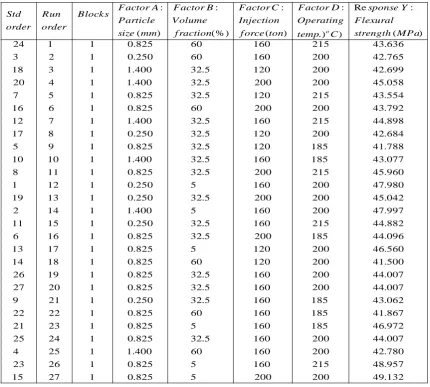
data of input parameters presented in Table 2, and expressed as a power law model of the
form of equation (2).
) 2755 . 0 ^ ( * ) 1053 . 0 ^ ( * ) 0463 . 0 ^ ( * ) 0002 . 0 ^ ( * 041676689 .
7 A B C D
Yflex (3)
Twenty – seven observed responses presented in Table 2 were obtained by evaluating
equation (3) using the data values of the factors’ levels of Box – Behnken design matrix.
Table 2: Experimental design matrix of Box – Behnken design for optimization of power
function (equation) of flexural strength of PP composites.
The response surface models were stated as equations (9) and (10) for coded and uncoded
factors presented and discussed in chapter 4, section 4.2.
The test for statistical significance of the response model is presented in the analysis of
variance (ANOVA) Table 3, and also as Table 4 in chapter 4, section 4.3, where it was
discussed.
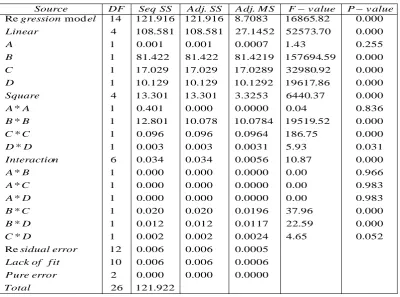
Table 3: Analysis of variance (ANOVA) for RSM optimization of WARPP for flexural strength. 052 . 0 000 . 0 000 . 0 983 . 0 983 . 0 966 . 0 000 . 0 031 . 0 000 . 0 000 . 0 836 . 0 000 . 0 000 . 0 000 . 0 000 . 0 255 . 0 000 . 0 000 . 0 65 . 4 59 . 22 96 . 37 00 . 0 00 . 0 00 . 0 87 . 10 93 . 5 75 . 186 52 . 19519 04 . 0 37 . 6440 86 . 19617 92 . 32980 59 . 157694 43 . 1 70 . 52573 82 . 16865 0000 . 0 0006 . 0 0005 . 0 0024 . 0 0117 . 0 0196 . 0 0000 . 0 0000 . 0 0000 . 0 0056 . 0 0031 . 0 0964 . 0 0784 . 10 0000 . 0 3253 . 3 1292 . 10 0289 . 17 4219 . 81 0007 . 0 1452 . 27 7083 . 8 000 . 0 006 . 0 006 . 0 002 . 0 012 . 0 020 . 0 000 . 0 000 . 0 000 . 0 034 . 0 003 . 0 096 . 0 078 . 10 000 . 0 301 . 13 129 . 10 029 . 17 422 . 81 001 . 0 581 . 108 916 . 121 922 . 121 000 . 0 006 . 0 006 . 0 002 . 0 012 . 0 020 . 0 000 . 0 000 . 0 000 . 0 034 . 0 003 . 0 096 . 0 801 . 12 401 . 0 301 . 13 129 . 10 029 . 17 422 . 81 001 . 0 581 . 108 916 . 121 26 2 10 12 1 1 1 1 1 1 6 1 1 1 1 4 1 1 1 1 4 14 Re * * * * * * * * * * mod Re . . Total error Pure f it of Lack error sidual D C D B C B D A C A B A n Interactio D D C C B B A A Square D C B A Linear el gression value P value F MS Adj SS Adj SS Seq DF
Source
Where A, B, C and D are the particle size, volume fraction, injection force and operating
temperature respectively. The coefficients with the factors A, B, C and D represent the effects
of the factors, while the coefficients with A2, B2, C2, D2 and those with A*B, A*C, A*D, B*C, B*D and C*D represent the quadratic effect and interaction between the two factors
respectively.
determination (R2adj) modifies R2 by taking into account the number of predictors (terms) in the model. The R2adj. close to the R2 value insured a satisfactory adjustment of the quadratic model to the experimental data. The predicted R2 is a measure of how well the model predicted the response value. The R2adj. and R2pred. are within 0.20 of each other showing that they are in reasonable agreement (Mourabet et. al., 2013). The regression statistics can be
checked using a numerical method for coefficient of determination (R2), adjusted R2 (R2adj.) as expressed in equation (4) and (5) (Trinh and Kang, 2010).
residual el
residual SS SS
SS R
m od 2
1 (4) 2 .
1 2
1
1 R
p n
n
R adj
(5)
where SS is the sum of squares.
n is the number of experiments.
p is the number of predictors (terms) in the model, not counting the constant term.
3: Validation of the Model.
It is necessary to check the fitted model to ensure that it provides an adequate approximation
to the real system. Unless the model shows an adequate fit, proceeding with the optimization
of the fitted response surface is likely to give misleading result. The graphical optimization
method i.e. optimization plot was used as a primary tool for optimization. The graphical
technique was validated using numerical method. The crucial phase of numerical
optimization is the assignment of optimization parameters. There are three optimization
parameters namely maximum, minimum and target that define each desirability index, di. The
desirability function di is defined differently based on the objective of the response according
to Relia Wiki (2013) and is expressed as:
(i) If the response is to be maximized, di is defined as:
L
T
Y
idi
0
1 Y T
T Y L
L Y
i i i
(6)
where T represents the target value of the ith response ( the highest value) and L represents the acceptable lower limit value for the response.
U Y
U Y T
T Y i
d
i i i
i
T
U
Y
U
1
0
(7)
Where U represents the acceptable upper limit of the response and T is the smallest value.
(iii)For a specific target response value, di is defined as:
U Y
U Y T
T Y L
L Y
i i
d
i i i i
i
T
U
Y
U
L
T
L
Y
0
0
(8)
By the evaluation of equation (6) for maximization as a desirability, using the maximum and
minimum values of Flexural strength in Table 2 at desirability index di = 1, Yi > T.
Which gives Yi 49.132
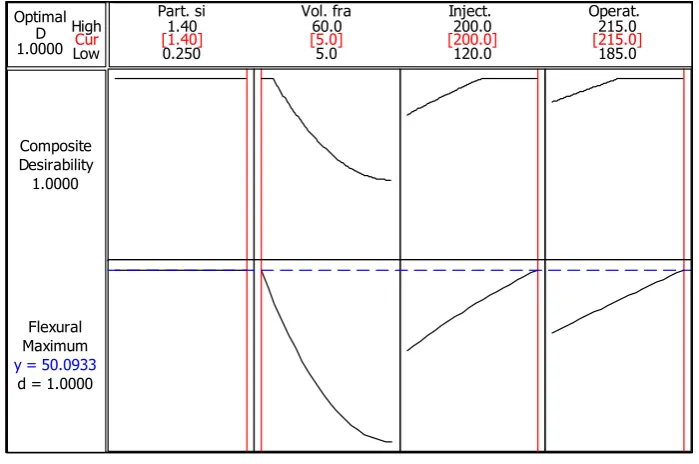
From the optimization plot of Figure 5 presented and discussed in chapter 4 section 4.4, Yi =
50.093MPa.
4 RESULTS AND DISCUSSIONS
4.1 Results of characterization of WARPP samples
The quality of WARPP samples used in this study was evaluated using microscopic method –
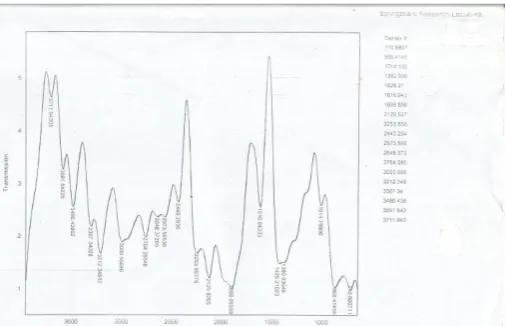
Fourier transform infrared spectroscopy (FTIR) technique. Three different spectra were
produced from three different samples. The spectra were represented by Figures 2, 3 and 4.
Their vertical axes represent the absorption peaks while the horizontal axes are the
wavenumbers.
Absorption
500 . 41 132 . 49
500 . 41
Figure 2: A plot of transmission against wave number of sample 1.
Sample 1: 0.25(5 % vol. fraction), from Figure 2 we have the following peaks.
3406.78- O-H stretch vibration (H bond)
2983.83 – C-H stretch vibration, (C-H) alkane group.
1749.52 – C=O stretch vibration
883.52 – C-H bend (deformation vibration).
Figure 3: A plot of Transmission vs. Wave number of sample 1.40(35 % vol. fraction).
For sample 2: 1.40(35 % vol. fraction), from Figure 3 the absorption peaks are:
3486.43 – O-H stretch vibration
3000.56 – C-H stretch vibration
1616.94 – C = O stretch vibration
Figure 4: A plot of Transmission vs. wave number of sample 3.
For sample 3: 0.80(60 % volume fraction), from Figure 4 the absorption peaks are:
3420.22 – O – H stretch vibration.
3024.21 – C-H stretch vibration.
1709.54 – C=O stretch vibration
828.50 – C-H bend (deformation vibration).
The identifiable mode of vibration by the chemical bonds are stretch vibration and
deformation vibration.
Discussion of the FTIR spectrum.
In Figure 2, the region of absorbance peaks is 3800.762cm-1 and 760.4085cm-1, for the sample composition designated as 0.25(5% vol. fraction). Figures 3 and 4 had their
absorbance peaks in the regions of 3711.943cm-1 and 710.881cm-1 for sample composition designated as 1.40(35% vol. fraction), and 3768.433cm-1 and 828.508cm-1 for the sample composition designated as 0.80(60% vol. fraction). The corresponding absorbance ranges are
3040.353cm-1, 3001.062cm-1 and 2939.9247cm-1 respectively. The corresponding absorbance intensity range is 26.667 – 10.000 = 16.667%, 46 – 10 = 36%, and 40 – 10 = 30%
respectively. Absorbance intensity indicates the influence of filler modification on light
absorption. The lowest absorbance intensity value signifies that composite of the designated
composition 0.25(5 % vol. fraction) may be more porous.
In Figure 2, where the intensity of absorption is 3406.78 cm-1 is showing strong hydrogen bonding with stretch vibration. The hydrogen bonding is due to de-methylation of the
methoxyl group (-OCH3) in silane coupling agent, which splited and CH3 being replaced by
signifies deformation vibration (bending) of C-H bond. The absorption band 1,749.52
signifies the carboxyl, c = o stretch vibration.
Similarly, the absorption peak in Figure 3 is around 3486.43cm-1. Also de-methylation of the methoxyl group in silane coupling agent occurred, and the methyl group was replaced by
hydrogen atom. The absorption band 3000.56cm-1 is due to C-H stretch vibration of the methoxyl group. The absorption band 868.41cm-1 signifies deformation vibration of C-H bond.
In Figure 4, the peak is around 3420.22cm-1 and is due to the hydrogen bonding (O-H) stretch vibration. De-methylation also took place with the methoxyl group in silane coupling agent
splited, creating condition for the production of hydrogen bond. The absorption band
868.41cm-1 is due to C-H deformation vibration.
4.2: Result of the evaluation and optimization of flexural strength of WARPP.
The response surface models are second order regression models that contain
15
n1
n2
/2
numbers of regression parameters, where n is the number of factors. Theparameters include the coefficients for main effects A, B, C and D, coefficients for quadratic
main effects A^2, B^2, C^2 and D^2 and the coefficients for two factor interaction effects
A*B, A*C, A*D, B*C, B*D and C*D and a constant value.
For coded factor,
2 ^ 1345 . 0 2 ^ 3747 . 1 2 ^ 0021 . 0 9188 . 0 1913 . 1 6048 . 2 0078 . 0 007 .
44 A B C D A B C
Y
. * 0245 . 0 * 054 . 0 * 07 . 0 * 0003 . 0 * 0003 . 0 * 0005 . 0 2 ^ 024 .
0 D A B A C A D B C B D C D
(9) For uncoded factor,
2 ^ 0063012 .
0 10154 . 0 0505655 .
0 176485 .
0 0175116 .
0 6945 .
25 A B C D A
Y
C A E B
A E D
E C
E
B^2 8.40365 05 ^2 1.06481 04 ^2 3.16206 05 * 1.08696 05 *
00181774 .
0
D C E D
B E C
B E D
A
E 05 * 6.36364 05 * 1.30909 04 * 4.08333 05 *
89855 .
2
(10)
4.3: Test for statistical significance
052 . 0 000 . 0 000 . 0 983 . 0 983 . 0 966 . 0 000 . 0 031 . 0 000 . 0 000 . 0 836 . 0 000 . 0 000 . 0 000 . 0 000 . 0 255 . 0 000 . 0 000 . 0 65 . 4 59 . 22 96 . 37 00 . 0 00 . 0 00 . 0 87 . 10 93 . 5 75 . 186 52 . 19519 04 . 0 37 . 6440 86 . 19617 92 . 32980 59 . 157694 43 . 1 70 . 52573 82 . 16865 0000 . 0 0006 . 0 0005 . 0 0024 . 0 0117 . 0 0196 . 0 0000 . 0 0000 . 0 0000 . 0 0056 . 0 0031 . 0 0964 . 0 0784 . 10 0000 . 0 3253 . 3 1292 . 10 0289 . 17 4219 . 81 0007 . 0 1452 . 27 7083 . 8 000 . 0 006 . 0 006 . 0 002 . 0 012 . 0 020 . 0 000 . 0 000 . 0 000 . 0 034 . 0 003 . 0 096 . 0 078 . 10 000 . 0 301 . 13 129 . 10 029 . 17 422 . 81 001 . 0 581 . 108 916 . 121 922 . 121 000 . 0 006 . 0 006 . 0 002 . 0 012 . 0 020 . 0 000 . 0 000 . 0 000 . 0 034 . 0 003 . 0 096 . 0 801 . 12 401 . 0 301 . 13 129 . 10 029 . 17 422 . 81 001 . 0 581 . 108 916 . 121 26 2 10 12 1 1 1 1 1 1 6 1 1 1 1 4 1 1 1 1 4 14 Re * * * * * * * * * * mod Re . . Total error Pure f it of Lack error sidual D C D B C B D A C A B A n Interactio D D C C B B A A Square D C B A Linear el gression v alue P v alue F MS Adj SS Adj SS Seq DF
Source
As can be seen from ANOVA Tables 4, the F - values obtained for the significant terms are
greater than the F – value of 2.64 at 95% significance (F0.95, 14, 12) of a standard F- distribution
table. This confirmed the adequacy of the model fit. The significance of each term in the
models was indicated by the p – values associated with the terms. A term is not significant if
p – value is greater than 0.05. The value 0.05 indicates the significance level of observed
effects. Significance level is the probability of the observed significant effect being due to
pure error. That is, the risk of saying that a factor is significant when in fact it is not.
4.4 Optimization Plot.
Optimization plot is the graphical representation of the dependent and independent variables
at their optimal settings. The optimal values of the factors were indicated in the plot. The
optimization plot indicated a maximum predicted value of 50.0933MPa flexural strength with
particle size of 1.40mm, volume fraction of 5%, injection force of 200tons and operating
Cur
High Low 1.0000D Optimal
d = 1.0000 MaximumFlexural
y = 50.0933
1.0000 Desirability Composite
185.0 215.0 120.0
200.0 5.0
60.0 0.250
1.40 Vol. fra Inject. Operat.
Part. si
[1.40] [5.0] [200.0] [215.0]
Figure 5: Optimization plot for flexural strength.
CONCLUSIONS
This work has demonstrated the application of Numerical optimization in validating the
optimized performance characteristics of flexural strength of WARPP. From the study carried
out, the following conclusions were drawn:
1. The result of statistical analysis (ANOVA) shows that the control and interaction factors
B, C, D and B*B, C*C, B*C and B*D have significant effects on the flexural strength of
WARPP.
2. The flexural strength of WARPP is in the range of 46.65MPa – 50.09MPa.
3. The response model of WARPP is representable with nonlinear power law and second
order polynomial equation.
4. The optimal value of flexural strength of WARPP was obtained with the particle size of
1.40mm, volume fraction of 5%, injection force of 200tons and operating temperature of
215oC.
5. The results of the optimization plot were obtained at a condition (desirability = 1) that
satisfied each of the parameters without compromising on any of them (i.e. they are
equally weighted). This demonstrated that to obtain a maximum amount of information in
a short period of time, with the least number of experiments, RSM and optimization plot
can be successfully applied for modeling and optimizing the flexural strength of WARPP.
6. The flexural strength of WARPP obtained from the validation of the model is in the range
was appropriate for validating the optimized performance characteristics of flexural
strength of WARPP.
REFERENCES
1. Abdullahi M. Characteristics of Wood Ash/OPC Concrete. Leonardo Electronic Journal
of Practices and Technologies, 2006; (8): 9-16.
2. Chapra S. C., and Canale R. P. Numerical Methods for Engineers. 5th Edition, McGraw-Hill, New York, 2006; 460 – 462 and 623 – 625.
3. Goodman M. M. The effects of wood ash additive on the structural properties of line,
1998. plaster. [Online]. Available: http://archive.org/stream/effects of
woodashoogood/effectsofwoodash.
4. Hill W. J and Hunter W. G. A review of response surface methodology: A literature
survey, 1966. Technometrics, 571- 591. Mead, R. and D. J. Pike… [Online]. Available:
www.stat.rudgers.edu/home/buyske/591/Lect06.pdf
5. Mourabet M., El Rhilassi A., El Boujaady H., Bennani-Ziatni M., Taitai A. Use of
Response Surface Methodology for Optimization of Fluoride adsorption in an aqueous
Solution by Brushite. Arabian Journal of Chemistry, 2013; 12: 028.
6. Naik Tarun R., Kraus Rudolph, and Kumar R. Wood Ash: A new source of Pozzolanic
material. Report No. CBU Centre for by-product utilization. University of Wisconsin,
2001.
7. Okunade E. A. The Effect of Wood Ash and Sawdust Admixtures on the Engineering
Properties of a Burnt Latrite-Clay. Journal of Applied Sciences, 2008; 8: 1042-1048.
8. Radharamanan R. and Ansui A. P. Quality Improvement of a Production Process using
Taguchi Methods. Proceedings of Institute of Industrial Engineers’ Annual Conference,
Dallas, Texas, 2001.
9. Relia Wiki: Response Surface Methods for Optimization. [Online].
http://reliawiki-org/index.php/Response_Surface_methods_for_opti.. (Accessed Sept. 19), 2013.
10. Sanusi O. M., Oyinlola A. K., Akindapo J. O. Influence of Wood Ash on the Mechanical
properties of Polymer Matrix Composite Developed from Fibre glass and Epoxy resin.
International Journal of Engineering Research and Technology (IJERT). ISSN 2278 –
0181, 2013; 2(12).
11. Suresh R. K. Multi Objective Optimization during Turning of AISI 8620 Alloy Steel
using Desirability Function Analysis. International Journal of Engineering Science &
12. Trinh T. K. and Kang L. S. Application of Response Surface Method as an Experimental
Design to Optimize Coagulation Tests. Journal of Environmental Engineering Research,
2010; 15(2): 63 – 70.
13. Unal R. & Dean B. Taguchi Approach to Design Optimization for Quality and Cost: An
Overview. Presented at the Annual Conference of the International Society of Parametric
Analysis, 1991.