Background: Labour analgesia, though practiced worldwide, is not very popular in low-income countries. The aim
of the study was to assess the awareness, attitude, acceptance, and reasons for hindrance of labour analgesia among
patients visiting a tertiary care center in the capital city
Methods: It was a cross sectional study conducted in Obstetrics and Gynecology outpatient department of
Kathmandu Medical College Teaching Hospital in the month of August 2017. All pregnant patients presenting for
antenatal checkup was included. Data was collected based on a questionnaire after informed consent. Statistical
analysis was done in SPSS version 20 and results were expressed in frequencies and percentage.
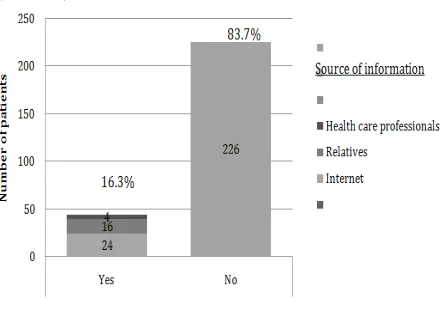
Results: Total of 270 pregnant women participated in the study. Out of these forty-four (16.3%) patients were
aware about labour analgesia. The acceptance rate was high (72.2%). Majority (84.6%) had no problem with
expenditure associated with labour analgesia.
Conclusions: Despite low awareness about painless delivery among the antenatal women, the acceptance rate is
high.
Keywords: Acceptance; Awareness; Labour analgesia.
Knowledge and Acceptance of Labour Analgesia in
Pregnant Women
Mona Sharma,1 Saurya Dhungel,2 Sujata Niroula,1 Manan Karki,1
1Department of Anaesthesia and Intensive Care, Kathmandu Medical College, Sinamangal, Kathmandu, Nepal. 2Deaprtment of Public Health, Tribhuvan University, Kathmandu, Nepal.
Correspondence:
Mona Sharma, Department of Anaesthesiology and Intensive
Care, Kathmandu Medical College, Sinamangal, Kathmandu, Nepal. Email:
ABSTRACT
J Nepal Health Res Counc 2018 Jul-Sep;16(40): 302-6
INTRODUCTION
Labor pain is one of the major determinants of women’s childbirth experience. Epidural labour analgesia is the gold standard method,1,2 with no evidence of harm to the
neonate3,4 but, beneficial effect has been observed.5,6 Developed countries have high acceptance rate of labour analgesia,7 therefore, their data focuses on overall birth experience.8 In our country,little information has been documented on the views of pregnant women about the use of analgesia in labour. The very fact that, childbirth can be achieved without pain may seem absurd to many.9 Culture, upbringing and ethnicity can influence the attitude towards pain.10 Maternal request for pain relief suffices the indication for labour analgesia according to American Society of Anaesthesiologists.11 Women who received labour analgesia were higly satisfied with experience of childbirth.12 This survey, assessed the awareness and acceptance about labour analgesia among antenatal women and attempted to point out the reasons for impediment for not receiving analgesia.
METHODS
Following institutional ethical committee approval, on August 2017 a cross sectional study was carried out in
antenatal clinic of Kathmandu medical college teaching hospital. Sample size of 270 patients was calculated based on a previous study10 where only 27% of the patients were aware about labour analgesia and using the formula 4pq/d2 . Where p is proportion of aware patients (27%), q is 100-p and d is absolute precision or alpha error of 5 %.
A structured questionnaire was used to obtain information about the personal data and other clinical and non-clinical data about the patient. The questionnaire was prepared after discussion among the authors and referring to previous studies.9, 10A pilot study was done on 20 patients attending the antenatal clinic, and the questionnaire justified our aim, hence validated. To reduce the subject bias, we assured the participants that we respected their views and beliefs. We would keep the data confidential and complete anonymity would be provided. There were no leading questions. Patients were included only after an informed consent was obtained. The investigator inquired patients based on the questionnaire, in local language. If any patient regarded the questions non-answerable or lost interest in the survey, those patients were excluded from the study. Single interviewer collected the data, who had
DOI: http://dx.doi.org/10.3126/
previous experiences with community surveys. To avoid interviewer’s bias, he recorded the answers as provided by the respondent. He provided neutral explanations and feedbacks.
The survey had two sections. The first section, demographic data was recorded, such as age, education level, occupation, parity, and previous normal or cesarean delivery. The second section consisted of main objective of the study; comprising of questions to assess the knowledge and perception about labour analgesia. Patients were asked about the pain they expected to occur in the present pregnancy. In case of multigravida, we also inquired about their previous experience. However, if the patient had little or no knowledge about painless labour; we educated patients regarding the types of analgesia focusing on labour epidural analgesia. After imparting the facts and myths; patients were asked if they would prefer labour analgesia during the present pregnancy. If patients were reluctant we inquired the reason for hindrance.
The data obtained were analyzed using the computer software program, Statistical Package for Social Sciences version 20, (SPSS Incorporation) and the results were displayed on tables in numbers and percentages. Pearson Chi-Square test was used to obtain correlation between different factors.
RESULTS
Two hundred seventy pregnant females were approached, and all of them actively participated in the survey. Therefore, none were excluded. The mean age of the participants was 25.9. The influence of sociodemographic profile on awareness of painless deliveryis demonstrated below (Table 1).
Table 1. Socio-demography of patients and its effect on awareness of labour analgesia.
Characteristics Number (%) Χ2 P
value
Education
Uneducated 9 (3.3)
13.9 0.003* Could read
and write (13.3)36
Intermediate
level (48.1)130 Graduate and
above (35.2)95
Residence
Kathmandu (88.9)240
0.49 0.78
Outskirts of
Kathmandu (11.1)30
Occupation
Self employed (Shopkeeper, beauty parlor etc.)
35 (13)
11.01 0.12
Housewife (64.1)173
Skilled job (teacher, nurse)
37 (13.7)
Service/
clerical 25 (9.3)
Data given in number (percentage), chi square, * P value < 0.05 staitistically significant.
Total awareness amongst all of the participants and among them who had knowledge about labour analgesia, their source of information is depicted in the bar diagram (Chart 1).
Figure 1. Knowledge and source of information about labour analgesia.
Among the forty four (16.3%) patients, only three (1.11%) had complete knowledge about painless delivery, rest had only some idea about it.Experience of past labour and delivery in multigravida women is shown in Table 2. Table 2. Experience of multigravida regarding analgesia during previous labour and delivery.
Characteristics Response Number (%)
Demand for
analgesics (n=121) Yes 39 (32.2)
No 82 (67.8)
Type of analgesia
received (n=39) Assurance 12 (30.8) Injections 15 (38.5) Did not receive
any 12 (30.8)
Reason for not demanding analgesic (n=82)
Not aware 32 (39)
Could be harmful
for baby 8 (9.8)
Data expressed in numbers and percentage.
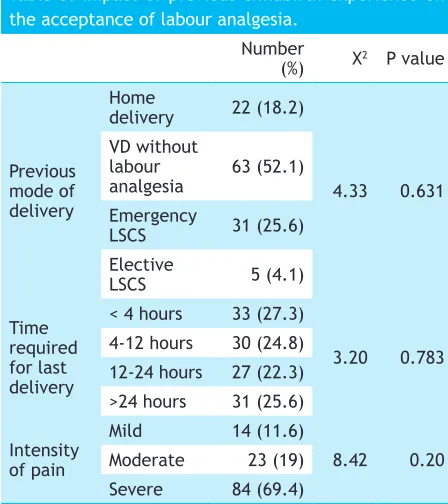
The influence of experience of previous childbirth experience was assessed and shown in table 3.
Table 3. Impact of previous childbirth experience on the acceptance of labour analgesia.
Number
(%) Χ2 P value
Previous mode of delivery
Home
delivery 22 (18.2)
4.33 0.631 VD without
labour
analgesia 63 (52.1) Emergency
LSCS 31 (25.6)
Elective
LSCS 5 (4.1)
Time required for last delivery
< 4 hours 33 (27.3)
3.20 0.783 4-12 hours 30 (24.8)
12-24 hours 27 (22.3) >24 hours 31 (25.6)
Intensity of pain
Mild 14 (11.6)
8.42 0.20
Moderate 23 (19)
Severe 84 (69.4)
Data expressed in number and percentage, Χ2 chi square, P value< 0.05 was considered statistically significant, LSCS lower segment cesarean section, VD vaginal delivery.
Out of 270 patients, 195 (72.2%) accepted labour analgesia and there was no correlation between acceptance and socio-demographic profile or past experience in case of multigravida. The rationale for not accepting pain relief during childbirth and effect of expenditure on the decision is given in Table 4.
Table 4. Reason for not accepting pain relief during childbirth and impact of cost on the decision.
Characteristics Number (%)
Reason for hindrance (n=75)
Natural process 35 (46.7) Could harm the baby 17 (22.7) If only obstetrician
had advised 14 (18.7)
Fear of LSCS 9 (12)
Ready to expend (n=195)
Yes 165 (84.6)
No 30 (15.4)
Consider if the service is free (n=30)
Yes 25 (83.3)
No 5
Data represented in number and percentage. LSCS lower
segment Cesarean section.
Perspective of patients towards upcoming labour and delivery is given in table 5.
Table 5.Attitude of patients towards upcoming labour and delivery.
Emotion towards
labour Number (%)
Calm 118 (44)
Little anxious 16 (6) Concerned about
the baby 75 (28)
Fear of the pain 61 (22)
Anticipated pain Mild 8 (3)
Moderate 57 (21.1)
Severe 205 (75.9) Data expressed in numbers and percentage.
DISCUSSION
In developing countries, pain, associated with childbirth, is often considered natural. And the idea of abolishing it with medicines seems unnecessary or against the traditional values. Knowledge about labour analgesia was present in 16.3% of our pregnant women, this value is lesser than studies performed earlier by Olayemi et al,10 but more than Nabukenya et al13 and Naithani et al.14 However, it is very low in comparison to data from the developed countries, where awareness rate is about 80%.15,16 This suggests that people need to be enlightened about such service available in a tertiary care hospital. The data from various low income or third world countries, is almost the same,India (10.2%)9 Nigeria (27%)10 (19.5%)17 Uganda (7%).13 This image states the practice of labour analgesia is not mandated and not rendered important by practioners. Among the patients who knew about painless labour, most had gathered the information from the Internet and media. Our data is in contrary to other literatures, which quote that health care professionals and previous experience or friends and family are the source of information for patients.13,18,19 It seems not illogical to note that health care professional do not include educating women about painless deliver during antenatal visits.
after receiving labour epidural analgesia.20
In our study population, only nine (3.3%) were illiterate; and majority were housewives (64.1%) and resident of Kathmandu city (88.9%). Although, the aware population percentage was small (16.3%), patients desiring painless labour were high(72.2%). This means that if given choice, parturients want to experience painless childbirth. Our acceptance rate is higher than other studies.10 Previous use and knowledge of epidural analgesia were significant factors for acceptance of labour analgesia in another study.17 A study proved statistically significant association between socioeconomic status, gravida, pain perspective and awareness of labour analgesia.9 Our study population had no such factors that influenced acceptance or awareness about labour analgesia except for education, which had significant association with awareness. Patients who had education qualification above graduation were knowledgeable about painless delivery and this could be because of their broadened point of view and wanting a better quality of medical management for their childbirth.
Two hundred and five patients (75.9%) both primigravida and multigravida; anticipated that the pain would be severe in upcoming labour. This in accordance with findings of Melzack et al,21 whose 80% study population consisting of both primi and multigravida experienced excruciating pain. However, in a study by Oladokun et al,17 the pain score differed significantly with parity, where 41% nulliparous rated labour pain to be mild and 50.4% multiparous women rated it to be severe. Many rspondents(43.7%) admitted to be calm and only sixty-one (22.6%) of them were concerned about the pain. But on giving them a choice of pain relief during labour, 72.2% patients desired for labour analgesia. This indicates that many mothers want the labour and delivery to be pain free.
On inquiring if they were ready to listen to information about painless delivery; majority, 241 (89.3%) were interested. This implies that patients are ready to hear about new information, provided physician take an extra step forward. Authors believe that antenatal visits are the best time to impart the information. This is backed up by a study, which states the information provided about pain relief during antenatal periods are the most useful.22
Among the patients who declined labour epidural analgesia, 46.7% described their hindrance to acceptability was that childbirth was natural; which was an expected answer in studies conducted in low income countries.9 Even in the Nigerian study, the 76.5% of patients who had refused, had the same reason.10
Society like ours has beliefs that are encrypted in peoples’ mind and cultural practice, which plays role in making a decision. This is a fact that some patients do not regard pain as a cause of maternal dissatisfaction during labour.23 Fourteen (18.7%) expressed that if their primary doctor that is the obstetrician had advised, they would have then considered it. Patients come to antenatal clinics and develop a bond with the primary doctor. Therefore, it would be very much effective if our obstetricians, nurses were encouraged to talk to the patients about painless labour. There are literatures citing that information provided by healthcare professionals are desired by patients and are effective as well.18,19 Being a low-income country expenditure on labour analgesia could have been a factor for hindrance among respondents, but surprisingly, one sixty five (85.93%) have accepted the extra cost.
Fear of labour pain has resulted in escalation of elective cesarean section, as evidenced by a study.24 The unawareness among women about labour analgesia should be combated with information, which should be freely available in form of pamphlets or posters in the antenatal clinic. They should be given the information in the antenatal period. Should they have any queries, they should have an access to the physician providing such service to avoid misconceptions and facilitate the knowledge.13,17,19
Limitations of our study could be the fact that, this was a structured questionnaire; respondents could have felt that the questions were mechanistic and could distort what they really meant or have experienced. Multigravida could have recall bias about previous experience about labour and childbirth. And the study was based in a single centre.Further surveys in various regions of the country could investigate this desire
CONCLUSIONS
Despite the fact that very few women had knowledge about labour analgesia, majorities were enthusiastic to adopt pain relief for their upcoming delivery. Epidural analgesia was not desirable to 27.78% of women despite apparent knowledge of the technique. Their reasons could be explored in future studies, which might guide the process of introducing an epidural service.