Condition Assessment of Power Transformer
Winding by FRA using Different AI Techniques
Bhatt Palak Rohitkumar N. D. Rabara
Student Assistant Professor
Department of Electrical Engineering Department of Electrical Engineering L. D. College of Engineering, Ahmedabad, India L. D. College of Engineering, Ahmedabad, India
Abstract
There are many methods of fault diagnosis of Power transformer but among all these FRA is the most suitable method for electrical and /or mechanical faults of a transformer. The concept of FRA has been successfully used as a diagnostic technique to detect the winding deformation of power transformer. In FRA measurement, the nine statistical indicators are used to detect the deviation in FRA signature. The effects of different winding parameters on FRA signature is described. The artificial neural network approach has been proposed to complement these nine indicators. ANN can be used to increase the efficiency and accuracy of diagnosis system. Neural network toolbox is used to train the multilayer feed-forward neural network. The Probabilistic neural network (PNN) approach and General Regression Neural network (GRNN) has been introduced due to its higher sensitivity and accuracy over the neural network. Neural pattern recognition toolbox is used to train the multilayer probabilistic neural network. Different practical case studies and their data are used to train and test the multilayer feed-forward neural network, probabilistic neural network and general regression neural network.Among all these AI techniques PNN gives the best accuracy result. In this work Matlab-2014 is to be used.
Keywords: Transformer; FRA; ANN; Winding Parameters; PNN; GRNN
________________________________________________________________________________________________________
I.
I
NTRODUCTIONPower transformers are expensive and important units in electric power networks. In 1831, Michael faraday had carried out many experiments for demonstrating the principle of electromagnetic induction. The electricity was produced in first time from magnetism occurred on 29th August 1831. Faraday's invention contained all the basic elements of transformers - two independent coils and a closed iron core.The transformers are being mechanically stressed out of service due to transportation and mishandling in the course of an installation. Over the past few decades, a number of diagnostic methods have been developed for monitoring the health of transformers. There are many methods such as SCI (short-circuit impedance measurement), FRA (frequency response analysis), LVI (low voltage impulse), etc. The Short Circuit Impedance Measurement is not widely used on site because its sensitivity is low and the hidden trouble cannot be found effectively. On the other hand, the sensitivity of FRA and LVI is high.FRA is a powerful and sensitive diagnostic test technique to winding displacements. It is now being standardized by both IEEE and CIGRE.In this paper, the basic introduction is carried out in section II and history of FRA in section III. Section IV explains how SFRA is carried out. Section V explains the variation in SFRA plot due to variation in winding parameters. Section VI explains the case study using artificial neural network. Section VII explains the case study using probabilistic neural network. Section VIII explains the case study using General regression neural network. Section IX explains the comparison of ANN, PNN and GRNN. Section X explains the conclusion of this paper.
II.
W
HAT ISFRA?
FRA is a comparison based technique [1,2]. Comparisons are taken according to time, type and phase of the transformers. Among all these, time comparison is more reliable. Phase comparison is only option for old transformers.
Today, FRA measurements are carried out by dedicated instruments most of which employ the swept frequency method and only a few follow the impulse response method. The Frequency Response Analysis (FRA) can detect the type of fault and the exact location of fault.In FRA, Impedance measurement of transformer winding is carried out over a wide frequency range and then the results are compared to the reference set. When variation is found, it may indicate the damage to the transformer. Frequency response analysis can detect many type of faults includes short circuit fault,interturn fault, failure of transformer oil and mechanical displacement.
In 1980, further research carried out by Central Electricity Generating Board in UK.
From 1988 to 1990, proving trials by European utilities, the technology cascades internationally via CIGRE, EuroDoble and many other conferences and technical meetings.
In 2002, “Methods for comparing frequency response analysis measurements,” in Proc. 2002 IEEE Int. Symp. Electrical Insulation, Boston, MA, 2002, pp. 187-190 was published by S. Ryder.Comparison between two statistical methods was carried out to compare FRA response curves.
In 2003, “A new technique to detect winding displacements in power transformers using frequency response analysis”, Power Tech Conference Proceedings, 2003 IEEE Bologna, Volume 2, 23-26 June 2003 Page(s):7 pp. Vol.2 was published by Coffeen, L.; Britton, J.; Rickmann, J. The objective of this paper is to calculate quantitative indicators to indicate fault situations.
In 2004, First SFRA standard, “Frequency Response Analysis on Winding Deformation of Power Transformers”, DL/T 911-2004, is published by The Electric Power Industry Standard of People‟s Republic of China.
In 2008. ”Mechanical-Condition Assessment of Transformer Windings Using Frequency Response Analysis (FRA)” is published by CIGRE report 342.
Thus, from 1991 to present, Results & Case Studies were published and presented, validating the FRA method.
IV.
B
ASIC CIRCUIT OFSFRA
In recent years, the FRA technique gained popularity because of its sensibility to failures, such as winding displacements, deformations, and electrical failures. FRA method is based on the evaluation of transfer function [4] by means of statistical and mathematical indicators which are evaluated in several frequency bands. The normally used frequency range is 20Hz to 2MHz.
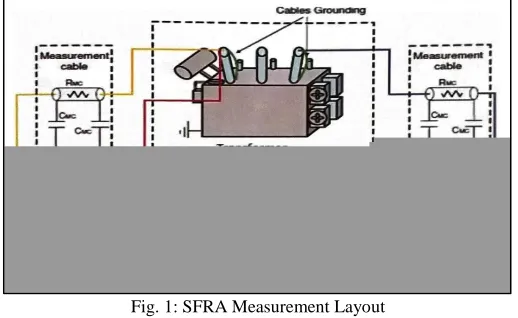
Two terminal pairs of transformer are chosen as input and output as shown in Fig. 1. SFRA is performed by applying low voltage signal of varying frequencies to the transformer winding and the measurements of both input and output signals are taken. Now, the ratio of output to input signal gives required response. And this output to input signal ratio called transfer function of transformer from which both the magnitude and phase can be obtained. Any geometrical deformation changes the RLC network, which in turn changes the transfer function at different frequencies.
Fig. 1: SFRA Measurement Layout
V.
E
FFECTS OF DIFFERENT WINDING PARAMETERSFig. 2: Transformer Winding Parameters Table – 1
Effects of Winding Parameters Physical parameters
Types of faults
Inductance Disc deformation, Local breakdown, Winding short circuits
Shunt Capacitance Disc movements, Buckling due to large mechanical forces, Moisture ingress, Loss of clamping pressure Serial Capacitance Aging of insulation
Resistance Shorted or broken disk, Partial discharge
Effects of different parameters are listed here: 1) Effect of self /mutual inductance. 2) Effect of Series capacitance. 3) Effect of Series resistance. 4) Effect of Shunt capacitance.
Effect of Self/Mutual Inductance: A.
When increasing the inductance [8] will shift the resonance and anti-resonance frequencies to the left over the entire range of frequency. It will also have a minor impact on the amplitude. And decreasing the inductance value will shift the resonance and anti-resonance frequencies to the right when compared with the base values signature.
Effect of Series Capacitance: B.
There are no variations in low frequency and medium frequency region when capacitance increased or decreased. So no impact in FRA signature in low and medium frequency region. And In both cases resonance and anti-resonance frequencies will shift to the right.
Effect of Series Resistance: C.
When increasing the value of the series resistance will introduce minor impact on the amplitude in the medium and high frequency range. Also, some high frequency resonance frequencies will shift to the right. Decreasing the value of the series resistance will not have any impact on the FRA signature except in the very high frequency range where the amplitude will be slightly affected.
Effect of Shunt Capacitance D.
The effect of increasing shunt capacitance is more visible in the high frequency range, where resonance frequencies will shift right with little impact on the amplitude. On the other hand, decreasing shunt capacitance will affect the amplitude of the FRA signature in the entire frequency range and resonance frequencies in the medium and high frequency range will be shifted to the right.
VI.
C
ASE STUDY USING ANNCaseI. A three phase auto transformer with tertiary winding of rating 315 MVA, 400/220/33 kV and 50 Hz is manufactured for EMCO Ltd. Thane. The SFRA plot is shown in Fig. 4.
Fig. 4. SFRA plot for case I
Fig. 3: Neural Network
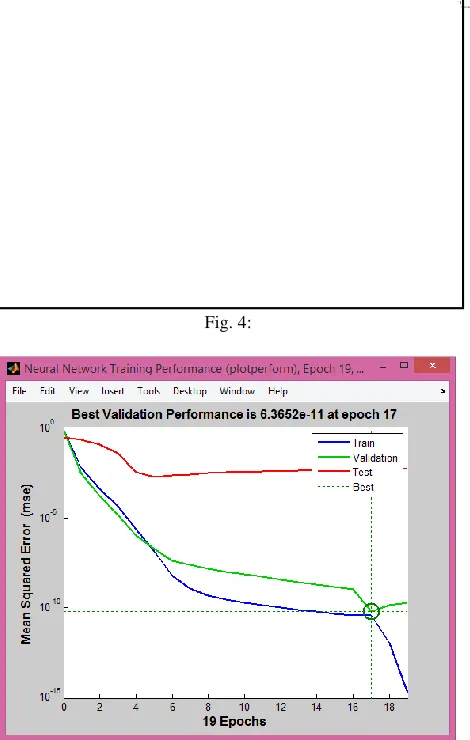
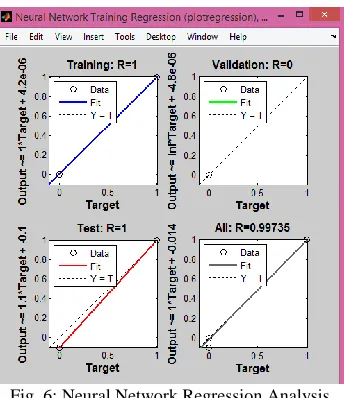
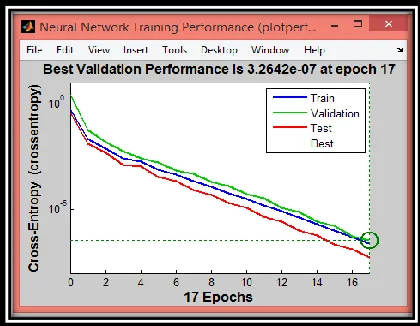
After the NN is created, it is trained. In this case, Levenberg-Marquardt is used as training algorithm. From the Fig. 6. It can be observed that best validation performance is achieved at epoch 17. After completion of training of neural network, the next step is validating the network. Validation of neural network is done to check the network performance and retrain the network. The next step is to observe the regression plot which is shown in Fig. 7.The regression plot which indicates the relationship between the outputs of network and targets. If the training were perfect, the network outputs and targets would be exactly equal. But this relationship is rarely perfect in practice.
Fig. 4:
Fig. 6: Neural Network Regression Analysis
After validation of the network, the ANN is tested using the different field data which are not introduced during the training process. The network is tested by different case studies data.
VII.
C
ASE STUDY USING PNNCaseI. A three phase auto transformer with tertiary winding of rating 315 MVA, 400/220/33 kV and 50 Hz is manufactured for EMCO Ltd. Thane. The SFRA plot is shown in Fig. 8.
Fig. 7: SFRA Plot for Case I
Fig. 8: Structure of PNN
PNN is a kind of feed forward neural network. It is a four layer feed forward neural network that is capable of realizing or approximating the optimal classifier. The four layers are such as, input layer, pattern layer, summation layer and output layer shown in fig 9.
Generally, Gaussian activation function is used in PNN because if the pattern falls within the certain region then the function output is „1‟ otherwise function output is „0‟.PNN is closely related to Parzen window pdf estimator.
PDF for n training set is
[ ( )( )]
OUTPUT MSE
CC
SSRE
SSMMRE
ASLE
INPUT LAYER HIDDEN
LAYER
PATTERN/ SUMMATION
Fig. 9: PNN Performance
Fig. 10: PNN Confusion Matrix
VIII.
C
ASE STUDY USING GRNNCaseI. A three phase auto transformer with tertiary winding of rating 315 MVA, 400/220/33 kV and 50 Hz is manufactured for EMCO Ltd. Thane. The SFRA plot is shown in Fig. 13.
Fig. 12: SFRA Plot for Case I
The General Regression Neural Network is one of the most popular neural network. It is a feed forward neural network for supervised data. It uses nonlinear regression function for approximation. It basically employs the smoothing factor as a parameter in learning process [14]. The smoothing factor is selected to optimize the transfer function for all the nodes.There are four layers: the input layer, patternlayer, summation layer and output layer shown in fig. 14.
Fig. 13: Structure of GRNN
The main task of regression is getting relation between input variables X and output variables Y. If X is a vector of known inputs, then the following scalar function is defined,
= ( ) ( )
This parameter gives the information of difference between two vectors. The output vector Y can be calculated following.
̂ (X) = ∑ (
)
∑ (
)
̂ (X) = a weighted average of all observed samples.
= each sample is weighted in an exponential manner according to Euclidean distance, , from .
Σ is the smoothing factor. Large values of sigma improve smoothness of the regression surface. It must be greater than zero and usually range from 0.01 to 0 for good result.
OUTPUT MSE
CC
SSRE
SSMMRE
ASLE
INPUT LAYER HIDDEN
LAYER
PATTERN/ SUMMATION
Fig. 15: GRNN Confusion Matrix
IX.
C
OMPARISON OF ANN,
PNN AND GRNNThe different case studies apply for ANN, PNN and GRNN, but among all these the accuracy of PNN is highest.
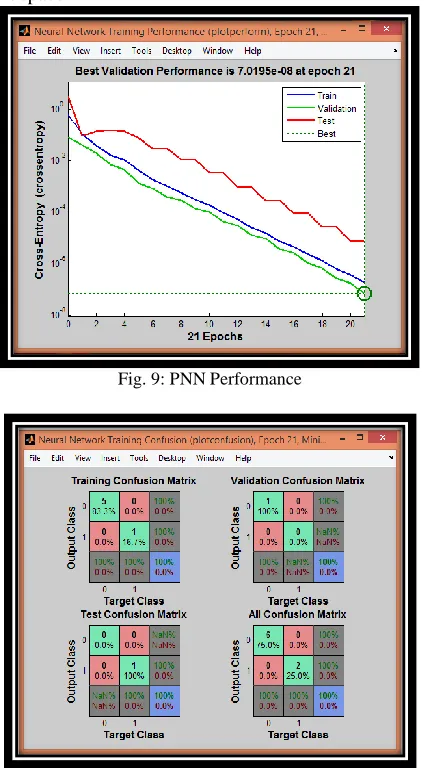
From fig.11 it is shown that there is not any data misclassification in PNN confusion matrix.it means that PNN confusion matrix gives 100% data classification.
From fig.16 it is shown that GRNN confusion matrix gives 88.9% data perfect classification and 11.1% data misclassification which shows in red color box.
From fig.7 it is shown that in regression analysis when the value of All R is 1 it means that the output and target matches to each other. But in this case this value is 0.9999 which is very closer to 1.
From fig.no.12 it is shown that PNN gives the best accuracy. It is 100% accurate.
C
ONCLUSIONThere are different case study using SFRA is carried out at GETCO. There are different types of case study such as after and before overheating, before and after tap changing position, different winding connections. SFRA is basically used to detect the winding deformation of transformer.
After studying all these cases, it is concluded that SFRA is very sensitive towards the winding deformation and winding movements. This method is sensitive in the frequency region and provides wide frequency range.
The results of SFRA gives to the ANN, PNN and GRNN as input data. Further checking the sensitivity of SFRA. The AI technique providesmore sensitivity and more stability. Once a network is trained, it gives the best result. Among allthese network such as backpropagation neural network, probabilistic neural network and general regression neural network, PNN gives the best accuracy result for data classification.
R
EFERENCES[1] Jimmy Cesar Gonzales Arispe, Student Member, IEEE, and Enrique Esteban Mombello, Senior Member, IEEE, “Detection of Failures Within Transformers by FRA Using Multiresolution Decomposition”, IEEE TRANSACTIONS ON POWER DELIVERY, VOL. 29, NO. 3, JUNE 2014. [2] IEEE Guide for the Application and Interpretation of Frequency Response Analysis for Oil-Immersed Transformers, Sponsored by the Transformers
Committee IEEE, IEEE Power and Energy Society, IEEE Std C57.149™-2012, 8 March 2013.
[3] K.P. Badgujar, M. Maoyafikuddin. S.V. Kulkarni, “Alternative statistical techniques for aiding SFRA diagnostics in transformers”, Published in IET Generation, Transmission & Distribution.
[4] Jongwookkim, Byungkoo Park, SeungChealJeong, Sang Woo Kim, PooGyeon Park, “Fault diagnosis of a Power transformer using an improved frequency response analysis”, Power Delivery, IEEE TRANSACTION, 2005.
[5] Amini. A., Das. N., Islam. S., “Impact of buckling deformation on the FRA signature of Power transformer”,Power Engineering conference(AUPEC) 2013, Australasian Universities.
[6] Mizayaki. S., Mizulani,Y., Suzuki. H., Ichikawa.M. “Detection of deformation and displacement of transformer winding by frequency response analysis”, Condition monitoring and diagnosis, 2008.
[7] JinZhijian, Zhu Minglin, Zhu Zishu., “Fault location of transformer winding deformation using frequency response analysis”, Electrical insulating materials, 2001.
[8] Abu-Siada.A., Hashemnia.N.,Islam.S., Masoum,M.S.A., “Impact of transformer model parameter variation on FRA signature”, Universities Power Engineering Conference(AUPEC), 2012.
[9] Usha,K., Joseph,J., Usa,S. “Location of faults in transformer winding using SFRA”, Condition Assessment Techniques in Electrical Systes(CATCON), 2013.
[10] D.K. Xu, C.Z. Fu, Y.M. Li, “Application of artificial neural network to the detection of the transformer winding deformation” 11th Int. Symp. On High Voltage Engineering ,Conf. Publ. No. 467, London, UK, August 1999, vol. 5, pp. 220-223.