policy of education and the challenges of precarious work of teachers of basic education in the state of paraná) (1995-2002). in Políticas educacionais: Um exame das proposições e reformas educacionais. (educational policy: an examination of the propositions and educational reforms). (pp.117 - 146). paraná: editora unioeste.
law project n. 8.035 /2010. pne (still in analysis at the national congress). ministry of education. bra-n. bra-zil. retrieved from < http://bd.camara.gov.br/bd/handle/bdcamara/5826//wwww.mec.gov.br>. munhoz, m., & Kovaliczn, r. a. (2012).a formação continuada dos professores da rede pública de
en-sino do estado do paraná, nos governos lerner e requião: semelhanças e diferenças perceptíveis. (the continuing formation of teachers in the public schools of the state of paraná, in governments lerner and requiao: similarities and notable differences)paraná. in Simpósio de educação da XX semana de Pedagogia. (education symposium on the twentieth week of pedagogy). retrieved from http://www.unioeste.br/cursos/cascavel/pedagogia/eventos/2008/1/artigo%2016.pdf. oliveira, J. f. (2009). A função social da educação e da escola publica: tensões, desafios e perspectivas
(The social function of education and public school: tensions, challenges and prospects) in: Fer-reira, E. B.; Oliveira, D. A. (Orgs.).Crise da escola e políticas educativas. (Crisis at school and educational policies). (pp. 237-252). belo horizonte: autêntica.
pde. (2007). ministry of education. brazil. retrieved from http://portal.mec.gov.br/arquivos/livro/ and/ or http://www.dominiopublico.gov.br/download/texto/me004370.pdf.
silva, m. a. (2011). a questão docente nas políticas públicas (the teacher question in public policy). in: cunha, c.; sousa, J. V; silva, m. a. Políticas públicas de educação na América Latina: Lições aprendidas e desafios. (public education policies in latin america: lessons learned and chal-(public education policies in latin america: lessons learned and chal-lenges) (pp. 325 – 354). campinas, sp: autores associados.
sordi, m. r. l. (2005). avaliacao da qualidade do trabalho docente: do auto-engano ao auto-conhecimen-to.( evaluation of the quality of teaching: from self-deceiving to self-knowledge in: romanovski, J. p.; martins, p. l. o.; Junqueira, s. r. a. Conhecimento local e conhecimento universal: Forma-ção docente, aprendizado e ensino.( Local knowledge and universal knowledge: teacher forma-tion, learning and teaching) (pp. 121 – 136). curitiba: champagnat.
Wachowicz, l. a. (2012). uma inversão didática nos cursos de pós-graduação. (didactic inversion in postgraduate courses). Diálogo Educacional, curitiba, pr, 9(26), 29- 45. retrieved from http:// www2.pucpr.br/reol/index.php/dialoGo?dd1=154.
Advised by Saleh A. Alabdulkareem,King Saud University, Saudi Arabia
received: May 05, 2014 accepted: June 26, 2014
Romilda Teodora Ens PhD., Professor, Advisor at PUCPR, Imaculada Conceicao Street, 1155. Prado Velho. Curitiba/Parana/Brazil.
E-mail: [email protected]
Gisele Rietow Bertotti Master Degree Student at PUCPR, Imaculada Conceicao Street, 1155. Prado Velho. Curitiba/Parana/Brazil.
E-mail: [email protected]
Rudimar Gomes Bertotti Master Degree Student at UFPR, �V de �ovembro Street, 1���. Cit� Cen-�V de �ovembro Street, 1���. Cit� Cen-tre. Curitiba/Parana/Brazil.
E-mail: [email protected]
PEDAGOGICAL CONTENT KNOWLEDGE
(PCK): SOME USEFUL MODELS AND
IMPLICATIONS FOR TEACHERS’ TRAINING
Carmen Fernandez
University of São Paulo, São Paulo, Brazil E-mail: [email protected]
Abstract
In recent years the profession of teaching has reached a maturity to the point of being considered a pro-ducer of own knowledge necessary to the practice. The teacher is no longer seen as a technician, but as an intellectual actor and the specialized literature advocates teaching as a profession, and it recognizes that the teacher has “knowledge base”, a set of skills that are developed during his teaching activity. The Pedagogical Content Knowledge (PCK) is a concept that seeks to represent the teachers’ professional knowledge and it has been widely used in the literature about teachers’ knowledge. It has proved a fruit-ful model for investigations aimed to document the knowledge that makes one a good teacher. Despite the relevance that the PCK is, the consensus on what is the PCK is still far from being achieved and many researches propose different models and concepts for the PCK, sometimes conflicting. Many works brings the PCK and speak of it as if it were a clear concept and do not clarify which model / conception are using, which makes investigations on the PCK difficult and ends up attracting a lot of criticism. Thus, this study aims to look critically at the various models proposed in the literature most used and point differences and similarities so that an overview can be built with more insight and analyze their use and validity. The study will also present some ways to have access to PCK and the relation between PCK and teacher education is also discussed.
Key words: knowledge base of teaching; pedagogical content knowledge; professional knowledge; teachers’ education; teachers’ knowledge.
Introduction
every profession has a body of knowledge that set it apart from others and makes people who master such skills considered suitable professionals to exercise the profession. interesting-ly, for the profession that educates all other, the teachers; there is no consensus about the body of knowledge necessary to be a teacher, even about its existence. common sense is that to be
a teacher just knows some specific content. Consequently, the widespread idea that other skills are not needed beyond the specific content to be a teacher. This situation makes the teacher
profession often a temporary one and shows inconsistency between the social and economic de-preciation of the profession with the responsibility and training required. although knowledge
of the specific content (Chemistry, Biology, Portuguese, Geography, etc.) is the primary task of being a teacher, your domain is only part the story, since specific skills for teaching are long
80 bucat (2005) follows this same line to mention that “[...] there is a vast difference be-tween knowing about a topic (content knowledge) and knowledge about the teaching and learn-ing of that topic (pedagogical content knowledge” (bucat, 2005, p. 2). nowadays, teaching as a professional activity of teachers is seen as a set of actions intentionally set by a teacher, to promote the students’ learning of concepts, procedures and attitudes in the context of an institu-tion - the school - which affects the teaching activity and is affected by it (montero, 2001).
the pedagogical content Knowledge (pcK) is a concept that has come to represent the knowledge that teachers use in the teaching process (Kind, 2009). in this sense, if you can identify pcK, the understanding of what it means to be a good teacher could be enhanced and could facilitate the promotion of pcK development in pre-service teachers in ways of more intentional and consistent manner.
the pcK is a construct that has been widely used in the literature about teachers
knowl-edge _ and it is considered the specific professional knowlknowl-edge and also it has proved to be
a fruitful model for investigations aimed to document the knowledge that makes one a good teacher. despite the relevance that the pcK is, the consensus on what is the pcK is still far from being achieved and many researches propose different models and concepts for the pcK,
sometimes conflicting. Many works brings the PCK and speak of it as if it were a clear concept
and do not clarify which model / conception are using, which makes investigations on the pcK
difficult and ends up attracting a lot of criticism.thus, this study aims to look critically at the
various models proposed and most used in the literature and point differences and similarities so that an overview can be built with more insight and analyze their use and validity.
In the context of teacher education a central issue is the definition of what are the skills
that a teacher needs to know to teach (knowledge base). as already mentioned, for many
de-cades, it was believed that what the teacher needed to know in order to teach was the specific
content. in practice, however, is not only content what characterizes a good teacher. if so, all university teachers, researchers and experts in their content, should be excellent teachers.
how-ever, it is known that this is not at all a truth and, on the contrary, the inefficiency of experts in
the classroom is one of the major complaints of the students in general (Kind, 2009).
from the 1980s becomes an effective appreciation of the practical understanding of what it is that knowledge of teachers. accordingly, a series of models representing the knowledge of teachers has been produced in an attempt to describe and delineate a body of knowledge base for teaching (elbaz, 1983; shulman, 1986, 1987; Wilson, shulman, richert, 1987; freire, 1985, 1996; tardif, 2002; Gauthier, 1998, pepper, 2008). there is a consensus that for teaching prac-tice is required knowledge from different sources, namely: personal knowledge, knowledge from initial and continuous training knowledge of curriculum and knowledge of professional practice.
research on teachers’ knowledge produced a substantial change from the study of teach-ing in order to provide prescriptions for teachers to a situation that is the recognition of the knowledge of teachers (montero, 2001). thus, a shift occurs from a concern for propositional and generalizable knowledge to an interest in a practical and personal knowledge, expressed through metaphors, stories, pictures, etc. several authors have positioned themselves in this second part, including shulman (1986), morine-dershimer (1989), clark and peterson (1986), among many others.
81 in the literature on teacher knowledge, various names have been used, each indicat-ing one aspect of that relevant knowledge (henze, Van driel, Verloop, 2007). together, these designations give an overview of how teachers’ knowledge has been investigated in the last decades (Verloop et al., 2001). the most commonly used names are personal knowledge (con-nelly, clandinin, 1985), situated knowledge (brown, collins, duguid, 1989), knowledge of professional, craft knowledge (shimahara, 1998), action-oriented knowledge (carter, 1990), tacit knowledge (eraut, 1994), among others. in this work the expression teachers’ knowledge
is used to indicate all the teachers’ knowledge and beliefs that influence their teaching practices
as assigned by Verloop, Van driel and meijer (2001).
Practical Knowledge
there is consensus in the literature that practical knowledge results from the recognition of professional knowledge of teachers, valuing their contribution to the construction of knowl-edge about teaching, regarding it as well as an intellectual activity. this means that one starts from the assumption that the teacher builds knowledge in your classroom in contact with their students that is distinct from that formal knowledge learned in the academia. schön (1992), follower of deweys’ ideas, is considered one of the authors who contributed to enhancing the practical knowledge through its proposal for an epistemology of practice.
according to carter (1990) the characteristics of the professional practice of teachers seem to require an idiosyncratic, situational, intuitive knowledge, highly tentative and hardly
fits the categories of basic and applied (formal knowledge), in other words, knowledge own of
technical rationality. in this sense, several authors have performed propositions about the
com-ponents of practical knowledge. Elbaz (1983) identifies five comcom-ponents: knowledge of your
-self, the environment, the content, the development of curriculum and instructional strategies.
Shulman (1987) and Wilson, Shulman and Richert (1987) defines seven categories for teach
-er knowledge: content knowledge, gen-eral pedagogical knowledge, curriculum, pedagogical content knowledge, students and their characteristics, educational contexts, and knowledge of purposes, aims, objectives and educational philosophies. putnam and borko (1997) recognize three: general pedagogical knowledge, content and pedagogical content. calderhead (1996)
identifies five components: knowledge of yourself, subject matter knowledge, students’ knowl
-edge, curriculum and teaching methods. Grossman (1990) systematizes shulman’s proposal on four components: content knowledge, general pedagogical knowledge, pedagogical content knowledge and context knowledge.
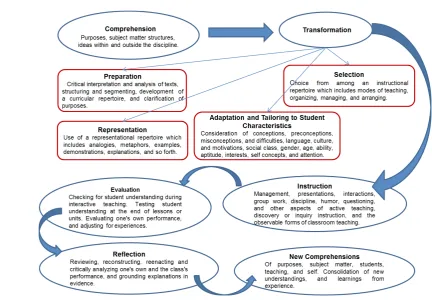
in the same article of the year 1987, shulman presents the model of pedagogical rea-soning and action (mpra, figure 1). this model represents how the practical knowledge of
teachers can be developed and points to the relevance of reflection in this process.
regarding to the mpra model shulman explains that most of the teaching begins by some form of “text”, a textbook, script or other material that the teacher or students would like to understand. according to the mpra proposed by him, starting from a textbook, educational goals, and a set of ideas, the pedagogical reasoning and action involve a cycle through activities of comprehension, transformation, instruction, assessment and reflection. the starting point and end of the process is an act of understanding. because of its procedural nature, the mpra requires reasoning processes of the teacher on the content for teaching that are in continuous restructuring. their dynamic is being enriched by the context in which it happens as a result of social interactions that educational activity implies and distinct periods that characterize the
teaching practice. The MPRA is thus a dynamic and cyclical model of teacher reflection and
action. this model seeks to embrace the knowledge that the teacher has on the subject matter and on methodological approaches that develops on a particular subject. at each step, a series of knowledge and skills is required. thus, in the mpra model shulman represents the steps
that occur in the development of professional practice of a teacher, particularly using a specific
82 the teachers’ knowledge the specific content; however, it is tied to its pedagogical dimension. and this transformation of content into pedagogically powerful ways is what shulman calls pedagogical content knowledge.
Figure 1: A Model of Pedagogical Reasoning and Action (MPRA). adapted from shulman, 1987, p. 15 and salazar, 2005.
Models of Teacher Knowledge and PCK
Shulman’s Model of the Knowledge Base of Teaching
In 1986, Shulman and Sykes defined the knowledge base for teaching as “the body of
understanding and skills, and device and values, character and performance that together con-stitute the ability to teach.” they listed eight categories involving this base:
General liberal education, including basic skills for reading, math, writing and i.)
reasoning
content knowledge in the domains in which teaching will occur ii.)
Content-specific pedagogical knowledge
iii.)
General knowledge of pedagogical principles and practice iv.)
curriculum knowledge v.)
understanding of student diversity and individual differences vi.)
performance skills vii.)
foundations of professional understanding (including history and policy, phi-viii.)
losophy and psychology; cultural and cross-cultural factors; professional ethics
appar-83 ently came to mean a special kind of knowledge of teachers who had not previously served by any name. according to shulman (1986) content knowledge includes: knowledge of concepts, theories, ideas, knowledge of proofs and evidences as well as practices and approaches to de-velop this knowledge. While the pedagogical knowledge includes the educational purposes, the methods of teaching and learning, that is, knowledge about techniques or methods used in the classroom, the nature of the target audience and strategies for assessing students’ knowledge. in general pedagogical knowledge encompasses educational purposes and values and, in addition, requires a cognitive, social and developmental theory of learning and how they apply within the classroom.
later, shulman (1987) outlines the categories of teacher knowledge to promote under-standing among its students, he considers seven types of basic knowledge that a teacher must have:
content Knowledge i.)
General pedagogical Knowledge ii.)
curricular Knowledge iii.)
pedagogical content Knowledge (pcK) iv.)
Knowledge of learners and their characteristics v.)
Knowledge of educational contexts vi.)
Knowledge of purposes, educational purposes and educational values and vii.)
their philosophical and historical bases
shulman (1987) says that the pedagogical content Knowledge is that special amalgam of content and pedagogy that is uniquely the province of teachers, their own special form of professional understanding.
Pedagogical Content Knowledge (PCK) in the Initial Vision of Shulman
shulman introduced the idea of pedagogical content Knowledge as an element of what he called a knowledge base for teaching. Key elements in shulmans’ conception for pcK are
knowledge of representations of the specific content and instructional strategies on the one hand, and understanding of learning difficulties and students’ conceptions of specific content
on the other.
Expression of PCK was initially presented by Shulman to denote a specific type of teach
-er knowledge, knowledge that diff-erentiates a teach-er in a given discipline from an exp-ert of
that discipline. This expression was first named by Shulman at a conference at the University
of texas in 1983, whose title was suggestive: “the missing paradigm in the research about teaching.”
What Shulman called the missing paradigm was the specific content and lack of atten
-tion that it was earning on the way to being a teacher. during his research history, the interests of shulman focused on two main points: cognition for professional practice, especially under
conditions of uncertainty as the professions of physicians and teachers; and the specificity of the
domain expert. shulman (1986) examined questions used from evaluations to select teachers over the years and realized that, historically, sometimes the programs to select teachers focused
on specific content and sometimes the focus was on pedagogy. Shulman then asks whether it is
always necessary to have this separation between content and pedagogy on the path to becom-ing a teacher.
In the 1987 article, Shulman mentions the idea of PCK for the first time referring to
the intersection of content and pedagogy, and says: “[...] that special amalgam of content and pedagogy that belongs only to the universe of teachers, their special form of professional under-standing.” (shulman, 1986, p. 9). for shulman yet, is this ability to transform the content that
distinguishes, for example, a chemistry teacher from an expert in chemistry. Shulman defined
84 [...] which goes beyond knowledge of subject matter per se to the dimension of subject matter knowledge for teaching. i still speak of content knowledge here, but of the particular form of content knowledge that embodies the aspects of content most germane to its teachability. Within the category of pedagogical content knowledge i include, for the most regularly taught topics in one’s subject area, the most useful forms of representation of those ideas, the most powerful analogies, illustrations, examples, explanations, and demonstrations—in a word, the ways of representing and formulating the subject that make it comprehensible to others. since there are no single most powerful forms of representation, the teacher must have at hand a veritable armamentarium of alternative forms of representation, some of which derive from research whereas others originate in the wisdom of practice. (shulman, 1986, p. 9)
from the moment that shulman coined the term pcK, it gained momentum in tions of knowledge of teachers and has been widely used. pcK is now a model for investiga-tions of knowledge of teachers. studies of pcK suggest that this knowledge is related to the planning and instruction in the classroom. for carter (1990), practical knowledge and pcK are two distinct categories, but interrelated in the learning of the teaching process. to this author, the pcK is a broader category that is part of professional knowledge and is more formal than the category practical knowledge, which is more personal and situational. considering the cat-egories of teacher knowledge proposed by fenstermacher (1994) in formal and practical, the
PCK seems to have more specific characteristics of formal knowledge than practical. Further
-more, Grossman (1990) argues that the pcK is part of practical knowledge and its construction meets the same methodological parameters. this is also the opinion of shulman. thus, it is still a matter of discussion whether the research program sponsored by shulman is in the category of formal or practical knowledge. some authors consider it as the participant of peculiarities of both, through which could be interpreted as a summary category.
The Knowledge Base of Teachers by Grossman and the Systematization of PCK
Grossman (1990), following shulman, represented the proposed knowledge by this au-thor emphasizing the value of content knowledge for the development of the curriculum:
[...] content knowledge by teachers affects both what teachers teach and the way they do. [...] how active shapers of the curriculum, teachers make explicit their curriculum decisions their knowledge, interests, and values; they can pay more attention to what most dominate or have more interest and, moreover, give less importance or even avoid those contents who know less; deal thus to adapt a particular curriculum as much as possible to their own disciplinary knowledge, by selecting that in this function.
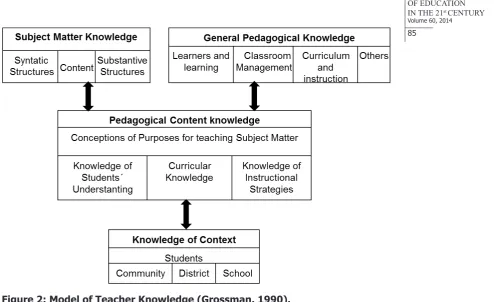
Grossman was the first to systematize the components of the knowledge base of teachers
proposed by shulman and characterized the concept of pcK in their model of teacher knowl-edge (figure 2). for the author, there are four interacting components that form the knowlknowl-edge base for teaching. they are: a) general pedagogical knowledge; b) subject matter knowledge; c) the pedagogical content knowledge; d) knowledge of context. in this model, the pcK occupies a central position and is seen as the transformation of pedagogical knowledge, context and
con-tent specific. Each of the components in this model also encompasses other areas of the knowl
-edge base. of these, the pedagogical content knowl-edge is one that interacts with all the others. extracting from the model their view of pcK (figure 2), Grossman reexamines shulman’ idea of knowledge base for teachers, including to the pcK the knowledge of the curriculum and
rep-resenting in the model the hierarchy of the knowledge of the purposes for teaching an specific
85
Figure 2: Model of Teacher Knowledge (Grossman, 1990). from:Grossman, 1990, p. 5
Model of Teachers Knowledge Base of Carlsen and the PCK
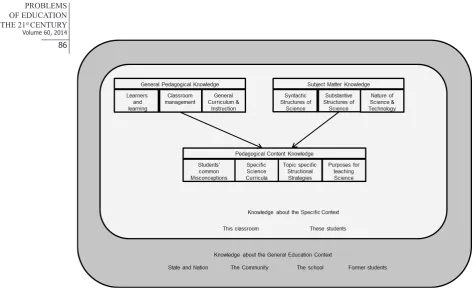
carlsen (1999) presents a proposal slightly different from Grossman to the knowledge
base of teachers based on five areas of knowledge and specifying knowledge of the context in general and specific. Knowledge of general educational context includes the nation, state, community and schools, while knowledge about the specific educational context focuses on
86
Figure 3: Domains of teacher knowledge (Carlsen, 1999). from: carlsen, 1999, p. 136
this model differs from Grossman (1990) for greater emphasis to the context and its unique relationship with the various areas of knowledge, in addition to represent the
relation-ship between the broader educational context and the specific context of the classroom and in
-dividual students. Another significant difference from the Grossman model is that the purposes
for teaching science are at the same hierarchical level of the other components of pcK in the carlsen model.
PCK Model of Magnusson Krajcik & Borko
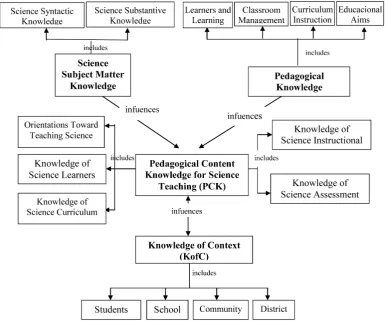
from the Grossman model of the knowledge base of teachers, many proposals have emerged to represent the core knowledge in the model of Grossman, the pcK. among them, we highlight the model magnusson; Krajcik and borko (1999) that emphasizes the components of pcK for teaching science (figure 4).
this model basically follows the Grossman’s proposal, adding assessment knowledge as a component of pcK. moreover, in this model, the “conceptions of purposes for teaching con-tent” present in the Grossman model are replaced by “orientations for the teaching of science” in magnusson et al. (1999). these guidelines are explained by the authors: process, academic rigor, didactic, conceptual change, activity-driven, discovery, project based science, inquiry and guided inquiry. although the contributions of magnusson; Krajcik and borko model (1999) friedrichsen; van driel and abell (2010) point out some criticism related to the terms used in it. according to the authors the term “orientations to teaching science” is used with different meanings in different works reported in the literature. this ambiguity, according to the authors,
is the result of the origin of the term, which is defined at first as “knowledge and beliefs about
87
Figure 4: Components of pedagogical conent knowledge for science teaching. from: magnusson; Krajcik; & borko, 1999, p. 99.
Model of PCK from Park & Oliver and this Development
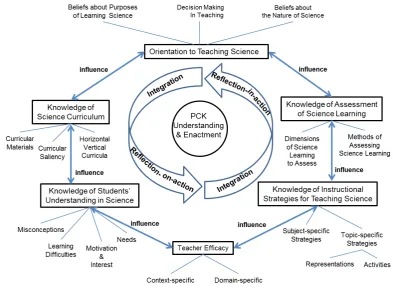
in the work of park and oliver (2008), was added to the magnusson’s et al. model a sixth
component on the efficacy of the teacher. The affective perspective has been highlighted in the
literature as one of the components of pcK. the authors call this model of construction of pcK
as Model Hexagonal (Figure 5). In this model is shown the emergence of teacher efficacy, the
qualification of idiosyncrasy, the importance of reflection, and the recognition of the signifi
-cance of students’ roles as units within PCK (Park & Oliver, 2008). The efficacy component
88
Figure 5: Hexagonal model of pedagogical content knowledge for science teach-ing.
from: park & oliver, 2008, p. 279.
Model of Domains of Teachers Knowledge and Their Manifestations of Rollnick et al.
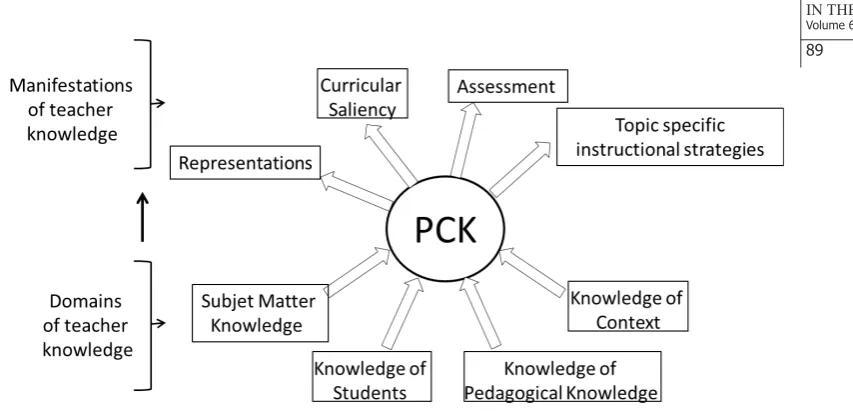
rollnick et al. (2008) consider the pcK an amalgam of four areas of the knowledge base for teaching. they are: a) content Knowledge; b) Knowledge of students; c) General pedago-gical Knowledge; d) context Knowledge. during classroom observations, they concluded that the manifestations of these domains generate other domains or “products of education” (figure
6). They are: a) Content Representations; b) Instructional Strategies specific for a content; c)
89
Figure 6: Tailored model for PCK. from:rollnick et al., 2008, p. 1381.
Morine-Dershimer & Kent’s Model and the Emphasis on the Pedagogical Content
morine-dershimer and Kent (1999) present a model that shows their interpretation of the place of pedagogical knowledge in respect of all categories of teacher knowledge
identi-fied by Shulman (1987) and emphasize three points (Figure 7). One is the close relationship
between the aims and purposes and their inseparability from knowledge about assessment pro-cesses. another is that curriculum knowledge is powered by both the content knowledge and the knowledge of goals / assessment processes. and yet in the model only the category
knowl-edge of general contexts is directed to a subcategory of knowlknowl-edge of specific contexts, but
each of the other categories are directly related to pedagogical content knowledge, that means,
knowledge of the specific content, knowledge of the specific curriculum and knowledge of ob
-jectives / assessment procedures of specific pedagogy and specific students. (Morine-Dershimer
& Kent, 1999).
for these authors, therefore, the pcK consists of six knowledge: i) knowledge of the purposes and educational objectives linked directly to knowledge of assessment procedures; ii) pedagogical knowledge; iii) curriculum knowledge; iv) content knowledge; v) knowledge of
specific contexts; and vi) knowledge of learners and learning.
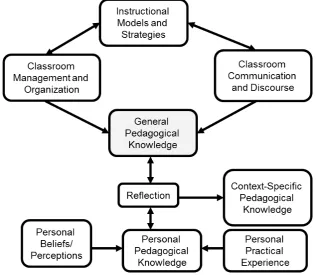
figure 8 shows the conception of morine-dershimer and Kent (1999) on the various fac-ets of general pedagogical knowledge that has been reported by recent research on education. studies on the three main areas that contribute to the general pedagogical knowledge - organi-zation and management of the classroom, instructional models and strategies, communication and discourse in the classroom - have attempted to educational / evaluation processes and goals
with students of critical characteristics result from a pedagogical practice, confirming the rela
-tionships of figure 7. it is worth mentioning here the relationship between general pedagogical knowledge, which is the result of research and educational literature and personal pedagogical
knowledge that is stocked personal beliefs and practice personal experience. The reflection pro
-cess promotes the connection between the general and personal pedagogical knowledge so that perceptions formed by personal beliefs and experiences are enhanced and made more objective,
while conceptions of pedagogy and principles are exemplified by the research explained and contextualized. The result of this process is the context-specific pedagogical knowledge that
90
Figure 7: Categories contributing to pedagogical content knowledge. from:morine-dershimer & Kent, 1999, p. 22
91
Abell’s Model – Adding the Knowledge Base of Teachers from Grossman and the PCK Model from Magnusson et al.
in the handbook of research on science education abell (2008) proposes a model of teacher knowledge that encompasses the two models most commonly used in the literature: the
model of Grossman (1990, figure 2) and the model of Magnusson; Krajcik; & Borko (1999, fig
-ure 4) thereby account both components of the knowledge base of teachers and the components of pcK within the same model (figure 9) that shows so useful.
Figure 9: A model of science teacher knowledge (modified from Grossman, 1990
and Magnusson, Krajcik & Borko, 1999). from: abell, 2008, p. 1107
Model of the PCK Summit
this is the latest model and is the result of a conference held in 2012, in which thirty
researchers met and discussed the PCK, aiming to reach consensus to make the definition of
92
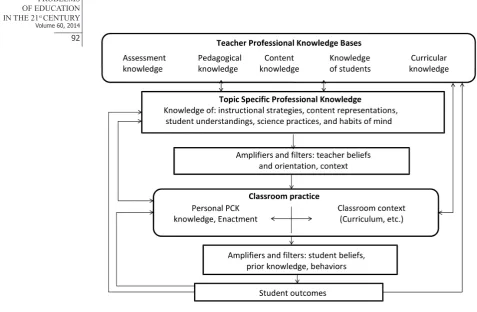
Figure 10: Consensus model of PCK from PCK Summit (Helms & Stokes, 2013; Gess-Newsome & Carlson, 2013).
In the PCK Summit model five main domains are defined for teachers profession: i)
knowledge of assessment; ii) pedagogical knowledge; iii) content knowledge; iv) knowledge of
students and v.) curricular knowledge. These five knowledge influences and are influenced by
the professional knowledge of a particular topic. this professional knowledge includes
knowl-edge of instructional strategies and representations of content, student understanding, scientific
practices and habits of mind.
This specific professional knowledge passes through filters and amplifiers, which are the
teachers’ beliefs, the context in which it is inserted and the orientations for teaching. after this
filter, this specific professional knowledge will be transformed and adapted during the class
-room practice transforming it in the personal PCK. Then, this knowledge passes through filters and amplifiers of students, taking into account their beliefs, prior knowledge and their behavior,
then to be assessed through student outcomes.
In this model seems to have a theoretical PCK (specific professional knowledge of the
topic) and a personal, idiosyncratic pcK, which manifests itself in the practice of the
class-room, and that this practice influences and is influenced by the knowledge base as by specific professional knowledge of the topic. Student outcomes, in turn, influence both personal PCK from classroom practice and the topic specific professional knowledge as the knowledge base.
It is through this relationship, where the practice of the classroom is influenced and influences the other knowledge that the model is built based on the action, in other words, the teacher is a reflective agent reflecting on their practice and reassesses it to achieve better results
with their students reconstructing and transforming your personal PCK, their specific profes
93 Access, Documentation and Analysis of Science Teachers’ PCK
the study of a teacher’s pcK is quite complex, because, among other things, to the fact it is a set of implicit knowledge, which should be explained in some way. thus, various ways have been proposed and evaluated to be sought to document and investigate the pcK of a teacher.
baxter and lederman (1999) conducted a compilation of research that sought to access the pcK of science teachers and proposed three groups according to the methodologies used to access the pcK: a) convergent and inferential techniques; b) the representations in the form
of conceptual maps, classification and pictorial cards; c) multimethod evaluations. Among the
convergent and inferential techniques stand out likert questionnaires and multiple choice tests. What these methods have in common is the fact that they use verbal descriptions predetermined about the desirable teacher knowledge as a criterion for comparison of the verbal responses of pre-service teachers and teachers. concept maps have been used to measure knowledge of structures represented by key concepts and the relationships between those terms. in activities with rating cards are requested the teacher to organize the cards in an order that best illustrates the relationships between the items contained in the cards. the use of likert questionnaires, concept maps and rating cards have been criticized for being too restrictive, because only par-ticular ideas are used and, as a consequence, the results provide just the way the subject sees the ideas presented by the researcher. (baxter, lederman, 1999)
in the area of science education, the instruments proposed by loughran et al. (loughran, berry, mulhall, 2004, 2006, 2008; loughran, milroy, berry, Gunstone, & mulhall, 2001) are very well known. they are named core - content representation and pap-ers - pedagogical and professional experience repertoires. the core is a tool that proposes research questions
about how the teacher selects the contents reflecting on strategies, methodologies and socio-economic and cultural aspects. The PaP-eR is a record of the lesson and reflection of what the
teacher believes to be necessary for effective learning.
in studies of pcK, the multimethod assessments are the most used, where a variety of
techniques - interviews, concept maps, video stimulated reflection, vignettes and other data
col-lection are used. in the analysis, triangulation of data from these multiple sources is performed
and a general profile of teachers’ PCK is inferred (Baxter, Lederman, 1999). Examples of re
-search in which this triangulation was used can be seen in recent papers and dissertations (sales, 2010; pereira & fernandez, 2013; montenegro, 2012; Girotto-Jr & fernandez, 2013; oliveira Jr, 2012; sharma, 2012).
Teacher Education, Development of PCK and the Teacher Education Curriculum
from the foregoing, it is noticed that in view of the recent work the shulmans ideas have been consolidated. according to acevedo (2009) each discipline has an educational dimension that is not separated from its contents, by which seems to be essential shift attention from the
more generic approaches toward more specific during the training of teachers, which means
emphasizing the importance the specific teaching courses in this training (e.g. Methods / Instru
-mentation for the teaching of chemistry).
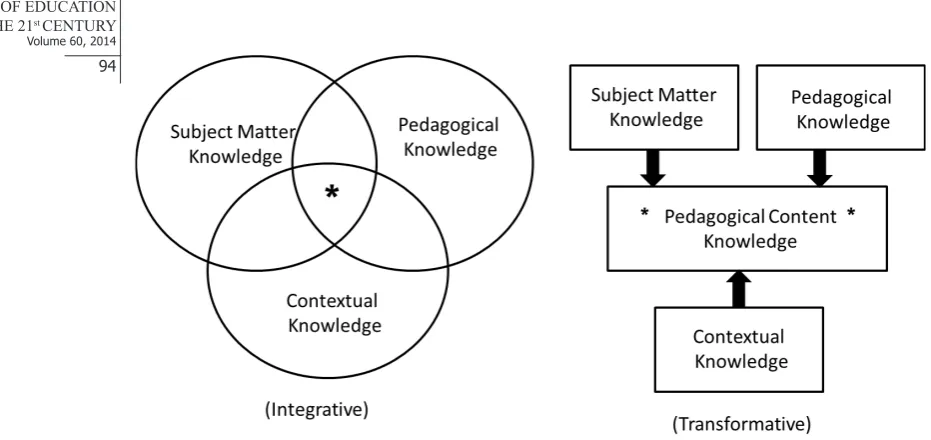
in an attempt to compile data from the literature, Gess-newsome (1999) proposes two theoretical models to explain the origin and development of pcK: the Integrative Model and
94
Figure 11: Two models of teacher knowledge (Integrative Model on the left and Transformative Model on the right; * = knowledge needed for class-room teaching.
from: Gess-newsome, 1999, p. 12.
the two models represent the extremes of a continuum. in the integrative model, the pcK does not exist as a domain of knowledge and knowledge of teachers would be explained by the intersection of three constructs – subject matter, pedagogy and context. teaching based on this view would be the act of integrating knowledge across these three areas (figure 11). at the other extreme the pcK would be the synthesis of all the knowledge necessary for the teach-er education. in this case, the pcK would be the transformation of subject mattteach-er knowledge, pedagogy and context knowledge to a distinct way - the only form of knowledge that would impact on teacher practice (transformative model, figure 11).
in integrative model knowledge may develop separately and then integrate in the teach-ing action while the transformative model is not so concerned with the development of these skills, but how to become pcK in teaching practice, such as a knowledge base for teaching. the difference between these two models can be explained by an illustrative analogy used by the author. it is the formation of a mixture vs. a chemical transformation which result from the act of two chemical substances is placed in contact in the same container. in the case of the mixture, the substances remain chemically distinct, although its visual impact is that of a full integration. the substances of the mixture can however be easily separated by physical methods. on the other hand, in the case of formation of a new product, or as a result of a chemical reaction, the starting substances cannot be separated, and the initial properties cease to exist.
thus, the integrative model would resemble a mixture while the transformative model, the initial knowledge base would be fully combined resulting in new knowledge, pcK. the author raises doubts whether the teachers’ knowledge would be as of the type of a mixture (in-tegrative model) or a compound (transformative model). this would bring important implica-tions to research and practice in terms of identifying and developing the teachers’ knowledge. empirical evidence shows, however, that the two models may occur, depending on the profes-sional’ moment of the teacher (Kind, 2009).
95 therefore, more empirical data are needed at different levels to understand how pcK development occurs and to base public policies on teacher education.
to nilsson (2008, 2009) both models are a good starting point for analyzing the curricula of teacher education, whether they are experienced teachers or beginners with some experience. these building models of pcK can help teacher educators to plan a curriculum driven to that complete training.
abell (2007, 2008) believes that science teachers’ educators should give explicit atten-tion to the individual components of pcK as a way to aid learning for novice teachers. barnett and hodson (2001) argue that experienced teachers have a more accessible, useful and orga-nized knowledge than novice teachers. for them, the beginners “access” knowledge of the con-cepts, procedures and strategies one by one, while experienced teachers use the most relevant knowledge in an integrated manner. thus, working with group discussion, where more and less experienced members discuss their own personal beliefs and practices and about the personal practices and beliefs of the other members would each understand the distinct characteristics of
the contexts in which they operate. Nilsson (2008) points out that reflection by the pre-service
teacher of their professional development becomes him conscious of their own learning. the practice provides experiences for undergraduates, but they also need the discussion of this
experience in seminars for their reflection. De Jong, Veal and Van Driel (2002) referring to the formative elements that would help build the PCK of undergraduates reaffirm the importance of
incorporating the teaching practice in the training process, along with discussion of articles on educational work, as alternative conceptions of students and how they reason. nilsson (2008)
also notes that the lack of experience of the classroom of undergraduates reflects in their PCK.
the author suggests that to stimulate the development of pcK these undergraduates, it is rea-sonable to recognize the knowledge by parts in order to improve the development of the whole. rollnick et al. (2008) argue that pcK should be inserted in teacher training, because if you can access the pcK and describe the professional practice of teachers, then it could be transferred to inexperienced teachers, and thus help them in their training.
to talanquer (2004) the difference between the experienced teacher and the novice teacher is, for example, in the fact that when choosing an activity, the novice teacher selects a book and follows the sequence proposed by the author. on the other hand the experienced teacher has a “look” for the book completely differently. according to the author, “[...] the task
demands that teachers reflect on the goals, purposes and philosophy of what to do in chemistry
in a given context – considering the level of intellectual development, prior knowledge, interest and motivations of their students”.
according to talanquer (2004), teacher training programs should collaborate to build the pcK of future teachers, opening spaces for the key pieces of the content to be taught are
subject to analysis and didactic and pedagogical discussion. [...] This type of reflection would
help student teachers develop their pcK as well as the critical capacity and analytical skills that allow them to design the classroom as a space exploration and continuing research.
like other disciplines, chemistry has its particularities that require consideration by the
teacher in the classroom. The teaching of science has documented a repertoire of students’ diffi
-culties in certain content. The chemistry experienced teacher need to consider these diffi-culties
in planning their teaching and adjust the chemical content to their students in a given context. for example, in balancing a chemical equation the novice teacher pays little attention to the type of problem used. in turn, the experienced teacher will make a careful selection, so that his/ her sequence presents examples of combinations of chemicals that exist in atomic and molecu-lar form, problems where there is an exchange of polyatomic ions, examples working balance
of mass and charge, etc. The experienced teacher will recognize the difficulty of students to
understand why the number of atoms, but not the molecules is conserved during a chemical
reaction and will be aware of this difficulty, selecting examples that put those ideas into con
-flict. Anyway, just analyzing the decisions that a chemistry teacher takes in his/her classroom
96 decisions are anchored in a content knowledge impregnated pedagogically that is embedded in the teacher initial education and expanded substantially in their experience of the classroom. (talanquer 2004)
Final Considerations
based on this brief overview of the literature on pcK and on their development, is it possible to observe some differences, but is also explicit its importance in terms of research to understand the professional development of teachers. once the pcK includes several key elements of the knowledge of teachers, it is the central model whose study is able to provide support for curriculum reforms in teacher education.
there is evidence that the pcK is a fruitful model that contributes to the understanding of the professional knowledge of teachers, systematizing empirical data and enables the docu-mentation and exchange of ideas on relevant knowledge to teaching practice. it is a complex concept, since it arises from various human interactions in different contexts.
in a relatively recent review article on the pcK Kind (2009) lists the different approach-es to understanding the pcK and points to two basic differencapproach-es in the conceptions of the au-thors in relation to the position of content knowledge, namely: i.) the knowledge of content is a knowledge base of teachers but would not be part of pcK; ii.) the content knowledge is part of what is called pedagogical content knowledge. in the original proposal of shulman (1987), con-tent knowledge was not included in pcK, but it was one of the seven basic knowledge of teach-ers. the models of Grossman (1990), magnusson, Kracjik & borko (1999), carlsen (1999), abell (2008) and the model of pcK summit follow that line, leaving the content knowledge external to pcK and belonging to base knowledge. other proposals differ from the original idea of shulman, incorporating content knowledge to pcK (fernandez-balboa, stiehl, 1995; Koballa, Gräber, coleman, Kemp, 1999; marks, 1990; cochran, deruiter, King, 1993; Veal, makinster, 1999; banks, leach, moon, 2005).
the pcK model originally presented by shulman included content representations,
stu-dents’ difficulties and instructional strategies. In addition, the Shulmans’ model was already highlighted the reflection process in the development of PCK. After Shulman models differ as
to what knowledge should be included in pcK and which should list the knowledge base.
As already mentioned above, a first distinction between the models refers to the fact
that content knowledge is part of the knowledge base or part of pcK. a second distinction is the inclusion of the knowledge of the assessment and if it is part of the base or part of the pcK. initial models from shulman and Grossman didn´t considered knowledge of assessment as a separated component. so, in this case, magnusson Kracjik & borko (1999) made a good contribution including this component. after these authors, other models consider assessment knowledge as an important component, even though they differed if is a component of the base knowledge or of the pcK.
some models, starting from the idea of Grossman, emphasize the role of context (carls-en, 1999), others emphasize the pedagogical knowledge (morine-dershimer & Kent, 1999).
the model of the pcK summit somehow revisits the initial model from shulman’s both in terms of pcK and in terms of base knowledge and incorporates new elements that were brought by other models presented. in the pcK summit model, the assessment knowledge, which had been ignored by shulman and Grossman, is incorporated into the knowledge base. in addition to this knowledge, appears as a base knowledge, agreeing with the initial idea shul-man, the knowledge of the curriculum (separate from pedagogical knowledge like in Gross-man’s model) and knowledge of students (separate from context as in Grossmans’). the pcK summit model still represents the development of pcK with the practice in the classroom and incorporates the role of the beliefs of teachers and students, while also taking into account the
filter of the context. Thus reaffirms the initial idea of Shulman and Grossman and replaces PCK
97 summit seems a improved model compared to other models by incorporating elements of previ-ous models and have made a remake of the original idea of shulman and Grossman.
regardless of the different interpretations, pcK currently has been considered the best theoretical framework to examine and understand the skills of teachers, systematizing empirical data and enables the documentation and exchange of ideas on relevant knowledge to teaching practice (fernandez, 2013). thus, the study of pcK of teachers in different professional mo-ments (initial training, trainees, beginners, experienced, pre- and in-service training, etc.) aims to provide bases for the training of teachers. if the professional practice of good teachers can be accessed and documented, can then be used as a starting point for inexperienced teachers and thus help them in their training. there is consensus that the training courses for teachers should have as an explicit goal the development of teachers’ pcK. his documentation and exploitation during the initial training can assist undergraduates in the process of becoming better
teach-ers as well as to assist experienced teachteach-ers to develop more reflective practices and thereby promote further development of their PCK. Thus, the central role of the reflective process in
the development of pcK should be a point to be considered in curriculum reform as well as the potential the pcK concept has for informing science teacher education.
but, on the other hand, since there are different ways of conceptualizing pcK and dif-ferent authors propose difdif-ferent models in which some skills are prioritized over others, it is important to be aware and present which model is being used in research related to pcK. the
lack of information may bring difficulties to the reader and can increase the amount of criticism
that has been made to this concept.
Aknowledgements
The author thanks the the financial support for the research group conducted by Brazilian
government agencies cnpq, capes and fapesp (process n. 13/07937-8).
References
abell, s. K. (2007). research on science teacher knowledge. Handbook of research on science education. p. 1105-1149.
abell, s.K. (2008). twenty years later: does pedagogical content knowledge remain a useful idea? Inter-national Journal of Science Education, 30 (10), 1405-1416.
acevedo, J. a. (2009). conocimiento didáctico del contenido para la enseñanza de la naturaleza de la ciencia (i): el marco teórico (pedagogical content Knowledge for teaching the nature of science (i): the theoretical framework). Revista Eureka sobre Enseñanza y Divulgación de las Ciencias, 6 (1), 21-46.
banks, f., leach, J., & moon, b. (2005). extract from “new understandings of teachers’pedagogic know-ledge”. Curriculum Journal, 16 (3), 331–340.
barnett, J., & hodson, d. (2001). pedagogical context Knowledge: toward a fuller understanding of what good science teachers know. Science Teacher Education, 84 (4), 426-453.
baxter, J. a., & lederman, n. G. (1999). assessment and measurement of pedagogical content ledge. in: Gess-newsome, J., & lederman, n. G. (eds.). Examining pedagogical content know-ledge: the construct and its implications for science education. dordrecht, the netherlands: Klu-wer academic publishers, 147-161.
brown, J. s., collins, a., & duguid, p. (1989). situated cognition and the culture of learning. Educational Researcher, 18, 32–42.
bucat, r. (2005). implications of chemistry education research for teaching practice: pedagogical content knowledge as a way forward. Chemistry Education International, 6 (1), 1–2.
calderhead, J. (1996). teachers: beliefs and knowledge. in d. c. berliner & r. c. calfee (eds.), Hand-book of educational psychology. new york: macmillan, 709–725.
98 clark, c., & peterson, p. l. (1986). teachers´ thought processes. in: m.c. Wittrock (ed.), Handbook of Research in Teaching, 3rd ed., new york: macmillan, 255-296.
cochran, f. K.; deruiter, J. a.; & King, r. a. (1993). pedagogical content knowing: an integrative mo-del for teacher preparation. Journal of Teacher Education, 44, 261–272.
connelly, f. m., & clandinin, d. J. (1985). personal practical knowledge and the modes of knowing: re-levance for teaching and learning. in: e. eisner (ed.), Learning and teaching the ways of knowing. chicago: university of chicago, 174–198.
de Jong, o., Veal, W. r., & Van driel, J. h. (2002). exploring chemistry teachers’ Knowledge base in: Gilberty, J.K.; de Jong, o.; Justi, r.; treagust, J.; Van driel, J. h Chemical Education: Towards Research-based Practice. the netherlands: Kluwer academic publishers, 369-390.
elbaz, f. (1983). Teacher thinking. A study of practical knowledge. londres: croomhelm. eraut, m. (1994). Developing professional knowledge and competence. london: falmer.
fenstermacher, G. d. (1994). the knower and the known: the nature of knowledge in research on tea-ching. Review of Research in Education, 20, 3-56.
fernandez, c. (2013). pcK - conhecimento pedagógico do conteúdo: perspectivas e possibilidades para a formação de professores (pcK - pedagogical content Knowledge: prospects and possibilities for teacher training. in: Viii encontro nacional de pesquisa em educação em ciências – en-pec, 2011, campinas, sp. Atas do VIII ENPEC – I CIEC 2011. rio de Janeiro, rJ: abraen-pec, 2013. v. 1. p. 1-12. retrieve 3/05/2014, from: http://www.nutes.ufrj.br/abrapec/viiienpec/resu-mos/r0370-1.pdf.
fernández-balboa, J. m., & stiehl, J. (1995). the generic nature of pedagogical content knowledge among college professors. Teaching and Teacher Education, 11 (3), 293–306.
freire, p. (1985). Pedagogia do Oprimido (Pedagogy of the Oppressed). rio de Janeiro: ed. paz e terra, 256p.
freire, p. (1996). Pedagogia da autonomia: saberes necessários à prática educativa (Pedagogy of autono-my: knowledge necessary for educational practice). são paulo: paz e terra.
friedrichsen, p., Van driel, J. h., & abell, s. K. (2010). taking a closer look at science teaching orienta-tions. Science Education, 358-376.
Gauthier, c. (1998). Por uma teoria da pedagogia: pesquisas contemporâneas sobre o saber (For a theory of pedagogy: contemporary research on knowledge), 1998. unijui: ed. da uniJui.
newsome, J. (1999). pedagogical content knowledge: an introduction and orientation. in: Gess-newsome, J.; lederman, n.G. (eds.) Examining Pedagogical Content Knowledge, dordrecht, the netherlands: Kluwer academic publishers, 3-17.
Gess-Newsome, J., & Carlson J. (2013). The PCK summit consen sus model and definition of pedagogi -cal content knowl edge. in: the symposium “reports from the pedagogi-cal content Knowledge (pcK) summit, esera conference 2013, september, 2013.
Girotto, Jr. G., & fernandez, c. (2013). following early career chemistry teachers: the development of pedagogical content Knowledge from pre-service to a professional teacher. Problems of Educa-tion in the 21st Century, 55, 57-73.
Grossman, p. l. (1990). The making of a teacher: teacher knowledge and teacher education. new york: teachers college press.
Grossman, p. l. (1994). teacher knowledge. in: husen, t.; postlethwaite, t. n. (eds.), The international encyclopedia of education (2nd ed.). london: pergamon press.
helmes, J., & stokes, l. (2013). a meeting of minds around pedagogical content Knowledge:
desi-gning an international PCK summit for professional, community, and field development. Retrieve
8/05/2014, from:
http://www.inverness-research.org/reports/2013-05_rpt-pcK-summit-eval-final_03-2013.pdf.
henze, i., Van driel. J., & Verloop, n. (2007). science teachers’ knowledge about teaching models and modelling in the context of a new syllabus on public understanding of science. Research in Sci-ence Education, 37, 99–122.
Kind, V. (2009). pedagogical content knowledge in science education: perspectives and potential for progress. Studies in Science Education, 45 (2), 169-204.
Koballa, t. r., Gräber, W., coleman, d., & Kemp, a. c. (1999). prospective teachers’ conceptions of the knowledge base for teaching chemistry at the gymnasium. Journal of Science Teacher Education, 10 (4), 269–286.
Marks, R. (1990). Pedagogical content knowledge: From a mathematical case to a modified conception.
99 magnusson, s., Krajick, J., & borko, h. (1999). nature, sources, and development of pedagogical content
knowledge for science teaching. in: Gess-newsome, J.; lederman, n. G. (org.), Examining ped-agogical content knowledge: the construct and its implications for science education dordrecht: Kluwer academic publishers, 95-132.
loughran, J., milroy, p., berry, a., Gunstone, r.; & mulhall, p. (2001). documenting science teachers‘ pedagogical content knowledge through papers. Research in Science Education, 31 (2), 289-307.
loughran, J., mulhall, p., & berry, a. (2004). in search of pedagogical content knowledge in science: developing ways of articulating and documenting professional practice. Journal of Research in Science Teaching, 41 (4), 370-391.
loughran, J. J., berry, a., & mulhall, p. (2006). Understanding and developing science teachers‘ pedago-gical content knowledge. rotterdam, the netherlands: sense publishers.
loughran, J., mulhall, p., & berry, a. (2008). exploring pedagogical content knowledge in science tea-cher education. International Journal of Science Education, 30 (10), 1301-1320.
magnusson, s.; Krajcik, J.; & borko, h. (1999). nature, sources and development of pedagogical con-tent knowledge for science teaching. in J. Gess-newsome; n. G. lederman (eds.), Examining pedagogical content knowledge: the construct and its implications for science education, boston: Kluwer, 95-132.
montenegro, V. l. s. (2011). Processo reflexivo e o desenvolvimento do Conhecimento Pedagógico do Conteúdo: análise a partir de uma intervenção na formação contínua de professores de quími-ca (Reflective process and Pedagogical Content Knowledge development: analysis from an in-service chemistry teacher workshop). 2011, 270f. dissertação (mestrado em ensino de ciên-cias) - instituto de física, instituto de Química, instituto de biociências, faculdade de educação, universidade de são paulo, são paulo. retrieved 3/05/2014, from http://www.teses.usp.br/teses/ disponiveis/81/81132/tde-14062012-115507/pt-br.php
montero, l. (2001). la construción del conocimiento en la enseñanza. in: marcelo, c. (ed.) La función docente (The teaching role). madrid: ed. síntesis, 47-83.
morine-dershimer, G., & Kent, t. (1999). the complex nature and sources of teachers´ pedagogical knowledge. in: Gess-newsome, J.; lederman, n.G. (eds.) Examining Pedagogical Content Knowledge, dordrecht, the netherlands: Kluwer academic publishers, p. 21-50.
nilsson, p. (2008). teaching for understanding: the complex nature of pedagogical content knowledge in pre-service education. International Journal of Science Education, 30 (10), 1281-1299.
nilsson, p. (2009). from lesson plan to new comprehension: exploring student teachers’ pedagogical reasoning in learning about teaching. European Journal of Teacher Education, 32, 239–258. oliveira-Jr., m. m. (2011). Flashes das disciplinas de formação inicial no repertório profissional de licen
-ciandos em química. (Flashes of initial training courses in professional repertoire of pre-service chemistry teachers) 2011, 194 f. dissertação (mestrado em ensino de ciências) - instituto de fí-sica, instituto de Química, instituto de biociências, faculdade de educação, universidade de são paulo, são paulo. retrieved 2/06/2014, from http://www.teses.usp.br/teses/disponiveis/81/81132/ tde-30052012-145050/pt-br.php
park, s., & oliver, s. (2008). revisiting the conceptualization of pedagogical content knowledge (pcK): pcK as a conceptual tool to understand teachers as professionals. Research in Science Education, 38, 261-284.
pereira, p. G. e. m., fernandez, c. (2013). indícios do modelo integrativo no desenvolvimento do pcK em licenciandos em química durante o estágio supervisionado. (evidence of pedagogical content Knowledge in chemistry student teachers during pre-service training) Revista de Educación de las Ciencias, 14, 74-78.
pimenta, s. G. (org). (1997). Saberes pedagógicos e atividade docente (Pedagogical knowledge and tea-ching activity). 6ª ed. são paulo: cortez, 2008, 248p.
putnam, r., & borko, h. (1997). teacher learning: implications of new views of cognition. in: biddle, b.; Good, t.; Goodson, i. International Handbook of Teachers and Teaching. dordrecht, Kluwer academic publishers, 1223-1296.
100 salazar, s. f. (2005). el conocimiento pedagógico del contenido como categoría de estudio de la forma-ción docente (the pedagogical content knowledge as a category of study of teacher education). Actualidades investigativas en educación, 5 (2). retrieved 2/06/2014 from: http://revista.inie.ucr. ac.cr/
sales, m. G. p. (2010). Investigando o conhecimento pedagógico do conteúdo sobre “soluções” de uma professora de Química (Inquiring the pedagogical content knowledge about “solutions” of a chemistry teacher). 2010, 253 f. dissertação (mestrado em ensino de ciências) instituto de físi-ca, instituto de Químifísi-ca, instituto de biociências, faculdade de educação, universidade de são paulo, são paulo. retrieved 3/06/2014, from http://www.teses.usp.br/teses/disponiveis/81/81132/ tde-21022011-155615/pt-br.php
shimahara, n. K. (1998). the Japanese model of professional development: teaching as craft. Teaching and Teacher Education, 14, 451–462.
schön, d. a. (1992). La formación de professionals reflexivos. hacia un nuevo diseño de la enseñanza y el aprendizaje en las profesiones (The formation of reflective professionals). barcelona: paidós/ mec, 1992.
shulman, l. s. (1986). those who understand: knowledge growth in teaching. Educational Researcher, 15 (4), 4-14.
shulman, l. s. (1987). Knowledge and teaching: foundations of a new reform. Harvard Educational Review, 57 (1), p. 1-22.
shulman, l. s., sykes, G. (1986). a national board for teaching? in search of a bold standard. a report for the task force on teaching as a profession. carnegie corporation, new york.
silva, a. n. (2012). Um professor de Química e dois contextos escolares: o conhecimento pedagógico do conteúdo em ação (A chemistry teacher and two scholar contexts: the pedagogical content knowledge in action). 154f. dissertação (mestrado) apresentada ao instituto de física, instituto de Química, instituto de biociências e à faculdade de educação, universidade de são paulo, são paulo, retrieved 3/06/2014, from http://www.teses.usp.br/teses/disponiveis/81/81132/tde-25022013-132509/pt-br.php
talanquer, V. (2004). formación docente: Qué conocimiento distingue a los buenos maestros de química? (teacher training: What knowledge distinguishes good teachers of chemistry?) Revista Educación Química, 15 (1), 60-66.
tamir, p. (1988). subject matter and related pedagogical knowledge in teacher education. Teaching and Teacher Education, 4 (2), 99-110.
tardif, m. (2002). Saberes docentes e formação profissional (Teacher Knowledge and training teachers). 12ª ed., petrópolis (sp): Vozes.
Veal, W. r., & makinster, J. G. (1998). pedagogical content knowledge taxonomies. Electronic Journal of Science Education, retrieved 3/04/2012, from http://unr.edu/homepage/crowther/ejse/vealmak. html
Verloop, n., Van driel, J., & meijer, p. (2001). teacher knowledge and the knowledge base of teaching. International Journal of Educational Research, 35, 441–461.
Wilson, s. m., shulman, l. s., & richert, a. e. (1987). 150 different ways of knowing: representations of knowledge in teaching. in: calderhead, J. (ed.) Exploring teachers´ thinking. london: cassell educational.
Advised by Laima Railienė, University of Šiauliai, Lithuania
received: April 17, 2014 accepted: June 25, 2014
Carmen Fernandez PhD., Assistant Professor, Chemistr� Institute, Department of Chemistr�, Universit� of São Paulo, Av. Prof. Lineu Prestes 748 05508-000 São Paulo, Brazil.
E-mail: [email protected]