Lasya et al. World Journal of Engineering Research and Technology
ENERGY OPTIMIZATION IN WSN USING CHANNEL CODING
B. Lasya Sri1* and L. Nirmala Devi2
1
Deputy Manager, HAL, Hyderabad, India.
2
Associate Professor, Dept of E.C.E, OUCE, Osmania University, India.
Article Received on 14/11/2017 Article Revised on 05/12/2017 Article Accepted on 25/12/2017
ABSTRACT
The Wireless Sensor networks are highly distributed networks of small,
lightweight wireless nodes, deployed in large numbers to monitor the
physical or environmental conditions. The major challenges of WSN
arerobust, reliability and power consumption Source of Power supply used in sensor nodes
are often battery powered. Hence a frequent requirement for charging of battery or sometimes
replacement of sensor nodes itself is necessary. For maximizing the lifetime of sensor node,
Optimization[5] of power consumption plays an important role. Error correction codes (ECC)
is an efficient method implemented to optimize the transmitted power. In this paper a
systematic approach for selection of suitable error correction codes for wireless sensor
networks is followed. Coding gain of ECC results in energy conservation during
transmission. Suitable Error correction code will be chosen based on the trade off in
performance between BER (Bit Error Rate) and power consumption.
KEYWORDS: Turbo codes, processing, decoding, algorithm.
INTRODUCTION
The tremendous usage of wireless sensor networks in recent years is due to the recent
advances of wireless communication systems, signal processing and high speed processors
and light weight advanced sensor nodes. Each node of Wireless sensor network consists of
three subsystems: the sensor subsystem which senses the environment, the processing
subsystem which performs local computations on the sensed data, and the communication
subsystem which is responsible for message exchange with neighbouring sensor nodes.
wjert, 2018, Vol. 4, Issue 1, 279-288.
World Journal of Engineering Research and Technology
WJERT
www.wjert.org
ISSN 2454-695X
Review Article
SJIF Impact Factor: 4.326
*Corresponding Author
B. Lasya Sri
Deputy Manager, HAL,
Lasya et al. World Journal of Engineering Research and Technology
Due to recent advances in micro-electro mechanical systems (MEMS) technology, the
various miniaturized sensors are designed. Sensor nodes operate indifferent modes like
transmit mode, receive mode, idle mode and sleep mode.Each sensor is responsible for
sensing of physical parameters such as temperature, pressure, or relative humidity and
converting into respective voltage or current. However the major challenge of WSN is the
power consumption of the sensor nodes which affects the lifetime of the sensor node. This
results in periodic charging or replacement of the battery which is hectic in case of WSN as
the nodes will be placed in remote areas in most of the applications. The data collected can be
sent regularly over the network to automated monitoring systems. The power consumed
during sensing and processing is far less than the consumption during transferring of data to
nearby nodes or destination. The power consumption during Receive mode is also
comparatively less.
Fading and Random noise induced by the Channel may result in corruption of data being sent.
On receipt of the corrupted data receiver requests for the retransmission through negative
acknowledge (NACK) which results wastage of energy.[3] So to avoid the data corruption in
the channel, it is preferred for channel coding through Error control codes. Error control
codes are one of the methodfor minimizing the power consumption in wireless sensor
network. Error control codes are classified into Forward Error correction codes (FEC) and
Backward Error correction codes. Most commonly used FEC codes are Block codes and
Convolutional codes. So by using the suitable channel coding techniques, channel errors can
be avoided thereby reducing the Transmission energy.[1]
In block codes the encoder of a block code divides the information sequence into message
blocks of k information bits each, called message block. Hence, there are total 2k different
possible messages. Then the encoder converts each message block into code word of size of
length n.
Examples of block codes are Hamming codes, Golay codes, etc
Convolution codes are widely used in practice, with several hardware implementations
available for encoding and decoding as they use memory registers. Convolution codes often
operate on continuous streams of symbols not partitioned into discrete message blocks. These
codes accept k new symbols each time step and produce n new symbols. Convolution codes
uses complex decoders which require high power consumption. Turbo codes have very long
Lasya et al. World Journal of Engineering Research and Technology
are also known as hybrid codes.Further, decoding is done at base station for Turbo codes,
energy conservation is very less.
However, in case of Back ward error correction there is a requirement of retransmission for
the corrupted data through Automatic Repeat request (ARQ) for the negative acknowledge
(NACK). Hence, retransmission leads to the more energy requirement.
Coding For Wireless Channels
Error correction codes provide the capability for bit errors introduced by transmission of
modulated signal through a wireless channel to be either detected or corrected by a decoder in
the receiver.Channel coding can significantly reduce the power required to achieve a given
BER. Conventional error control codes use block or convolution code designs: the error
correction capability of these codes is obtained at the expense of an increased signal
bandwidth or a lower data rate. Trellis codes use a joint design of the channel code and
modulation to provide good error correction without any bandwith or rate penalty. Turbo
codes and the more general family of codes on graphs minimize transmit power, but the
associated processing complexity may compromise these power gains. All of these codes can
also be designed for fading channels to limit required energy.
FEC codes are classified intoBlock codes and Convolutional codes
A block code is called a linear code when the mapping of the k information bits to the n
codeword symbols is a linear mapping. An (n,k) block code is linear if the 2k length-n
codewords of the code form a subspace of Bn. Thus, if Ci and Cj are two codewords in an
(n,k) linear block code, then Ci + Cj must form another code word of the code.
Cyclic codes are a subclass of linear block codes where all codewords in a given code are
cyclic shifts of one another. The cyclic nature of cyclic codes creates a nice structure that
allows their encoding and decoding functions to be of much lower complexity than the matrix
multiplications associated with encoding and decoding for general linear block codes. Thus,
most linear block codes used in practice are cyclic codes.
A convolutional code generates coded symbols by passing the information bits through a
linear finite-state shift register. The shift register consists of K stages with k bits per stage.
There are n binary addition operators with inputs taken from all K stages: these operators
Lasya et al. World Journal of Engineering Research and Technology
In this paper, we analyze four codes: RS code, hamming codes, golay code and turbo codes. The most common type of block code is a Hamming code, which is parameterized by an
integer m≥2. For an (n,k) Hamming code, n = 2m-1, and k=2m-m-1, so n-k=m redundant bits
are introduced by the code. The minimum distance of all Hamming code is dmin=3, so t=1
error in the n = 2m-1 codeword symbols can be corrected. Although Hamming codes are not
very powerful, they are perfect codes with the error probability.
………. Eq (1)
Golay and extended Golay codes are another class of channel codes with good performance.
The Golay code is a linear (23,12) code with dmin = 7 and t=3. The extended Golay code is
obtained by adding a single parity bit to the Golay code, resulting in a (24,12) block code
with dmin = 8 and t = 3.The extra parity bit does not change the error correction capability
since t remains the same, but it greatly simplifies implementation since the information bit
rate one half the coded bit rate.
The most common nonbinary block code is Reed Solman (RS) code, they have the similar
properties as the binary codes. RS codes achieve minimum distance of dmin = N-K+1, which
is the largest possible minimum distance between codewords for any linear code with the
same encoder input and output block lengths. Probability of symbol error associated with the
non binary code is upper bounded by.
………. Eq (2)
Similar to the form for the binary code The probability of bit error is then.
………. Eq (3)
Another powerful class of block codes is the BCH codes. These codes are cyclic codes, and
typically outer perform all other block codes with the same n and k at moderate to high SNRs.
Designing an error correction code is always a tradeoff between energy and band-width
efficiency. More errors arecorrected by using lower rate codes the system operates with a
Lasya et al. World Journal of Engineering Research and Technology
But the lower code rate codes have excess of overhead and thus there is large bandwidth
consumption. It also increases the decoding complexity.
Convolution codes are said to have memory since thecurrent codeword depends on more
input bits (kK) than the number input to the encoder to generate it (k). There are multiple
ways to characterize convolutional codes, including atree diagram, state diagram, and trellis
diagram. The tree diagram represents the encoder in the formof a tree where each branch
represents a different encoder state and the corresponding encoder output.A state diagram is a
graph showing the different states of the encoder and the possible state transitions and
corresponding encoder outputs. A trellis diagram uses the fact that the tree representation
repeatsitself once the number of stages in the tree exceeds the constraint length of the code.
Viterbi Algorithm[2] is used for decoding of Convolution code.
However, similar to the block codes, Convolution codes are not able to correct the block
errors. Hence, a convolutional interleaver, is designed to spread out burst errors but it delays
the transmission through the channel.
Concatenated codes may have the inner and outer codes separated by an interleaver to break
up block errors introduced by the channel. Concatenated codes typically achieve very low
error probability with less complexity than a single code with the same error probability
performance. A common concatenated code has a convolutional inner code and a Reed
Soloman (block) outer code.
However, the maximum-likelihood decoder for a concatenated code, which performs joint
decoding, is highly complex. It was discovered that a near-optimal decoder for concatanated
codes can be obtained based on iterative decoding, and that is the basic premise behind turbo
codes.
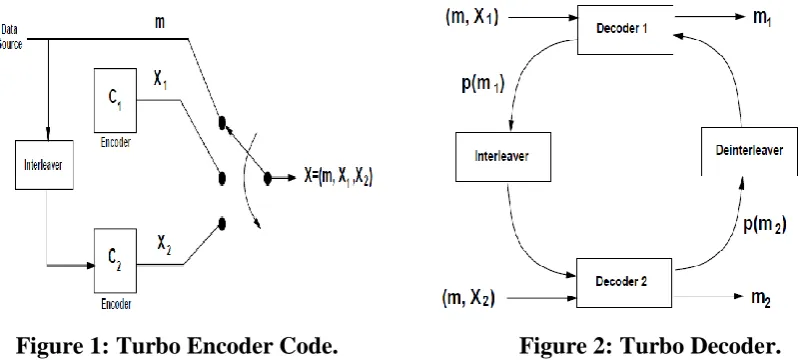
Turbo codes[4] are the more general family of codes on graphs with iterative decoding
algorithms. Turbo codes consist of two key components: parallel concatenated encoding and
iterative, “turbo” decoding. Parallel concatenated encoder consists of two parallel
convolutional encoders separated by an interleaver, with the input to the channel being the
data bits m along with the parity bits X1 and X2 output from each of the encoders in response
Lasya et al. World Journal of Engineering Research and Technology
Figure 1: Turbo Encoder Code. Figure 2: Turbo Decoder.
Iterative or “turbo” decoding exploits the component-code substructure of the turbo encoder
by associating a component decoder with each of the component encoders. More specifically,
each decoder performs soft input/soft output decoding.
Optimal Code Selection
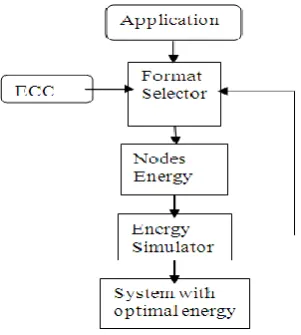
In this paper, we select the optimal code among different Error correction codes (ECC). The
code selection depends on the sensor network constraints of network size, environmental
conditions of application, type of channel and also modulation techniques used. In this type
of modulation and the optimal ECC of the specified application attains 50% of energy. For
every application it is considered a maximum BER for the better QOS. To reduce the BER, it
is preferred to use the Error control codes. Energy minimization also obtained with coding
gain of ECC. Hence, along with the type of modulation, ECC also selected in the format
selector To obtain the optimum energy of the network, first we calculate the node energy and
the energy consumed by the network in the simulation block repeatedly until the optimal
ECC is selected. Accordingly, life time of the network will be improved.
In this paper, for additive white Gaussian channel noise (AWGN) channels using BPSK
Lasya et al. World Journal of Engineering Research and Technology
Figure 3: Optimal Code Selection.
Sensor Node energy calculation
Two types of energy models used for calculating energy consumption are Radio energy
model and Computation energy model.
Radio energy model: this model focuses on energy consumed by the circuit and the transmitting modulated signal.
The radio energy per bit in transmitting N number of bits is given as
………. Eq (4)
Where,
: power consumed while transmitting the signal.
: power consumed by the circuit.
: duration for which the transceiver is ON
The signal transmission power requirement is given by
………. Eq (5)
Whereℷ is the wavelength; d is the distance; n is the path loss componet; Precis the power received; Grais the gain of the receiver antenna and Gtais the gain of the transmitter antenna.
The power consumed by total circuit is given by
Lasya et al. World Journal of Engineering Research and Technology
Computation energy model: Energy consumed with the encoding and decoding process of ECC.
Let is the Energy consumed during encoding
& is the Energy consumed during encoding
Then Computational energy per bit is given by
………. Eq (7)
Hence, addition of computation energy model and radio energy model gives the Sensor node
energy per bit. That is Node Energy Enodeenergy
………. Eq (8)
Energy of the Network
In the Turbo codes Transmitter Energy will be reduced by increasing the decoder complexity
and the decoding is considered at the base station where enough energy is available.
Hence, overall sensor network energy is given by
ETNE = Eencoder + ETR+ ERR ………. Eq (9)
Where ETNE is the total energy of the network;
Eencoder is the encoding energy of the node;
ETR is thetransmitting energy of all the sensor nodes
ERR is the receiving energy of all the nodes.
If M is the total number of bits that has been transmitted and
Etr is the Eenergy consumed for a single bit transmission from thenode,
Erris the energy consumed for a single bit reception by the node.
Then,
………. Eq (10)
Simulation Environment
Sensor node energy as well as wireless sensor network energy consumption are calculated
Lasya et al. World Journal of Engineering Research and Technology
evaluated using NS2. NS2 is also used to runthe large scale experiments which are difficult
to implement in real case. It uses OTcl interpreter as the front end and simulator is written in
C++.For various error correction codes Performance evaluation of BER to SNR is obtained
using MATLAB and is shown in graphs below.Based on the application and required power
consumption as well as the required BER suitable Error Correction code is chosen.
Sensor node and sensor network energy consumption simulation parameters are shown in the
table below:
Table 1: Simulation parameters.
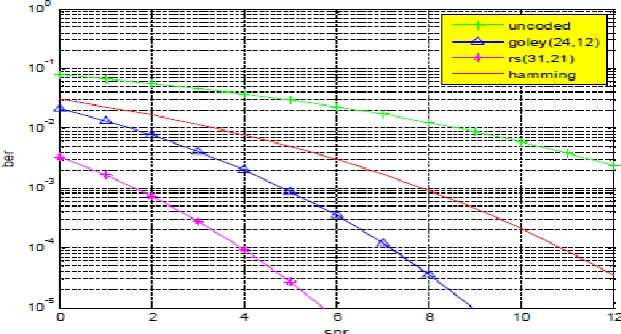
Following graph shows the comparision for uncoded system with coded system of various
ECCs: In fig 4. performance of various ECCs in terms of bit error rate for hamming codes,
extended Golaycodes and Reed Solomon codes is shown. It indicates that compared to the
Hamming and Golay codes, RS codes are performing better. Coding gain of Hamming code
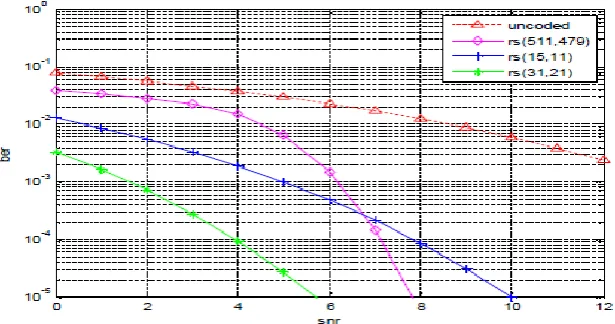
is 1.4dB. In fig 5. for various code rates, the RS codes performance evaluation was simulated.
However, the problem of energy consumption by coding gain is resolved by Turbo codes that
saves the transmitter’s energy.
Lasya et al. World Journal of Engineering Research and Technology
Figure 5: Performance Evaluation of RS Codes.
CONCLUSION
Power consumption is one of the major constraints in the wireless sensor network. The sensor
nodes are located in the areas where it is difficult to replace and WSN is powered by battery.
Hence, it is preferred the minimum power utilization. To achieve this ECC is preferred using
coding gain. Out of these ECC techniques Turbo code is preferred, since Turbo codes
decoding is done at Base station where there is availability of enough energy which achieves
power conservation.
REFERENCES
1. “Analysis and optimization of energy of sensor node using ACO in wireless sensor
network” – ICACTA- by Rajevv Arya, S.C. Sharma, 2015.
2. “Comparison on energy-efficient cluster based routing algorithms in wireless sensor
network” – The Third Information Systems International Conference by Shahrzad
Dehghania, Mohammad Pourzaferanib, Behrang Barekatain.
3. “Nanonetwork Minimum Energy coding” - 2014 IEEE 11th Intl Conf on Ubiquitous
Intelligence & Computing and IEEE 11th Intl Conf on Autonomic & Trusted Computing
and 2014 IEEE 14th Intl Conf on Scalable Computing and Communications and Its
Associated Workshops by Muhammad Agus Zainuddin, Eugen Dedu, Julien Bourgeois,
2014.
4. Käsper, “Turbo Codes http:// users.tkk.fi/~pat/coding/essays/turbo.pdf .
5. Optimization of Wireless Sensor Network Using Network Coding Algorithm – ICN The
Twelfth International Conference on Networks by J´essica Bartholdy Sanson, Natanael R.