Oyeleye et al. World Journal of Engineering Research and Technology
AN EXPLORATORY STUDY OF ROBOTICS AND THEIR
IMPLICATIONS TO THE KNOWLEDGE-BASED SOCIETY
1
*Oyeleye Christopher Akinwale, 1Egbetola Funmilola Ikeolu, 1Akinpelu James Abiodun, 2Oloyede Ayodele and 1Sijuade Adeyemi Adeyeye
1
Department of Computer Science and Engineering, Ladoke Akintola University of
Technology, Ogbomoso, Nigeria.
2
Department of Computer Science, Caleb University, Imota, Lagos, Nigeria.
Article Received on 23/05/2018 Article Revised on 13/06/2018 Article Accepted on 04/07/2018
ABSTRACT
Robotics is a branch of engineering that involves the conception,
design, manufacture and operation of robots. There is currently a
strong consensus in the knowledge world of an emerging robotic
society in which almost all activities of human sphere are being
automated for seamless control and management by robots. These vary
from caring for the sick, driving a car, making love to securing
people‟s lives among others. However, in order to allow for a common
understanding of robotics and help evaluate the impact of robotic science to knowledge
society, there is a need to exhaustively investigate the implications of robotic science to the
knowledge-based society. In this paper, an exploratory review of robotics and their
implications to the knowledge-based society in the areas of health, security and entertainment
are discussed. The features and architecture of some existing robots in the aforementioned
areas are also presented. The paper was concluded by discussing ethical issues and negative
effects of robotic science to the society.
KEYWORDS: Robotics, Knowledge-based-society, Ethical-issues.
1. INTRODUCTION
There is a growing notion that our society is entering a „robot society‟ (VanEst and Kools,
2015). Robotics is now being used in multiple applications and automated systems. Needful
World Journal of Engineering Research and Technology
WJERT
www.wjert.org
SJIF Impact Factor: 5.218*Corresponding Author Oyeleye Christopher
Akinwale
to mention that one of the major problems of robotics is its human-robot interaction.
Human-robot interaction is understood as a generic field where classical human-machine interaction
elements like communications with machines, intermediation between human and objects,
need for anticipation and simulations among others can be included (Santis, Siciliano,
De-Luca and Bicchi, 2008). That means, system integrators, robot manufacturers and companies
are increasingly aware of the need to consider social aspects and this does not only refer to
ergonomic or safety issues but basically refers to new qualification needs, new technical
competences in communication and decision processes within work processes. All these
issues are key aspects that need to be considered when reflecting on system development in
the working relation between humans and robots. Despite attempts and the research work
done by robot researchers to emulate human intelligence and appearance, the result is not
achieved. Most robots still cannot see and are not versatile. For the effective and proper
mechanism of robotics technology, it is important to prioritize the inefficiency associated in
it. The use of robots in performing various jobs will lead to reduction of jobs of the human
being, and as such, the initiation should be done systematically. The development of robots is
expected to lessen many high-end precision jobs in various sectors like agriculture, military,
health and so on.
Robotics has always inspired the vision of autonomous entities that would create a seismic
shift in economic productivity, increasing it without obvious limit by providing labour at
minimal cost. While at one extreme, this could make everyone rich, at the other, it could
result into massive unemployment and associated poverty (Gary and Daniel, 2014).
Evidently, there is a successful track record in industrial robots, the first robotics area to
make significant inroads into society. More recently, robotic airplanes and other military
robots have also become increasingly important. Hence, service robotics is becoming a major
emerging focus of robotics research to successfully drive technical advances and commercial
growth (IFR, 2012); consequently, the promotion of innovation in service robotics.
Innovations in this area can be accelerated enough to have a sizeable economic benefit. Consistent with this, one‟s goal is to spur innovation in the area of robot-human cooperation
or co-robotics. Be as it may, the need to establish a common understanding of the emerging
robotic science, its implication to the knowledge society, ethics and negative effects cannot
be over-emphasized. This will establish a common understanding of the fundamentals of
most existing robotic systems and establish the current successes vis-à-vis the challenges
paper is as follows: section two discusses robotics, its sub-systems, and its integration into the
knowledge society; section three discusses the applications of robotic science to the
knowledge-based society in the areas of health, security and entertainment; section four
discusses the ethics and negative effects of robotic science to the society while section five is
the conclusion and future works.
2. Robotics
Robotics is a branch of engineering that involves the conception, design, manufacture and
operation of robots (Rouse, 2006). Indeed, robotic technology deals with anything dealing
with robots. In basic words, robotic technology is the science and study of robots. It starts
with the design and ends with the manufacturing of robots. The word robots comes from the Czech word „robota‟ which means „forced word or labour‟ (Edger, 2014). Robots are
machines, made by humans, that perform actions that otherwise are done by humans. Robots
do tasks either automatically or via a controller that controls every movement in high
precision. Robotic technology is a new field of technology and it mostly includes the creation
of robots, specifically for the use of production in factories. It also includes the creation of
artificial intelligence which its main purpose is to mimic the intelligence of a human.
According to Thomas (2013), workers today are not being replaced by other competitive
humans, or low-cost labour from other countries, but instead humans are being replaced by
machines. It is obvious that there has been a rise in robotics technology and many companies
today are using these automated machines to do the job that humans used to do.
Robotics do not only concern factory applications, but also its use in a more complex and
unstructured outside world including the automation of numerous human activities, such as
caring for the sick, driving a car, making love and killing people (Lambèr, 2015). The
military sector and the car industry are particularly strong drivers behind the development of
this new information technology. The car industry took the lead with the introduction of the
industrial robot as well as with the robotization of cars leading to intelligent driverless cars
used in adverse environments. The military, especially in the United States, stood at the
forefront of artificial intelligence development, and now artificial intelligence is driven by
computers and the Internet (Rinie, 2015). More precisely, robotics make use of the existing
ICT infrastructures and also implies a continued technological evolution of these networks.
Through robotics, the internet has gained, as it were, „senses and hands and feet‟ (Singer,
pleasant, but it also raises countless difficult societal and ethical issues. The debate on the
application of robotics to distant battlegrounds is very current, while the application of care
robots is just appearing on the horizon.
2.1 Robotics Sub-systems
The robotics sub-systems are made up of actuators and transmission systems. These include
solenoid, motor drive, pneumatic and hydraulic system which allows the robot to move.
Mechanics parts are motors which usually rotate and a mechanism to transfer motion to all
the necessary parts of a robot to create the motion that is required. Usually, robots require a
power supply but depends on what a robot is required to do. For a mobile robot, the size of
battery is to be decided besides the efficiency since power supply will be in the board of
robot, but if it is not mobile robot then electricity can be fed through a supply cable
(Shakhatreh, 2011; Bishop, 1995). Power storage system is battery or some other electronic
devices. In addition, sensors can be internal or external. The sensors in a robot are considered
as the senses in a robot while micro-controller and processors are the brain that controls the
whole system (Ijspeert, Nakanishi and Schaal, 2001). Moreover, algorithms and software
must be created at either higher or low level as it may be required to run the robot in a desired
way (Shakhatreh, 2011; Robert, 2006; Vapnik, Golowich, and Smola, 1996). More closely,
the sub-systems are discussed as follows:
a. Actuators: Actuators are essentially the prime movers providing linear force and motion.
b. Power supplies (PWM amplifiers): is a device for increasing or decreasing the electrical power voltage and ampere. To be able to increase the velocity of the motor drive, the
voltage and ampere through chart meter power supply amplifiers must be increased.
c. Power generation and storage system: Solar cells are working on the moon or in space using a renewable energy like the sun light. Fuel cells are used in a big heavy robot so a
diesel engine is required and fuel to run it, these engines‟ power is based on hydrogen and
oxygen burning. Rechargeable cells are more in use nowadays due to the technology
advancements ensuring that rechargeable cells contain quite a lot of energy.
d. Sensors
i. Simple switch sensors: are used to turn on and off the whole cycle or some part of the cycle (Shakhatreh, 2011).
work pieces. There are different models with different applications for example variable
force control, load and compression sensing, pumps, contact sensing, weighing and
household appliances.
iii. Gyroscopes: is a device for measuring and maintaining orientation, based on the principles of momentum. In essence, a mechanical gyroscope is a spinning wheel or disc
whose axle is free to take any orientation. Although, this orientation does not remain
fixed, it changes in response to an external torque much less and in a different direction
than it would without the large angular momentum associated with the disk's high rate of
spin and moment.
iv. Potentiometer: has the same task like encoder but uses different method for measuring degree of rotation. It converts the analogue voltage value from 0 - 10 volt to digital signal
bit, which gives the required degree of rotation in the motor drive. A potentiometer is
mounted at the gear motor which enables the direct current (DC) motor controller to
measure the position of the axle (Paul, 2003).
v. Proximity sensors: A sensor is able to detect or recognize the presence of close objects without any physical contact with them. There are different types of these sensors which
could be either mechanical or infrared in nature. A proximity sensor often emits an
electromagnetic force or a beam of electromagnetic radiation (for instance infrared), and
looks for changes in the field by reading the return signal. The object being sensed is
often referred to as the proximity sensor's target. Different proximity sensor targets
demand different sensors. For example, a capacitive or photoelectric sensor might be
suitable for a plastic target; an inductive proximity sensor requires a metal target (Robert,
2006).
e. Algorithms and software: This is a step by step procedure and logic programming language through logical event sequences by planning the whole task at the beginning,
then controlling the motors and actuators via feedback signal that are obtained from
sensors. The system developer needs to plan trajectory of each individual actuator
motions and end effectors to ensure that the task requirements are met (Robert, 2006).
2.2 Robotics and the Knowledge Society
The knowledge society is a human structured organization based on contemporary developed
knowledge and representing new quality of life support systems (Michael and Alan, 2007). It
capability to transfer information into knowledge. The understanding of knowledge is the
central challenge when defining a knowledge society. From our present perception of the
knowledge society, it is useful to emphasize the role of the knowledge society in the future
development of human society. The development of robots was the essential first step before
established interaction between robotic systems and humans. Although robot technology was
primarily developed in the mid and late 20th century, it is important to note that the notion of
robot-like behaviour and its implications for humans have been around for centuries in
religion, mythology, philosophy and fiction. “Robot” appears to have first been used in Karel
Chapek‟s 1920‟s play Rossum‟s Universal Robots, though this was by no means the earliest
example of a human-like machine. Indeed, Leonardo da Vinci sketched a mechanical man
around 1495, which has been evaluated for feasibility in modern times ((Michael, 2007;
Rosheim, 2006).
Similar robotic devices, such as a wooden ox and floating horse, were believed to have been
invented by the Chinese strategist Zhuge Liang, and a famous Chinese carpenter was reported
to have created a wooden/bamboo magpie that could stay aloft for up to three days. More
recently, robotic-like automata, including Vaucanson‟s duck, have been created.
Mechanical-like birds were present in the 1933 poem Byzantium by Yeats, and robots have had a large
presence in science fiction literature, most notably Azimov‟s works. Indeed, Asimov‟s Laws
of Robotics appear to be the first designer guidelines for Human-Robot Interaction. Early
robot implementations were remotely operated devices with no or minimal autonomy. In
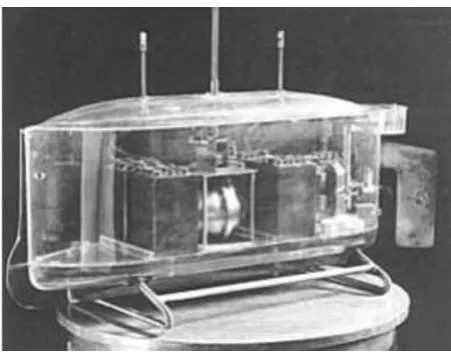
1898, Nicola Tesla demonstrated a radio-controlled boat, which he described as incorporating “a borrowed mind”, in which Tesla controlled the boat remotely. A breakthrough in
autonomous robot technology occurred in the mid-1980s with work in behaviour-based
robotics (Arkin, 1998). Indeed, it could be argued that the work is a foundation for many
current robotic applications. Behaviour-based robotics breaks with the monolithic sense
plan-act loop of a centralized system, and instead uses distributed sense-response loops to generate
appropriate responses to external stimuli. The combination of these distributed responses produces “emergent” behaviour that can produce very sophisticated responses that are robust
Figure 1: Tesla’s boat (Tesla, 1898).
A second important breakthrough for autonomy of robots is the emergence of hybrid
architectures. These architectures simultaneously allow sophisticated reactive behaviours that
provide fundamental robot capabilities along with the high-level cognitive reasoning required
for complex and enduring interactions with humans. Robot behaviours initially focused on
mobility, but more recent contributions seek to develop lifelike anthropomorphic behaviours.
These are acceptable behaviours of household robots and desirable behaviours for robots that
follow, pass, or approach humans (Yamaoka, Kanda, Ishiguro and Hagita, 2000). Emerging
from the early work in robotics, human factors‟ experts have given considerable attention to
two paradigms for human–robot interaction which are teleoperation and supervisory control.
At the teleoperation extreme, a human remotely controls a mobile robot or robotic arm. With
supervisory control, a human supervises the behaviour of an autonomous system and
intervenes as necessary.
Early work was usually performed by people who were interested not only in robotics but
also factory automation, aviation and intelligent vehicles. Work in these areas is typified by Sheridan‟s seminal contributions (Sheridan, 1992), and other significant contributions from
human factors researchers. Every robot application appears to have some form of interaction, even those that might be considered “fully autonomous.” For a tele-operated robot, the type
of interaction is obvious. For a fully autonomous robot, the interaction may consist of
high-level supervision and direction of the robot, with the human providing goals and with the
robot maintaining knowledge about the world, the task and its constraints. In addition, the
interactions may be through observation of the environment and implicit communications by,
general view of HRI, one might consider that it includes developing algorithms,
programming, testing, refining, fielding, and maintaining the robots.
3. Applications of Robotic Science to the Knowledge-Based Society
In this section, applications of robotic science via their interactions with humans in the areas
of health, entertainment and security are discussed.
3.1 Robotics in Health
Physicians could rely more on robots to perform medical procedures to reduce the chance of
errors and to speed up procedures. At the same time, scientific researchers will continue to
develop cures and vaccines to eradicate the most life threatening illnesses of our time, such as
cancer and malaria. Furthermore, they will continue with the development of artificial organs,
presumably using 3D printers as predicted by Gartner. They will also improve
nanotechnology to treat illnesses more locally, thereby reducing the potential for
wider-ranging side effects.
3.1.1 INTERNIST-I
One of the best-known robotic systems is the large diagnostic program constructed by
researchers at the University of Pittsburgh during the 1970s. The work was developed by
Harry Pople (a computer scientist with an interest in AI, logic programming and medical
applications) and Jack Myers, university professor (medicine) and prominent clinician, who
was eager to try to encode some of his diagnostic expertise in a high-performance computer
program. Rather than selecting a small subtopic in medicine for the work, Pople and Myers
decided to consider the entire field of internal medicine. This necessarily required approaches
that quickly narrowed the search space of possible diseases and also permitted case analyses
in which two or more diseases could co-exist and interact. The resulting program, now known
as INTERNIST-1, is capable of making multiple and complex diagnoses in internal medicine
(Yamaoka, Kanda, Ishiguro and Hagita, 2000).
An experimental program for computer-assisted diagnosis in general internal medicine, was
designed to aid the physician with the patient's workup in order to make multiple and
complex diagnoses. The capabilities of the system derive from its extensive knowledge-base
and from heuristic computer programs that can construct and resolve differential diagnoses.
This program represents an example of applied symbolic reasoning (artificial intelligence). A
the thought processes and problem-solving methods employed by human beings. An
important aspect of the INTERNIST-I approach to computer-assisted diagnosis is that the
program attempts to form an appropriate differential diagnosis in individual problem areas.
A problem area is defined as a selected group of observed findings, the differential diagnosis
of which forms what is assumed to be a mutually exclusive, closed (exhaustive) set of
diagnoses. Physicians routinely construct such closed differential diagnoses on the basis of
causal considerations (for example, bacterial pneumonias) or pathoanatomic considerations
(causes of obstructive jaundice). By constructing specific differential diagnoses to address
identified problem areas, a physician or computer program can narrow the set of possible
diagnoses from all known diseases to well-defined collections of competing diagnoses in a
small number of categories. Heuristic principles, such as diagnosis by exclusion, can then be
employed to resolve each differential diagnosis. The use of such strategies in INTERNIST-I
represents an attempt to model the behaviour of physicians. The algorithm for the
performance evaluation of INTERNIST-I is as follows:
i. Initial positive (present) and negative (absent) patient findings are entered by the user. As each new positive manifestation is encountered, the program retrieves its complete
differential diagnosis from the inverted disease profiles in the knowledge base. A disease
hypothesis is created for each item on the manifestation's differential-diagnosis list. A
master list of all such disease hypotheses is maintained. Higher-level concepts from the
classification hierarchy are retained on the differential-diagnosis list as long as the
diagnoses that they subsume are indistinguishable in their ability to explain the observed
data. The master differential list therefore comprises all possible diagnoses that can
explain any of the observed findings (taken either individually or in groups).
ii. For each disease hypothesis, four lists are maintained: all positive manifestations in the patient that are explained by the disease hypothesis (i.e., findings matching the disease
profile stored in the data base); all manifestations that might occur in a patient with the
disease but are known to be absent in the patient being considered; all manifestations
present in the patient but not explained by the disease hypothesis, that is, not found on
the disease profile (these manifestations represent either "red herrings" or items that
would have to be explained by a second disease present in the patient); and
manifestations on the disease's profile about which nothing is known (this list is used in
iii. Each hypothesis on the master list of diagnoses is given a score. Scores are calculated as the sum of a positive and a negative component as follows. The positive component
includes the weights of all manifestations explained by the hypothesis, based on the
evoking strengths of the observed manifestations for the diagnosis. A nonlinear
weighting scheme is used: an evoking strength of 0 counts as 1 point; strength of 1 count
as 4 points; a 2 counts as 10 points; a 3 counts as 20; a 4 as 40; and a 5 as 80. Any
disease hypothesis related to a previously concluded diagnosis (through links in the data
base) is given a bonus score. The bonus awarded is 20 points times the frequency
number listed for the hypothesized diagnosis in the disease profile of the concluded
diagnosis. The negative component includes the weight of all manifestations that are
expected to occur in patients with the disease but are absent in the patient under
consideration. A nonlinear scale based on the expected frequency of the manifestation in
the disease is used: a frequency of 1 count as - 1 point; a 2 as - 4 points; a 3 as -7 points;
a 4 as -15 points; and a 5 as -30 points. Also included are the weights of all
manifestations present in the patient but not explained by the hypothesized diagnosis.
The import (clinical significance) of each manifestation is used to assess this penalty: an
import of 1 count as -2 points; a 2 as -6 points; a 3 as -10 points; a 4 as -20 points; and a
5 as -40 points. The net score for any disease hypothesis is thus the sum of the above
four component weights.
iv. After all disease hypotheses have been scored, the master list of all hypotheses is sorted by descending score. Diagnoses whose scores fall a threshold number of points below
the topmost diagnosis are temporarily discarded as unattractive. They may be
reconsidered, however, if further evidence obtained during the case analysis raises their
scores above the threshold (relative to the topmost diagnosis).
v. At this point, the sorted master differential-diagnosis list is a heterogeneous grouping of many disease hypotheses. A critical step in the diagnostic logic of INTERNIST-l is to
delineate a set of competitors for the topmost diagnosis (i.e., to create a problem area
containing the topmost disease hypothesis). Only one of the set of diseases in a properly
defined problem area is likely to be present in a patient. Problem area construction is
carried out by the INTERNIST-l partitioner, which employs a remarkably powerful yet
simple heuristic rule. The rule states, "Two diseases are competitors if the items not
explained by one disease are a subset of the items not explained by the other; otherwise,
they are alternatives (and may possibly coexist in the patient)." To paraphrase, if Disease
either one taken alone, then the diseases are classified as competitors. Competitors for
the likeliest diagnosis are identified from the master differential list using the
partitioning rule; including the topmost diagnosis, they constitute the current problem
area. Because INTERNIST-I defines problem areas in this ad hoc manner, its differential
diagnoses will not always resemble those constructed by clinicians.
vi. Once the problem area containing the most attractive diagnosis has been selected, criteria for establishing a definitive diagnosis can be applied. If the problem area contains only
the topmost diagnosis, INTERNIST-I will immediately decide on (conclude) that
diagnosis. If there is more than one diagnosis in the problem area, INTERNIST-I directly
concludes the leading diagnosis when its score is 90 or more points higher than the
nearest competitor. The value of 90 was chosen because it slightly exceeds the weight
carried by a pathognomonic finding (80 points). This method of concluding a diagnosis
is a hallmark of INTERNIST-I. The absolute score of the diagnosis does not matter. The
only point of importance is whether the diagnosis is sufficiently higher in score than its
reasonable competitors (other diagnoses that explain the same set of findings).
vii. If it is not possible to conclude a diagnosis (which by default means that the current problem area contains more than one hypothesis), one of three questioning strategies is
selected: pursuing, ruling out, or discriminating. The pursuing mode is selected if the
second-best contender is 46 to 89 points behind the topmost diagnosis. In the pursuing
mode, questions are asked to establish the topmost diagnosis, since it is close to fulfilling
criteria for conclusion. The questions asked are those that are most specific for the
leading diagnosis (i.e., those with high evoking strengths). If there are five or more
diagnoses within 45 points of the topmost diagnosis, the ruling-out mode is used.
Questions that have high frequency numbers under the contenders are asked, with the
expectation that several negative responses will remove some of the diagnoses from
contention. The discriminating mode is used when there are two to four diagnoses within
45 points of the leading diagnosis. The questions asked attempt to maximize the spread
in scores.
viii.When a diagnosis is concluded, all observed manifestations explained by the diagnosis are removed from future consideration. The program then recycles using the remaining
unexplained positive findings. Subsequent findings are marked as explained when a
previously concluded diagnosis can account for them. However, it is not possible to undo
ix. When a problem area contains more than one disease hypothesis and all useful lines of questioning have been exhausted (without meeting criteria for concluding the topmost
diagnosis), the program will defer making a diagnosis in that problem area. Diagnoses in
the problem area are then displayed by descending score, along with an explanation that
the differential diagnosis cannot be resolved.
3.1.2 MYCIN
MYCIN was developed at Stanford by Shortliffe in the 1970‟s. It was an expert system for
diagnosing blood diseases. It was a precursor to today‟s expert systems and acts as an ideal
case study. MYCIN was composed of approximately 500 rules, manipulating a large base of
structured facts. The rules provided procedural knowledge to
1) Request or infer the required information.
2) Apply specialized knowledge to determine a therapy.
3) Provide advice to doctors.
4) Respond to questions about its reasoning.
MYCIN is a rule based ES using backward chaining. A typical rule IF stain of organism is
gram negative AND morphology is rod AND is anaerobic THEN suggestive that class is
enterobacteriaceae. The rules were actual stored as LISP expressions. Inexact reasoning was
employed using certainty factors. This is a number on the scale -1 to 1. -1 being definitely
false +1 definitely true. MYCIN used meta-rules to redirect search at stages. An example of
such a Meta rule is
IF infection is pelvic abscess
AND
rules mention in premise E
AND
rules mention in premise gram pos rods
THEN evidence should use rules for E before rules for gram pos rods.
3.2 Care-O-bot Robot for Entertainment
Based on the successful hardware and software architecture, Care-O-bot is a new generation
of mobile robots has been designed at Fraunhofer Institute of Manufacturing Engineering and
Automation (IPA). This robot was created to communicate with and to entertain visitors
(Birgit, 2007). Their tasks include welcoming visitors, leading a guided tour through the
(differential drive) including shaft encoders for motion tracking. The robots are able to move
at a speed of up to 1.2 m/s. Four castor wheels are further used for keeping the robots upright.
A gyroscope is integrated in the robot platforms to track their current orientations. A
two-dimensional (2D) laser scanner is attached to the front of each robot. The laser scanner is
used for self-localization, navigation, and obstacle detection. Additional safety sensors are a
bumper at the bottom of the robots and several infrared sensors which are integrated in the
bumper facing upwards. These sensors are used to detect obstacles above the scanning level
of the laser scanner.
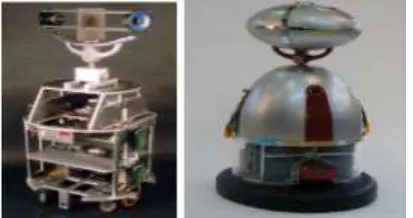
Figure 2: Hardware platform of a care-o-bot (Birgit, 2007).
Activating one of the safety sensors as well as pressing either of the emergency stop buttons
results in an immediate stop. Besides software restricting the allowed operation area, a
magnetic sensor facing towards the ground is used as a secondary system to prevent the
robots from leaving their assigned area. This area is bounded by a magnetic band lowered in
the ground. Being equipped with several long lasting batteries the robots are able to move
independently for up to ten hours without interruption. For daily operation the robots can be
recharged overnight. However, the control software for the mobile robots is based on the object oriented „Real-time Framework‟ and the software library „Robotics Toolbox‟, both
developed at Fraunhofer IPA. The Robotics Toolbox is an extensive software library, which
in several independent packages contains modules for implementing all necessary service
robot control functions. Furthermore, the use of rapid prototyping methods is being supported
by adequate simulation and test environments for all modules.
The real-time framework supports the software developer in designing a service robot
application. It enables simple and fast integration of single Robotics Toolbox components to
an application. The framework provides the structural integration of threads and components
(automatic initialization/de-initialization, error treatment). The communication functions of
communication as well as mechanisms for implementation of distributed communication, e.g.
for remote diagnosis.
Figure 3: software architecture of care-o-bot (Traub,1999).
The real-time framework further presents an abstraction layer for operating system functions
and thereby improves the portability of the control software. More importantly, the safety
concept of care-o-bot ensures that major accidents are avoided. One of the most common
accidents caused through industrial robots is a person being hit by the robot. For stationary
robots, the responsibility lies partly with the user safety measures. For example, keeping a
certain distance to the robot must be obeyed. For mobile robots, however, all responsibility
lies by the vehicle, therefore the major goal for safe operation should be to prevent a mobile
robot from driving into people or from leaving its operation area which might lead to
additional incidents. For example, a fall through the stairs onto people. For maximum safety,
a redundant three-level safety system has been implemented on Fraunhofer IPA‟s mobile
platforms. Whenever an obstacle is detected in the robot‟s vicinity, the speed of the vehicle is
reduced at a degree depending on the distance to the obstacle. If an obstacle or a person gets
too close to the vehicle, the robot will stop and wait until the area is clear again.
3.3 Robotics in Security
The field of robotics has changed dramatically during the past 30 years. While the first
programmable articulated arms for industrial automation were developed by George Devol
and made into commercial products by Joseph Engleberger in the 1960s and 1970s, mobile
robots with various degrees of autonomy did not receive much attention until the 1970s and
1980s. The first true mobile robots arguably were Elmer and Elsie, the electromechanical „tortoises‟ made by W. Grey Walter, a physiologist, in 1950 (Walter, 1950). These
remarkable little wheeled machines had many of the features of contemporary robots: sensors
(photocells for seeking light and bumpers for obstacle detection), a motor drive and built-in
behaviors that enabled them to seek (or avoid) light, wander, avoid obstacles and recharge
their batteries. Their architecture was basically reactive, in that a stimulus directly produced a
response without any thinking. That development first appeared in Shakey, a robot
constructed at Stanford Research Laboratories in 1969. In this machine, the sensors were not directly coupled to the drive motors but provided inputs to a „thinking‟ layer known as the
Stanford Research Institute Problem Solver (STRIPS), one of the earliest applications of artificial intelligence. The architecture was known as „sense-plan-act‟ or „sense-think-act‟
(Arkin, 1998).
3.3.1 PackBot
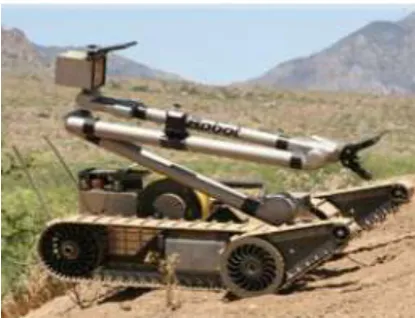
PackBot is equipped with cameras and communication equipment and may include
manipulators (arms); it is designed to find and detonate IEDs, thus saving lives (both civilian
and military), as well as to perform reconnaissance (Stefan, Sethu, Aaron, Auke and Jun,
2015). Its small size enables it to enter buildings, report on possible occupants, and trigger
booby traps. It is equipped with machine guns, grenade launchers, or anti-tank rocket
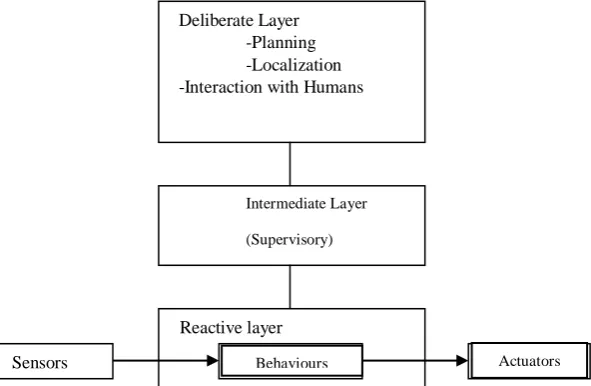
launchers as well as cameras and other sensors. For packbot, most current systems use the so-called „three level software architecture‟. The lowest level is basically reflexive, and allows
the robot to react almost instantly to a particular sensory input. The highest level, sometimes
called the Deliberative layer, includes Artificial Intelligence such as planning and learning, as
well as interaction with humans, localization and navigation. The intermediate or „supervisory‟ layer provides oversight of the reactive layer, and translates upper level
commands as required for execution. Many recent developments have concentrated on
Figure 4: A packbot machine (Patrick, 2008).
The features of packbot are as follows (Stefan, Sethu, Aaron, Auke and Jun, 2015):
i. Sensor fusion: More accurate situational awareness will require the technical ability to assign degrees of credibility to each sensor and then combine information obtained from them. For example, in the vicinity of a „safe house‟, the robot will have to combine
acoustic data (obtained from a variety of microphones and other sensors) with visual
information, sensing of ground movement, temperature measurements to estimate the
number of humans within the house, and so on. These estimates will then have to be
combined with reconnaissance data (say from autonomous flying vehicles) to obtain a
probabilistic estimate of the number of combatants within the house (Patrick, George and
Keith, 2008).
ii. Attack decisions: Sensor data will have to be processed by software that considers the applicable Rules of Engagement and Laws of War in order for a robot to make decisions
related to lethal force. It is important to note that the decision to use lethal force will be
based on probabilistic calculations, and absolute certainty will not be possible. If multiple
robot vehicles are involved, the system will also be required to allocate functions to
individual members of the group, or they will be required to negotiate with each other to
determine their individual functions. Such negotiation is a current topic of much
challenging research in robotics.
iii. Human supervision: Autonomy will be granted to robot vehicles gradually, as confidence in their ability to perform their assigned tasks grows. Learning algorithms that
enable the robot to improve its performance during training missions. Even so, there will
be fundamental ethical issues. For example, will a supervising warfighter be able to override a robot‟s decision to fire? If so, how much time will have to be allocated to allow
command, say in a situation where the robot makes the decision not to release a missile
on the basis that its analysis leads to the conclusion that the number of civilians (say
women and children) greatly exceeds the number of insurgents in the house (Patrick,
George and Keith, 2008).
Figure 5: Typical three-level architecture for robot control in packbot (Patrick, George and Keith, 2008).
4. Ethics and Negative Effects of Robotic Science to the Society
In this section, the ethical issues and negative impacts of robotic science on the society are
presented.
4.1 Ethics of Robotic Science to the Society
The increased use of advanced robots has created new morality issues. Among these are the
following (Bekey, 2012; Decker, 2008):
i. There is no universal consensus on what is right and wrong. Robotics do not have the
capacity to make moral judgements; these need to be programmed into them, and this can
cause difficulties. A robot could make a choice on your behalf that you feel is ethically
wrong. A robot car might choose to save you at the expense of a young child, but you
might disagree with that decision
ii. Robots are already used in warfare. An increasing number of armed drones have
participated in wars since the Balkans conflict. The existence of lethal robots creates a
security threat should this type of robot fall into the wrong hands. What is more, it has
been argued that the use of drones makes it easier for people to kill without being
hindered by their conscience. Loss of a sense of responsibility has enabled many humans
Deliberate Layer -Planning -Localization -Interaction with Humans
Intermediate Layer (Supervisory)
Reactive layer
cfggggBBeha
viours
Sensors
gggAAct uators
to make morally abhorrent choices in the past, most notably during the Second World
War.
iii. It is generally accepted that the life of a human is more valuable than the life of a robot.
Yet, when society replaces humans with robots for increased efficiency and productivity
at the expense of that human, an ethical dilemma emerges.
4.2 Negative effect of Robotics on the Society
The use of robots in industries and daily life could adversely affect social life in the following
ways (Lin, Abney and Bekey, 2012; Bacevich and Cohen, 2001):
i. When robots replace humans in social jobs, a sense of alienation in humans may be
induced. This could cause depression.
ii. The use of robots in the workplace could cause employees stress. Not only do employees
risk replacement by robots, robots also have the capacity to track their movements. This
dehumanizes the workplace and creates mental and physical problems.
iii. Currently, many companies in the Western world have factories elsewhere. Whilst the
circumstances in which many laborers work are a constant topic of concern, replacing all
those who work in those factories with robotics would eliminate the livelihoods of many.
iv. Robots are faster and generally more accurate than humans in the jobs they perform.
When various countries can afford to use robots, whilst others cannot, new inequalities
would appear between developing and developed nations.
5. CONCLUSION AND FUTURE WORKS
Human progress and technology are interlinked. While this type of progress has been positive
in many regards, it is far from certain that this will always be the case. In order to create a
sustainable society, it is imperative that scientific research focuses on improvements that
positively impact human societies and our natural environment. In order to allow such
developments to take place, there must be ample space and time. Population growth will
intensify the crises that the world already faces, and people in crisis do not have time to wait
for the development of sustainable technologies. This will force technicians to focus on the
development of technologies that solve a crisis quickly, but these are often damaging to the
environment. Anything that causes rapid environmental depletion will ultimately fail to
provide a durable solution. A falling population would offer scientific researchers more time
to develop new sustainable technologies, as it would increase the longevity of finite natural
challenges a shrinking population might cause, without increasing unemployment levels.
Whilst the incorporation of robotics into society will certainly create serious ethical
discussions, it appears that a falling population, through technical stimulation, could
ultimately lead to a more sustainable society and living environment. The challenge of
creating a robot that can properly discriminate among targets is one of the most urgent,
particularly if one believes that the (increased) deployment of robots is inevitable. While this
is a technical challenge and resolvable depending on advances in programming and artificial
intelligence, there are some workaround policy solutions that can be anticipated and further
explored in future works.
REFERENCES
1. Bekey, G.A. Current Trends in Robotics: Technology and Ethics. In (eds.) Lin, P., Abney,
K., Bekey, G.A. Robot Ethics – The Ethical and Social Implications of Robotics.
Cambridge, MA: MIT Press, 2012.
2. Lin, P., Abney, K., Bekey, G.A. Robot Ethics – The Ethical and Social Implications of
Robotics. Cambridge, MA. MIT Press, 2012.
3. Van Est, R., Kools, L., Eds. Working on the Robot Society; Rathenau Instituut: The
Hague, The Netherlands, 2015.
4. De Santis, A.; Siciliano, B.; De Luca, A.; Bicchi, A. An atlas of physical human-robot
interaction. Mech. Mach, 2008.
5. Gary Anderson, Daniel Berleant. Innovation Theory and the National Robotics Initiative
Effort of the National Science Foundation. Journal of the washington academy of
sciences, Summer 2014; 100(2): 1-20.
6. IFR Statistical Department (in the International Federation of Robotics), 2012,
http://www.worldrobotics.org/uploads/media/Executive_Summary_WR_2012.pdf. Also “World robots – industrial robots 2012,” IFR Statistical Department (in the International
Federation of Robotics), http://www.worldrobotics.org/index.php?id=downloads.
7. C. M. Bishop. Neural networks for pattern recognition. New York: Oxford University
Press, 1995.
8. V. Vapnik, S. Golowich, and A. Smola. “Support vector method for function
approximation, regression estimation, and signal processing,” in Advances in Neural
Information Processing Systems 9, M. Mozer, M. I. Jordan, and T. Petsche, Eds.
9. A. Ijspeert, J. Nakanishi, and S. Schaal. “Trajectory formation for imitation with nonlinear dynamical systems,” presented at IEEE International Conference on Intelligent
Robots and Systems (IROS 2001), 2001.
10.Stefan Schaal, Sethu Vijayakumar, Aaron D‟Souza, Auke Ijspeert and Jun Nakanishi. “Real-Time Statistical Learning for Robotics and Human Augmentation” Computational
Learning and Motor Control Laboratory Computer Science and Neuroscience, HNB-103,
Univ. of Southern California, Los Angeles, CA 90089, 2015.
11.Michael A. Goodrich and Alan C. Schultz. “Human–Robot Interaction: A Survey”,
Brigham Young University, Provo, UT 84602, USA, 2007. [email protected].
12.M. E. Rosheim, Leonardo‟s Lost Robot. Berlin: Springer Verlag, 2006.
13.N. Tesla. Tesla‟s boat, 1898; Available from: http://www.brotherhoodoflife.
com/Tesla-boat.jpg.
14.Edger Lopez, The Rise of Robotic Technology: A Review of Literature, 2014.
15.Shakhatreh Fareed. The basics of robotics. Lahti University of Applied Sciences
Machine- and production technology, 2011.
16.Patrick Lin, George Bekey and Keith Abney. Autonomous Military Robotics: Risk,
Ethics, and Design. Ethics + Emerging Sciences Group at California Polytechnic State
University, San Luis Obispo, 2008.
17.Bacevich AJ and Cohen EA. War over Kosovo: politics and strategy in a global age.
Columbia University Press, Columbia, 2001.
18.Decker M. Caregiving robots and ethical reflection: the perspective of interdisciplinar y