Abstract— Construction industry plays a vital role in an economical aspect all over the world as an integral part of the development of a nation. The most important factor which affects the people is shelter. Shelter is very essential to everyone. Due to over population and increasing occupants of migrated people, the necessity to occupy the constructional building seems to be gradually increased. To avail the economical residence and work place to all with good quality assurance at a low cost might be tedious. The increasing demand for cost effective and quality parameters of the construction of any type of building leads to develop the new advanced technologies to overcome the drawbacks in the construction fields. Construction is one of the significant sectors of an Indian economy with involving a complex process including Architectural planning, Engineering design and tedious execution. As by realization the quality and cost should be achieved in an acceptable manner depends upon the type of building to be construct. Hence this project involves detailed cost estimation and quality analysis for walls of a building such as by using brick wall, precast wall panels and by MIVAN formwork with the help of Value Engineering concept. This paper describes the comparative analysis of conventional wall construction, precast wall construction and MIVAN formwork on the basis of cost and quality parameter.
I. INTRODUCTION
In civil engineering, Value Engineering supports to identify the alternative materials and methods with less expensive substitutions, without sacrificing the functionality of the system. Value engineering is a systematic and conceptual approach for occurring the necessary functions in a project at the lowest cost in all fields. This concept mainly focusing on the functions of various components and materials, rather than their physical attributes. The expenditure on constructing the vertical structures is occupying the major part of cost in the total cost of construction. Therefore the selection and proper planning of type of method adopted for construction will reduce the cost of construction, duration of construction, labour requirement and so on while enhancing the quality of the construction process.
Brick wall construction is a traditional method to construct the building with a limited durability which requires regular maintenance. Precast wall panels were introduced to avail the variety of shapes, creative designs with multiple colors to enhance the appearance of the building in the way of satisfying the trendy culture. These precast wall panels made easy installation with high durability but its initial cost is high at the initial stage of construction. In this speedy world, the innovative advanced technologies were made the construction industry to play a major role into the sustainable society by offering sustainable construction. Therefore for undertaking the mass housing projects and other high rise industrial projects, it is necessary to adopt the new technologies which are capable of the fast rate construction with achievable quality at an effective cost. Hence, MIVAN formwork is adopted for repetitive design construction to ensure the best quality, fast and economical construction. It includes the concrete surface finish produced with the aluminum or metal formwork to deliver the quality wall finish without the need for extensive plastering work.
1.1 OBJECTIVE
To compare the Brick wall construction, Precast wall panel installation, MIVAN formwork on the basis of,
1) Cost Parameter 2) Quality Parameter
1.2 NEED FOR STUDY
To achieve the value added construction projects without compromising the quality at any cost as the concept of value engineering represented in the figure 1.1.
Volume-6 Issue-2
International Journal of Intellectual Advancements
and Research in Engineering Computations
A Study of Value Engineering Practices in Wall Construction of a
Residential Building
Sathiyapriya Venkidusamy, PG Scholar, Dr.P.S.Kothai, Professor, S.Khaviya, PG Scholar,
Department of Civil Engineering, Kongu Engineering College, Perundurai,
Fig. 1.1 Value Engineering Concept 1.3 Nature and Scope of Work
The scope of the research is mainly focus on the study of literature review for identifying the past research works with the way of utilizing the Value Engineering concept and the collection of data from the construction site.
It includes planning, cost estimation and cost comparison to compare the various alternative methods to adopt the best one in the construction field to increase the value of the innovative technologies and its cost effective and qualitative performance in construction projects.
The factors which affect the quality of the construction building were identified through serious study on the literature collections and from the direct approach to the construction site.
The data such as brick work execution, precast design and its erection, MIVAN formwork of construction are combined and then compared to avail the benefits.
It is necessary to improve the quality in construction with lowest cost in the upcoming years due to over population and demand for material availability to lead the construction projects successfully.
II. METHODOLOGY
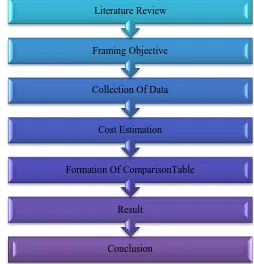
The desired objective can be obtained by sequencing the flow of work into a typical methodology. Figure 2.1 represents the methodology adopted for successful completion of the project.
Fig. 2.1 Methodology Flow Chart
III. DATA COLLECTION
This chapter describes the data collected from the construction site. Data collection should be done in different companies to get the price details for the brick wall construction, precast wall panel construction and MIVAN formwork construction. In the data collection we can also know the procedures of the construction work and also find out the difficulties of the work. This collection is helpful to find out cost of the project for the three types of wall constructions. The collected details were compared manually as per the factors identified from the literature study.
3.1 BRICK WALL CONSTRUCTION
The most durable part of any building or structure is the vertical walls. If the walls are made up of bricks, then it provides strength, durability to the structure and also helps to control indoor and outdoor temperature. It separates a building from outside world. Construction with mortar as a binding material with individual units of bricks, stones, marbles, granites, concrete blocks, tiles etc., is said to be masonry in the construction field. Mortar is a mixture of binding material with sand. Binding materials can be cement, lime, soil or any other. The durability and strength of brick masonry wall construction depends on the type and quality of material used and workmanship. The brick masonry structures are under construction process at the construction site is shown in the figure 3.1 below.
Conclusion Result
Fig. 3.1 Brick Wall Construction
3.2 PRECAST WALL PANEL CONSTRUCTION
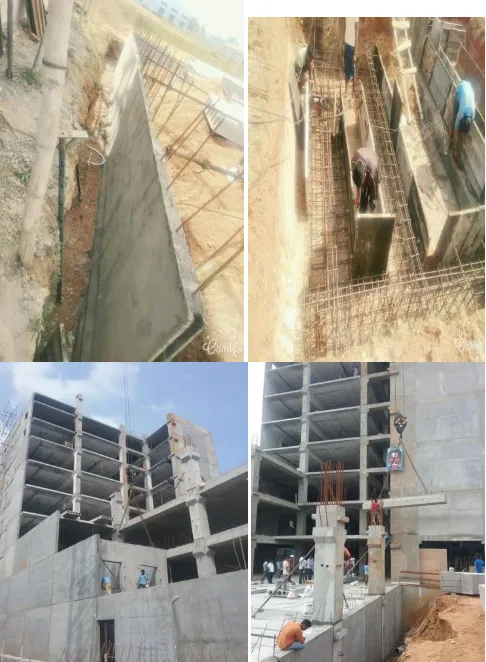
The Precast is a construction product produced by casting concrete in a reusable mould or form which is then cured in a controlled environment, transported to the construction site and lifted into place. The precast wall structures under construction at the construction site are shown in the figure 3.2 below.
Fig. 3.2 Precast Wall Constructions
M45 Grade is used for precast walls. Fe500 steel rebar is used. After the battery cases moulding the precast walls are stored in a stored house constructed near the batching plant. The storage house consists of various groups of walls which are divided as per the requirement. Precast wall is one among the strongest and structurally sound building materials on the market. It has come through many design innovations and upgrades.
3.1 MIVAN FORMWORK CONSTRUCTION
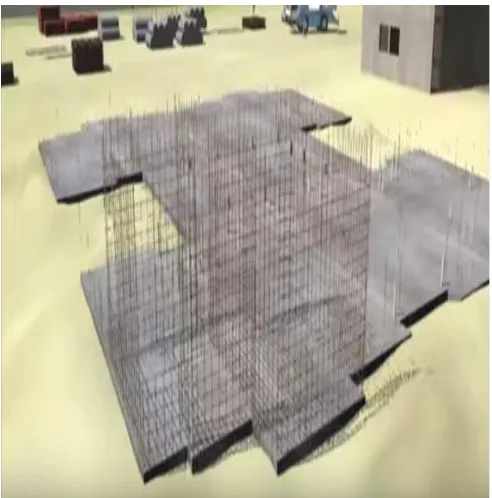
panels. These panels are manufactured in the MIVAN’S dedicated factories in Europe and South East Asia. Once they are assembled then they are subjected to trail tractions in order to eliminate any dimensional or on site problems. All the formwork components are received at the site working after they are ordered. Walls and slabs are cast in one operation. The MIVAN step by step process at the construction site is shown in the figure 3.3 below.
1. Setting up the wall reinforcing steel
2. Placement of aluminum formwork
3. Pouring concrete
4. Resulting structure
Fig. 3.3 MIVAN Formwork Construction
3.4 BUILDING DETAILS
The built up area of about 1760 sq.ft is taken to construct a G+1 residential building. The building details are tabulated in the table 3.1 below:
Table 3.1 Building Details
Total outer wall area 6800 sq.ft
Total inner wall area 6800 sq.ft
Ground floor ceiling area 1760 sq.ft
Frist floor ceiling area 592 sq.ft
This building is north facing to avail the natural lights and other natural benefits. This building consists of ground floor and first floor. It consists of several rooms, such as portico, veranda, kitchen room, foyer, stair room, bedroom, bathroom etc. The construction cost is estimated by using three different methods of wall construction are going to be compared individually. This comparison includes concreting work with respect to two different concreting methods. This comparison is made to increase the quality and the performance of building by reducing the unwanted cost included to construct the building.
3.5 COST ESTIMATION FOR BRICK WALL CONSTRUCTION
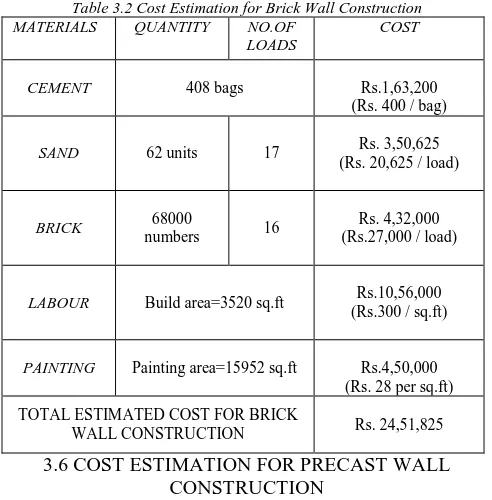
The G+1 Residential Building wall is constructed by using brick then it requires 62 units of sand, 408 bags of cement, 68000 numbers of brick for about 1760 sq.ft of floor area. The cost estimation for brick wall construction is shown in the table 3.2 below:
Table 3.2 Cost Estimation for Brick Wall Construction
MATERIALS QUANTITY NO.OF
LOADS
COST
CEMENT 408 bags Rs.1,63,200
(Rs. 400 / bag)
SAND 62 units 17 Rs. 3,50,625
(Rs. 20,625 / load)
BRICK 68000
numbers 16
Rs. 4,32,000 (Rs.27,000 / load)
LABOUR Build area=3520 sq.ft Rs.10,56,000
(Rs.300 / sq.ft)
PAINTING Painting area=15952 sq.ft Rs.4,50,000
(Rs. 28 per sq.ft) TOTAL ESTIMATED COST FOR BRICK
WALL CONSTRUCTION Rs. 24,51,825
3.6 COST ESTIMATION FOR PRECAST WALL CONSTRUCTION
For precast wall panels, the cost estimation includes purchasing cost, delivery cost and so on which is differ from conventional construction cost as shown in the table 3.3 below:
Table 3.3 Cost Estimation for Precast Wall Construction
Total G.F wall area 3971.5 sq.ft Total F.F wall area 3120 sq.ft Total precast wall area 7092 sq.ft Total precast wall area after
excluding doors and windows 6800 sq.ft
Cost of precast wall construction (including mould cost, design
cost, transportation cost, erection cost and labour cost)
Rs.48,96,000 (Rs.720 per sq.ft)
Total painting cost Rs.2,07,376 ( Rs. 13 per sq.ft) TOTAL ESTIMATED COST
FOR PRECAST WALL CONSTRUCTION
Rs. 51,03,376
3.7 COST ESTIMATION FOR MIVAN WALL CONSTRUCTION
The MIVAN wall construction includes step by step process. The formwork is carried out by using an aluminium panels. The requirement of steel also calculated as per the plan. Then the concrete is poured by using crane throughout the wall area. To avoid the honey comb of concrete within the wall an admixture CAC Hyper fluid is added. Finally painting work would be carried out. These cost particulars are mentioned below as shown in the table 3.4.
Table 3.4 Cost Estimation for MIVAN Wall Construction
S.NO TYPE OF COST AMOUNT IN INR
1. Aluminium formwork
cost Rs. 28000 2. Steel cost Rs. 220000 3. Concreting cost Rs. 353600 4. Labour cost Rs. 30000 5. Painting cost Rs. 207376
Total cost Rs. 838976
3.8 QUALITY COMPARISON FOR WALL CONSTRUCTION
Table 3.5 Quality Comparison Table
QUALITY COMPARISON TABLE FOR CONSTRUCTION OF WALLS
FACTORS BRICK PRECAST MIVAN
Superior strength and durability
Lesser number of joints thereby reducing the leakages and enhancing the strength and durability but it is much difficult.
Strength gradually increases over time while reducing the need for other structural components.
The panels are made out of Structural Grade Aluminum alloy. Around 100 to 200 uses or repetitions can be made possible with maintaining the constant strength over the structure. Safety and Protection Requires additional protective layer coating to protect the building from environmenta l impacts.
Precast wall provides an excellent protection against impacts from
explosions, vehicles and projectiles.
MIVAN shuttering has been invented mainly to offer utmost safety for the construction works.
Speed of constructio
n
Slow due to step by step construction. For Example, curing process takes about 4 to 21 days.
It is much faster than
conventional construction but less fast than MIVAN construction.
Fast, as wall & floor cast together and curing overnight.
Labour Requiremen
t
Brick wall construction requires experienced labour whoever being skilled or unskilled workers.
It requires both skilled and unskilled labours.
MIVAN requires technically skilled and experienced labour force at the work site.
Environme ntal friendly
Brick built walls offer a constant and pleasant temperature, also noticeable in energy consumption.
It is nontoxic, environmentally safe and composed of natural materials.
Highly eco friendly and is suitable for all climatic regions.
Low Maintenanc
e
It requires repair after severe weather or at any impact.
Precast concrete requires little or no maintenance, which makes it the ideal choice for nearly any design solution.
MIVAN requires low maintenance when compared to brick and precast wall construction.
Economical The brick
work and plastering of wall increases the cost and duration of the
construction project.
Precast concrete wall panels offer lower long-term costs when compared with other materials. Ease of installation, reduction in overall project timeline and total flexibility in design make
The initial cost per unit of forming area is less when compared to traditional methods. The reduction of cost is also due to the elimination of brickwork and plaster and also due to reduction
precast the economical solution.
in time. The cost of the project gets substantially reduced due to shear wall construction.
3.8 RESULT AND DISCUSSION
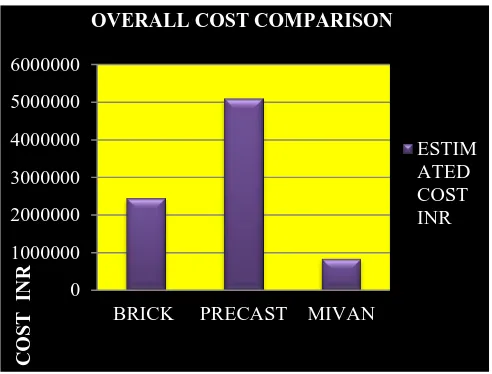
The cost and quality comparison for brick wall, precast panel and MIVAN formwork is compared successfully. The comparison of total project cost for wall construction by conventional brick construction, precast panel structure and MIVAN construction of a single storey building are compared as shown in the figure 3.8 below.
Fig 3.8 The comparison of total project cost for wall construction by conventional brick construction, precast panel structure and MIVAN
construction of a single storey building
The conventional wall construction of the building comes around Rs.25 lakh, also consumes more time to complete the overall building activity. The precast wall construction of the building comes around Rs.52 lakh, it is more expensive than conventional wall construction, but in quality wise and time saving manner the precast wall construction is more effective in all its properties such as enhancing the outlook of the structure, reduces workmanship of the building, leads to low maintenance meanwhile increasing the durability of the structure etc., while the MIVAN construction of the building comes around Rs.9 lakh. When comparing the three different types of wall structure expenses, the MIVAN technology formwork being less expensive. By adopting MIVAN technology in the forthcoming project, the construction industry can save the project cost to minimum with availing the environmental benefits. This technology is choosed as a best alternative for construction activity among the conventional methods by ensuring value engineering concept on the basis of quality and cost.
0 1000000 2000000 3000000 4000000 5000000 6000000
BRICK PRECAST MIVAN
CO
ST
INR
OVERALL COST COMPARISON
ACKNOWLEDGMENT
First and foremost I thank my parents without whose blessing I could not have completed this project in a successful manner. I greatly acknowledge the wholehearted co-operation rendered by my auspicious guide Dr. P.S.KOTHAI M.E., Ph.D., Professor, Department of Civil Engineering for her encouragement and support in the successful completion of this project even in her busy schedule. I wish to extend my heartfelt appreciation to the project coordinator Dr.D.AMBIKA M.E., Ph.D., Assistant Professor, Department of Civil Engineering for her encouragement and valuable advice that made me to carry out the project work successfully. I express my deep sense of gratitude to my dear friends K.DINESH KUMAR B.E., M.THENDRAL PRIYAN B.E., GOWTHAM B.E., and all my friends for providing me the exact site details. I record my sincere thanks to for their timely help and assistance in the successful completion of this project.
REFERENCES
[1] Danish Sadruddin Ansari, Pratik Sudhakar Kudale (2016), “Comparative Analysis of MIVAN Formwork Building and Conventional Formwork Building Based on Cost and Duration”, International Journal of Engineering Research, Vol.05, No.08, pp.672-675.
[2] Dineshkumar, N, Kathirvel.P (2015), “Comparative Study on Prefabrication Construction with Cast In-Situ Construction of Residential Buildings”, International Journal of Innovative Science, Engineering & Technology, Vol.02, No.04, pp.527-532.
[3] Sujin George, Mohammed Zaki, Sahil Meshram, Mahavash Ali, Kashif Shah (2017), “Cost analysis of precast wall panel and burnt brick masonry wall”, International Research Journal of Engineering and Technology, Vol.04, No.03, pp. 906-908.
[4] Teena Joy (2014), “A Study on Factors Influencing Quality of Construction Projects”, International Journal Of Innovative Research & Development, Vol.03, No.05, pp. 384-387.
[5] Thorat V.M , Mahesh Papal, Vivek Kacha, Tushar Sarnobat, Swapnil Gaikwad (2015), “Hollow Concrete Blocks-A New
Trend”, International Journal Of Modern Engineering Research, Vol.05, No.05,
pp.19-26.