Volume-6 Issue-1
International Journal of Intellectual Advancements
and Research in Engineering Computations
Analysis of leaf spring by using composite material for light
vehicles
S. P. Sundareswaran
1, K. Sarath Kumar
2, V.R. Sri raj balaji
2, S.S. Yuvaraj Shankar
21
Assistant Professor,
2UG Students
Department of Mechanical Engineering, Builders Engineering College, Nathakadaiyur,
Tamil Nadu, India.
[email protected], [email protected]
Abstract - Reducing weight while increasing or maintaining strength of products is getting to be highly important research issue in this modern world. Composite materials are one of the material families which are attracting researchers and being solutions of such issue. In this paper we describe design and analysis of composite leaf spring. For this purpose, a rear leaf spring for MAHINDRA “BIG BOLERO PIK-UP” is considered. The objective is to compare the stresses, deformations and weight saving of composite leaf spring with that of steel leaf spring. Thedesign constraint is stiffness.The Automobile Industry has great interest for replacement of steel leaf spring with that of composite leaf spring, since the composite materials has high strength to weight ratio, good corrosion resistance.The material selected was glass fiber reinforced polymer (E-glass/epoxy) is used against conventional steel.The design parameters were selected and analyzed with the objective of minimizing weight of the composite leaf spring as compared to the steel leaf spring.
I.INTRODUCTION
The leaf spring is one of the main components and it provides a good suspension and it plays a vital role in automobile application. It carries lateral loads, brake torque, driving torque in addition to shock absorbing. The advantage of leaf spring over helical spring is that the ends of the spring may be guided along a definite path as it deflects to act as a structural member in addition to energy absorbing device.
The automobile industry is exploiting composite material technology for structural components in order to obtain the reduction of weight without decrease in vehicle quality and reliability. Energy conservation is one
of the most important objectives in any vehicle design and reduction of weight is one of the most effective measures for energy conservation as it reduces overall fuel consumption of the vehicle. The suspension leaf spring is one of the potential items for weight reduction in automobiles as it accounts for ten to twenty percent of the unsprung weight. The leaf spring should absorb vertical vibrations, shocks and bump loads by means of spring deflection so that the potential energy is stored in the leaf spring as strain energy and then released slowly. Thus elastic strain energy storage capacity is an important criterion while selecting the material for leaf spring. The specific elastic strain energy is inversely proportional to the density and young’s modulus. The automobile industry has shown increased interest in the replacement of steel leaf spring with fiber glass composite leaf spring because FRP composites possess lower young’s modulus, lower density and lesser weight as compared to steel. This research is an innovation in this field as it finds the suitability of natural fiber based hybrid composite material in leaf spring application. Recently natural fibers have been receiving considerable attention as substitutes for synthetic fiber reinforcements such as glass in plastics due to their low cost, low density, acceptable specific strength, fairly good mechanical properties, eco friendly and biodegradability characteristics.
Fig 1
FUNCTIONS OF LEAF SPRING
Supports the chassis weight.
Controls chassis roll more efficiently--high rear moment center and wide spring base.
Controls rear end wrap-up.
Controls axle damping.
Controls lateral forces much the same way a hard bar does.
Controls braking forces.
Regulates wheelbase lengths (rear steers) under acceleration and braking.
OBJECTIVE OF WORK
1) Static analysis of standard Steel leaf spring and composite E-glass/Epoxy leaf spring using FEA. Finding out the deflection and bending stress for the same. 2) Comparison of the results of standard Steel leaf spring and composite leaf springs
3) Validation of results by theoretical calculations
INPUT VALUES APPLIED ON THE LEAF SPRING IN ANSYS WORKBENCH
Fig 2
MATERIAL PROPERTIES
60Si7 STEEL
60Si7 is the most popular grade of spring steel being used in automobile leaf spring. So the test steel leaf spring used for experiment is made up of 60Si7. The composition of material is 0.56 C%, 1.80 SI%, 0.70 Mn%, 0.045 P%, 0.045 S%.
MECHANICAL PROPERTIES
Table 1 Young’s
modulus 2.1e5 MPa
Poisson’s ratio 0.266
Density 7860 kg/m3
Shear
modulus 78989 MPa
Bulk modulus 1.4245e5 MPa
ADVANTAGES
High Strength & Toughness
Good Hardenability & Plasticity
Excellent Decarburization
Strong Resistance & Good Elasticity
Perfect Machinability
large sectionand and important modified parts
APPLICATION
Coulters, Worm and laminated springs(Leaf springs) for railway vehicles.
E GLASS/ EPOXY
The most common types of glass fiber used in fiberglass is E-glass, which is alumino-borosilicate glass with less than 1% w/w alkali oxides, mainly used for glass-reinforced plastics like epoxy. Fiberglass is a type of fiber reinforced plastic where the reinforcement fiber is specifically glass fiber. The glass fiber may be randomly arranged but is commonly woven into a mat. The plastic matrix may be a thermosetting plastic- most often epoxy.
MECHANICAL PROPERTIES
Table 2 Young’s
modulus 24000 MPa
Poisson’s ratio 0.3
Density 1520 kg/m3
Shear
modulus 28991 MPa
ADVANTAGES
Fiberglass is a strong lightweight material and is used for many products. Although it is not as strong and stiff as composites based on carbon fiber, it is less brittle, and its raw materials are much cheaper. Its bulk strength and weight are also better than many metals, and it can be more readily molded into complex shapes.
APPLICATIONS
Uses for regular glass fiber epoxy include mats and fabrics for thermal insulation, electrical insulation, sound insulation, high-strength fabrics or heat- and corrosion-resistant fabrics. It is also used to reinforce various materials, such as tent poles, pole vault poles, arrows, bows and crossbows, translucent roofing panels, automobile bodies, hockey sticks, surfboards, boat hulls, and paper honeycomb. It has been used for medical purposes in casts. Glass fiber is extensively used for making FRP tanks and vessels. Open-weave glass fiber grids are used to reinforce asphalt pavement. Nonoven glass fiber/polymer blend mats are used saturated with asphalt emulsion and overlaid with asphalt, producing a waterproof, crack-resistant membrane. Use of glass fiber reinforced polymer rebar instead of steel rebar shows promise in areas where avoidance of steel corrosion is desired.
RESULTS
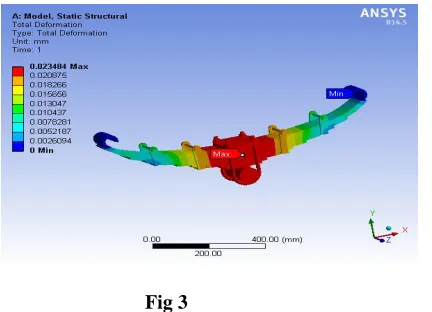
RESULTS FOR 60Si7 STEEL (8000N)
TOTAL DEFORMATION
Fig 3
EQUIVALENT ELASTIC STRAIN
Fig 4
EQUIVALENT STRESS
Fig 5
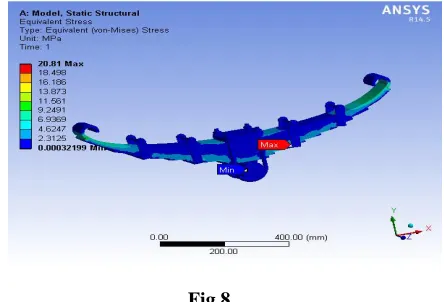
RESULTS FOR E GLASS EPOXY(8000N)
TOTAL DEFORMATION
EQUIVALENT ELASTIC STRAIN
Fig 7
EQUIVALENT STRESS
Fig 8
COMPARISION OF RESULTS
RESULT COMPARISION FOR 60Si7 STEEL
Table 3
RESULT COMPARISION OF E-GLASS EPOXY
Table 4
GRAPH
Graph 1
Graph 2
0 0.01 0.02 0.03
1 2
Total deformation
(mm)
Total deformati on (mm)
0 10 20 30
1 2
Equivalent stress
(MPa)
Equivalen t stress (MPa)
60Si7 STEEL Minimu
m
Maximm 8000N
Total deformation (mm) 0 0.0234
Equivalent elastic strain
(mm/mm) 0
9.7X10⁻⁵
Equivalent stress (MPa) 0 20.482
E-GLASS EPOXY Minimu
m
Maximu m8000N
Total deformation (mm) 0 0.0205
Equivalent elastic strain
(mm/mm) 0
8.6X10⁻⁵
E-GLASS EPOXY
Graph 3
GRAPH 4
CONCLUSION
Analyzing results for leaf spring under force are listed in the Table. Analysis has been carried out by 60Si7 steel (conventional material) and optimizing the materials i.e., E glass epoxy, carbon fiber. The results such as total deformation, equivalent elastic strain and equivalent stress for each material are determined. Comparing the optimized materials and the conventional material, E glass epoxy composite material has the low values of total deformation and strain. Hence it is concluded that E glass epoxy material can be used for the leaf spring.
REFERENCES
[1] M. Venkateshan, D. HelmenDevraj, Design and analysis of leaf spring in light vehicles, IJMER 2249-6645 Vol.2, Issue.1, pp.213-218, Jan-Feb 2012.
[2] R. S. Khurmi and J. K. Gupta Machine Design chapter 23.
[3] U. S. Ramakant& K. Sowjanya, Design and analysis of automotive multi leaf springs using composite material, IJMPERD 2249-6890 Vol. 3, Issue 1,pp.155-162, March 2013,
[4] Rajendran I, Vijayarangan S, Design and Analysis of a Composite Leaf Spring, Journal of Institute of Engineers, India ,vol.-8,2-2002
[5] DakshrajKothari,Rajendra Prasad Sahu and Rajesh Satankar Comparison of Performance of Two Leaf Spring Steels Used For Light Passenger Vehicle, VSRD-MAP 2249-8303 Volume2 (1), 9-16, 2012
[6] Mr. V. Lakshmi Narayana, Design and Analysis of Mono Composite Leaf Spring For Suspension in Automobiles, IJERT 2278-0181, Vol. 1 Issue 6, August – 2012
[7] ShishayAmareGebremeskel, Design, Simulation, and Prototyping of Single Composite Leaf Spring for Light Weight Vehicle, Global Journals Inc. (USA) 2249-4596, Volume 12 Issue 7, 21-30, 2012
[8] ManasPatnaik, NarendraYadav, Study of a Parabolic Leaf Spring by Finite Element Method & Design of Experiments, IJMER 2249- 6645, Vol.2, 1920-1922, July-Aug 2012
[9] Design and Analysis of E-Glass/Epoxy Composite Monoleaf Spring for Light Vehicle SushilB.Chopade1, Prof.K.M.Narkar2 , Pratik K Satav3
0 0.01 0.02 0.03
1 2
Total deformation
(mm)
Total deformati on (mm)
0 10 20 30
1 2