CAKE: An Efficient Group Key Management for Dynamic Groups
PETERHILLMANN1
MARCUSKNUPFER¨ 1
TOBIASGUGGEMOS2
KLEMENTSTREIT1
Munich Network Management Team, Munich, GERMANY
1Universit¨at der Bundeswehr M¨unchen 2Ludwig-Maximilians-Universit¨at M¨unchen
Abstract. With rapid increase of mobile computing and wireless network linkage, the information exchange between connected systems and within groups increases heavily. Exchanging confidential in-formation within groups via unsecured communication channels is a high security threat. In order to prevent third parties from accessing this data, it is essential to encrypt it. For this purpose, the group participants need a common group key to enable encrypted broadcast messages. But efficient key man-agement of secured group communication is a challenging task, if participants rely on low performance hardware and small bandwidth. For coordination and distribution, we present the modular group key management procedure CAKE that is centrally organized and meets strict security requirements. The lightweight G-IKEv2 protocol in combination with the key exchange concept of CAKE leads to an effi-ciently integrated solution. The hybrid approach combines the advantages of the existing protocols with the objective to reduce the computation and communication effort. It is shown that the procedure is more suitable for changing MANET groups than the existing ones. Moreover, the exchanged group key can be used for any services which provides a wide range of applications.
Keywords:GKMP, IKEv2, wireless network, CAKE, LKH.
(Received November 22th, 2019 / Accepted December 5th, 2019)
1 Introduction
In today’s interconnected world, the wireless network linkage is growing rapidly. More and more devices are connected, especially in mobile and resource-constrained networks. Coming from fixed line net-works, unicast communication have been predominant so far. During the last decade, we have witnessed the rise of new low power network technologies, such as ZigBee, IEET 802.15.4, Bluetooth, LoRa, SigFox, 4/5 G, just to name a few. Most of these have in com-mon, that the bandwidth is limited and needs to be man-aged wisely, while the amount of information explodes with new scenarios in the context of IoT or Smart X. In order to meet the requirements in constrained envi-ronments, group communication is becoming more
im-portant for information exchange, as the benefits are re-duced network overhead, computation power, and en-ergy consumption. Efficiency is achieved by transmit-ting data packets only once, simultaneously to all group members. However, when it comes to security and pri-vacy multicast lacks efficiency. Major challenges arise from the necessary management of the multicast group (in the following referred as communication group), which needs to be secured as well as the actual com-munication within the group.
information, such as group keys. Group keys are used for the encrypted communication within a group. Typ-ically, all Group Members (GM) posses a symmetric key which is used to encrypt and decrypt the exchanged data. After all, it does not matter which service is using the GKMP infrastructure as underlying security tech-nology.
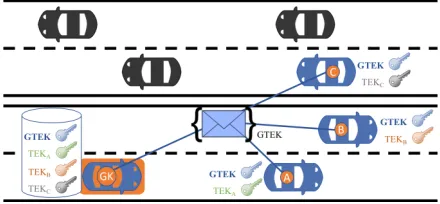
Different areas of application do have distinct re-quirements to be covered by a group key management concept. Consequently, no existing concept could be applied universally to all areas. Depending on the dynamics of the group composition and changes, the calculation of cryptographic keys for the group com-munication, and the numbers of transmitted messages it could be demanding for the GMs concerning com-putation power, network bandwidth and energy con-sumption. As a consequence, existing solutions for se-cured group communication do not fulfill the require-ments for mid-sized and large networks in resource-constrained environments. Exemplary use cases as in Figure 1, where an efficient and secure group communi-cation is needed, areInternet of Things(IoT) networks, saftey-critical system networks, Wireless Sensor Net-works(WSN), andMobile AdHoc Networks(MANET) for public authority communication.
Figure 1:Secure and Efficient Group Communication in a Vehicular AdHoc Network (VANET)
The paper at hand proposes a mechanism to opti-mize the distribution and updating procedure of keys and thus aims on improving the general security prop-erties in group communication in constrained environ-ments. The contribution of this paper is the combina-tion of an efficient networking protocol for group key management with a tree-based key update mechanism and a cryptographic key distribution scheme. The cen-tralized Group-IKEv2(G-IKEv2 [12, 23]) protocol is used for communication and initial key exchange with a key server. Thereon, the mechanism called Central Authorized Key Extension(CAKE [10]) is used to real-ize encrypted group communication. It utilreal-izes the idea ofSecure Lock[6] for compressing secured information into a single cipher and enhances its performance by the
combination with a logical key hierarchy (LKH [19]) and new concepts for managing keys.
The remainder of this paper is structured as fol-lows. In Section II a scenario illustrating the need of this hybrid approach as well as the requirements is given. Section 3 introduces related work on secure group communication and evaluates security as well as efficiency regarding the given scenario with a spe-cial focus on theLogical Key Hierarchy(LKH). After-wards, Section 4 describes the concept of our hybrid system combining the light-weight G-IKEv2 protocol andCentral Authorized Key Extension, called CAKE. Finally, Section 5 evaluates the findings and compares with the well-established LKH, before Section 6 sum-marizes and concludes this paper.
2 Scenario and Requirements
This work aims at concepting a highly efficient, but se-cure group key management scheme to facilitate sese-cure group communication. The motivation is mainly found by the manifold use of constrained devices in a wide range of applications such as civil, industrial or mili-tary use cases. A prominent example for a civil applica-tion is car-to-car communicaapplica-tion (see Figure 1), mainly revealing highly dynamic group formations and wire-less network limitations. In contrast, in home automa-tion scenarios (think of smoke detectors on battery) or military applications such as head-mounted units limi-tations in terms of availability of power, main memoy and storage, CPU and network datarates prevail.
Encrypted communication among a set of more than two group members is common to all scenarios. Thus, it seems desirable to share one cryptographic key among the group members in order to encrypt message trans-fers. Unfortunately, the management of such a key becomes costly quickly due to the dynamics withing a group (i. e. members joining or leaving the group rather frequently). Changing the cryptographic material upon every single group management action seems un-avoidable, which motivates working towards other than naive approaches. Analyzing diverse application areas leads to a set of requirements that can be organized into mostly two categories – security requirements and scenario-driven non-functional requirements.
Security requirements
Forward Secrecy: Whenever a group member leaves the group or is expelled, the member in question must not be able to have access to a valid group key.
Backward Secrecy: Whenever a new group member joins a group, the member in question must not be able to have access to a formerly valid group key before joining.
Key Independence: Having access to one key must not yield the possibility to deduce another mem-ber’s key.
Collision Free: Additionally, specific to group com-munication, there must not be a subset of group members that can deduce another member’s key(s) by combining their knowledge.
Minimal Trust: A certain trust relationship will be found mandatory, but it shall be subject to mini-mize.
“CIA:” – Confidentiality, Integrity and Authenticity must be granted any time, also implying the avoid-ance of man-in-the-middle attacks or data injec-tions.
Scenario-driven non-functional requirements
Low Datarates: The amount of transmitted data shall be minimal in order to facilitate network limited applications.
No 1-to-n Effect: Limited impact of a single mem-bership change on all the other group members is mandatory, meaning not suffering from the 1-affects-n phenomenon, if a single membership change in the group affects all the other group members.
Minimal Delay: The delay imposed by the use of both management actions and cryptographic operations must be minimal.
Minimal amount of key changes and exchanges: The amount of management actions such as exchanging (new) keys shall be limited to a necessary minimum (not implying anything about the total amount of keys in general).
Low calculation complexity: Especially in scenarios exposing CPU limitations, a low complexity of cryptographic calculations is vital, while keeping up the maximally possible security level at the same time.
Compatibility: Clients not capable or not willing to support fancy optimizations should not be ex-cluded from the communication. This is why a potential fall-back to simple (and standardized) mechanism should be supported.
Scenario-driven functional requirements
Based on the scenario, this yield in the following re-quirements for the group operations to be supported while complying the security requirements:
Join: One or more participants accede to an existing group. (Backward Secrecy)
Leave: One or more group members quit the group membership. (Forward Secrecy)
Re-Keying: Updateing the group key using an efficient procedure. (Prevent statistical analysis)
Merge: A common key can be efficiently provided to several groups by re-keying. (Backward Secrecy)
Split: A group is divided into several subgroups. (For-ward Secrecy)
3 Related Work
Secure group communication is an extensively stud-ied area and resulted in a couple of standardization ac-tivities (most recently a new standardization group for group key distribution was formed within the IETF1).
Rafaeli et al. [18] survey a set of approaches for se-cure group key distribution (GKD). According to their analysis, there are three different types of GKDs: cen-tralized, decentralized and distributed GKD protocols. Most of the protocols considered are rather Crypto-graphic Key Schemes (CKS)than networking protocols, but some of them are included inGroup Key Manage-ment Protocols. The paper at hand offers the integra-tion of an optimizedCryptographic Key Schemesinto a centralized management protocol. Thus, the following section is divided inGroup Key Management Protocols for communication andCryptographic Key Schemesto manage the group key. To our knowledge, none of the approaches provides an efficient and integrated so-lution, especially with focus on low resource require-ments. This is one of the reasons why the Internet Engineering Task Force(IETF) started a standardiza-tion process for group key distribustandardiza-tion in February 2018 [21].
3.1 Group Key Management Protocols
A high-level definition ofGroup Key Management Pro-tocols(GKMP) and their corresponding architecture is given by the IETF standard body in RFC 2093 [9] and RFC 2094 [8]. The development of actual GKMPs builds on top of these specifications and usually goes
1https://datatracker.ietf.org/wg/mls- Started in
hand in hand with the development of a peer-to-peer key exchange protocol and its corresponding architecture. The Internet Security Association and Key Manage-ment Protocol(ISAKMP, RFC 2408 [15]), and Group Domain of Interpretation(GDOI, RFC 6407 [22]) have been the first instantiations. The requirements and de-sign of these protocols were derived from multicast ar-chitectures of network vendors. Both, peer-to-peer key exchange and Group Key Management were revised for the sake of stronger security properties and bet-ter performance, resulting inInternet Key Exchange v2 (IKEv2, RFC 7296 [12]) and the currently proposed G-IKEv2 [23] for groups. As G-G-IKEv2 offers a reduced networking overhead and includes a structure for dis-tributing hierarchical keying information, we build the design of our solution on top of G-IKEv2 and the latest architecture from RFC 4046 [4].
3.2 Cryptographic Key Schemes
Centralized Cryptographic Key Schemes (CKS) com-prise a central control authority to manage the group key and to coordinate the cryptographic procedures, of-ten based on a GKMP. In contrast, decentralized tech-niques share the management of the keys between sev-eral instances [5, 17]. Thereby, the generation and dis-tribution of group keys is realized by cooperative in-stances, which are typical hierarchically ordered. In ad-dition, distributed key agreement procedures delegate the key generation process to not only an individual group member, but to a group of members.
One example is theGroup-Diffie-HellmanKey Ex-change [20], but others exist [18]. All members of a group are organized in a virtual topology, typically into a ring, hierarchies on basis of trees, or just unstructured. In all these schemes, every member of a group shares a commonTransport-Encryption-Key(TEK).
Another approach is dividing groups into subgroup with individual TEKs. A master within every subgroup takes care of the communication and keys, which allows avoiding 1-to-n effects while re-keying [5]. The down-side is requiring repetitive conversions of encrypted messages between the subgroups. Within the sub-groups, these approaches use key management tech-niques of the three shown categories why out of scope of this work.
Despite their structured nature, centralized CKS can further be categorized into one of the three subcate-gories:
• Pairwise keys: Transmission of the group key by the central instance via individual subscriber com-munication
• Broadcast secret: Transmission of the group key via broadcast instead of individual secured con-nections
• Hierarchical structure: Coordination of partici-pants in a tree structure with corresponding cryp-tographic subkeys
The first and most widely recognized CKS ever is defined in the GKMP, which belongs to the category of the pairwise keys. The central server shares an individ-ual secret key with each group member, which is called the Key-Encryption-Key (KEK). For a common TEK of a group, the server generates these. Subsequently, the server sends the group key to each participant indi-vidually encrypted using the KEK. Upon change of the group constellation, the entire group is re-created, lead-ing to high management and communication overheads. An example for the broadcast secret is theSecure Lock(SL) [6, 2] that enables the creation of a group or a re-keying action using a single broadcast message. The SL scheme is based on theChinese Remainder Theo-rem(CRT) [25, 24], which uses the properties of con-gruence to encrypt. However, the reduction of commu-nication overhead is obtained by more complex calcu-lations compared to GKMP so that this approach only renders feasible in special scenarios.
A compromise are schemes building on hierarchi-cal structure. A well-known approach is Logical-Key-Hierarchy (LKH) [19, 13], which is integrated into GDOI and G-IKEv2. The KEK’s and the group par-ticipants are maintained in a binary tree. Each node in the tree represents a KEK that is known to the underly-ing nodes. Maintainunderly-ing the associated keys of the tree structure increases the management effort, especially the calculation and distribution of internal keys. This approach offers a moderate advantage only in case of repetitive leavings of group members. Since this oper-ation does not take place in every secured group, this is unnecessary effort.
Focusing on the motivation for this paper, a cen-tralized scheme with common TEK renders mandatory, especially in order to control and authorize individual members of a group. In this paper, a combination of the advantages of GKMP, SL and LKH as CAKE [11] with an integration into G-IKEv2 is proposed, allowing for efficient key management.
4 Concept
Targeting highly efficient and encrypted group com-munication, this paper proposes the combination of lightweightG-IKEv2 ([23]) for the key exchange and Central Authorized Key Extension(CAKE) [10] for the
group key management. CAKE’s key management is centrally organized and requires a trustworthy Group Controller (GC). The GC is responsible for the gener-ation, administration and distribution of the keys and thus requires more computational power than any other (lightweight) group member.
The remainder of this section is organized into sub-sections inspired by group management operations and patterns:
(A) Client-Server communication based on G-IKEv2
(B) Member Registration on the GC
(C) Group and Group Key Creation
(D) Re-Key of the group
(E) Join of member(s) to a secured group
(F) Leave / Exclude of member(s) from a secured group
(G) Tree Management and Key Addressing
(H) Merging and splitting groups
4.1 Client-Server communication based on G-IKEv2
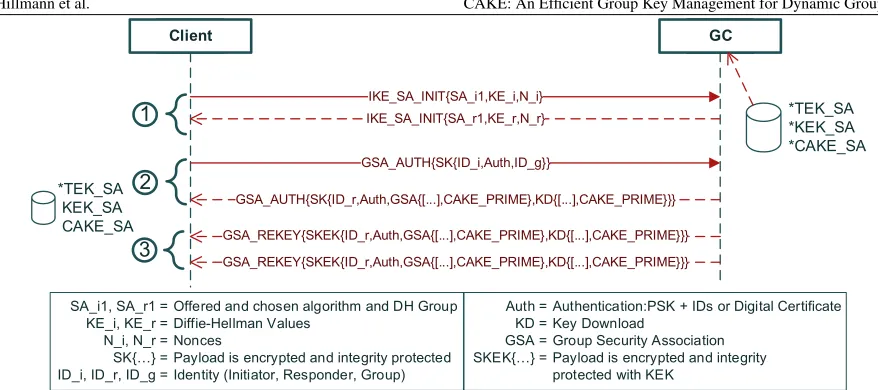
G-IKEv2 [23] is used to secure the transmission of cryptographic material for CAKE as it has already proven suitable for constrained devices [7]. G-IKEv2 already supports the establishment of a confidential and authenticated 1-to-1 channel between a client and the GC. It also offers the distribution ofGroup Trans-mission Encryption Keys (GTEK) andGroup Key En-cryption Keys (GKEK) and thus only requires addi-tional support for CAKE. To communicate securely in a group, every group member has to possess a GTEK used for the communication in the group and a GKEK used to distribute the GTEKs securely. Figure 2 gives an overview about G-IKEv2:
1. Key Exchange: A G-IKEv2 key exchange can be divided into two phases:
(a) Establishing an Initial Security Associa-tion(IKE SA INIT): The first two messages from the client to the GC and back estab-lish aSecurity Association (SA) and thus a secure channel between the client and the server (PhaseÀ: Initialization).
(b) Exchanging keys (GSA AUTH): Given the secured communication path, the client iden-tifies and authenticates itself and in turn
receives transport and key encryption keys (GTEK and GKEK) from the server. The Group Security Association (GSA) Policy in-cludes the security parameters (algorithms, lifetime, etc.), while the actual keys are trans-ported within theKey Download (KD) Pay-load(PhaseÁ: Group Lifetime).
2. Re-Keying (GSA REKEY): Whenever a GTEK or GKEK loses validity (e. g. being out-dated), a re-keying action is triggered by the server (GSA REKEY), which is close to equal to the GSA AUTH phase (PhaseÂ: Group Key Re-fresh).
4.2 Member Registration on the GC
Each participant Pi registers with CAKE by
negotiat-ing an individual key pair (Keyi) with the GC
dur-ing an IKE SA INIT exchange (À). The initial ex-change is done with a Diffie-Hellman key exex-change, which by design lacks authenticity. A second message GSA AUTH (Á) is used to authenticate both, the client and the GC. Note, that the GSA AUTH can be used to directly join a group as part of the registration process (see Section 4.5).
4.3 Group and Group Key Creation
On request, the GC randomly generates a GTEK and GKEK. According to G-IKEv2, the GC manages cryp-tographic material and algorithms for every group. They are stored in theTEK SAandKEK SAdatabases (see Figure 2).
The GC may decide to create a new group with the new group key and members already registered and au-thenticated by building a GSA REKEY payload as fol-lows:
1. The GC constructs a CRT congruency in analogy to the SL scheme, so-calledLock MX. Therefore, it uses the individual mi and Keyi from all
par-ticipants of the specified group to calculate the Lock MX to encrypt the GKEK (see CRT calcu-lation [25, 24]).
2. The GTEK is encrypted with the GKEK. For the sake of efficiency and security [14], X OR-operations are used for bitwise encryption of the new key tuple with a hashed GKEK. However, any encryption method specified by G-IKEv2 is sup-ported.
Client GC
*TEK_SA *KEK_SA *CAKE_SA
IKE_SA_INIT{SA_i1,KE_i,N_i} IKE_SA_INIT{SA_r1,KE_r,N_r}
GSA_AUTH{SK{ID_i,Auth,ID_g}}
GSA_AUTH{SK{ID_r,Auth,GSA{[...],CAKE_PRIME},KD{[...],CAKE_PRIME}}}
GSA_REKEY{SKEK{ID_r,Auth,GSA{[...],CAKE_PRIME},KD{[...],CAKE_PRIME}}} GSA_REKEY{SKEK{ID_r,Auth,GSA{[...],CAKE_PRIME},KD{[...],CAKE_PRIME}}}
*TEK_SA KEK_SA CAKE_SA
= = = = = SA_i1, SA_r1
KE_i, KE_r N_i, N_r SK{ } ID_i, ID_r, ID_g
Offered and chosen algorithm and DH Group Diffie-Hellman Values
Nonces
Payload is encrypted and integrity protected Identity (Initiator, Responder, Group) 1
2
3
= = = = Auth
KD GSA SKEK{ }
Authentication:PSK + IDs or Digital Certificate Key Download
Group Security Association Payload is encrypted and integrity protected with KEK
Figure 2:G-IKEv2 exchange with CAKE features
KEK MANAGEMENT ALGORITHM called CAKE) and a CAKE PRIME KD payload. They are distributed using a single GSA REKEY broadcast message.
A participantPi can only “open” the Lock MX, if
she possesses a valuemi that was included during the
creation of the lock. In consequence, only intended recipients (i. e. group members) are able to read the GKEK and GTEK by solving the CRT.
4.4 Re-Key of the group
In case the GT EK needs to be renewed, a re-keying action is carried out. The GC generates the keys GKEKnewandGT EKnew, which will be encrypted
us-ing theGKEKcurrent, embedded into the KD and
broad-casted with a GSA REKEY message. In order to grant forward and backward secrecy, a re-keying action is also carried out every time a member joins or leaves the group.
4.5 Join of new member(s) to a secured group
If a new participantPi+1wishes to join the group, she
sends a GSA AUTH request including the group IDIdg
she wishes to join. The GC authenticatesPi+1and
gen-erates an inhomogeneous prime numbermi+1for a CRT
congruency forPi+1. Additionally, a new GSA policy
and KD payload calledCAKE PRIMEis added, holding mi+1. The use of CAKE is communicated with a new
KEK MANAGEMENT ALGORITHMcalledCAKEwithin the GSA Policy (see Section 4.5.1.1 in [23]). The GC also generatesGKEKnewandGT EKnewand embeds the
information and keys into an GSA AUTH sent to the new group member via unicast.
Additionally, a re-key is triggered for any of the former group members. The re-key includes the KD (GKEKnew,GT EKnew) encrypted with the
GKEKCurrent. Switching fromGT EKold toGT EKnew
enables the enlarged group (former group plus joined members) to communicate securely. As long as the GT EKold andGKEKold are still secure theGT EKnew
andGKEKnewshould be generated by hashing theold
once. So the keys do not need to be distributed over the network. Only a tiny information message is necessary. A mass entry of more than one new participant is equivalent to the process as described before, whereas theGT EKnew is send to every new member
individu-ally. Alternatively, the new participants can be com-bined together via a CRT to transmit theGKEKnewso
that only one message is necessary instead of multi-ple individual ones. Unfortunately, the latter is only possible if the joining clients are already authenticated. In both cases, two GSA REKEY messages are broad-casted, one holding the Lock MX for the new clients and one with(GKEKnew,GT EKnew)encrypted with the
GKEKCurrent for the former group members. Thus, an
arbitrary number of new members joining a group re-quires a constant number of messages and thus scales efficiently with the amount of new members.
4.6 Leave / Exclude of a member from a secured group
Withdrawal of a member from a group can be initi-ated by the participant herself or be determined by the GC as exclusion. In any case, the presently known
GT EKCurrent andGKEKCurrent cannot be used, as the
expelled participant is in possession of them. To re-duce the effort, CAKE uses a rere-duced CRT system and a ternary tree structure, which is managed by the GC.
Figure 3 illustrates CAKE’s tree structure with level A (the root) representing the GKEK and GTEK. Every node represents a pair of keys (mt and keyt)
known by the underlying participants. The actual group members with their personal secrets mi and keyi are
mapped to the leaf nodes of the tree. The designation mX of a node defines a specificmifor the CRT system.
All pair of keys on the path from the root to the participant must be known by the participant. The tree structure enables efficiency, but its creation can be de-ferred and only be initialized if necessary. This allows the tree being set up and distributed during a period of low network load. Considering the state of the art, nearly any tree-based scheme ignores this issue and ex-cludes the costs for the tree setup in the evaluation.
Due to their flat structure, trees with more than two subnodes are better suited for larger groups than binary trees. In most scenarios (rarely more than 60 partic-ipants and hard to imagine more than 300 [16]), the ternary tree structure is ideal with regard to the size of the tree.
4.7 Tree Management and Key Addressing
In order to differentiate between different keys, an ef-ficient addressing scheme is mandatory. This applies to every key, not just the keys in the tree. The ID of every key pair is defined as an 8x2 bits address. This address space allows a maximum tree depth of 8 and 2,187 group members in a group with 3,280 key pairs in the tree. The IDs are starting from00at the root key pair on the top. Every parent has the children01,10 and11. The unused bits are padded with00. This al-lows a unique identification of the position of every key within the tree.
Temporary keys can be derived easily like the keys for re-keying actions. These key pairs not yet included in the tree structure obtain the ID starting with11. Af-ter a client is authenticated with the GC, it has its own secretmiandkeyi(see Section 4.5), distributed with an
address within or outside the tree. This support the re-balancing if the tree if necessary by the GC.
In order to take full advantage, the CAKE pro-tocol for the distribution of keys requires the imple-mentation of the following messages: I.) Download-ing key pairs on the path to the root from the GC - CAKE Download Array II.) Re-Addressing of keys - CAKE Update ArrayIII.) Receiving updates of key
pairs -CAKE Readress ArrayIV.) Re-Keying upon re-moval of group members -CAKE Leave Array
This is similar to the payloads already defined in G-IKEv2 forLKH Download Type (see Section 4.8.3 in [23]). According to this, these four CAKE Download Types and three substructures are defined as array ele-ments. This support the compatibility. As shown above, any message can be distributed securely as broadcast. Furthermore, the information of all download types are structured as an array to differentiate between the ele-ments. Each elements of the arrays is indexed with the identity of the key pair in the tree. Using the unique tree IDs, the nodes can detect if they are affected by the action or not by comparing address prefixes.
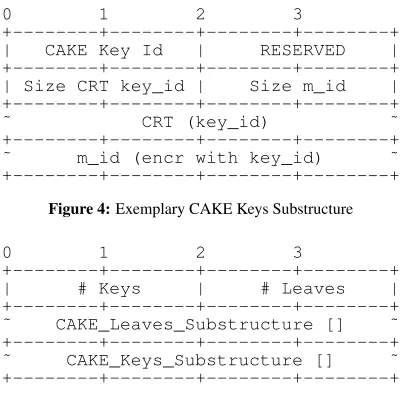
The CAKE Download Array can be embedded in GSA AUTH or GSA REKEY message. It holds mul-tiple keys, transported within a Key-Substructure (see Figure 4). Therefor, a CRT formiandkeyiis built using
the key pairs of the child nodes in the tree. The sub-structure includes the address of the key pair and the CRTs themselves. For efficiency, the tree has to be dis-tributed bottom up as other tree based group key man-agement schemes. If a client is in possession of one key pair, then he is able to solve the Lock MX to obtain the information.
For the re-addressing of the keys, we use the CAKE Update Array embedded in a GSA REKEY message. Due to the message type, the receiver knows, that there have been distributed keys before. Thus, these keys need to be updated in the client’s CAKE SA.
To change the ID of a key pair, the CAKE Readress Array is used. With this mes-sage, a key pair obtains a new position in the tree. Furthermore, it can be used to include nodes to the tree or to re-arrange subtrees (e. g. when the tree is re-balanced). The readdress information is holding in tuples(Idold,Idnew). If a key on his path to the root
receives re-addressing, it needs to update all keys on its path further down the tree.
Keys-mA1
mB1 mB2 mB3
mC12
mC11 mC13 mC21 mC22 mC23 mC31 mC32 mC33
mD12
mD11 mD13 mD21 mD22 mD23 mD31 mD32 mD33 Level A – Root
GTEK, GKEK
Level B
mt, keyt
Level C
mt, keyt
Level D – Leaves
GSA, mi, keyi, (Group members)
00
01 10 11
01 10 11 01 10 11 01 10
11
11
01 10 11 01 10 11
01 10
mXYZ
m à Secret for CRT Lock X à Tree Level of the secret Y à Index of the subgroup Z à Index within the subgroup {--} à Binary adressing of a secret
(key pair)
--Figure 3:Ternary tree structure to manage the keys and to reduce the calculation effort by withdrawal.
0 1 2 3
+---+---+---+---+ | CAKE Key Id | RESERVED | +---+---+---+---+ | Size CRT key_id | Size m_id | +---+---+---+---+
˜ CRT (key_id) ˜
+---+---+---+---+ ˜ m_id (encr with key_id) ˜ +---+---+---+---+
Figure 4:Exemplary CAKE Keys Substructure
0 1 2 3
+---+---+---+---+
| # Keys | # Leaves |
+---+---+---+---+ ˜ CAKE_Leaves_Substructure [] ˜ +---+---+---+---+ ˜ CAKE_Keys_Substructure [] ˜ +---+---+---+---+
Figure 5:Exemplary CAKE Leave Array
Substructure (see Figure 4) which in turn is embedded in the CAKE LEAVE ARRAY (see Figure 5). The op-eration allows excluding multiple nodes with only one message.
Please note that the GC may choose to distribute only the root key pair with a short and tiny mes-sage. The other keys on the path are updated later with CAKE Update Array instead of one large CAKE Leave Array.
4.8 Merging and splitting groups
To merge two or more existing groups, it requires a renewal of several keys. The new commonGT EKnew
will be spread based on the currently used individual GKEKs of the merging groups. It is mandatory to send one message per group to create a merged group.
A group split is done by re-addressing the sub-keys
within the key tree and building Lock MX in the amount of divivded subgroups including the new keys. The number of messages may be as small as one, but de-pends heavily on the previous tree structure. As every leave operation, it is coherent with a high effort and will be analyzed in detail in further studies.
Please note that the usage of the Delete Payload message as specified in [23] is not resistant to malicious attacks of internal group members. In the cryptographic community, this problem is referred to as Post Compro-mise Security, which is an unresolved unresolved prob-lem. So CAKE avoids the usage of this message and the process has to be authorised through the group con-troller.
5 Evaluation
Having a sound concept at hand, this section evalu-ates CAKE under the following three aspects: Firstly, a (theoretical) comparison of the computational com-plexity as well as networking load of CAKE, LKH and traditional GKMPs is carried out. Secondly, an im-plementation of CAKE for RIOT OS proofs both its lightweight nature and its applicability in constrained scenarios. Given the result, the section will close by evaluating CAKE against the requirements as stated in Section 2.
5.1 Comparison with LKH and GKMP
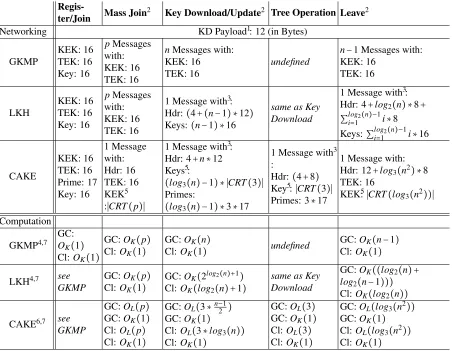
Existing concepts for managing group keys are tradi-tional GKMP systems (represented by G-IKEv2) and LKH. Table 1 contains the comparison of CAKE with these two concepts regarding the networking and com-putation overhead. On the one side, it is indisputable that as no client leaves the group the traditional GKMP approach performs optimal. On the other side, LKH and CAKE perform far better in terms of quantity of
Table 1:Comparison of CAKE with LKH and traditional GKMP (represented by G-IKEv2), with special regards on cryptographic overhead. The keys are defined for AES with 16 Byte keys.
Regis-ter/Join Mass Join
2 Key Download/Update2 Tree Operation Leave2
Networking KD Payload1: 12 (in Bytes)
GKMP KEK: 16 TEK: 16 Key: 16 pMessages with: KEK: 16 TEK: 16
nMessages with: KEK: 16 TEK: 16
undefined
n−1 Messages with:
KEK: 16 TEK: 16 LKH KEK: 16 TEK: 16 Key: 16 pMessages with: KEK: 16 TEK: 16
1 Message with3: Hdr:(4+ (n−1) ∗12)
Keys:(n−1) ∗16
same as Key Download
1 Message with3: Hdr: 4+log2(n) ∗8+
∑log2
(n)−1
i=1 i∗8
Keys:∑log2
(n)−1
i=1 i∗16
CAKE KEK: 16 TEK: 16 Prime: 17 Key: 16 1 Message with: Hdr: 16 TEK: 16 KEK5 :∣CRT(p)∣
1 Message with3: Hdr: 4+n∗12
Keys5:
(log3(n) −1) ∗ ∣CRT(3)∣
Primes:
(log3(n) −1) ∗3∗17
1 Message with3 :
Hdr:(4+8)
Key5:∣CRT(3)∣
Primes: 3∗17
1 Message with: Hdr: 12+log3(n2) ∗8
TEK: 16
KEK5:∣CRT(log3(n2))∣
Computation
GKMP4,7 GC: OK(1)
Cl:OK(1)
GC:OK(p)
Cl:OK(1)
GC:OK(n)
Cl:OK(1) undefined
GC:OK(n−1)
Cl:OK(1)
LKH4,7 see GKMP
GC:OK(p)
Cl:OK(1)
GC:OK(2log2(n)+1)
Cl:OK(log2(n) +1)
same as Key Download
GC:OK((log2(n) +
log2(n−1)))
Cl:OK(log2(n))
CAKE6,7 see GKMP
GC:OL(p)
GC:OK(1)
Cl:OL(p)
Cl:OK(1)
GC:OL(3∗n−1
2 )
GC:OK(1)
Cl:OL(3∗log3(n))
Cl:OK(1)
GC:OL(3)
GC:OK(1)
Cl:OL(3)
Cl:OK(1)
GC:OL(log3(n2))
GC:OK(1)
Cl:OL(log3(n2))
Cl:OK(1)
1Required for every Key distributed with G-IKEv2 2nbeing Group Members,pnumber of members joining
or leaving 3KEK and TEK is carried as in GKMP 4GC performsencryptand Client performsdecrypt
5∣CRT(i)∣: size of CRT withielements in Bytes 6O
L: Complexity of creating/solving Lock MX.
7O
K: Complexity of encryption/decryption of keys.
messages and computations when Forward Secrecyis required at the moment clients leave. This is a major benefit of these two concepts.
Although CAKE requires a pair of keys (mi and
keyi) to be sent when distributing the tree, it can
out-perform the LKH mechanism introduced in G-IKEv2. The amount of key headers is equal in both systems. Unfortunately, LKH tree entries need to be transported multiple times decreasing its efficiency. Using a CRT system, CAKE offers the distribution of keys using a single message. Beside this, the message can be send to a later point of time, when network load is low. Al-though, the size of the resulting Lock MX increases lin-early (see Table 2), it still decreases the necessary
pro-tocol information heavily.
CAKE also reduces the demand for computational power on the client-side. Instead of carrying out multi-ple decryption operations (as for exammulti-ple LKH would do), the client has to perform one single modulo and one decrypt operation only. Nonetheless, this comes at the price of storing more cryptographic material(mi,keyi)
compared to LKH where onlykeyihas to be stored for
every node in the tree.
5.1.1 Network overhead of LKH
max-imum number of 65,536 participants. For comparison we assume a tree with 11 levels resulting in a maximum of 2,048 participants. Removing one client from the key will therefore result in 10 keys having to be changed and distributed in the network (for better insights to LKH in G-IKEv2 we recommend Appendix A of [23]). This would result in 10 LKH UPDATE ARRAYs car-rying a total of∑10i=116∗i+8∗i+8=1,400 Bytes (16,
being the Key size, 8 being the LKH Keys header and 8 being the LKH UPDATE ARRAY header). Please note that in the current version of the G-IKEv2 ex-tension for LKH, many keys are transported multiple times which heavily decreases efficiency. With some optimizations, the LKH Key Download could be de-creased to 464 Bytes and, thus, being slightly more effi-cient than CAKE in terms of networking. However, this slightly better efficiency comes with the cost of higher computation overhead on the client, as in the worst case, 10 keys have to be decrypted individually. Addition-ally, changing the tree can currently not benefit from an address scheme as proposed in CAKE, making this operation more expensive in terms of networking and computation.
5.1.2 Unoptimized re-key networking overhead
Using the G-IKEv2 protocol without any optimizations (such as CAKE or LKH) would result in number of participants messages including 80 Bytes overhead for KEK and TEK. Assuming the current maximum of 2,187 participants, this would result in 2,187 messages. The IETF draft for G-IKEv2 [23] defines an additional GSA INBAND REKEY message for such tasks. Even without optimization, the new keys could be carried out in a single broadcast message, encrypting the KEK with every privately shared secret between client and server. The GSA REKEY message would carry one KEK Key Download Types (40 Bytes) for every participant and one TEK Key Download Type (40 Bytes). For 2,187 participants, this would result in a 2,187∗40+40=
87,520 Bytes overhead.
5.2 Performance on constrained hardware
RIOT OS [3] is an open source operating system that supports various hardware. Its minimal requirement of 1.5 KB main memory illustrates its lightweight nature and is one of the reasons we implemented CAKE on RIOT. Further, necessary cryptographic libraries with importance for embedded systems are available. The generation of an evaluation environment with realis-tic conditions is achieved by using IOT-LAB [1]. It provides a huge amount of wireless nodes with
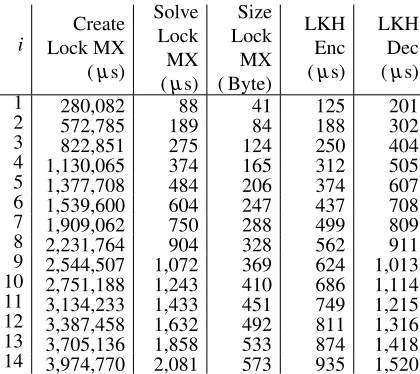
mini-Table 2:Required time for Lock MX operations withielements. For comparison, the time to encrypt and decrypt the key hierarchy of LKH with tree depthiis shown. The number of clients is 3ifor CAKE and 2ifor LKH.
i
Create Lock MX (µs)
Solve Lock MX (µs)
Size Lock MX ( Byte)
LKH Enc (µs)
LKH Dec (µs)
1 280,082 88 41 125 201
2 572,785 189 84 188 302
3 822,851 275 124 250 404
4 1,130,065 374 165 312 505
5 1,377,708 484 206 374 607
6 1,539,600 604 247 437 708
7 1,909,062 750 288 499 809
8 2,231,764 904 328 562 911
9 2,544,507 1,072 369 624 1,013 10 2,751,188 1,243 410 686 1,114 11 3,134,233 1,433 451 749 1,215 12 3,387,458 1,632 492 811 1,316 13 3,705,136 1,858 533 874 1,418 14 3,974,770 2,081 573 935 1,520
mal capabilities regarding CPU and memory. The IOT-LAB M3 board comes with a 72 MHz CPU and 64 KB SRAM and is used for the GC and all clients. The eval-uation focuses on the group management and the asso-ciated key distribution processes.
5.2.1 Memory requirements
For the evaluation we created a homogenous setup with a GC and a group of 14 clients on IOT-LAB M3 nodes. Regarding the memory requirements, the design princi-ples of RIOT OS need to be considered, as all memory is statically reserved, including the network buffer. The required memory on the GC is defined through the num-ber of all necessary keys within the ternary tree includ-ing the nodes. For each participant, the GC requires a total of 2,900 Bytes of data being stored, consisting of keys, IP addresses, and memory for CRT calculations and tree operations. Subsequently, the required memory for the GC is 40,600 Bytes in total, which is covered by the available memory of 64 KB in our evaluation setup. The memory requirements for participants of the group are lower. Each client requires only 2,900 Byte per con-nection to a GC.
5.2.2 Computational Costs for CRT
As the evaluation focuses on constrained hardware, we concentrate on time measurements for the crypto-graphic calculations. The most expensive operation is the IKE SA INIT message, which is caused by the necessary computation of the DH key exchange. The
measurements in our evaluation setup show computa-tion times on the IOT-LAB M3 nodes that are com-parable with the times on Arduino Due in [7]. Fur-thermore, most actions in CAKE require only one sin-gle GSA REKEY message carrying G-IKEv2 payloads (see [23]), which is beneficial in terms of computation time.
The most interesting new feature of CAKE is the Lock MX creation and solving on the GC and the clients in terms of computational cost. Table 2 shows the mea-surement results for the creation of the Lock MX with different tree depths as well as the time to resolve it on client side. These results are especially notable regard-ing amass entry(see Section 4.5), wherei represents the number of clients joining simultaneously. Along with the number of elements in the CRT, the compu-tation time of new keys increases. Evidently, this is mainly caused by the higher size of the Lock MX. On the other side, the clients significantly benefit from the new method to receive keys. One simple modulo oper-ation is needed on client side resulting in low computa-tion time for solving the Lock MX even at its maximum size of 14 elements.
For comparison, the costs for encrypting and de-crypting keys within an LKH tree are shown in Table 2. It can be seen that even though the AES implementa-tion is highly optimized, solving the Lock MX scales similar to decrypting the keys within the LKH tree. However, lowering network load with CAKE comes at the price of computational overhead for creating the Lock MX, which scales worse than LKH. Optimizing the Lock MX implementations will be part of further studies.
5.3 Fulfillment of requirements
Resource-constrained environments necessitate func-tional and non-funcfunc-tional requirements. The design of CAKE particularly focuses to meet these. Firstly, the ternary tree enables a reduced number of keys needed to be stored and sent. Additionally, through CAKE a re-keying is possible with one single message and the per-packet overhead is reduced. Thus, the require-ments Low Datarates and No 1-to-n Effectare ful-filled. When group changes happen, the evaluation shows that CAKE requires only a minimum of mes-sages to be sent. For group leave actions the CRT is utilized and the calculation complexity is reduced to only one modulo operation on client side. So,Minimal DelayandLow calculation complexityare achieved. The required Minimal amount of key changes and exchanges is realized by combining the ternary tree and the addressing scheme. This allows the
minimiza-tion of required acminimiza-tions in case of restructuring the tree. Moreover, theCompatibilityrequirement is achieved by using the G-IKEv2 protocol, which is currently be-ing standardized. Any client that is not capable of the newly introduced features may participate in the group by utilizing standard re-keying mechanism, while the CAKE-capable clients can still use the optimized fea-ture set. Additionally, through the use of G-IKEv2, the Security Propertiesare met, as they are included in the standardization and therefore well studied. From this point of view, CAKE is an optimization of key cal-culation and transport, leaving the security parameters as they are. Lastly, the Minimal Trustrequirement can be accomplished on a per-scenario-basis through-out the various supported authentication mechanisms of G-IKEv2.
Besides the practical applicability and its pros and cons in comparison to especially LKH, reviewing the initial design goals and requirements shows complete-ness. A detailed design explanation and security assess-ment can be found in [10].
6 Conclusion
In this paper, we presented the concept of an efficient group-key-management protocol that meets the require-ments of resource-efficient procedures in many applica-tion scenarios like MANET. It is based on the combina-tion of the lightweight G-IKEv2 [12] communicacombina-tion protocol in combination with CAKE [10] for the key exchange and key management. CAKE offers the pos-sibility to exchange keys within a group and to react ef-ficiently to dynamic changes of the group with low cal-culation effort and a low load on the network. Neverthe-less, it enables confidential key distribution and compli-ance with backward and forward security requirements for mobile computing. The main objective to reduce the network load to a minimum is achieved at the cost of additional storage space for supplement cryptographic key material. The CRT-based key hierarchy together with a ternary keys tree structure reduce the data to be transferred especially during group leave operations. The design of CAKE delegates computational demand-ing cryptographic operations to the group controller, re-lieving to potentially less powerful group members. In today’s interconnected world, this middleware technol-ogy shows advantageous in the area of secure group communication among highly constrained group mem-bers.
Thus, the optimization of both in concerning scenar-ios is subject of future work, which will allow for a more comprehensive and technical comparison of LKH and CAKE. Beside further improvements of the CAKE prototype, the basic concept and the implementation is evaluated for building and solving the CRT System worth investigating. Finally, a more detailed analysis of the solution to post-compromise security is of great interest in the case of merging and division of groups.
Acknowledgment
We thank the MNM-Team for all the helpful comments and discussions while writing this document, especially Nils gentschen Felde. We also thank our students Edgar Goetzendorff, B.Sc., and Mehdi Yosofie, B.Sc., for as-sisting us during the development of the prototype and the helpful discussions.
References
[1] Adjih, C., Baccelli, E., Fleury, E., Harter, G., Mitton, N., Noel, T., Pissard-Gibollet, R., Saint-Marcel, F., Schreiner, G., Vandaele, J., and Wat-teyne, T. FIT IoT-LAB: A large scale open exper-imental IoT testbed. InWorld Forum on Internet of Things (WF-IoT), pages 459–464. IEEE, 2015.
[2] Antosh, C. J. and Mullins, B. E. The scalabil-ity of secure lock. InIEEE International Perfor-mance, Computing, and Communications Confer-ence, volume 27, pages 507–512, 2008.
[3] Baccelli, E., Hahm, O., Gunes, M., Wahlisch, M., and Schmidt, T. C. Riot os: Towards an os for the internet of things. In Conference on Computer Communications Workshops (INFO-COM WKSHPS), pages 79–80. IEEE, 2013.
[4] Baugher, M., Canetti, R., Dondeti, L., and Lind-holm, F. Multicast Security (MSEC) Group Key Management Architecture, April 2005. RFC4046.
[5] Challal, Y. and Seba, H. Group key management protocols: A novel taxonomy.International Jour-nal of Computer, Electrical, Automation, Control and Information Engineering, 2(10):3620 – 3633, 2008.
[6] Chiou, G.-H. and Chen, W.-T. Secure broadcast-ing usbroadcast-ing the secure lock. IEEE Transactions on Software Engineering, 15(8):929–934, 1989.
[7] gentschen Felde, N., Guggemos, T., Heider, T., and Kranzlm¨uller, D. Secure Group Key Distri-bution in Constrained Environments with IKEv2.
In Conference on Dependable and Secure Com-puting, Taipei, Taiwan, 2017. IEEE.
[8] Harney, H. and Muckenhirn, C. Group Key Man-agement Protocol (GKMP) Architecture. Internet Engineering Task Force, 1997. RFC2094.
[9] Harney, H. and Muckenhirn, C. Group Key Man-agement Protocol (GKMP) Specification. Techni-cal Report 2093, Internet Engineering Task Force, 1997.
[10] Hillmann, P., Kn¨upfer, M., and Dreo Ro-dosek, G. CAKE: Hybrides Gruppen-Schl¨ussel-Management Verfahren. In M¨uller, P., Neumair, B., Raiser, H., and Dreo Rodosek, G., editors,10. DFN-Forum Kommunikationstechnologien, pages 31–40, Bonn, 2017. Gesellschaft f¨ur Informatik e.V.
[11] Hillmann, P., Kn¨upfer, M., and Dreo Ro-dosek, G. CAKE: Hybrides Gruppen-Schl¨ussel-Management Verfahren. In DFN Mitteilun-gen Ausgabe 92, pages 22–27, Berlin, 2017. Deutsches Forschungsnetz.
[12] Kaufman, C., Hoffman, P., Nir, Y., Eronen, P., and Kivinen, T. Internet Key Exchange Protocol Ver-sion 2 (IKEv2), 2014. RFC7296.
[13] Liu, Z., Lai, Y., Ren, X., and Bu, S. An Efficient LKH Tree Balancing Algorithm for Group Key Management. InProceedings of the International Conference on Control Engineering and Commu-nication Technology (ICCECT), volume 10, pages 1003–1005. IEEE Computer Society, 2012.
[14] Matt, C. and Maurer, U. The one-time pad re-visited. InIEEE International Symposium on In-formation Theory Proceedings (ISIT), volume 11, pages 2706–2710, 2013.
[15] Maughan, D., Schertler, M., Schneider, M., and Turner, J. Internet Security Association and Key Management Protocol (ISAKMP), 1998. RFC2408.
[16] Persistent Systems LLC. Mobile ad hoc network-ing solution delivers reliable comms, situational awareness, under rough conditions. https: //www.prnewswire.com/news-release s/persistent-systems-successfull y-demonstrates-flat-320-radio-m pu5-network-300634923.html/ (Access Date: 24 April 2018), 2018.
[17] Rafaeli, S. A decentralised architecture for group key management. Technical report, LAN-CASTER UNIVERSITY, 2000.
[18] Rafaeli, S. and Hutchison, D. A Survey of Key Management for Secure Group Communication. ACM Comput. Surv., 35(3):309–329, 2003.
[19] Sakamoto, N. An efficient structure for lkh key tree on secure multicast communications. In IEEE/ACIS International Conference on Software Engineering, Artificial Intelligence, Networking and Parallel/Distributed Computing (SNPD), vol-ume 15, pages 1–7, 2014.
[20] Steiner, M., Tsudik, G., and Waidner, M. Key Agreement in Dynamic Peer Groups. IEEE Transactions on Parallel and Distributed Systems, 11(8), 2000.
[21] Sullivan, N., Turner, S., Kaduk, B., and Cohn-Gordon, K. Messaging Layer Security, 2018.
[22] Weis, B., Rowles, S., and Hardjono, T. The Group Domain of Interpretation, 2011. RFC6407.
[23] Weis, B. and Smyslov, V. Group Key Management using IKEv2. Internet-Draft draft-yeung-g-ikev2-14, Internet Engineering Task Force, 2018. Work in Progress.
[24] Xu, G., Chen, X., and Du, X. Chinese Remain-der Theorem based DTN group key management. In IEEE International Communication Technol-ogy (ICCT), volume 14, pages 779–783, 2012.