ISSN 0000 ©2014 WEJ Journal
A Review Paper on PV/T Combination Flat Plate
Collector System and Design
*
Musallam Ahmed Tabook
1, Mohd Yusof Othman
2, Kamaruzzaman Sopian
3,MohdHafidz Ruslan
41-2
School of Physics Sciences, Faculty of Science and Technology,
3-4
Solar Energy Research Institute
University Kebangsaan Malaysia 43600 Bangi Selangor Malaysia
*
Correspondent author email:[email protected]
ABSTRACT: PV/T system became more demand in the field of renewable energy application. It requires tools and techniques to structure designed for system integration. This paper provides a review technology of conventional flat-plate system using water and air as integrated design for two application representation. The output of the study defined the common problem withthe heat increasing in the solar cell which was cased the low efficiency. This idea supported the new innovative solutions to decomposition and integrated by three applications. The proposed solution highlighted the description of the new design steps to overcome the heat problem and increase the efficiency of the PV/T system.
Keywords:PV/T flat plate, solar collector, combination PV/T system.
INTRODUCTION
Hybrid photovoltaic/thermal (PV/T) systems are quite attractive in order to harness the available solar energy resource at a particular location. A PV/T collector is a combination of photovoltaic (PV) and thermal (T) components and it enables to produce both electricity and heat simultaneously. PV/T collectors produce more energy per unit surface area than side-by-side PV modules and solar thermal collectors (Zondaget al.1999). Therefore, these systems are especially appropriate for the applications where the available surface area is limited. PV/T systems are reliable and work on a noiseless environment (Ibrahimet al.2011). Furthermore, life span of these systems is around 20–30 years and maintenance costs are negligible. Depending on these attractive features and the impressive growth in the PV solar electricity industry (Hoffmannet al.2006), PV/T technology is expected to expand significantly in the near future.
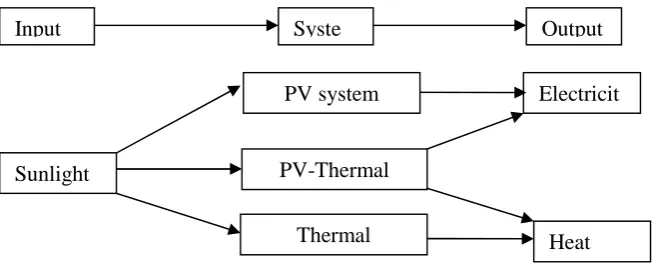
Hybrid PV/T collectors are very useful devices which enable to produce electricity and heat simultaneously as shown in Figure 1. Simply, PV/T systems consist of PV modules coupled to heat extraction units (Tripanagnostopouloset al.2002). Although PV modules convert sunlight directly into electricity, most of the absorbed solar radiation is dumped to the PV modules as waste heat. The heat generated is transferred to the heat exchanger in thermal contact with PV modules in order to supply the heat demand (Tonuiet al.2007). PV/T collectors can be designed as flat-plate or concentrating and are classified according to the type of heat-removal fluid used.
Input
Syste
Output
ms
Electricit
y
PV system
Sunlight
PV-Thermal
Heat
Thermal
World Essays J. Vol., 1 (1), 1-5, 2014
Research Background
The design optimization of a hybrid PV/T system for both centralized and non-concentrated solar radiation presented by (Zhaoet al.2011). The arrangement consisted of a PV module employing silicon solar cells and a thermal unit based on the direct absorption collector concept. The results showed that the optimum system can effectively and separately use the visible and infrared portion of the solar radiation. The thermal unit absorbs 89% of the infrared radiation for photo thermal conversion and transmits 84% of the visible light to the PV cell for photoelectric conversion.
Theoretical and experimental studies on a direct-coupled air PV/T collector carried out by (Shahsavaret al.2011). The results indicated that there are an optimum number of fans to obtain the maximum electrical efficiency. It was also observed that the glass cover on PV panels leads to an increase in thermal efficiency and decrease in electrical efficiency due to the increase in cell temperature.Solar thermal technology is now a mature technology. The widespread utilization of solar thermal technology can reduce a significant portion of the conventional energy. Internationally the market for solar technology has expanded significantly during the last decade. Though the initial investment in these technologies is high compared to available conventional alternatives, the return on investment has become increasingly attractive with the increase in the prices of conventional energy. The payback period depends on the site of installation, utilization pattern and fuel replaced by (Rhushi et al.2010).By (Alfegi et al.2008), have made a comparison between the performance of single pass and double-pass photovoltaic thermal collectors form solutions have been obtained from the differential equations of both the single-pass and pass collectors the results indicate that the pass photovoltaic thermal collector, has superior performance.As shown by (Fudholi et al.2011), the double-pass solar collector with staggered fins has an efficiency of more than 75% at a mass flow rate 0.083 kg/s and solar radiation at 788 W/m2. Secondly, the efficiency of solar collector is significant depending on the mass flow rate and solar radiation.
Research Gap
There is a substantial amount of research done on the PV / T system to increase the efficiency with high impacts performance in subsequent decisions. Relevant to this review is the previous work examining the relationship between solar productivity and heat effect. The existing literature on heat effect and labor glass integration have a lot of effect, which was clearly a addressees the issue of effectively utilizing a new set of proposed design to overcome the problem and increase the performance and reliability of the PV / T system.
Proposed design of PV/T flat plate collector
PV/T flat plate collector can be classified into water PV/T collector, combination of water/air PV/T collector and air PV/T collector, depending on the type of working fluid used as indicated previously above. Further, the PV/T collectors can be distinguished by present of the absorber collector.
The absorber collector plays an important function in the PV / T system. It cools down the PV cell or module, simultaneously collecting the thermal energy produced in the form of hot water or hot air. While this process occurs, the efficiency of the PV cell or module increases but it is interesting to note that all of the classifications. Flat plate collectors except as shown in figure 2 contain two applications. Therefore it is natural to extend this idea to a flat plate collector with three applications and it described at the bottom of the classification.
PV/T water collectors
Design concepts for water-type PVT-collectors are evaluated here, which can be classified in four groups as shown in figure 3.
Figure3. Types of PV/T water collectors: sheet and tube (a), channel (b), free flow (c) and two absorber (d) (Zondaget al.2033).
a) Sheet-and-tube PVT-collectors. b) Channel PVT-collectors. c) Free flow PVT-collectors. d) Two-absorber PVT-collectors.
Air heating system
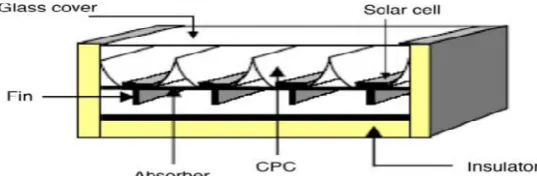
Basically air heaters are classified in the following two categories as shown in figure 4 and 5: Single pass PV/T air collector.
Double pass PV/T air collector.
Figure4. Single pass PV/T air collector (PVT) with Compound Parabolic Concentrator (CPC) and fins (Alfegiet al.2007)
Figure 5. Double pass PV/T solar air collector (a) with air cooling, (b) with CPC and fins and (c) with fins, sources (Tiwari.2010).
A
B
C
D
PV/T water collectors
Design concepts for water-type PVT-collectors are evaluated here, which can be classified in four groups as shown in figure 3.
Figure3. Types of PV/T water collectors: sheet and tube (a), channel (b), free flow (c) and two absorber (d) (Zondaget al.2033).
a) Sheet-and-tube PVT-collectors. b) Channel PVT-collectors. c) Free flow PVT-collectors. d) Two-absorber PVT-collectors.
Air heating system
Basically air heaters are classified in the following two categories as shown in figure 4 and 5: Single pass PV/T air collector.
Double pass PV/T air collector.
Figure4. Single pass PV/T air collector (PVT) with Compound Parabolic Concentrator (CPC) and fins (Alfegiet al.2007)
Figure 5. Double pass PV/T solar air collector (a) with air cooling, (b) with CPC and fins and (c) with fins, sources (Tiwari.2010).
A
B
C
D
PV/T water collectors
Design concepts for water-type PVT-collectors are evaluated here, which can be classified in four groups as shown in figure 3.
Figure3. Types of PV/T water collectors: sheet and tube (a), channel (b), free flow (c) and two absorber (d) (Zondaget al.2033).
a) Sheet-and-tube PVT-collectors. b) Channel PVT-collectors. c) Free flow PVT-collectors. d) Two-absorber PVT-collectors.
Air heating system
Basically air heaters are classified in the following two categories as shown in figure 4 and 5: Single pass PV/T air collector.
Double pass PV/T air collector.
Figure4. Single pass PV/T air collector (PVT) with Compound Parabolic Concentrator (CPC) and fins (Alfegiet al.2007)
Figure 5. Double pass PV/T solar air collector (a) with air cooling, (b) with CPC and fins and (c) with fins, sources (Tiwari.2010).
A
B
World Essays J. Vol., 1 (1), 1-5, 2014
Combination of water and/or air PV/T collector
The combination of more than one system in a one single system is one of modern techniques and applications in the field of solar energy, especially in the PV/T, which would open horizons and new areas, will directly contribute to increasing the amount of the spread of their applications on a large scale. Combination of water and/or air type collectors can be distinguished according to the flow pattern of the water or air. In water type PV/T collectors, the important parameters that need to be taken into consideration such as sheet and tube, channel, medium (fluid) flow and the absorber collector types. Performed by (Zondaget al.2003), other research on a PV / T system that utilized the heat. In this research, various PV/T module types such as with or without cover, air or water type, closed or open loop systems have been studied and the results are presented in system calculations for PV/T roof domestic systems. They concluded that the PV/T water collectors have a better performance than PV/T air collectors do and covered closed loop systems performed better than uncovered closed loop systems. Another comparative study has been prepared by (Zondaget al.2003), from the Netherlands. The concepts of sheet-and-tube channel PV/T, free flow and two-absorber PV/T-collectors are investigated. The results show that the combined PV/T collectors provide the efficiency of over 50%. For uncover collector, the thermal efficiency is 52% and thermal efficiency of single cover sheet and tube design is 58% and finally for channel above the PV design, the thermal efficiency is 65%.
In this paper as shown in figure 6 below we developed and design a new type of PV/T combination system that is consist in a transparent PV cell as a cover. The air flow in double bass in two channels and a water flow in copper water tubes also in upper and lower channel. The purpose of this system to produces three applications in one system.
Figure6. Diagram of PV/T combinationflat plate collector.
CONCLUSIONS
PV/T systems designed to extract heat from PV modules, heating water or air, aiming to reduce the operating temperature of PV modules and to observe the electrical efficiency at a sufficient level.This project proposed to design, construct and develop the PV/T combination system that produces electricity with the hot water and hot air, simultaneously.This paper an effort has been made to review the development of PV/T combination flat plate collector system. It is ascertained that the photovoltaic-thermal collectors is or may in future be practicable for many applications. The survey suggests that further research is needed to improve efficiency, reduce costs and solved several technical publications. The systems will be analyzed with respect to existing design, electrical and thermal energy output for the PV module types under the climatic conditions of Malaysia.
ACKNOWLEDGEMENTS
The authors would like to express their gradients to UniversitiKebangsaan Malaysia for sponsoring this work under project UKM-DLP-2011-013.
Collector Plate
Double pass air
Water in
Water tube on top
Water tube on bottom
Transparent PV cells
Inlet air
outlet air
REFERENCES
Alfegi MEA, Sopian K, Othman MYH, Yatim BB.2007.Journal of Engineering and Applied Sciences, Alfegi MEA, Sopian K, Othman MYH, Yatim BB.2008. American Journal of Applied Sciences, Fudholi A, Sopian K, Ruslan MH, Othman MY, Yahya M.2011. Applied Scince,
Hoffmann W. 2006. Solar Energy Materials and Solar Cells,
Ibrahim A, Othman MY, Ruslan MH, et al. 2011.Renewable and Sustainable Energy Reviews Rhushi Prasad P, Byregowda HV, Gangavati PB.2010. Journal of Scientific Research
Shahsavar A, Ameri M.2010.Solar Energy,
Tiwari GN. SwapnilDubey. Indian Institute of Technology (IIT) Delhi, New Delhi, India. RSC Energy Series No. 2 a catalogue record for this book is available from the British Library.
Tonui JK, Tripanagnostopoulos Y.2007.Renewable Energy,
Tripanagnostopoulos Y, Nousia Th, Souliotis M, et al.2002. Solar Energy,
Zhao J, Song Y, Lam WH, et al. 2011.Energy Convers Manage,
Zondag HA, de Vries DW, van Helden WGJ, van Zolingen RJC, van Steenhoven AA.2003.Solar Energy, Zondag HA, van Helden WGJ. 2003. 3rd World Conference,