STAKEFINDER – AN IMPROVED
STAKEHOLDER IDENTIFICATION
TECHNIQUE USING RECURRENCE VALUE
Jaya Vijayan
1, G. Raju
21Rajagiri College of Social Sciences(Autonomous) , Kalamassery,
2 Christ University (Deemed to be University), Bangalore
Abstract : Stakeholder identification is important activity in requirements engineering. Stakeholder identification and prioritization is equally difficult as gathering the requirements from the users in the software development life cycle. After identifying the stakeholders, they need to be prioritized according to the impact they have on the system. StakeRare is a method that uses social networks and collaborative filtering to identify and prioritize requirements in software projects. Stake Rare uses Page Ranking method to identify stakeholders and asks them to recommend other stakeholders and stakeholder roles. Then a social network is built with stakeholders as nodes and their recommendations as links, and prioritizes stakeholders using a variety of social measures to determine their project influence. In this paper a new method is proposed, Stakefinder which is an improved version of Stake Rare using a new measure called recurrence value which will be used to finalize and prioritize the stakeholders. Recurrence value of a stakeholder is nothing but the number of times a stakeholder is recommended by others. That is, if you are a stakeholder you can recommend other stakeholders whom you think are important for the project.
IndexTerms - Stakeholder, Social Network, StakeRare, Stakefinder, Recurrence Value, Page Ranking.
I.INTRODUCTION
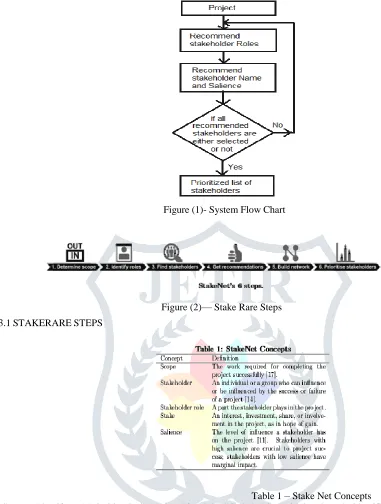
Figure (1)- System Flow Chart
Figure (2)— Stake Rare Steps
3.1STAKERARESTEPS
Table 1 – Stake Net Concepts
Step 1:- Identify and Prioritize Stakeholders-Find Initial Stakeholder, Initial and newly identified stakeholder provide recommendation. StakeRare builds social network Using Snowball Approach. Recommendation is done in following way
<Stakeholder, Stakeholder Role, Salience>
StakeRare prioritize stakeholders and roles. It applies social network measures such as betweeness centrality, closeness centrality to prioritize stakeholder. Stakeholder are prioritize using highest score of salience
Step 2:- Collect Profile- Prioritized stakeholders provides preferences on the initial requirement and other requirements. Preference is being done in following way
<Stakeholder, requirement, rating>
StakeRare propagates the requirements as well as ratings by stakeholders.
Step 3:- Predict Requirement-StakeRare applies collaborative filtering algorithms on profiles to predict requirements. StakeRare recommends requirements that may be relevant to the stakeholder’s .Stakeholders rate recommended requirements
Step 4:- Prioritize Requirement-StakeRare aggregates all stakeholders profiles into a prioritize list of requirements. Requirement prioritization could be done through two approaches,
So then we obtain prioritized lists of requirement. RALIC was a software project at the University College London which stands for Replacement Access, Library and ID Card. By applying StakeNet to the RALIC, the authors have demonstrated that StakeNet performs better than the existing method, with a higher precision in identifying stakeholders and their roles [8].
II.PROPOSED METHOD
A new method is proposed to identify stakeholders using a new measure called Recurrence value instead of PageRanking. Recurrence value of a stakeholder is nothing but the number of times a stakeholder is recommended by others. That is, if you are a stakeholder you can recommend other stakeholders whom you think are important for the project. There is noneed of giving a salience value. Thus the person who is most recommended will get more priority. For example, consider figure (3). Inthe figure, Alice is recommended by Bob, Carol, and Dave. Thus recurrence value of Alice is 3. Bob is recommended by only Alice and hence his recurrence value 1. Same way the number of arrows pointing to Carol are 2 and Dave is 1. Hence their recurrence value is 2 and 1respectively.
Figure (3) –Stakeholder Recommendation using recurrence value
In case, more than one stakeholder is having the same recurrence value, the stakeholder recommended by the person who has more recurrence value is given more priority. Thus the problem is solved. For example, consider figure (a). Here Bob and Dave have the same recurrence value 1. But Bob is recommended by Alice, who is having a recurrence value 3 and Dave is recommended by Bob whose recurrence value is 1. Hence Bob is given more priority than Dave. Thus from the figure the prioritized list of stakeholdersis
Stakeholder Recurrence Value
Alice 3
Carol 2
Bob 1
Dave 1
Table 2-Stakeholder based on Recurrence value
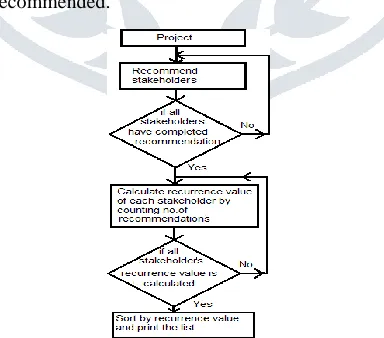
Thus recurrence value avoids the disadvantages and confusions created by PageRank measure. Recurrence value can be considered as a more accurate measure StakeRare uses one of the most accurate social measure called PageRank measure to prioritize stakeholders. It works based on salience value, which has got a lot of disadvantages. So if the salience value goes wrong it severely affects the result. In order to avoid the faults caused by salience value, a new measure called Recurrence value is introduced. PageRank, the social measure used by StakeRare uses salience value. In order to avoid the faults caused by salience value, a new measure called Recurrence value is introduced. In this measure, stakeholders are prioritized purely based on the number of times they are recommended.
Figure (4)-Proposed method system chart
III.IMPLEMENTATIONOFPROPOSEDMETHOD
MySQL(Version 5.5) as back end to store data. We can use StakeFinder either as a website or a Desktop application. If we host StakeFinder then, it will act and run as a website.
Step 1: First, admin login. For that, click on the ‘LOGIN/SIGN UP’ button on the top right corner.
Step 2: The admin can add the project in the Add Project form.
Step 3: Then the admin adds the initial stakeholder roles. For that select the project, whose initial stakeholders are being added and add initial roles.
Step 4: When all initial stakeholder roles are added click on ‘FINISH’ button on the bottom of the form, which directs you to add the initial stakeholders.
Step 5: Now to add all initial stakeholders, first select the project. Then continue adding new stakeholders.
Step 6: Once you finish adding all initial stakeholders, click on the ‘FINISH’ button on the bottom of the form
Step 8: The admin can track about all the new stakeholders added and whether they have completed they recommendation in ‘View Progress’ form
Step 9: Now Stakeholder can sign up and
login by clicking on the ‘LOGIN/SIGN UP’
button in the top right corner of the site.
Step 11: Now he/she can recommend other stakeholders. And after finishing it click on the ‘FINISH’ button on the bottom.
Step 12: After recommending stakeholder roles and other stakeholders, he/she can invite them by sending those messages.
Step 14: To view the report select the project in the View Report form
Step 15: You can also get a printed copy of the report by clicking the ‘Print’ button at the
bottom of the form.The stakeholders having same PageRank/Recurrence value has the same Rank. In the case of tie, all stakeholders in tie are given equal importance.
IV.RESULTANALYSIS
When we compare PageRank and Recurrence Value, we can see that PageRank works based on Salience value. Salience value is a rating given to a person out of 5 or 10. This value can be biased. Also a person who doesn’t know the influence of a person on the project can rate him wrongly. Thus salience value can go wrong and this affects the entire project. Whereas Recurrence value is purely based on the number of recommendation a person gets. Hence it is not biased. When we compare the two methods the recurrence value is more relevant and accurate measure as compared to PageRanking. Following is a comparison of the two methods with the prioritized stakeholders.
Table 3- Prioritized list of stakeholder using PageRank
Table 4 – Prioritized List of Stakeholders Using Recurrence value
V.CONCLUSION
know the influence of a person on the project can rate him wrongly. Thus salience value can go wrong and this affects the entire project. Whereas Recurrence value is
purely based on the number of recommendation a person gets. Hence it is not biased. When we compare the two methods the recurrence value is more relevant and accurate measure as compared to PageRanking. When a tie occurs between two stakeholders then both the page ranking and the recurrence method becomes difficult. As a future work this case also needs to be addressed.
REFERENCES