e-ISSN: 2278-7461, p-ISSN: 2319-6491
Volume 7, Issue 7 [July 2018] PP: 16-21
Self-Oscillatory Interactioms Of Supersonic Streams With
Cylinders, Placed In Open Channels
V. I. Pinchukov
Siberian division of Russian Academy of Sc., In-te of Computational Technologies, Novosibirsk, Russia Corresponding Authur, V. I. Pinchukov
ABSTRACT: Interactions of supersonic uniform streams with cylindrical bodies, placed in open channels, are
studied. Channels of rotation with the interval of cross-sectional area decreasing are considered. Two-dimensional Euler equations are solved by an implicit third order Runge-Kutta scheme. Self-oscillatory regimes are found in CFD studies at stream Mach numbers of 3 to 4.5.
KEYWORDS: Self-Oscillations, Channels, Inner Bodies, Euler Equations, Runge-Kutta Schemes.
--- --- Date of Submission: 28-06-2018 Date of acceptance: 13-07-2018 --- ---
I. INTRODUCTION
Resent paper is devoted to a search for new self-oscillatory flows. This search is carried out on a base of the hypothesis [1], that self-oscillations appear as a result of resonance interactions of “active” elements of flows, namely, elements, which amplify disturbances. Supposition is used about two types of “active” elements – contact discontinuities and intersection points of shocks with shocks or shocks with contact discontinuities. Possibility of the disturbances amplification by contact discontinuities is a result of the Kelvin-Gelmgoltce instability and is accepted. Inclusion of intersection points to a list of amplifiers is proposed in [1] as a hypothesis, which is checked by results of a search for new unsteady flows.
Self-oscillatory compressible flows may be classified into some families: 1. Flows near supersonic jets, inflowing to forward facing cavities (see, for example, [2-4]); 2. Jet impinging on a plate [1,5-9]; 3. Flows past forward-facing cavities [10-12] (outer stream is uniform in this case); 4. Cavity flows (tangential flows near surfaces with cavities) [13-16]; 5. Flows past snaked bodies [1,17-19]; 6. Flows past bluff bodies (vortex shedding from bluff bodies may result unsteady wake structures) [20-22]; 7. Transonic flows near profiles (Euler equations may have non-unique solutions in this case, which results bifurcations and self –oscillations) [23-24].
Numerical investigations of flows, containing the most number of “active” elements, are used to search for new unsteady flows in [25-27]. Flows near blunted bodies (cylinders or cones), giving off opposite jets, are discovered to have intensive self-sustained oscillations [25-26]. These flows may not be included to any mentioned above class of unsteady flows. Sonic underexpanded jet impinging on the pair open tube – inner cylinder [27] are found to have self-oscillatory regimes. It seems that these flows are closed to second class (see above) of unsteady flows. A search for self-oscillatory flows is continued here. Supersonic flows near the pare open channel – inner cylinder are considered. These flows may contain shock waves, contact discontinuities, intersection points. CFD studies of these flows are carried out and self-oscillations are observed for stream Mach numbers 3≤M≤4.5.
II. CFD DESIGN APPROACH
Fig. 1. Schematic Representation of a Numerical Domain and a Mesh.
The channel form at the [a,b] interval of cross-sectional area decreasing is defined by the formulae
Y(x)=Rtub-16h(x-a) 2 (x-2b+a)2/(b-a)4 .
2.2. Numerical method. An implicit conservative Runge-Kutta scheme [28] is modified and employed here. Namely, a special version of the code is developed for the case when functions x=x(a,b), y=y(a,b) perform mapping of the unit square with excisions {0≤a≤a0, 0≤b≤b0}, {a1≤ a ≤1, 0≤b≤b1} to a curvilinear quadrangle
with curvilinear quadrangular excisions (see fig. 1). This version allows carrying out calculations, described below, without dividing complicated domains into subdomains. Both recent method and method [28] are third order (viscous terms are approximated with second order). The 515
586 mesh is used in written below calculations. Naturally, numerical calculations deal with dimensionless variables. These variables are defined as relations of initial variables and next parameters of the outer stream or the body size: p - for pressure, ρ - for a density,
p
- for a velocity, rtub =y(C)-y(H) (the maximum inner channel radius) – for space variables,rtub/
p
- for time.III. RESULT AND DISCUSSION
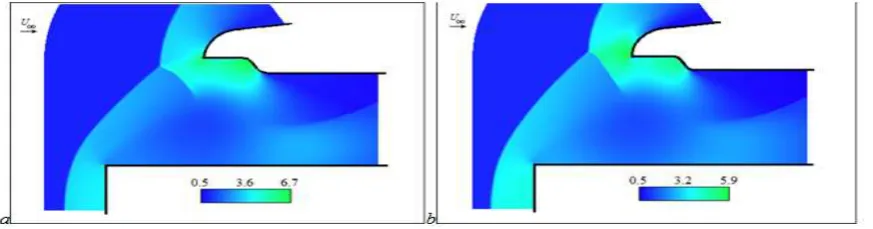
A search for self-oscillatory flows is carried out for each stream Mach number, considered below, by trial calculations of some variants. It is observed, that self-oscillations may appear, if the relation of channel and cylinder lengths provides position of shock waves intersection points closed to the channel edges. All flows considered below contain separation zones, starting at cylinder edges (signed by F in fig.1). A search is stopping, if 1-3 unsteady flows are found. Examples of unsteady flows for different Mach numbers are represented below. 3.1. Stream Mach number M=3. Figs. 2a and 2b shows density distributions at different instants in the flow, calculated for the geometry parameters Lc y l=1.4 (the cylinder length), Rc y l=.3 (the cylinder radius), Ltub=0.9 (the
channel length), Rm in= Rtub-h=1-h=.91 (the least channel radius),h=0.09, a=x(F)+ 0.25 Ltub, b=a+0.1 (see fig. 1). Solid walls (cylinder and channel walls) are shown by bold lines.
Density magnitudes at the cylinder edge (point C in fig. 1), are plotted in fig. 3.
Fig. 3. The Density History, M=3.
The density history, represented in fig. 3, shows that this flow is nearly periodic with the T=2.47 period. Fig. 2a corresponds to the final time instant t=34.1 (see fig. 3). To illustrate the flow dynamic through one period T the density distribution for the instant t=34.1+T/2 is shown in fig. 2b. If to compare figs. 2a and 2b, different position of the shock waves intersection point may be seen. The most intensive flow oscillations are observed in the region between this intersection point and the channel edge (signed by C in fig.1).
3.2. Stream Mach number M=3.5. Fig. 4 shows the density history for the self-oscillatory flow, defined by geometry parameters Lc y l=1.4 (the cylinder length), Rc y l=.3 (the cylinder radius), Ltub=0.9 (the channel length),
Rm in= Rtub-h=1-h=.92 (the least channel radius), h =.08, a=x(C)+ 0.25Ltub, b=a+0.1 (see fig. 1). Density magnitudes at the point C are plotted in this fig.
Fig. 4. The Density History, M=3.5.
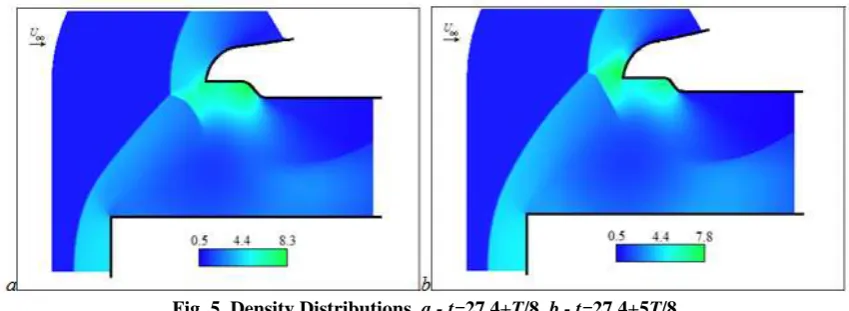
The density history, presented in fig. 4, illustrates that this flow is nearly periodic with the T=2.19 period. If to compare periods for Mach numbers 3.0 and 3.5, decreasing of the self-oscillation period is seen when Mach number is increasing. This tendency is true for next considered flows. To show the flow dynamic through one period T density distributions for instants t=27.4+T/8 and t=27.4+T5/8 are represented infigs. 5a and 5b.
Fig. 5. Density Distributions, a - t=27.4+T/8, b - t=27.4+5T/8.
If to compare figs. 5a and 5b, different position of the shock waves intersection point may be seen.
calculated for geometry parameters Lc y l=1.4, Rc y l=.3, Ltub=0.8, Rm in= Rtub-h= 1-h=.96, h =.04, a=x(C)+
0.25Ltub, b=a+0.1 (seefig. 1).
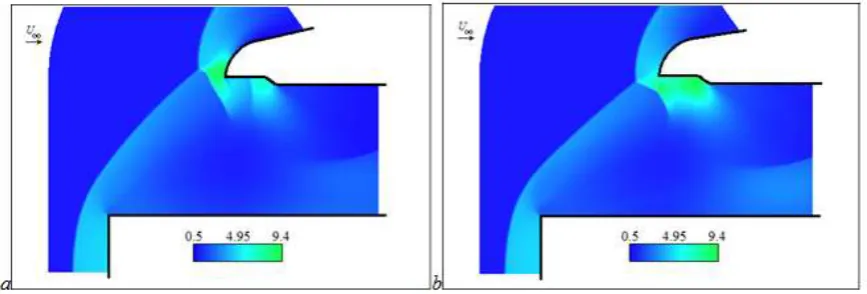
Fig. 6. Density Distributions, a - t=31.1, b - t=31.1+T/2
Density magnitudes at the cylinder edge (point C in fig.1) are plotted in fig. 7.
Fig. 7. The Density History, M=4.
So, this flow is nearly periodic with the T=1.88 period. Flow fields dynamics during one period after the final instant t=31.1 (see fig. 7) is calculated. Density distributions are shown for instants t=31.1 (fig. 6a) and t=31.1+T/2 (fig. 6b), correspondingly. Comparison of figs. 6a and 6b allows to conclude, that these figs.differ one from another by position of the shock waves intersection point.
3.4. Stream Mach number M=4.5. Fig. 8 shows the history of density magnitudes at point C for the self-oscillatory flow at M=4.5. Calculations are carried out for geometry parameters Lc y l=1.4, Rc y l=.3,
Ltub=0.8, Rm in= Rtub-h=1-h=.94,h=.06, a=x(C)+0.25Ltub, b=a+0.1 (see fig. 1).
Fig. 8. The Density History, M=4.5.
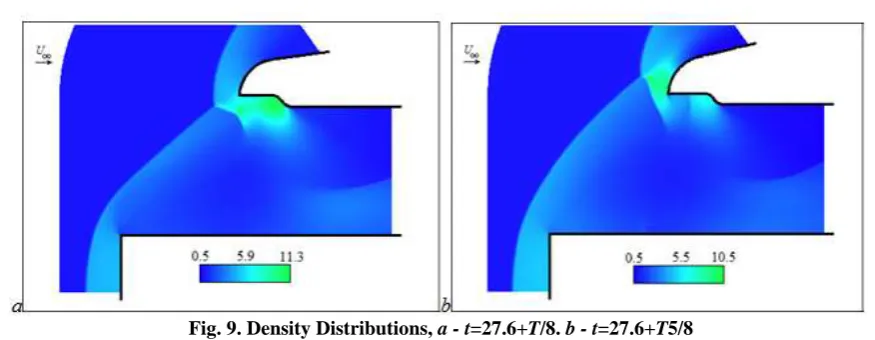
Fig. 9. Density Distributions, a - t=27.6+T/8. b -t=27.6+T5/8
The most intensive flow oscillations are observed in the region between the intersection point and the channel edge (signed by C in fig.1).
IV. CONCLUSIONS
Recent paper is devoted to CFD search for new self-oscillatory compressible flows. Flows with the most number of “active” elements are investigated numerically. Interactions of supersonic uniform streams with cylindrical bodies, placed in open channels, are studied. These flows contain several “active” elements, so unsteady regimes are possible according to the written above hypothetical mechanism of self-oscillations. Unsteady flows are observed at stream Mach numbers 3≤M≤4.5. The relation of inner cylinder and channel lengths should provide position of the shock waves intersection point closed to channel edge (signed by C in fig. 1). Channels with the interval of cross-sectional area decreasing are considered. This decreasing is conducive to possibilities of the self-oscillatory regimes appearance. If the interval of decreasing is absent, self-sustained oscillations are not observed in recent investigations.
At first glance these flows may be included to a class of unsteady supersonic flows past forward-facing cavities (the class 3, see introduction). But recent flow physics is seemed to be more similar to the flow physics of the 5th type, namely, to flows physics near snaked bodies. Last flows contain shock waves, produced by snakes. These waves move to main blunted bodies, where intensive oscillations are observed. Similarly, recent investigations show, that inner cylinders produce shock waves, which move to channel buff-ends, where the most intensive oscillations take place.
______________________________________________
NOMECLATURES
P - pressure, ρ - density,
M - stream Mach number, Lc y l- cylinder length,
Ltub - tube length,
rtub - tube radius at initial cross section, rc y l - cylinder radius,
Ltub - tube length,
____________________________________________
REFERENCES
[1]. V. I. Pinchukov, Numerical Modeling of Non- Stationary Flows with Transient Regimes, Comput. Mathem. and Mathem. Phisics, 49(10), 2009, 1844–1852.
[2]. J. Hartmann, On a new method for the generation of sound waves, Phys. Rev., 20(6), 1922, 719-726.
[3]. S. Murugappan, E. Gutmark, Parametric Study the Hartmann–Sprenger Tube, Experiments in Fluids, 38(6), 2005, 813-823. [4]. J. Kastner, M. Samimy, Development and Characterization of Hartmann Tube Fluid Actuators for High-speed Control, American
Institute of Aeronautics and Astronautics J., 40(10), 2002, 1926–1934.
[5]. W. Wu, U. Piomelli, Large-Eddy Simulation of Impinging Jets with Embedded Azimuthal vortices. J. of Turbulence, 16(10), 2014, 44-66.
[6]. C.-Y. Kuo, A. P. Dowling, Oscillations of a Moderately Underexpanded Choked Jet Impinging Upon a Flat Plate. J. Fluid Mech., 315, 1996, 267–291.
1998, 477.
[8]. G. F. Gorshkov, V. N. Uskov, Specialties of Self- Oscillations, Arising from Interaction of Supersonic Underexpanded Jet with Finite Obstacle, Prikl. Mekh. Tekh. Fiz., 40(4), 1999, 143-149 (in Russian).
[9]. B. Henderson, J. Bridges and M. Wernet, An Experimental Study of the Oscillatory Flow Structure of Tone-Producing Supersonic Impinging Jets, J. Fluid Mech., 542, 2005, 115-137.
[10]. D. W. Ladoon, S. P. Schneider and J. D. Schmisseur, Physics of Resonance in a Supersonic Forward-Facing Cavity, J. of Spacecraft and Rockets, 35(5), 1998, September –October.
[11]. W. A. Engblom, B. Yuceil, D. B. Goldstein and D. S. Dolling, Hypersonic Forward- Facing Cavity Flow: An Experimental and Numerical Study, AIAA Paper 95-0293, Jan. 1995.
[12]. K. B. Yuceil, D. S. Dolling, Nose Cavity Effects on Blunt Body Pressure and Temperatures at Mach 5. J. of Thermophysics and Heat Transfer, 9(4), 1995, 612–619.
[13]. J. Rossiter, Wind-Tunnel Experiments on the Flow over Rectangular Cavities at Subsonic and Transonic Speeds, Technical Reports & Memoranda 3438. Aeronautical Research Council, 1964.
[14]. C.-J. Tam, P. D. Orkwis and P. J. Disimile, Comparison of Baldwin-Lomax Turbulence Models for Two-Dimensional Open-Cavity Calculationsm, AIAA J., 34(3), 1996, Technical Notes: 629- 632.
[15]. C.-J. Tam, P. D. Orkwis and P. J. Disimile, Algebraic Turbulence Model Simulations of Supersonic Open-Cavity Flow Physics, AIAA J., 34(11), 1996, 2255-2260.
[16]. N. Murray, E. Sällström and L. Ukeiley, Properties of subsonic open cavity flow fields, Physics of Fluids, 21, 2009, 095103-16. [17]. M. Gauer, A. Paull, Numerical investigation of a Spiked Nose Cone at Supersonic Speeds, J. of Spacecraft and Rockets, 45(3), 2008,
459-471.
[18]. W. Caarese, W. L. Hankey, Modes of Shock Wave Oscillations on Spike Tipped Bodies, AIAA J., 23(2), 1985, 185-192.
[19]. R. C. Mehta, Pressure Oscillations Over a Spiked Blunt Body at Hypersonic Mach Number, Computational Fluid Dynamics J., 9(2), July 2008, 88-95.
[20]. R. Natarajan, A. Acrivos, The Instability of the Steady flow Past Spheres and Disks. J. Fluid Mech., 254, 1993, 323-344.
[21]. E. Berger, D. Scholz and M. Schumm, Coherent Vortex Structures in the Wake of a Sphere and a Circular Disk at Rest and under Forced Vibrations, J. Fluids and Structures, 4, 1990, 231-257.
[22]. H. Sakamoto, H. Haniu, The Formation Mechanism and Shedding Frequency of Vortices from a Sphere in Uniform Shear Flow, J. Fluid Mech., 287, 1995, 151-171.
[23]. A. Jameson, Airfoils Admitting Non-unique Solutions of the Euler Equations, Reston, Paper / AIAA; 1991, N 91-1625.
[24]. M. Hafez, W. H. Guo, Some Anomalies of Numerical Simulation of Shock Waves. Pt 1. Inviscid Flows, Comput. Fluids, 28(4/5), 1999, 701-719.
[25]. V. I. Pinchukov, Modeling of Self-Oscillations and a Search for New Self-Oscillatory Flows, Mathematical Models and Computer Simulations, 4(2), 2012, 170–178.
[26]. V. I. Pinchukov, Self-oscillatory Flows near Blunted Bodies, Giving off Opposite Jets: CFD Study. Intern. J. of Engineering and Innovative Technology, 6(5), 2016, 41-46.
[27]. V. I. Pinchukov, Sonic Underexpanded Jet Impinging on the Pair Open Tube – Inner Cylinder, Intern. J. of Modern Trends in Engineering and Research, 4(11), November 2017, 8-14.
[28]. V. I. Pinchukov, Numerical Solution of the Equations of Viscous Gas by an Implicit Third Order Runge-Kutta Scheme, Comput. Mathem. and Mathem. Physics, 42(6), 2002, 898-907.