e-ISSN: 2278-7461, p-ISSN: 2319-6491
Volume 5, Issue 6 [June 2016] PP: 34-39
Some aspects and the bibliometric analysis of the sustainable smart city
concept
BlažGrudnik Tominc
1, Andrej Božin
21
Technical University Wien (master student of Arch.), Austria
2Higher College of Civil Engineering Kranj (M.Sc. in Arch.), Slovenia
Abstract:In t
his paper some aspects of smart and sustainable city concept are presented. Since cities are understood as important generators of economic growth, the efficiency of performance of cities is in the focus of increasing number of research endeavors. Several different definitions of sustainable smart city exist and the European smart cities system is presented in this paper in more details. The results of a bibliometric analysis, presented in this paper, lead to the conclusion, that in the contemporary researchthe smart city concept is in the central focus of the research and is associated with smartness regarding technology, internet and big data, it represents the challenge in the field of simulation and application. The smart city field of research is undoubtedly important and relevant.Keywords:Bibliometric analysis, Indicators of city development, smart cities, sustainable cities
I.
INTRODUCTION
Cities are understood as important generators of economic development and growth and the efficiency of performance of cities is in the focus of increasing number of research endeavors. In the European Union cities are recognized as the key to the sustainable development, but on the other hand, the European model of sustainable urban development is under threat (European Commission, 2011), due to different demographic, social, economic, environmental and other problems.
Definition of city is not entirely clear. The lack of a harmonized definition of a city and its functional areas has hindered the analysis of cities in Europe. In cooperation with the OECD, the European Commission has developed a relatively simple and harmonized definition (European Commission, 2011, p.95):
(i) A city consists of one or more municipalities.
(ii) At least half of the city residents live in an urban center.
(iii) An urban center has at least 50 000 inhabitants. It consists of a high-density cluster of contiguous grid cells of 1 km2 with a density of at least 1 500 inhabitants per km2, as well as filled gaps.
With the purpose to develop policy measures that support the progress of a city in a best possible way, the developmental stage and performance efficiency of a city should be established. Namely, different stages of development of a city, demand different set of strategic and development plans and guidelines (Mavrič et. al. 2014).
There is no unique measurement system of a city developmental stage, since the city performance efficiency can be analyzed from different view point – this indicates, that this is very complex and multidimensional task. Systems of city performance indicators, that can be considered as indicators of stage of a city development, usually cover a wide range of urban and regional characteristics and performances, while also geographical aspects should be taken into account. At the same time the city size is also an influencing factor (European Smart Cities, 2015). The concept of smart city, indicating the performance efficiency of a city, as a mean of enhancing the quality of life of citizens, has gained increasing importance in policy makers‟ agendas, but overall, a shared definition of sustainable smart city is not yet available (Neirotti et al., 2014)).
This paper is organized as follows. In the next chapter we present some aspects of different systems of indicators, developed by different authors, where we focus especially on the concept of sustainable and smart cities. In the third chapter results of a bibliometric analysis with the purpose to study the theoretical framework of sustainable and smart cities concept, are presented. Paper concludes with discussion and conclusions.
II.
MEASUREMENT
OF
THE
CITY
PERFORMANCE
EFFICIENCY
development and urban quality of life for citizens: (i) the active city; (ii) beautiful city; (iii) green city; (iv) environment; (v) cooperation and (vi) city catalogue. In the following years researches have developed indicators for central area development (Nitulescu 2000), of urban status (Suler 2005), etc.
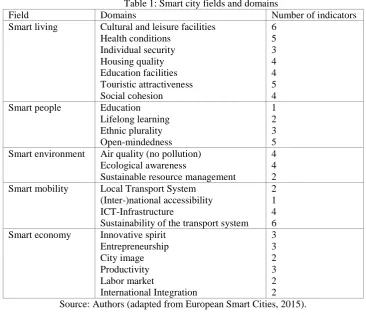
Cities in Europe are facing rapid economic and technological changes caused by the globalization and the integration process. These changes force European cities to combine competitiveness and sustainable urban development simultaneously. Since 2007, the TU WIEN is researching the phenomenon of smart cities and developing the smart city measurement set of indicators, enabling the benchmarking of city performance and sustainable development (European Smart Cities, 2015). In wide cooperation with different stakeholders and actors the European Smart City Model was developed. Basically it provides an integrative approach to profile and benchmark European medium-sized cities and is regarded as an instrument for effective learning processes regarding urban innovations in specific fields of urban development. According to this research, a Smart City is a city well performing in 6 key fields of urban development, built on the „smart‟ combination of endowments and activities of self-decisive, independent and aware citizens: (1) Smart Economy, (2) Smart Mobility, (3) Smart Environment, (4) Smart Governance, (5) Smart Living and (6) Smart People. This 6 key fields are covering 27 domains and as much as 90 indicators European Smart Cities, 2015).
Smart city fields and domains (adapted from European Smart Cities, 2015), are presented in Table 1.
Table 1: Smart city fields and domains
Field Domains Number of indicators Smart living Cultural and leisure facilities
Health conditions Individual security Housing quality Education facilities Touristic attractiveness Social cohesion 6 5 3 4 4 5 4 Smart people Education
Lifelong learning Ethnic plurality Open-mindedness 1 2 3 5 Smart environment Air quality (no pollution)
Ecological awareness
Sustainable resource management
4 4 2 Smart mobility Local Transport System
(Inter-)national accessibility ICT-Infrastructure
Sustainability of the transport system 2 1 4 6 Smart economy Innovative spirit
Entrepreneurship City image Productivity Labor market International Integration 3 3 2 3 2 2 Source: Authors (adapted from European Smart Cities, 2015).
III.
BIBLIOMETRIC
ANALYSIS
Figure 1: Number of documents published in period 2000-2015. Source: Authors
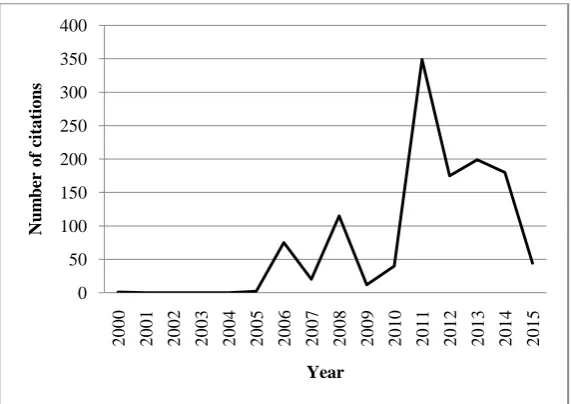
The number of citations of articles published in the time period analyzed, is presented by Fig. 2. The highest number of citations is found for articles published in 2011 (approximately 350); as expected, more recently published papers, are cited less, but as the number of citations is increasing, also the number of citations is expected to increase, especially beacuse the number of publications is increasing so rapidly (Fig.1 ).
Figure 2: Number of citations of articles published in period 2000-2015 Source: Authors
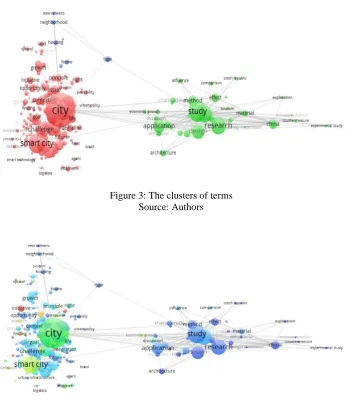
In the next step, the cluster analysis of the most frequently analysed areas (the term map) in this field was performed. It included all types of documents included in SCOPUS (articles, conference papers...). To create a term map based on a corpus of documents, VOSviewer software distinguishes the following steps (Van Eck &Waltman, 2011): identification of noun phrases, selection of the most relevant noun phrases, mapping and clustering of the terms, visualization of the mapping and clustering results. The data base included 442 documents (219 conference papers, 153 articles, 25 conference reviews, 15 book chapters, 13 reviews, 8 books, 6 articles in press, 1 editorial, 1 note and 1 short survey), published in English language. This analysis is based on terms marked as keywords in titles and summaries of the documents. Using the software VOSviewer the 13,428 terms were found: 349 of them were the most frequently used (at least 10 times of occurrences of term). For each of the 349 terms, a relevance score was calculated. Based on this score, the most relevant terms were selected. The default choice is to select the 60% most relevant terms, leading to 209 terms, included into the
0 20 40 60 80 100 120 140
2000 2002 2004 2006 2008 2010 2012 2014
Nu m b er o f d o cu m en ts Year All documents Article Conference paper 0 50 100 150 200 250 300 350 400
2000 2001 2002 2003 2004 2005 2006 2007 2008 2009 2010 2011 2012 2013 2014 2015
terms as well as regarding the connections among terms. The most frequent terms are city, smart city on one side and research and study on the other side, that are very much connected.
Figure 3: The clusters of terms Source: Authors
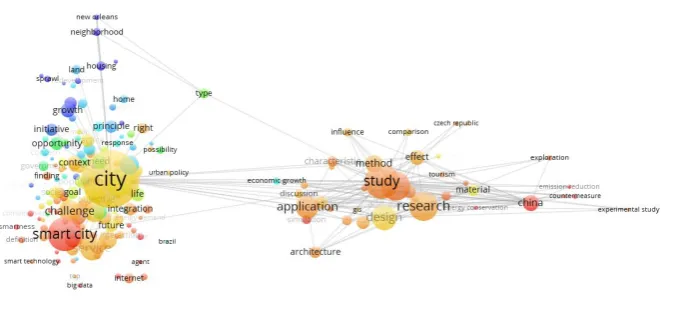
Figure 4: The terms map regarding the number of citations Source: Authors
Fig. 4 shows the terms map regarding the number of citations. The color of a term indicates the average citation impact of the publications in which the term occurs. Moving from blue to the red part of the the measurement scale, indicates the frequency of citations: red colored terms are the most cited terms (and therefore the documents). The most cited papers included the following terms: city, smart city, definition, urban form, initiative, big data in smart technology.
Figure 5: The time distribution of terms regarding the publications Source: Authors
The bibliometric analysis leads to the conclusion, that the smart city concept is in the central focus of the research and is associated with smartness regarding technology, internet and big data, it represents the challenge in the field of simulation and application. The smart city field of research is undoubtedly important and relevant.
IV.
CONCLUSION
In this paper some aspects of smart and sustainable city research are presented. Since cities are understood as important generators of economic growth, the efficiency of performance of cities is in the focus of increasing number of research endeavors. The measurement systems that try to measure the city efficiency, range from those, that are focused on a single or on a few aspects, to those, developing the whole network of mutually connected indicators.
Based on the Charter of European Sustainable Cities and Towns towards Sustainability (1994), different approaches for benchmarking of city performance efficiency and attributes of a smart city, were developed. The well-known system of benchmarking of smart cities, focused especially to the medium-sized cities with 100,000 to 500,000 inhabitants, was developed first in 2007 by TU Wien and later, in 2015, improved and adapted to larger European cities from 300,000 to 1 million inhabitants.
Cities in Europe (and also in other geographical areas) are very different, not only because of their size, but also because of the role that they play in the process of economic growth of a country. To properly address the challenges and assets of a certain city (each city is “unique” to a great extent), the stage of development and future expected trends in the city evolution, should be established. This represents the framework for forming adequate policy measures, that would enable the sustainable growth and development of a city towards a sustainable smart city.
With the purpose to study the theoretical framework of sustainable and smart cities concept the bibliometric analysis was performed, based on the SCOPUS database, using the following two keywords: »smart city« and »sustainable development«. The analysis was constrained to the documents published between 2000 and 2015. Results show, that especially after 2009, the number of documents published has increased significantly, confirming the relevance and growth of importance of researches in this field. The term map with clusters that were formed regarding the frequency of terms, relevance of terms as well as regarding the connections among terms in publications shows, that the most frequent terms are city, smart city on one side and research and study on the other side, and that they are very much connected.
The results of a bibliometric analysis, presented in this paper, lead to the conclusion, that the smart city concept is in the central focus of the research and is associated with smartness regarding technology, internet and big data, it represents the challenge in the field of simulation and application. The smart city field of research is undoubtedly important and relevant.
[3] Charter of European Cities & Towns Towards Sustainability, (1994). (Available on June 30, 2016: http://www.sustainablecities.eu/fileadmin/content/JOIN/Aalborg_Charter_english _1_.pdf)
[4] Mavrič, J., Tominc, P., Bobek, V. (2014). Qualitative indicators for measuring the performance and development of selected cities, Our economy, Vol. 60, No. 3-4, p.13-25.
[5] Neirotti, P., De Marco, A., Cagliano, A.C., Mangano, G., Scorrano, F. (2014). Current trends in Smart City initiatives: some stylised facts. CITIES, vol. 38, pp. 25-36. - ISSN 0264-2751
[6] Van Eck, N.J., &Waltman, L. (2011). Text mining and visualization using VOSviewer. ISSI Newsletter, 7(3): 50-54.
[7] Voula, M. (1996). Our city, our future: Towards sustainable development in European cities. Environment and Urbanization, 8(1), 133–154.