A Conceptual Framework for Coaching that Supports Teacher Development
Carmen Sherry Brown, EdD
Assistant Professor, Early Childhood Education
Department of Curriculum and Teaching
Hunter College, City University of New York (CUNY)
695 Park Avenue, New York, NY 10065
United States
Abstract
Coaching increases the likelihood that teachers adopt new teaching practices. Many forms of coaching in education are newly developed approaches. These approaches begin with the creation of theories and practices. This paper has three purposes: first, to present a broad definition of professional development and coaching as it pertains to education and teaching; second, to provide a description of the features of a conceptual framework for coaching; and third, to examine a coaching model that is using the conceptual framework to support early language and literacy practices. The conceptual framework for coaching is an ongoing, living document that provides an outline for creating learning environments that are open, collaborative and support continuous learning.
Keywords:
Coaching; professional development; curriculum implementation1. Introduction
The purpose of professional development in education is not just to guide the implementation of instructional innovations; its central function is to build strong collaborative work cultures that will develop the long-term capacity for change (Fullan, 2008). While the goal of coaching is to support professional development opportunities and to guide these learning experiences into meaningful, contextually based instructional objectives and goals, coaching and professional development are about facilitating learning for individuals and groups/teams. Coaches are change agents (West &Cameron, 2013), sources of knowledge and serve as resources in bridging the gap between professional development experiences and classroom instruction. Coaching is a growth-oriented strategy that supports the development of instructional goals designed to improve child outcomes and decrease teacher isolation. To support the professional learning experiences of teachers coaching must be strategic and intense, supportive and collaborative, and be on going (Guskey, 2002). In order for professional development to be meaningful and readily applicable in the classroom, an effective coaching model must be employed (Sheridan, Edwards, Marvin, & Knoche, 2009).
Planning and reflection are critical to the coaching process (Goldman, Wesner & Karnchanomai, 2013; Grant and Hartley, 2013). Dedicated time for teacher groups to meet and analyze their work supports teachers in reflecting on and refining their practice. During planning, the steps, resources, and supports needed to reach a goal are specified.
Reflecting on teaching practice involves taking time to think about what was effective and what was a barrier to enhancing or improving implementation of teaching practices. Reflection encompasses consideration both of the feedback and the support experiences of the coaching process (NCQTL, 2014).Support for enhancing teaching practices and professional learning are effective when they are tailored to the specific needs identified by teachers and when their approach to learning is collaborative and inquiry-based (Darling-Hammond & McLaughlin, 1995).
2.
Purpose of a conceptual framework
The purpose of the conceptual framework for coaching is to support the design of a system of ideas and objectives that lead to teacher professional development and personal growth. The fundamental principles encompassing the conceptual framework support the beliefs and the components of effective coaching strategies. Despite the variation in coaching models, common features exist. As described by Lloyd and Modlin (2012), program-level models that focus on changing teachers’ behavior include the following steps: (1) building relationships with teachers; (2) observing, modeling, and advising in the classroom; (3) meeting with teachers to discuss classroom practices, provide support and feedback, and assist with problem-solving for classroom challenges; and (4) monitoring progress toward identified goals (p.3).
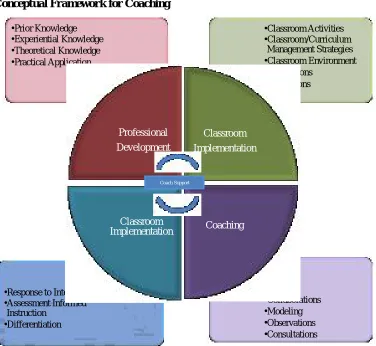
The University of Kansas Center for Research on Learning employs an instructional framework referred to as The Big Four, which includes: (1) classroom management, (2) content, (3) instruction, and (4) assessment for learning (Knight, 2009).The conceptual framework for coaching is a cycle matrix (see Appendix for conceptual framework) that incorporates the Big Four. The framework has themes that support professional development, classroom implementation and embedded coaching practices. The framework for coaching is divided into four segments with each segment representing an area of professional development and implementation in collaboration with teachers. The framework is cyclical with each rotation resulting in increased theoretical and practical knowledge for both the teacher and the coach. Interlinked in the framework are continuous support, guidance, and collaboration with the coach. The cycle is repeated several times, as research shows that it can take as many as 20 practices for teachers to master a new instructional skill (Joyce & Showers, 2002). Throughout the framework, an emphasis is placed on knowledge, skills, and continual learning. The conceptual framework facilitates a continuum of development in a coaching program by relating the essential professional development components to the entire coaching process.
3.
Professional Development
The first goal of any professional development model should be to support and guide changes in the way each teacher actually teaches (Guskey, 2002). Professional development has been defined as a set of processes or activities that change and improve the knowledge, skills, behavior, attitudes, professionalism, and practice of staff in the school organization so that they may result in improved student performance and achievement (Guskey, 2002). Professional workshop sessions and other formal meetings are a part of the professional development experience.
Effective coaching encourages collaborative introspective practices, in which all participants’ knowledge, skills and experiences are valued. Coaching promotes self-reflection and refinement of current practices on the part of the person being coached.
3.1. Prior knowledge
An important component of coaching and professional development is to understand and incorporate what teachers know and are able to do and to acknowledge these experiences during the coaching process. Studies of teacher learning suggest that teachers interpret new ideas and practices through the lens of their existing beliefs and habits of practice (Mansour, 2009; Kuzborska, 2011).Professional learning are interdependent on teachers’ prior and experiential knowledge. As teachers come to the classroom with an array of pre-existing knowledge, skills, beliefs, and attitudes, these predispositions influence how they interpret, organize, and apply information that they receive from professional development experiences. Coaches establish critical foundational relationships with teachers during the initial professional development sessions and introduction to the coaching framework. While taking into account the prior knowledge of teachers, they support them in processing and integrating new information in the context of their day-to-day work in the classroom. Professional learning emerges from mutual respect, collegial relationships and a shared responsibility for student learning as the integration of prior and new knowledge occurs.
3.2.Experiential knowledge
Experiential knowledge is the process of learning through action, experience, exploration, experimentation and discovery (Neill, 2006). Experiential learning allows teachers to be actively involved in the learning process while simultaneously acquiring new knowledge, concepts, and skills. Effective coaching puts the teacher in an active role that builds on their prior knowledge and experiences. Effective coaches allow teachers to develop skills through their own practice and experience with guidance and feedback. During professional development and embedded coaching opportunities, teachers and coaches are collaboratively involved in the learning experience. The results of experiential learning are personal and form the basis for future experiences and learning (Association for Experiential Education, 2014). Effective coaches support and encourage teachers to reflect on and conceptualize these experiences. These experiences must be built on and structured in a process of reflection to ensure that what has been learned is sustainable in the future. This process supports the transfer of professional development learning experiences into classroom practice.
3.3.Theoretical knowledge
The theoretical knowledge developed throughout the coaching process supports teachers in placing their experiences in a more focused scope of reference and provides a framework to reflect on during the learning process. Theory is used as a source of knowledge and reference for the coaching process and professional development support and it is used to attain a well-founded self-reflection. Theory and practice combined can lead to teacher’s personal perspective on coaching and training. Theoretical knowledge should have its foundation in practical application. The extent that the theoretical knowledge can be understood can be limited because it doesn't come with experience. Ideally, in the coaching process, coaches should have the applied experience and then are capable of connecting the practical knowledge with the theoretical knowledge.
3.4.Practical application
Through the actual use, rather than the theoretical possibilities, teachers practice the application of newly acquired skills and knowledge in the context of the classroom. Teachers should experience practical application in order to absorb theoretical knowledge and articulate the use of strategies effectively. Practical knowledge can lead to a deeper understanding of a concept through the application and/or personal experience. Both theoretical knowledge and practical application go hand in hand and each has their own importance. Coaches help to define the theoretical knowledge and support teachers in transferring this knowledge into practical applications; thus putting new knowledge and skills into practice.
4.
Classroom implementation: Initial coaching activities
4.1.Classroom activities
Research on effective staff development shows that a peer coaching methodology meets teachers’ needs and is effective at shaping classroom practice. Coaching offers the opportunity to improve the classroom experiences of children through strengthening teachers’ skills (Hsieh, Hemmeter, McCollum, & Ostrosky, 2009).To assist with the implementation of newly acquired skills and strategies throughout the classroom, coaches guide teachers in developing intentional and purposeful instructional activities that lead to skill acquisition and development in children. Coaches support teachers in using the curriculum, materials and resources as tools to guide the developmental progression of student learning. Coaching helps build capacity for effective instructional practices within specific content areas.
4.2.Classroom environment
Activities that lead to skill development are not confined to teacher-directed activities. They are reinforced and supported in a variety of ways throughout the classroom via communication, interactions, guided learning opportunities, and exploration. Improving classroom quality requires teachers who are skilled at providing safe, caring, supportive, and nurturing environments and coaches who have knowledge of developmentally appropriate classroom practices that allow for active engagement and learning across multiple domains (Lloyd & Modlin, 2012). Coaches support teachers in creating classroom environments that reinforce and extend key learning goals and concepts.
4.3.Interactions
Coaches use teacher observations during classroom visits to help teachers enhance their abilities to interact with students in ways that support student development. Coaching can be used during normal classroom routines as a way to help teachers identify strategies, reflect on their interactions with children, problem solve challenges, and receive supportive feedback. Coaches also guide teachers in effective facilitation skills that support high-quality interactions between teachers and students and students and their peers.
5.
Coaching: Intensive, strategic and focused
To promote a knowledge base of effective teaching practices and strategies that result in teacher development, coaching activities should be intense, strategic and focused. Coaching strategies should concentrate on the goals and objectives for enhancing practices and teacher knowledge. The coach used non-judgmental directed questioning, constructive feedback, and deep listening techniques to guide self-reflection.
5.1.Planning and reflective practices
According to Rush and Shelden (2005), coaching is defined as an adult learning strategy in which the coach promotes the learner’s ability to reflect on his or her actions as a means to determine the effectiveness of an action or practice and develop a plan for refinement and use of the action in immediate and future situations. Reflection is an evaluation process to help verify if current practice is effective and if not, how to adapt and modify it. Reflective practice includes technical, practical, and critical reflection. Adequate time must be found within the school day to allow school personnel to learn and work together to accomplish identified goals. Planning time allows all team members the opportunity to engage in collaborative, professional learning. In order for teachers and coaches to have meaningful and productive conversations about instructional goals and outcomes, there must be shared expectations regarding lesson planning and observation (Achieve the Core, 2014).Planning time should be utilized to discuss and reflect on assessment data and classroom observations.
5.2.Collaborations
5.3.Modeling
Professional development and planning session alone may be insufficient in changing professional practices. Modeling has been found to be a highly effective way to introduce a new concept and help teachers understand a new practice (Penuel, Fishman, Yamaguchi, & Gallagher, 2007). Teachers need time to see new strategies modeled during the school day and opportunities to use new skills in developing and implementing learning activities (Garet, Desimone, Birman, & Yoon 2001; Joyce & Showers, 2002; Rodriguez & Knuth, 2000). Modeling an activity for teachers may be done to determine how a jointly developed idea or strategy might look in practice. Modeling provides a wider use of instructional techniques and strategies. Through the use of modeling, coaches can support teachers with professional growth, instruction, and assessment.
5.4.Observations
Coaching uses the common practices of observation and constructive feedback. Professional development should allow teachers multiple opportunities to have their lessons observed and receive structured feedback. Observation refers to the process of gathering and recording information about implementation of desired teaching practices during on-going classroom activities, routines, and transitions (NCQTL, 2014, p.4). To derive clear and measurable improvement goals for teachers, observations of their practices are embedded in the coaching framework. The observations support documentation that can determine how teacher learning and development occur over time. Classroom observation and feedback serve as a valuable tool to increase teacher knowledge and enhance teaching skills. Coaches should plan for weekly and monthly observations. These observations serve as a guide for discussion, feedback, and reflection.
5.5.Consultation
Consultants provide professional advice and guidance based on their area of expertise and experience. As consultants, coaches support teachers in developing and sustaining best practices in instruction, assessment, and reflection to guide student development and learning. Like consultants, coaches bring technical expertise to support and guide an identified process...
6.
Classroom implementation: Subsequent coaching activities
6.1.Response to Intervention
Coaches support all components of a Response to Intervention (RtI) framework during follow-up classroom visits and collaborations with teachers. RtI is a multi-tier approach to the early identification and support of students with learning and behavior needs. The RtI process begins with high-quality instruction and universal screening of all children in the general education classroom. Progress is closely monitored to assess both the learning rate and level of performance of individual students (National Center for Learning Disabilities (NCLD), 2014). In an RtI framework, coaches and teachers use baseline-screening data to determine developmental levels of individual students. Instructional goals and objectives are matched to individual student’s strengths and needs. Instructional activities are differentiated to support student’s at all developmental levels. Coaches and teachers use screening data to determine who may need Tier 2 or 3 supports. Students who are identified as being at risk for failure are given supplemental instruction in tier 2. If students continue to demonstrate slow or minimal progress, they are given more intense, focused instruction in tier 3.
6.2.Differentiated instruction
The goal of differentiated instruction is to maximize student growth and individual success by providing various paths for students to acquire content, to process information and ideas, and to develop products. Coaches support teachers in using an RtI framework to focus on students who may need increasing levels of support to experience success.
6.3.Individualization
7.
Conceptual framework in practice: Coaching opportunities that guide teacher development
Many forms of coaching in education are newly developed approaches (Cornett & Knight, 2009). These approaches begin with the creation of theories and practices, conducting exploratory research, and refining those theories and practices through experimentation, implementation, reflection, and revision. To determine how the conceptual framework for coaching was used as a foundation for aliteracy-coaching model, the Read to Succeed Buffalo (RTSB) Literacy Intervention Specialists (LIS’) coaching strategies were documented and analyzed.
7.1. Professional development (Initial)
According to Killion (2002), the ultimate goal of any educational professional development is to improve student achievement, which can be accomplished in three ways: (1) increasing teacher content knowledge, (2) changing teachers’ attitudes about their content areas, and (3) expanding the teacher’s repertoire of instructional practices (Killion &National Staff Development Council (NSDC), 2002).
As one of teachers’ biggest complaints about staff development is its lack of relevance to academic disciplines (Killion &NSDC, 2002),the RTSB LIS’ supported the professional learning of teachers in the areas of literacy and reading development that the National Reading Panel has determined as critical for reading proficiency: Phonemic awareness, phonics, vocabulary, fluency and comprehension. Referred to as the Big 5, these areas of reading development independently and concurrently work to support reading development in young children. The Big 5 professional development supported the infusion of these components into the daily schedule, which included the 90-minute reading block. Using teachers’ prior and experiential knowledge, the in-service professional development that was provided by the LIS’was designed to promote and enhance best practices in reading instruction: Explicit instruction in phonemic awareness; systematic phonics instruction; methods to improve fluency; and ways to enhance comprehension.
To increase both the quantity and quality of children's receptive and expressive vocabulary, the RTSB LIS’ supported teachers in understanding the significance of the data obtained from the assessments that measure these key constructs. The Peabody Picture Vocabulary Test (PPVT)-IV is a measure of receptive processing and verbal ability in Standard American English. The Expressive Vocabulary Test (EVT)-2 is a measure of expressive vocabulary and word retrieval for Standard American English. The LIS provided initial professional development to support teachers in identifying, describing and quantifying receptive and oral language development using the data from the PPVT and EVT.
To identify the practices and environmental supports that guide children’s language and literacy development, the LIS’ used the Early Language and Literacy Observation (ELLCO) K-3. The ELLCO is a classroom observation tool that addresses the critical role the environment, and the resources within the environment, plays in early language and literacy development. During the initial professional development, the LIS’ and teachers discussed the specific elements of the ELLCO tool and how these components enhance learning opportunities inside the classroom setting. The components include: Classroom structure; curriculum; language environment; books and reading; and print and writing.
Early intervention for children at-risk for reading difficulties has led early childhood and elementary educators and researchers to examine early literacy instructional practices including the commonplace practice of storybook read alouds (Lonigan & Shanahan, 2009).Dialogic reading has also been shown to increase young children’s vocabulary (Hargrave & Sénéchal, 2000) and expressive language (Hargrave & Sénéchal, 2000). Dialogic Reading and interactive read aloud involve a shared book reading experience between an adult and a child. This practice improves children’s oral language, early literacy, and reading development. During the initial professional development, the RTSB LIS discussed the components of a Dialogic Reading checklist to support teachers in enhancing their read alouds; including vocabulary development and questioning techniques to support oral language. The checklist documented specific interactions and facilitations that support children’s receptive and oral language; expressive and reading fluency; and comprehension.
7.2. Classroom Implementation (Initial)
The RTSB LIS’ supported teachers with the initial implementation of professional development activities and concepts into the classroom practices by documenting instructional activities and strategies with the following documents: ELLCO (K-3), Big 5 observation and dialogic reading observation. The physical arrangement and organization of a classroom can be powerful and supportive of effective literacy instruction (Reutzal and Clark, 2011). The interactions and facilitations that teachers have with young children during learning activities support language and vocabulary development. The RTSB LIS’ used the ELLCO (K-3) to observe, identify and document literacy behaviors that guide early language and literacy development. The LIS’ used objective ratings of the classroom environment that documented the classroom organization and instructional support. The baseline assessment details areas of strength and areas that need further development. The LIS’ rated the classroom, materials and teacher interactions on a scale from basic to exemplary.
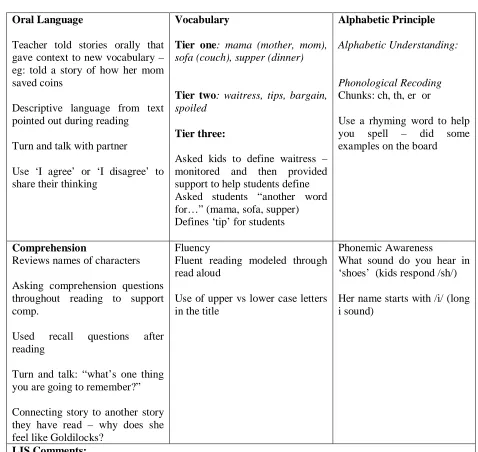
The Big 5 observation documents the infusion of the 5 components of literacy development that support reading proficiency in the classroom routine. The LIS identified specific instances where teachers supported phonemic awareness and phonics instruction: vocabulary development, comprehension, and fluency strategies. Dialogic reading strategies were documented during teacher read alouds. Teacher read alouds provide a context for incorporating robust vocabulary instruction and to integrate more intentional explicit vocabulary and comprehension strategies to benefit all children (Coyne, Zipoli et al., 2009).
7.3. Coaching
A coaching model that provides teachers with opportunities for ongoing discussion and reflection increase changes in teacher practice (Garet et al., 2001). This type of professional collaboration and collegiality can be seen during dedicated planning time. Dedicated planning time is time specifically devoted to discussing observation and assessment data. Adequate time for planning is necessary for LIS’ and teachers to review, discuss, analyze, and interpret assessment information. Observation and assessment information are presented and discussed during planning time, which guides LIS’ and teachers in identifying areas of strength and areas that need support.
During initial coaching and planning sessions, LIS’ discussed the baseline assessment data from the PPVT and EVT as well as the observations from the ELLCO tool (see Appendix for pre- and post-scores), Dialogic Reading and Big 5 observations (see Appendix for sample Big 5). The LIS’ and teachers worked collaboratively to develop an instructional plan that will support children in their developmental progression around key skills and concepts. Subsequent coaching sessions were used to discuss and determine progress in providing learning environments that guide children’s development, supporting children’s evolving needs and interests, and the use of purposeful, intentional instruction to engage children in exploring beyond their current knowledge and skills. During subsequent coaching sessions, the LIS’ used active listening and Socratic questions to explore and probe deeper into areas that need focus, which supports the teachers in identifying problems and generating solutions.
7.4.Classroom Implementation (subsequent activities)
The quality of teacher development achieved will depend on the support and guidance, facilitations and reflections provided by coaches during initial professional development and classroom implementation. During subsequent classroom activities, teachers were encouraged to demonstrate their new learning within the classroom context. With the support of the LIS’, teachers reflected on how their teaching and instructional practices influence student learning. They were supported with the application of this new knowledge and received feedback with ongoing observation and assessment data. See Appendix for teachers’ perceptions of their support. The LIS’ appeared less reliant on short-term instructional methods and more focused on active-learning methods to foster ongoing learning.
Job embedded professional development refers to teacher learning that is grounded in day-to-day teaching practice and is designed to enhance teachers’ content-specific instructional practices with the intent of improving student learning (Darling-Hammond & McLaughlin, 1995; Hirsh, 2009). The LIS’ used the coaching framework as an ongoing process, which focused on and guided teachers in strengthening and broadening their instructional strategies. Through technical assistance, LIS’ strived to provide teachers with continuous support, opportunities for problem solving and application of learning. This type of professional development has been seen as more effective than the one-day or short-term workshops (Joyce & Showers, 2002). Utilizing the conceptual framework for coaching, the LIS’ support was teacher-centered and job-embedded with a continuous focus on professional development and instructional growth.
8.
Conclusion
The conceptual framework for coaching provides a context for aligning professional and state standards with teacher professional development and proficiencies. The conceptual framework is an ongoing, living document that provides a means for creating learning and educational environments that are open, collaborative and support continuous learning.
Russo (2004) summarized that effective staff development must be “ongoing, deeply embedded in teachers’ classroom work with children, specific to grade levels or academic content, and focused on research-based approaches. It also must help to open classroom doors and create more collaboration and sense of community among teachers in a school” (para. 8). A major vehicle for improving teaching is professional development. A coaching program that is well designed and supported integrates elements of effective professional development with the essential goals of professional learning communities in ways that advance both school and systemic improvement (AISR, 2002). Although there is no single ideal coaching model that meets every school district or programs needs and requirements, the essential components of a coaching framework must include supporting teachers in enhancing their prior and experiential knowledge; providing embedded ongoing professional development, and providing feedback and follow-up in a collaborative, collegial way. Providing professional development that is individualized, classroom practice based, and ongoing is critical to changing teaching practices.
Coaching is fundamentally about teachers examining practice in reflective ways. The conceptual framework for coaching supports coaches in analyzing classroom observation tools (e.g. observation rubrics).These tools help teachers and coaches develop shared expectations and vocabulary that enhances classroom practice. Research on professional development for teachers has shifted in the last decade from delivering and evaluating professional development programs to focusing more on authentic teacher learning and the conditions that support it (Webster-Wright, 2013).Coaches provide a system of support for teachers as they learn innovative instructional and teaching strategies. Teachers are supported during the implementation stage with continued practice, reflection and refinement of their teaching methods. Utilizing a conceptual framework for coaching supports coaches in taking an active role in defining, assessing, and supporting teacher practices and classroom interactions that support teacher development.
A focus on improving performance and the development of skills is key to an effective coaching relationship. The conceptual framework for coaching emphasizes the importance of establishing supportive, collaborative, collegial environments that creates a culture of inquiry and reflection. This will enable teachers to take responsibility for developing their own learning in the classroom.
References
Achieve the Core. (2014). Instructional practice for the Common Core State Standards. Retrieved on December 30, 2014 from: http://achievethecore.org/page/969/instructional-practice-guide-list-pg
Association for Experiential Education (2014). What is experiential education? Retrieved on April 2, 2015 from: http://www.aee.org/what-is-ee
Cornett, J., & Knight, J. (2009). Research on coaching. In J. Knight (Ed.). Coaching: Approaches and perspectives (pp. 192-216). Thousand Oaks, CA: Corwin Press.
Darling-Hammond, L., & McLaughlin, M. (1995). Policies that support professional development in an era of reform. Phi Delta Kappan 76 (8), 597–604.
Fullan, M. (2001). Leading in a culture of change. San Francisco, CA: Jossey-Bass Fullan, M. (2008). The six secrets of change. San Francisco, CA: Jossey-Bass.
Garet, M., Porter, A., Desimone, L. Birman, B., &Yoon, K. (2001). What makes professional development effective? Analysis of a national sample of teachers. American Education Research Journal, 38(4), 914-945.
Goldman, E., Wesner, M., & Karnchanomai, O. (2013). Reciprocal peer coaching: Acritical contributor to implementing individual leadership plans. Human Resource Development Quarterly, 24(1), 63–87. Grant, A. M. & Hartley, M. (2013). Developing the leader as coach: Insights, strategies, and tips for embedding
coaching skills in the workplace. Coaching: An International Journal of Theory, Research, and Practice, 6(2), 102.
Guskey, T.R. (2002). Professional development and teacher change. Teachers and Teaching: Theory and Practice, 8, 381-391.
Hirsh, S. (2009). A new definition. Journal of Staff Development, 30(4), 10–16.
Hsieh, W., Hemmeter, M. L., McCollum, J. A., & Ostrosky, M. A. (2009). Using coaching to increase preschool teachers use of emergent literacy teaching strategies. Early Childhood Research Quarterly 24(3), 229-247.
Joyce, B. & Showers, B. (2002). Student achievement through staff development. Alexandria, VA: Association for Supervision and Curriculum Development.
Killion, J. (2002). Assessing impact: Evaluating staff development. Oxford, OH: National Staff Development Council.
Klingner, J. K., & Edwards, P. (2006). Cultural considerations with response to intervention models. Reading Research Quarterly, 41, 108-117.
Knight, J. (2004). Instructional coaches make progress through partnership: Intensive support can improve teaching. Journal of Staff Development, 25(2).
Knight, J. (2007). Instructional coaching: A partnership approach to improving instruction. Retrieved on April 19, 2014 from: http://www.instructionalcoach.org/
Knight, J. (2009). The Big Four: A simple and powerful framework to dramatically improve instruction. Strategram,
21(4).http://web.harrisonburg.k12.va.us/languagearts/uploads/Strategramsv21no4_BigFour.pdf
Kuzborska, I. (2011). Links between teachers' beliefs and practices and research on reading. Reading in a Foreign Language, 23(1), 102.
Lloyd, C. M., & Modlin, E. L. (2012). Coaching as a key component in teachers’ professional development: Improving classroom practices in Head Start settings. OPRE Report 2012-4, Washington, DC: Office of Planning, Research and Evaluation, Administration for Children and Families, U.S. Department of Health and Human Services.http://www.acf.hhs.gov/sites/default/files/opre/coaching_key.pdf
Lonigan, C. J., & Shanahan, T. (2009). Developing Early Literacy: Report of the National Early Literacy Panel. Executive Summary. A Scientific Synthesis of Early Literacy Development and Implications for Intervention. National Institute for Literacy. http://lincs.ed.gov/publications/pdf/NELPReport09.pdf Mansour, N. (2009). Science teachers' beliefs and practices: Issues, implications and research agenda.
International Journal of Environmental and Science Education, 4(1), 25-48. National Center for Learning Disabilities (NCDL). (2014). What is RtI? Found at:
National Center on Quality Teaching and Learning (NCQTL). (2014). Practice-based coaching Collaborativepartnerships.
https://eclkc.ohs.acf.hhs.gov/hslc/tta-system/teaching/docs/practice-based-coaching.pdf
Neill, J. (2006). Experiential learning & experiential education: Philosophy, theory, practice &resources. Found at: http://www.wilderdom.com/experiential/
Reutzal, D. R., & Clark, S. (2011). Organizing literacy classrooms for effective instruction: A survival guide. The Reading Teacher, 65(2), 96-109.
Rush, D. D., & Shelden, M. L. (2005). Evidence-based definition of coaching practices.CASEInPoint, 1(6), 1-6. Russo, A. (2004). School-based coaching. Harvard Education Letter Research Online. Retrieved December 16,
2005 from: http://hepg.org/hel-home/home
State Education Resource Center (SERC). (2013).Effective professional development: Principles and beliefs. Retrieve March 8, 2014 from:
http://www.ctserc.org/s/index.php?option=com_content&view=article&id=184:pd-principles-beliefs&catid=51:8-professional-development&Itemid=144
Sheridan, S. M., Edwards, C. P., Marvin, C. A., & Knoche, L. L. (2009). Professional development in early childhood programs: Process issues and research needs. Early Education and Development, 20(3), 377– 401.
Webster-Wright, Ann (2013) The eye of the storm: A mindful inquiry into reflective practices in higher education. Reflective Practice, 14(4),556-567.
West, L. & Cameron, A. (2013). Agents of change: How content coaching transforms. Teaching and Learning. Portsmouth, N.H.: Heinemann.
Youngs, P. (2013). Using teacher evaluation reform and professional development to support Common Core assessments. Washington, D.C.: Center for American Progress.
Appendix
Figure 1: A Conceptual Framework for Coaching
•Planning
•Collaborations
•Modeling
•Observations
•Consultations
•Response to Intervention
•Assessment Informed
Instruction
•Differentiation
•Classroom Activities
•Classroom/Curriculum
Management Strategies
•Classroom Environment
•Facilitations
•Interactions
•Prior Knowledge
•Experiential Knowledge
•Theoretical Knowledge
•Practical Application
Professional Development
Classroom Implementation
Coaching Classroom
Implementation
Table 1: Sample Big 5 observation
Oral Language
Teacher told stories orally that gave context to new vocabulary – eg: told a story of how her mom saved coins
Descriptive language from text pointed out during reading
Turn and talk with partner
Use ‘I agree’ or ‘I disagree’ to share their thinking
Vocabulary
Tier one: mama (mother, mom), sofa (couch), supper (dinner)
Tier two: waitress, tips, bargain, spoiled
Tier three:
Asked kids to define waitress – monitored and then provided support to help students define Asked students “another word for…” (mama, sofa, supper) Defines ‘tip’ for students
Alphabetic Principle
Alphabetic Understanding:
Phonological Recoding Chunks: ch, th, er or
Use a rhyming word to help you spell – did some examples on the board
Comprehension
Reviews names of characters
Asking comprehension questions throughout reading to support comp.
Used recall questions after reading
Turn and talk: “what’s one thing you are going to remember?”
Connecting story to another story they have read – why does she feel like Goldilocks?
Fluency
Fluent reading modeled through read aloud
Use of upper vs lower case letters in the title
Phonemic Awareness
What sound do you hear in ‘shoes’ (kids respond /sh/)
Her name starts with /i/ (long i sound)
LIS Comments:
This lesson covered a lot of ground! CAP skills such as beginning of book, end of book and starting point were reviewed with children at the start of the lesson. Also, at the start of the book the teacher pointed out that the name of the book was in all capital letters instead of the first letter of each word. One child guessed that we should shout the title “A CHAIR FOR MY MOTHER!” – Great demonstration of understanding how an author might use capitals! A lot of questions and prompts were used to support understanding of the text. Turn and talk was used after the story was read to get children to discuss one thing they will remember from the book. This is being used to help children begin to identify important parts of the story.
- What can we do next to move children from favorite part to understanding the most important part?
Chart 1: ELLCO scores
Chart 2: Teachers' perception of support
15 7 9.1 16.6 3 21.8 13.4 12.7 31.4 13.7 0 5 10 15 20 25 30 35 Classroom Structure (24) Curriculum (16) The Language Environment (14)
Books and Reading (34)
Print and Writing (16) In d iv id u al C o m p o n e n t S c o r e ELLCO Components
maximum in parenthesis
Early Language and Literacy Classroom Observation Classroom Scores
N=9
Fall 2013 Spring 2014
11
5
8
6
10 10 10
4
2
4
1 1
2
1 1 1
0 2 4 6 8 10 12
Availabilty Lesson Plans Instructional Activities Modelling Feedback Data Analysis Information/Resources
N u m b e r o f Te ac h e r s
Area of Support
Teachers' Perception of Literacy Intervention Specialists' Support Spring 2014
N=11